
Elastic Shirring vs Traditional Smocking: Key Sewing Differences
Two garments can feature almost identical gathered bodices while requiring substantially different sewing techniques. One may rely on elastic thread to contract the fabric, while the other uses decorative embroidery stitches to secure carefully arranged folds.
The distinction between elastic shirring and traditional smocking becomes particularly important during garment development. It influences pattern preparation, thread selection, sewing equipment, operator skills, production time, and the functional characteristics of the finished garment.
Although both techniques manipulate fabric fullness, they solve different construction problems. Understanding their sewing mechanisms helps fashion designers and manufacturers select an appropriate method rather than make decisions based solely on finished appearance.
Quick Answer: How Does Elastic Shirring Differ From Traditional Smocking?
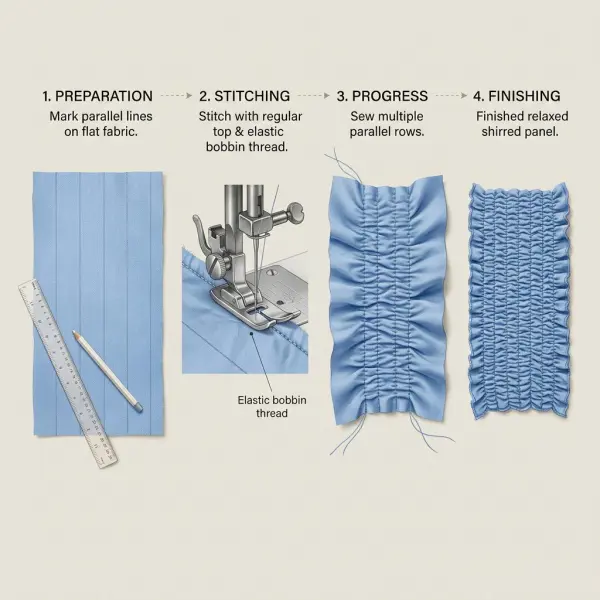
Elastic shirring gathers fabric through rows of elasticated stitching, commonly using conventional sewing thread in the needle and elastic thread in the bobbin of a compatible sewing machine. The elastic contracts after stitching, creating gathered sections that can expand and recover.
Traditional English smocking uses decorative embroidery stitches worked across evenly prepared fabric pleats. The stitches connect selected folds to establish patterns, control fullness, and provide varying degrees of flexibility without relying on elastic thread.
The main sewing differences concern how fabric is prepared, how gathering is formed, and how the finished construction accommodates movement. Elastic shirring creates contraction during sewing, while traditional smocking generally requires the fabric to be pleated before decorative stitching begins.
For garment manufacturers, elastic shirring may be suitable for repeatable production of flexible bodices, cuffs, and waistlines. Traditional hand smocking is particularly relevant when intricate stitch patterns and visible craftsmanship are central to the garment's design.
Neither technique guarantees superior quality. The appropriate choice depends on fabric compatibility, intended performance, production resources, and product positioning.
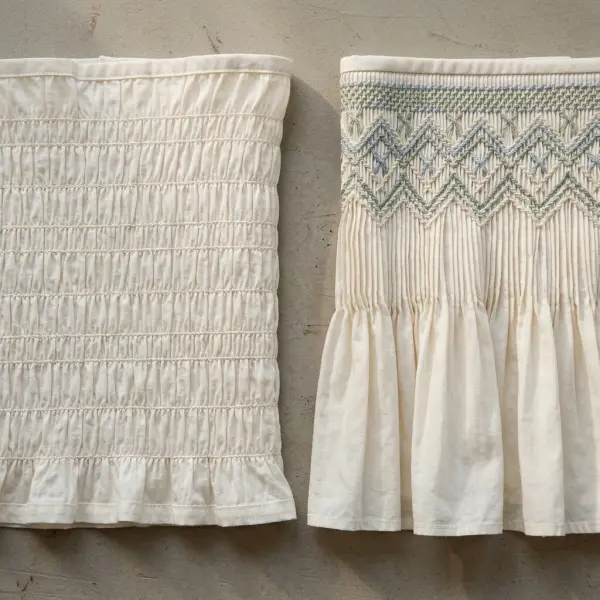
Different Sewing Principles Behind Similar Fabric Textures
The fundamental difference between elastic shirring and traditional smocking lies in the mechanism that controls fabric fullness. Elastic shirring depends on the contraction of an elastic component, whereas traditional English smocking relies on the arrangement of fabric folds and the geometry of decorative stitches.
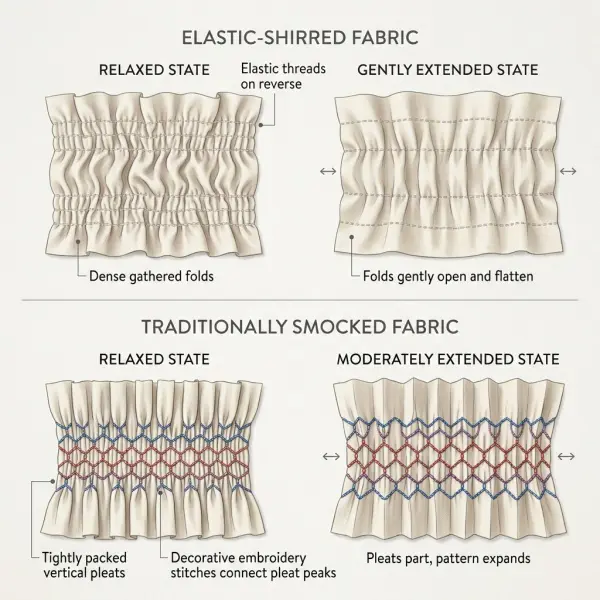
In elastic shirring, the sewing operation introduces gathering as the elasticated stitching contracts. Multiple rows distribute this effect across a selected garment section. The fabric between stitches can unfold when stretched, allowing the panel to accommodate movement.
Traditional smocking begins with an organized arrangement of pleats. Decorative stitches connect these folds in a controlled pattern, determining which areas remain relatively stable and which can expand.
The Smocking Arts Guild of America distinguishes English smocking through its use of embroidery across previously pleated material. This preparation stage is an essential difference from conventional elastic shirring.
|
Sewing Characteristic |
Elastic Shirring |
Traditional English Smocking |
|
Gathering mechanism |
Elastic contraction |
Prepared pleats secured by embroidery |
|
Fabric preparation |
Usually marked before stitching |
Generally pleated before embroidery |
|
Primary sewing thread |
Elastic and conventional thread |
Embroidery thread |
|
Stitch arrangement |
Repeated, typically parallel rows |
Decorative patterns connecting folds |
|
Source of extension |
Elastic stretching and gathered fabric opening |
Movement permitted by folds and stitch geometry |
|
Main production requirement |
Consistent elasticated stitch formation |
Accurate pleating and embroidery |
|
Typical appearance |
Fine, repeated gathered texture |
Defined decorative stitch patterns |
These differences affect much more than appearance. They determine how the garment must be patterned, assembled, measured, and evaluated throughout production.
For a broader introduction to their design applications, see Smocking and Shirring Explained for Garment Construction.
How Elastic Shirring Is Sewn
Conventional elastic shirring can be produced using a compatible sewing machine configured with regular upper thread and elastic bobbin thread. The machine forms stitches that hold the elastic against the reverse side of the fabric, allowing it to contract the material after stitching.
This method is particularly useful when developing flexible sections from woven fabrics that would otherwise offer limited stretch.
Preparing the Fabric and Sewing Equipment
Fabric preparation begins with establishing the required panel dimensions and identifying the locations of the shirring rows. Markings should remain sufficiently accurate during sewing and be removable or concealed in the finished garment.
The elastic thread is commonly wound onto the bobbin by hand, although winding and threading requirements depend on the sewing machine. Excessively stretching the elastic during winding can change the resulting contraction and make production outcomes more difficult to reproduce.
The elastic shirring guide from Seamwork demonstrates the conventional bobbin-based method using elastic thread below the fabric and standard sewing thread above it.
For commercial sampling, the machine setup should be documented rather than treated as an individual operator's informal preference.
Sewing Multiple Rows of Elasticated Stitches
The first row of shirring may produce only modest gathering. Additional rows progressively establish the contracted panel as their combined elastic force draws the material together.
During subsequent rows, the operator generally needs to manage the previously gathered fabric so that the next stitching line remains correctly positioned. This requires controlled handling rather than forceful stretching.
Row spacing also influences the appearance and behavior of the finished panel. Closely positioned rows can create a denser texture, while wider spacing may leave more visible fabric between them. The preferred arrangement depends on the fabric and intended garment application.
Securing and Finishing the Shirred Panel
The elastic thread must remain securely anchored at the ends of each stitched row. Depending on the construction method, this may involve suitable stitch securing, tied thread ends, or incorporation into garment seams.
Some elastic shirring methods also use controlled steam during finishing to encourage further contraction. However, heat and moisture should only be applied under conditions compatible with the fabric and elastic material.
The finished panel should be evaluated after the intended finishing process. Measuring it immediately after sewing may not accurately represent the dimensions of the garment delivered to customers.
How Traditional Smocking Is Sewn
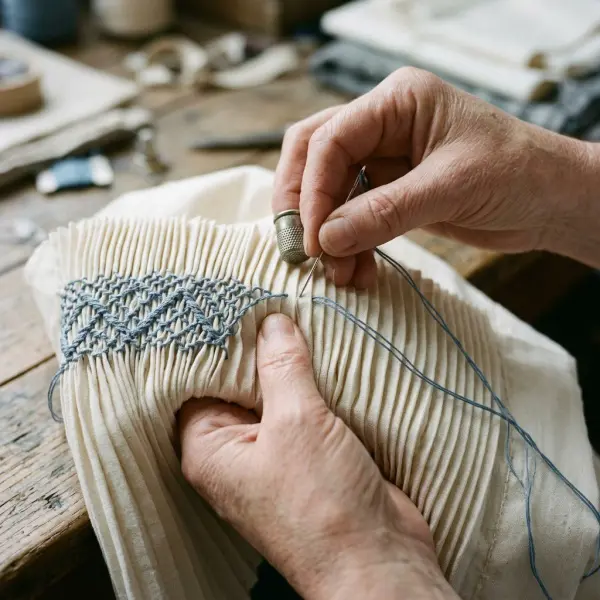
Traditional English smocking is constructed by preparing regularly spaced fabric folds and working embroidery stitches across them. The decorative stitches establish the pattern while controlling how the folds remain connected and move.
Unlike conventional elastic shirring, traditional hand smocking separates the gathering operation from the principal decorative stitching operation.
Preparing Even Fabric Pleats
Fabric may be pleated manually using marked gathering points or prepared with a specialized smocking pleater. A pleater feeds the material through an arrangement of rollers and needles to create multiple gathering-thread rows.
The gathering threads allow the fabric to be drawn into regular folds before the embroidery begins. Accurate preparation is particularly important when the intended smocking design contains repeating geometric patterns.
Irregular pleats can change the placement of embroidery stitches, disrupt pattern symmetry, and produce inconsistent panel dimensions. These problems are difficult to conceal once detailed decorative stitching has been completed.
Working Decorative Smocking Stitches
Smocking embroidery connects selected folds according to a planned pattern. Different stitches establish different visual relationships between the pleats and can influence how freely the construction expands.
The Smocking Arts Guild of America's educational resources identify several fundamental English smocking stitches, including cable, trellis, and wave stitches.
|
Smocking Stitch |
General Construction Characteristic |
|
Cable stitch |
Connects neighboring folds in a generally horizontal arrangement |
|
Trellis stitch |
Establishes diagonal connections that create geometric patterns |
|
Wave stitch |
Produces recurring diagonal movements across the pleats |
|
Honeycomb stitch |
Connects folds in an arrangement resembling a honeycomb pattern |
The stitch selection affects the finished texture and potentially its flexibility. A highly restrictive decorative pattern may hold fabric folds relatively firmly, while another arrangement may permit greater movement.
Consequently, the embroidery pattern is not simply a decorative decision. It forms part of the structural specification of the garment panel.
Removing Temporary Gathering Threads and Completing the Panel
Once the necessary embroidery is complete, temporary gathering threads may be removed according to the construction method. Some threads may remain until later assembly stages to maintain alignment and dimensional control.
The panel can then be incorporated into the garment, with surrounding seams or other construction details helping stabilize its boundaries.
Smocking executed over a complete garment section requires careful coordination between the embroidery pattern and the sewing pattern. The designer must establish where decorative stitching ends, where joining seams begin, and how the finished panel will align with neighboring components.
Equipment and Material Requirements
The equipment required for elastic shirring and traditional hand smocking reflects their different construction sequences. Elastic shirring concentrates gathering and stitching within a machine sewing operation, while traditional smocking requires separate pleat preparation and embroidery activities.
These requirements influence how readily a manufacturer can introduce either technique into an existing production line.
Sewing Machines, Pleaters, and Specialized Equipment
For small-scale production, elastic shirring may be performed with a compatible conventional sewing machine. Larger manufacturers may use specialized elastic feeding systems or multi-needle sewing equipment, depending on the desired stitch structure and production method.
Traditional hand smocking can be completed with basic needlework equipment, although a specialized pleater can make preparation more efficient and regular. Machine-assisted decorative smocking is also possible, but its stitch formation and finished appearance may differ from traditional hand embroidery.
|
Equipment or Material |
Elastic Shirring |
Traditional Hand Smocking |
|
Conventional sewing machine |
Commonly required |
May support garment assembly |
|
Elastic thread |
Required for elastic construction |
Not normally required |
|
Standard sewing thread |
Required |
Used where appropriate |
|
Embroidery thread |
Not usually necessary |
Principal decorative stitching material |
|
Smocking pleater |
Not normally required |
Optional preparation equipment |
|
Hand embroidery needles |
Not normally required |
Required |
|
Specialized industrial equipment |
May improve production capability |
May support preparation or alternative machine methods |
|
Marking tools |
Used to position stitch rows |
Used to establish pleat or pattern placement |
A factory should assess whether its existing machinery can reliably reproduce the approved construction before accepting bulk production commitments. Equipment compatibility is particularly relevant when introducing elastic thread into machines normally configured for conventional stitching.
Thread Selection and Fabric Compatibility
Elastic shirring requires an elastic component with suitable contraction, extension, and recovery characteristics. Its performance should remain compatible with the garment's intended care instructions and wearing conditions.
Traditional smocking places greater emphasis on embroidery thread appearance, thickness, color, and interaction with the fabric folds. A thread that is disproportionately heavy for a delicate fabric may create unnecessary bulk or distort the embroidery pattern.
Both techniques therefore require material-specific sampling. Changing the fabric or thread after approval can alter the finished dimensions even when the nominal stitch pattern remains unchanged.

Stitch Formation, Stretch, and Recovery
Elastic shirring and traditional smocking can both allow gathered fabric to expand, but they do not necessarily provide the same degree of recovery or resistance to repeated movement.
Understanding this distinction is essential when the gathered section performs a fitting function rather than serving only as decoration.
Elastic Shirring and Recoverable Extension
In elastic shirring, the elasticated stitching draws the fabric into a contracted arrangement. When the panel is stretched, the folds open and the elastic extends. Once released, the elastic helps return the construction toward its relaxed dimensions.
The amount of available extension is limited by several factors, including the original fabric width, elastic characteristics, stitch structure, and surrounding garment seams.
A shirred panel should not be evaluated only by how far it can stretch. Its resistance to extension, comfort at intended wearing dimensions, and ability to recover after repeated use are equally relevant.
Traditional Smocking and Geometric Flexibility
Traditional smocking can provide flexibility through the movement of fabric folds and the arrangement of connecting stitches. Its extensibility depends on how the stitches restrict or permit those folds to open.
Because conventional embroidery thread does not provide the same elastic contraction mechanism as elastic shirring thread, traditional smocking should not automatically be expected to exhibit comparable recovery.
Certain smocking patterns may be suitable for flexible decorative sections, while others are intended primarily to maintain a stable dimensional surface. The specific stitch arrangement matters more than the general technique name.
Production Time, Labor, and Cost Differences
Traditional hand smocking generally requires more individual manual operations than conventional machine elastic shirring. The actual cost difference, however, depends on pattern complexity, production volume, equipment, labor rates, fabric consumption, and quality requirements.
A narrow hand-smocked detail may be commercially manageable, whereas an extensively embroidered bodice can represent a significant portion of the garment's labor cost.
Comparing the Production Workflow
|
Production Stage |
Elastic Shirring |
Traditional Hand Smocking |
|
Fabric preparation |
Cutting and row positioning |
Cutting and pleat preparation |
|
Gathering |
Formed during elasticated sewing |
Established before embroidery |
|
Main stitching operation |
Repeated machine sewing |
Decorative hand embroidery |
|
Operator requirements |
Machine handling and elastic control |
Pleating accuracy and embroidery skills |
|
Finishing |
Elastic securing and dimensional stabilization |
Gathering-thread management and panel assembly |
|
Inspection |
Gathering uniformity, dimensions, and recovery |
Pleat regularity, embroidery accuracy, and dimensions |
|
Scaling consideration |
Equipment and process repeatability |
Availability of skilled labor and consistent craftsmanship |
Machine elastic shirring can be commercially attractive when the design requires repeated gathered rows across large production quantities. Its efficiency depends on whether the factory can maintain stable sewing conditions without excessive adjustments or rework.
Traditional hand smocking offers a different commercial proposition. The additional labor may be justified when the decorative construction contributes meaningfully to product differentiation and customers value the craftsmanship involved.
Evaluating Total Construction Cost
Fashion businesses should compare the complete manufacturing cost of each construction rather than assume that the faster sewing method will automatically produce the more profitable garment.
Costing should account for the following factors:
- Additional fabric required to create the gathered or pleated section.
- Preparation, sewing, embroidery, and finishing time.
- Thread consumption and equipment requirements.
- Operator training and specialist labor availability.
- Inspection, defect management, and potential rework.
For premium apparel, the relevant question may be whether customers recognize and value traditional decorative work. For volume-oriented collections, consistent panel measurements and reliable production capacity may have greater commercial significance.
How to Choose the Right Technique for a Garment
The appropriate choice between elastic shirring and traditional smocking depends on the intended function of the constructed panel, the visual identity of the garment, and the manufacturer's ability to reproduce it.
A garment that needs substantial localized extension presents different requirements from one designed around decorative embroidery.
|
Garment Development Objective |
Potentially Suitable Technique |
|
Flexible bodice on a woven summer dress |
Elastic shirring |
|
Decorative embroidery on children's occasionwear |
Traditional smocking |
|
Expandable sleeve cuff |
Elastic shirring |
|
Heritage-inspired decorative garment panel |
Traditional smocking |
|
Repeated gathered details for volume production |
Machine elastic shirring |
|
Intricate geometric embroidery for premium apparel |
Traditional smocking |
|
Flexible construction with decorative embroidery |
A validated combination of techniques |
These recommendations are starting points rather than universal design rules. A traditional smocking construction may provide sufficient flexibility for a particular garment, while elastic shirring may be selected primarily for its visual texture rather than its fitting function.
Establishing Measurable Construction Requirements
Before selecting a method, the product development team should identify what the finished panel needs to achieve. A flexible waistband, for example, requires appropriate relaxed dimensions and wearing comfort. A decorative smocked yoke may place greater emphasis on pattern alignment and embroidery quality.
Those objectives should be translated into a garment technical specification covering the panel dimensions, stitch arrangement, thread requirements, appearance reference, and relevant performance criteria.
This approach also improves communication between designers and manufacturers. Instead of requesting a general smocked appearance, the brand specifies the construction outcome that the supplier must reproduce.
Approving a Representative Production Sample
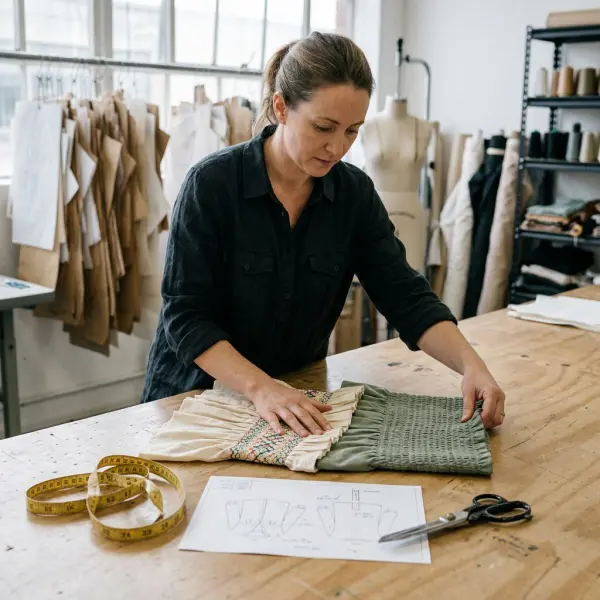
An approved sample should reflect the actual production fabric, thread, construction method, and intended finishing conditions. Small samples are useful for evaluating stitch appearance, but full-size panels are needed to assess how the construction behaves within the garment.
A shirred back panel may perform well in isolation but become restrictive when attached to stable side seams. Similarly, a smocked decorative section may lose its intended symmetry when incorporated into an incorrectly dimensioned garment pattern.
Construction approval should therefore include both isolated sample assessment and finished garment evaluation.
Common Mistakes When Selecting a Sewing Method
Using Retail Terminology as a Technical Specification
A retail product description may use the term smocked to describe an elastic-shirred bodice. Transferring that terminology directly into a manufacturing specification can create misunderstandings about stitch formation, material requirements, and functional performance. Technical documentation should identify the actual construction method and include an approved visual reference.
Applying the Same Pattern Dimensions to Both Techniques
Elastic shirring and traditional smocking may produce different levels of contraction even when constructed from the same fabric. Reusing identical pattern dimensions without evaluating the gathering behavior can result in incorrectly sized panels. Each construction should have a validated relationship between its original fabric dimensions and finished measurements.
Treating Sample Sewing Conditions as Universal Settings
A machine configuration that produces satisfactory shirring on cotton lawn may not deliver the same outcome on poplin or double gauze. Similarly, an embroidery thread suitable for one pleated material may be inappropriate for another. Brands should validate construction parameters whenever significant material or equipment changes occur.
Choosing a Technique Based Only on Sewing Speed
Machine elastic shirring may reduce certain labor requirements, but speed alone does not determine commercial suitability. Rework, inconsistent measurements, material consumption, and customer complaints can offset apparent savings. Manufacturers should evaluate the complete production outcome, including quality and repeatability.
The specific causes of uneven gathering, insufficient contraction, and inconsistent elasticated stitching are examined in Common Shirring Problems and How to Achieve Consistent Fabric Gathering.
Important Technical Caveats
The comparison between elastic shirring and traditional English smocking describes two established construction approaches, not every possible variation within fabric manipulation.
Non-elastic shirring, machine smocking, alternative elastic feeding systems, and dimensional smocking techniques may use different equipment, preparation methods, and stitch arrangements.
Machine settings also require particular caution. The BERNINA WeAllSew elastic shirring tutorial presents example stitch lengths and row spacing for a specific sewing approach. Such recommendations are useful sampling references, but they should not be treated as universal industrial production standards.
Before bulk manufacturing, brands should verify the approved construction's dimensional stability, visual consistency, functional extension, and compatibility with the intended garment care process. Where recovery is a required characteristic, the specification should define how it will be evaluated.
There is no universally appropriate gathering ratio, stitch length, row spacing, or production cost for either technique. These parameters must reflect the actual garment and manufacturing conditions.
Frequently Asked Questions (FAQ)
1. Can elastic shirring be sewn on any sewing machine?
No. Although elastic shirring can be produced using many conventional sewing machines, compatibility depends on the bobbin system, thread handling mechanism, stitch formation, and manufacturer instructions.
Some machines may require different threading procedures or adjustments to achieve satisfactory results. Elastic thread can behave differently from ordinary sewing thread, particularly within the bobbin tension system.
Manufacturers should test the intended machine configuration before approving production. Adjustments to bobbin tension or other components should follow suitable equipment guidance, especially when the machine is also used for conventional sewing operations.
2. Does traditional smocking require a special pleating machine?
No. Traditional English smocking can be prepared manually by establishing evenly spaced gathering points and drawing the fabric into regular folds. A specialized smocking pleater can make the preparation process more efficient, particularly when multiple gathering-thread rows are required.
The economic value of a pleater depends on production frequency, panel size, and the number of garments being manufactured. Occasional decorative projects may be manageable through manual preparation, while repeat orders can justify more specialized equipment. Regardless of the preparation method, regular pleat formation remains essential to achieving accurate embroidery patterns and controlled dimensions.
3. Which technique is more suitable for mass-produced clothing?
Elastic shirring is often more practical for volume apparel production when the intended construction consists of repeated elasticated sewing rows. Suitable machinery and stable operating parameters can support repeatable manufacturing.
Traditional hand smocking generally requires more specialist labor, particularly when detailed embroidery patterns are involved. Nevertheless, it can remain commercially viable for larger orders when suppliers possess sufficient skilled production capacity.
The decision should reflect the product's positioning, manufacturing resources, target price, and quality requirements. Machine-assisted smocking may offer an alternative when decorative appearance is important but traditional handwork is not essential.
4. Is traditional smocking less stretchy than elastic shirring?
Traditional smocking often provides a different type of flexibility rather than simply less stretch. Its extension depends on the arrangement of fabric folds and embroidery stitches, whereas elastic shirring additionally relies on the extensibility of elastic thread.
Some traditional smocking patterns can accommodate considerable movement. Others are relatively restrictive because of their decorative stitch arrangement.
When a garment requires reliable elastic recovery, the two methods should not be assumed to perform equivalently. Testing representative finished panels at their intended wearing dimensions provides a more reliable basis for selection than comparing their appearance or technique names.
5. Can existing garment patterns be converted from smocking to elastic shirring?
Yes, but the conversion normally requires pattern adjustments. The original construction may have been designed around a specific pleating ratio, panel width, embroidery pattern, or seam arrangement.
Replacing traditional smocking with elastic shirring changes how the fabric contracts and how the finished panel expands. The designer should establish revised cutting dimensions through sampling and evaluate the interaction between the elasticated section and adjacent garment components.
A visually successful conversion may still require adjustments to fit, coverage, seam allowances, and size grading before the garment is suitable for commercial production.
6. Which technique is easier to inspect during garment quality control?
Neither technique is universally easier to inspect because each has different quality characteristics. Elastic shirring can often be evaluated through row uniformity, finished dimensions, elastic security, and recovery behavior.
Traditional smocking requires attention to pleat regularity, decorative pattern alignment, stitch consistency, thread security, and the appearance of the completed panel.
Complex hand embroidery may require experienced inspectors capable of recognizing construction deviations. Elastic shirring may require additional functional evaluation when it contributes to garment fit. In both cases, an approved reference sample and measurable acceptance criteria provide a stronger inspection basis than subjective visual judgment alone.
Conclusion
Elastic shirring and traditional smocking create gathered textile surfaces through fundamentally different sewing mechanisms. Elastic shirring uses elasticated stitch formation to contract fabric, while traditional English smocking organizes prepared pleats through decorative embroidery.
Their differences extend into material selection, pattern development, equipment requirements, operator skills, production efficiency, and finished garment performance.
For fashion businesses, selecting the appropriate technique requires clarity about what the garment needs to accomplish. Traditional smocking can support distinctive craftsmanship and decorative identity, while elastic shirring can provide flexible construction and compatibility with repetitive machine production.
The strongest manufacturing decisions begin with a clearly defined construction objective, representative sampling, and measurable approval criteria. This allows the selected technique to support both the designer's intention and the commercial requirements of the finished garment.


Comments 0
Leave a CommentSend Comment
Anda harus Login terlebih dahulu untuk dapat memberikan komentar.