

How PIM Systems Organize Fashion Product Data Across Sales Channels
A fashion brand may sell the same cotton shirt through its own ecommerce website, an international marketplace, a wholesale retailer, and a regional online store. The physical product remains the same, but the information required to present it can vary considerably between destinations.
The brand's website might feature a detailed description of the fabric, relaxed silhouette, and styling possibilities. A marketplace may require specific product categories, standardized size attributes, and unique identifiers. A wholesale buyer may request a structured product catalog containing style codes, material details, and available colorways.
Maintaining these different versions manually creates opportunities for errors. Product information may become inconsistent when teams copy data between spreadsheets, ecommerce dashboards, marketplace templates, and retailer portals.
Product Information Management (PIM) systems address this challenge by separating the underlying product information from the formats used to publish it. Instead of rebuilding each listing independently, fashion businesses can maintain controlled product records and prepare channel-specific outputs from a common information foundation.
Understanding how that process works is particularly valuable for apparel brands expanding beyond a single sales channel.
Quick Answer: How Do PIM Systems Organize Fashion Product Data Across Sales Channels?
PIM systems organize fashion product data across sales channels by maintaining centralized product records and transforming approved information into the formats required by different ecommerce platforms, marketplaces, and retail partners. They help brands manage product attributes, style and variant relationships, localized descriptions, publication requirements, and channel-specific content.
A typical process begins with collecting product information from authoritative sources. The PIM organizes this information into a consistent product structure, allowing shared details such as fabric composition and fit to remain connected to individual size and color variants.
Teams can then enrich product records, validate required fields, and prepare different versions for specific destinations. A brand's ecommerce website may receive detailed descriptions, while a marketplace receives standardized attributes and product identifiers.
Depending on the PIM platform and its integrations, information can be distributed through APIs, exports, connectors, or scheduled synchronization processes.
The key advantage is greater control over product consistency without requiring identical content everywhere. However, PIM does not automatically guarantee real-time synchronization, accurate inventory, or marketplace compliance. These depend on integration design, data governance, and the requirements of each destination.
Why Fashion Brands Need Different Product Data for Different Sales Channels
Selling through multiple channels creates an information management problem that is easy to underestimate.
The challenge is not simply maintaining the same product name in several places. Each destination may have different expectations regarding product attributes, content length, image specifications, category structures, variant grouping, and supported data formats.
A fashion brand may also position the same product differently depending on its audience. On its own website, the company might emphasize garment design, craftsmanship, and styling. In a wholesale catalog, buyers may care more about size ranges, available colorways, product identifiers, and commercial specifications.
Both presentations can be accurate, even when their wording and structure differ.
This distinction is central to multichannel product information management. Fashion businesses need a reliable set of underlying product facts while retaining the flexibility to present those facts appropriately in different commercial contexts.
Different Channels Have Different Information Requirements
Consider four common destinations for fashion product information.
|
Sales channel |
Typical information needs |
Operational consideration |
|
Brand ecommerce website |
Product descriptions, garment details, size guides, images, styling information |
Maintain clear customer-facing content and accurate variants |
|
Online marketplace |
Standardized categories, product identifiers, required attributes, approved images |
Match the destination's current listing specifications |
|
Wholesale and B2B retail |
Style codes, available variants, material information, product specifications |
Provide structured and consistent information for buyers |
|
International storefront |
Localized descriptions, size conventions, language-specific content |
Validate market-specific information and presentation |
These are typical distinctions rather than universal rules. A marketplace may allow extensive descriptions, while a wholesale partner may impose a highly specific data template.
For example, Google Merchant Center's product data specification defines product attributes and formatting requirements used for shopping listings, including information relevant to fashion products such as color, size, product identifiers, and variant grouping.
The exact requirements depend on the product, destination, and applicable listing conditions. This illustrates why product data cannot always be copied unchanged from one channel to another.
Product Consistency Does Not Mean Identical Product Descriptions
One misconception about PIM is that every sales channel should display exactly the same content.
Consistency should primarily apply to factual information. The material composition, garment measurements, physical characteristics, and product identifiers should remain accurate wherever the product appears.
Editorial presentation can vary.
A premium fashion website may describe a blouse as a lightweight wardrobe piece with a relaxed silhouette and subtle textured finish. A marketplace listing may use a more direct title that includes the garment category, material, and color.
Both can originate from the same verified product record without being identical.
The important distinction is between controlled variation and contradictory information. A blouse cannot accurately be described as 100% cotton in one channel and a cotton-polyester blend in another unless there is a genuine, properly identified difference in the products being sold.

How PIM Creates a Central Structure for Fashion Product Information
PIM systems typically organize product information using structured product models, attributes, categories, and identifiers.
These elements help the system understand which information belongs to a product style, which belongs to an individual variant, and which information should be available for specific sales channels.
The foundation is often described as a central product information repository. Its purpose is to maintain an authoritative commercial record, although some underlying values may continue to originate in other business systems.
For a broader introduction to the concept and business responsibilities, seeProduct Information Management Explained for Fashion Businesses.

Product Families and Category Structures
Fashion merchandise is usually organized into meaningful product groups.
A brand may sell dresses, shirts, trousers, jackets, handbags, and footwear. Each category has different characteristics that customers and retail partners need to understand.
A shirt might require collar type, sleeve length, fit, and fabric composition. Footwear may require upper material, outsole material, heel height, and footwear sizing information.
A PIM can use product families or comparable data structures to define the attributes relevant to different kinds of merchandise.
This prevents every product record from becoming an enormous form containing fields that have little relevance to the item being described.
Categories serve a related but different purpose. They organize products for classification and navigation, while product families typically help define the attributes associated with particular product types. Exact terminology and implementation vary between platforms.
A fashion business might internally classify a garment as:
Women > Clothing > Tops > Blouses
A marketplace may use a different category tree. PIM and its integration layer can help map the internal classification to the destination's accepted category, provided the mapping has been configured correctly.
Parent Styles and Sellable Variants
Fashion products frequently exist in multiple size and color combinations.
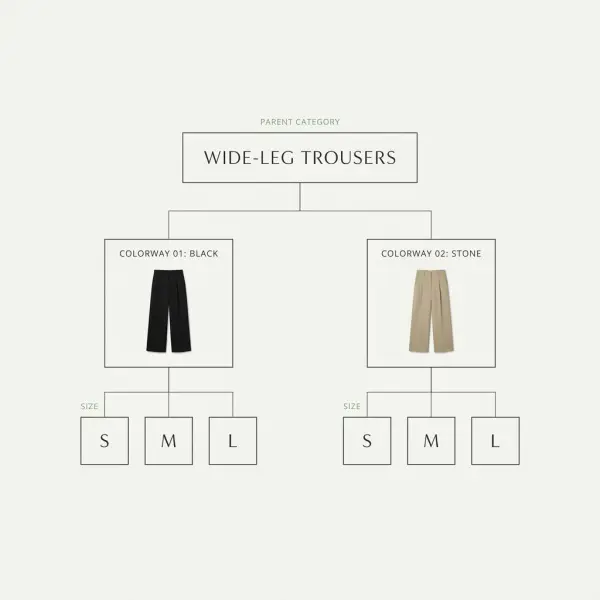
A single trouser style might be available in Black, Stone, and Navy, with five sizes for each color. If every combination is offered, the style produces 15 sellable variants.
Rather than maintaining 15 completely unrelated product records, an appropriate PIM data model can associate those variants with a common style or parent product.
Shared information might include the brand, design description, general silhouette, and material composition. Variant-specific information may include SKU, size, color, GTIN where applicable, and color-specific imagery.
For illustration, imagine the following simplified structure:
|
Data level |
Example identifier |
Relevant information |
|
Parent style |
TR-240 |
Tailored Wide-Leg Trousers |
|
Colorway |
TR-240-BLK |
Black, approved black garment images |
|
Colorway |
TR-240-STN |
Stone, approved stone garment images |
|
Sellable variant |
TR-240-BLK-S |
Black / Small |
|
Sellable variant |
TR-240-BLK-M |
Black / Medium |
|
Sellable variant |
TR-240-STN-S |
Stone / Small |
The exact hierarchy is platform-dependent. Some PIM products use parent models and multiple variant levels, while others manage variants through a different internal structure.
The important principle is to preserve the relationship between the style and its sellable variations.
This becomes especially relevant when distributing data to channels with different product grouping conventions. A destination might present all sizes and colors on one product page, while another may require separate variant records associated through a common grouping identifier.
Standardized Attributes and Controlled Values
A major source of inconsistency in fashion catalogs is the uncontrolled use of descriptive terms.
One team may enter the color "Off White," another "Off-White," and a third "Cream." These terms may describe intentionally different shades or may simply reflect inconsistent naming.
A PIM implementation can establish controlled vocabularies for attributes where standardization is useful.
For example, the brand may maintain an internal color code, approved color name, and optional channel-specific representation. The internal value remains stable while the appropriate external label is selected for publication.
This approach also applies to fit classifications, sleeve lengths, product categories, material terminology, and other attributes.
Standardization should not erase meaningful product distinctions. Two shades that look similar may require separate color identifiers when they represent different physical products.
How PIM Transforms One Product Record Into Multiple Channel Listings
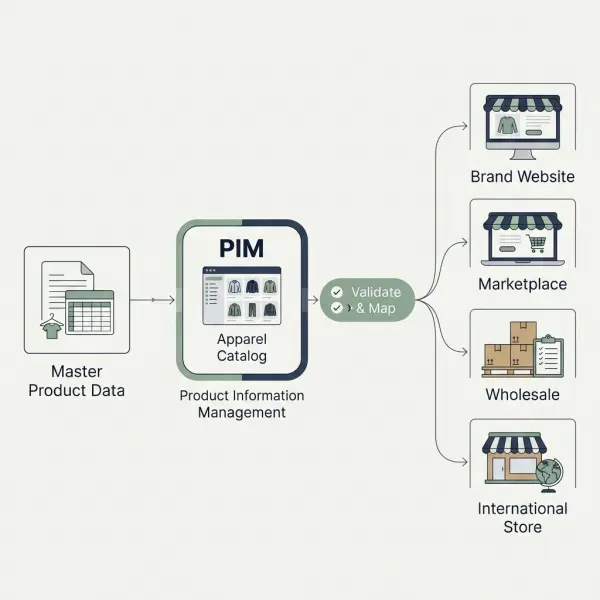
The central function of multichannel PIM is to prepare product information for different destinations without forcing teams to maintain disconnected versions of the same facts.
This requires a process often described as product data enrichment, channel configuration, attribute mapping, and syndication.
These activities may happen within the PIM platform, through a separate syndication service, or inside integration software that connects PIM to external destinations.
Not every PIM includes native connectors for every marketplace. The actual architecture depends on the selected software and available integrations.
Step 1: Create and Validate the Master Product Record
The process begins with an approved commercial product record.
For a linen-blend shirt, this might include the style identifier, product category, confirmed fabric composition, colorways, size range, fit description, care information, and approved imagery references.
These details may originate from a product development system, supplier specifications, merchandising records, or content workflows.
The purpose of collecting them is to create a controlled source from which relevant channel outputs can be prepared.
A master record is not necessarily a copy of every field from every connected system. Businesses should decide which information belongs in PIM and which information is better maintained elsewhere.
For example, the inventory system may remain authoritative for stock quantities, while PIM manages the descriptions and attributes used in product listings.
Step 2: Define Channel-Specific Content
Once the core product record is established, the business can define which information each destination needs.
A fashion website may require a full product description, fit guidance, care information, and styling notes. A wholesale export may prioritize structured identifiers and specifications.
A PIM can maintain separate channel-specific values where necessary, such as a shorter product title for one destination and a more editorial product description for another.
In Akeneo's documentation explaining PIM channels, channels represent selections of products and information intended for particular outputs. Its implementation supports channel-specific context such as locales and completeness settings.
Other PIM products may use different terminology or configuration models, but the underlying concept is similar: product content can be prepared according to destination requirements.
Step 3: Map Internal Attributes to External Requirements
Attribute mapping is the process of connecting fields in the PIM to fields expected by a destination platform.
A fashion brand might use an internal attribute called primary_color, while an external shopping feed expects a field called color.
Similarly, the brand's internal product family may need to be translated into a destination-specific category structure.
The mapping process can be straightforward when values correspond directly. It becomes more complex when different platforms use different accepted terms, data types, size conventions, or product relationships.
A simplified example illustrates the concept:
|
Internal product attribute |
Website output |
Google Merchant Center field |
|
Internal style name |
Product title |
title |
|
Variant SKU |
Variant identifier |
id, when appropriate |
|
Parent style identifier |
Product group reference |
item_group_id |
|
Color name |
Color option |
color |
|
Size label |
Size selector |
size |
|
Fabric description |
Material information |
material |
This table is illustrative rather than a complete technical mapping.
The fields, required attributes, and rules must be verified against the current specification of the destination. Not every internal attribute should automatically be published, and some external fields may require information from systems other than PIM.
A direct field mapping also does not resolve every semantic difference. If a marketplace requires a particular set of size values, the brand must ensure that any transformation preserves the actual garment sizing information.
Step 4: Check Publication Readiness
Before product information is sent to a channel, the business should verify that the required information is complete and suitable for publication.
A product might be ready for the brand's website but incomplete for a marketplace that requires additional structured attributes.
This is why a single universal completeness score may be insufficient for multichannel operations.
Akeneo's product completeness documentation describes how completeness can depend on product families, channels, and locales.
Completeness checks are useful, but they should not be confused with factual verification or destination acceptance.
A product can contain values in every required field and still have an incorrect composition statement, an invalid identifier, or an image that fails the receiving platform's requirements.
For that reason, robust publication controls may combine required-field checks, approved-value validation, business rules, and destination-specific testing.
Step 5: Publish and Monitor Product Information
Approved product information is then distributed through the configured integration process.
Depending on the platform and destination, this may involve APIs, product feeds, CSV or XML exports, marketplace connectors, or dedicated integration middleware.
The publication workflow should also record whether the destination accepted the information.
A successful export from PIM does not necessarily mean that the product has appeared correctly on the receiving platform. Data can be rejected, delayed, transformed, or partially processed after it leaves the source system.
Fashion businesses should therefore distinguish between information being sent, accepted, processed, and displayed.
Managing Product Titles, Descriptions, and Images Across Channels
Product information is not limited to structured attributes. The language and imagery used to describe merchandise are equally important in commercial presentation.
Fashion brands often need several approved representations of a product, particularly when they operate both direct-to-consumer and wholesale channels.
PIM helps maintain a relationship between the shared product record and the content intended for different audiences.
Channel-Specific Product Titles
A product title should communicate the garment clearly while respecting the conventions of its destination.
On a brand website, a product might appear as "Mira Relaxed Linen-Blend Shirt." The collection name and brand voice may be important parts of the presentation.
An external sales channel may benefit from a more descriptive title containing the garment category, fit, and color, subject to that platform's actual guidelines.
PIM can support multiple approved title fields or apply configured title-building rules using verified product attributes.
Automated title generation still needs editorial controls. Combining too many attributes can produce awkward, repetitive, or misleading names, particularly for fashion items with complex materials or distinctive design features.
Product Descriptions for Different Audiences
The same logic applies to descriptions.
A consumer-facing description may explain how a garment drapes, how it fits, and how it can be styled. A wholesale-oriented record may prioritize material, size range, measurements, and product construction.
The two descriptions should remain consistent with the same underlying product facts.
Rather than rewriting every listing independently, a brand can establish reusable content components and channel-specific descriptions where appropriate.
For example, verified composition and care information can be maintained as structured attributes, while editorial teams create distinct descriptions for different audiences.
PIM helps preserve these relationships, but content accuracy still depends on review by the appropriate teams.
Product Images and Colorway Accuracy
Imagery requires particular attention because fashion customers use photographs to evaluate color, silhouette, details, and styling.
A shirt available in White and Navy should display the correct product images when the customer selects each color.
The commercial product record needs reliable associations between product variants and their approved images.
PIM may store image references, media associations, or supported asset files. A separate Digital Asset Management (DAM) system may maintain the master media library and asset approval processes.
This relationship is explored in greater detail in PIM vs Digital Asset Management: What Fashion Brands Should Know.
For multichannel publishing, the operational requirement is that the correct images reach the correct products in an acceptable format. Some destinations may require different aspect ratios, image sizes, backgrounds, or file specifications.
A brand should therefore validate both the product-to-image association and the receiving channel's media requirements.
How PIM Handles Different Size Systems and Languages
International fashion retail introduces challenges that extend beyond translating product descriptions.
A brand selling across several markets may need different size conventions, localized measurement guidance, language-specific content, and market-dependent product classifications.
PIM can support these requirements by maintaining localized values and channel-specific data where the platform has suitable capabilities.
However, the source information and transformations must be governed carefully.
Keeping Internal Sizing Consistent
Consider trousers sold using an internal numeric size system.
The brand may need to present corresponding market-specific size labels and measurement guidance on different storefronts.
A poorly designed process might replace the original size values with loosely interpreted equivalents, creating confusion between physical garment measurements and regional size labels.
A better approach preserves authoritative garment measurements and the relevant size system while maintaining any approved market-specific mappings separately.
Size conversion is not always universal. Fit, category, brand grading, and regional conventions can affect how sizes should be presented.
For this reason, international size labels should be validated against the brand's actual size specifications rather than generated through unverified assumptions.
Localizing Product Content Without Changing Product Facts
Localization involves adapting product content for a particular language or market while preserving the information's intended meaning.
A fabric term may have a recognized equivalent in another language, but translating marketing descriptions and technical terminology requires different levels of care.
For example, a descriptive phrase about a garment's feel should not be translated into an unsupported claim about performance. Likewise, a source material specification should not be simplified in a way that changes its technical meaning.
PIM can maintain multiple approved language values and track whether localized content is complete.
Still, linguistic accuracy, technical correctness, and compliance with applicable market requirements remain responsibilities of the business and its qualified reviewers.

How Product Data Synchronization Works Across Sales Channels
Once a fashion brand has created approved product information, it needs a reliable way to deliver changes to connected destinations.
This is commonly discussed as product data synchronization.
Synchronization may be scheduled, event-driven, manually triggered, or initiated through application programming interfaces (APIs). The appropriate method depends on the business requirements, the integration technology, and the capabilities of the receiving platform.
It is important not to assume that every PIM system provides real-time synchronization by default.
Scheduled Exports and Product Feeds
A scheduled export produces product information at defined intervals.
For example, a brand may generate a product data feed for a marketplace according to an agreed schedule. The feed contains approved product information arranged in the required format.
Scheduled exports can be suitable when information changes relatively infrequently or the destination primarily supports batch updates.
However, the delay between a change in PIM and its appearance on the receiving channel depends on the export schedule and the destination's own processing time.
This becomes a concern when product information needs to change urgently, such as a corrected material description or the removal of inaccurate content.
API-Based Integration
API-based integration allows software systems to exchange information through defined interfaces.
A PIM may provide product data through an API, while an integration application transfers that information into an ecommerce platform or marketplace.
Depending on the architecture, changes can be transmitted automatically when product records are updated, or another system may periodically request new information.
API availability does not automatically guarantee immediate publication.
The integration still needs to handle authentication, data transformation, request limitations, destination errors, and potentially asynchronous processing.
For fashion companies managing large assortments, these operational details can be just as important as the PIM's product editing interface.
Handling Errors, Rejections, and Conflicting Updates
A reliable synchronization workflow should make it possible to identify failed updates and understand why they failed.
Suppose the merchandising team corrects the material composition for a jacket. The information is approved in PIM and sent to three destinations.
The brand website accepts the change immediately, while another platform rejects the update because a required field is missing. A third destination processes the change later.
The PIM record may now be correct even though the information displayed publicly remains inconsistent.
An effective integration process should provide mechanisms for monitoring publication status, reviewing errors, retrying failed updates where appropriate, and reconciling destination data.
It should also define what happens when a product is edited directly in a downstream platform.
Without clear rules, subsequent synchronization may overwrite local changes or allow conflicting information to persist. This is why field ownership and source-of-truth decisions are essential to the integration design.
Why Variant Accuracy Matters for Marketplace Listings and Product Discovery
Fashion catalog synchronization becomes especially sensitive when products have multiple color and size combinations.
An incorrect variant association can cause several problems. A customer might see the wrong color image, a size may be associated with the wrong SKU, or separate products may be grouped incorrectly.
These errors can also affect the way external platforms understand product relationships.
Google Merchant Center, for example, uses the item_group_id attribute to associate related product variants. Its guidance on item group identifiers describes how related variants share a grouping identifier while maintaining their own product information.
A fashion business must still submit appropriate variant-specific attributes and comply with the destination's current specification.
PIM can help maintain these relationships, but correct export mapping and destination validation remain necessary.
Product Variants and Structured Data for Search Engines
Fashion websites may also describe product variations through structured data.
Google Search Central documents the use of ProductGroup and associated Product entities to represent related variants through properties such as variesBy, hasVariant, and productGroupID.
According to Google's product variant structured data guidance, this information helps Google understand product relationships and may support eligibility for relevant product listing experiences when other requirements are met.
PIM can supply the underlying product and variant information used in this markup.
However, structured data is implemented by the website or ecommerce integration, not automatically by the existence of a PIM database.
Product URLs, canonicalization, markup, price, and availability also require appropriate handling by the website and its commerce systems.
This is an important distinction for fashion SEO teams. Well-organized PIM data can support product discovery and search implementation, but it does not independently determine rankings, indexing, or rich-result visibility.
A Practical Example: Launching One Fashion Collection Across Four Channels
Consider a fictional fashion brand preparing a new collection of 30 styles, including blouses, skirts, trousers, and jackets.
The collection contains multiple colors and sizes. It will be sold through the brand's own website, a regional marketplace, an international storefront, and a wholesale retail partner.
Without a structured product information workflow, the company might prepare four separate sets of product listings. Different teams would enter descriptions, product attributes, and variant information into separate systems.
Even when the original specifications are correct, repeated manual handling increases opportunities for inconsistency.
A PIM-based workflow provides another approach.
Building the Collection's Master Records
The brand begins by establishing the approved style records and their sellable variants.
Technical teams provide confirmed fabric composition, care details, and product measurements. Merchandising teams add product categories and collection assignments.
Content teams prepare customer-facing descriptions and associate approved images with the correct styles and colorways.
The product records remain linked through stable identifiers, making it possible to distinguish shared design information from variant-specific details.
At this stage, the goal is not to create four finished catalogs. It is to prepare reliable information that can be used to generate the required outputs.
Preparing Different Outputs
Each destination requires a different presentation of the collection.
The brand's ecommerce website receives richer descriptions, fit guidance, and product imagery. The regional marketplace receives structured product attributes and identifiers according to its listing requirements.
The international storefront receives approved localized content and appropriate size information. The wholesale buyer receives structured commercial product specifications.
The PIM and its connected integrations apply the relevant field mappings and publication rules.
A revised product description may be intended for multiple destinations, while a market-specific title might affect only one storefront.
Managing Corrections After Launch
Two weeks after launch, the technical team identifies an error in the published fiber composition of one blouse.
The company updates the authoritative specification, verifies the correction, and approves the revised commercial information.
The integration process then sends the corrected information to the relevant destinations.
Rather than manually opening every listing and rewriting the content independently, the business can use the shared product record to coordinate the correction.
It must still monitor the receiving systems and verify that the displayed content was updated successfully.
The main operational benefit is control over the correction process. It does not remove the need for human verification or technical monitoring.
This example is illustrative, not a measured case study. Actual efficiency gains would depend on the brand's integrations, governance, and existing data quality.

How Fashion Businesses Can Build an Effective Multichannel PIM Workflow
Successful multichannel product management depends on more than a technically capable application.
The business needs consistent product definitions, clear responsibilities, suitable integrations, and an approval process that accounts for the requirements of different destinations.
Fashion companies can begin with a relatively focused implementation rather than attempting to automate every catalog process immediately.
Start With Product Data Ownership
The first step is deciding which systems and teams are authoritative for different information.
For example, product development may own technical measurements and confirmed fabric specifications. Merchandising may manage assortment classifications. Marketing may approve product descriptions, while inventory quantities remain governed by the designated inventory system.
These decisions should be documented before synchronization rules are configured.
Otherwise, a company may connect several systems without knowing which value should prevail when inconsistencies appear.
Build a Channel Requirement Matrix
A channel requirement matrix identifies the data each destination expects and who is responsible for maintaining it.
It can also document whether a field is mandatory, optional, localized, or subject to a particular format.
For example, a product title may be required by all channels, while some additional attributes may be necessary only for particular marketplaces or product categories.
The matrix should be reviewed when channel requirements change.
A useful starting framework includes the following activities:
- Inventory the destinations: Identify every website, marketplace, retailer, and product feed receiving data.
- Document the attributes: Record required fields, accepted values, identifiers, and variant structures.
- Assign authoritative sources: Specify which team or system owns the underlying information.
- Define transformation rules: Establish how internal categories, sizes, and content fields map to each destination.
- Configure validation: Check publication requirements before exporting.
- Monitor distribution: Track successful updates, rejected records, and unresolved discrepancies.
These activities can be implemented progressively. A business may start with its highest-volume channels before extending the workflow to less frequently used destinations.
Test Complex Fashion Products Before Scaling
A pilot should include more than simple products with a single size and color.
Fashion catalogs often contain challenging cases such as mixed-material garments, multiple colorways, one-size accessories, coordinated sets, and products with different regional size conventions.
Testing these examples helps identify limitations in product models and integration mappings.
For instance, a marketplace may interpret a multi-piece fashion set differently from a brand's internal merchandising structure. The correct representation should be determined from the actual product and the destination's specifications, rather than by forcing every item into a generic variant model.
The pilot should also include corrections, unpublished products, and discontinued merchandise. These cases reveal whether the integration can handle the full product lifecycle rather than only new product creation.
Measure Data Quality and Channel Reliability
Fashion brands can evaluate the effectiveness of multichannel PIM using operational indicators.
Useful measures include product completeness by channel, percentage of successful publication attempts, number of rejected listings, unresolved product data errors, and time needed to correct information across destinations.
The business may also track how often employees need to manually re-enter product attributes or reconcile conflicting catalog records.
These indicators should be interpreted carefully. A decline in marketplace errors may reflect improved validation, while a change in publication time may also be affected by the receiving platform's processing schedule.
Measuring these outcomes against the previous workflow helps determine whether the PIM implementation is producing meaningful operational improvements.





Comments 0
Leave a CommentSend Comment
Anda harus Login terlebih dahulu untuk dapat memberikan komentar.