
Common Shirring Problems and How to Achieve Consistent Fabric Gathering
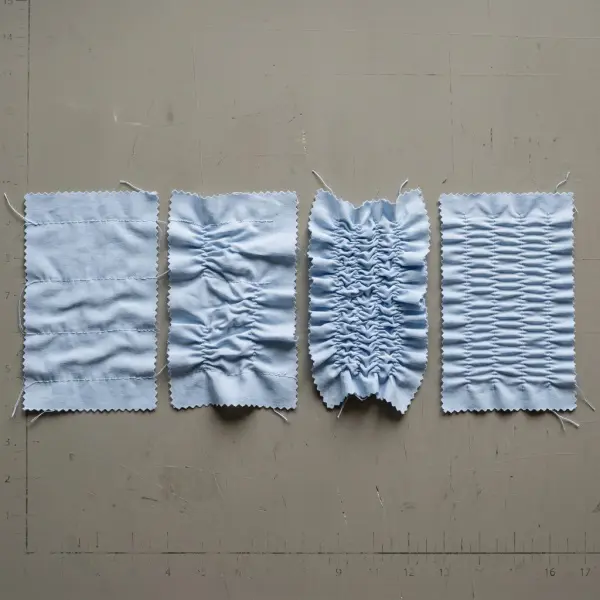
A shirred bodice may look perfectly balanced during initial sampling but become uneven, excessively tight, or insufficiently gathered during bulk production. Even when operators use the same sewing machine settings, differences in fabric characteristics, elastic thread handling, and finishing procedures can produce noticeably different results.
For garment manufacturers, inconsistent shirring is not simply a visual defect. It can affect finished measurements, wearing comfort, material consumption, production efficiency, and product returns.
Achieving consistent fabric gathering requires understanding how individual construction variables interact. Rather than repeatedly adjusting thread tension until the fabric looks acceptable, manufacturers need a controlled approach that connects material selection, machine configuration, sewing procedures, and quality inspection.
Quick Answer: What Causes Inconsistent Shirring?
Inconsistent shirring occurs when elasticated stitching fails to gather fabric uniformly or produce the intended finished dimensions. Common causes include incorrect thread tension, uneven bobbin winding, unsuitable fabric weight, inconsistent stitch length, irregular row spacing, and improper fabric handling during sewing.
Loose gathering may indicate insufficient elastic contraction, incorrect thread feeding, or excessive fabric stiffness. Excessively tight shirring can result from an unsuitable combination of elastic tension, stitch length, and construction parameters. Uneven gathering across a panel may indicate changes in elastic feeding, operator handling, or stitch formation.
To achieve consistent results, manufacturers should develop representative fabric samples, establish repeatable machine settings, standardize elastic thread preparation, and measure finished panels after the approved finishing process.
For commercial garment production, visual consistency alone is insufficient. Shirred sections should also meet dimensional requirements, provide appropriate extension and recovery, and maintain acceptable performance after laundering.
There is no universal sewing machine setting or gathering ratio suitable for every fabric. Production parameters must be validated for the actual material, equipment, and garment design.
Why Shirring Consistency Is Difficult to Achieve
Elastic shirring depends on the interaction between elastic thread, conventional sewing thread, fabric resistance, and stitch formation. A change in any of these variables can influence how much fabric contracts and how evenly the gathering develops.
This makes shirring different from many conventional garment seams. A standard joining seam primarily connects fabric components, while elastic shirring actively changes the dimensions and mechanical behavior of the material being sewn.
A manufacturer may successfully reproduce a conventional side seam using established machine settings across several fabric colors. The same approach may be less reliable for shirring if differences in finishing, stiffness, thickness, or elastic feeding affect the construction.
Understanding the underlying mechanism helps explain why troubleshooting must address the complete sewing process rather than focus exclusively on thread tension. The construction principles are introduced in [internal-link]Smocking and Shirring Explained for Garment Construction|https://fitinline.com/article/read/smocking-and-shirring-explained-for-garment-construction/[/internal-link].
The Variables That Influence Fabric Gathering
|
Production Variable |
Potential Effect on Shirring |
|
Fabric weight and stiffness |
Determines how readily the material responds to elastic contraction |
|
Elastic thread characteristics |
Influences contraction, extension, and recovery |
|
Bobbin winding |
Affects elastic thread feeding and tension consistency |
|
Upper and bobbin thread tension |
Influences stitch formation and gathering intensity |
|
Stitch length |
Changes stitch frequency and may influence contraction |
|
Row spacing |
Affects gathering distribution and surface appearance |
|
Fabric handling |
Influences dimensional and visual uniformity |
|
Number of stitching rows |
Affects the cumulative gathering effect |
|
Heat and moisture |
May change finished dimensions and elastic behavior |
These variables are interconnected. Increasing tension to compensate for unsuitable fabric stiffness, for example, may create excessive thread stress without producing an acceptable gathered surface.
Common Shirring Problems, Causes, and Solutions
Effective troubleshooting begins with identifying the visible defect, examining its probable causes, and testing corrective actions systematically. Several different construction problems can produce similar symptoms, so manufacturers should avoid assuming that every gathering defect originates from the same machine setting.
The following problems are particularly relevant to conventional elastic-bobbin shirring.
1. Shirring Is Not Gathering Enough
Insufficient gathering occurs when the fabric remains relatively flat or contracts less than required by the garment specification.
One possible cause is unsuitable fabric selection. Heavy or stiff materials may resist the contraction generated by relatively fine elastic thread. Incorrect elastic feeding, unsuitable stitch length, and insufficient tension can also contribute.
The [external-link]Seamwork guide to elastic shirring|https://www.seamwork.com/sewing-tutorials/a-guide-to-elastic-shirring[/external-link] explains that lightweight fabrics generally respond more readily to conventional elastic-bobbin shirring and that gathering becomes more pronounced as additional rows are sewn.
Before increasing machine tension, operators should confirm that the elastic is feeding correctly and evaluate a representative sample containing the intended number of stitching rows. A single row may not demonstrate the final gathering behavior.
2. Shirring Is Too Tight
Excessive gathering occurs when the finished panel contracts beyond its target dimensions. A bodice may become difficult to put on, a waistband may exert uncomfortable pressure, or a cuff may restrict movement.
Possible causes include excessive elastic tension, inconsistent bobbin winding, unsuitable stitch settings, or excessive contraction during finishing. The relationship between these factors depends on the machine and material combination.
Corrective action should begin with measuring the relaxed panel and comparing it with the approved specification. Adjustments can then be tested individually until the required contraction and wearing performance are achieved.
For fashion businesses, an excessively gathered garment should not automatically be considered acceptable simply because its fabric can stretch to the intended body measurement. Resistance to extension and wearing comfort also matter.
3. Fabric Gathering Is Uneven
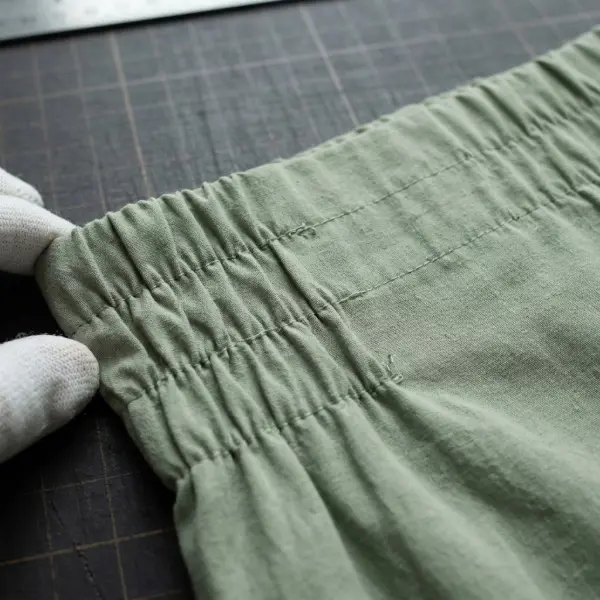
Uneven gathering appears when some areas contract more strongly than others, producing irregular folds or inconsistent fullness across a panel.
The defect may originate from unstable elastic feeding, differences in bobbin preparation, irregular fabric handling, or changes in stitching conditions. Operators may also unintentionally stretch some sections more than others while sewing subsequent rows.
Consistent feeding and handling procedures can reduce these variations. Previously gathered fabric should be managed according to the approved sewing method so that each new row is formed under comparable conditions.
When uneven gathering appears after a bobbin replacement, the replacement bobbin and its threading path should be examined before changing other machine settings.
4. Elastic Thread Breaks During Sewing
Elastic thread breakage interrupts production and may leave partially unsecured rows that compromise the finished panel.
Potential causes include excessive tension, restricted thread movement, damaged machine components, unsuitable elastic thread dimensions, or incompatibility between the elastic and the machine's bobbin system.
Repeated breakage should be treated as a technical problem rather than an unavoidable part of shirring. Operators should inspect the thread path, bobbin condition, elastic quality, and relevant machine components before resuming production.
If the problem persists, a sewing machine technician may need to examine the equipment. Continuing production while repeatedly replacing broken elastic can increase rework and conceal construction defects.
5. Loose Elastic Loops Appear on the Reverse Side
Loose loops on the reverse side may indicate incorrect elastic feeding or an imbalance in stitch formation. In some cases, the elastic may not be correctly positioned within the bobbin tension mechanism.
The resulting stitches may appear irregular and fail to contract the fabric consistently. Loose elastic sections may also be vulnerable to snagging or movement during garment assembly.
Operators should first recheck bobbin installation and the approved threading procedure. Adjusting tension before confirming correct threading can introduce additional variables without resolving the original problem.
6. Shirring Rows Are Crooked or Irregularly Spaced
Inconsistent row spacing affects the appearance of the gathered surface and can create noticeable differences between garment panels.
This defect often develops when operators rely entirely on visual estimation or lose alignment as the fabric progressively contracts. It can become particularly visible on wide bodices and striped or checked fabrics.
Manufacturers can improve consistency through suitable fabric markings, sewing guides, reference points, or approved machine attachments. Row spacing should be evaluated against the intended appearance rather than left to individual operator preference.
7. Elastic Thread Becomes Unsecured at the Row Ends
Elasticated stitching can lose its intended contraction if the thread ends are not secured appropriately. The problem may become apparent during garment assembly, stretching, or laundering.
Securing methods vary according to the sewing equipment and construction approach. Some methods use short reverse stitches, while others require thread ends to be tied or anchored through subsequent sewing operations.
For example, [external-link]Brother's machine-specific shirring instructions|https://help.brother-usa.com/app/answers/detail/a_id/64721/~/shirring-with-the-machine[/external-link] advise against backstitching on the covered models and instead recommend knotting and anchoring the thread ends.
This illustrates why manufacturers should follow equipment-specific procedures rather than assume that conventional seam-securing methods are suitable for every elastic shirring construction.
8. Shirring Loses Its Shape After Washing
A garment may meet dimensional requirements during production but develop loose gathering, reduced recovery, or altered proportions after laundering.
Possible causes include changes in the base fabric dimensions, elastic deterioration, unsuitable finishing conditions, or unsecured stitch ends. These effects can interact, making it difficult to identify the cause through visual inspection alone.
Representative garments should be evaluated using the intended care conditions before bulk approval. If the shirred section changes substantially, the manufacturer should investigate both the fabric and elastic construction rather than attribute the entire problem to elastic quality.
Shirring Troubleshooting Reference Table
A structured troubleshooting reference can help sewing operators, production supervisors, and quality control teams identify appropriate starting points for investigation.
|
Shirring Problem |
Possible Causes |
Recommended Action |
|
Insufficient gathering |
Fabric stiffness, incorrect elastic feeding, unsuitable settings |
Check threading and test alternative validated settings |
|
Excessively tight gathering |
Excessive contraction or unsuitable tension |
Reassess relaxed dimensions, tension, and finishing |
|
Uneven gathering |
Variable elastic feeding or fabric handling |
Standardize bobbin preparation and sewing procedures |
|
Elastic thread breakage |
Excessive stress, restricted feeding, or damaged components |
Inspect thread path, elastic compatibility, and equipment |
|
Loose elastic loops |
Incorrect bobbin threading or stitch imbalance |
Rethread and examine stitch formation |
|
Irregular row spacing |
Inconsistent marking or operator alignment |
Introduce suitable sewing guides |
|
Unsecured row ends |
Inappropriate thread-securing method |
Validate equipment-specific anchoring procedures |
|
Poor recovery |
Elastic deterioration or excessive extension |
Evaluate elastic quality and functional performance |
|
Dimensional change after washing |
Fabric shrinkage or elastic instability |
Conduct laundering trials and review materials |
|
Misaligned garment panels |
Inconsistent row positioning or construction sequence |
Establish common reference points and assembly controls |
These are diagnostic possibilities rather than definitive one-to-one relationships. When several potential causes exist, testing one variable at a time is generally more informative than making several simultaneous adjustments.

How to Set Up a Sewing Machine for Consistent Shirring
A reliable shirring setup should produce the required gathering repeatedly without excessive thread breakage, unstable stitch formation, or frequent operator adjustments.
For conventional elastic-bobbin shirring, the setup normally includes standard upper sewing thread, compatible elastic bobbin thread, and a suitable stitch configuration. The precise parameters depend on the equipment and fabric.
Standardize Elastic Bobbin Preparation
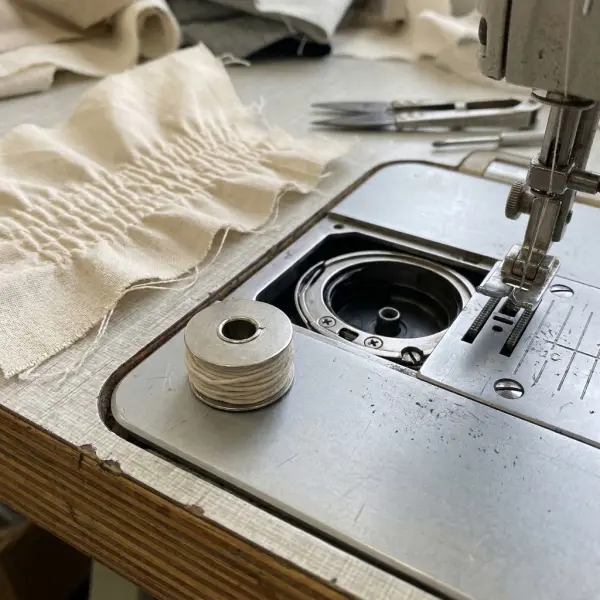
Elastic bobbin preparation is particularly important because variations introduced during winding can affect subsequent thread feeding.
[external-link]SINGER's external sewing guidance recommends hand winding elastic thread without stretching it for the method demonstrated in its tutorial. It also advises checking the resulting gathering on a fabric sample before proceeding with the garment.
For commercial production, the relevant objective is repeatability. If an approved preparation method consistently produces acceptable results, it should be documented and reproduced by trained operators.
Where conventional bobbin winding creates excessive variation, the production team should evaluate whether a different compatible feeding method or specialized equipment would be more appropriate.
Establish Suitable Stitch Length and Thread Tension
Stitch length and tension influence both the formation of individual stitches and the resulting fabric contraction.
The [external-link]BERNINA WeAllSew shirring tutorial|https://weallsew.com/create-shirring-elastic-thread/[/external-link] uses a straight stitch length of approximately 3–4 millimeters and row spacing of approximately 9.5–12.7 millimeters for its demonstrated construction.
These values are useful starting references, not universal production specifications. Different machines, elastic materials, fabric structures, and garment designs may require different settings.
A controlled sampling process should establish the combination that produces acceptable stitch formation, contraction, and recovery. Adjustments to bobbin-case components should follow appropriate equipment guidance, particularly when the machine is shared with conventional sewing operations.
Maintain Stable Sewing Conditions
Machine settings alone do not guarantee uniform gathering. Sewing speed, fabric feeding, operator handling, and thread replacement procedures can introduce variation even when the numerical settings remain unchanged.
Production supervisors should observe whether operators are able to maintain stable conditions throughout a complete panel. If the approved method is difficult to reproduce without repeated manual correction, it may need further development before bulk manufacturing begins.
Controlling the Gathering Ratio During Product Development
The gathering ratio describes the relationship between the original fabric width and the relaxed width after gathering. For shirred garments, it provides a practical basis for pattern development, material consumption calculations, and finished measurement control.
The ratio can be calculated as follows:
Gathering Ratio = Original Fabric Width ÷ Relaxed Shirred Width
A sample measuring 60 centimeters before shirring and 30 centimeters afterward has a gathering ratio of 2:1.
The key point is that the ratio should be established experimentally for the intended construction. It should not be borrowed from an unrelated garment or treated as a fixed property of a particular fabric category.
Comparing Sample Results
Consider a hypothetical development trial using three equally sized cotton fabric samples.
|
Measurement |
Sample A |
Sample B |
Sample C |
|
Original width |
60 cm |
60 cm |
60 cm |
|
Relaxed width after finishing |
35 cm |
30 cm |
26 cm |
|
Gathering ratio |
1.71:1 |
2.00:1 |
2.31:1 |
|
Width reduction |
41.7% |
50.0% |
56.7% |
|
Evaluation for a 30 cm target |
Insufficient contraction |
Meets target |
Excessive contraction |
These figures are illustrative rather than actual laboratory test results or recommended production standards. They demonstrate how different construction parameters can produce substantially different finished dimensions.
If the garment requires a relaxed panel width of 30 centimeters, Sample B meets that dimensional objective. However, its extension, recovery, appearance, and laundering performance still need evaluation before approval.
Measuring Under Consistent Conditions
Measurements should be taken using comparable procedures. A panel measured immediately after steaming may behave differently from one measured after cooling and relaxation.
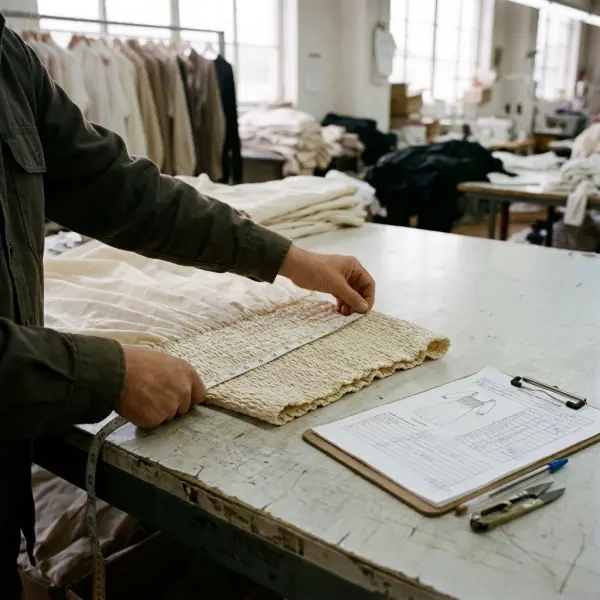
Manufacturers should establish when measurements are taken, where measurement points are located, and whether the fabric is evaluated in a relaxed or extended condition.
Without a consistent measurement method, apparent production variation may partly reflect inconsistent inspection practices rather than actual sewing defects.
How Fabric Selection Affects Shirring Quality
A suitable fabric allows the elasticated stitching to produce the intended gathering without excessive bulk, irregular contraction, or undesirable stiffness.
Lightweight woven materials are frequently selected for conventional elastic shirring, but fabric weight alone does not determine compatibility. Weave structure, surface finishing, drape, thickness, and dimensional stability also influence the finished construction.
|
Fabric |
Potential Shirring Behavior |
Consideration |
|
Cotton lawn |
Often forms fine, relatively uniform gathers |
Check dimensional stability and coverage |
|
Cotton voile |
May gather readily with limited bulk |
Consider transparency and stitch visibility |
|
Cotton poplin |
Can produce more defined gathers |
Evaluate stiffness and contraction |
|
Viscose challis |
Often produces soft, fluid gathering |
Control handling and dimensional change |
|
Double gauze |
Can create a pronounced textured surface |
Assess bulk and existing surface irregularity |
|
Lightweight linen blends |
May produce structured gathering |
Evaluate stiffness and finishing |
|
Heavy canvas or denim |
May resist conventional fine elastic shirring |
Consider an alternative construction method |
A fabric substitution should therefore trigger renewed construction evaluation when it changes relevant material characteristics. Even two fabrics with the same fiber composition can respond differently to elasticated sewing.
Where the construction is primarily decorative rather than dependent on elastic recovery, alternative fabric manipulation methods may be appropriate. The differences are discussed in [internal-link]Elastic Shirring vs Traditional Smocking: Key Sewing Differences|https://fitinline.com/article/read/elastic-shirring-vs-traditional-smocking-key-sewing-differences/[/internal-link].
Quality Control for Shirred Garments
Quality control for elastic shirring should evaluate appearance, dimensional accuracy, stitch security, and functional performance. Inspection based solely on whether the fabric appears evenly gathered may overlook defects that affect garment fit or durability.
For brands selling fitted dresses, flexible waistbands, or elasticated cuffs, the shirred construction is part of the garment's functional system. Its quality should be assessed accordingly.
Visual and Construction Inspection
Inspectors should compare production samples with the approved construction reference. The inspection should consider whether the gathering is distributed consistently, whether stitching rows remain aligned, and whether elastic thread is securely incorporated.
Relevant inspection points include:
- Uniform gathering across the panel.
- Consistent stitch-row spacing and positioning.
- Absence of broken or skipped stitches.
- Secure elastic thread ends.
- Absence of unacceptable loose thread loops.
- Correct alignment at joining seams.
The importance of each criterion depends on the garment. Minor row variation may be less noticeable on a highly textured fabric but unacceptable on a minimalist bodice featuring exposed, regularly spaced stitching.
Dimensional and Functional Inspection
A shirred garment should be evaluated in its relaxed condition and, where appropriate, under a defined extension procedure.
Useful measurements can include relaxed panel width, extended width at a specified load or wearing dimension, and residual dimensional change following stretching and recovery.
For an elasticated bodice, extension alone does not establish acceptable performance. The garment must also accommodate the intended body measurements without excessive pressure or distortion.
Laundering and Recovery Evaluation
Laundering trials help manufacturers identify whether the construction maintains acceptable dimensions and appearance under the garment's intended care conditions.
The evaluation should distinguish between changes originating from fabric shrinkage and those related to elastic recovery or stitch security. Comparing measurements before and after laundering can help narrow the investigation.
Acceptance limits, washing conditions, recovery intervals, and testing procedures should be established according to the product specification. An informal stretching exercise should not be represented as a standardized laboratory test.
How Garment Manufacturers Can Prevent Shirring Defects in Bulk Production
Preventing shirring defects requires moving beyond sample approval toward a documented and repeatable production process.
A successful sample demonstrates that a construction is achievable under specific conditions. It does not establish that every operator, machine, or material batch will automatically reproduce the same result.
Develop an Approved Shirring Construction Standard
The approved construction standard should connect the garment's design requirements with the practical sewing procedure.
A useful production specification may include:
|
Specification Component |
Required Information |
|
Fabric |
Approved material reference and relevant characteristics |
|
Elastic thread |
Approved product, size, and material specification |
|
Machine |
Compatible machine type and configuration |
|
Bobbin preparation |
Approved winding and threading procedure |
|
Stitch configuration |
Validated stitch type and length |
|
Row arrangement |
Number, spacing, and position of rows |
|
Panel dimensions |
Original and relaxed finished measurements |
|
Thread securing |
Approved anchoring procedure |
|
Finishing |
Permitted heat, moisture, and handling conditions |
|
Performance |
Extension, recovery, and laundering requirements |
|
Quality acceptance |
Approved reference sample and applicable tolerances |
Such documentation allows operators and quality teams to work from the same construction requirements. It also provides a reference when investigating production deviations.
Conduct Pilot Production Before Large Orders
Pilot production allows manufacturers to evaluate whether the approved shirring construction can be reproduced under realistic operating conditions.
A small production batch can reveal differences between sample-room execution and regular production-line performance, including operator variation, machine incompatibility, and inconsistent handling during finishing.
The purpose is not merely to identify defective garments. It is to determine whether the process is sufficiently stable before committing larger quantities of fabric and production capacity.
Monitor Changes in Materials and Production Conditions
Changes in elastic thread batches, fabric lots, equipment, or operators should receive appropriate attention when they could affect the finished construction.
A factory does not necessarily need to repeat the entire development process for every minor change. However, targeted verification is advisable when a change introduces uncertainty about contraction, stitch formation, or recovery.
For repeat collections, retaining approved construction samples and production records can reduce unnecessary experimentation while providing a basis for investigating new defects.
Important Technical Caveats
Shirring troubleshooting should always account for the specific construction method being used. Conventional elastic-bobbin shirring, specialized industrial elastic feeding systems, and alternative gathering constructions may require different operating parameters.
Several assumptions deserve particular caution.
|
Common Assumption |
Technical Reality |
|
Increasing tension always improves gathering |
Excessive tension may cause distortion or thread breakage |
|
Longer stitches always produce better shirring |
Suitable stitch length depends on equipment, materials, and required performance |
|
Steam can correct every gathering defect |
Steam cannot reliably correct unsuitable materials or defective stitch formation |
|
A 2:1 gathering ratio is universally appropriate |
Each construction requires an approved ratio |
|
Greater stretch means better quality |
Comfort, recovery, and dimensional stability also matter |
|
Identical machine settings guarantee identical results |
Material and operator variation can affect the outcome |
|
Successful sampling guarantees production consistency |
Bulk production requires additional process control |
These limitations are particularly important when transferring an approved garment between suppliers. Reproducing the same appearance may require different validated machine parameters if the receiving factory uses different equipment.
Frequently Asked Questions (FAQ)
1. Why is my shirring not gathering even though I am using elastic thread?
The presence of elastic thread does not guarantee that shirring will contract correctly. Insufficient gathering may result from incorrect bobbin threading, unsuitable tension, short stitch length, excessive fabric stiffness, or incompatible equipment.
Begin by checking whether the elastic follows the correct thread path and whether the machine forms stable stitches. Prepare a sample using several rows before evaluating the final gathering effect.
If the result remains insufficient, test individual construction variables systematically. Increasing tension without confirming the material and threading conditions may create new problems rather than resolve the original defect.
2. Why does shirring become uneven after changing the bobbin?
Uneven gathering after a bobbin replacement may indicate differences in elastic winding or feeding conditions. The new bobbin may contain elastic wound under a different level of tension, or the thread may not be positioned correctly within the bobbin mechanism.
For garment production, replacement bobbins should be prepared according to the same approved procedure. Operators should also confirm correct installation before continuing a partially completed panel.
If the construction changes noticeably after replacement, inspect the new bobbin first rather than immediately altering the machine settings that produced acceptable results previously.
[H3] 3. Does steaming always make shirring tighter?
No. Steam can encourage additional contraction in certain elastic shirring constructions, but the result depends on the elastic material, fabric characteristics, and finishing conditions.
A panel with incorrect stitch formation or unsuitable elastic feeding may remain defective after steaming. Excessive heat can also be incompatible with some fabrics or elastic components.
Manufacturers should validate the permitted finishing procedure during sampling and measure panels after the specified cooling and relaxation period. Steam should be treated as a controlled finishing operation rather than a universal solution for gathering defects.
4. What is the ideal stitch length for elastic shirring?
There is no universal ideal stitch length for elastic shirring. Conventional sewing tutorials frequently recommend relatively long straight stitches, often around 3–4 millimeters, but the appropriate setting depends on the machine, elastic thread, fabric, and desired construction.
The best approach is to prepare several representative samples with controlled variations in stitch length while keeping other parameters stable.
Evaluate each sample for gathering intensity, stitch formation, relaxed dimensions, and extension behavior. Select the configuration that meets the garment specification rather than the one that simply produces the strongest contraction.
5. Can defective shirring be repaired without replacing the entire garment panel?
Sometimes. Localized defects, such as an unsecured thread end or a damaged individual stitching row, may be repairable if the correction restores the required appearance and functional performance.
More extensive problems, including severe uneven gathering or incorrect panel dimensions, may require removal and replacement of multiple stitching rows.
Repair feasibility also depends on whether the fabric retains needle marks, becomes distorted during stitch removal, or suffers damage during rework. For commercial garments, manufacturers should compare the cost and reliability of repair with the cost of replacing the affected panel.
6. How can fashion brands ensure consistent shirring across different suppliers?
Fashion brands should establish measurable construction requirements and provide an approved physical reference sample rather than rely solely on photographs or descriptive terminology.
Suppliers should validate the construction using their own compatible equipment and the approved fabric and elastic materials. The resulting panels should meet the same dimensional, visual, and functional acceptance criteria, even if their machine settings differ.
This approach separates the required product outcome from the equipment-specific production method. It is particularly useful for brands working with multiple factories or transferring established collections between suppliers.
Conclusion
Consistent shirring depends on controlling the relationship between fabric characteristics, elastic thread behavior, stitch formation, and production procedures.
Although many shirring defects can be corrected through appropriate machine adjustments, recurring problems often indicate weaknesses in material selection, process documentation, operator training, or quality control.
For garment manufacturers, the most reliable approach is to establish a validated construction standard during product development, confirm its repeatability through pilot production, and maintain appropriate inspection throughout manufacturing.
A well-executed shirred garment should offer more than an attractive gathered surface. It should deliver the intended dimensions, wearing comfort, construction stability, and performance expected throughout its use.


Comments 0
Leave a CommentSend Comment
Anda harus Login terlebih dahulu untuk dapat memberikan komentar.