
How Function, Comfort, and Climate Shape Modern Wardrobes
Quick Answer
Function, comfort, and climate shape modern wardrobes because people rarely dress for temperature alone. Clothing also has to respond to humidity, wind, rain, sun exposure, indoor cooling or heating, physical activity, commuting, travel, workplace expectations, and rapid changes between environments.
This makes the useful modern wardrobe less about owning one garment for each traditional season and more about building combinations that can be adjusted. Lightweight layers, breathable base garments, adaptable outerwear, versatile mid-layers, and clothing that works across several temperature ranges can often provide more practical value than rigid seasonal categories.
The long-term climate context also matters. The World Meteorological Organization reported that 2015–2025 were the 11 warmest years on record globally, although this does not mean every location experiences the same conditions or that individual weather events can be interpreted from global temperature alone.
For fashion businesses, the strategic challenge is therefore not simply producing warmer or cooler clothing. It is understanding where customers live, how they move through their day, what makes them comfortable, and which garments can adapt when those conditions change.
A Modern Wardrobe Has to Manage More Than Seasons
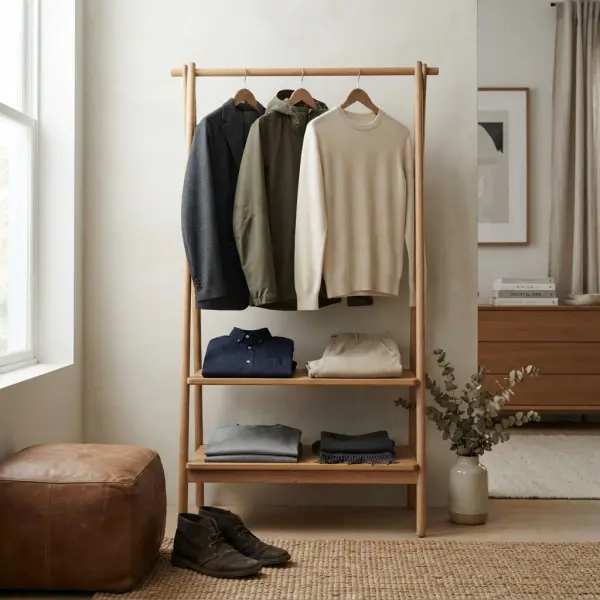
The familiar four-season wardrobe is a useful organizational idea, but it does not describe how everyone actually experiences weather.
A person may live in a tropical climate where temperature varies relatively little throughout the year but rainfall and humidity change substantially. Another may experience cold winters, warm summers, and highly variable spring and autumn conditions. Someone working in a strongly air-conditioned office can move from hot outdoor conditions to a cool indoor environment several times in a single day.
Then there is travel. A business traveler can leave a humid city in the morning and arrive somewhere considerably cooler the same evening. A commuter can walk through rain, sit in heated public transport, spend eight hours indoors, and return home after temperatures have dropped.
The wardrobe therefore has to solve transitions, not simply seasons.
This is one reason transitional dressing remains an active fashion category. Vogue's 2026 coverage, for example, described spring wardrobes around “in-between weather,” while resort collections continue to function commercially as bridges between more clearly defined seasonal deliveries. These editorial observations do not prove that conventional seasons have disappeared, but they do reflect an established need for clothing that works between climatic categories.
For fashion brands, that changes the planning question from “What does the customer wear in spring?” to something more specific: What combinations of temperature, precipitation, activity, and indoor conditions does the customer actually need to navigate?
Climate Sets the Conditions, but Lifestyle Determines the Wardrobe
Climate provides the environmental framework. Lifestyle determines how much of that environment the wearer actually experiences.
Two people living in the same city can need very different wardrobes.
One may commute by car from an air-conditioned home to an air-conditioned office. Another may walk, cycle, use public transport, or spend part of the workday outdoors. Their local weather is identical, yet the clothing problems they encounter are not.
A useful wardrobe strategy therefore considers at least four layers of context:
- Regional climate: typical temperature, humidity, rainfall, wind, and seasonal variation.
- Daily weather: the actual conditions encountered on a particular day.
- Activity: how much heat and moisture the wearer generates through movement.
- Built environment: heating, air conditioning, transport, workplaces, homes, and other controlled spaces.
The final layer is especially easy for apparel brands to overlook. Modern dressing frequently takes place across artificial microclimates.
A lightweight cardigan may be unnecessary outdoors in a tropical afternoon but useful inside a strongly cooled office. A substantial winter coat may be essential during a commute and immediately removed on entering a heated building. A waterproof shell can protect a cyclist from rain but become uncomfortable if the garment cannot accommodate the heat generated through movement.
This is why climate should inform apparel design without becoming the only design input.
What Does Comfort Actually Mean in Clothing?
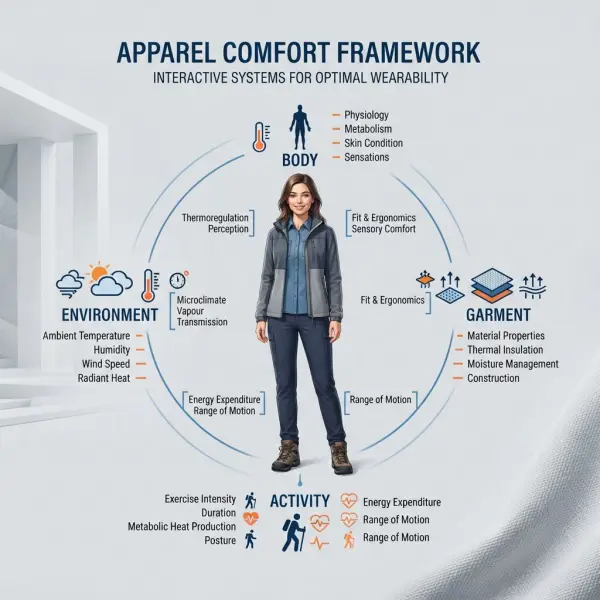
Comfort is not one measurable textile property.
It emerges from the interaction between the body, clothing system, environment, garment fit, activity, and subjective expectations.
Thermal resistance matters because clothing can slow heat transfer. Water-vapour resistance matters because moisture produced by the body needs pathways through the clothing system. Air movement, surface texture, weight, fit, stretch, pressure, seams, and garment construction can also influence how comfortable clothing feels.
The distinction is important enough that ISO 11092:2026, which measures thermal resistance and water-vapour resistance of textile materials and multilayer assemblies, explicitly states that its test conditions are not intended to represent specific comfort situations and that the standard does not itself provide physiological comfort specifications.
In other words, laboratory textile data can help explain performance, but it cannot completely predict whether a customer will feel comfortable wearing the finished garment on a particular day.
That is why sophisticated product development combines material testing with garment-level evaluation and realistic wear trials.
Thermal Comfort Is a System, Not a Fabric Label
A fabric cannot simply be declared “comfortable” in isolation.
A lightweight textile can feel comfortable in warm conditions but inadequate in strong wind. A highly insulating fabric can be valuable in cold weather yet excessive during physical activity. A material that allows moisture vapour to move relatively easily may still be used in a garment whose lining, coatings, fit, or construction restrict the overall clothing system.
Even the same garment can feel different depending on the wearer.
Walking quickly generates more body heat than standing still. Carrying a backpack can reduce ventilation across the back. Humidity can influence how easily perspiration evaporates. Wind can increase heat loss. Direct sunlight can add thermal load.
For fashion companies, this means comfort claims should be framed carefully.
Terms such as “cooling,” “breathable,” “temperature regulating,” and “all-season” can sound straightforward to customers but may refer to very different mechanisms and testing approaches. Unless those terms are backed by appropriate evidence, more specific language is often safer and more informative.
A relaxed lightweight shirt, for example, might be described through its loose construction, fabric weight, and intended warm-weather use rather than through a broad scientific-sounding comfort promise.

Hot Climates Change the Priorities of a Wardrobe
When heat dominates, reducing unnecessary thermal burden becomes more important than insulation.
The World Health Organization recommends light and loose-fitting clothing during periods of high heat, while the UK Met Office similarly advises lightweight, loose-fitting garments and breathable materials such as cotton or linen in hot conditions.
These public-health recommendations should not be converted into simplistic fashion rules. Fiber name alone does not determine comfort. Fabric weight, structure, finishing, garment fit, color, moisture behaviour, sun exposure, and activity all matter.
A dense heavy cotton garment, for example, can behave very differently from a lightweight open cotton construction. Linen can offer useful warm-weather characteristics, but different weaves, blends, finishes, and garment designs change how it feels and performs.
For product teams working in hot climates, several design priorities become especially relevant:
- low unnecessary garment mass;
- adequate ease around the body;
- airflow where appropriate;
- manageable moisture and drying behaviour;
- protection from sun exposure when required;
- compatibility with air-conditioned indoor environments.
That final point can make warm-climate wardrobes surprisingly layered.
A customer may need clothing that remains comfortable outside at 32°C but also works during several hours in a much cooler office. The useful solution may be a lightweight base outfit combined with a removable overshirt, cardigan, or thin jacket rather than one garment designed around a single temperature.
Humidity Changes How Warm Weather Feels
Temperature does not tell the whole story.
High humidity can make evaporation of perspiration less effective, which changes how the body experiences heat. Clothing that feels manageable in dry heat may feel less comfortable under humid conditions, particularly when the fabric or garment traps additional moisture close to the body.
This has practical implications for fabric and silhouette.
Loose garments can allow more space for air movement. Lightweight constructions reduce unnecessary bulk. Materials that dry reasonably quickly may be valuable where clothing repeatedly becomes damp through perspiration or rain.
But this should not be reduced to a universal “best fabric for humidity” list.
Performance depends on fabric construction as much as fiber chemistry. Knitted versus woven structures, yarn size, fabric density, finishes, coatings, lining, and garment fit can substantially change the result.
Brands serving humid markets should therefore evaluate complete fabric and garment combinations under conditions that resemble customer use instead of relying exclusively on generic fiber descriptions.

Cold Conditions Create a Different Clothing Logic
Cold-weather wardrobes solve almost the opposite problem: retaining useful warmth while preventing the clothing system from becoming unnecessarily heavy, restrictive, or difficult to adjust.
Layering becomes particularly valuable because different garments can be removed or added as activity and surroundings change.
The logic usually involves some combination of:
- a comfortable next-to-skin layer;
- one or more insulating layers;
- external protection where wind, rain, or snow requires it.
The exact garments vary enormously. Someone walking between a train station and office may require a different system from someone standing outdoors for hours.
The purpose of layering is therefore not simply to wear more clothes. It is to separate functions across garments so the system can be adjusted.
This logic also creates product-development opportunities. Fine-gauge knitwear can work beneath tailored outerwear. Lightweight insulation can reduce bulk. Oversized coats can accommodate layering. Detachable liners can extend a garment's usable range.
For consumers, the best cold-weather wardrobe is often the one that allows the most practical combinations with the fewest frustrating incompatibilities.
A beautifully designed coat loses versatility if its armholes cannot accommodate a sweater. A thick knit may be comfortable on its own but impossible beneath the customer's existing jacket. Wardrobe compatibility matters as much as individual garment quality.
Rain Changes the Wardrobe Without Necessarily Changing the Temperature
Rain introduces another dimension because the problem is not always warmth.
In warm climates, a rain layer may need to block precipitation while adding as little heat as practical. In cooler environments, the same precipitation can quickly increase discomfort if clothing becomes wet and heat loss increases.
The right response therefore varies.
A short urban trip through intermittent showers might justify a light outer shell. A long exposed commute may require more substantial rain protection. Someone travelling primarily by car may only need enough coverage to move between buildings.
These distinctions are explored more deeply in Weather-Ready Fashion Explained for Everyday Dressing, where water repellency, water penetration resistance, garment construction, and layering are treated as separate performance questions.
At wardrobe level, however, the important principle is simpler: rain protection should fit the frequency and severity of exposure.
A bulky specialist rain garment that is almost never carried provides little everyday value. A compact jacket that can remain in a work bag may be used constantly even if its technical specification is more modest.
Wind Can Matter as Much as Temperature
Two days with the same air temperature can require different clothing if wind exposure differs significantly.
Wind increases convective heat loss at the body and clothing surface, which is why a lightweight wind-resistant layer can sometimes add more practical comfort than another bulky insulating garment.
This illustrates an important product-development principle: garment function should address the environmental problem directly.
If wind is the dominant issue, additional insulation is not always the most efficient solution. If rain is the issue, thicker fabric does not necessarily provide meaningful water protection. If humidity is the concern, simply reducing garment weight may not address poor ventilation.
Fashion product briefs become stronger when the environmental problem is broken into specific variables instead of being summarized as “summer,” “winter,” or “bad weather.”
Indoor Climate Has Quietly Become Part of Fashion Design
Wardrobe discussions often focus on outdoor climate, yet many customers spend most of their time indoors.
Heating and air conditioning alter what clothing needs to do.
In hot regions, aggressively cooled workplaces, retail spaces, airports, and transport can make light layering useful even when outdoor temperatures remain high. In winter climates, powerful indoor heating encourages garments that can be easily removed upon entry.
This helps explain the everyday value of cardigans, overshirts, lightweight knits, unstructured jackets, scarves, and compact outer layers. They are not merely seasonal products. They help customers move between controlled and uncontrolled environments.
For fashion brands, indoor climate can influence several product decisions:
- how easily a garment can be removed;
- whether it can be carried without excessive bulk;
- whether layers fit comfortably together;
- whether the product looks appropriate both indoors and outdoors;
- whether temperature adjustment requires changing the entire outfit.
A formal suit built around continuous indoor use, for example, creates different requirements from officewear designed for someone who walks or cycles part of the commute.
The same customer segment can therefore contain multiple climate-use cases.
Why Adaptability Is Becoming More Valuable Than Maximum Performance
Modern wardrobes often benefit from garments that perform adequately across several scenarios rather than exceptionally in only one.
This does not mean specialist clothing is unnecessary. Extreme cold, heavy rain, high-altitude conditions, demanding outdoor activity, and occupational environments can require specialized performance.
Everyday wardrobes usually operate under less extreme constraints.
A lightweight jacket that works over a shirt, knit, or T-shirt may be worn through much of the year. A loose overshirt can function as an indoor layer, mild-weather jacket, or travel piece. Trousers that work with both sandals and closed shoes can bridge more temperature conditions than highly seasonal alternatives.
This is where versatility becomes a design specification rather than a marketing adjective.
True versatility requires compatibility across:
- temperature ranges;
- layering combinations;
- footwear;
- social settings;
- activities;
- care routines;
- styling contexts.
A beige jacket is not automatically versatile because the color is neutral. If the cut is difficult to layer, the textile wrinkles badly during travel, and the garment only works with one silhouette, its actual wardrobe versatility may be limited.
The Modern Wardrobe Is Increasingly Modular
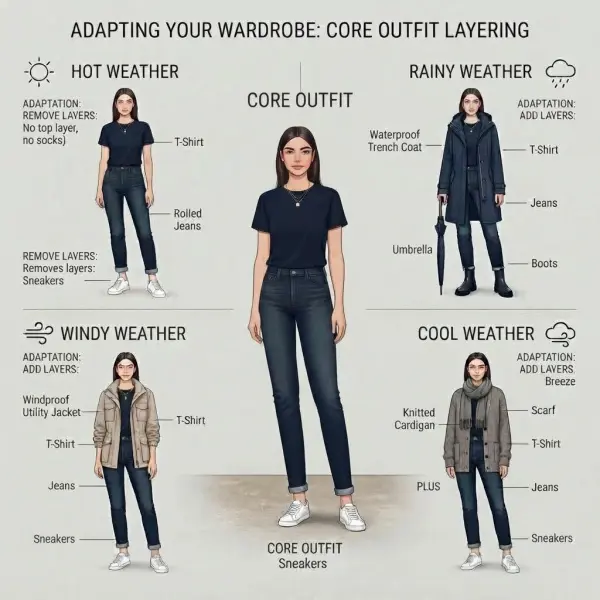
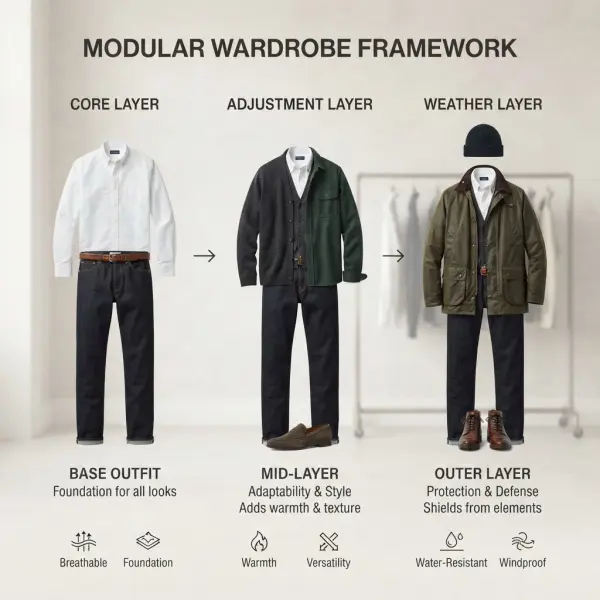
A useful way to think about adaptable dressing is as a modular system.
Instead of designing outfits that only work as fixed combinations, the wardrobe contains components that can be recombined as conditions change.
Consider a simple system:
Core layer: a shirt, T-shirt, blouse, dress, or other garment suitable for the main indoor environment.
Adjustment layer: a cardigan, overshirt, vest, or lightweight knit that adds moderate warmth or coverage.
Weather layer: a shell, rain jacket, windbreaker, trench, or other external protection.
The wearer can then move through several environments without changing the entire outfit.
This approach is particularly effective when brands coordinate proportions. Sleeves should fit inside outerwear. Hem lengths should work together. Necklines should not compete awkwardly. A jacket should accommodate the intended knit without restricting movement.
Wardrobe modularity is therefore partly a pattern-cutting and merchandising problem.
A collection can contain individually strong pieces and still perform poorly as a wardrobe if the garments do not layer comfortably together.
Traditional Seasonal Categories Still Matter—But Not Equally Everywhere
Climate adaptation does not mean fashion seasons have become irrelevant.
Cold-weather coats still have clear seasonal demand in many markets. Swimwear remains highly seasonal in some regions. Rain patterns, school calendars, holidays, travel periods, and cultural dressing cycles continue to create strong selling windows.
What deserves reconsideration is the assumption that one seasonal structure fits every market.
A global brand may simultaneously serve customers entering autumn, customers experiencing tropical rainy conditions, and customers approaching summer. Even within one country, altitude, latitude, coastal influence, and urban microclimates can produce significant differences.
The long-term climate background adds another layer. WMO reported that 2025 was approximately 1.43°C above the 1850–1900 average and either the second- or third-warmest year in major datasets, with 2015–2025 forming the hottest 11-year sequence on record. WMO State of the Global Climate 2025
That global signal should not be translated into simplistic merchandising conclusions such as “winter clothing will disappear.” Local weather remains variable, and individual markets can still experience severe cold.
The more defensible business implication is that historical calendar assumptions should be checked against current local conditions and actual customer behaviour rather than treated as fixed rules.
Climate Adaptation Does Not Mean Chasing Every Weather Event
There is a risk of overreacting.
A single unusually warm winter or rainy summer does not necessarily justify redesigning an entire assortment. Weather is variable even without long-term climate change, and apparel lead times mean that brands often make product decisions months before selling conditions are known.
Strategic adaptation therefore needs a longer view.
Brands can combine historical sales data, regional climate patterns, recent weather behaviour, customer feedback, and product-category performance to identify persistent issues. The goal is to distinguish structural wardrobe needs from temporary anomalies.
For example, repeated weak sales of very heavy outerwear combined with stronger performance from lightweight layers may indicate a useful assortment shift in a particular market. One mild winter alone provides much weaker evidence.
This distinction matters because climate-responsive merchandising should reduce risk, not create a new form of trend chasing.
How Climate Changes Product Assortment Planning
For apparel businesses, climate should influence assortment architecture before it influences advertising language.
A market with long humid summers may justify deeper inventory in lightweight tops, loose trousers, dresses, overshirts, and rain-compatible outerwear, with relatively shallow heavy-knit categories.
A cooler market with strong seasonal variation may require a more pronounced progression from lightweight transitional products to insulation and heavy outerwear.
The crucial insight is that climate shapes the relative importance of categories.
Product teams can ask:
- How many months can customers realistically wear this product?
- Does it solve a frequent or occasional environmental problem?
- Can it bridge more than one selling period?
- Does it layer with products already in the assortment?
- Is inventory exposure high if the weather arrives later than expected?
- Can the product be repositioned across seasons without misleading customers?
These questions connect climate directly to inventory risk.
A highly seasonal garment has a shorter full-price selling window. A more adaptable product may remain commercially useful longer, although this advantage depends on design, market, pricing, and customer behaviour.
Regionalization Can Be More Useful Than One Global Collection Logic
Global fashion businesses face a basic contradiction: centralized collections simplify design and production, while customers experience highly localized climates.
The solution does not always require entirely separate regional collections.
Brands can regionalize through assortment depth.
The same global collection might allocate more rainwear to one market, more lightweight layers to another, and more insulation to a third. Colors, fabric weights, and delivery dates can also be adjusted selectively.
This approach is operationally simpler than redesigning every product for every location, but it still requires reliable local demand signals.
Retailers with strong store-level or regional data can use sell-through, markdown, return, and weather correlations as one input. Smaller brands can gather useful qualitative signals from customer service, wholesale partners, local buyers, social engagement, and repeat-purchase behaviour.
The objective is not perfect weather prediction.
It is avoiding the assumption that a garment has the same practical relevance everywhere.
Function Should Be Designed Into the Wardrobe, Not Added Afterwards
Many functional-fashion mistakes occur because function enters product development too late.
A design is completed aesthetically, then the team attempts to add weather protection, pockets, ventilation, adjustability, or layering capability without reconsidering the underlying pattern.
The result can be awkward.
A hood may distort the neckline. An added lining can reduce internal space. Large pockets can interfere with garment drape. A waterproof textile can behave differently from the material used during early sampling.
The stronger approach is to define function early enough that it can influence silhouette and construction.
This does not mean every garment needs visible technical detailing. As discussed in why rainwear and lightweight outerwear are becoming more stylish, some of the most effective functional fashion integrates protection discreetly into contemporary silhouettes.
At wardrobe scale, the same principle applies.
A collection designed around adaptability should establish layering relationships, garment lengths, fabric weights, and functional roles from the beginning rather than hoping individual products will happen to work together.
Comfort Can Conflict With Fashion Intent
Not every aesthetically strong design maximizes comfort, and not every comfortable garment creates the visual identity a fashion brand wants.
This tension is normal.
An oversized silhouette may improve airflow but create unwanted volume. A fitted shape may support a particular aesthetic while reducing layering flexibility. A structured fabric can produce an architectural silhouette but feel less forgiving during long periods of sitting.
The correct choice depends on the product brief.
The mistake is assuming that comfort is a binary quality that can simply be added to every design without trade-offs.
Instead, product teams should decide which dimensions of comfort matter most for the use case.
For a commuter jacket, mobility, temperature regulation, and pocket access may rank highly. For occasionwear, tactile comfort and freedom of movement may matter more than all-day climatic adaptability. For travel clothing, weight, wrinkle recovery, layer compatibility, and long sitting periods can become more important.
Good product development prioritizes instead of pretending every objective can be maximized simultaneously.
Sustainability Claims Require Separate Evidence
Climate-responsive wardrobes are sometimes presented as automatically sustainable because versatile garments can theoretically be worn more often or replace several specialized products.
That possibility is reasonable, but it should not be treated as guaranteed.
A multifunctional jacket that customers genuinely wear frequently may deliver more utility than several rarely used garments. But versatility alone says nothing about fiber sourcing, manufacturing impacts, chemical use, durability, repairability, laundering, transport, or end-of-life outcomes.
Similarly, describing a wardrobe as “seasonless” does not automatically reduce production or consumption.
A brand could sell seasonless products while still releasing them at high volume.
For fashion companies, the safer approach is to separate climate adaptability, product versatility, and environmental sustainability into different claims. They may reinforce each other under certain conditions, but one does not prove the others.
A Practical Framework for Climate-Responsive Wardrobe Design
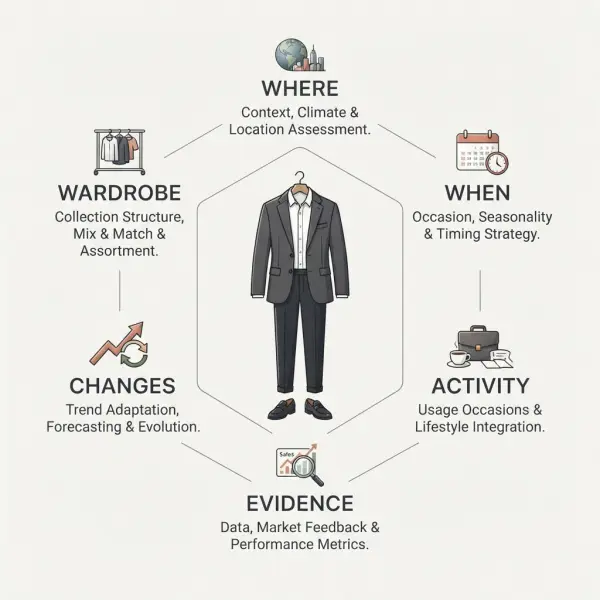
Fashion businesses can approach wardrobe planning through six connected questions.
|
Question |
What the Team Should Determine |
Product Implication |
|
Where? |
Climate, regional weather, indoor conditions |
Fabric weight and protection |
|
When? |
Season and time-of-day variation |
Layering and adjustability |
|
What activity? |
Commuting, work, travel, leisure |
Mobility and thermal requirements |
|
What changes? |
Rain, wind, temperature, indoor transitions |
Modular garment combinations |
|
What wardrobe? |
Products the customer already owns |
Styling and layer compatibility |
|
What evidence? |
Testing, customer data, sales signals |
Credible claims and assortment decisions |
The framework deliberately moves beyond a single garment.
Weather-ready product development matters, but the customer ultimately experiences an outfit and a wardrobe. The jacket interacts with the knit beneath it. The trouser interacts with footwear. A dress may need an outer layer that preserves its silhouette.
This makes wardrobe design partly a systems problem.
Common Mistakes in Climate-Responsive Wardrobe Planning
Mistake 1: Designing From Average Temperature Alone
Monthly averages can hide rain, humidity, wind, daytime variation, and extreme conditions.
A wardrobe designed only around temperature risks missing the conditions that actually create discomfort. A 25°C humid rainy day presents a different apparel problem from a dry 25°C afternoon.
Brands should define the complete environmental scenario instead of using temperature as the only climate variable.
Mistake 2: Assuming Everyone in the Same Market Has the Same Climate Exposure
Office workers, delivery riders, students, tourists, commuters, outdoor workers, and remote workers can encounter dramatically different conditions.
Customer segmentation should therefore include lifestyle and movement patterns where those differences materially affect the product.
Mistake 3: Confusing Fiber Names With Guaranteed Comfort
Cotton, linen, wool, polyester, nylon, viscose, and other fibers can each appear in fabric constructions with very different weights, densities, finishes, and performance.
Fiber content is useful information, but it should not replace evaluation of the actual fabric and garment.
Mistake 4: Using “All-Season” Without Defining the Conditions
A garment can work across several seasons in one region and only one season in another.
“All-season” claims are therefore highly context-dependent.
More useful communication might explain that a garment is designed for layering, moderate temperatures, travel, or transitional conditions rather than implying universal climatic suitability.
Mistake 5: Treating Climate Adaptation as a Trend
The current visual popularity of technical jackets may rise and fall, but heat, rain, wind, cold, humidity, and indoor climate are functional realities.
Brands should distinguish the enduring environmental problem from the aesthetic trend used to solve it.
Mistake 6: Building Layers That Do Not Work Together
An outer jacket may be theoretically versatile yet too narrow to fit over the brand's own knitwear.
This type of mismatch is avoidable.
Collection fittings should test intended combinations, not only garments individually.
What Fashion Businesses Should Verify Before Acting
Climate-responsive product planning works best when evidence comes from several directions.
Brands should examine their target region rather than relying on generalized global climate narratives. Global warming data provides important context, but a worldwide average cannot specify how much rainwear, knitwear, or outerwear a particular store should order.
Customer behaviour matters just as much.
Returns can reveal overheating, restrictive layering, unexpected transparency, or unsuitable fabric weight. Reviews may expose problems that do not appear during sample approval. Store teams can identify which outer layers customers remove immediately after entering a building.
Technical evidence also deserves careful interpretation.
ISO 11092 measures thermal and water-vapour resistance under controlled conditions but explicitly does not claim to recreate specific comfort situations.
That is an excellent general rule for fashion teams: measurements describe properties; customers experience systems.
Product decisions should connect the two.
Frequently Asked Questions
How does climate influence what people wear?
Climate establishes the recurring environmental conditions a wardrobe needs to handle, including temperature, humidity, precipitation, wind, and seasonal variation.
However, climate does not determine clothing by itself. Work environment, activity, transportation, culture, dress codes, access to heating or air conditioning, and personal preference also shape wardrobe choices.
For fashion businesses, climate is therefore most useful as one layer of customer understanding. Product teams should combine regional conditions with real use cases rather than assuming that everyone living in a warm, cold, or rainy region needs the same clothing.
What is a climate-responsive wardrobe?
A climate-responsive wardrobe is a group of garments that can be combined or adjusted to suit the environmental conditions the wearer commonly experiences.
It might include breathable core garments, removable mid-layers, lightweight outerwear, rain protection, or insulation depending on the market.
The objective is not to prepare for every possible weather event. It is to create enough flexibility for realistic changes in temperature, rain, wind, activity, and indoor environment.
For brands, the concept is especially useful when it informs garment compatibility and assortment planning rather than becoming only a marketing phrase.
Does climate change mean fashion seasons are disappearing?
No. Fashion seasons and climatic seasons still matter, although their relevance varies by region and product category.
WMO confirms a clear long-term global warming trend, with 2015–2025 representing the 11 warmest years in its record. That does not mean every region is warming identically or that cold seasons no longer occur.
Fashion companies should therefore avoid translating global climate statistics directly into local inventory decisions. Historical sales, regional climate, recent weather patterns, customer behaviour, and category-specific evidence remain necessary for assortment planning.
What clothing works best in hot weather?
No single garment or fiber is universally best.
WHO recommends light and loose-fitting clothing during hot conditions, while the Met Office similarly advises lightweight, loose-fitting clothing and breathable materials.
Within fashion design, the final performance also depends on fabric weight, structure, garment fit, moisture behaviour, color, sun exposure, and activity.
Brands should therefore evaluate actual fabrics and complete garments rather than assuming that a fiber label alone guarantees warm-weather comfort.
Is layering useful in warm climates?
Yes, although the purpose differs from cold-weather layering.
In warm regions, the main outfit may remain lightweight while an additional layer handles air conditioning, rain, wind, sun exposure, or cooler evenings.
The layer itself needs to be proportionate to the problem. A thin overshirt or compact jacket may be more useful than substantial insulation.
This is why layering should be understood as adjustability, not simply adding warmth. The same wardrobe principle can serve very different climates when the garments are appropriate to local conditions.
Are transseasonal clothes better for fashion businesses?
They can be commercially useful because garments that work across broader temperature ranges may have longer selling windows and more styling applications.
But transseasonal design is not automatically commercially superior.
A region with severe winter conditions still requires genuine cold-weather products. Highly seasonal categories can also generate strong demand when the selling window is clear.
The business value depends on climate, assortment architecture, inventory depth, price point, and customer behaviour. Brands should treat transseasonality as one product strategy rather than a universal replacement for seasonal planning.
Can one wardrobe work in every climate?
Not realistically.
Some garments can travel across many conditions through layering, but climatic extremes create fundamentally different requirements. Tropical humidity, heavy rain, dry desert heat, freezing temperatures, and snow cannot all be handled equally well by one small set of identical products.
A more realistic goal is portability between adjacent conditions.
For example, a modular wardrobe may adapt successfully between warm and mildly cool weather, or between dry and intermittent rainy conditions, while specialist garments handle the extremes.
What data should fashion brands use for climate-responsive assortment planning?
Brands should combine several types of evidence rather than relying on one dataset.
Useful inputs include regional climate patterns, recent weather observations, historical product sales, markdown rates, returns, customer reviews, local store feedback, ecommerce location data, and performance by product category.
The key is separating short-term weather noise from repeated commercial patterns.
Global climate reports can establish long-term environmental context, but they are not a substitute for local merchandising data. The strongest assortment decisions connect climate information with evidence of how customers actually buy and wear clothing.
Conclusion
Modern wardrobes are shaped by a basic reality: people move between environments faster than traditional clothing categories imply.
A customer may experience heat, air conditioning, wind, rain, physical activity, public transport, and changing temperatures within the same day. Clothing has to function across those transitions while still meeting expectations around appearance, comfort, cost, care, and social context.
The response does not have to be increasingly technical clothing.
Often, the more useful strategy is better wardrobe architecture: breathable or appropriate core garments, compatible layers, selective weather protection, flexible silhouettes, and products that can be added or removed without disrupting the entire outfit.
Climate adds urgency to that thinking but should be interpreted carefully. WMO data confirms that recent years sit within an unprecedented period of global warmth, while local climates and individual weather remain highly variable.
For fashion businesses, that means the strongest response is not attempting to predict every weather event or abandoning seasons altogether.
<p class="Norm





Comments 0
Leave a CommentSend Comment
Anda harus Login terlebih dahulu untuk dapat memberikan komentar.