
Private Label Fashion Explained for Retailers and Entrepreneurs
Private label fashion allows a retailer or entrepreneur to sell apparel under a brand they control while outsourcing some or all of the manufacturing to external suppliers. The business owns the customer-facing identity and usually makes decisions about product positioning, specifications, branding, packaging, assortment, and sales, while a factory or manufacturing partner handles production according to the agreed scope.
That distinction matters. A private label business is not simply buying generic clothing and reselling it unchanged, but it also does not require the brand owner to build or own a garment factory. Between those two extremes sits a broad range of operating models, from lightly customized supplier-developed garments to products built around detailed specifications, exclusive fabrics, custom fits, trims, packaging, and quality standards.
For retailers, the attraction is greater control over what customers see and buy. For entrepreneurs, it can provide a practical path into fashion product ownership without assuming the fixed cost and operational complexity of running manufacturing facilities. The trade-off is that outsourced production does not remove responsibility. Product development, sourcing discipline, quality control, inventory decisions, compliance, and supplier management become central capabilities.
Quick Answer: What Is Private Label Fashion?
Private label fashion is a business model in which apparel, accessories, or related fashion products are manufactured by an external supplier but sold under a retailer's or entrepreneur's own brand. The brand owner typically controls the commercial identity of the product and may determine specifications such as design details, fabrics, colors, sizing, labels, packaging, quality requirements, and target price.
The level of customization can vary substantially. Some private label programs start with an existing manufacturer's style that is modified with different colors, labels, trims, or packaging. Others involve more extensive product development based on specifications created specifically for the brand.
Private label therefore sits between simple resale and vertically integrated manufacturing. The company can behave as a product brand without owning sewing lines, dyeing facilities, or factories, but it must still coordinate suppliers, approve samples, establish quality expectations, plan inventory, and comply with the regulations of the markets where products are sold.
For retailers, private label can also become part of a broader brand and assortment strategy rather than merely a lower-priced alternative to third-party brands. Broader retail research has increasingly emphasized differentiation, product development, sourcing, and brand building as important private-brand capabilities.

How Does the Private Label Fashion Model Work?
A private label fashion business separates brand ownership from physical manufacturing. The retailer or entrepreneur creates the market proposition and controls the customer relationship, while one or more suppliers provide production capabilities. Exactly where responsibility changes hands depends on the agreement between the brand and the manufacturer.
At one end of the spectrum, a supplier may already have developed a basic T-shirt, blouse, leggings, handbag, or other product. The buyer chooses from available fabrics or colors, adds branded labels and packaging, and places an order. This model can shorten product development but limits differentiation because other buyers may have access to similar constructions.
At the other end, the fashion business develops a detailed product concept and gives the supplier specifications covering measurements, construction, fabric, trims, finishing, labels, packaging, testing requirements, and acceptable tolerances. The manufacturing partner then samples and produces the garment. This requires stronger product-development capability but gives the brand more control over the resulting product.
Most real private label operations sit somewhere between these two models.
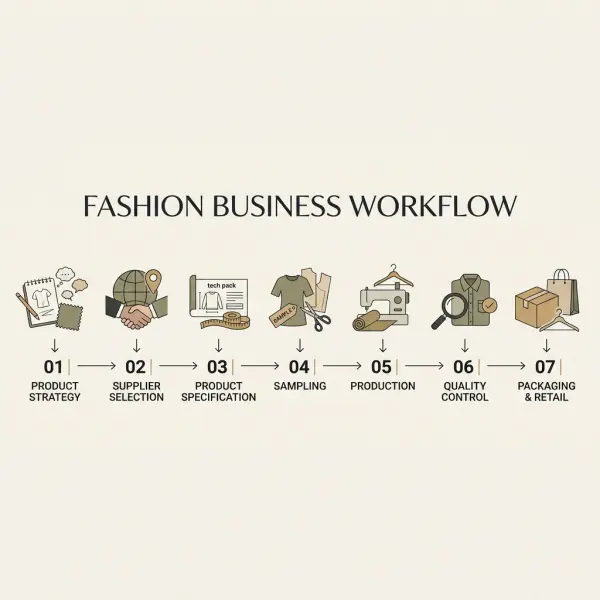
A Typical Private Label Workflow
The workflow commonly moves through several commercial and production stages:
- Market and assortment planning: The business identifies the customer segment, product category, price architecture, competitive context, and intended role of the product.
- Supplier selection: Potential manufacturers are evaluated for capability, minimum order quantity, product specialization, capacity, quality systems, lead time, location, and commercial terms.
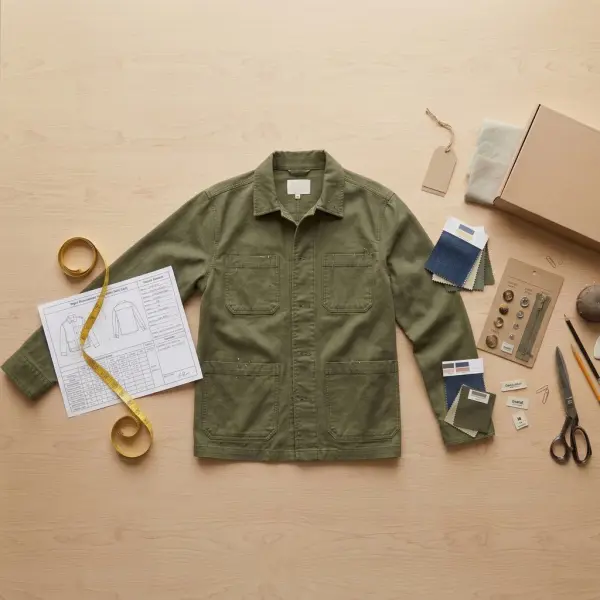
- Product specification: The brand defines the garment, materials, colors, measurements, trims, labels, packaging, and quality expectations to the level required by the chosen manufacturing model.
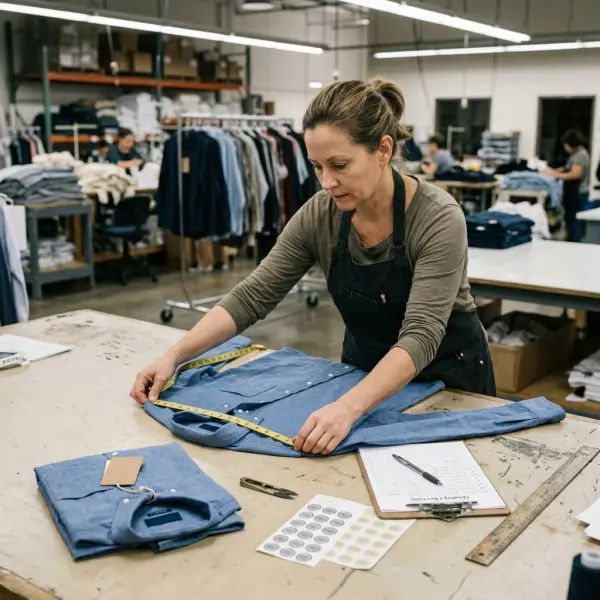
- Sampling and approval: Samples are reviewed for fit, construction, appearance, materials, workmanship, and other requirements before bulk production.
- Commercial confirmation: Pricing, quantities, delivery terms, payment conditions, and production timelines are finalized.
- Bulk production and quality control: The manufacturer produces the order while the buyer or appointed quality team monitors conformance to approved standards.
- Packaging, logistics, and retail: Finished products are labeled, packed, transported, received into inventory, and sold through the brand's channels.
This workflow looks straightforward on paper, yet most operational problems appear between these stages rather than inside them. A sample can be approved but production fabric may differ from the sampled fabric. A price may look attractive until freight, duties, inspection, rejected units, packaging, payment fees, and markdown risk are included. Private label management therefore depends heavily on documentation and disciplined handoffs.
Businesses building this supplier infrastructure can benefit from treating fashion vendor management as a core operating function rather than a purchasing task.
Private Label Does Not Mean the Brand Has to Own a Factory
One of the most useful distinctions for new fashion entrepreneurs is that product ownership and factory ownership are different things. A private label company can control the brand, product concept, customer experience, pricing, distribution, and much of the specification while contracting manufacturing to another company.
This is normal across many consumer-product supply chains. Manufacturing requires a different set of assets and capabilities from brand building: production equipment, trained operators, production planning, industrial engineering, maintenance, compliance systems, material handling, quality processes, and capacity utilization all create operational demands that a young brand may not be prepared to manage.
Outsourcing those activities allows the fashion business to concentrate resources on areas closer to the market. That may include merchandising, design, customer acquisition, retail, content, e-commerce, assortment planning, and demand analysis. It also makes it possible to switch or diversify manufacturing partners as the product portfolio evolves, although changing suppliers can create new sampling, quality, cost, and lead-time risks.
The deeper question of how a company establishes recognizable products while using outside manufacturers deserves separate treatment. See how private label brands build product identity without owning factories for the product-identity side of this model.

What Does the Brand Actually Control?
The phrase "private label" can make outsourced manufacturing sound passive. In a well-managed program, it is not. The competitive value comes from deciding which product variables the brand needs to control and then creating a sourcing system capable of reproducing them consistently.
For a basic product, the retailer may only specify the color, size range, label, and packaging. A more differentiated fashion brand may control substantially more, including garment block, measurements, fabric specifications, surface design, trim selection, stitching details, finishing, garment wash, tolerances, presentation, and inspection criteria.
The practical levels of control can be viewed this way:
|
Area |
Possible Brand Control |
Operational Implication |
|
Brand identity |
Brand name, labels, hangtags, packaging, visual language |
Requires consistent artwork, specifications, and supplier execution |
|
Product design |
Silhouette, detailing, construction, dimensions |
Requires stronger technical communication and sampling |
|
Materials |
Fabric composition, weight, color, finish, trims |
Requires sourcing verification and material approval |
|
Fit |
Measurement chart, grading, tolerances |
Requires fit testing and consistent production control |
|
Quality |
Workmanship standards and inspection criteria |
Requires measurable acceptance requirements |
|
Assortment |
Categories, colors, sizes, drops, price points |
Creates inventory and demand-planning responsibilities |
|
Customer experience |
Product copy, retail presentation, after-sales policy |
Remains primarily under the brand's control |
Greater control can create stronger differentiation, but it also creates more work. Every specification becomes something that must be communicated, sampled, approved, measured, and reproduced during production.
Why Do Retailers and Entrepreneurs Use Private Label?
The strongest reason to pursue private label is usually control over the offer, not simply the possibility of buying products cheaply. A retailer selling only widely distributed third-party products is often competing with other sellers carrying the same or very similar merchandise. A proprietary assortment can create products, price points, fits, colors, packaging, or combinations that customers cannot compare as directly across competing stores.
Broader private-brand research supports this shift from viewing private label purely as a low-price tool toward treating it as a more deliberate merchandising and brand-building capability. McKinsey, for example, identifies merchandising and brand building, insights-led product development, and sourcing as major capabilities behind stronger private-brand programs. Fashion businesses should apply that logic carefully because apparel carries its own fit, material, seasonality, and inventory complexities. McKinsey analysis of private-brand strategy
Product Differentiation
Private label gives the business an opportunity to decide what should be different. For a workwear retailer, that might be pocket placement and durability specifications. A modest-fashion business might concentrate on opacity, sleeve proportions, garment length, drape, and coordinated color families. An activewear brand might prioritize stretch recovery, seam placement, fit, and sweat-management characteristics appropriate to the product.
None of those features becomes distinctive merely because a private label is sewn into the garment. Differentiation comes from product decisions that customers can recognize and that suppliers can reproduce consistently.
More Control Over Pricing Architecture
Selling proprietary products can give retailers greater freedom to establish their own price architecture because there is no identical branded SKU being offered by numerous competing retailers. This does not automatically mean higher margins. Manufacturing cost, minimum order quantities, freight, duties, quality failures, inventory holding, returns, markdowns, marketing, and fulfillment all influence the final economics.
For that reason, entrepreneurs should evaluate private label through fashion unit economics, not by comparing factory cost with retail price alone.
Stronger Assortment Control
A retailer can use private label to fill gaps that external brands do not serve well. This might mean an extended size range, a particular fit profile, coordinated wardrobe essentials, climate-specific apparel, uniforms for a defined occupation, or price points missing from the existing assortment.
That creates a useful feedback loop. Retailers close to customers may observe recurring complaints, requests, return reasons, or size gaps and translate them into product requirements. The advantage depends on whether the organization can turn that insight into reliable products rather than simply increasing the number of SKUs.
Customer-Facing Brand Equity
When customers associate a garment with the retailer's own brand, positive product experiences can accumulate around that identity. Fit consistency, recognizable fabrics, reliable sizing, packaging, service, and visual direction may eventually become part of what customers expect from the label.
This takes repetition. A single customized product is not yet a strong private brand. Brand equity develops when product and commercial decisions remain coherent across multiple buying cycles.
What Private Label Fashion Does Not Automatically Provide
Private label is sometimes marketed as though changing the neck label turns an ordinary garment into a defensible brand. That is too simplistic.
A supplier can make production accessible, but it cannot automatically provide customer demand, distinctive positioning, profitable inventory, or brand loyalty. If the same base garment is offered to many buyers with only different labels, the business may still be competing mainly through advertising and price.
Nor does private label automatically mean exclusivity. A garment may carry your label while its basic pattern, fabric, or construction remains available to other customers of the supplier. Businesses requiring exclusivity should determine exactly what is protected contractually—design, artwork, molds, patterns, fabrics, colors, territory, or an entire finished product—and whether the supplier is legally and operationally able to provide that exclusivity.
Private label should therefore be understood as an operating model, not proof of product uniqueness.
Private Label Fashion vs Manufacturing Your Own Products
Owning a fashion brand and owning a manufacturing facility solve different business problems. A vertically integrated business may operate its own production because control, speed, specialist processes, capacity economics, confidentiality, or supply reliability justify the investment. A private label business purchases that manufacturing capability from external partners instead.
The outsourced approach reduces the need to establish production infrastructure, but some costs are replaced rather than eliminated. Supplier qualification, sampling, inspections, communication, production follow-up, logistics, and quality failures all consume management resources. Brands using overseas manufacturing may also face longer replenishment cycles and greater working-capital exposure depending on order quantities and payment arrangements.
For many new entrants, the more useful question is therefore not "Should I own a factory?" but "Which capabilities should remain inside the business, and which can a specialist supplier perform more efficiently?"

What Are the Main Risks of a Private Label Fashion Business?
The private label model shifts manufacturing execution outside the company, but commercial risk remains with the brand. In some cases, outsourcing makes the risk less visible because the machinery and factory floor are somewhere else while the financial consequences still arrive in the retailer's inventory.
Inventory Risk
Factories normally require commercially viable production quantities, and materials may carry their own minimum order quantities. A brand can therefore be forced to commit money before knowing exactly how quickly products will sell.
This is especially significant in apparel because demand is divided across style, color, and size. One style may perform well overall while certain sizes or colors become dead stock. Order planning should therefore consider SKU-level demand rather than simply total unit volume.
Quality Inconsistency
An approved sample demonstrates what a supplier can make under the sampling conditions; it does not guarantee that every bulk unit will match it. Fabric variation, cutting, operator consistency, finishing, measurement control, subcontracting, or production pressure can affect bulk quality.
The practical response is not to rely solely on verbal expectations. Important dimensions, materials, workmanship requirements, defects, packaging conditions, and inspection criteria should be documented in a form appropriate to the complexity of the product.
Supplier Dependency
A good manufacturer may become strategically important very quickly. If one factory controls the pattern knowledge, material sourcing, specialized process, or most of the production capacity behind a bestseller, disruption at that supplier can become a brand-level problem.
Diversification can reduce concentration risk, but duplicating production across factories also requires additional sampling, quality alignment, material control, and sometimes higher volumes. Supplier diversification is therefore a risk-management decision rather than an automatic solution.
Cash-Flow Pressure
Private label typically introduces a gap between spending and receiving customer revenue. Deposits may be required before production, balances before shipment, and freight or import charges before products enter saleable inventory. Unsold stock can keep capital tied up for months.
The operating model should therefore be designed around cash conversion as carefully as around gross margin.
Compliance and Labeling Responsibility
A supplier's willingness to manufacture a garment does not establish that the product complies with every market where the brand intends to sell it. Requirements vary by jurisdiction and product category, so businesses should determine which party is legally responsible for labeling, product safety, documentation, testing, traceability, and import obligations in each target market.
In the United States, for example, the Federal Trade Commission states that most textile and wool products require information including fiber content, country of origin, and identification of the manufacturer or another responsible business. Its Care Labeling Rule also requires manufacturers and importers of covered apparel to provide appropriate care instructions. FTC apparel and textile labeling guidance
The European Union has its own framework. Textile products marketed to EU consumers generally need textile-fibre composition information, with requirements governing how that information is presented; language requirements can also depend on the countries where the products are made available. These examples illustrate why private label businesses should verify market-specific rules rather than copy a supplier's existing label. EU textile labelling guidance
How Can a Small Fashion Business Start Private Label More Carefully?
The strongest starting point is usually one clearly defined customer problem and a manageable product scope. Launching ten poorly understood categories creates more complexity than learning deeply from one or two products.
A retailer that already sells third-party products has an advantage: sales data, customer questions, returns, and store observations may reveal where the assortment is weak. A new entrepreneur without that evidence needs other ways to validate demand, such as customer interviews, small-scale testing, competitor analysis, preorder experiments where appropriate, or initial quantities that match the business's risk capacity.
Before asking manufacturers for quotations, the business should establish a clear commercial brief covering the customer, intended retail price, product requirements, quality level, approximate quantity, size range, and desired delivery timing. Otherwise, factory prices from different suppliers may represent substantially different products and become difficult to compare.
A practical sequence is:
- Begin with a narrow category whose construction and customer use case you can understand.
- Define a target customer and product proposition before selecting a manufacturer.
- Decide which attributes must be proprietary or tightly controlled and which can use existing supplier options.
- Obtain and compare samples rather than buying purely from quotations or photographs.
- Clarify minimum order quantities at both garment and material level.
- Calculate landed and operating costs rather than factory price alone.
- Establish measurable quality requirements before bulk production.
- Verify labeling, testing, import, safety, and consumer-information obligations for the intended sales markets.
- Plan the reorder decision before the first order arrives, including the lead time required for replenishment.
The goal of an initial private label collection should not be maximum assortment breadth. It should be to learn whether the business can repeatedly turn a customer need into a product that can be sourced, sold, replenished, and supported at viable economics.
Choosing the Right Type of Private Label Supplier
Not every garment factory is suitable for every brand. A technically capable high-volume manufacturer may be commercially impractical for a startup with small orders, while a flexible small workshop may not have the systems or capacity needed by a retailer preparing national expansion.
Product specialization is usually more important than a long catalogue. A factory experienced in woven shirts may not be the right partner for seamless activewear, tailored jackets, technical outerwear, lingerie, or highly washed denim. Machinery, operator skills, pattern knowledge, finishing capability, material relationships, and quality controls differ by category.
During supplier evaluation, fashion businesses should examine more than price:
- Product-category experience and relevant machinery
- Realistic minimum order quantities
- Sampling capability and development lead time
- Fabric and trim sourcing options
- Production capacity and peak-season constraints
- Quality-control process
- Communication and change-management discipline
- Use of subcontractors
- Commercial terms and payment structure
- Export, documentation, or market-specific experience where relevant
- Willingness to document specifications and approved standards
A supplier claiming it can make "anything" is not necessarily more useful than one that clearly explains what it does well and where its limitations are.
Private Label and Reselling Are Not the Same Business Model
Both models allow a company to sell fashion products without owning a factory, which is why they are often confused. The central distinction is how much ownership and control the seller has over the product and brand proposition.
A reseller primarily buys finished products that already exist and earns revenue by distributing or merchandising them. A private label business sells products under an identity it controls and usually has at least some influence over labeling, specification, packaging, or product development.
The boundary can become less clear when wholesalers offer ready-made garments that buyers can relabel. That may technically create a private-label product from the consumer's perspective, but its commercial characteristics remain closer to wholesale resale if there is little product differentiation.
A detailed decision framework belongs in the cluster article Private Label vs Reseller Fashion Business: Key Differences.
Common Private Label Fashion Mistakes
Choosing the Product After Choosing the Factory
A low quotation or attractive supplier catalogue can tempt an entrepreneur to build the business around whatever a manufacturer happens to offer. The result is often an assortment shaped by supplier convenience instead of customer need. A more robust sequence starts with positioning and product requirements, then searches for manufacturing capabilities that fit them.
Treating the Sample as the Entire Quality System
A polished development sample can create false confidence. Bulk production introduces different quantities, workers, material lots, timelines, and process conditions. The approved sample should function as one reference inside a broader quality system that includes specifications, tolerances, inspection points, defect definitions, and procedures for handling non-conforming goods.
Comparing Suppliers Only by Unit Price
A factory quoting $1 less per garment is not necessarily the lower-cost choice if it requires larger quantities, produces more defects, uses slower logistics, offers weaker payment terms, or creates higher markdown exposure. Supplier economics should be evaluated in relation to landed cost, inventory commitment, quality, lead time, and the commercial value of the final product.
Assuming a Custom Label Creates a Brand
Replacing a manufacturer's label with your own creates branded merchandise, but brand value requires considerably more. Customers need reasons to recognize and prefer the product: fit, styling, quality, value, service, availability, storytelling, specialist functionality, or some combination that remains consistent over time.
Expanding the SKU Count Too Quickly
Each new style multiplied by colors and sizes adds inventory decisions. A collection of eight styles in four colors and five sizes already represents 160 SKU combinations before any depth of inventory is considered. Small brands can therefore become operationally complex long before they appear large from the outside.
Leaving Compliance Until Production Is Finished
Labels, fiber declarations, care information, warnings, testing, documentation, and import requirements can affect product specifications and packaging. Discovering an obligation after thousands of units have already been produced can require relabeling, retesting, delayed shipments, or other corrective work. Market-specific requirements should be incorporated into product development, not treated as a final shipping task.
What Brands Should Verify Before Acting
Private label is not a standardized legal category with one identical operating model across all markets. Supplier terminology also varies. One manufacturer may call an existing blank garment with a custom label "private label," while another uses the term for a fully developed custom collection.
Before signing a purchase order, brands should verify what the commercial arrangement actually includes: design ownership, pattern ownership, material specifications, exclusivity, intellectual-property rights, tooling, labeling, testing, quality criteria, subcontracting, production tolerances, defective-goods procedures, payment terms, delivery obligations, and responsibility for regulatory documentation.
Businesses selling internationally should be particularly careful about assuming that a product accepted in one market is automatically compliant elsewhere. The U.S. and EU examples above already show differences in textile labeling frameworks, and additional product-safety, chemical, import, environmental, or consumer-information requirements may apply depending on the product and jurisdiction. Legal and compliance advice should therefore be obtained for the markets and categories involved rather than inferred from a generic private-label checklist.
A Practical Decision Framework for Retailers and Entrepreneurs
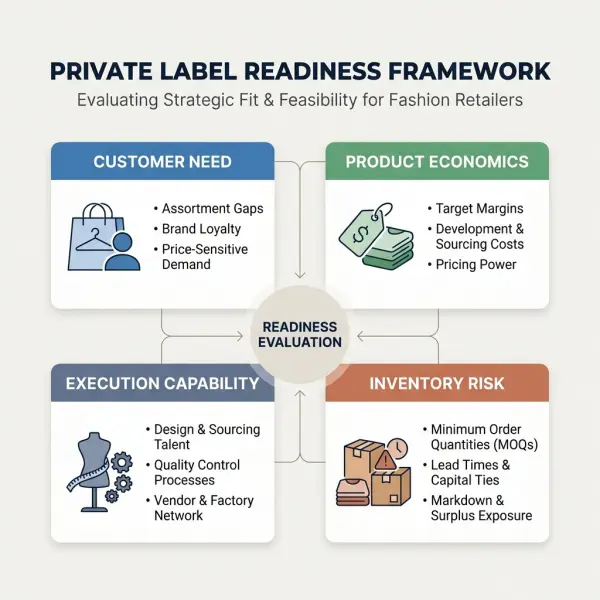
Private label tends to make more strategic sense when the business has identified a customer need that cannot be served as effectively through ordinary resale and is prepared to manage product and inventory responsibility.
Before moving forward, decision-makers can ask four questions.
First, is there a reason for this product to exist under our brand? A clear answer might involve fit, price-value positioning, functionality, styling, quality consistency, category expertise, or a gap in the current assortment. "We found a factory" is not a customer proposition.
Second, do we understand the economics beyond the factory quotation? The model should include sampling, labels, packaging, quality control, payment charges, freight, duties or taxes where applicable, warehousing, fulfillment, returns, expected markdowns, and unsold inventory.
Third, can we manage product execution? Someone must own specifications, supplier communication, approvals, quality decisions, and production schedules. Outsourcing manufacturing does not outsource these decisions automatically.
Fourth, can the business absorb a mistake? Initial orders contain uncertainty. A company whose survival depends on selling every unit of an untested product at full price is taking a very different risk from a retailer testing a small proprietary extension to an established category.
Private label is strongest when those questions lead to an operating model rather than simply a logo on a garment.
Frequently Asked Questions About Private Label Fashion
Is private label fashion the same as white label clothing?
Not always. The terms are sometimes used interchangeably by suppliers, so buyers should verify what each manufacturer means. In common commercial usage, white label often describes a largely standardized product that multiple sellers can brand as their own, while private label may involve greater buyer-specific control over specifications, colors, materials, fit, trims, or packaging. This distinction is not universal, however. The purchase agreement and actual product-development process matter more than the terminology used on a supplier's website.
Do I need to design clothing from scratch to start a private label?
No. Private label can begin with an existing supplier-developed product and limited customization such as color, branding, labels, trims, or packaging. More differentiated brands may progressively move toward custom specifications, proprietary patterns, fabrics, or construction details. The appropriate level depends on the brand proposition, technical capability, budget, quantities, and supplier. Greater customization normally increases development work and may increase minimum-order or material commitments.
Can a small retailer launch a private label?
Yes, if it can find a manufacturing arrangement compatible with its quantities and has enough capital and operational capacity to manage development and inventory. The main constraint is often not company size but order economics. Small brands should pay particular attention to minimum order quantities, sample costs, material minimums, replenishment lead time, size-level inventory, and cash flow. Starting with fewer SKUs can make it easier to learn before increasing assortment complexity.
Is private label automatically more profitable than reselling established brands?
No. Private label may provide more control over pricing and product cost, but profitability depends on the whole economic model. Development expenses, manufacturing quantities, quality failures, freight, import costs, inventory holding, customer acquisition, returns, fulfillment, and markdowns can absorb apparent gross-margin advantages. Established third-party brands may also bring their own demand and recognition. Businesses should compare contribution economics and inventory risk rather than assuming proprietary products produce higher profit.
Who is responsible for quality when an external factory makes the product?
Responsibility is shared operationally but must be defined contractually and commercially. The manufacturer is expected to produce according to agreed requirements, while the buyer needs to communicate those requirements clearly and establish appropriate approval and inspection procedures. If a brand does not define measurements, materials, tolerances, workmanship, or defect criteria, disagreements become more likely. Ultimately, customers usually hold the selling brand or retailer accountable for the product experience regardless of where production occurred.
Can a private label manufacturer sell the same product to other brands?
Possibly. A private label does not automatically create product exclusivity. If the brand starts from a supplier's existing style, that supplier may sell the same or a similar product to other buyers unless contractual restrictions say otherwise. Businesses seeking exclusivity should clarify what is exclusive, for how long, in which territories or channels, and which design assets or specifications belong to each party. Intellectual-property arrangements should be documented rather than assumed.
How much should a private label brand customize its first collection?
Enough to support a clear product proposition, but not necessarily every possible detail. New businesses can create unnecessary cost by customizing elements customers do not value while overlooking fundamentals such as fit, material quality, sizing, lead time, and inventory. The most useful approach is to identify the few characteristics that materially support the target customer's needs and control those carefully. More customization can be added when sales evidence justifies additional development complexity.
Conclusion
Private label fashion gives retailers and entrepreneurs a way to become product owners without becoming factory operators. That separation can make fashion brand development more accessible, but it should not be confused with an effortless sourcing model. The business still needs to decide what the product should be, who it serves, how it should perform, what it should cost, how much inventory to hold, and whether suppliers can reproduce the agreed standard.
The strongest private label businesses treat manufacturers as part of an operating system rather than as catalogues of products waiting for a logo. Product specifications, supplier relationships, quality control, unit economics, compliance, inventory planning, and customer insight all influence whether a proprietary assortment becomes an advantage or another source of unsold stock.
For retailers already close to their customers, private label can turn real assortment gaps into distinctive products. For entrepreneurs, it can provide a credible route into fashion ownership without the capital burden of establishing manufacturing infrastructure. In both cases, the strategic value comes from controlling the right decisions—not from owning every stage of production.





Comments 0
Leave a CommentSend Comment
Anda harus Login terlebih dahulu untuk dapat memberikan komentar.