

Fashion Unit Economics Explained for Small Apparel Brands
Quick Answer
Fashion unit economics is a management framework for understanding how much economic value a fashion business creates—or loses—each time it sells a product, fulfills an order, or acquires a customer. For a small apparel brand, the analysis normally starts with the revenue actually realized from a sale and then considers the product cost and other costs that change with that transaction, such as payment fees, fulfillment, shipping subsidies, marketplace commissions, and the economic impact of returns.
The purpose is not simply to prove that a garment is sold above its manufacturing cost. A T-shirt can have an attractive markup over factory cost and still generate weak economics once discounts, fulfillment, customer acquisition, and returns are considered.
A useful unit economics model therefore separates product margin, contribution margin, customer acquisition economics, and fixed operating costs rather than combining everything into one percentage. Contribution margin, for example, is generally calculated as revenue minus variable costs and represents the amount available to cover fixed expenses and ultimately generate operating profit.
For small apparel brands, this framework is particularly useful when deciding what to price, which products to reorder, how aggressively to discount, which sales channels to prioritize, and whether increasing sales volume is actually improving the business.

What Is Fashion Unit Economics?
Fashion unit economics is the analysis of the revenue and economically relevant costs associated with a defined unit of a fashion business, such as one garment sold, one customer order, or one acquired customer. Its purpose is to show whether the underlying transaction creates enough margin to support the rest of the business.
The word unit matters because there is no single unit that works for every decision. A merchandising team may want to understand profitability per SKU. An ecommerce manager may care more about contribution per order because shipping and payment fees occur at the order level. A growth team may analyze contribution per newly acquired customer because advertising expenditure is tied to customer acquisition rather than directly to an individual garment.
This makes unit economics more useful as a management framework than as one universal accounting formula. The calculation should be designed around the economic question being asked. A brand deciding whether to reorder a dress needs a different level of analysis from a brand deciding whether it can profitably increase paid advertising.
At its simplest:
Unit economics = economic revenue generated by a unit − economically relevant costs associated with that unit
The difficult part is rarely the subtraction. The difficult part is deciding what should be included, at what level, and without counting the same cost twice.
Why Unit Economics Matters So Much in Fashion
Fashion businesses have several characteristics that can make top-line sales misleading. Products are bought or manufactured before much of the demand is known, assortments often contain numerous sizes and colors, seasonal relevance can shorten selling windows, promotions can reduce realized prices, and unsold inventory may eventually require markdowns.
A brand can therefore experience rising revenue while simultaneously weakening the economics of each sale. Imagine an apparel company that increases sales by running a 25% promotion and doubling paid advertising. Orders may rise dramatically. Yet if the lower selling price, higher customer acquisition cost, and additional fulfillment volume consume most of the available margin, the increase in revenue may contribute far less to operating profit than management expected.
Unit economics gives decision-makers a way to ask a more useful question:
When another unit is sold, what does that sale actually contribute economically to the business?
That question becomes especially important for smaller fashion brands because their cash and inventory capacity are limited. Reordering the wrong SKU, subsidizing shipping too aggressively, or scaling a poorly performing acquisition campaign can consume working capital long before the problem becomes obvious from revenue figures alone.
This relationship also explains why unit economics should be considered alongside fashion cash flow management. A profitable-looking product does not eliminate the need to finance inventory, production deposits, marketing, payroll, and the time gap between spending cash and receiving sales proceeds.
Start With the Right Unit of Analysis
A frequent mistake is asking for “the unit economics” of a fashion business without first defining the unit. Several views can be correct at the same time because they answer different questions.
|
Unit of analysis |
Useful for answering |
Typical metrics |
|
Product / SKU |
Should this product be reordered or repriced? |
Net selling price, product cost, variable cost, contribution per unit |
|
Order |
Is this ecommerce order economically attractive? |
Order revenue, items per order, payment cost, fulfillment, shipping, returns |
|
Customer |
Can the brand acquire customers sustainably? |
Customer acquisition cost, first-order contribution, repeat contribution |
|
Channel |
Where should the brand sell? |
Net channel revenue, commission, fulfillment, promotion, channel contribution |
|
Cohort |
Do customers acquired in a period become more valuable over time? |
CAC, repeat purchase behavior, contribution over time |
For a small apparel business beginning this analysis, product-level and order-level economics usually provide the most actionable starting point. They expose whether the core merchandise generates enough economic room before management moves into more sophisticated customer lifetime value or cohort analysis.
A useful model can later connect these levels rather than forcing them into a single number.

The Basic Building Blocks of Fashion Unit Economics
A practical fashion unit economics model typically moves through several layers. These layers should be kept distinct because each answers a different management question.
1. Realized Revenue
The first number should generally be what the business economically realizes from the transaction, not automatically the original retail price printed on the product tag.
If a jacket has a recommended retail price of $120 but regularly sells with a 20% promotion, treating $120 as the economic revenue per sale will exaggerate the product's performance. The analysis should reflect actual discounts, refunds, and other adjustments consistently with the way the brand structures its model.
For example:
List price: $120
Promotion: $24
Realized selling price before other adjustments: $96
This distinction becomes increasingly important for brands that rely heavily on promotional calendars, discount codes, outlet sales, marketplaces, or seasonal markdowns.
2. Product Cost
The next layer is the economic cost of putting the product into saleable inventory. Depending on the brand's sourcing model, this can include more than the amount shown on a factory quotation.
IAS 2, the IFRS accounting standard for inventories, states that inventory cost includes costs of purchase, costs of conversion, and other costs incurred in bringing inventory to its present location and condition. Costs of purchase can include purchase price, non-recoverable duties, transport, and handling, while manufacturing inventory can also include appropriate production overhead allocations.
For managerial unit economics, a brand may also maintain a separate landed product cost view that captures commercially useful costs such as:
- garment purchase or manufacturing cost;
- packaging that is directly associated with the product;
- inbound freight and applicable import duties;
- product-specific finishing, labeling, or inspection costs; and
- other costs consistently attributable to bringing the unit into sellable inventory.
The exact treatment should be consistent with the company's accounting policy and management purpose. A managerial costing model should not be presented as though it automatically replaces formal inventory accounting.

3. Variable Selling and Fulfillment Costs
A product with a healthy difference between selling price and product cost may still have weaker economics after the transaction is processed.
Depending on the channel and operating model, another sale may trigger costs such as payment processing, pick-and-pack operations, marketplace commissions, sales commissions, outbound shipping paid by the brand, or other transaction-linked expenses.
This is where the distinction between gross margin and contribution margin becomes commercially useful.
Gross margin typically focuses on revenue relative to cost of goods sold. Contribution margin takes another management view by subtracting variable expenses from revenue. OpenStax defines unit contribution margin as the amount by which a product's selling price exceeds its total variable cost per unit; that contribution is then available to cover fixed expenses and, beyond them, profit.
The deeper strategic implications of this metric belong in how contribution margin shapes fashion business decisions. For unit economics, the key point is simply that a gross-margin-positive product is not automatically a strongly contributing product.
4. Returns, Refunds, and Reverse Logistics
Returns create another layer of complexity because the economic result depends on what happens after the merchandise comes back. A returned garment that can immediately be resold at full price has a different economic outcome from a worn, damaged, seasonal, or opened product that must be discounted or written down.
Return handling may also create shipping, inspection, repackaging, customer-service, and payment-related costs. The appropriate treatment varies by business model, so brands should avoid applying one arbitrary “return cost” percentage to every SKU.
The issue is material enough to monitor closely in online retail. The National Retail Federation and Happy Returns estimated that 19.3% of online sales in the United States would be returned in 2025, although that is an overall online-retail figure rather than a global apparel-specific benchmark. Apparel businesses can experience materially different rates depending on fit consistency, product category, price point, customer behavior, geography, and return policy.
The practical lesson is not that every apparel company should assume a particular return rate. It is that unit economics should use the brand's own return behavior whenever reliable data exists.

5. Customer Acquisition Cost
Customer acquisition cost, or CAC, answers a different question from product margin: how much did the business spend to acquire a new customer?
A common ecommerce formula is:
CAC = total customer acquisition spend ÷ number of new customers acquired
The important detail is defining acquisition spend consistently. Marketing costs can extend beyond media spend to creative production, agency fees, software, affiliates, influencers, or other resources involved in acquisition, depending on the management model being used. Shopify's current ecommerce acquisition guidance similarly cautions businesses against calculating CAC from advertising spend alone when other acquisition expenses are significant.
CAC should not simply be inserted into every SKU's economics without understanding the unit mismatch. A customer may buy multiple products in an order, and the same customer may buy repeatedly. Product contribution, order contribution, and customer acquisition economics therefore need to be connected carefully rather than blended indiscriminately.
A Simple Fashion Unit Economics Example
Consider a small direct-to-consumer apparel brand selling a casual dress. The following numbers are illustrative assumptions, not industry benchmarks.
|
Economic item |
Per order |
|
List price |
$80.00 |
|
Average discount |
-$8.00 |
|
Realized product revenue |
$72.00 |
|
Landed product cost |
-$24.00 |
|
Payment processing |
-$2.20 |
|
Pick and pack |
-$3.00 |
|
Shipping subsidy |
-$4.00 |
|
Expected return-related economic allowance |
-$3.80 |
|
Illustrative contribution before acquisition cost |
$35.00 |
The dress appears attractive if the brand looks only at the $80 list price and $24 landed product cost. That comparison suggests a $56 spread. Once the actual discount and variable transaction costs are included, however, the illustrative contribution falls to $35.
That $35 is not the same as net profit. The business still has fixed expenses such as salaries, software subscriptions, studio or office costs, permanent warehouse infrastructure, administrative expenses, and other overhead. Contribution margin exists partly to show how much remains available to support those costs.
Suppose the company then spends an average of $28 to acquire a first-time customer who buys only this dress in the initial transaction. The first-order contribution after acquisition would fall substantially. That does not automatically mean the customer is unprofitable over their entire relationship with the brand; repeat purchases could change the economics. It does mean management should not describe the initial $35 contribution as though acquisition were economically free.
Gross Margin, Contribution Margin, and Profit Are Not the Same Thing
These terms are frequently mixed together in small fashion businesses, which can make product decisions unreliable.
Gross margin generally evaluates revenue after cost of goods sold. Contribution margin looks at revenue after variable costs and expenses relevant to the chosen unit of analysis. Operating profit goes further by considering operating expenses, including fixed costs.
A simplified conceptual sequence looks like this:
Revenue → gross margin → contribution margin → operating profit
The exact financial statement presentation depends on the company's accounting framework, but for internal decision-making the distinction prevents a common error: treating every dollar above factory cost as profit.
A garment could have a 65% gross margin and still produce an unattractive contribution after marketplace commission, fulfillment, shipping subsidy, promotions, and return economics. Conversely, a lower-gross-margin product might have acceptable contribution if it sells organically, has a low return rate, ships efficiently, and encourages customers to purchase multiple items.
For this reason, margin percentages should always be accompanied by a definition of what costs have actually been included.
Unit Economics Changes by Sales Channel
The same garment can produce different economics depending on where it is sold.
A direct-to-consumer ecommerce sale may avoid a wholesale discount but create payment, fulfillment, shipping, returns, and customer acquisition expenses. A marketplace may provide traffic but charge commissions and additional fulfillment or advertising fees. Wholesale may reduce the revenue per unit received by the brand but transfer some retailing activities and inventory risk to the buyer, depending on the commercial arrangement.
That means channel comparisons should use net economics, not selling price alone.
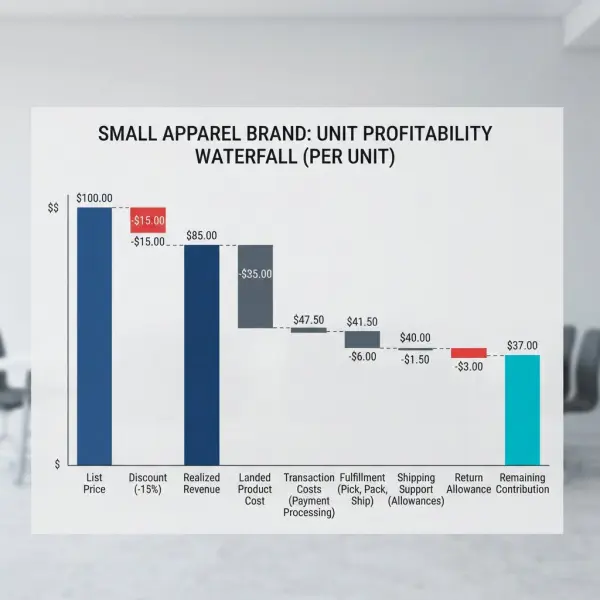
Consider a product with a $100 recommended retail price. A brand may initially assume its own website is automatically the most profitable channel because it receives the retail price directly. That conclusion could change once a 15% promotion, paid acquisition, outbound shipping, and returns are included. At the same time, wholesale revenue should not be judged only by its lower per-unit price if it requires less customer-level acquisition and fulfillment expense.
The correct decision depends on actual channel economics, payment terms, sell-through, return arrangements, inventory ownership, marketing requirements, and strategic value. Unit economics reveals the trade-off; it does not make every distribution decision purely mathematical.
Fashion Inventory Makes Unit Economics More Complicated
A unit economics model based only on sold units can hide what happened to the units that did not sell.
Suppose a brand produces 1,000 shirts for $20 each but sells only 600 near full price. If the remaining 400 later require deep markdowns, the first 600 sales may still appear economically attractive when analyzed in isolation. Yet the collection as a whole may underperform because capital and product cost were committed across all 1,000 units.
This is one reason fashion businesses should connect SKU contribution with sell-through, markdown exposure, inventory aging, and stock depth. IFRS inventory guidance also recognizes that inventory may need to be written down when its cost is no longer recoverable because it is damaged, obsolete, or its selling price has declined. Under IAS 2, inventories are measured at the lower of cost and net realizable value.
Unit economics therefore helps answer “Is each sale economically useful?” while inventory economics asks an adjacent question: “Did the complete buy or production commitment create an acceptable outcome?”
Both matter.
How Unit Economics Shapes Everyday Fashion Decisions
Good unit economics data changes practical decisions across a fashion company.
For product development, it can reveal whether an attractive design has too little pricing room for the required materials and construction. A garment may be technically feasible but commercially difficult at the price customers are expected to accept.
For sourcing, it helps teams evaluate more than the lowest factory quote. A cheaper unit price can be offset by larger minimum order quantities, higher defect rates, expensive freight, or inventory risk. Cost decisions should therefore be evaluated within the full commercial model.
For merchandising, unit economics provides additional context for assortment planning. A high-volume basic with predictable sell-through may play a different economic role from a fashion-forward item with higher unit margin but greater markdown risk.
For marketing, contribution establishes how much economic room exists before acquisition becomes destructive. A campaign that produces a high return on ad spend can still be unattractive if it mainly sells heavily discounted, low-contribution merchandise.
For operations, order economics can make details such as packaging, shipping thresholds, and split shipments financially visible rather than treating them as back-office concerns.
These cross-functional uses are why fashion unit economics should not live only in a finance spreadsheet.

How Small Apparel Brands Can Build a Practical Unit Economics Model
A small brand does not need a complex financial system to begin. It needs consistent definitions and transaction data that can gradually become more detailed.
The most useful first step is to choose one level—usually SKU or order—and reconstruct what economically happens when a sale is made. Start with actual realized revenue, connect it with product cost, then identify significant costs that vary with the transaction. Once that view is reliable, add channel comparisons, return behavior, and acquisition economics.
Brands should also separate known transaction data from modeled assumptions. Payment fees may be precisely observable. Return allowance may initially be estimated. Future markdown exposure may be a scenario rather than a booked cost. Mixing these without labels creates false precision.
A sensible progression is:
- Establish reliable net selling-price data by SKU and channel.
- Build consistent product or landed-cost records.
- Identify major variable selling and fulfillment costs.
- Calculate contribution at product and order level.
- Add actual return behavior when enough data is available.
- Connect customer acquisition cost without confusing customer, order, and SKU economics.
- Compare planned economics with actual results after products have been selling.
- Use the model for pricing, promotion, reorder, channel, and assortment decisions.
The model should become more accurate as operational data improves, not more complicated simply because more spreadsheet columns are possible.
A particularly useful next step is to understand cost per product sold, because weak product-cost data can distort every downstream margin calculation.
Common Unit Economics Mistakes in Small Fashion Brands
Treating Factory Cost as the Complete Cost of a Sale
A factory price is important, but it answers only part of the question. Freight, transaction fees, fulfillment, channel commissions, and other variable selling costs can materially reduce what remains from a sale. The better approach is to preserve factory or purchase cost as its own metric while building additional layers toward landed cost and contribution.
Using List Price Instead of Actual Selling Price
A product may have a $100 retail price while the average customer effectively pays $82 after promotions. Using $100 in the unit economics model overstates economic revenue and can make advertising or sourcing decisions look safer than they are. Brands with frequent promotional activity should monitor realized selling price alongside the headline ticket price.
Calling Gross Margin “Profit”
Gross margin has not yet absorbed every operating cost required to run a fashion company. Describing gross margin as profit can encourage brands to spend aggressively because the amount available for marketing, salaries, software, facilities, and other expenses appears larger than it really is. Management reports should name each margin level precisely.
Ignoring Returns Until They Become a Customer-Service Problem
Returns are not only a service metric. They can alter revenue, logistics costs, inventory availability, markdown exposure, and customer economics. The better solution is not to insert an arbitrary return assumption but to track returns by product, reason, channel, customer type, and condition where the data supports that level of analysis.
Allocating Every Fixed Cost to Every Garment Too Early
Trying to force rent, founders' salaries, software, photography, and every overhead item into a single “true cost per garment” can make incremental product decisions confusing. Fixed costs absolutely matter for overall profitability, but contribution analysis deliberately separates them so management can see what each additional sale contributes toward covering those fixed costs.
Assuming More Sales Automatically Improve Economics
Volume helps only when the additional sales contribute enough value. If growth requires deeper discounts, more expensive acquisition, high return rates, or operational complexity, the incremental economics can deteriorate as revenue rises. This is why unit economics should be reviewed at different levels of volume instead of assuming that current ratios remain unchanged indefinitely.
What Brands Should Verify Before Acting on Unit Economics
Unit economics can create a false sense of precision if definitions are inconsistent. Before using the model for major pricing, inventory, or advertising decisions, a fashion business should verify how discounts, taxes, shipping revenue, returns, marketplace fees, duties, inventory costs, fulfillment costs, and acquisition expenses are being treated.
Cost behavior also deserves attention. A cost is not automatically fixed or variable forever. Warehouse labor, for example, may behave relatively fixed within one operating range and increase when the business crosses a capacity threshold. OpenStax describes this concept as the relevant range: fixed costs can remain stable within a certain activity range but change when production or activity exceeds that range.
Multi-product fashion businesses introduce another complication. Contribution depends on product and sales mix, so a company-level average can conceal large differences between categories or SKUs. OpenStax specifically identifies sales mix as an important consideration in multi-product cost-volume-profit analysis.
Most importantly, management unit economics is not a substitute for statutory financial accounting, tax reporting, or professional accounting advice. Its purpose is decision support. Brands should reconcile management definitions with their formal accounts and local reporting requirements where relevant.
Frequently Asked Questions About Fashion Unit Economics
What is the simplest definition of unit economics for a clothing brand?
Unit economics shows how much economic value remains from a defined unit—usually a garment, order, or customer—after the costs relevant to that unit are considered. For a product-level view, a brand may start with realized selling revenue and subtract product cost plus other variable costs caused by the sale. The result helps management determine whether additional sales are economically useful, although it should not automatically be interpreted as final company profit because fixed operating expenses still need to be covered.
Is unit economics the same as gross margin?
No. Gross margin is one component of unit economics, but a useful unit economics model can go further. Gross margin generally looks at revenue after cost of goods sold, while contribution analysis also considers variable expenses associated with generating or fulfilling the sale. A brand can therefore have an attractive gross margin but a much weaker contribution margin after payment processing, channel fees, fulfillment, shipping support, and other transaction-dependent costs are included.
Should customer acquisition cost be included in product unit economics?
It depends on the question being answered. CAC exists at the customer-acquisition level, while a product is usually analyzed at the SKU level. A newly acquired customer may buy several garments in one order and may purchase again later, so assigning the entire acquisition cost arbitrarily to one SKU can distort product performance. A better approach is usually to calculate product or order contribution first and then connect it with customer-level acquisition economics.
How should fashion brands treat returns in unit economics?
Brands should use their actual return data whenever possible and avoid assuming that every return produces the same loss. Some garments can be inspected, repacked, and resold at full price; others may require markdowns or become unsellable. The economics can include refunded revenue, reverse shipping, handling, payment effects, and loss in resale value, but the calculation must avoid double counting. Return assumptions should also be segmented when products or channels behave differently.
Can a product with lower gross margin still be a good product?
Yes. A lower gross-margin product can still make commercial sense if it sells reliably, requires little discounting, has low return and fulfillment costs, supports larger baskets, or requires relatively little customer acquisition spending. Conversely, a high-gross-margin fashion item may underperform if it requires heavy promotion or experiences high markdown and return exposure. Gross margin should therefore be interpreted alongside sell-through and contribution rather than used as the only measure of product quality.
How often should a small fashion brand review unit economics?
The frequency should match how quickly the inputs change. Fast-moving ecommerce brands may review key order and marketing economics weekly while evaluating full SKU performance monthly or by collection. Smaller seasonal brands may rely more heavily on launch, mid-season, and end-of-season reviews. The important point is to update the model when selling price, discount behavior, freight, supplier cost, return patterns, commissions, fulfillment cost, or customer acquisition economics materially change.
Does positive unit economics guarantee that a fashion brand will be profitable?
No. Positive unit economics means the chosen unit contributes economic value under the costs included in the model. The company can still lose money if total contribution is insufficient to cover fixed operating expenses, financing costs, taxes, inventory losses, or other obligations. A business can also face cash shortages despite positive margins if it must fund production and inventory well before receiving customer cash. Unit economics is therefore an essential decision tool, but not a complete profitability or cash-flow model.
Conclusion
Fashion unit economics gives small apparel brands a clearer view of what lies between a retail price and genuine economic contribution. Its value comes from breaking the transaction into understandable layers: realized revenue, product cost, variable selling and fulfillment expenses, returns, customer acquisition, and ultimately the fixed costs that the resulting contribution must help support.
The strongest model is not necessarily the one with the most variables. It is the one in which every number has a clear definition and corresponds to the business decision being made.
For apparel founders, that distinction changes the conversation. Instead of asking only whether a garment has a good markup, management can ask whether the SKU generates adequate contribution, whether a discount is economically defensible, whether an acquisition campaign has enough margin behind it, whether a marketplace channel produces an acceptable result, and whether a reorder remains attractive after actual sell-through and return behavior are known.
That is the practical role of unit economics: not to reduce fashion to a spreadsheet, but to reveal whether product, pricing, channel, inventory, and growth decisions are working together as an economically sustainable system.





Comments 0
Leave a CommentSend Comment
Anda harus Login terlebih dahulu untuk dapat memberikan komentar.