

Fashion Vendor Management Explained for Apparel Businesses
Quick Answer
Fashion vendor management is the structured process of selecting, onboarding, coordinating, monitoring, developing, and, when necessary, replacing the external suppliers and production partners that help an apparel business bring products to market. These vendors may include fabric mills, textile converters, trims suppliers, garment factories, printing and embroidery facilities, laundries, testing laboratories, packaging companies, logistics providers, and other specialized partners.
Good vendor management goes beyond negotiating the lowest price or maintaining a supplier contact list. It connects product specifications, quality expectations, lead times, purchasing terms, production capacity, communication, traceability, compliance, risk, and performance data into an ongoing management process.
For apparel businesses, this matters because a product can fail commercially even when its design is strong. Late fabric, inconsistent dye lots, unavailable trims, unclear specifications, production bottlenecks, or poorly managed subcontracting can affect delivery, quality, cost, and customer experience. The objective is therefore not to find a “perfect” vendor, but to build a vendor network that can consistently support the brand's product, operating model, risk tolerance, and scale.
What Is Fashion Vendor Management?
Fashion vendor management is a business management process for governing external companies that supply materials, components, manufacturing services, logistics, testing, or other capabilities required to develop and produce apparel products.
The word vendor is used broadly in the fashion industry. A fabric mill may manufacture cloth directly. A converter may source greige fabric and arrange dyeing or finishing. A trims supplier may provide buttons, zippers, labels, elastics, or packaging. A garment factory may cut, sew, finish, pack, or coordinate additional subcontractors. Each relationship involves different technical requirements and operational risks.
Vendor management creates a repeatable structure around those relationships.
At a basic level, it answers several practical questions: Which vendors are approved to supply a particular product or service? What specifications have they agreed to? How are prices and commercial terms documented? What lead times and capacities have been confirmed? How is incoming or finished-product quality evaluated? What happens when a shipment is late or a material fails inspection? Who owns the corrective action?
As an apparel company grows, these questions become difficult to manage through email threads, messaging applications, spreadsheets, and individual employee memory alone.

Vendor Management Is Not the Same as Sourcing or Procurement
The terms sourcing, procurement, and vendor management overlap, but they describe different parts of the commercial relationship.
|
Activity |
Primary Purpose |
Typical Question |
|
Sourcing |
Finding potential supply options |
Who could manufacture this fabric, trim, or garment? |
|
Supplier evaluation |
Determining whether a vendor is suitable |
Can this supplier meet our technical, commercial, capacity, and risk requirements? |
|
Procurement |
Buying goods or services under agreed conditions |
What quantity are we ordering, at what price, and when must it arrive? |
|
Vendor management |
Managing the relationship and performance over time |
Is this vendor continuing to meet our expectations, and what needs to improve? |
In practice, fashion teams frequently move between all four activities. A sourcing manager may discover a factory, evaluate its capability, negotiate commercial conditions, place an initial order, and subsequently monitor performance.
The distinction becomes useful when a company begins scaling. Finding a good supplier once does not guarantee reliable performance across several seasons, larger volumes, different product categories, or changing delivery schedules. Vendor management is the mechanism that continues after initial sourcing.
A more detailed discussion of qualification criteria belongs in how brands evaluate fabric suppliers, trims vendors, and production partners.
Why Does Vendor Management Matter in Apparel Businesses?
Vendor management matters because fashion products depend on multiple organizations completing interdependent tasks within a relatively narrow commercial timeline. A garment factory cannot reliably start bulk production if fabric has not arrived. Fabric cannot be approved if color, handfeel, width, shrinkage, or other agreed characteristics are outside specification. Even a low-cost button can delay shipment if the required quantity or color is unavailable.
This dependency makes vendor performance an operational issue rather than simply a purchasing issue.
A brand may negotiate an attractive unit cost with a supplier but lose part of that advantage through late shipments, repeated sampling, defective materials, air freight, rework, production downtime, claims, or missed selling windows. Conversely, the cheapest quoted vendor is not automatically the lowest-cost vendor once the full operational consequences are considered.
Vendor management therefore helps fashion businesses balance several factors that do not always move in the same direction: price, quality, speed, flexibility, capacity, technical capability, compliance expectations, traceability, minimum order quantity, payment terms, and relationship stability.
For small brands, these trade-offs are especially important. A large retailer may split production among several suppliers, whereas a small label may depend heavily on one fabric source or one factory. That concentration can simplify coordination, but it also increases dependency when something goes wrong.
Which Vendors Are Typically Managed by Fashion Businesses?
The vendor network of an apparel company can extend well beyond the cut-and-sew factory. The exact structure depends on the product category and business model, but common vendor groups include fabric manufacturers, textile converters, trims suppliers, manufacturing partners, specialist processors, packaging vendors, testing providers, freight companies, and warehousing partners.
A simple apparel vendor ecosystem may look like this:
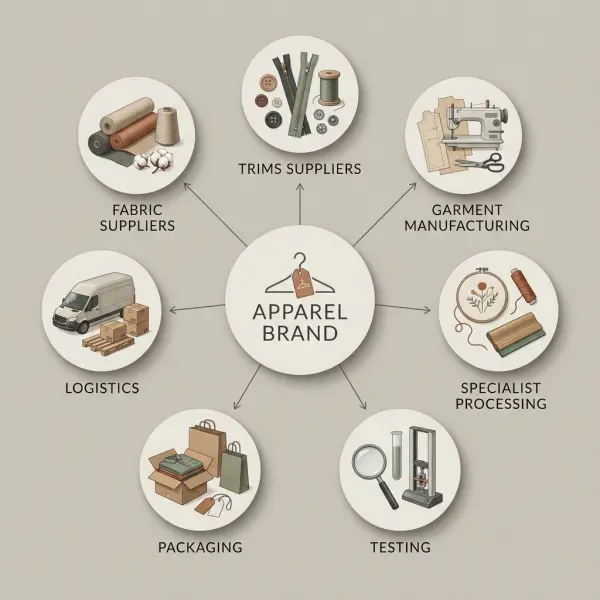
Material vendors often require particularly close technical coordination because variations introduced early in production can affect everything downstream. Fabric width, weight, shade, shrinkage, surface appearance, stretch characteristics, finishing, or usable yield can influence marker planning, consumption, garment measurements, production efficiency, and final appearance.
Trims require a different management logic. A zipper may represent only a small share of garment cost but can become a critical-path component when a specific size, finish, puller, color, or branding treatment has a long production lead time.
Production partners introduce additional dependencies involving workmanship, machinery, labor availability, line capacity, production planning, quality systems, finishing capability, packing, and sometimes subcontracting.
This is why a fashion company should not treat all vendors as interchangeable records in a purchasing database. The business impact of failure differs substantially from one vendor category to another.

How Does Fashion Vendor Management Work Across the Vendor Lifecycle?
Effective vendor management usually follows a lifecycle rather than a one-time approval event. The details vary between businesses, but the underlying logic remains similar: define what is needed, determine who can provide it, establish working expectations, monitor execution, address problems, and periodically decide whether the relationship should continue.
1. Define the Vendor's Role and Requirements
Vendor management begins before a purchase order is issued. The fashion business first needs enough clarity about the product or service being purchased.
For materials, this may involve composition, construction, width, weight, finish, color requirements, testing criteria, minimum order quantities, target cost, sampling requirements, production quantity, and required delivery timing. For factories, the requirements may also include garment category, machinery, construction complexity, order volume, quality level, finishing, packing, and production calendar.
A weak requirement cannot be repaired simply by choosing a stronger supplier. When buyers provide ambiguous specifications, frequently revise designs, or confirm orders late, vendor performance data may partly reflect problems originating inside the buying organization.
2. Qualify and Onboard the Vendor
Once potential suppliers have been identified, qualification determines whether they are appropriate for the intended role. Capability, capacity, technical performance, commercial fit, quality systems, required documentation, and relevant social or environmental due diligence may all matter depending on the relationship.
Responsible sourcing requires more than collecting a certificate or completing a vendor form. The OECD's garment and footwear guidance describes due diligence as a process for identifying, preventing, mitigating, tracking, communicating, and, where appropriate, addressing adverse impacts associated with operations and business relationships. OECD responsible garment and footwear supply chain guidance
For smaller apparel companies, onboarding does not need to become a large bureaucratic exercise. What matters is that critical commercial, technical, communication, and risk expectations are established before the relationship becomes operationally important.
3. Align Specifications, Commercial Terms, and Responsibilities
Many vendor problems are actually expectation problems.
A purchase price can be clear while other conditions remain ambiguous. Which version of the specification is final? Who approves lab dips or strike-offs? Is quoted fabric width usable width or total width? When does production lead time begin? Are packaging materials included? What happens when approved quantities change? Who bears the cost of defective goods?
The appropriate level of documentation depends on order size, product complexity, bargaining position, and applicable law. Nevertheless, fashion businesses benefit from keeping critical approvals and changes traceable rather than relying entirely on informal conversations.
This stage also connects vendor management with fashion cash flow management. Deposits, payment schedules, material commitments, production timing, and inventory arrival can influence working capital well before finished products generate revenue.
4. Monitor Execution Instead of Waiting for Failure
Vendor monitoring should capture performance while work is happening, not only after an order is completed.
The required checkpoints depend on the vendor. A fabric supplier might be tracked through lab-dip approval, bulk fabric readiness, inspection, and delivery. A factory could be tracked through sample approval, material readiness, pre-production activity, production status, inline quality checks, final inspection, and shipment.
The purpose is not to create surveillance for its own sake. The purpose is to detect exceptions while the business still has options.
If a fabric delivery is already ten days late when the factory expects material tomorrow, the problem has become a production emergency. If the delay is identified earlier, the brand may still be able to adjust the cutting plan, prioritize another style, negotiate partial delivery, or revise the launch sequence.
5. Resolve Problems and Record Corrective Actions
Vendor management becomes most valuable when something deviates from plan.
Teams need a consistent way to record the problem, establish the immediate containment action, identify the likely cause, agree on corrective action, assign responsibility, and verify whether the issue has actually been resolved.
This is especially useful for recurring defects. If stitching failures, shade variation, missing labels, inaccurate quantities, or late confirmations repeatedly appear but each incident is handled as an isolated emergency, the organization never converts operational experience into vendor knowledge.
Formal corrective and preventive action—often abbreviated CAPA in quality-management contexts—may be appropriate in structured manufacturing environments. Smaller brands can use a simpler issue log, provided that repeated problems are visible and followed through.
6. Decide Whether to Develop, Retain, Diversify, or Exit
Vendor relationships should eventually lead to decisions.
A high-performing supplier may receive more volume, earlier forecasts, development opportunities, or preferred-vendor status. A technically strong but inconsistent supplier may need a joint improvement plan. A strategically critical single-source vendor may justify development of a backup source. Persistent quality, delivery, commercial, ethical, or communication problems may eventually justify reducing exposure or ending the relationship.
The objective is not constant supplier replacement. Switching suppliers also creates costs: new sampling, testing, negotiations, minimum quantities, production learning, shade differences, altered handfeel, fit risk, and relationship rebuilding.
Vendor management therefore helps a company distinguish between a vendor worth developing and a vendor whose recurring problems create unacceptable risk.
What Should a Fashion Vendor Management System Track?
A useful vendor system tracks information that supports decisions, rather than collecting data simply because it is available.
For many apparel businesses, the vendor record needs several layers of information:
- Vendor identity and scope: legal or trading name, locations, contacts, supplied categories, production capabilities, and relevant facilities.
- Commercial data: price history, currency, minimum order quantities, payment terms, incoterms where applicable, sampling charges, tooling charges, and other agreed conditions.
- Technical information: product specifications, approved standards, testing requirements, material references, color approvals, packaging instructions, and sample history.
- Operational performance: confirmed versus actual lead times, order status, delivery reliability, quantity accuracy, quality incidents, and responsiveness.
- Risk and due diligence information: required policies, assessments, documentation, audit information where appropriate, corrective actions, subcontracting information, and traceability records.
- Relationship history: disputes, significant changes, improvement plans, major successes, and decisions from vendor reviews.
The sophistication of the software matters less than the discipline of maintaining useful information. A company with twenty active suppliers may be able to operate with structured spreadsheets and shared documentation. A business handling hundreds of styles and vendors may require purchasing, product lifecycle management, enterprise resource planning, supplier portals, or specialized supply-chain systems.
Where vendor information connects purchasing, inventory, production, and finance, fashion ERP systems can provide a broader operational framework.
Vendor Segmentation: Not Every Supplier Needs the Same Level of Management
Treating every vendor with identical procedures sounds consistent but can waste resources.
A low-value packaging supplier with several readily available alternatives does not necessarily require the same management intensity as a fabric mill producing a proprietary material used across a brand's best-selling collection.
Vendor segmentation helps determine where management attention should be concentrated.
A practical segmentation can consider two dimensions: business importance and replacement difficulty. A vendor becomes more strategically significant when failure would materially affect revenue, quality, product identity, delivery, compliance, or customer expectations and when alternatives cannot be activated quickly.
This creates several possible management approaches. Routine vendors can use standardized ordering and periodic performance checks. Important operational vendors may require regular delivery and quality monitoring. Strategic suppliers may justify forecasts, capacity discussions, development planning, senior-level reviews, and contingency arrangements.
Segmentation should remain dynamic. A small trims vendor can become critical if it supplies a proprietary closure with no immediate substitute. Conversely, a formerly strategic supplier may become less critical after dual sourcing is established.
How Should Vendor Performance Be Measured?
Vendor performance should be measured against expectations the supplier can understand and influence. A useful scorecard normally combines quantitative indicators with contextual review rather than reducing the relationship to a single number.
Potential indicators include:
|
Performance Area |
Example Indicator |
What It Helps Reveal |
|
Quality |
Defect rate, rejection rate, first-pass approval |
Whether output consistently meets agreed requirements |
|
Delivery |
On-time or on-time-in-full performance |
Whether commitments are being achieved |
|
Development |
Sample turnaround and approval performance |
How effectively the vendor supports product development |
|
Commercial |
Price consistency, charge accuracy, agreed terms |
Whether commercial execution remains predictable |
|
Responsiveness |
Response or issue-resolution time |
Whether problems can be managed efficiently |
|
Capacity |
Confirmed versus achieved output |
Whether commitments match operational reality |
|
Risk / due diligence |
Required documentation and corrective-action status |
Whether identified requirements and issues are being addressed |
A scorecard should not create false precision. A supplier scoring 88 rather than 84 is not necessarily meaningfully better if the underlying metrics are weak or inconsistently defined.
Context matters too. An apparent delivery failure might result from the vendor, but it might also follow a late purchase order, delayed buyer approval, specification revision, or inaccurate demand forecast. Mature vendor management separates supplier-caused performance from buyer-caused disruption wherever possible.

Buyer Behavior Is Part of Vendor Performance
Vendor management is sometimes discussed as though performance flows in only one direction: the supplier performs, and the buyer evaluates.
Apparel supply chains are more interconnected than that.
Frequent order changes, unrealistic lead times, late approvals, inaccurate forecasts, delayed payments, aggressive price revisions, or uncertain order commitments can make supplier planning more difficult. Research published by the International Labour Organization has examined relationships between purchasing practices and working conditions in global supply chains, including the garment sector. ILO research on purchasing practices and working conditions
This does not mean vendors should not be held accountable. It means performance should be managed as a system.
A brand expecting factories to reserve capacity should provide useful visibility where commercially possible. A buyer asking for reliable lead times should control approval delays internally. A sourcing team demanding accurate quotations should provide stable specifications.
Strong vendor relationships are therefore not synonymous with being lenient. They are built around clearer commitments, better information, realistic escalation, and accountability on both sides.
How Do Risk, Due Diligence, and Traceability Fit Into Vendor Management?
Risk management is one component of vendor management, but it should not be reduced to a compliance checklist.
Fashion supply chains can involve multiple tiers and specialized processes that are not always visible in a simple direct-supplier list. The OECD notes that the garment and footwear sector has fragmented and multi-tiered supply chains and provides a risk-based due diligence framework for businesses to identify and address adverse impacts associated with operations and business relationships.
The appropriate investigation depends on the product, geography, process, vendor, company size, applicable regulation, customer expectations, and identified risk. A factory audit or supplier declaration can provide information, but neither automatically proves that all upstream risks have been identified or resolved.
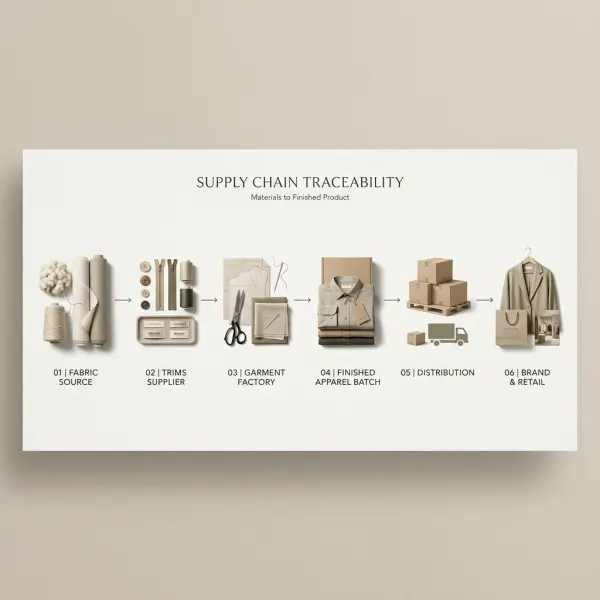
Traceability is related but distinct. GS1 describes traceability around the ability to follow the history, application, or location of an object and uses standardized identification, event, and data concepts to support information exchange across supply chains. GS1 traceability standards
For an apparel business, practical traceability might begin with questions such as which supplier supplied a material, which production order used it, which factory manufactured the garment, and which finished-product batch received it. More advanced supply chains may capture additional upstream information, but the required depth depends on the business objective and applicable requirements.
How Can Small Apparel Businesses Build a Practical Vendor Management Process?
Small brands do not need enterprise-scale supplier management software before establishing vendor discipline. The first objective is visibility.
Start with one central approved-vendor record. Document what each supplier provides, critical contacts, commercial terms, standard lead times, minimum quantities, approved specifications, current orders, major quality issues, and key documents. This alone reduces dependency on scattered messages or individual employee knowledge.
Next, identify which vendors could materially interrupt the business. Ask what would happen if the main fabric supplier, factory, zipper vendor, or printing partner became unavailable for several weeks. Not every dependency requires an immediate backup vendor, but critical dependencies should at least be visible.
A practical monthly or order-cycle review can then focus on a few measures:
- Were promised deliveries achieved?
- Were materials or products within agreed specifications?
- Did any recurring defect appear?
- Were quotations, invoices, and quantities accurate?
- Did the supplier communicate emerging problems early enough?
- Did the brand itself create avoidable delays?
- Is any corrective action still open?
- Has demand changed enough to require a capacity discussion?
Once this routine is stable, the business can gradually introduce vendor segmentation, scorecards, structured corrective actions, risk reviews, and system integration.
The sequence matters. Sophisticated software cannot compensate for unclear specifications or inconsistent internal purchasing behavior.
What Role Does Technology Play in Vendor Management?
Technology can improve vendor visibility when it connects information that would otherwise remain fragmented.
A vendor portal might centralize documents, purchase orders, acknowledgments, shipping information, and corrective actions. Product lifecycle management software can connect supplier activity to style development and material specifications. Enterprise resource planning systems can connect procurement with inventory, manufacturing, finance, and payment records. Traceability platforms may extend visibility into material or production events.
But digitalization should follow process design rather than substitute for it.
Before adding another platform, a fashion business should know which vendor decisions it is trying to improve. Is the problem late material visibility? Version control? Quality claims? Missing certifications? Purchase-order confirmation? Factory capacity? Traceability? Supplier communication?
A technology investment becomes more useful when the underlying workflow, responsibilities, definitions, and required data are already reasonably clear.
Common Vendor Management Mistakes to Watch For
Several vendor-management weaknesses repeatedly create operational friction. They are introduced here only at a high level because common vendor management mistakes that disrupt fashion operations deserve a separate operational analysis.
Choosing Primarily on Unit Price
A low quoted price can become expensive if it comes with inconsistent quality, unreliable lead times, high minimum quantities, repeated rework, or difficult claims resolution. Vendor economics should therefore be considered in the context of the total operating relationship rather than unit cost alone.
Depending on Informal Knowledge
When supplier agreements, approvals, historical problems, and critical contacts exist mainly in individual inboxes or messaging applications, vendor knowledge becomes vulnerable when staff change or problems escalate. A basic shared vendor record substantially improves continuity.
Measuring Vendors Without Measuring Buyer-Caused Delays
A scorecard loses credibility when every late delivery is automatically recorded against the supplier, even when the buyer approved materials late or changed specifications. Fair attribution creates better data and better conversations.
Treating Approval as Permanent
Vendor capability can change. Machinery, management, workforce, capacity utilization, financial condition, subcontracting arrangements, or product mix may evolve. Vendor status therefore benefits from periodic review rather than perpetual approval based on an old qualification.
What Should Brands Verify Before Acting?
Vendor-management frameworks should be adapted rather than copied mechanically.
First, verify whether the metric actually matches the vendor's role. Fabric mills, trims suppliers, garment factories, laboratories, and freight providers should not necessarily share identical performance criteria.
Second, distinguish internal policies from legal or regulatory obligations. Requirements involving product safety, labeling, chemicals, labor, customs, environmental matters, due diligence, or record retention can differ by product and jurisdiction. Companies operating across markets should verify the requirements applicable to their own activities instead of assuming that one global checklist is sufficient.
Third, be careful with certificates and audits. They can provide useful evidence, but they do not automatically establish that every product, site, subcontractor, process, or period is covered.
Quality-management principles can also inform vendor controls. The current ISO 9001:2026 framework covers operational control, performance evaluation, and continual improvement across a quality management system, but businesses do not need ISO certification merely to apply disciplined supplier-management practices. ISO 9001 quality management overview
Finally, vendor management should remain proportional. A five-person label and a multinational retailer need different systems. Both, however, benefit from clear specifications, documented commitments, visible performance, early risk escalation, and decisions based on evidence rather than memory.
Frequently Asked Questions About Fashion Vendor Management
What is the simplest definition of vendor management in fashion?
Fashion vendor management is the ongoing process of organizing and controlling relationships with external suppliers and service providers that contribute to product development, manufacturing, and delivery. It begins with qualification and onboarding but continues through ordering, performance monitoring, problem resolution, improvement, and eventual renewal or exit. The important distinction is that vendor management is not simply finding suppliers. It manages whether those suppliers continue to meet the brand's technical, commercial, operational, and risk requirements over time.
Is a garment factory considered a vendor?
Yes. In broad commercial terminology, a garment factory can be considered a vendor because it provides externally purchased manufacturing services. Fashion teams may also use terms such as supplier, manufacturer, production partner, or factory depending on the relationship. The terminology matters less than understanding the role. A factory usually requires deeper management than a routine commodity supplier because it directly influences construction quality, production capacity, delivery timing, finishing, packing, and sometimes subcontracted processes.
How many vendors should a fashion brand have?
There is no universally correct number. The appropriate vendor base depends on product range, purchasing volume, geographic strategy, minimum order quantities, material specialization, bargaining power, operational capacity, and risk tolerance. Too many vendors can fragment order volume and increase management complexity, while excessive dependence on one supplier can create concentration risk. A small brand may benefit more from a compact group of dependable partners plus selected alternatives for critical materials or processes than from maintaining a large vendor list it cannot manage effectively.
Should fashion brands always have backup suppliers?
Not for every item. Backup sourcing is most useful where supplier failure could materially disrupt the business and switching would otherwise take substantial time. Critical fabrics, proprietary trims, major production partners, or specialist processes may justify alternative-source development. Maintaining a backup also has costs, however: sampling, testing, minimum purchases, relationship maintenance, and potentially divided order volume. Brands should therefore prioritize contingency planning according to operational impact and replacement difficulty rather than automatically duplicating every vendor.
What is the difference between an approved vendor and a preferred vendor?
An approved vendor has generally met the company's minimum criteria for supplying a defined product or service. A preferred vendor usually represents a stronger commercial or strategic relationship based on factors such as demonstrated performance, capability, collaboration, consistency, or business importance. These definitions are company-specific rather than universal standards. Fashion businesses should therefore document what each status actually means, including whether approval applies to a particular facility, product category, process, or time period.
How often should vendor performance be reviewed?
The review frequency should reflect vendor importance and operating rhythm. Critical factories or material suppliers may require order-by-order monitoring plus monthly or seasonal reviews, while routine vendors may only need periodic assessment. Review frequency should also increase when performance deteriorates, production volume grows sharply, management changes, a new product category is introduced, or significant corrective actions remain open. The useful question is not simply “How often should we score vendors?” but “How quickly would we need to detect deterioration before it affects the business?”
Can spreadsheets be enough for vendor management?
Yes, especially for a small apparel business with a manageable number of active suppliers. A well-maintained spreadsheet combined with organized specifications, purchase records, issue logs, and shared documentation can provide more operational value than sophisticated software filled with incomplete data. As supplier counts, orders, facilities, product categories, compliance records, and internal teams expand, manual systems become harder to control. That is usually the point at which integrated procurement, PLM, ERP, vendor portals, or related systems become more valuable.
Conclusion
Fashion vendor management is ultimately the discipline of turning external supplier relationships into a manageable operating system.
The visible parts of fashion—design, product, branding, merchandising, and retail—depend on a much less visible network of material suppliers, trims companies, factories, processors, laboratories, logistics providers, and other specialists. Each vendor carries different capabilities, dependencies, and potential points of failure.
Managing those relationships well does not require controlling every supplier through an elaborate bureaucracy. It requires knowing which vendors matter, defining expectations clearly, documenting critical commitments, monitoring meaningful performance, recognizing buyer-caused as well as supplier-caused problems, escalating risks early, and using historical evidence to decide where relationships should be strengthened, diversified, improved, or ended.
For growing apparel businesses, that discipline becomes increasingly important. More products and larger volumes do not merely create more purchase orders. They create more dependencies.
A vendor-management system makes those dependencies visible—and therefore more manageable.





Comments 0
Leave a CommentSend Comment
Anda harus Login terlebih dahulu untuk dapat memberikan komentar.