

Automated Sewing Technology Explained for Apparel Manufacturing
Automated sewing technology is changing how apparel factories perform repetitive stitching operations, control sewing parameters, and organize garment assembly. Rather than relying entirely on manual machine adjustments and operator-controlled stitching, manufacturers can use programmable machines, electronic controls, specialized sewing units, and robotic systems to automate selected production tasks.
The distinction matters because sewing automation does not necessarily mean removing people from the production line. Many automated sewing machines still require operators to position fabric, prepare components, monitor stitch quality, and handle finished pieces. What changes is the degree of control over specific sewing operations.
For fashion brands and garment manufacturers, understanding these differences helps determine where automation fits within existing production methods, what the technology can realistically accomplish, and which garment construction processes remain dependent on skilled workers.
Quick Answer: What Is Automated Sewing Technology?
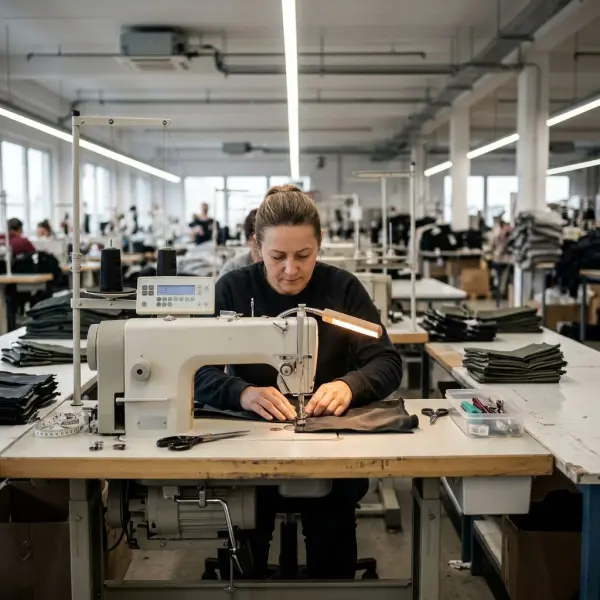
Automated sewing technology refers to industrial sewing equipment and control systems that perform selected stitching operations with reduced manual intervention. It can involve programmable stitch patterns, automatic thread trimming, electronic fabric feeding, material positioning systems, or robotic fabric handling.
In apparel manufacturing, automation ranges from digitally controlled sewing machines operated by skilled workers to specialized units that execute an entire predefined sewing cycle after the fabric has been loaded. More advanced robotic systems may also handle tasks such as fabric pickup, positioning, alignment, and transfer.
The technology is particularly relevant to repetitive construction tasks, including pocket attachment, bartacking, buttonhole sewing, and programmed decorative stitching. However, its suitability depends on fabric behavior, garment design, production volume, machine configuration, and the amount of manual handling still required.
The central advantage is not simply higher stitching speed. It is the ability to make suitable sewing operations more repeatable, with greater control over machine settings and work sequences. Full garment assembly remains more complicated because flexible fabrics, curved seams, changing garment shapes, and multi-layer construction create handling challenges that fixed automated processes cannot always accommodate.
Understanding Automated Sewing in Garment Production
Sewing is one of the most operation-intensive stages of apparel manufacturing. After fabric panels are cut, they must be assembled through a sequence of construction operations that may involve different stitch types, seam allowances, machine settings, attachments, and handling techniques. A basic woven shirt, for example, requires joining shoulders, attaching sleeves, constructing collars and cuffs, creating buttonholes, and completing hems.
Although these tasks are collectively described as sewing, they are not mechanically identical. Straight seam construction differs from attaching a curved collar, securing a waistband, or positioning a patch pocket. Each operation places different demands on the machine and the operator.
Automated sewing technology addresses selected parts of this complexity by controlling operations that would otherwise depend on repeated manual actions. It may automate a single machine function, a defined stitching sequence, or a larger manufacturing workstation.
The Difference Between Conventional and Automated Sewing
In conventional industrial sewing, the operator typically guides the fabric, regulates sewing speed, manages seam direction, and adjusts machine settings when required. The machine creates stitches mechanically, but the operator determines much of the fabric movement and timing.
An automated system transfers some of these decisions or movements to electronic controls and mechanical devices. For example, a programmable pattern sewing machine can execute a predefined stitch path while the fabric is held in a controlled position.
This distinction does not make conventional industrial machines obsolete. Their versatility is often valuable when a production line handles different garment designs, unfamiliar fabric constructions, or operations requiring frequent adjustments.
|
Aspect |
Conventional industrial sewing |
Automated sewing |
|
Stitching control |
Primarily operator-controlled |
Electronically controlled for selected operations |
|
Fabric guidance |
Usually guided manually |
May be manual, guided by fixtures, or mechanically controlled |
|
Machine settings |
Often adjusted through mechanical controls |
May be digitally programmed and stored |
|
Repetitive operations |
Depend significantly on operator execution |
Can follow predefined sequences |
|
Flexibility |
Often suitable for varied sewing tasks |
Depends on equipment design and changeover requirements |
|
Operator involvement |
Continuous during many operations |
Reduced for certain tasks, but often still necessary |
The distinction is best understood as a spectrum rather than a strict separation between manual and automated factories. A production line may use conventional overlock machines, digitally controlled lockstitch machines, and specialized automatic units alongside one another.
Main Types of Automated Sewing Technology
Not all automated sewing equipment performs the same function. Some systems improve the control of a familiar industrial machine, while others are designed to complete a particular garment construction operation with minimal intervention during the stitching cycle.
Understanding these categories is useful when reviewing manufacturing capabilities, comparing suppliers, or planning production improvements.
1. Digitally Controlled Industrial Sewing Machines
Digitally controlled sewing machines use electronic systems to regulate selected sewing parameters. Depending on the model, these parameters may include stitch length, fabric feed movement, needle-thread tension, presser foot pressure, automatic backtacking, and thread trimming.
A useful example is JUKI's DDL-9000C series, which includes digitally controlled fabric feeding and configurations with electronic tension and presser foot control. According to JUKI's technical documentation, machine adjustments can be stored and reproduced to suit different sewing conditions.
Consider a manufacturer producing woven shirts in several fabric weights. A digitally controlled machine may help the sewing team reproduce previously established settings when switching between compatible materials. This can reduce reliance on repeated manual adjustment, although test sewing remains necessary whenever material characteristics change.
These systems are not necessarily autonomous. An operator may still guide the fabric throughout the sewing operation. The automation concerns machine functions and parameter control rather than complete garment handling.
2. Computer-Controlled Pattern Sewing Machines
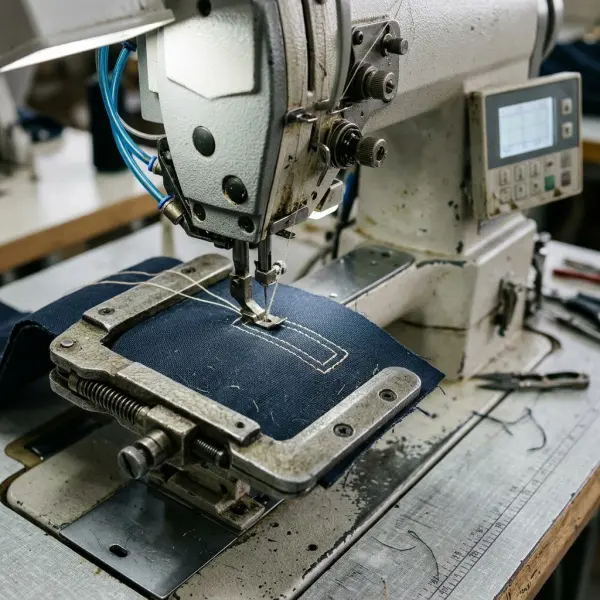
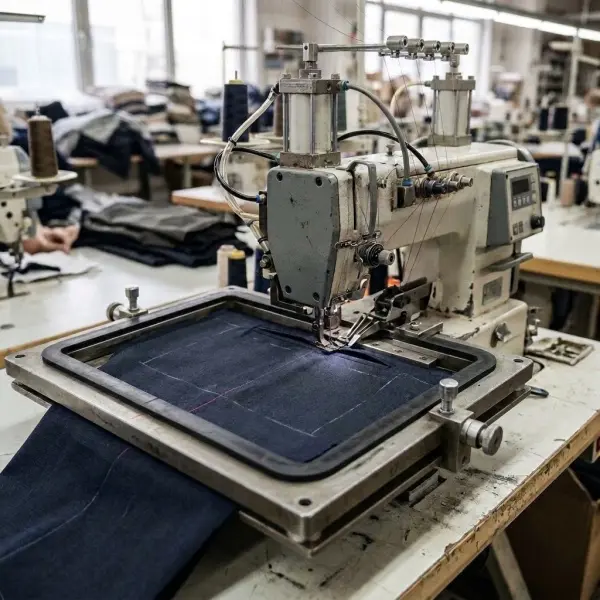
Computer-controlled pattern sewing machines execute programmed stitch paths over a defined sewing area. They typically combine electronically controlled needle movement or material positioning with a clamping mechanism that secures the workpiece.
Once the material is correctly loaded and the appropriate pattern selected, the machine can perform the programmed stitching sequence with limited manual guidance.
For example, the JUKI AMS-221EN series is a computer-controlled cycle sewing machine that stores stitching patterns and uses an electronically controlled positioning system. Its documented features illustrate how stitch paths can be programmed rather than continuously directed by the operator.
Typical applications of programmable sewing systems include reinforcing selected garment areas, attaching components with consistent stitch patterns, and producing repeated decorative stitching.
The main limitation is the defined working area and the need for suitable workpiece positioning. A machine that performs a rectangular reinforcement pattern accurately may not be appropriate for assembling an entire garment section with unpredictable fabric movement.
3. Specialized Automatic Sewing Units
Specialized automatic sewing units are built around particular garment operations. Rather than functioning as general-purpose machines, they combine sewing mechanisms, guiding devices, clamps, cutters, and sometimes stacking equipment into a defined production sequence.
Automatic pocket welting machines provide a practical example. These machines can handle parts of the welt-pocket construction process, which requires precise stitching and cutting to create a structured pocket opening.
JUKI's APW-895N automatic welting machine is designed for straight welt pockets, including pockets with flaps, on products such as jackets, suits, and trousers.
Such equipment is useful where manufacturers repeatedly produce similar construction details. However, a specialized machine may have limited value for styles that do not use its intended operation.
This is why automated sewing capacity should be evaluated by operation, not simply by counting the number of automatic machines installed in a factory.
4. Robotic Sewing and Automated Fabric Handling
Robotic sewing systems extend automation beyond the stitching mechanism. They aim to manipulate textile components using technologies such as robotic arms, computer vision, force sensors, specialized grippers, and programmed motion control.
The engineering challenge is substantial because fabric is flexible and deformable. Unlike a rigid metal component, fabric can wrinkle, stretch, fold, slip, or change shape as it is moved. A robotic system therefore needs to control not only the sewing path but also the position and behavior of the material.
A September 2026 study published in the International Journal of Intelligent Robotics and Applications describes a robotic sewing framework combining vision-based fabric detection, grasp-point estimation, motion planning, and force-regulated control. The research illustrates the technical methods being developed to address flexible fabric manipulation, but it does not establish that such systems are ready for unrestricted commercial garment assembly. See the research on robotic sewing and flexible fabric manipulation.
Robotic sewing is therefore an important area of technological development, but it should not be confused with the more established use of programmable industrial sewing equipment for individual operations.
How Automated Sewing Systems Work
Automated sewing systems generally operate by combining programmed machine instructions with mechanical control of the sewing process. The exact workflow differs according to whether the machine is operator-guided, fixture-based, or integrated with automated material handling.
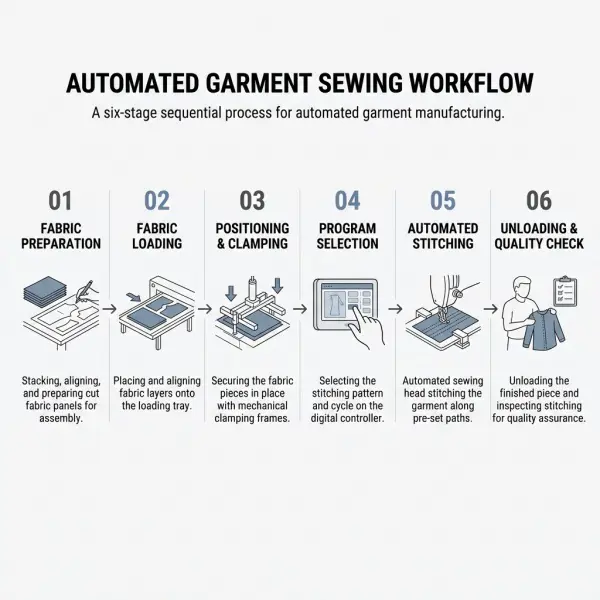
A computer-controlled sewing unit typically follows a sequence involving preparation, material positioning, program selection, stitching, and unloading.
Fabric Preparation and Loading
Before sewing begins, fabric components must be prepared according to the garment specification. This can involve positioning layers, aligning seam edges, preparing reinforcement materials, or arranging parts within a fixture.
In many automated systems, this preparation is still performed manually. Even when stitching itself is programmed, inaccurate placement can cause misaligned seams, incorrect reinforcement positions, or variations in the finished component.
For example, attaching a patch pocket involves more than following a rectangular stitch path. The pocket must first be positioned correctly relative to the garment panel, with the required seam allowance and shape maintained.
Positioning and Program Control
Once the fabric is positioned, the machine uses the selected program or control settings to execute the required operation. On some systems, clamps hold the workpiece while a mechanical positioning system moves it relative to the needle.
Program data may define stitch coordinates, stitch length, sewing speed, reinforcement sequences, and thread trimming behavior. The available parameters vary considerably between machines.
This programming should not be confused with automated interpretation of a fashion design. Most industrial sewing systems do not independently read a garment sketch and determine how to assemble it. The appropriate sewing operation and machine instructions must be established through product development, engineering, or machine programming.
Stitching, Finishing, and Unloading
During the programmed cycle, the system follows its defined stitching instructions. Depending on the equipment, it may also perform functions such as backtacking, thread trimming, cutting, or automated release of the workpiece.
The completed component is then removed manually or through an integrated handling system. Quality inspection may take place immediately or at a subsequent production checkpoint.
This sequence highlights an important distinction: automating the stitching cycle does not automatically eliminate fabric loading, handling, unloading, or inspection. Those activities can remain substantial parts of the complete operation.
Where Automated Sewing Technology Is Used in Apparel Manufacturing
Automated sewing technology is especially relevant to garment components with repeatable shapes, defined stitching positions, or standardized construction requirements.
The suitability of an operation depends on how securely the material can be positioned and whether the required stitching can be reproduced within the machine's working area.
|
Garment operation |
Possible automation approach |
Typical application |
|
Bartacking |
Programmable bartack machine |
Reinforcing pocket openings, belt loops, and stress points |
|
Buttonhole sewing |
Automatic buttonhole sewing machine |
Shirts, trousers, jackets |
|
Button attachment |
Automatic button sewing machine |
Shirts, uniforms, casualwear |
|
Pattern reinforcement stitching |
Computer-controlled pattern sewing |
Straps, garment attachments, and localized reinforcements |
|
Welt pocket construction |
Specialized automatic welting unit |
Suit jackets, trousers, tailored garments |
|
Selected seam operations |
Digitally controlled sewing with attachments or guides |
Repeatable seams on compatible garment components |
These examples do not mean that every factory uses automated equipment for these operations. Machine selection depends on manufacturing requirements, capital availability, operator capability, and the complexity of the garment.
Woven Shirts and Uniforms
Woven shirts and uniforms often contain repeatable construction details, including cuffs, collars, buttonholes, and reinforcement stitching. Some of these operations can be handled by specialized equipment when component dimensions and materials are compatible with the machine.
For a uniform manufacturer producing a limited number of approved styles, stable construction details may make certain programmed operations practical.
A fashion brand producing frequently changing silhouettes may require greater flexibility. In that case, a combination of general-purpose and automated machines can be more appropriate than relying heavily on dedicated equipment.
Denim and Casualwear
Denim manufacturing uses several repetitive reinforcement and attachment operations that are suitable for specialized sewing machinery. Bartacking at pocket openings and belt loops is a familiar example.
However, denim garments also involve varying fabric thicknesses, seam intersections, stretch characteristics, and finishing requirements. Those factors influence machine settings and the feasibility of automating a particular operation.
A factory producing heavy rigid denim may require different machine configurations from one manufacturing lightweight stretch denim, even when the basic garment design appears similar.
Tailored Apparel and Structured Garments
Tailored jackets and trousers contain construction details that may benefit from dedicated sewing systems, particularly where consistent positioning is required.
Automatic pocket welting illustrates how manufacturers can automate a defined component operation without automating the entire garment.
Other stages, such as handling shaped garment panels, setting sleeves, assembling complex linings, and achieving the intended garment balance, may still require skilled manual guidance.
The technology therefore supports garment construction selectively rather than replacing the complete production process.
The Role of Digital Control in Modern Sewing Equipment
Digital control is one of the foundations of automated sewing technology. It allows manufacturers to define selected machine parameters electronically rather than depending exclusively on manual adjustment.
This creates opportunities to reproduce approved sewing settings across repeated operations. For example, after testing a particular fabric and seam construction, a factory may store suitable machine settings for future production runs using the same material and specifications.
For apparel manufacturers, the practical value lies in controlling how an operation is performed, not simply increasing the maximum speed of the sewing mechanism.
Stored Sewing Parameters and Repeatability
Digital machines may allow operators or technicians to save sewing conditions for particular production tasks. These can include feeding behavior, stitch parameters, and other electronically adjustable functions.
When a repeat order uses compatible materials and the same construction specifications, stored settings may reduce the need to establish every parameter from the beginning.
Nevertheless, stored programs are starting points rather than substitutes for production verification. Changes in fabric finish, thickness, stretch, needle selection, or thread can influence the resulting seam.
Production Data and Connected Machines
Some industrial sewing systems support digital communication or software-based management of machine settings. Depending on the equipment, information may be transferred through local interfaces, connected devices, or factory management systems.
For example, JUKI documents data management functionality for certain configurations of its digital sewing equipment. The supported functions include reviewing machine adjustment data and transferring settings.
However, digital control does not automatically mean that a machine provides real-time production analytics, defect detection, or integration with a manufacturing execution system.
Those capabilities depend on the specific hardware, software, connectivity, and implementation.
This distinction matters for manufacturers exploring broader initiatives such as digital production planning and apparel manufacturing workflows. Connected sewing equipment can contribute operational data, but production management still requires reliable information about materials, orders, work-in-progress, machine availability, and quality.
Why Fully Automated Garment Sewing Remains Difficult
The sewing process presents a challenge that is different from many forms of industrial assembly: textile materials do not maintain a fixed shape when handled.
Fabric can bend, collapse, fold, stretch, and shift under its own weight. Its behavior also varies according to fiber composition, fabric construction, finishing, thickness, and moisture conditions.
These material characteristics make automated handling difficult, particularly when the system needs to align multiple layers along a changing seam path.
Flexible Materials Require Continuous Control
A rigid component can often be positioned using fixed reference points. Fabric behaves differently because its geometry changes during manipulation.
A robotic system may need to recognize fabric edges, estimate the position of material layers, control gripping forces, and compensate for deformation during movement.
Research into robotic garment assembly continues to address these problems. A 2025 IEEE conference paper describes a robotic system that integrates fabric picking, stacking, loading, sewing, and unloading for relatively thin materials. The experimental scope is significant, but it also demonstrates why full-process automation requires much more than a programmable sewing head.
Garment Variety Creates Additional Complexity
A sewing workstation designed for a specific component may require changes when manufacturers introduce new sizes, seam shapes, or material combinations.
These changes can involve modifying fixtures, programming new sewing paths, testing different feeds, or adjusting the material handling process.
Fashion production introduces an additional commercial challenge because collections may contain multiple silhouettes, colorways, size ranges, and construction details. The greater the variation, the more frequently a dedicated automated system may need to be reconfigured.
Consequently, automation feasibility is partly a product design question. Standardized construction can make selected operations easier to automate, while complex or frequently changing designs may continue to rely on operator flexibility.
How Fashion Businesses Can Apply Automated Sewing Technology
Fashion businesses do not need to operate automated sewing equipment themselves to benefit from understanding it. Apparel brands, sourcing teams, product developers, and factory owners can use this knowledge to make more informed production decisions.
The starting point is identifying which construction operations are repeated frequently enough, and consistently enough, to justify a controlled automated process.
For Garment Manufacturers: Match Technology to the Operation
Manufacturers should evaluate automation at the operation level before considering large-scale equipment changes.
A practical assessment begins with the garment construction sequence. Identify where a specific stitch pattern, attachment task, or reinforcement operation appears repeatedly, then determine whether available equipment can perform it with the required material and seam quality.
Useful questions include:
- Can the component be positioned consistently within the machine's sewing area?
- Does the operation require frequent changes in fabric, shape, or size?
- Which activities remain manual before and after stitching?
- Can the machine reproduce the approved stitch and seam specification?
- Are appropriate maintenance, programming, and operator training resources available?
The equipment decision should follow the process analysis. Purchasing a specialized automatic sewing unit without understanding the existing work sequence can create a new bottleneck rather than improve the manufacturing system.
For Fashion Brands: Understand Supplier Capabilities
Fashion brands working with external factories should distinguish between general sewing capacity and specialized automated capability.
A supplier may advertise automated sewing equipment without specifying the operations it performs. For sourcing teams, more useful information includes the machine type, compatible materials, maximum sewing area, available attachments, and the garment operations supported.
These details can be incorporated into evaluating garment production partners and supplier capabilities.
Brands should also ask suppliers to demonstrate relevant construction details on actual production materials. A machine's ability to sew a sample pattern does not necessarily establish compatibility with the complete garment specification.
For Product Development Teams: Design for Repeatable Construction
Product developers can support automated sewing by providing precise garment specifications, consistent component dimensions, and clearly defined construction methods.
For example, a standardized reinforcement pattern may be easier to program and reproduce when its position, stitch geometry, and material layers are clearly specified.
The same principle applies to pocket positioning, attachment details, and seam construction. When designers introduce a new fabric or change a construction detail, they should verify that the existing manufacturing process remains suitable.
This connects automated sewing with broader CAD marker making and fabric preparation workflows. Although marker making and sewing automation perform different tasks, accurate component preparation and dimensional consistency can support more predictable downstream assembly.
For Smaller Fashion Businesses: Focus on Process Fit
Small apparel businesses should not assume that the most advanced equipment is automatically the most appropriate.
A workshop producing short runs of varied garments may gain more practical flexibility from general-purpose industrial sewing machines equipped with suitable guides and basic automated functions than from a dedicated machine designed for one specialized task.
Conversely, a business repeatedly producing standardized uniform details may have a clearer application for programmable sewing equipment.
The decision depends on the relationship between product variety, repeatability, technical support, and overall production requirements. A detailed investment assessment belongs in the related article, What Fashion Businesses Should Know Before Using Automated Sewing Machines.
Common Misconceptions About Automated Sewing Technology
Automation terminology can be misleading when manufacturers, technology vendors, and fashion brands use the same words to describe different capabilities.
Several misconceptions deserve attention because they can influence purchasing decisions, production expectations, and supplier evaluation.
Mistake 1: Assuming Automated Sewing Means a Fully Autonomous Factory
An automated thread trimmer, programmable sewing unit, and robot-assisted fabric handling system represent very different levels of automation. Yet all may be described as automated sewing technology.
A factory can operate many automated machines while still depending on workers for fabric preparation, loading, alignment, inspection, and garment transfer. A more accurate assessment identifies which operations are automated and which remain manually controlled.
Mistake 2: Treating Programmable Stitching as Universal Garment Assembly
A programmable machine can reproduce predefined stitch paths under suitable operating conditions. That does not mean it can assemble every garment component.
Curved seams, complex fabric manipulation, and unpredictable material behavior may exceed the capabilities of a particular sewing system. Manufacturers should evaluate each construction operation against the machine's physical working area, control method, and material requirements.
Mistake 3: Assuming Digital Settings Eliminate Technical Sewing Knowledge
Electronic controls can simplify parameter adjustment and help reproduce approved settings, but selecting appropriate conditions still requires an understanding of sewing mechanics.
Technicians must consider needle size, thread compatibility, stitch formation, feeding performance, fabric damage, and seam appearance. Incorrect settings can still produce puckering, skipped stitches, thread breakage, or uneven seams, even when those settings are stored digitally.
Mistake 4: Confusing Machine Speed With Complete Production Output
Industrial sewing machine specifications often describe maximum sewing speed in stitches per minute. This figure does not represent the number of finished garments a factory can produce.
A complete operation includes material positioning, sewing, unloading, quality checks, and sometimes rework. If these additional activities take substantial time, increasing stitching speed alone may have limited effect on overall throughput.
The operational implications are explored in How Sewing Automation Improves Speed, Consistency, and Production Control.
Important Technical and Safety Considerations
Automated sewing equipment should be assessed as an industrial production system rather than simply as a computerized sewing machine.
Its technical performance depends on mechanical construction, control software, workholding devices, machine settings, material compatibility, and the skill of the people operating and maintaining it.
Machine Compatibility and Stitch Quality
Not every automated system is suitable for every fabric or stitch requirement. Machine capabilities must be matched to the material, seam construction, and intended garment performance.
Before production, manufacturers should test actual material combinations and examine seam strength, stitch balance, puckering, fabric damage, and dimensional accuracy where applicable.
The type of stitch and seam remains an engineering decision. Automation controls how the approved operation is executed; it does not make an unsuitable stitch construction appropriate for the garment.
Machine Safety and Operator Protection
Automated movements can introduce hazards related to moving needles, clamps, cutting mechanisms, and material transfer devices.
The ISO 10821 industrial sewing machine safety standard identifies hazards and establishes safety requirements for industrial sewing machines, sewing units, and systems.
The International Labour Organization also addresses machinery safety, ergonomic risks, and workplace control measures in its code of practice for textiles, clothing, leather, and footwear.
Manufacturers should therefore review guarding, operating procedures, maintenance arrangements, and worker training as part of equipment implementation. Applicable legal requirements depend on the country or production location.
Automation does not eliminate the need for occupational safety management.
Performance Claims Must Reflect Actual Operating Conditions
A manufacturer's published machine speed or technical specification describes equipment capability under defined conditions. It should not be interpreted as a guaranteed production improvement for every garment or factory.
Performance depends on fabric characteristics, sewing patterns, handling methods, operator proficiency, maintenance, and production organization.
Similarly, environmental or energy-saving claims require context. A machine may use less electricity during a particular operation, but its total environmental impact cannot be determined from sewing speed or motor specifications alone.
Manufacturers should separate verified machine specifications from supplier estimates, demonstration results, and actual factory performance.
Frequently Asked Questions About Automated Sewing Technology
1. What is the difference between an automatic sewing machine and a computerized sewing machine?
A computerized sewing machine uses electronic controls to manage selected functions, while an automatic sewing machine performs one or more operations with reduced manual intervention. The categories overlap, and manufacturers do not always use these terms consistently.
For example, a computerized industrial lockstitch machine may allow operators to store sewing parameters while still requiring continuous manual fabric guidance. A dedicated automatic bartack machine may complete a programmed reinforcement cycle after the material is positioned.
When comparing equipment, the most useful distinction is which tasks are electronically controlled, which movements are automated, and which actions still require an operator.
2. Can automated sewing machines sew an entire garment?
Some systems can automatically sew substantial portions of a predefined operation, but fully autonomous assembly of an entire garment remains technically challenging. Most established industrial automation focuses on selected construction tasks rather than all stages of garment assembly.
Complete garment production requires aligning different fabric components, controlling flexible materials, handling curved seams, and accommodating variations in garment size and construction.
Robotic research continues to develop more integrated sewing and fabric handling capabilities. However, a successful demonstration of automated stitching or component handling should not be interpreted as evidence that unrestricted, commercially scalable garment assembly is available.
3. Which garments are most suitable for automated sewing?
Garments containing consistent, repeatable construction details are generally more suitable for specialized sewing automation than garments requiring frequent changes in handling or complex seam geometry.
Uniforms, woven shirts, denim products, and tailored apparel may contain operations such as buttonhole sewing, bartacking, or pocket welting that can be performed using dedicated equipment.
Suitability still depends on the specific component rather than the garment category alone. A factory may automate belt-loop reinforcement on denim trousers while retaining manual guidance for other sewing operations. Fabric weight, stretch, component dimensions, and production requirements must be verified before selecting a machine.
4. Does automated sewing eliminate the need for skilled sewing operators?
No. Automated sewing changes the distribution of work between the operator and the machine, but it does not automatically remove the need for skilled personnel.
Some repetitive stitching movements can be programmed, while workers continue to handle fabric positioning, machine preparation, inspection, troubleshooting, and maintenance. More sophisticated equipment may also require programming and technical support.
The skills required can therefore shift toward machine setup, material handling, quality verification, and equipment operation. The extent of that shift depends on the automation level and factory organization.
For manufacturers, workforce planning should reflect actual operating requirements rather than assuming that every automated machine replaces a complete manual job.
5. Can automated sewing machines work with stretch fabrics and delicate textiles?
Some automated sewing machines can process stretch fabrics and delicate textiles, but compatibility depends on their feeding mechanisms, sewing configuration, workholding system, and material characteristics.
Stretch fabrics may deform during positioning or stitching, while lightweight materials can shift, wrinkle, or become damaged by unsuitable clamping pressure. Different material layers may also behave differently under the same sewing conditions.
Manufacturers should conduct sewing trials using the actual fabric, needle, thread, stitch construction, and production specifications. Testing should consider appearance, seam performance, distortion, and handling reliability rather than relying only on the machine's advertised fabric compatibility.
6. What should a fashion brand ask a factory about automated sewing capabilities?
A fashion brand should ask which garment operations are automated, what equipment performs them, and whether those machines are compatible with the proposed product specifications.
Useful information includes the supported stitch types, maximum work area, applicable materials, setup requirements, and the amount of manual handling involved. Brands should also ask how the factory verifies seam quality and manages changes in materials or garment construction.
For products with specialized details, a production sample or technical demonstration is more informative than a general statement that the factory uses advanced automation. Supplier capability should be evaluated against the actual garment requirements.
Conclusion: Understanding Automation as a Manufacturing Capability
Automated sewing technology is best understood as a collection of manufacturing capabilities rather than a single method of producing garments. Digitally controlled machines, programmable stitching systems, specialized sewing units, and robotic technologies each address different parts of the apparel assembly process.
The established applications are particularly relevant to operations that can be defined, positioned, and repeated consistently. More complex tasks involving flexible materials, variable garment geometry, and multi-stage handling continue to present engineering and production challenges.
For garment manufacturers, the practical starting point is understanding the construction operation and identifying what can realistically be controlled by machinery. For fashion brands, the priority is recognizing how a supplier's equipment capabilities relate to product quality, consistency, and manufacturing requirements.
As technology develops, further integration between sewing equipment, digital production systems, and automated material handling may expand the range of operations that can be automated. The pace and usefulness of that development will depend on material-handling reliability, technical feasibility, production economics, and the ability to accommodate real garment variation.
The most useful question is therefore not whether a factory uses automated sewing, but which operations it automates, how those systems work, and whether they are appropriate for the garments being produced.




Comments 0
Leave a CommentSend Comment
Anda harus Login terlebih dahulu untuk dapat memberikan komentar.