

Knife Pleats vs Box Pleats: Construction Methods and Design Differences
Knife pleats and box pleats are two familiar techniques in garment construction, but their differences go beyond the direction of the folds. Both manipulate fabric to create controlled fullness, yet they produce distinct surface patterns, silhouettes, and construction requirements. Understanding these distinctions helps fashion designers select the right pleat structure and gives manufacturers clearer instructions for pattern development and sewing.
A knife-pleated skirt typically has a sequence of folds running in the same direction, creating a continuous visual rhythm. A box-pleated skirt, by contrast, uses opposing folds to form symmetrical sections that emphasize individual panels. Both styles can look structured or relatively soft, depending on fabric characteristics, pleat depth, pressing, and how the folds are secured.
These details become significant during apparel development. A pleat that appears straightforward in a fashion sketch must be translated into accurate pattern measurements, fold placement lines, stitching instructions, and finishing requirements. Changing from knife pleats to box pleats may alter the layout of the entire garment panel, even if the finished waist measurement remains unchanged.
For fashion brands and garment manufacturers, the choice involves more than visual preference. It affects pattern engineering, material consumption, production consistency, quality inspection, and the customer's experience of fit and movement.
Quick Answer: What Is the Difference Between Knife Pleats and Box Pleats?
Knife pleats are fabric folds arranged in the same direction, while box pleats are formed from two opposing folds that face away from each other on the garment's visible side. Knife pleats create a repeated directional pattern, whereas box pleats produce symmetrical, box-like sections with a central visible panel.
Both techniques reduce the apparent width of a fabric panel while preserving extra material inside the folds. This concealed fabric can open as the garment moves, creating fullness without requiring the entire garment to appear loose.
The main construction difference is how the folds are organized. Knife pleats repeat a single fold direction, making them suitable for continuous pleated surfaces. Box pleats require a mirrored fold arrangement, which can be used as a single design detail or repeated across a garment.
Neither technique automatically requires more fabric than the other. Consumption depends on the number of folds, pleat depth, spacing, and finished panel width. Fabric weight and finishing methods also affect whether the pleats remain crisp or relax during wear.
For apparel businesses, knife pleats are often useful when the design needs consistent directional texture, while box pleats are suitable for balanced, symmetrical fullness.
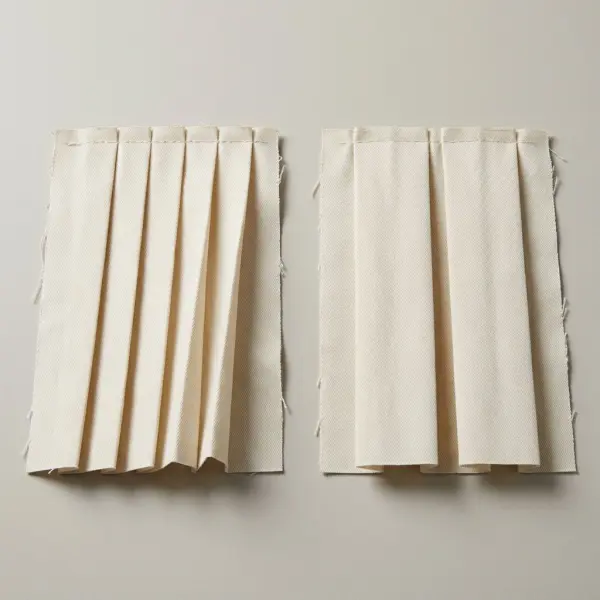
Understanding the Structure of a Pleat
Before comparing construction methods, it helps to understand what happens to the fabric inside a pleat.
A pleat is created when part of a fabric panel is folded back on itself. This action reduces the panel's visible or finished width without removing the underlying material. Depending on the garment design, the concealed fabric may remain flat, form a raised shape, or expand when the wearer moves.
Pleats are commonly described through several technical elements: the outer fold, inner fold, pleat depth, underlay, spacing, and placement line. These measurements determine how the fabric is distributed and how the folds appear after assembly.
According to Seamwork's guide to pleat construction, pleat depth describes the distance between the outside and inside folds, while the underlay accounts for the additional fabric hidden behind the visible fold.
These distinctions are important because designers sometimes specify the visible width of a pleat without defining the concealed fabric allowance. A manufacturer cannot reliably calculate material requirements from appearance alone.
Pleat Depth, Width, and Spacing
Pleat depth determines how much fabric extends beneath the visible fold. Deeper folds conceal more material and can provide additional fullness when released.
Pleat width describes the visible section or interval associated with a pleat, although drafting conventions can differ depending on the pleat arrangement. Spacing identifies the distance between neighboring folds or pleat units.
For example, two skirts may have the same finished waist measurement but use different combinations of pleat depth and spacing. One may contain numerous narrow knife pleats, while the other uses fewer, deeper box pleats.
The resulting garments can differ substantially in appearance and movement despite sharing the same finished waist circumference.
Fold Direction and Fabric Grain
Fold direction determines the relationship between neighboring pleats. Knife pleats repeat in one direction, whereas box pleats are organized around mirrored pairs.
Fabric grain also influences the finished result. When pleats are intended to fall vertically, the patternmaker generally aligns the relevant panel and fold geometry with the specified grainline. This helps maintain predictable drape and reduces unintended twisting.
However, not every pleated design follows a simple vertical arrangement. Bias-cut garments, radiating pleats, and experimental silhouettes may use different orientations.
The essential requirement is that the grainline and fold directions are clearly identified in the technical pattern.
What Are Knife Pleats?
Knife pleats are repeated fabric folds whose visible outer folds face the same direction. They produce a consistent linear arrangement that can extend across an entire garment panel or appear in selected sections.
A classic knife-pleated skirt is a useful example. Each fold overlaps the adjacent section, creating a sequence of similar pleat faces. When the skirt is stationary, the folds can appear relatively flat. During movement, the concealed underlays may open and create additional volume.
Knife pleats can vary considerably in size. Broad folds create a different visual effect from narrow, closely spaced pleats, and the spacing can be adjusted to suit the design.
The defining characteristic is not the pleat size but the consistent direction of the outer folds within the pleated sequence.
How Knife Pleats Are Constructed
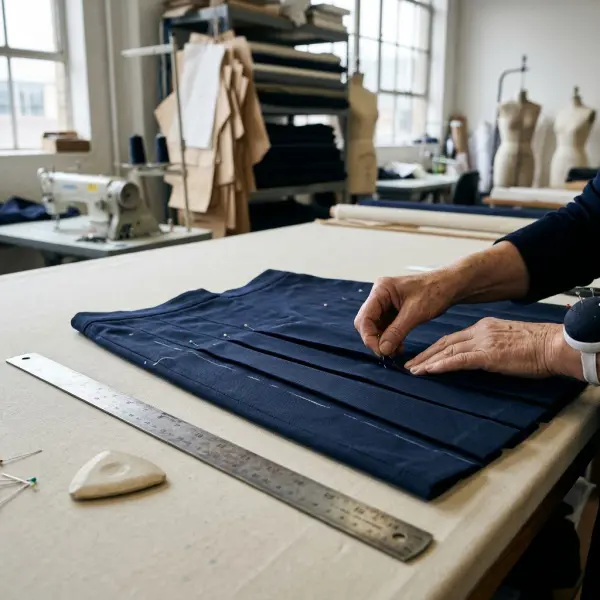
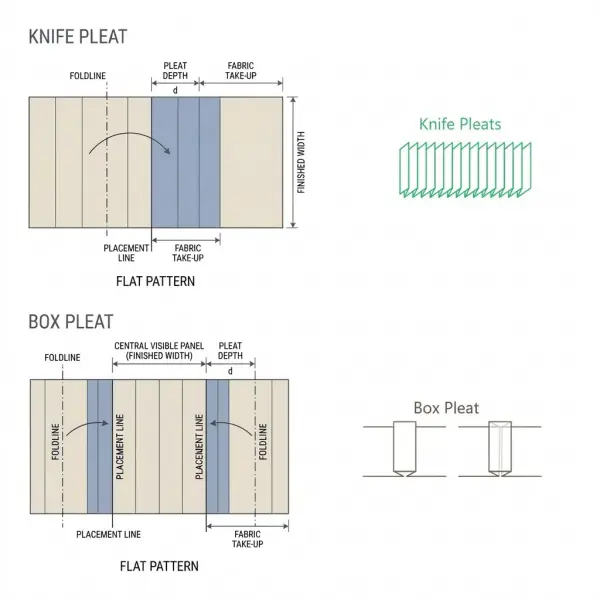
Knife pleat construction begins with a pattern containing defined foldlines, placement lines, and direction markings.
During cutting and preparation, the required fabric allowance is included in the panel dimensions. Operators transfer the markings onto the material and fold the fabric so that each outer fold reaches its intended placement line.
The folds are then secured temporarily through pins, basting, or other production-appropriate methods. Depending on the garment, the pleats may be stitched within a seam allowance, partially topstitched, or held through pressing and their attachment to adjoining components.
A typical construction sequence includes:
- Prepare the fabric panel and transfer the fold and placement markings.
- Confirm the fold direction and the required pleat depth.
- Fold each section consistently toward its corresponding placement line.
- Pin or baste the pleats to prevent movement during assembly.
- Press the folds according to the fabric's handling and care requirements.
- Secure the pleated edge or stitch the pleats to the specified length.
- Attach the panel to the waistband, yoke, or other garment component.
- Inspect the final fold spacing, direction, and garment balance.
Although the sequence is conceptually simple, a row of repeated pleats requires accurate execution. Small deviations in one fold can affect the spacing of subsequent folds, particularly when the entire panel is pleated.

How Knife Pleats Influence Silhouette
Knife pleats create a strong directional rhythm because the folds repeat in a consistent arrangement. This can make the garment appear visually organized even when it contains substantial material.
In skirts, knife pleats can create movement around the lower body while maintaining a relatively controlled waist. In dresses, they may be concentrated below a fitted bodice to introduce fullness without using gathers.
Knife pleats can also be partially stitched down to control the upper silhouette. For instance, securing the folds through part of the hip area can keep the fabric closer to the body before it opens lower down.
However, stitched-down pleats should be evaluated for comfort. Restricting their opening can reduce the additional room that the concealed fabric would otherwise provide.
Where Knife Pleats Work Well
Knife pleats are commonly used in uniform skirts, tailored dresses, certain kilts, decorative panels, and other garments where repeated folds form an important part of the design.
They can also appear in smaller sections, such as at a neckline or waist, where the intention is to introduce localized shaping rather than create a fully pleated surface.
For apparel brands, their main design advantage is repeatability. Once the fold width, depth, and direction are established, the technique produces a recognizable pattern that can be carried across multiple styles.
That repeatability should not be confused with automatic production simplicity. Long sequences of narrow pleats may require considerable marking, folding, and pressing accuracy.
What Are Box Pleats?
Box pleats are symmetrical fabric folds created by arranging two knife-like folds in opposite directions, with their visible outer folds facing away from one another. This creates a defined central panel with concealed fullness underneath.
Unlike a continuous sequence of knife pleats, a box pleat has an internal symmetry. The left and right sides relate to a central axis, producing a balanced, rectangular-looking surface.
Box pleats can be used individually or repeated across a garment. A single box pleat positioned at the center back of a shirt serves a different design purpose from multiple box pleats distributed around a skirt.
In both cases, the construction allows extra fabric to be incorporated without leaving the full additional width exposed in the garment's resting shape.
The Scandinavian Academy of Fashion Design's box pleat reference describes this arrangement as two outward-facing folds that create a flat exterior panel with additional fabric concealed behind it.
How Box Pleats Are Constructed
Box pleat construction requires a mirrored arrangement of two folds around a central section.
The patternmaker begins by defining the center of the box pleat, the visible panel width, and the depth of the folds on each side. The corresponding fold and placement lines are then added to the pattern.
During assembly, the fabric is folded so that the visible outer folds face away from the center. The two sides should be positioned symmetrically unless the design intentionally specifies an asymmetric variation.
The pleat can then be temporarily secured, pressed, and attached to the relevant garment component.
A simplified construction sequence involves:
- Mark the centerline of the intended box pleat.
- Mark equal fold depths and corresponding placement lines on both sides.
- Fold the left section outward from the center.
- Fold the right section outward in the opposite direction.
- Check that the resulting central panel is symmetrical.
- Temporarily secure the folds and press as specified.
- Stitch or attach the pleat according to the garment construction.
- Inspect the finished shape, alignment, and release of fullness.
Symmetry is the most visible requirement. If one side is wider or deeper than the other, the central panel may appear displaced even when the total finished width is correct.
How Box Pleats Affect Shape and Volume
Box pleats concentrate concealed fullness around a defined position. This can create a structured appearance while allowing the fabric to open below the point where it is secured.
For example, a box pleat at the center back of a shirt may introduce additional width across the upper back when the wearer moves. Whether it provides meaningful movement allowance depends on the surrounding pattern, pleat depth, yoke placement, and fit.
In skirts and dresses, repeated box pleats produce a series of broader, symmetrical panels. The folds can support an A-line or fuller silhouette depending on the cut, pleat placement, and fabric properties.
Deep box pleats may create noticeable volume, particularly in fabrics with substantial body. This should be evaluated during sampling because the material may project outward rather than fall close to the body.
Box Pleats vs Inverted Box Pleats
Box pleats and inverted box pleats use related fold structures but present different arrangements on the visible side of the garment.
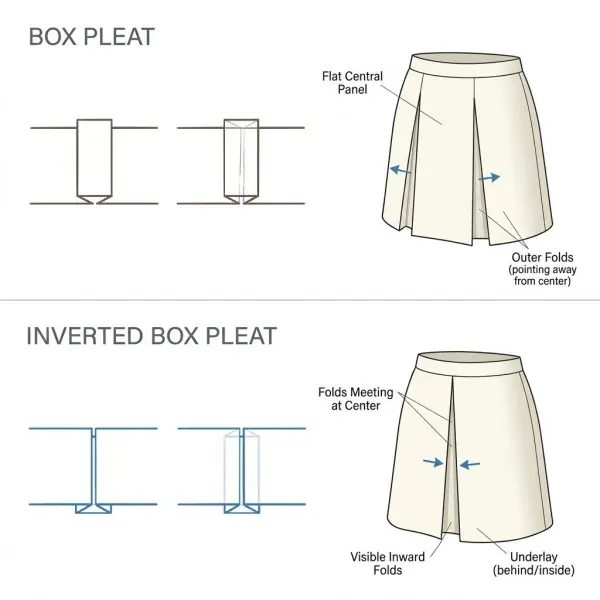
In a standard box pleat, the visible outer folds face away from each other, leaving a central panel between them.
In an inverted box pleat, the visible outer folds face toward each other and meet or nearly meet at the center. The additional fabric is largely concealed behind the meeting folds.
A box pleat viewed from its reverse side can resemble an inverted box pleat. This relationship explains why technical illustrations sometimes show nearly identical underlying fabric arrangements despite different exterior appearances.
The distinction matters in production because reversing the fold direction can change the intended design. Pattern instructions should identify the garment's right side and the required direction of each fold.
Knife Pleats vs Box Pleats: Construction and Design Comparison
The distinction between knife pleats and box pleats becomes clearer when comparing fold direction, symmetry, pattern requirements, and visual effect.
|
Comparison factor |
Knife pleats |
Box pleats |
|
Fold direction |
Outer folds face the same direction |
Paired outer folds face away from each other |
|
Basic structure |
Repeated directional folds |
Mirrored pair of folds |
|
Visual rhythm |
Continuous, directional repetition |
Symmetrical, panel-like repetition |
|
Common arrangement |
Multiple pleats across a garment section |
Single or repeated pleat units |
|
Design emphasis |
Linear movement and directional texture |
Balanced structure and localized fullness |
|
Pattern marking |
Repeated fold and placement lines |
Mirrored fold and placement lines around a center |
|
Main alignment concern |
Consistent depth, spacing, and direction |
Symmetry and correct central positioning |
|
Typical applications |
Pleated skirts, dresses, uniforms |
Skirts, shirt backs, dresses, outerwear |
|
Fabric consumption |
Depends on total pleat take-up |
Depends on two fold take-ups per box unit |
|
Production difficulty |
Depends on number and precision of repeated folds |
Depends on symmetry, depth, and number of box units |
The table highlights an important point: construction method does not determine garment quality by itself. A precisely executed box pleat and a precisely executed knife pleat can both create professional results.
Their suitability depends on the design objective and the technical requirements of the garment.
Visual Direction Versus Symmetry
Knife pleats create a repeated movement across the garment surface. The eye follows the direction of the folds, producing a continuous pattern.
Box pleats create individual visual units. The central panels can become prominent features, especially when the pleats are broad or evenly repeated.
These effects influence styling. A narrow knife-pleated skirt may create a fine textured surface, while a skirt with several broad box pleats may emphasize its larger panel divisions.
Neither effect is inherently more formal or more fashionable. The final impression depends on garment proportions, textile selection, color, pressing, and styling.
Distributed Versus Concentrated Fullness
Knife pleats can distribute concealed fullness across a broad section of fabric. Box pleats can concentrate fullness at specific points or distribute it through repeated symmetrical units.
Consider two skirts with the same finished waist measurement. One uses twelve repeated knife pleats around the waist, while another incorporates four deeper box pleats.
Even if the total added fabric is similar, the skirts may hang differently because the folds are positioned and released differently.
For designers, this means pleat selection should be assessed on the full garment, not just a small fabric swatch.
How Much Fabric Do Knife Pleats and Box Pleats Require?
Knife pleats and box pleats do not have a universal fabric-consumption advantage over one another. The required material depends on pleat depth, the number of folds, the visible panel width, and the amount of flat fabric between pleated sections.
For either construction, additional fabric must be allocated to the underlays concealed behind the visible surface.
A general planning relationship for conventional pleats is:
Flat pattern width = finished panel width + total pleat take-up
For a conventional single fold, the take-up is approximately twice the pleat depth. For a box pleat consisting of two equally deep folds, the total take-up is approximately four times the depth of one side.
These calculations assume the depth is measured from the outer fold to the inner fold and that the pattern is not using a specialized pleat geometry.
Example: Calculating Fabric for Knife Pleats
Suppose a skirt panel needs a finished pleated width of 48 cm and includes eight knife pleats, each with a 2 cm pleat depth.
The additional material required per pleat is approximately:
2 cm × 2 = 4 cm
For eight pleats:
8 × 4 cm = 32 cm
The total flat pattern width becomes:
48 cm + 32 cm = 80 cm
This calculation excludes seam allowances, plackets, and other pattern requirements.
It also assumes that the stated 48 cm represents the finished width after the folds are formed. The pleat arrangement must still be drafted to distribute the folds appropriately across that width.
Example: Calculating Fabric for Box Pleats
Now consider a separate 48 cm finished panel containing two box pleats. Each box pleat has two sides with a depth of 2 cm.
The total take-up of one box pleat is:
2 sides × 2 cm depth × 2 = 8 cm
For two box pleats:
2 × 8 cm = 16 cm
The required flat pattern width becomes:
48 cm + 16 cm = 64 cm
This example consumes less fabric than the previous knife-pleat example because it contains fewer individual folds, not because box pleats are inherently more material-efficient.
If the designs contained equivalent total pleat take-up, their material requirements could be similar.
Why the Three-to-One Rule Does Not Always Apply
A commonly taught calculation for fully packed knife pleats uses approximately three times the finished pleated width.
This relationship applies when the visible pleat width and pleat depth are equal in a fully covered arrangement with no extra flat spaces. It is a useful drafting convention, not a universal ratio for all pleated garments.
For instance, when a 2 cm visible segment contains 4 cm of concealed underlay, the total flat fabric requirement for that segment is 6 cm. This produces a 3:1 relationship.
If the pleats are spaced farther apart or use shallower folds, the total fabric requirement changes.
A patternmaking explanation from Minerva Patterns on drafting knife, box, and inverted pleats similarly emphasizes calculating the hidden underlay rather than applying one ratio to every garment.
For sourcing and costing, pattern consumption should be established from the actual approved pattern.
How Fabric Choice Affects Knife and Box Pleats
Fabric behavior can change the appearance of a pleat as significantly as the fold arrangement itself.
A knife pleat formed in crisp cotton poplin may show a sharply defined crease. The same pleat in a soft rayon fabric may create a gentler fold that moves more freely.
Box pleats respond similarly, but the symmetrical construction can make differences in stiffness and thickness particularly visible around the central panel.
Cotton Poplin and Shirting Fabrics
Cotton poplin can be suitable for both knife and box pleats when the design requires defined folds without excessive thickness.
In a shirt, a box pleat below the back yoke may provide localized fullness. In a skirt or dress, repeated knife pleats can create a more directional appearance.
However, crease retention depends on the cotton fabric's finishing and how it is cared for. Ordinary pressing does not automatically make cotton pleats permanent.
Wool and Tailoring Fabrics
Suitable wool suiting materials can be used for tailored pleats, including pleated trousers and structured skirts.
Their ability to be shaped through controlled pressing can help produce defined folds, although the result depends on fiber blend, fabric construction, finish, and the garment's care process.
Knife pleats may emphasize repeated vertical lines, while box pleats can create broader panels with organized fullness.
Heavier suiting fabrics require special attention to the number of layers accumulated at the waist or seam intersections.
Polyester and Synthetic Blends
Certain thermoplastic synthetic fibers, including polyester, can be heat-set under controlled conditions to improve crease retention.
This makes some synthetic and blended fabrics suitable for specialist pleating processes. However, the performance depends on the fiber composition, construction, finishing method, and temperature compatibility.
A polyester-containing fabric is not automatically permanently pleated simply because it has been pressed.
Fashion brands should verify the actual pleating process and conduct appropriate washing or care tests before making durability claims.
Linen, Rayon, and Fluid Fabrics
Linen and fluid rayon fabrics can produce attractive pleats, but their behavior differs from crisp, stable materials.
Linen may develop a more relaxed appearance and visible wrinkling, depending on its construction and finish. Fluid rayon fabrics may produce folds that drape softly rather than maintaining sharply defined edges.
For box pleats, this softness can reduce the prominence of the central panel. For knife pleats, it may make the repeated folds less rigid.
Whether this is desirable depends on the design. A relaxed resortwear dress may benefit from softer folding, while a formal uniform skirt may require more consistent crease definition.
How Pleat Selection Influences Garment Fit and Movement
The effect of pleats on fit depends on where the fullness is located and where the folds are allowed to open.
Both knife and box pleats can introduce additional fabric beyond a garment's resting dimensions. However, that fabric does not automatically create effective wearing ease in every direction.
Knife Pleats in Skirts and Dresses
Repeated knife pleats can provide fullness across a skirt while keeping the upper section relatively controlled.
As the wearer walks, the folds may open and allow the skirt to move outward. The amount of movement depends on skirt length, pleat depth, stitching, fabric behavior, and the underlying pattern shape.
A knife-pleated skirt with folds stitched down through the upper hip may behave differently from one secured only at the waistband.
Design teams should therefore test the garment while walking and sitting, not simply inspect the folds on a dress form.
Box Pleats in Shirts and Outerwear
A box pleat positioned below a shirt yoke may help accommodate movement across the back. The concealed fabric can open as the wearer's posture changes, provided the pattern and seam construction allow it.
In outerwear, box pleats may be used in back panels or other areas where controlled fullness serves both aesthetic and functional purposes.
However, a box pleat should not be assumed to improve mobility without fitting tests. Its effectiveness depends on the garment's armhole, shoulder, sleeve, and overall body dimensions.
Where Pleats Release Fullness Matters
A pleat secured along most of its length behaves differently from one attached only at a seam.
If the folds are stitched down, the concealed material is less able to open in that section. When the stitching ends, the fabric can expand more freely.
This distinction is particularly important in fitted garments. Pleats may create visible decorative lines without providing substantial ease in areas where movement is restricted.
The pattern and sewing specification must therefore define the intended release point, not just the pleat's surface appearance.
Manufacturing Considerations: Which Pleat Is Easier to Produce?
Neither knife pleats nor box pleats are universally easier to manufacture. Their production complexity depends on the number of folds, the accuracy required, the fabric, the construction equipment, and the factory's experience.
Knife pleats may involve many repeated operations, while box pleats require careful symmetrical positioning. The practical difference is determined by the specific garment design.
Pattern Accuracy and Marking
Knife pleats require reliable spacing across the entire pleated section. If marking errors accumulate, the final folds may fail to align correctly with the waistband, side seams, or center front.
Box pleats require accurate positioning around the intended centerline. A slight difference between the left and right folds can make the central panel visibly asymmetric.
Both techniques benefit from clear pattern notches, foldlines, placement lines, and directional arrows.
For digital pattern development, these markings must remain unambiguous after grading, conversion, and transmission to the factory.
Sewing Operations and Pressing
The production sequence typically involves marking or positioning, folding, securing, sewing, and pressing.
Knife-pleated garments may require numerous repeated folds to be arranged consistently. Repeated box pleats may involve more complex positioning of each mirrored pair.
Pressing can become a significant operation when the garment contains many pleats. The operator must maintain the correct fold direction and avoid unwanted creases or impressions.
Production teams should confirm whether the factory can create the required pleat structure using standard garment assembly methods or whether specialist pleating processes are necessary.
Quality-Control Requirements
Quality control should evaluate more than whether the folds are visually present.
For knife pleats, inspectors should verify that the folds face the correct direction, spacing is consistent, and the finished dimensions match the approved sample.
For box pleats, symmetry becomes especially important. The center of each pleat should align with its specified position, and the left and right sides should match the intended construction.
In both cases, inspection should consider the garment's appearance when hanging naturally. A pleat can be correctly folded on a table yet create undesirable distortion once the garment is assembled.
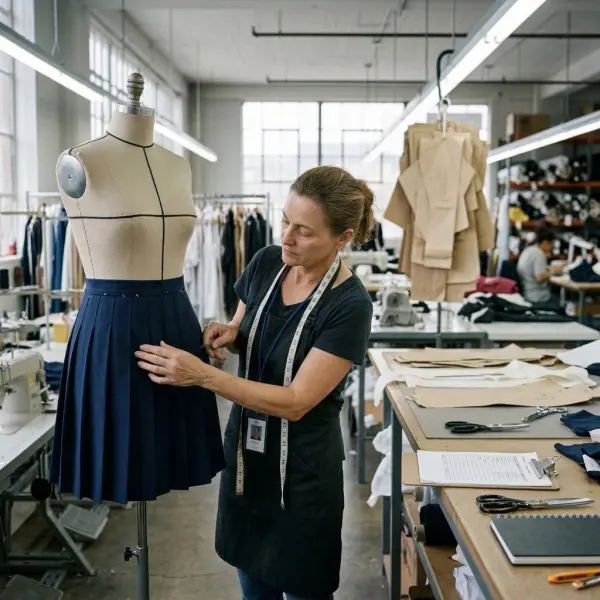
Cost Implications for Fashion Brands
Pleat selection influences garment costing through a combination of material consumption, labor operations, equipment requirements, and finishing.
A garment with many knife pleats may require additional time for fold preparation and inspection. A garment with fewer box pleats may involve fewer repeated operations but more careful positioning of each symmetrical detail.
The relevant comparison is therefore not simply knife pleats versus box pleats. It is the total construction cost of the proposed design.
Fabric Consumption and Cutting Efficiency
The amount of fabric required should be calculated from the flattened pattern.
Deep pleats increase pattern width, which may affect how the pieces fit within the available fabric width. This influences cutting layout and potentially total yardage.
Pattern pieces with extensive pleating may also require additional seams or adjustments to the cutting strategy.
Brands should not assume that equal finished garment measurements produce equal fabric requirements.
Labor and Production Time
Labor cost depends on how many operations are required and how consistently they can be performed.
A small number of box pleats can be relatively straightforward. A fully knife-pleated skirt may involve more preparation, depending on the equipment and method.
The reverse can also be true when a design contains complex box pleats requiring precise pattern matching or decorative topstitching.
Manufacturers should evaluate operation time using actual samples rather than assigning fixed cost assumptions based on the pleat type alone.
Quality and Rework Risk
Pleated garments may require additional corrections when folds are uneven, panel dimensions are inaccurate, or pressing creates unwanted marks.
Reworking a pleated panel can affect production efficiency, particularly when the issue becomes visible only after attachment to a waistband or adjoining garment piece.
An approved sample and clear construction specification help reduce this risk.
For an extended discussion of defects and preventive techniques, see common pleating and gathering mistakes in garment construction.
How Fashion Designers Should Choose Between Knife and Box Pleats
The appropriate pleat type should follow the garment's design objective, material properties, and manufacturing constraints.
Knife pleats are worth considering when the intended appearance depends on directional repetition. Box pleats are useful when the design requires balanced, symmetrical sections or localized fullness.
These are design tendencies rather than fixed rules.
Choose Knife Pleats for Directional Repetition
Knife pleats can support garments where a sequence of folds is part of the overall identity.
Examples include a uniform-inspired skirt with consistent vertical pleats or a dress with a repeated pleated panel below the waist.
The designer should determine the width and depth of the folds, their direction, and how the pleated section transitions into adjoining garment parts.
A design with many narrow folds also needs suitable fabric stability and production capability.
Choose Box Pleats for Symmetrical Structure
Box pleats are particularly useful when symmetry contributes to the visual effect.
A skirt with broad box pleats can emphasize individual panels rather than a continuous directional pattern. A shirt with a single box pleat at the center back may use the technique primarily to provide controlled fullness below the yoke.
The designer should evaluate whether the intended central panel remains visually balanced when the garment is worn.
Fabric stiffness, pleat depth, and positioning influence whether the result appears structured or bulky.
Evaluate the Full Garment, Not Just the Detail
A pleat swatch can demonstrate folding accuracy, but it cannot fully predict garment behavior.
Design approval should include the complete silhouette, movement, fit, and finishing. The same pleat may look different depending on garment length, waistband construction, lining, and textile weight.
A fashion brand considering multiple pleat options can develop small construction samples first, followed by full garment prototypes for the most promising alternatives.
This approach helps identify practical problems before production patterns and material orders are finalized.
Practical Development Framework for Apparel Businesses
Fashion businesses can use a simple development framework to turn pleat selection into a repeatable product decision.
The process should begin with design intention and end with production verification.
First, define the required visual effect. Determine whether the garment needs continuous directional folds, symmetrical panels, or a localized area of concealed fullness.
Second, select an appropriate fabric. Evaluate its weight, drape, thickness, crease behavior, and compatibility with the proposed construction. A fabric that looks attractive in a flat swatch may create unwanted bulk once multiple layers are folded together.
Third, develop the pleat geometry. Establish visible width, depth, spacing, fold direction, and the amount of additional fabric required. Mark these dimensions clearly in the pattern and technical specification.
Fourth, produce a physical sample. Examine the pleated section after sewing and pressing, then evaluate it as part of the complete garment. Check fit and movement where the design has functional requirements.
Fifth, assess manufacturing feasibility. Confirm that the supplier can achieve the approved appearance consistently using available machinery, labor skills, and finishing processes.
Finally, establish inspection criteria. Define acceptable fold alignment, symmetry, dimensions, and garment appearance so that production quality can be compared against the approved sample.
This framework can be applied to both knife and box pleats without assuming that one construction is inherently superior.
Common Design and Construction Mistakes
Several recurring problems can affect pleated garments, particularly when the design is transferred from sampling to bulk production.
Confusing Box Pleats With Inverted Box Pleats
Box pleats and inverted box pleats have related structures, but their visible fold directions are reversed. If a pattern specifies only a central pleat without showing the intended orientation, production teams may interpret the design differently.
The technical package should include a clear drawing that identifies the garment's right side and the fold directions. This reduces the risk of producing a visually different garment from the approved design.
Applying a Fixed Fabric Ratio Without Pattern Verification
Using three times the finished width as a universal pleating formula can lead to incorrect material estimates. That ratio is appropriate for certain fully packed pleat arrangements but not for all pleat depths and spacing configurations.
Patternmakers should calculate the actual take-up and verify the finished dimensions after folding. A physical test panel is useful when the pleat geometry is unfamiliar or complex.
Choosing Pleat Depth Without Considering Bulk
Deep folds introduce additional layers that can become bulky around waistbands, cuffs, and seam intersections. This problem may be more visible in thick cotton twill or heavyweight suiting than in lightweight fabrics.
Reducing depth, adjusting the fold position, or selecting a different fabric can improve the result. The decision should be made through sampling rather than relying on the appearance of the flat pattern.
Failing to Control Fold Direction
Knife pleats rely on directional consistency, while box pleats depend on mirrored fold placement. A reversed fold can interrupt the intended pattern or create an asymmetric design.
Clear pattern arrows, production reference samples, and intermediate inspection can help operators maintain the correct arrangement.
Overlooking Care and Crease Retention
A pleated garment may appear crisp after factory pressing but lose definition through washing or repeated wear. The risk depends on fabric composition, finishing, pleating method, and care conditions.
Brands should test the finished garment using its intended care procedure before claiming that the folds will retain their appearance over time. Where specialist heat-setting is involved, the supplier should document the process and compatible material requirements.





Comments 0
Leave a CommentSend Comment
Anda harus Login terlebih dahulu untuk dapat memberikan komentar.