

Common Pleating and Gathering Mistakes That Affect Garment Appearance
Pleating and gathering can give garments structure, movement, and decorative character, but small construction errors can quickly change the intended result. Uneven folds, irregular fullness, distorted seams, and poorly pressed pleats are among the problems that can make an otherwise well-designed garment appear unbalanced or unfinished.
These defects are not always caused by poor sewing technique. An inaccurate pattern, unsuitable fabric, incorrect gathering ratio, or poorly defined technical specification can create problems before the first seam is sewn. In production, the same issue may affect dozens or hundreds of garments if it is not identified during sampling.
Consider a pleated skirt with a neatly fitted waistband but inconsistent pleat spacing. The garment may still be wearable, yet the irregular folds interrupt its visual symmetry. A gathered dress with excessive fullness concentrated near one side seam may appear twisted or uneven, despite having technically correct overall measurements.
For fashion designers, garment manufacturers, and quality-control teams, these details matter because pleats and gathers are highly visible construction features. Their appearance depends on the relationship between pattern accuracy, fabric behavior, sewing technique, pressing, and final garment assembly.
This guide examines common pleating and gathering mistakes, explains why they happen, and identifies practical ways to prevent them during garment development and apparel production.
Quick Answer: What Are the Most Common Pleating and Gathering Mistakes?
The most common pleating and gathering mistakes include uneven pleat spacing, incorrect fold direction, inconsistent pleat depth, poorly distributed gathers, excessive fabric fullness, seam puckering, inaccurate fabric allowances, and inappropriate pressing. These problems can distort a garment's silhouette, create unwanted bulk, or make decorative details appear irregular.
Pleating problems often begin with inaccurate markings or inconsistent folding. When pleat depth, placement, or direction varies, the finished garment may develop uneven panel widths or asymmetrical folds. Gathering problems are more frequently associated with uneven distribution, inappropriate gathering ratios, broken gathering threads, or difficulty controlling the fabric during sewing.
Fabric selection is another major factor. A heavy material may create bulky gathers, while a lightweight or unstable fabric can shift during pleating and stitching. Excessive pressing may flatten gathers, while insufficient or unsuitable pressing can leave intended pleats poorly defined.
The most effective prevention combines accurate pattern development, fabric testing, clear construction instructions, suitable machine settings, and quality checks before final assembly.
For apparel businesses, identifying the source of an error is more valuable than correcting its appearance temporarily. A distorted fold caused by incorrect pattern dimensions will not be permanently resolved through pressing alone.
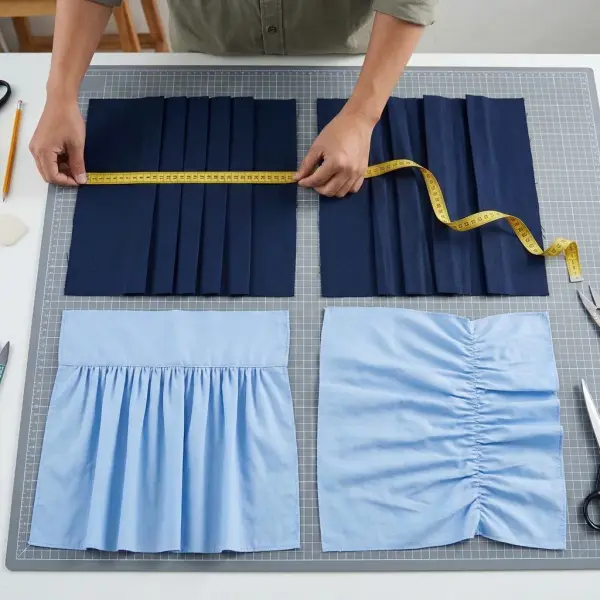
Why Small Construction Errors Become Visible in Pleated and Gathered Garments
Pleats and gathers manipulate excess fabric into a controlled arrangement. Because the fabric is deliberately folded or compressed, small dimensional differences can become more noticeable than they would on a plain garment panel.
A basic straight seam may tolerate minor visual variation without significantly changing the garment's appearance. A series of closely spaced pleats, however, creates a repeating pattern that makes inconsistencies easier to detect. When one fold is wider, deeper, or angled differently from its neighbors, it interrupts the intended rhythm.
Gathering creates a different quality-control challenge. Unlike pleats, which usually have defined foldlines and placement lines, gathers distribute numerous small folds along a seam. Their appearance requires controlled variation rather than identical geometric repetition.
This distinction is important when identifying defects. A gathered skirt does not need every small fold to have exactly the same width, but the overall fullness should appear balanced and consistent with the approved design.
The consequences can extend beyond appearance. Incorrect pleat take-up may change finished garment measurements. Excessive gathers can create thickness at a waistband, while distorted seams may affect how the garment hangs or moves.
These problems become commercially relevant when construction details are central to the product's design identity. A fashion brand selling a premium pleated skirt, for example, needs consistent fold definition and alignment across its production batch. Visible irregularities may reduce perceived quality even when the garment remains structurally sound.
Mistake 1: Uneven Pleat Spacing and Inconsistent Fold Depth
Uneven pleat spacing is one of the most recognizable defects in pleated garments. It occurs when the visible distance between folds differs from the intended pattern specification.
In a knife-pleated skirt, repeated folds normally create a deliberate visual rhythm. When the spacing becomes inconsistent, some sections appear compressed while others seem unusually wide.
Inconsistent pleat depth can produce a related problem. Two pleats may appear similar from the outside but contain different amounts of concealed fabric. This can change how they open, hang, or align with adjacent garment sections.
Why Pleat Spacing Becomes Uneven
The problem may begin during marking. If foldlines and placement lines are transferred inaccurately, the operator may follow incorrect reference points despite sewing carefully.
Fabric movement can also contribute. Lightweight, slippery, or loosely structured materials may shift during handling, making it difficult to maintain consistent measurements.
Another cause is cumulative error. A slight discrepancy in each repeated pleat may eventually create a significant mismatch at the end of the panel.
For example, if ten pleats each introduce an unintended 2 mm dimensional error, the accumulated discrepancy could reach 20 mm. Whether the errors add together or partially cancel depends on their direction, but the example illustrates why repeated construction details require careful control.
How to Prevent Uneven Pleats
Accurate marking should begin before folding. Patternmakers need to distinguish between foldlines, placement lines, and the amount of fabric concealed in the underlay.
The Seamwork guide to pleat construction explains these dimensions and illustrates the importance of aligning marked folds correctly.
For repeated production, templates can help maintain consistent spacing. Operators should also check the total finished panel width after forming the pleats rather than waiting until the waistband or adjoining component has been attached.
The inspection should consider both the visible spacing and the concealed fold structure. A pleat that appears correct when laid flat may hang differently if its depth is inconsistent.
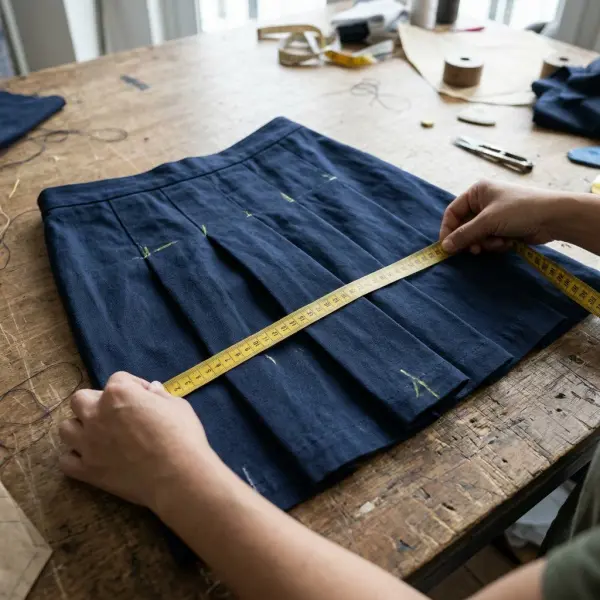
Mistake 2: Incorrect Pleat Direction and Poor Fold Alignment
Pleat direction determines the visual arrangement of the folds. A knife pleat generally follows the same direction as neighboring knife pleats, while a box pleat uses opposing folds arranged around a center.
When a fold faces the wrong direction, the design can become visibly inconsistent. The error may appear as an interruption in a repeated pleat sequence or as an incorrectly formed symmetrical panel.
This issue frequently results from ambiguous construction instructions. A technical drawing may show the front of the garment without clearly identifying the fold direction on the fabric's right side.
For a box pleat, reversing the intended folds can produce an inverted box pleat. Although both constructions are valid, they create different visible arrangements.

Why Fold Direction Errors Occur
Pleat direction errors can happen when pattern markings are incomplete, difficult to interpret, or transferred to the wrong fabric surface.
They can also occur when the operator works with a mirrored pattern piece and unintentionally reverses the intended fold arrangement.
If the garment requires symmetrical pleats on the left and right sides, the production team must understand whether the folds should mirror each other or maintain the same directional orientation.
Without clear instructions, two operators may produce different results from the same basic pattern.
How to Maintain Correct Pleat Alignment
Technical specifications should identify the garment's right side, intended fold direction, and placement of the visible fold edges.
An approved sample provides an important reference, particularly when the pleat arrangement is not immediately obvious from a flat drawing.
For box pleats, the central panel should be checked for symmetry. For knife pleats, the fold sequence should be inspected before the pleated panel is permanently attached to other garment components.
A detailed explanation of these structural distinctions is available in knife pleats versus box pleats and their construction methods.
Mistake 3: Incorrect Fabric Allowance for Pleats and Gathers
Pleats and gathers require more fabric than their finished dimensions suggest. When this additional material is calculated incorrectly, the garment may become too narrow, too full, or dimensionally inconsistent with the specification.
Pleats conceal material inside folds. Gathers draw a longer fabric section into a shorter finished length. Both techniques require accurate pattern dimensions before assembly.
The problem often begins when a designer communicates a desired appearance without defining the amount of fabric required to achieve it.
Miscalculating Pleat Take-Up
For a conventional knife pleat, the concealed fabric allowance is related to the depth of the fold. Under a common drafting convention, a pleat with a 2 cm depth requires approximately 4 cm of additional fabric take-up.
If a pattern contains eight such pleats, their combined take-up is approximately 32 cm.
This relationship applies to the specified conventional pleat geometry. Other pleat arrangements require their own calculations, and the finished garment dimensions must be verified after folding.
If the patternmaker omits or miscalculates the take-up, the final pleated panel may fail to match the intended waistband or seam length.
Choosing an Incorrect Gathering Ratio
Gathering ratios describe the relationship between the original fabric length and its finished gathered length.
For example, a fabric edge measuring 120 cm gathered into a 60 cm seam has a gathering ratio of 2:1.
This ratio does not establish a universal level of desirable fullness. A lightweight voile may accommodate the additional material easily, while a thick cotton twill could create excessive bulk.
A smaller ratio may be more appropriate for heavier materials, but the correct selection depends on the actual fabric and design.
The Threads guidance on gathering methods similarly emphasizes evaluating the amount of fullness in relation to the fabric's weight and the intended effect.
Why Fabric Allowance Errors Affect Production
Incorrect fabric allowances can create fit problems, wasted material, and additional sampling work.
If a gathered skirt contains too little fabric, the designer may lose the intended fullness. If it contains too much, the waistband seam may become excessively bulky.
A pleated panel with insufficient take-up may fail to form the required folds or may need to be cut again.
For manufacturers, the safest approach is to verify flattened pattern dimensions and finished measurements separately. The two measurements serve different purposes and should not be treated as interchangeable.
Mistake 4: Unevenly Distributed Gathers
Uneven gathering occurs when fullness accumulates in certain areas instead of being distributed according to the design.
The problem is particularly noticeable in gathered skirts, puff sleeves, tiered dresses, ruffles, and waist seams. One section may contain tightly clustered folds while another appears almost flat.
Unlike pleats, gathers are not usually expected to form perfectly identical folds. Nevertheless, a balanced overall distribution is essential to the intended appearance.
Why Gathers Become Uneven
Uneven gathering can result from pulling the gathering threads without redistributing the fabric before final stitching.
It can also occur when the gathered panel is attached without matching reference points between the two fabric sections.
During sewing, the presser foot and feed mechanism may push or compress the small folds. If the operator does not control the fabric carefully, fullness can shift toward one end of the seam.
Slippery fabrics can make this process more difficult because the folds move readily during handling.
How to Create More Consistent Gathers
The construction process should begin with evenly placed reference marks along both the gathered edge and the adjoining piece.
These markers divide the seam into corresponding sections, allowing the operator to distribute the fullness gradually rather than concentrating it near one end.
Parallel rows of temporary gathering stitches can help control the folds. The gathered edge should be adjusted to the required finished length before permanent attachment.
In its technical explanation of evenly distributed gathering, Threads describes using parallel gathering stitches, securing the fabric at intervals, and adjusting the gathers as the final seam is sewn.
After the gathered edge has been positioned, the operator should inspect the overall distribution before stitching. Correcting uneven fullness at this stage is generally easier than removing a completed seam.
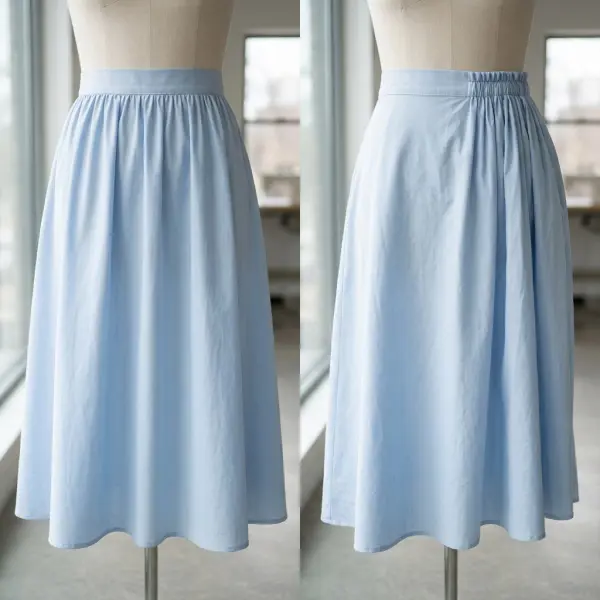
Mistake 5: Gathering Threads Break During Construction
Broken gathering threads can interrupt the construction process and make it difficult to maintain the intended fullness.
Traditional gathering methods use temporary stitches that allow the fabric to move along the sewing threads. If the thread breaks while the operator is drawing up the fabric, the gathered section may loosen or require additional preparation.
This problem becomes more likely when excessive force is applied or the stitching and thread setup are unsuitable for the material.
Common Causes of Broken Gathering Threads
A gathering thread may break because the sewing tension is excessive, the thread is weak or damaged, the stitch length is too short for easy adjustment, or the operator pulls too aggressively.
Long, densely gathered fabric sections can also create substantial resistance as the material is moved along the thread.
The problem should not automatically be attributed to thread strength. Machine settings, fabric friction, gathering density, and handling technique may all contribute.
Practical Ways to Prevent Thread Breakage
Temporary gathering stitches should be long enough to permit controlled adjustment, with the appropriate length established through testing. A standard stitch length intended for permanent seams may be too restrictive for some gathering operations.
Operators should leave sufficient thread tails and avoid locking the temporary gathering rows in a way that prevents the intended adjustment.
Gathering should be performed gradually, moving the fabric along the threads without excessive force. Depending on the method, operators may draw either needle or bobbin threads, but they should use the chosen system consistently.
Alternative methods, including gathering over a stronger cord or using suitable gathering equipment, may be appropriate for more difficult materials.
The correct technique depends on fabric behavior and the intended construction, not on a single universal machine setting.
Mistake 6: Seam Puckering Around Pleats and Gathers
Seam puckering is an unwanted wrinkling or distortion that appears along a stitched seam. It can resemble gathering, but the two should not be confused.
Intentional gathers are a planned construction feature. Seam puckering is an unintended distortion caused by interactions among the fabric, thread, stitching, and feeding conditions.
This distinction is particularly important when inspecting garments that already contain intentional fullness. A gathered blouse may have acceptable small folds at the neckline but unacceptable puckering along the adjoining yoke seam.
Incorrect Thread Tension
Excessive sewing-thread tension can cause a seam to contract or become distorted after stitching.
The Coats technical guidance on eliminating seam puckering identifies tension-related puckering as one of several distinct causes. The problem can occur when stretched sewing thread relaxes and draws the surrounding fabric together.
The appropriate correction involves checking thread balance and reducing excessive tension while maintaining a secure, balanced stitch.
Simply loosening every machine setting is not a reliable solution because seam performance must still meet the garment's requirements.
Uneven Fabric Feeding
When adjoining fabric layers move through the sewing machine at different rates, one layer may become stretched or compressed relative to the other.
This can produce an irregular seam even when the operator begins with correctly measured pattern pieces.
Feed-related puckering may be influenced by presser-foot pressure, feed mechanisms, material friction, and operator handling.
The corrective approach should address the actual feeding problem. Depending on the machine and fabric, this may involve adjusting presser-foot pressure, improving layer control, or using an appropriate differential or specialized feeding mechanism.
Needle, Thread, and Fabric Compatibility
Seam puckering can also result when the sewing needle and thread are unsuitable for a tightly woven or delicate material.
A relatively large needle or thread can displace fabric yarns and create distortion along the stitch line. Some fabrics are especially sensitive because their structure provides limited room for the thread.
Using a compatible needle and thread combination, adjusting stitch density, or modifying the construction method may improve the result.
Manufacturers should diagnose the cause rather than assume that every puckered seam requires the same correction.
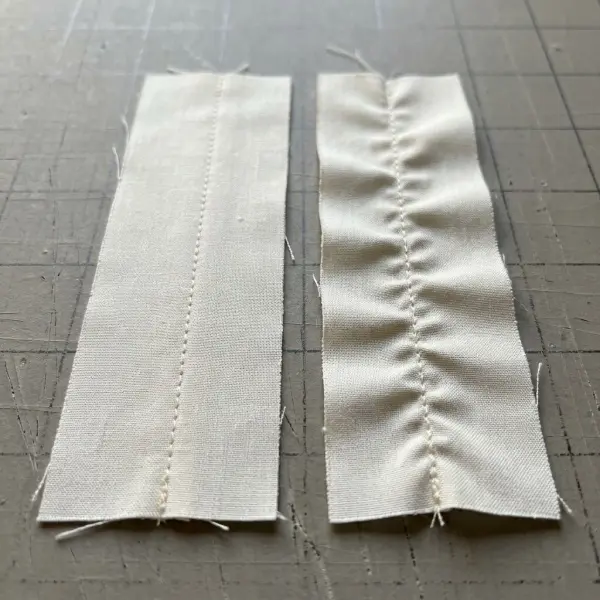
Mistake 7: Excessive Fullness and Bulky Seam Intersections
Pleats and gathers introduce additional fabric, but the location of that material matters as much as the quantity.
A design may look attractive when the garment is viewed from a distance, yet reveal excessive bulk around the waistband, cuff, shoulder, or seam intersection.
This issue is especially relevant when thick fabric is folded into multiple layers or densely gathered into a narrow attachment area.
Why Bulk Develops
Every fold adds fabric layers. Deep pleats can create substantial thickness where the underlays overlap, particularly near a waistband.
Dense gathers create a different form of accumulation. Many small folds are compressed into a short seam, producing a raised ridge that may be difficult to sew or press neatly.
Additional components such as linings, interfacing, seam allowances, and elastic bands can increase the total thickness.
The final result depends on fabric weight, construction geometry, seam placement, and finishing.
How to Reduce Unwanted Bulk
Material selection should be reviewed before attempting to solve the problem through sewing alone.
A lighter fabric or lower gathering ratio may produce the desired silhouette without excessive thickness. Pleat depth and placement can also be adjusted to reduce material concentration.
Where appropriate, carefully planned seam allowance grading or other bulk-management techniques may help, provided the seam's strength and durability are maintained.
For example, a gathered cotton skirt attached to a structured waistband may require a different seam construction from a chiffon skirt attached to a lightweight lining.
The most effective solution is usually determined during sampling, before the final construction becomes part of the bulk production process.
Mistake 8: Poor Pressing That Distorts Pleats or Flattens Gathers
Pressing contributes significantly to the finished appearance of pleated garments. However, it can also create defects when heat, moisture, pressure, or movement are inappropriate for the fabric and construction.
A sharply defined knife pleat may require controlled pressing to establish the intended fold. Soft gathers, by contrast, can lose their dimensional character when pressed too aggressively.
Applying the same pressing method to both techniques can therefore produce undesirable results.
Pressing Pleats Incorrectly
Dragging an iron across an unstable pleated panel may shift the fabric and distort foldlines. Inconsistent pressure can also create uneven crease definition.
The appropriate technique generally involves positioning the folds accurately and applying controlled pressing rather than dragging the iron across them.
The temperature and moisture settings must be compatible with the fabric's fiber content and finish. Some materials are sensitive to heat or pressure and may develop unwanted shine, flattening, or surface damage.
A pressing cloth or suitable protective method can be useful for certain fabrics, but it does not eliminate the need to test safe pressing conditions.
Flattening Soft Gathers
Gathered sections should usually retain their intended fullness after pressing.
Excessive pressure can flatten the small folds or create sharp creases that were not part of the original design. This may make the gathered area appear stiff or irregular.
The Tilly and the Buttons guide to sewing gathers recommends gentle pressing rather than crushing the gathered fullness.
The aim is to settle the seam and improve its finish without removing the fabric's dimensional character.
Confusing Pressed Pleats With Permanent Pleats
A well-pressed pleat is not necessarily permanent.
Crease retention depends on fiber composition, fabric construction, finishing treatment, and the pleating process. Certain thermoplastic synthetic materials can be heat-set under suitable conditions, but this does not mean ordinary ironing provides permanent pleat retention.
Manufacturers should verify how the fabric responds to washing, steaming, and the intended care method.
Claims about permanent or long-lasting pleats should be based on the actual production process and garment testing.
Mistake 9: Ignoring Fabric Grain and Dimensional Stability
Fabric grain influences the way a garment hangs, stretches, and responds to construction.
When pleated panels are cut or assembled with unintended grainline differences, the folds may twist or hang unevenly. This can become particularly visible on long skirts or garments made from lightweight fabrics.
Gathered panels may also behave differently when part of the edge is cut on the bias or when adjoining fabrics have different stability characteristics.
Pleats That Twist After Assembly
A pleated skirt may look symmetrical when arranged on a cutting table but develop uneven folds when hanging freely.
Possible causes include inconsistent grainline placement, fabric distortion during cutting, inaccurate seam alignment, or uneven handling during assembly.
A panel cut off-grain may not respond to gravity in the same way as the approved sample.
The solution begins with verifying the pattern grainline and cutting accuracy. Pressing may temporarily improve appearance, but it cannot reliably correct a fundamentally distorted panel.
Gathered Seams That Stretch Out of Shape
A gathered edge attached to an unstable or bias-cut adjoining component may cause dimensional changes during handling.
As the fabric stretches, reference markings can shift and the finished seam may become longer than intended.
Stabilizing selected edges before assembly may help control this problem. Appropriate staystitching, stay tape, or other stabilization methods should be selected based on the material and construction.
These measures should be verified through sampling, especially when working with delicate, slippery, or loosely structured textiles.
Mistake 10: Failing to Control Pleats and Gathers During Final Assembly
Pleats and gathers may be correctly prepared before sewing but become distorted when the garment components are joined.
A pleated panel can shift as it is attached to a waistband. A gathered section can bunch under the presser foot, or additional fabric can become accidentally trapped in the permanent seam.
The result may include irregular folds, unintended tucks, twisted panels, or uneven seam lengths.
Waistbands often act as a fixed reference dimension for pleated or gathered skirts.
If the prepared skirt edge does not match the waistband length, the operator may try to compensate by stretching one section, compressing another, or changing the fold distribution.
This can create an uneven garment even when the individual components were initially prepared correctly.
The better approach is to verify the finished pleated or gathered edge length before attachment. Matching notches or reference points should align without forcing the fabric.
Accidental Tucks in Gathered Seams
Small folds are expected in gathered fabric, but an unintended deep tuck can create an obvious defect.
This happens when excess material becomes trapped beneath the stitching line rather than being distributed as intended.
Operators should inspect the gathered edge during sewing and stop when visible bunching develops. A temporary hand-basting step may be useful for unstable or difficult materials.
The final seam should secure the fullness without creating unintended fold concentrations outside the approved appearance.
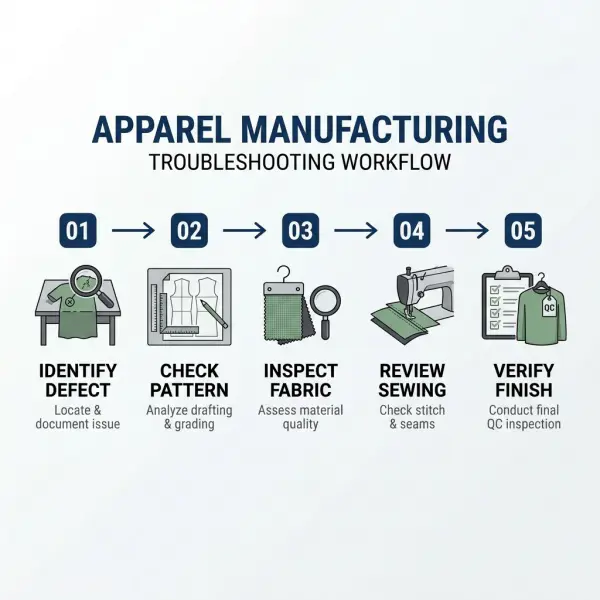
How to Diagnose Pleating and Gathering Defects
Correcting a defect begins with identifying whether the problem originated in pattern development, fabric selection, preparation, sewing, pressing, or final assembly.
A visual irregularity alone does not always reveal its cause. For example, a distorted pleat could result from incorrect marking, inconsistent depth, fabric grain problems, or poor pressing.
The following table provides a practical starting point for investigating common defects.
|
Visible problem |
Likely causes to investigate |
Recommended corrective action |
|
Uneven pleat spacing |
Inaccurate marking, fabric shifting, cumulative folding errors |
Verify pattern lines, measurements, and fold placement |
|
Incorrect fold direction |
Ambiguous instructions, reversed markings |
Check right-side orientation and approved pleat layout |
|
Asymmetrical box pleat |
Unequal fold depth, incorrect center positioning |
Recheck centerline and mirrored fold dimensions |
|
Finished panel too narrow |
Incorrect pleat take-up or excess gathering |
Verify flat and finished pattern dimensions |
|
Gathers concentrated in one area |
Poor distribution, shifted reference marks |
Redistribute fullness using matching section markers |
|
Broken gathering threads |
Excessive pulling, unsuitable stitches or thread |
Test thread, stitch length, and gathering method |
|
Puckered seam |
Thread tension, feeding, needle or fabric incompatibility |
Diagnose seam mechanics and adjust the actual cause |
|
Excessive waistband bulk |
High gathering ratio, thick fabric, overlapping layers |
Review fullness, material, and seam construction |
|
Flattened gathers |
Excessive pressing pressure |
Use controlled pressing that preserves the intended volume |
|
Twisted pleated panel |
Grainline or cutting distortion, assembly misalignment |
Check cutting accuracy and garment balance |
|
Pleats lose definition after washing |
Inadequate crease retention for the material and process |
Test finishing and intended care procedure |
A useful troubleshooting process distinguishes between dimensional defects and surface appearance defects.
Dimensional defects require checking the pattern and construction measurements. Surface defects may involve folding, stitching, handling, or finishing.
Some problems involve both. A seam that appears puckered may also have experienced unequal feeding, leaving one fabric layer effectively longer than the other.
Quality teams should therefore avoid treating pressing as the default correction for every visible irregularity.
How Fashion Brands Can Prevent Construction Defects Before Production
Preventing pleating and gathering errors is generally more effective than correcting completed garments. For apparel brands, the best opportunity to reduce defects is during product development, when patterns, fabric selections, and construction specifications can still be adjusted.
The production system should connect design intent with measurable instructions and an approved physical reference.
Establish Clear Technical Specifications
A technical package should explain how the fabric manipulation is constructed, not simply identify it by name.
For pleated garments, the specification should define pleat type, number, depth, spacing, direction, placement, release point, and pressing requirements.
For gathered garments, it should identify the relevant seam lengths, gathering ratio or approved fullness, distribution requirements, and attachment method.
An approved sample helps interpret these instructions and provides a visual reference for both production and quality control.
Test the Actual Production Fabric
A construction technique that works on one fabric may behave differently on another.
The development team should test the proposed material for fold stability, bulk, seam appearance, drape, and compatibility with the intended pressing process.
If the production fabric is substituted, even with a material of similar weight, the pleating or gathering result should be reviewed again.
Fabric width, shrinkage, finish, and handling characteristics may affect both pattern consumption and final appearance.
Use a Pre-Production Construction Checklist
Before bulk cutting and assembly, manufacturers can review the most important construction controls:
- Confirm that flat pattern dimensions and finished garment measurements are correct.
- Verify pleat foldlines, placement lines, directions, and depth.
- Check gathering ratios and reference-mark distribution.
- Test the proposed needle, thread, stitch, and machine-feed settings.
- Confirm pressing conditions on the actual fabric.
- Inspect sample garments after assembly and intended care testing.
- Establish visual acceptance criteria using approved production samples.
These checks should be integrated into sampling and pre-production approval rather than treated as an additional inspection at the end of manufacturing.
Introduce In-Line Quality Checks
Waiting until final inspection can make pleating and gathering defects more expensive to correct.
A pleat-direction error discovered before waistband attachment may be corrected through refolding. The same problem identified after complete garment assembly may require seam removal, repressing, and further sewing.
For gathers, an early check can confirm distribution before the permanent seam is completed.
In-line quality control should focus on construction stages where defects are easiest to detect and correct. The exact checkpoints depend on the production process and garment design.
What Pleating and Gathering Defects Mean for Production Costs
Construction defects affect production economics through additional labor, material waste, inspection requirements, and potential shipment delays.
Not every visual irregularity creates the same cost. A minor fold adjustment before permanent stitching may require little additional work, while a finished garment with incorrect pleat direction could need substantial rework.
The timing of detection is therefore important.
Rework and Material Loss
When a pleated panel contains incorrect dimensions, the manufacturer may need to remove stitching and reform the folds.
However, some materials cannot be repeatedly unpicked or pressed without developing visible needle marks, fabric damage, or unwanted creases.
If the garment panel cannot be restored to the required appearance, replacement fabric and additional cutting may be necessary.
This is why pattern accuracy and fabric testing have commercial value beyond improving aesthetics.
Productivity and Operator Consistency
Pleating and gathering operations depend on both the construction method and the operator's control of the material.
Repeated narrow folds may require precise marking and positioning. Gathers may require careful distribution immediately before stitching.
When instructions are ambiguous, different operators may develop slightly different methods, producing inconsistent results across a production batch.
Standardized construction procedures, approved samples, and suitable operator training can help make results more repeatable.
Customer Returns and Product Expectations
Visible defects may affect customer satisfaction, particularly when pleating or gathering is a prominent design feature.
A customer purchasing a pleated skirt may expect consistent fold definition and an even silhouette. If the garment arrives with distorted pleats or irregular gathering, the appearance may not match the product photography.
However, return rates or financial losses cannot be attributed to pleating defects without actual business data.
Brands should assess these issues using their own inspection results, customer feedback, and return reasons rather than relying on unsupported industry assumptions.
Important Technical Caveats: When an Irregularity Is Not a Defect
Not every variation in pleating or gathering represents poor construction. Some designs intentionally use asymmetry, irregular folds, or unevenly distributed volume.
A fashion collection may include intentionally twisted pleats or softly arranged gathers that do not follow a rigid geometric pattern. These details should be judged against the approved design, not a generic expectation of symmetry.
The distinction becomes important during quality inspection.
A conventional knife-pleated uniform skirt may require highly consistent fold direction and spacing. An experimental draped dress may intentionally use uneven fold arrangements to create movement or sculptural shape.
Fabric behavior also matters. Certain linen garments may develop a relaxed crease appearance during wear, while finely pleated synthetic garments may be designed to retain a more structured surface.
Quality-control teams should distinguish between intentional design characteristics, acceptable material variation, and actual construction defects.
For that reason, the approved physical sample, technical specification, and intended care performance should establish the acceptance standard. Generic rules should support inspection, not replace the product's specific design requirements.
Frequently Asked Questions
1. Why do pleats become uneven after sewing?
Pleats may become uneven after sewing because their folds shift during handling, attachment, or pressing. Inaccurate pattern markings and inconsistent pleat depths can also create the problem before sewing begins.
The first step is to compare the finished panel against the original fold and placement markings. If the measurements are incorrect, the pleats may need to be released and reconstructed. If the measurements are correct but the fabric has shifted during assembly, the issue may be addressed by improving temporary securing and sewing control. Pressing can refine properly formed folds, but it should not be used to conceal incorrect dimensions.
2. Why are my fabric gathers uneven?
Uneven gathers usually result from poor distribution of fullness, insufficient reference markings, or movement of the fabric during sewing.
A longer fabric edge must be reduced to the intended seam length while maintaining the required appearance. If the fullness is gathered toward one side, the garment may look unbalanced. Using matching notches or reference marks on both fabric pieces helps divide the seam into manageable sections. Temporary gathering stitches should allow adjustment before the permanent seam is sewn. Operators should also monitor the folds during stitching because fabric feeding can change their distribution after the pieces have been pinned.
3. How do you prevent gathering threads from breaking?
Gathering threads are less likely to break when the stitching method, thread quality, machine tension, and handling technique are suitable for the fabric.
Temporary gathering stitches should allow the fabric to move along the thread without excessive resistance. Pulling too aggressively, especially across a long or densely gathered section, can increase the risk of breakage. Operators can work gradually, use appropriate stitch lengths, and avoid unnecessary tension on the thread. For difficult materials, alternative methods such as gathering over a stronger cord may be useful. Any adjustment should be tested on the actual fabric before production.
4. Can incorrect ironing damage pleats and gathers?
Yes. Incorrect pressing can distort pleats, flatten gathers, create unwanted creases, or damage sensitive fabrics.
Pleats generally require accurate fold positioning and controlled pressing, while soft gathers often need gentler treatment to preserve their volume. Excessive heat can damage certain fibers or finishes, and too much pressure may create shine or flatten the intended texture. A pressing cloth can provide protection for some fabrics, but it is not a substitute for selecting suitable heat and moisture conditions. Manufacturers should test pressing methods on the production material and verify the garment's appearance after the intended care process.
5. Why does gathered fabric pucker near the seam?
Puckering near a gathered seam may result from incorrect thread tension, unequal feeding of fabric layers, unsuitable stitching conditions, or instability in the material.
The difficulty is that intentional gathering already creates small folds, making it necessary to distinguish designed fullness from unintended seam distortion. Inspectors should evaluate whether the irregularity follows the seam stitching or reflects the approved gathering distribution.





Comments 0
Leave a CommentSend Comment
Anda harus Login terlebih dahulu untuk dapat memberikan komentar.