

Embroidery, Lace, and Appliqué: Decorative Textile Techniques Compared
Quick Answer
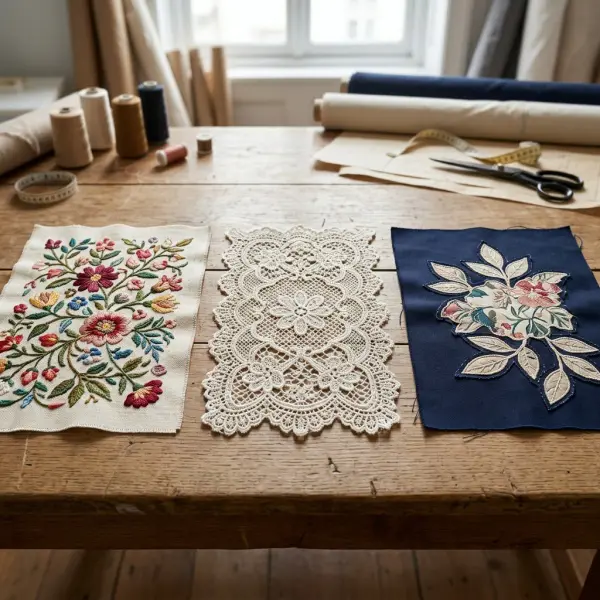
Embroidery, lace, and appliqué are decorative textile techniques, but they create surface interest in different ways. Embroidery builds a design with stitches on or through a foundation material. Lace creates an openwork textile structure in which threads form motifs and connecting grounds. Appliqué attaches separately cut pieces of fabric, lace, leather, or another material onto a base.
The boundaries are not always clean. Embroidery can be worked on net to create lace-like fabric. Lace motifs can be cut out and appliquéd onto a garment. Appliqué edges are often secured or decorated with embroidery. Historical techniques such as Carrickmacross lace combine net, applied fabric, cutting, and embroidery in one construction.
For fashion businesses, the practical distinction lies in where the design is created, how much structural support it needs, and when it enters the production process. Embroidery can be executed directly on garment panels or finished products. Lace may be purchased as fabric, trim, or individual motifs. Appliqué requires both a foundation and separately prepared components.
The right technique depends on the intended appearance, base fabric, garment construction, production volume, equipment, labor availability, care requirements, and acceptable cost.
What Is the Difference Between Embroidery, Lace, and Appliqué?
The simplest difference concerns the role of the foundation material.
Embroidery normally decorates an existing woven, knitted, nonwoven, leather, or other substrate with thread-based stitches. The foundation remains part of the finished product.
Lace is usually an openwork structure in which the patterned threads and the spaces between them form the textile itself. Traditional needle and bobbin lace can exist without a permanent woven ground, although some modern fabrics marketed as lace are embroidered on net or produced on removable supports.
Appliqué uses separately shaped material pieces that are placed and secured onto a foundation. The applied element may contrast with the base through color, texture, transparency, fiber, pattern, or relief.
|
Technique |
Core construction principle |
What creates the design? |
Is a permanent foundation required? |
Typical commercial format |
|
Embroidery |
Stitches are added to a material |
Thread, decorative yarn, cord, beads, sequins, or similar elements |
Usually yes |
Embroidered fabric, garment panel, badge, trim, or finished product |
|
Lace |
Threads form an openwork textile structure |
Motifs, grounds, bars, braids, loops, or knitted nets |
Not always |
Full-width fabric, narrow trim, edging, insertion, or motifs |
|
Appliqué |
Cut material components are attached to a base |
Added fabric, lace, leather, felt, film, or other surface pieces |
Yes |
Garment panel, patch, motif, border, badge, or layered composition |
These definitions are useful, but commercial materials frequently combine techniques. A product developer should therefore describe what has physically been made rather than forcing every textile into one exclusive category.
Why Are These Techniques Frequently Confused?
They are confused because the finished visual effect may be similar even when the production logic is different.
A floral motif could be:
- Embroidered directly onto tulle
- Formed inside a warp-knitted lace
- Cut from lace and appliquéd onto satin
- Created as free-standing machine embroidery
- Cut from woven fabric and secured with embroidered edges
- Assembled from separate appliqué pieces with embroidered internal details
From the front, several of these options may produce a comparable floral surface. From the reverse, however, their construction, seam bulk, flexibility, finishing, labor requirements, and durability may be very different.
Historical development also explains some of the overlap. The Metropolitan Museum of Art describes how needle lace developed from cutwork embroidery: sections of a woven foundation were removed, and the resulting spaces were stabilized and filled with stitches. Over time, lacemakers created structures that no longer required the original cloth foundation.
This relationship means that embroidery, cutwork, lace, and appliqué should not be treated as completely isolated traditions. Their technical histories and contemporary manufacturing applications frequently intersect.
How Embroidery Creates Decorative Textile Surfaces
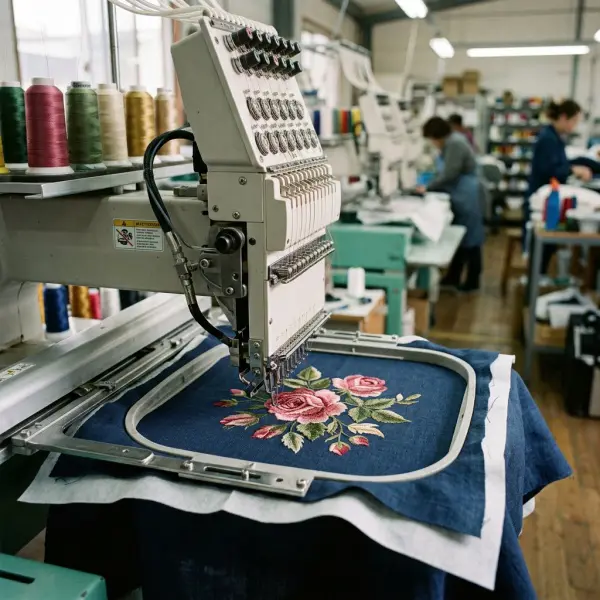
Embroidery is the process of creating decoration by stitching thread or other flexible materials onto or through a foundation. It can be worked manually, with conventional sewing equipment, or through computerized single-head, multi-head, Schiffli, chenille, sequin, and other specialist machines.
The foundation may be almost any sewable material, including cotton shirting, denim, knitwear, tulle, organza, leather, felt, coated fabric, or a garment component. The foundation’s stability strongly affects the result.
The V&A’s guide to embroidery styles illustrates how embroidery includes a broad range of stitch systems, materials, cultural practices, and openwork techniques rather than one standardized decorative method.
Hand Embroidery
Hand embroidery gives the maker direct control over stitch direction, spacing, tension, layering, and variation. It is especially useful when the design depends on irregularity, delicate material handling, highly dimensional surfaces, or regionally specific craft knowledge.
Common hand-worked structures include satin stitch, chain stitch, couching, split stitch, stem stitch, running stitch, French knots, bullion knots, and combinations of several stitches.
Hand embroidery is not inherently superior to machine embroidery. Its value depends on the design objective, workmanship, material selection, production context, and whether the customer recognizes the labor involved. Poorly controlled handwork can create inconsistent density, distorted motifs, loose threads, or uneven tension just as easily as poorly programmed machine embroidery.
For commercial fashion, hand embroidery is most viable when:
- The quantity is limited
- The selling price can absorb substantial labor
- Controlled variation is part of the design identity
- Skilled production partners are available
- The product story is supported by genuine traceability
- Repair and replacement expectations are realistic
Scaling hand embroidery is not simply a matter of assigning more workers. Quality consistency, training, material distribution, approval standards, production scheduling, and fair compensation all require management.

Machine Embroidery
Machine embroidery translates artwork into programmed stitch instructions. A digitized file determines stitch type, direction, sequence, density, color changes, trims, underlay, and other production parameters.
Digitizing is not equivalent to converting an image into a printable graphic. The programmer must anticipate how thread and fabric will behave under repeated needle penetration and tension.
Commercial digitizing software can manage fill patterns, stitch density, sequencing, overlap removal, trims, and specialized effects. Tajima’s documentation, for example, describes tools for programmed fills, graduated density, sequencing, chenille, appliqué-related patch production, and reducing unnecessary overlapping stitches.
The quality of machine embroidery depends on the relationship between:
- Artwork scale
- Stitch length and density
- Underlay
- Thread type and weight
- Needle selection
- Upper and bobbin tension
- Fabric stability
- Hooping or fixation
- Backing and topping
- Machine speed
- Design sequence
- Operator control
High stitch density does not automatically produce higher quality. Excessive stitches can increase thread consumption, machine time, stiffness, puckering, needle damage, and stress on the foundation. ZSK’s production guidance treats density as a measurable quality and cost variable rather than a purely aesthetic choice.
The Role of Backing and Topping
Many embroidered fabrics require temporary or permanent stabilization. Backing is placed behind the material to reduce movement and help support the stitches. Topping is placed on the face when the textile surface is textured, elastic, piled, or otherwise likely to allow stitches to sink.
Madeira’s technical guidance notes that backing must be selected according to both the base material and embroidery design. It also distinguishes tear-away, cut-away, fusible, water-soluble, and specialty stabilizers, while recommending toppings for surfaces such as knitwear and terry fabrics.
A backing that is too light may allow puckering or misregistration. A backing that is too heavy may make the finished panel stiff, visible, uncomfortable, or difficult to sew into the garment.
The correct stabilizer is therefore part of the product specification, not merely an embroidery contractor’s consumable.
How Lace Differs From Embroidery
Lace is distinguished by its deliberate use of open space as part of the textile structure. Threads form motifs and supporting networks rather than simply decorating a fully formed base material.
Traditional needle lace is built with a needle and sequential stitches, while bobbin lace is created by crossing, twisting, and interlacing multiple threads. Machine-made alternatives include Leavers lace and warp-knitted Raschel lace.
This does not mean every commercial product called lace is made without a foundation. Embroidered tulle, chemical lace, cutwork, and free-standing embroidery may be sold alongside structurally constructed lace because they serve similar visual markets.
A more complete examination of needle, bobbin, Leavers, Raschel, guipure, Chantilly-style, and stretch lace appears in this guide to lace fabric types and characteristics.
Lace Uses Negative Space Structurally
In embroidery, open areas often reveal the base fabric. In lace, the openings are generally part of the textile construction itself.
This distinction affects how the material behaves. A fine lace ground may stretch, snag, distort, or transmit stress differently from an embroidered woven fabric. The lace structure may need to carry the garment load even though much of its visible area is open.
Designers should therefore avoid treating lace as “embroidery with holes.” The ground, connecting bars, motif density, yarn system, and edge construction all influence its mechanical performance.
Lace Is Often Sourced Before Garment Assembly
Full-width lace usually enters the product-development process as a fabric. It is spread, cut, lined, seamed, and handled much like other apparel materials, although motif matching and openwork construction require special attention.
Embroidery may instead be scheduled after pattern panels are cut. In some production systems, it is applied to a partially assembled or finished garment.
This workflow difference has commercial consequences. A delayed lace delivery can stop cutting. A delayed embroidery program may stop a later stage of assembly. Both can affect lead time, but at different points in the production calendar.
Lace Can Become an Appliqué Component
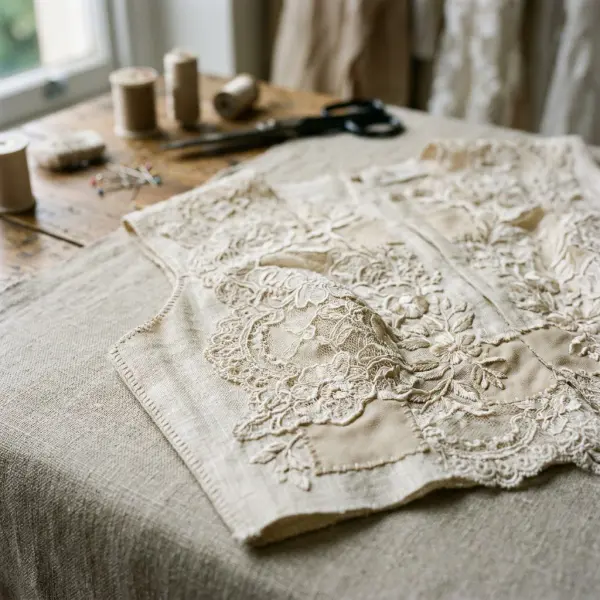
Individual lace motifs are often cut from a larger fabric and repositioned on a bodice, sleeve, veil, neckline, or seam. Once the motif is separated and attached to a foundation, it is functioning as an appliqué even though the component itself is lace.
This technique allows designers to conceal seams, build gradual motif placement, create asymmetrical layouts, or concentrate expensive lace only where it contributes most visibly.
It also adds labor. Motifs must be selected, cut, positioned, secured, inspected, and protected against unraveling or distortion.
How Appliqué Creates Decoration Through Layering
Appliqué creates a design by attaching one material onto another. The applied pieces may be woven fabric, knit fabric, lace, felt, leather, mesh, ribbon, reflective film, embroidered patches, or other sewable components.
Unlike embroidery, appliqué does not depend primarily on thread to fill the visual area. Thread is commonly used to secure or outline the shape, but the applied material provides most of the color, texture, pattern, or opacity.
Appliqué can be performed manually or with automated cutting and embroidery equipment. It may be added to flat fabric, pre-cut panels, or finished garments depending on the design and machinery.
Raw-Edge Appliqué
In raw-edge appliqué, the cut edge remains visible. It may be secured with straight stitching, zigzag stitching, satin stitching, adhesive bonding, or a combination of methods.
This approach can reduce preparation time and create a deliberately casual, graphic, or deconstructed appearance. Its suitability depends on whether the applied material frays and whether that fraying is acceptable.
Felt, leather, some coated fabrics, nonwovens, and certain knits may remain comparatively stable at the edge. Loosely woven fabrics may require stronger containment.
Turned-Edge Appliqué
Turned-edge appliqué conceals the raw edge by folding it underneath before attachment. It can produce a clean, crafted appearance, but small curves, sharp corners, and intricate motifs increase preparation time.
The technique is common in handwork, quilting, premium childrenswear, heritage-inspired fashion, and products where the reverse or edge quality will be closely examined.
For volume production, repeatability depends on templates, folders, pressing methods, operator skill, and the complexity of the shape.
Satin-Stitch or Embroidered-Edge Appliqué
Machine appliqué frequently uses a dense satin or zigzag border to cover the cut edge. The sequence may include a placement stitch, positioning of the appliqué material, a tack-down stitch, trimming, and the final decorative border.
This technique can create strong visual outlines and secure fabrics that would otherwise fray. However, the edge stitching adds density, stiffness, machine time, and thread consumption.
The applied material must also remain flat during the sequence. Poor placement can create gaps, folds, inconsistent borders, or exposed cut edges.
Reverse Appliqué
Reverse appliqué places a contrasting material beneath the foundation. Portions of the top layer are cut away to reveal the lower material.
The technique can create visual depth without stacking a prominent component on the garment face. It may also reduce edge bulk, although the exposed cut edge still requires appropriate stabilization.
Reverse appliqué is frequently associated with handcraft traditions, but the design logic can also be adapted to contemporary casualwear, leather goods, laser-cut panels, and performance-inspired products.
Bonded and Laser-Cut Appliqué
Adhesive films, heat bonding, and precision cutting can help control placement and reduce manual trimming. Laser cutting can produce complex shapes and may seal the edges of some synthetic materials, although results depend on fiber content, thickness, coatings, equipment settings, ventilation, and acceptable edge appearance.
Bonding is not automatically a substitute for stitching. Adhesive performance can be affected by washing, dry cleaning, heat, flexing, surface treatments, and incompatible materials.
For products expected to experience repeated wear or laundering, brands should test bonded appliqués through the full intended care cycle.

Where the Three Techniques Overlap
The most commercially interesting textiles are often hybrids. A buyer may be less concerned with whether a product belongs to one historical category than with how several processes combine to create the required result.
Embroidered Lace
Embroidery can be applied to tulle or net to produce a lace-like fabric. In chemical or free-standing embroidery, the design is stitched onto a temporary support that is later removed, leaving the thread structure behind.
The finished textile may visually resemble guipure or another openwork lace. Structurally, however, it has been created by an embroidery sequence rather than conventional bobbin, needle, Leavers, or Raschel lacemaking.
The difference affects design freedom, stitch density, minimum connecting points, production cost, handfeel, and how thread ends are secured.
Lace Appliqué
Lace appliqué can refer to lace motifs attached to another fabric or to historical lace constructions in which separately produced motifs are applied to a net ground.
Smithsonian collection records for Brussels appliqué lace describe examples combining bobbin-lace motifs with machine-made net. The objects demonstrate that “appliqué lace” can be both lace and appliqué, depending on which stage of the construction is being described.
For apparel developers, the relevant questions are:
- Were the motifs made separately?
- What is the foundation?
- How were the motifs attached?
- Are the connecting stitches structural or decorative?
- Can the finished textile be cut without destabilizing the applied motifs?
Carrickmacross and Other Composite Techniques
Carrickmacross lace is a useful example of category overlap. Smithsonian records classify Carrickmacross pieces using combinations of lace, appliqué, and embroidery terminology.
In this type of construction, fabric is applied to a net ground, areas may be cut away, and stitching helps define and secure the design. Calling the result only embroidery, lace, or appliqué would leave out part of the technical process.
This is why sourcing descriptions should state the construction sequence rather than depend solely on the final trade name.
Appliqué With Embroidered Details
Appliqué pieces can provide large fields of color efficiently, while embroidery supplies outlines, fine details, text, texture, or shading.
For example, a large varsity-style letter may use twill appliqué for the main area and satin stitching for the border. Filling the entire letter with embroidery would use more stitches, require longer machine time, and create a stiffer result.
The combination is not automatically cheaper, however. Material cutting, placement, tack-down, trimming, and rejects must be included in the cost.
Which Technique Is Most Suitable for Different Design Goals?
No technique is universally superior. Each one solves a different design and production problem.
|
Design objective |
Technique often considered first |
Why it may work |
Main limitation to verify |
|
Fine linework or lettering |
Embroidery |
Stitches can define controlled lines and small details |
Small text may close up or distort |
|
Large blocks of contrasting color |
Appliqué |
Added fabric covers area without dense thread filling |
Placement and edge finishing add operations |
|
Transparency across a full garment area |
Lace |
Openwork is integrated into the textile |
Snagging, lining, and seam stability |
|
Sculptural thread texture |
Embroidery |
Stitch direction and layering create relief |
Density can create stiffness and puckering |
|
Decorative borders or scalloped edges |
Lace |
Engineered edges can become garment finishes |
Usable width and motif direction |
|
Graphic layered shapes |
Appliqué |
Separate materials create strong contrast |
Fraying, bonding, and seam bulk |
|
Delicate motifs across tulle |
Embroidery or lace |
Both can create fine pattern over a transparent ground |
Construction, weight, and cost differ |
|
Concentrated luxury detailing |
Hybrid technique |
Lace, embroidery, and appliqué can be layered selectively |
Labor and quality control become complex |
The decision should be made against the garment architecture rather than the artwork alone. A motif that works on a rigid jacket panel may distort on a stretch bodysuit. An appliqué that performs on denim may be too bulky on chiffon.
How the Techniques Affect Garment Development
Artwork Preparation
Embroidery artwork must be translated into stitch logic. Lines need adequate thickness, shapes need workable stitch directions, and small gaps must remain open after thread coverage and fabric movement.
Lace development may require motif repeats, ground structures, scallop planning, yarn systems, and machine-specific pattern programming.
Appliqué artwork must be converted into cut components, placement references, seam or stitch margins, and attachment sequences.
A flat fashion illustration rarely contains all the information required for any of these processes. Technical development must define the material and sequence behind the visible design.
Placement and Pattern Engineering
Decoration affects pattern placement. An embroidered area may need to avoid seam allowances, darts, folds, buttonholes, or hardware. A lace motif may need to be centered or mirrored. An appliqué may cross a seam only if its assembly order permits it.
Product teams should establish a placement reference that includes:
- Distance from garment landmarks
- Orientation
- Finished dimensions
- Tolerances
- Relationship to seams
- Relationship to pattern grading
- Whether placement changes by size
- Whether the component is applied before or after assembly
Using the same decoration file across all sizes can create poor proportions. A chest motif that is balanced on a medium garment may appear oversized on the smallest size and undersized on the largest.
Sampling Sequence
A decorative prototype should be developed on the intended production material, not only on substitute fabric.
The sampling process should test the actual interaction between foundation, thread, lace, stabilizer, applied component, adhesive, needle, stitch settings, and care method.
A reasonable sequence is:
- Material compatibility test
- Small technique trial
- Full-scale motif sample
- Garment-panel sample
- Construction sample
- Fit sample with decoration
- Care and durability testing
- Sealed production standard
Skipping directly to a finished garment may hide the source of a defect. When puckering appears, for example, the problem could originate in digitizing, backing, tension, material relaxation, pressing, or garment assembly.
Cost and Scalability Compared
The visible size of a decoration is a poor predictor of its cost. A small, dense embroidered motif may require more machine time than a large but simple appliqué. A full-width lace fabric may reduce decoration operations but carry a high material price and inefficient marker utilization.
Embroidery Cost Drivers
Embroidery costing commonly considers stitch count, machine runtime, number of color changes, trims, thread type, setup, hooping, backing, motif size, garment handling, and order quantity.
The same stitch count can produce different costs if one design contains frequent trims and color changes while another runs continuously.
Embroidery applied to finished garments may require specialist frames and slower handling. Flat-panel embroidery is often easier to position and stabilize, but it must be coordinated before garment assembly.
Lace Cost Drivers
Lace cost includes purchase price, usable width, repeat, directional motifs, edge utilization, matching, cutting loss, lining, seam methods, mending, and defect allowances.
A lace that costs less per metre may become more expensive per garment if its large repeat causes substantial marker waste.
Custom lace development may also involve design charges, yarn sourcing, machine setup, sampling, minimum quantities, and longer lead times.
Appliqué Cost Drivers
Appliqué costing must include the applied material, cutting, sorting, placement, temporary fixation, edge finishing, embroidery or stitching, trimming, bonding, and inspection.
Automated cutting can improve repeatability, but it does not eliminate placement and attachment requirements. Small, intricate pieces may be especially difficult to handle at scale.
Handwork Versus Automation
Handwork is appropriate when its visual character and customer value justify the labor. Automation is appropriate when repeatability, volume, and lead time are more important.
The choice is rarely all-or-nothing. Many commercially viable products use machine-prepared components with selective hand finishing. Others use computerized embroidery to secure hand-positioned lace motifs.
The strongest production plan allocates skilled labor only where it creates visible or functional value.
Quality-Control Priorities
Each technique creates its own defect profile.
Embroidery Quality Checks
Inspect embroidery for:
- Puckering around the motif
- Poor registration between colors
- Loose or broken threads
- Exposed bobbin thread
- Incomplete fills
- Excessively dense or stiff areas
- Skipped stitches
- Needle damage
- Uneven outlines
- Backing visibility
- Abrasive reverse surfaces
- Incorrect placement or orientation
The reverse should be reviewed as carefully as the face when the embroidery contacts the skin.
Lace Quality Checks
Lace inspection should cover:
- Broken ground connections
- Holes outside the intended design
- Distorted motifs
- Repeat inconsistency
- Uneven scallops
- Width variation
- Shade variation
- Poor stretch recovery
- Loose cords or threads
- Snagged areas
- Damaged edges
- Differences between approved and bulk construction
Fine defects may be difficult to see on dark lace, so inspection lighting and background contrast matter.
Appliqué Quality Checks
Appliqué should be checked for:
- Incorrect component shape
- Misplacement
- Uneven borders
- Exposed raw edges
- Fraying
- Adhesive marks
- Bubbling or delamination
- Lifting corners
- Incomplete tack-down
- Distortion of the foundation
- Shade or grain-direction mismatch
- Excessive bulk
A passed appearance inspection does not replace wash, abrasion, flexing, or dry-cleaning tests.
How Fashion Businesses Can Choose Strategically
Begin With the Required Effect
Product teams should define what the decoration must accomplish.
Is it intended to create transparency, brand identification, visual texture, color contrast, cultural reference, edge finishing, body placement, or premium differentiation?
Embroidery is often the strongest candidate for thread-defined detail. Lace is appropriate when openwork and patterned transparency are central. Appliqué works well when the design depends on material layering or broad contrasting shapes.
When several goals are required, a hybrid construction may be more efficient than forcing one technique to do everything.
Match the Technique to the Base Fabric
The foundation must withstand the production process.
Dense embroidery can distort lightweight woven fabric. A rigid appliqué can restrict the movement of stretch knitwear. Heavy lace may pull down a delicate lining. Heat-bonded components may damage heat-sensitive surfaces.
Compatibility trials should evaluate both immediate appearance and performance after care.
Evaluate Production Capacity Before Finalizing the Design
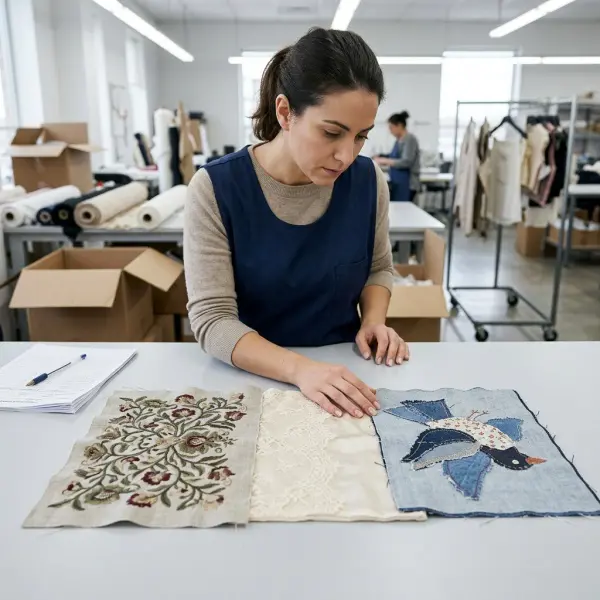
A beautiful sample does not prove that a supplier can repeat the result across thousands of pieces.
Brands should verify:
- Available machinery
- Maximum embroidery or appliqué field
- Number of production heads
- Digitizing capability
- Cutting accuracy
- Handwork capacity
- Operator training
- Quality-control procedures
- Repair process
- Daily output
- Material traceability
- Backup capacity
The objective is not merely to find a supplier that can produce one successful sample. It is to confirm that the supplier can maintain the approved result across the planned order.
Build Decoration Into the Critical Path
Decorative techniques often have separate material, artwork, sample, and approval timelines. They should appear explicitly in the production calendar.
Typical dependencies include:
- Artwork approval
- Digitizing or pattern programming
- Thread or lace color development
- Applied-material sourcing
- Cutting tools or files
- Stabilizer testing
- Placement approval
- Embroidery or appliqué capacity booking
- Panel delivery
- Quality inspection
- Repair allowance
Late decorative approval can delay assembly even when the main garment fabric is available.
Communicate the Technique Accurately
Marketing descriptions should reflect the verified construction.
“Embroidered,” “lace,” “appliquéd,” “hand-finished,” “handmade,” and “machine-made” are not interchangeable. A machine-embroidered lace-look fabric should not be presented as handcrafted bobbin lace. Lace motifs attached by hand may be accurately described as hand-appliquéd even when the lace itself is machine-made.
Precise communication protects credibility and helps customers understand what they are buying.
Common Mistakes in Decorative Textile Development
Selecting by Appearance Without Examining the Reverse
The reverse reveals backing, thread paths, joins, raw edges, adhesives, and construction weaknesses.
Ignoring it can result in skin irritation, visible internal finishing, laundering problems, or unexpected seam bulk.
A decorative textile should be approved from both sides and within the completed garment.
Treating Stitch Count as the Only Embroidery Cost
Stitch count is useful but incomplete. Color changes, trims, thread breaks, hooping, garment handling, special threads, and machine speed can materially affect production time.
A lower stitch count may also be inefficient if the design requires repeated stops and manual component placement.
Assuming Lace and Embroidered Tulle Behave Identically
Both may look delicate and transparent, but their structures distribute force differently.
Substituting one for the other can change stretch, drape, seam stability, weight, snagging, and motif cutting behavior. A replacement must be tested rather than approved from appearance alone.
Using Appliqué to Reduce Cost Without Counting Handling
Appliqué may reduce embroidery fill stitches, but it introduces cutting, placement, tack-down, trimming, and inspection.
The technique saves money only when the complete production sequence is more efficient for the relevant design and quantity.
Making Handmade Claims Without Traceability
Some products combine machine-produced materials with manual placement or finishing. That does not make the entire textile handmade.
Brands should identify which operation was performed by hand, where it occurred, and how production was documented.
Ignoring Care Compatibility
An appliqué material may shrink differently from the base. Metallic embroidery thread may react differently to pressing or cleaning. Lace and lining may change dimensions at different rates.
Testing each component separately is not sufficient. The decorated composite must be tested as it will be sold.
Important Technical Caveats
Decorative textile terminology varies across craft traditions, museums, factories, sourcing markets, and retailers. The same term may describe a historical technique, a visual style, or a modern machine-made imitation.
Several precautions improve accuracy:
- Identify the construction sequence, not only the trade name.
- Separate the foundation material from the decorative component.
- Confirm whether a support is permanent, removable, or dissolved.
- Distinguish structural stitches from decorative stitches.
- Verify whether lace was made as fabric or created through embroidery.
- State which production stages are handmade.
- Test hybrid materials as complete systems.
- Avoid assuming that greater labor, higher stitch density, natural fibers, or historical styling automatically indicate higher quality.
- Qualify sustainability claims using material, processing, durability, waste, care, and traceability evidence.
The appropriate technique is the one that delivers the intended design and performance within the project’s genuine production constraints.
Frequently Asked Questions
Is embroidery considered appliqué?
Embroidery and appliqué are different techniques, although they are frequently combined. Embroidery creates decoration primarily through stitches. Appliqué creates decoration by attaching a separate material piece to a foundation.
When embroidery stitches secure or outline an applied fabric shape, the result can accurately be described as embroidered appliqué. The material piece provides the main surface area, while the stitches provide attachment and detail.
Product specifications should list both processes when both affect cost, production, and quality.
Is embroidered tulle the same as lace?
Not necessarily. Embroidered tulle consists of stitched motifs applied to an existing tulle ground. True needle, bobbin, Leavers, or Raschel lace develops its motifs and supporting structure through its own lacemaking or knitting process.
Both can provide transparency and floral patterning, so they may serve similar design purposes. They can nevertheless differ in weight, stretch, motif stability, cutting behavior, cost, and seam performance.
A buyer should ask for the construction method rather than relying on appearance or supplier naming.
Can lace be used as appliqué?
Yes. Lace motifs can be cut from lace fabric and attached to another textile. This is common in bridalwear, eveningwear, lingerie, veils, couture-inspired garments, and decorative accessories.
The motif may be machine-stitched, hand-sewn, embroidered around the edge, bonded temporarily, or secured through a combination of methods.
The production team must check whether cutting damages structural threads and whether the attachment method remains secure after cleaning and wear.
Is appliqué cheaper than embroidery?
Appliqué can be less expensive when it replaces a large area of dense embroidery with a relatively simple cut component. This is common in large letters, badges, sportswear graphics, and bold motifs.
It is not always cheaper. Intricate shapes, difficult placement, manual trimming, multiple layers, embroidered borders, and high rejection rates can offset the stitch savings.





Comments 0
Leave a CommentSend Comment
Anda harus Login terlebih dahulu untuk dapat memberikan komentar.