

Why Material Choice Matters in Bags, Shoes, and Outerwear
Quick Answer
Material choice matters in bags, shoes, and outerwear because each product asks a material to perform a different job. A bag must carry weight through handles, straps, seams, and reinforced attachment points. A shoe upper must flex repeatedly, hold shape, tolerate abrasion, and support an acceptable foot climate. Outerwear must move with the body while meeting expectations for warmth, weather protection, drape, weight, and care.
The visible shell is therefore only one part of the decision. Leather, coated textile, microfiber, bio-based composite, or another alternative can work well when its thickness, backing, finish, strength, flexibility, and aging behavior match the component and construction. The same sheet may be suitable for a rigid bag panel but unsuitable for a folding gusset, shoe vamp, or soft jacket sleeve.
Fashion teams should define the product's load, movement, exposure, comfort, care, appearance, and service-life requirements before approving a material. They should then test the exact color and construction in a production-intent prototype. The best material is not the one with the strongest category story. It is the one that works as part of the finished product system and can be sourced, manufactured, cared for, and replaced consistently.

Material Choice Is a Product-Architecture Decision
A fashion material is not selected for a product category in the abstract. It is selected for a position within a product, where it will interact with pattern geometry, seams, adhesives, reinforcement, lining, hardware, body movement, climate, and care. Material choice is therefore the process of matching a material-component system to the mechanical, sensory, aesthetic, commercial, and compliance requirements of its intended use.
Visual approval can hide this distinction. Problems appear later when a handle stretches, boot cracks across the vamp, or jacket restricts the elbow. The material may have been assigned the wrong job or construction.
That is why broad category comparisons are only a starting point. The earlier guide to leather and leather alternatives for fashion applications explains how natural leather, coated synthetics, and newer composites are built. Product development begins with the next question: what will this exact material have to do, in this exact component, throughout manufacture and use?
Four kinds of fit must align:
- Functional fit: Does the material withstand the expected load, flexing, abrasion, moisture, temperature, and care?
- Construction fit: Can it be cut, skived, folded, stitched, bonded, molded, edge-finished, or sealed with the intended equipment?
- Experience fit: Does its handfeel, weight, noise, breathability, drape, and aging match what the customer expects?
- Business fit: Are usable yield, minimum order, lead time, repeatability, testing, claims, repair, and warranty exposure workable?
A swatch can suggest appearance and handfeel. Demonstrating all four forms of fit requires a written brief, component-specific testing, a representative prototype, and controlled production evidence.
Bags, Shoes, and Outerwear Place Different Demands on Materials
The same words—durable, flexible, water-resistant, premium—mean different things across these products. For a tote, durability may be dominated by handle anchorage and base abrasion. For a shoe, it may mean surviving thousands of flexes without cracking or delaminating. For a jacket, a material can be physically strong yet feel unsuccessful because it is heavy, noisy, restrictive, or difficult to care for.
|
Product |
Primary material job |
High-risk zones |
Experience priorities |
Evidence that matters |
|
Bag |
Carry and protect contents while retaining shape |
Handle roots, strap anchors, top opening, zipper ends, corners, base, folded edges |
Weight, structure, touch, cleanability, opening behavior |
Attachment strength, seam and tear behavior, abrasion, rub fastness, loaded-use trial |
|
Shoe |
Enclose and move with the foot while supporting fit and appearance |
Vamp flex line, topline, eye stays, toe, heel counter area, upper-sole bond |
Flexibility, internal moisture management, pressure, weight, temperature |
Flex, tear, seam, delamination, abrasion, water-vapor and whole-shoe trials |
|
Outerwear |
Cover a moving body while providing the intended climate and weather function |
Elbows, shoulders, armholes, cuffs, pocket entries, closures, hem |
Drape, mobility, warmth, moisture transfer, weather protection, care |
Mobility fitting, abrasion, seam behavior, water and water-vapor tests, care and aging trials |
The table is not a universal specification. A fashion clutch, hiking boot, and evening jacket clearly need different thresholds from a travel bag, school shoe, and rain shell. Its purpose is to show why a single material datasheet or generic “durability” result cannot approve every use.
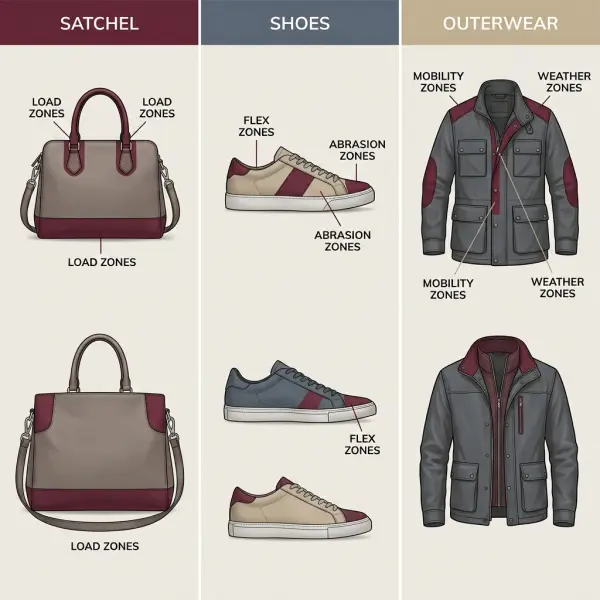
Why Bag Materials Must Be Designed Around Load Paths
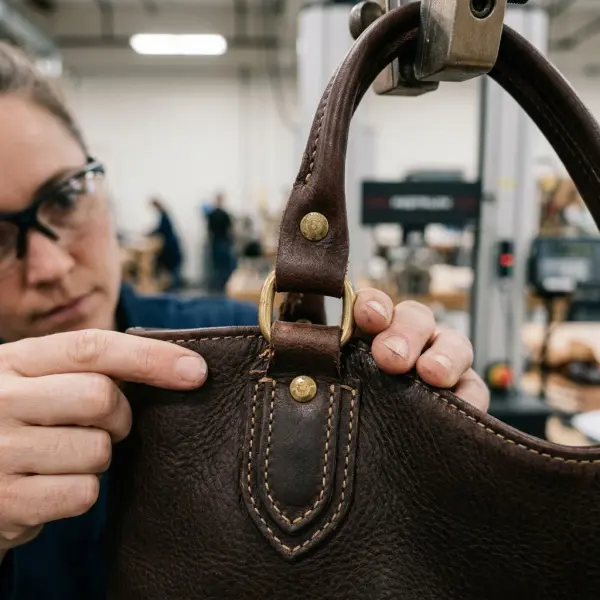
A bag is a small load-bearing structure. Its body material may create the desired shape and surface, but the carried mass travels through the base and side panels into seams, handle tabs, strap anchors, rings, rivets, and other fittings. The weakest interface—not necessarily the weakest sheet—often determines when the product becomes unusable.
Consider a large unlined tote cut from a soft material. The body can appear strong in a tensile test, yet the handle area may elongate because the sheet is too stretchy, the reinforcement is too small, or stitch holes concentrate stress. A rigid coated material presents another risk: it may support a crisp silhouette but crack where a narrow handle folds or where the top edge is turned repeatedly. Both cases show why “bag material” is too broad a specification.
Structure, load, and touch may require different materials
The outer material need not perform every job alone. A structured handbag may combine a face material with backing, board, lining, and localized reinforcement. A strap can retain the same face but require a non-stretch core. Each interface needs approval.
Bag development should distinguish at least these component roles:
- Body panels that determine silhouette, surface wear, and cleanability.
- Gussets and openings that fold, compress, and recover.
- Handles and straps that carry repeated tensile loads and contact skin or clothing.
- Attachment patches and seam zones that must resist tear and stitch-hole growth.
- Base and corners that receive concentrated abrasion, dirt, and impact.
Testing organizations reflect this whole-product logic. SATRA's overview of luggage testing describes separate methods for handle strength and attachment strength of load-bearing fittings. Intertek likewise identifies fastenings, buckles, handles, wheels, and strap attachments in luggage and bags testing. Fashion handbags need their own thresholds, but the principle holds: test the assembled load path under a representative load and use pattern.
A useful bag trial combines laboratory checks with wear simulation. Load the prototype to a defined mass, use each carry method, cycle the closures, place it on representative surfaces, and inspect handle roots, seams, distortion, edges, hardware, and color transfer. Set the load and cycles from the product brief, not an arbitrary “heavy-duty” claim.
Why Shoe Materials Must Survive Movement and Manage Comfort
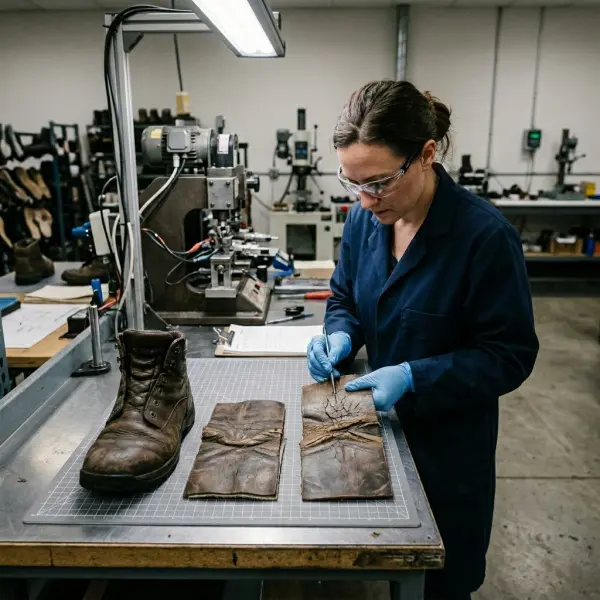
A shoe upper is repeatedly bent, stretched, rubbed, and exposed to heat and moisture generated during wear. It must also work with the last, lining, reinforcements, closures, toe puff, counter, sole, adhesives, and stitch lines. A material that looks convincing on a flat panel can behave very differently once shaped around a foot and flexed at the vamp.
Footwear standards illustrate the range of properties involved. The ISO catalogue for footwear test methods includes separate methods for upper flex resistance, tear strength, seam strength, delamination resistance, water-vapor permeability and absorption, abrasion, color fastness, water resistance, and whole-shoe upper-to-sole adhesion. There is no single “shoe suitability” result because the risks are distributed across materials, components, and assembly.
The vamp is a demanding material zone
The vamp bends near the ball of the foot during each step. If the face coating is too brittle, the finish may whiten or crack. If the layers have weak adhesion, repeated bending can initiate delamination. If the material stretches excessively, the upper may lose shape; if it is too rigid, it can resist lasting, create pressure, or produce deep, unattractive creases.
The same material may work on a less mobile quarter panel or overlay. Component mapping can therefore retain a distinctive lower-flex material away from the vamp while a flexible companion material handles the bend zone.
Breathability is a system property, not a surface impression
Foot comfort is affected by design, fit, activity, socks, lining, insock, openings, climate, and upper-material moisture behavior. Leather's water-vapor behavior varies and can change with finishing. Coated alternatives vary with film chemistry, thickness, backing, perforation, and lining.
SATRA lists water-vapor permeability and absorption alongside flexing, abrasion, tear, and finish-delamination methods for leather used in footwear uppers and linings. A brand should therefore test the intended layered upper, not claim comfort from a generic material name. A breathable lining cannot fully compensate for an impermeable upper across every climate and wear pattern.
Production trials should also examine needle perforation, seam puckering, skiving, edge behavior, lasting response, heat exposure, adhesive compatibility, and color migration. Test the finished shoe on the intended last and sole construction. Material-level passes do not rule out pressure, bond failure, lining abrasion, or movement-related defects created during assembly.
Why Outerwear Materials Must Balance Protection With Wearability
Outerwear sits between the body and the environment, so its success cannot be reduced to surface durability. A fashion jacket may prioritize supple drape and patina. A commuting coat may need rain resistance and easy care. A cold-weather piece may depend on insulation and wind control. A material can meet one of these needs while undermining another.
Weight, bending stiffness, coating, thickness, seam construction, and air permeability affect how a jacket hangs and moves. A soft swatch does not predict a full sleeve, doubled collar, facing, or multilayer closure.
Protection and moisture transfer are separate questions
Water repellency, resistance to water penetration, and water-vapor resistance describe different behaviors. A surface can shed light spray without withstanding pressure at seams. A barrier can resist water entry while also slowing the movement of water vapor. AATCC lists distinct textile methods for spray repellency, rain, impact penetration, and hydrostatic pressure in its standard test-method directory. These results should not be treated as interchangeable marketing claims.
For clothing and textile-like assemblies, ISO 11092:2026 measures thermal resistance and water-vapor resistance under steady-state conditions using a sweating guarded hotplate. Its scope includes fabrics, films, coatings, foams, leather, and multilayer assemblies. This helps compare material systems, but comfort still depends on design, ventilation, activity, fit, and weather. Laboratory values do not simulate every wearer or condition.
Movement and care can overturn a promising selection
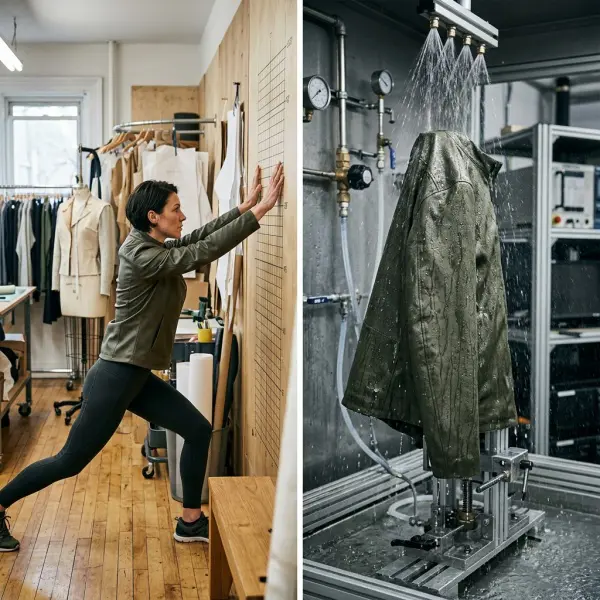
Outerwear fitting should include dynamic actions rather than a standing mirror check. Ask the wearer to reach forward and overhead, bend the elbows, sit, close the garment over intended layers, use pockets, and move the collar. Inspect restriction, riding up, pressure, noise, crease recovery, surface whitening, and stress around armholes and closures.
Care is equally structural. A material may tolerate gentle wiping but not washing, heat, solvent cleaning, or prolonged damp storage. The shell, lining, adhesive, interlining, edge finish, trim, and printed components must share a workable care route. In the United States, the FTC notes that care instructions are intended to tell consumers how to clean covered apparel in its apparel and labeling guidance. Exact obligations and exemptions vary by material and product, so brands should conduct market-specific review rather than copying a supplier instruction.
The Material Must Work With Construction, Not Against It
Material performance can change after cutting, folding, stitching, bonding, pressing, molding, or edge finishing. Thick leather may need skiving; coated fabric may show needle or heat damage; a composite may bond well with one adhesive but poorly with another. A jacket material can drape as a single layer yet become rigid after facings and reinforcement are added.
Direct substitution is therefore risky. Replacing leather with an alternative while freezing the pattern, stitch density, needle, reinforcement, adhesive, and edge process assumes identical behavior. The comparison in genuine leather versus vegan leather for fashion buyers should lead to a new product-development trial, not material-only approval.
A peer-reviewed comparison of leather, artificial leather, and selected newer alternatives found substantial differences across properties such as tensile and tear strength, flexing, and water-vapor behavior. The authors did not find one alternative that reproduced leather's entire performance profile, although individual alternatives performed well in selected areas. The technical performance study supports a component-specific conclusion: define which properties matter for the product, then compare exact candidates against those needs.
Manufacturing teams should record process compatibility during sampling, including:
- Cutting quality, edge fraying or fiber pull, marking, and usable yield.
- Needle size, thread, stitch density, stitch-hole growth, puckering, and seam recovery.
- Folding, skiving, splitting, molding, pressing, heat, and edge-finish response.
- Adhesive preparation, open time, pressure, curing, bond strength, and visible staining.
- Cycle time, operator handling, rework, rejection, and machinery or tooling changes.
These notes turn an attractive prototype into a repeatable product specification. Without them, the factory may solve problems informally during the first order and reproduce a different result on the second.
A Practical Material-Selection Workflow for Three Product Categories
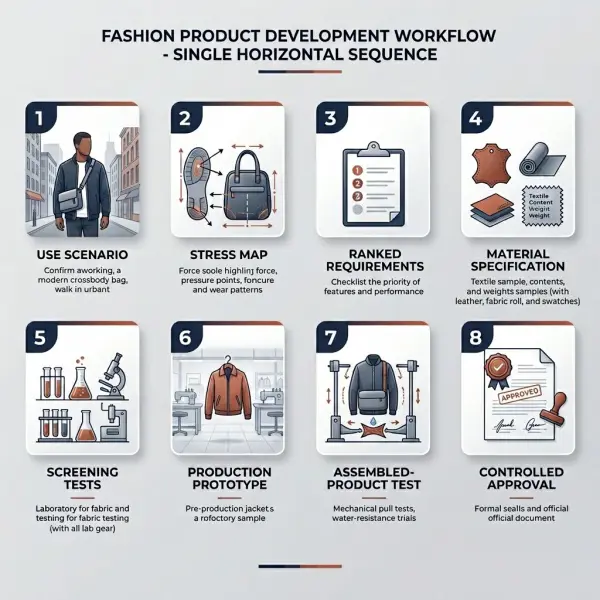
The most reliable process begins with failure prevention, not a favorite material. Design, technical development, sourcing, quality, compliance, production, and marketing should agree on what the product must do before the supplier is asked to support a story about it.
- Write the use scenario. Define user, carry load or activity, climate, contact with skin or clothing, expected care, price position, warranty, and intended frequency of use.
- Map components and stress zones. Mark handles and anchors for bags, flex and bond zones for shoes, and movement, exposure, and closure zones for outerwear.
- Set ranked requirements. Separate non-negotiable safety, function, and compliance needs from aesthetic preferences. Give every requirement a test, inspection, or fitting method.
- Specify each material completely. Record supplier code, construction, layers, thickness, weight or area measure, finish, color, backing, stretch, acceptable variation, and relevant content claims.
- Screen materials before full sampling. Use component-relevant tests to eliminate obvious mismatches, but avoid generic thresholds that are unrelated to the actual product.
- Build production-intent prototypes. Use intended patterns, reinforcements, linings, adhesives, hardware, needles, thread, edge treatments, machinery, and care route.
- Test the assembled product. Apply representative load, flex, abrasion, moisture, closure cycling, movement, storage, and care. Inspect both immediate damage and changes after conditioning.
- Approve the system and control change. Keep an approved sample, specification, test report, construction notes, tolerance table, claims evidence, and supplier change-notification requirement.
This workflow should sit inside a wider fashion sourcing strategy for growing apparel brands. Material performance can still be undermined by inconsistent batches, undocumented substitutions, long lead times, limited colors, poor incoming inspection, or a supplier that cannot reproduce the approved finish.
Common Material-Selection Mistakes and Their Consequences
Using one “durability” requirement for every product
Durability is a bundle of failure modes, not one property. A high tensile result does not prove that a bag handle attachment will survive, a shoe upper will resist repeated flexing, or a jacket will remain comfortable. Replace the broad claim with product- and component-specific risks.
Approving the shell while ignoring the assembly
Lining, reinforcement, adhesive, thread, edge paint, hardware, and seams can move the failure point. Test the layered component and finished product, especially at attachments, flex zones, and closures.
Choosing thickness as a shortcut for strength
A thicker sheet can feel substantial but may be heavier, harder to fold, less breathable, more difficult to stitch, or still weak at a coating-to-backing interface. Specify performance and process behavior alongside thickness.
Copying a successful material into a different component
A material approved for a rigid bag body has not automatically been approved for a strap, shoe vamp, or jacket sleeve. Reassess the movement, load, skin contact, care, and construction of the new position.
Testing a convenient color instead of the production color
Pigments, coatings, print layers, and finishing recipes can affect flex, rub fastness, migration, appearance, and heat response. Testing should represent the exact color and finish, particularly when pale linings or clothing may contact a dark surface.
Treating early wear as the complete service life
A one-week trial may reveal fit and handling problems but not hydrolysis, coating fatigue, prolonged humidity damage, color change, or adhesive aging. Combine use trials with justified accelerated tests and retain samples for comparison.
Letting marketing language define the specification
Terms such as premium, vegan, plant-based, weather-resistant, breathable, and durable do not state a construction or threshold. Product development should approve measurable attributes first; marketing should describe only what the final evidence supports.
Important Technical and Commercial Caveats
- Laboratory tests isolate properties. They support comparison and quality control but cannot reproduce every user, climate, care habit, load, fit, or manufacturing variation.
- Test methods are not automatically interchangeable. Results depend on specimen preparation, conditioning, equipment, units, endpoint, and method version. Record the complete method and requirement.
- A material pass is not a product pass. Seams, holes, folds, adhesives, reinforcements, hardware, and pattern geometry create new failure modes.
- Performance can vary by color and finish. Approval should attach to the exact supplier code and controlled variant, not only a family name.
- Water-repellent is not the same as waterproof. Surface wetting, impact penetration, hydrostatic resistance, seam leakage, and whole-product exposure answer different questions.
- Breathability is not a universal comfort promise. Moisture and heat experience also depend on design, lining, ventilation, fit, activity, socks or underlayers, and climate.
- Natural or bio-based content does not establish suitability. A promising feedstock still needs complete-composition disclosure, product-relevant testing, stable supply, and verified claims.
- Care instructions need evidence. The least tolerant component may determine the care route for the entire bag, shoe, or garment.
Finally, requirements must be proportional. An evening clutch does not need a travel-case test regime, and a fashion jacket should not borrow protective-clothing claims without meeting the relevant standards. Over-testing adds cost; under-testing transfers foreseeable risk to production and customers. The product brief should determine the balance.
Frequently Asked Questions
What is the most durable material for a handbag?
There is no universally most durable handbag material because durability depends on bag size, carried load, construction, use, and acceptable aging. A strong body material can still fail where a handle, strap, rivet, or seam concentrates stress. For a daily tote, buyers should prioritize attachment strength, tear and stitch-hole behavior, base and corner abrasion, rub fastness, shape retention, and cleanability. For a small evening bag, surface scratching and closure performance may matter more than heavy-load capacity. Compare exact material codes in a finished prototype, using the intended reinforcement, thread, edge treatment, and hardware, then test with a realistic defined load.
Can the same leather or alternative be used for both bags and shoes?
It can, but approval for one product does not prove suitability for the other. A material that works on a structured bag panel may be too stiff or vulnerable to repeated cracking at a shoe vamp. Conversely, a flexible shoe-upper material may stretch too much for a bag body or handle. The product team should compare component-specific needs: flexing, tear, seam strength, moisture behavior, abrasion, shape retention, bonding, and finish durability. If the supplier markets one article for multiple uses, request application-specific test evidence and build separate production-intent prototypes. The shared material name is useful for range consistency, not as a substitute for validation.
Why does a shoe material crack where the foot bends?
Cracking at the vamp can result from a brittle or thick surface finish, unsuitable material flexibility, weak adhesion between layers, deep crease geometry, manufacturing heat, poor fit, or aging. The underlying cause cannot be confirmed from appearance alone. Inspect whether the damage is only in the finish, extends into the substrate, or involves delamination. Review the exact material, color, thickness, backing, lasting process, toe shape, fit, and flex-test history. Corrective action may require a more flexible finish, different material, adjusted pattern or last, lower-stress construction, or changes to processing. Applying a softer care product will not repair every structural cause.
Is waterproof material enough to make waterproof outerwear?
No. A water-resistant or waterproof shell material does not automatically create a waterproof garment. Water can enter through seams, needle holes, zippers, pocket openings, cuffs, the neck, or an unsuitable design. The brand must also define what “waterproof” means through an appropriate test method and performance threshold. Development may require seam sealing, compatible tapes or adhesives, protected closures, drainage, and testing after flexing and care. At the same time, a stronger water barrier may affect water-vapor transfer and wearer comfort. Test the complete garment or representative seam and closure assemblies under the exposure described in the product claim.
How should a small brand test materials without a large laboratory budget?
Start by ranking the failures that would create the greatest customer harm, returns, or warranty cost. Use supplier reports to screen candidates, but confirm that they match the exact material code, color, finish, method, and recent production. Then commission a focused set of third-party tests for the highest-risk properties and run documented in-house prototype trials for load, flex, closures, rubbing, movement, care, and visible aging. Small brands do not need every available method. They need a defensible plan tied to intended use. Keep control samples and test notes so later deliveries can be compared, and budget additional validation before making strong performance claims.
Does thicker leather or vegan leather always last longer?
No. Thickness can add body, abrasion allowance, or strength in some constructions, but it can also increase weight and bending stress, complicate stitching or folding, and reduce comfort. Longevity depends on fiber or backing structure, finish, layer adhesion, tear behavior, flex resistance, edge construction, manufacturing, care, and the component's job. A thin reinforced strap can outperform a thicker unreinforced one at its attachment, while a thick coated sheet may crack at a tight fold. Specify a thickness range because it affects production, but approve it together with relevant performance results and a finished prototype rather than using thickness as a quality grade.
When should different materials be used within one product?
Use different materials when component requirements conflict or when one premium material would add cost or risk without adding value everywhere. A bag may need a structured body, flexible gusset, reinforced strap core, and abrasion-resistant base. A shoe may use a highly flexible vamp material with more supportive quarters and a durable toe overlay. Outerwear may combine a protective shell with a comfortable lining, localized reinforcement, and flexible underarm panels. The design should still account for visual coherence, differential stretch, color migration, bonding, care compatibility, and end-of-life complexity. Material zoning is useful when it solves a defined problem, not when it merely increases feature count.
Conclusion
Bags, shoes, and outerwear expose the limits of choosing material by label, swatch appeal, or category reputation. A bag channels load through attachments. A shoe bends around a moving foot and creates a demanding heat-and-moisture environment. Outerwear must balance protection with drape, mobility, weight, and care. Those are different engineering and customer-experience problems.
The practical unit of approval is therefore not “leather,” “vegan leather,” or even a supplier sheet. It is an exact material used in an exact component with an exact construction. Its suitability depends on where the product stretches, folds, rubs, carries load, meets the body, receives weather, and encounters cleaning or storage.
Good material selection makes trade-offs visible early enough to manage. Mapping stress zones, ranking requirements, testing production-intent prototypes, and controlling changes protects design intent while reducing avoidable failures, rework, returns, unsupported claims, and supply surprises.




Comments 0
Leave a CommentSend Comment
Anda harus Login terlebih dahulu untuk dapat memberikan komentar.