

Fashion Customer Segmentation Explained for Apparel Brands
Understanding fashion customers requires more than identifying their age, income, or favorite clothing styles. Two shoppers may purchase the same jacket for entirely different reasons. One may be looking for a versatile piece that works across several seasons, while the other is responding to a particular silhouette, designer influence, or social occasion.
For apparel brands, these differences affect far more than advertising. They influence product development, assortment planning, pricing, inventory allocation, customer service, and the way a collection is presented across retail channels.
Fashion customer segmentation provides a structured way to understand these differences without assuming that every shopper within a broad market behaves alike. Done well, it helps brands decide which customer needs they can serve profitably, where meaningful demand exists, and how to make their products more relevant.
Quick Answer: What Is Fashion Customer Segmentation?
Fashion customer segmentation is the process of dividing a broad apparel market or existing customer base into smaller groups with shared characteristics, needs, preferences, or purchasing behaviors so brands can develop more relevant products, marketing strategies, and shopping experiences.
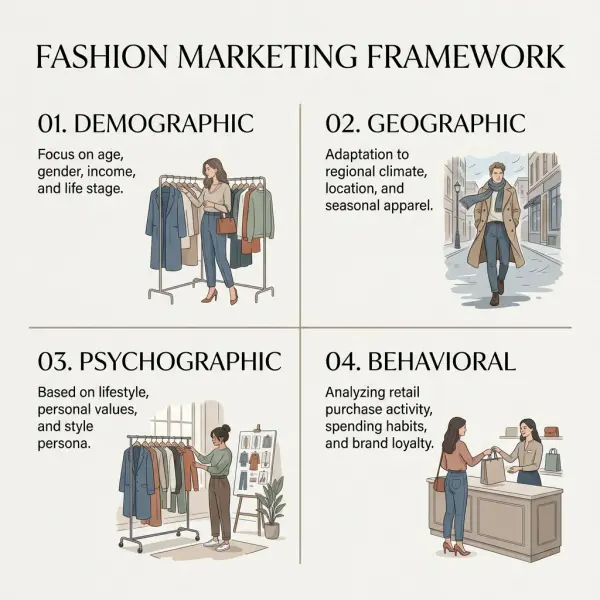
Fashion businesses commonly segment customers using four dimensions: demographic characteristics, geographic location, psychographic preferences, and behavioral patterns. These may include age, spending capacity, climate, lifestyle, preferred garment categories, shopping frequency, and responses to promotions.
The purpose is not simply to categorize shoppers. Effective segmentation helps a brand understand which customers are buying, why they choose particular products, what influences their purchasing decisions, and which commercial approaches are most appropriate.
For example, a contemporary womenswear brand might identify customers seeking affordable everyday clothing, shoppers prioritizing professional wardrobe versatility, and occasional buyers interested in statement pieces. Each group may require different product assortments, communications, or inventory strategies.
However, customer segments are not permanent identities. Shopping needs can change with lifestyle, circumstances, season, and purchasing occasion. Brands should therefore treat segmentation as a working commercial framework that requires validation and periodic review.
What Does Customer Segmentation Mean in the Fashion Industry?
Customer segmentation is a marketing and business planning approach that groups consumers according to characteristics relevant to how they evaluate, purchase, and use products. In apparel, these characteristics extend into highly practical considerations such as garment fit, preferred materials, styling versatility, sizing requirements, and willingness to pay.
Consider a brand selling tailored trousers. Its customers may include office professionals, shoppers who prefer minimalist wardrobes, people seeking occasionwear, and customers looking for comfortable garments with a polished appearance.
All four groups could purchase the same product, yet their purchasing criteria may differ. The professional buyer might prioritize easy care and durability. The occasionwear shopper could place greater weight on silhouette and finish. Someone seeking comfort may pay closer attention to fabric stretch, waistband construction, and ease of movement.
A useful segmentation model recognizes these different purchase motivations rather than assuming that everyone buying tailored trousers belongs to one uniform audience.
This approach reflects the general marketing definition presented in OpenStax Principles of Marketing, which explains segmentation as dividing markets into more precisely defined groups with common needs and potentially similar responses to marketing activities.
For fashion brands, the distinctive challenge is connecting those groups to real decisions about garments, collections, sales channels, and commercial performance.

Why Customer Segmentation Matters for Apparel Brands
Fashion products are shaped by a combination of functional requirements, personal taste, social context, and purchasing power. A garment may be technically well made and visually appealing but still fail commercially if it does not address the expectations of the customers a brand is trying to reach.
Segmentation helps connect product decisions with a more clearly defined audience. Rather than designing for an abstract customer who supposedly likes everything in the collection, brands can identify groups with recognizable needs and assess whether their product offering serves them effectively.
More Relevant Product Development
A brand serving customers who prioritize everyday comfort may benefit from focusing on easy-care fabrics, consistent sizing, versatile colors, and garments suitable for repeated wear. A brand addressing fashion-forward occasion shoppers might instead invest in distinctive silhouettes, decorative details, and shorter seasonal collections.
Neither direction is universally superior. What matters is whether the design and production decisions correspond to a sufficiently valuable market opportunity.
Segmentation can also help product teams identify unmet requirements within an existing customer base. Repeated requests for longer trouser inseams, more inclusive sizing, or lightweight jackets suited to humid climates may reveal commercial needs that are not captured by conventional style categories.
More Focused Marketing and Brand Communication
Customers do not all respond to the same product message. A shopper buying an investment coat may want information about fabric composition, lining, construction, and long-term wardrobe compatibility. A buyer searching for a trend-led party outfit might be more interested in styling inspiration, delivery availability, and the intended occasion.
Segmentation allows marketing teams to match these different concerns with suitable product photography, editorial descriptions, campaign themes, and communication channels.
This does not mean each group needs a separate advertising campaign. Often, the more useful adjustment is a change in emphasis: presenting the same garment through different practical benefits, provided those benefits are supported by the actual product.
Better Assortment and Inventory Decisions
An apparel business needs to decide how much stock to commit to each category, color, size, and price point before actual demand is fully known.
Segmentation provides an additional perspective for these decisions. If reliable sales and customer information show that repeat buyers favor a particular fit or core color palette, the buying team can consider maintaining continuity in those options. Meanwhile, experimental colors or silhouettes may be ordered more cautiously until demand is established.
This can complement fashion assortment planning, which translates customer demand and business positioning into a practical product mix.
Segmentation does not eliminate forecasting errors. It helps make the assumptions behind purchasing decisions clearer and easier to test.
Stronger Commercial Prioritization
Some customers purchase frequently but spend relatively little per order. Others buy only occasionally but purchase higher-value products. Certain groups may respond strongly to discounts, while others place more importance on fit confidence, service, availability, or product quality.
A business that understands these differences can evaluate which groups contribute sustainable revenue and contribution margin, rather than focusing exclusively on customer numbers.
This distinction matters particularly for smaller apparel brands with limited production budgets. Attempting to satisfy every preference can lead to an expensive assortment that lacks a clear commercial identity.
Industry reporting also illustrates why rigid assumptions about shopper priorities can be misleading. The State of Fashion 2026 report from McKinsey and The Business of Fashion discusses consumers reconsidering spending priorities and seeking value under economic pressure. These market-level observations reinforce the need to examine actual customer behavior rather than relying entirely on established demographic stereotypes.

The Four Main Types of Fashion Customer Segmentation
Fashion brands generally begin with four recognized segmentation dimensions. Each answers a different business question, and the most useful model often combines several rather than treating them as competing methods.
|
Segmentation type |
Main question |
Fashion-specific examples |
Business application |
|
Demographic |
Who is the customer? |
Age range, occupation, household circumstances, spending capacity |
Product positioning and pricing |
|
Geographic |
Where does the customer shop or live? |
Region, climate, urban location, local market |
Seasonal assortments and distribution |
|
Psychographic |
What motivates the customer's choices? |
Personal style, lifestyle, values, attitudes toward fashion |
Product storytelling and brand positioning |
|
Behavioral |
How does the customer interact with fashion products and brands? |
Purchase frequency, spending patterns, category preferences, returns, promotion response |
Retention, merchandising, and campaign targeting |
These categories provide complementary information. Demographics may help describe an audience, while behavioral evidence can reveal purchasing patterns that were not obvious from its demographic profile.
Demographic Segmentation: Understanding Customer Characteristics
Demographic segmentation groups customers using characteristics such as age, occupation, household composition, or income. These variables can provide an initial view of the audience a brand intends to serve.
A workwear label, for example, might focus on consumers who regularly need professional clothing. A children's apparel business may organize its product strategy around relevant child size and age categories while recognizing that purchasing decisions are usually made by parents or caregivers.
The limitation is that demographic similarities do not guarantee identical clothing preferences. Two customers within the same age group and income range may have completely different attitudes toward style, garment quality, and shopping frequency.
Demographic information is therefore most useful when it supports a clear business question rather than becoming a substitute for understanding individual needs.
Geographic Segmentation: Accounting for Place and Climate
Geographic segmentation examines how customer requirements vary across countries, regions, cities, and climatic conditions.
For apparel brands, location can affect seasonality, garment weight, preferred coverage, local styling conventions, product availability, and distribution logistics. A lightweight outerwear collection suited to a tropical metropolitan market may need different fabric specifications and merchandising timing from products designed for colder climates.
Geographic segmentation also matters for brands selling across multiple markets. Local sizing preferences, shopping calendars, climate, cultural context, and retail infrastructure can influence how an assortment performs.
However, a country or city is not a homogeneous fashion market. Brands still need to distinguish customers within a location rather than relying on national or regional generalizations.
Psychographic Segmentation: Understanding Style and Lifestyle Motivations
Psychographic segmentation groups consumers according to attitudes, values, interests, and lifestyle characteristics that influence their purchasing decisions.
One customer may prefer a restrained wardrobe built around versatile garments. Another may consider clothing an important form of personal expression and actively search for distinctive designs. A third may prioritize practicality because daily work, commuting, or family responsibilities place particular demands on clothing.
These motivations can affect which garment attributes customers value and how they interpret a brand's message.
Psychographic insights are typically developed through customer interviews, surveys, qualitative feedback, and other appropriately collected research. Brands should avoid assuming that a person's values can be determined reliably from a single purchase.
Behavioral Segmentation: Studying What Customers Actually Do
Behavioral segmentation examines observable purchasing and engagement patterns. In fashion retail, these might include order frequency, product-category preferences, purchase timing, discount responsiveness, and previous returns.
A customer who frequently replenishes basic T-shirts may have different shopping needs from someone who purchases a single formal outfit for a special event. These patterns can help a retailer decide when to recommend familiar products, introduce complementary categories, or communicate about restocked items.
Behavioral information has practical value because it can be connected to real transactions. Nevertheless, past purchases do not always explain the customer's underlying motivation, and behavior can change.
The detailed distinctions between these approaches are explored in demographic versus behavioral segmentation for fashion marketing.
What Do Fashion Customer Segments Look Like in Practice?
A customer segment becomes commercially useful when it describes a recognizable purchasing need that a brand can address. Labels such as “young shoppers” or “premium consumers” may provide some context, but they rarely explain enough about product expectations or shopping behavior to guide operational decisions.
Consider a hypothetical contemporary apparel brand selling wardrobe essentials, relaxed tailoring, and seasonal statement pieces. Its customer research and sales analysis might identify the following groups.
|
Illustrative customer segment |
Main purchasing priority |
Typical product interest |
Potential brand response |
|
Everyday Wardrobe Builders |
Versatility, comfort, easy care |
Basic tops, casual trousers, layering garments |
Consistent essentials, fit information, coordinated outfits |
|
Professional Style Buyers |
Polished appearance and practical wearability |
Tailored trousers, shirts, blazers |
Workwear edits, fabric details, styling guidance |
|
Occasion-Focused Shoppers |
Appearance appropriate to a particular event |
Dresses, coordinated sets, statement pieces |
Occasion-based collections, clear delivery information |
|
Fashion Experimenters |
Novelty, creative styling, distinctive design |
Trend-led silhouettes, unusual colors, statement accessories |
Limited collections, editorial inspiration, new-arrival communication |
These are illustrative groups, not established industry-wide customer categories. Their usefulness would need to be tested against the brand's actual audience.
A person can also belong to more than one group. Someone buying everyday wardrobe essentials may later purchase a formal outfit for an event. The brand should therefore distinguish relatively persistent customer preferences from temporary purchasing occasions.
This distinction is particularly relevant when developing marketing activities. A segment should help explain a pattern, not permanently restrict which products a customer can see.

How Can Apparel Brands Identify Their Most Valuable Customer Segments?
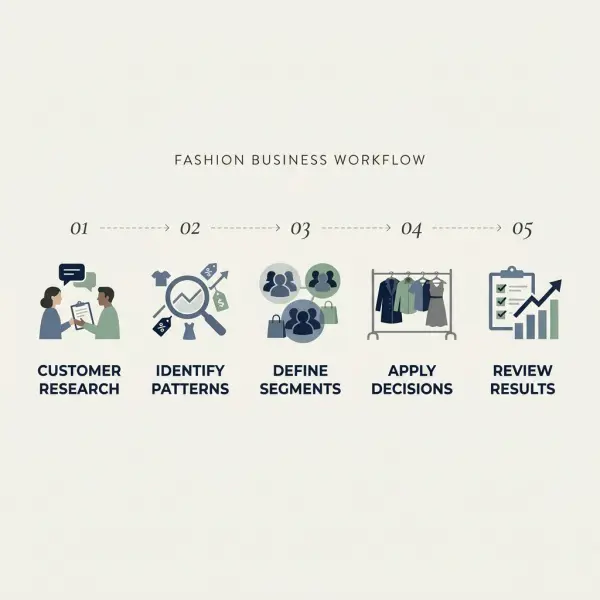
A reliable segmentation process begins with a business decision rather than with the available customer data.
For example, a retailer might want to understand why some customers return regularly while others never make a second purchase. A new apparel brand may need to determine which audience is most suitable for its initial collection. An established manufacturer launching a direct-to-consumer label may need to identify which product benefits are most likely to attract end customers.
These are different questions, and they require different evidence.
Start With a Specific Commercial Objective
Brands should first clarify what they want segmentation to improve. The objective might involve reducing slow-moving inventory, improving repeat purchasing, refining product-market fit, or identifying opportunities within an existing category.
A useful starting question is: Which differences between customers could change what we design, stock, communicate, or sell?
If a distinction does not affect any meaningful business decision, it may not justify creating a separate segment.
For a young apparel startup, three well-defined customer groups may be more manageable than an elaborate model containing dozens of overlapping profiles. A larger omnichannel retailer, meanwhile, may require a more detailed structure because it manages multiple categories, markets, and customer journeys.
Combine Transactional and Qualitative Information
Customer order records provide observable evidence, but they do not necessarily explain purchasing motivations.
A retailer might see that a particular customer frequently buys linen-blend clothing. This could reflect preferences for breathability, styling, fabric texture, local climate, or simply the availability of particular products. Transaction records alone cannot establish which explanation is correct.
Useful information sources include:
- Transaction records: Product categories, order values, purchase dates, discounts, and repeat purchasing.
- Product and service feedback: Fit complaints, material preferences, size requests, and reasons for returns.
- Customer research: Voluntary surveys, interviews, and appropriately conducted user testing.
- Retail observations: Frequently requested styles, common fitting-room concerns, and questions raised with sales associates.
- Digital interactions: Product discovery, search terms, and engagement patterns where data collection and usage are lawful.
A combination of sources helps prevent a brand from confusing observable behavior with assumed motivation.
For smaller businesses, direct conversations with customers may be especially valuable. A short interview about why someone selected one garment over another can reveal product considerations that a sales dashboard does not capture.
Develop Segments Around Meaningful Differences
Once the information is organized, brands can look for recurring patterns and assess whether those differences merit separate commercial approaches.
A practical model may combine a broad customer need with a few observable characteristics. For instance, a segment of workwear shoppers could be further understood through their preferred silhouettes, typical purchase frequency, or sensitivity to delivery timing.
The segmentation rules should remain clear enough to reproduce. If one employee classifies shoppers according to age, another according to personal taste, and a third according to purchase value, the resulting categories may be inconsistent.
For analytics purposes, brands may establish a primary segment for each customer while separately tracking product interests and purchasing occasions. Alternatively, overlapping segments can be useful for marketing, provided the rules for campaign eligibility and measurement are explicit.
Evaluate Whether a Segment Is Worth Serving
Not every identifiable group represents a viable business opportunity.
OpenStax describes five factors for evaluating effective market segments: accessibility, differentiability, actionability, measurability, and substantiality. These provide a useful commercial framework for deciding whether a group can be served effectively. See Essential Factors in Effective Market Segmentation.
For an apparel business, these considerations translate into practical questions. Can the brand reach the customers without excessive marketing expenditure? Do they have needs that differ meaningfully from other groups? Can the business manufacture or source suitable products? Is the expected demand large enough to justify the additional assortment complexity?
A segment may look attractive in a presentation yet prove difficult to serve because suitable production capacity, minimum order quantities, or distribution channels are unavailable.
Customer desirability and operational feasibility must be evaluated together.
Turning Customer Segmentation Into Apparel Business Decisions
Segmentation should eventually influence decisions made outside the marketing department. Its commercial value depends on whether customer insight changes the way a brand develops products, commits inventory, establishes pricing, and serves customers.
Product Design and Collection Development
Suppose customer research identifies strong demand for versatile everyday dresses that can be worn across professional and casual settings. A product development team might prioritize adjustable styling, practical lengths, comfortable fabric constructions, and colors compatible with different wardrobe combinations.
This approach can also inform technical product specifications. Customers concerned with garment fit may benefit from more consistent measurement standards, clearer size charts, and better communication about fabric stretch or ease.
These decisions still require design validation, wear testing where appropriate, and commercial analysis. Segmentation indicates what customers may need; it does not automatically determine the correct technical solution.
Sourcing and Production Planning
Different customer segments can create different requirements for materials, construction, quality standards, and manufacturing flexibility.
A brand serving shoppers who purchase durable wardrobe staples might place greater emphasis on fabric performance, construction consistency, and repeatable production specifications. A brand built around frequent design changes may need suppliers capable of smaller batches, flexible development schedules, and shorter product introduction cycles.
Both approaches involve trade-offs.
Smaller production runs may reduce initial inventory exposure but can increase per-unit costs or create supplier minimum-order challenges. Larger runs may improve certain production efficiencies while increasing the financial risk of unsold products.
The appropriate sourcing strategy depends on demand evidence, supplier capability, quality requirements, margins, and lead times.
Pricing and Product Value Communication
Customer segmentation can reveal different perceptions of product value.
Some shoppers may assess a garment mainly through the initial purchase price. Others may consider fabric quality, fit, durability, styling flexibility, service, or brand identity. These differences can influence how products are positioned and explained.
A premium casualwear brand, for instance, may benefit from presenting accurate information about garment construction, fabric composition, and care. A value-focused retailer might emphasize versatility, coordinated outfits, and clearly communicated prices.
However, brands should not assume that affluent customers are indifferent to price or that lower-income customers purchase only discounted clothing.
Purchase decisions involve competing priorities, and individual customers may behave differently across categories and occasions.
Retail Merchandising and Customer Experience
Segmentation can influence how products are organized and discovered, both online and in physical stores.
A retailer with significant demand for professional dressing might create a dedicated workwear edit that brings related products together. Another serving customers who frequently purchase coordinated outfits may invest in outfit-based photography and cross-category product recommendations.
Online, useful merchandising adjustments may include more relevant product filters, occasion-based navigation, fit guidance, and carefully designed recommendation systems.
The aim is to reduce friction between what shoppers need and what they can find.
Personalization should remain helpful rather than restrictive. Customers must still be able to explore styles outside their inferred preferences.

Measuring Whether Fashion Segmentation Actually Works
Creating segments is only the beginning. Apparel brands should assess whether the resulting decisions improve performance compared with an appropriate baseline.
A segmentation strategy that produces more email clicks but also increases unnecessary discounts may not improve profitability. Similarly, a customer group with high average order value may still contribute relatively little margin if fulfillment, returns, or acquisition costs are unusually high.
Relevant performance indicators may include purchase conversion rate, repeat purchase rate, average order value, gross margin, contribution margin, return rate, and customer acquisition cost. Which measures matter most depends on the original segmentation objective.
For retention analysis, brands can also examine recency, frequency, and monetary value (RFM). RFM groups customers according to how recently they purchased, how often they purchased within a defined period, and how much they spent. The framework is described in Shopify's RFM segmentation guide.
RFM can help identify repeat customers, customers whose purchasing activity has declined, and customers who have recently made a first purchase. However, it does not establish their preferences or predict future behavior with certainty.
Compare Segments Using Commercially Relevant Metrics
A simple evaluation table can help teams review whether their segmentation model is producing useful decisions.
|
Business objective |
Useful metrics |
What to investigate |
|
Improve customer retention |
Repeat purchase rate, retention by cohort |
Are customers returning without excessive promotional incentives? |
|
Refine product assortment |
Sell-through, stockout rate, inventory aging |
Are segment-specific product choices matching demand? |
|
Improve marketing relevance |
Conversion, incremental revenue, acquisition cost |
Are targeted activities generating additional profitable purchases? |
|
Reduce sizing friction |
Size-related return rate, fit feedback |
Are products meeting the fit needs of intended customers? |
|
Improve customer economics |
Contribution margin, customer lifetime value estimates |
Is the segment commercially sustainable after relevant costs? |
These indicators require context. Seasonal apparel businesses, for example, may naturally experience longer purchasing intervals than retailers selling frequently replenished basics.
Customer lifetime value estimates also depend on assumptions about future purchasing and profitability. Brands with limited purchase histories should treat those estimates cautiously.
Where feasible, controlled experiments or matched comparisons can help determine whether a targeted intervention caused an improvement rather than merely coinciding with one.
Common Fashion Customer Segmentation Mistakes
Even businesses with substantial customer data can develop weak segmentation models. The most consequential errors tend to involve assumptions that are too broad, categories that are difficult to act upon, or a failure to connect analysis with commercial decisions.
Treating Age Groups as Complete Fashion Identities
A common mistake is assuming that a generation shares a particular clothing style, spending pattern, or attitude toward fashion.
Age may be relevant to some customer needs, but it does not independently explain purchase motivation. Within the same generation, shoppers can have substantially different professional requirements, climates, budgets, aesthetic preferences, and lifestyle priorities.
A more reliable approach combines relevant demographic information with observed demand and customer feedback.
Creating Too Many Segments Too Early
Detailed segmentation can look sophisticated, particularly when a brand has access to extensive analytics tools. Yet dividing a relatively small customer base into many narrow groups may produce unstable results and make campaigns difficult to manage.
Each segment creates potential demands for product planning, reporting, creative development, and operational coordination.
Brands should introduce additional subdivisions only when the differences are meaningful, the evidence is sufficient, and the business can respond in a commercially reasonable way.
Confusing High Sales With High Customer Value
A customer group responsible for significant revenue is not necessarily the most profitable group.
Frequent discount purchases, expensive fulfillment requirements, elevated return rates, or high acquisition costs can materially affect contribution margin. At the same time, brands should not automatically penalize customers for returns without understanding whether product accuracy, fit inconsistency, or service quality contributed to the problem.
Segmentation decisions should consider both revenue and the costs associated with serving customers.
Failing to Update Customer Categories
Fashion purchasing behavior can change as customers enter different life stages, develop new interests, relocate, or respond to changing economic conditions.
A shopper previously classified as promotion-driven may later demonstrate a preference for full-price staples. Another may temporarily increase clothing expenditure because of a professional transition or an upcoming occasion.
Static segmentation rules can become misleading when they are not reviewed. Brands should periodically reassess segment definitions, membership, and performance, especially after significant assortment, channel, or market changes.
What Customer Segmentation Data Can and Cannot Tell Fashion Brands
Customer data can reveal associations and purchasing patterns, but it rarely explains every reason behind a customer's decision.
For example, a high return rate for one dress style may indicate sizing problems, fabric expectations, inaccurate imagery, delivery issues, or customers purchasing multiple sizes to compare at home. The return rate identifies an operational concern; additional evidence is needed to determine its cause.
Similarly, a shopper who buys discounted products is not necessarily unwilling to pay full price. The customer may have purchased during a promotional period because the desired size or style happened to be available.
These distinctions matter because brands can otherwise turn weak assumptions into product and marketing decisions that reinforce their own errors.
Privacy, Profiling, and Responsible Data Use
Segmentation also requires care when individual customer information is collected and processed.
For fashion businesses operating internationally, applicable privacy and marketing laws can differ by jurisdiction, data type, marketing channel, and processing purpose. Brands should establish appropriate legal grounds for processing, explain how personal information is used, respect relevant customer rights and marketing preferences, and avoid collecting unnecessary information.
The UK's Information Commissioner's Office specifically addresses profiling for direct marketing, including transparency, fairness, accuracy, lawful basis, and the potential risks associated with assumptions about individuals. Its guidance on collecting information and profiling customers provides a useful regulatory reference.
A privacy-conscious segmentation model can often begin with relatively limited information, such as relevant product preferences or appropriately processed purchase history. More intrusive profiling is not automatically more useful.
Brands should also avoid relying on sensitive personal characteristics or inferred sensitive attributes unless the processing is necessary, lawful, and appropriately safeguarded.
Customer Segmentation vs Buyer Personas: How They Work Together
Customer segmentation and buyer personas are related but distinct marketing tools.
Segmentation identifies groups of consumers who share meaningful needs or behaviors. A buyer persona presents a research-informed representation of a particular customer type, often including purchasing motivations, goals, concerns, and decision-making context.
For example, a fashion brand might identify a segment of customers purchasing practical professional clothing. A corresponding buyer persona could describe a representative shopper who needs garments suitable for commuting, office settings, and repeated wear.
The segment establishes the shared commercial characteristics. The persona helps teams understand how those characteristics may appear in an individual shopping journey.
Personas should not be treated as exact descriptions of every customer in a segment. Their details need to be grounded in credible research, not invented stereotypes.
For a dedicated explanation of the methodology, see how to build buyer personas from fashion shopping behavior.
Frequently Asked Questions About Fashion Customer Segmentation
1. What is the main purpose of customer segmentation in fashion?
The main purpose of fashion customer segmentation is to identify meaningful differences between shoppers so a brand can make more relevant product, marketing, and commercial decisions. It helps businesses understand which customers they want to serve, what those customers need, and how they typically evaluate clothing purchases.
Segmentation can support decisions about product categories, fit requirements, pricing, distribution, and retail communication. Its value depends on whether the identified groups are distinct enough to justify different actions. Merely assigning labels to customers does not create business value unless the information influences decisions and those decisions are evaluated.
2. Can small clothing brands use customer segmentation without expensive software?
Yes. Small apparel brands can begin with basic sales records, customer conversations, order histories, product feedback, and simple spreadsheet analysis. Specialized customer analytics software is not required to establish an initial segmentation framework.
A practical starting point is to identify two or three customer groups with different purchasing needs and examine whether they respond differently to products or communications. As sales history and customer volume increase, the model can become more detailed. Small brands should prioritize data accuracy and useful commercial distinctions over complexity, while ensuring that any customer information is collected and processed appropriately.
3. What customer data is most useful for fashion segmentation?
The most useful data depends on the brand's commercial objective. For customer retention, purchase dates, order frequency, and relevant transaction values may be informative. For product development, garment preferences, fit feedback, size-related returns, and customer interviews may provide stronger insights.
No single dataset explains every purchasing decision. Transaction records reveal what was purchased, but they may not explain why. Customer research can add motivational context, although small or unrepresentative samples can introduce bias. Brands should combine suitable evidence sources, maintain data quality, and collect only the personal information that is necessary and lawful for their intended purposes.
4. How many customer segments should a fashion brand have?
There is no universally correct number of fashion customer segments. The appropriate number depends on the size and diversity of the customer base, the range of products sold, the available evidence, and the business's capacity to serve different groups.
A small specialist apparel brand may find a few well-defined segments sufficient, while a retailer operating across numerous categories and markets may require a more detailed hierarchy. Every additional segment should represent a meaningful distinction that can support practical decisions. Creating more groups does not automatically improve accuracy or profitability, especially when the number of customers within each group becomes too small for dependable analysis.
5. How often should apparel brands review their customer segmentation?
Customer segmentation should be reviewed regularly and whenever material changes occur in the brand's products, customer base, distribution channels, or market conditions. There is no fixed review frequency appropriate for every business.
A seasonal apparel brand might revisit its segments during major collection planning cycles, while an online retailer running frequent campaigns may monitor behavioral patterns more often. The review should examine whether segment sizes, purchasing behavior, profitability, and customer needs remain consistent with earlier assumptions. Changes should not be made simply because short-term results fluctuate; brands should consider sample size, seasonality, and the strength of the underlying evidence.
6. Is behavioral segmentation better than demographic segmentation for clothing brands?
Behavioral segmentation is useful when a fashion brand needs to understand observable shopping activity, such as purchase frequency, product preferences, or response to promotions. Demographic segmentation provides a different perspective by describing customer characteristics that may be relevant to market coverage or product positioning.
Neither approach is universally better. Behavioral records may be limited for prospective customers or new businesses without sufficient transaction history. Demographic information, meanwhile, may be too broad to explain individual purchase motivation. Many apparel brands benefit from combining relevant characteristics with observed behavior and qualitative customer research, while avoiding unsupported assumptions.
7. Does customer segmentation guarantee better sales or customer loyalty?
No. Customer segmentation does not guarantee increased sales, higher conversion rates, or stronger loyalty. It provides a framework for identifying customers and developing more relevant commercial strategies, but results depend on execution and market conditions.
An accurately identified segment may still receive products with unsuitable pricing, inconsistent sizing, poor availability, or inadequate service. Similarly, a targeted marketing campaign may fail if its message does not address the customer's actual concerns. Brands should evaluate segmentation through measurable outcomes, preferably using suitable comparisons or controlled tests. The objective is better-informed decision-making rather than assuming that more personalized communication automatically creates commercial success.
Conclusion: Better Segmentation Begins With Better Customer Understanding
Fashion customer segmentation is most valuable when it connects customer needs with decisions that apparel businesses can realistically make.
A brand does not need to classify every shopper into a highly detailed profile. It needs to understand which differences matter: why customers choose particular garments, what they expect from fit and quality, how they evaluate value, and which purchasing patterns affect commercial performance.
These insights can guide product development, supplier planning, merchandising, pricing, and customer communication. They can also help businesses recognize when an assortment is trying to satisfy too many different expectations without serving any group particularly well.
The strongest segmentation models remain flexible. Customers change, fashion categories evolve, and the reasons behind a purchase may differ from one occasion to another. Brands that regularly compare customer assumptions with actual evidence are better positioned to identify these changes without treating every temporary pattern as a permanent market shift.
Ultimately, the goal is not to know everything about every shopper. It is to understand enough about the right customers to offer products that genuinely fit their needs—and to serve those customers in a commercially sustainable way.




Comments 0
Leave a CommentSend Comment
Anda harus Login terlebih dahulu untuk dapat memberikan komentar.