
Why Comfort-First Dressing Is Influencing Modern Fashion
Quick Answer
Comfort-first dressing is influencing modern fashion because consumers increasingly expect clothes to support movement, changing routines, varied climates, and multiple occasions without looking purely functional. The shift is visible in relaxed tailoring, softer denim, refined knitwear, adaptable layers, sneakers, and garments that combine ease with a polished appearance.
This does not mean fashion has abandoned structure, formality, or visual impact. It means discomfort is becoming harder to justify when a product can deliver both a strong silhouette and a better wearing experience. Hybrid work has reinforced the need for wardrobes that move between home, commuting, offices, travel, and social settings, while price-conscious shoppers are giving more weight to versatility and repeat wear.
For fashion businesses, comfort-first dressing changes the product brief. Fabric handfeel alone is not enough: pattern balance, ease allowance, seam placement, temperature management, stretch recovery, sizing, and care performance all affect whether a garment feels comfortable in real use. The commercial opportunity is therefore not simply to make clothing looser. It is to design comfort deliberately, communicate it specifically, and validate it on different bodies and in realistic wearing conditions.

What Is Comfort-First Dressing?
Comfort-first dressing is an approach to clothing in which physical ease, freedom of movement, climate suitability, and psychological confidence are treated as core design requirements rather than secondary benefits. The garment must still satisfy its intended aesthetic, social, and functional purpose; comfort is not a substitute for design.
That distinction matters. A loose T-shirt may feel easy to wear but fail in a workplace that requires a more considered appearance. A stretch blazer may look relaxed yet become uncomfortable if its lining traps heat or its armhole restricts reaching. Conversely, a close-fitting knitted dress can be comfortable when the fabric, pattern, recovery, seam construction, and size are appropriate for the wearer.
Comfort-first dressing is therefore broader than loungewear, athleisure, or oversized fashion. Those categories helped normalize ease, but the principle now reaches travel suits, elasticated formal trousers, soft-cup bras, cushioned loafers, unstructured jackets, and adaptive apparel.
|
Concept |
What it prioritizes |
What it does not necessarily imply |
|
Comfort-first dressing |
Wearability is built into the design decision |
Loose, plain, casual, or inexpensive clothing |
|
Loungewear |
Rest and at-home ease |
Suitability for work or public settings |
|
Athleisure |
Athletic references used in everyday wardrobes |
Technical performance equal to sportswear |
|
Relaxed fit |
More ease or volume around parts of the body |
Better thermal, tactile, or pressure comfort by itself |
|
Functional apparel |
Performance for a defined activity or need |
A soft aesthetic or broad lifestyle appeal |
The overlap is real, but the terms are not interchangeable. Comfort-first dressing is best understood as a design priority that can operate across categories rather than as one product category.
Why Has Comfort Become More Influential?
Daily routines now demand more from fewer outfits
Many consumers no longer dress for a single, clearly separated setting throughout the day. A weekday outfit may need to work for a video call, public transport, a client meeting, errands, and dinner. That favors garments with visual adaptability: a drawstring trouser that reads as tailored, a knitted jacket that holds its shape, or a dress that accommodates sitting and walking without constant adjustment.
Hybrid work is only one part of the explanation, and its reach varies by occupation and country. Still, it offers a useful illustration. In May 2026, Gallup reported that 52% of US employees in remote-capable jobs worked hybrid schedules, while 26% worked exclusively remotely. The data applies to remote-capable US workers, not the global workforce, but it shows why the boundary between home and office wardrobes remains commercially relevant: Gallup Hybrid Work Indicator.
The fashion effect is not simply “people work from home, so they wear sweatpants.” The stronger shift is toward pieces that can cross contexts. A customer may accept less ceremonial structure, but still wants to look intentional. That is why comfort-led products increasingly borrow codes from tailoring, sportswear, workwear, and knitwear at the same time.

Versatility has become part of perceived value
When budgets are under pressure, value is rarely judged by ticket price alone. Consumers may also consider how often an item can be worn, how many situations it covers, how well it survives care, and whether it remains useful as their routine changes. McKinsey's 2026 consumer analysis describes shoppers as optimizing across several dimensions of value, including upfront cost, durability, versatility, repair, and resale potential: how consumers are recalibrating value.
Comfort can strengthen that value equation because an easy-to-wear product is more likely to enter regular rotation—provided it also fits the customer's taste and needs. A beautiful garment that pinches at the waist, overheats during a commute, or requires constant readjustment may offer poor practical value even when the quality of its materials is high.
Versatility should not become a vague promise. A coat designed for a cold, dry city may not be versatile in a humid tropical market. A wrinkle-resistant travel trouser may be useful for frequent flyers but irrelevant to customers who prioritize natural texture or home laundering. The right interpretation of value remains segment- and context-specific.
Activewear changed expectations beyond the gym
Sportswear and athleisure taught a broad audience to notice properties that once sat mainly in performance categories: stretch, lightness, moisture management, flat seams, elasticated support, pockets that work, and footwear cushioning. As those features became familiar, customers had more reasons to question why everyday clothing could not offer comparable ease.
This is not evidence that all fashion is becoming sportswear. Rather, performance categories expanded the vocabulary of acceptable comfort. McKinsey and the World Federation of the Sporting Goods Industry reported in 2025 that an active lifestyle had become a meaningful identity marker for a segment of consumers, extending beyond the established athleisure trend: Sporting Goods 2025 report.
The design response is visible in tailored trousers with recovery, office-appropriate knit polos, commuter outerwear, and more supportive leather footwear. Successful versions translate useful performance attributes into the visual language of another category instead of merely copying gym details.
Consumers can feel the difference immediately
Comfort is unusually tangible. A shopper may not be able to verify a supply-chain claim in a fitting room, but they can often feel scratchiness, stiffness, pressure, weight, or restricted movement within minutes. Online, they look for proxies such as fabric composition, close-up images, fit descriptions, reviews, model measurements, and demonstrations of movement.
Cotton Incorporated's 2025 Global Lifestyle Monitor survey found that respondents rated cotton clothing highly for comfort and softness. That survey reflects consumer perception, and Cotton Incorporated is an industry organization with a direct interest in cotton, so the results should not be treated as neutral proof that one fiber is universally more comfortable. They do, however, show how strongly shoppers associate material cues with comfort: 2025 Global Lifestyle Monitor findings.
This is commercially important because comfort can influence both the first purchase and the repeat purchase. Marketing may persuade a customer to try a product once. Consistent wearability is what gives that product a chance to become the item they replace, recommend, or buy in another color.
Comfort Is a System, Not a Single Fabric Claim
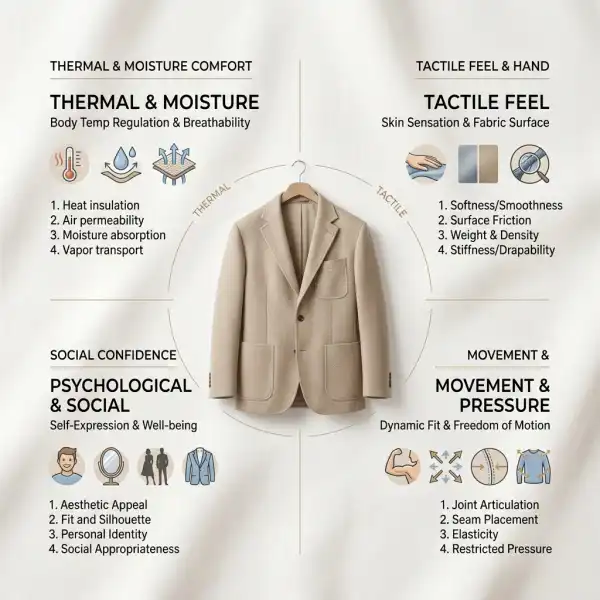
Clothing comfort is multidimensional. A technical review of wearable textiles describes sensorial comfort in relation to tactile, moisture, pressure, and thermal sensations, while also recognizing that comfort cannot be reduced to touch alone: review of comfort evaluation in wearable textiles. In practical apparel development, four connected dimensions are especially useful.
|
Comfort dimension |
What the wearer experiences |
Product variables that influence it |
|
Thermophysiological |
Feeling too hot, cold, damp, or clammy |
Fabric structure, weight, air permeability, moisture behavior, layering, lining, climate |
|
Tactile or sensorial |
Softness, smoothness, itch, cling, roughness, seam irritation |
Fiber and yarn, surface finish, labels, trims, seam type, skin contact, laundering |
|
Ergonomic or pressure |
Freedom to sit, walk, bend, reach, and breathe without unwanted pressure |
Pattern shape, ease allowance, stretch and recovery, closures, elastic tension, grading |
|
Psychological and social |
Feeling confident, appropriately dressed, secure, and like oneself |
Silhouette, opacity, coverage, body relationship, cultural norms, occasion, styling |
These dimensions can conflict. A very soft brushed surface may feel pleasant in a cool store but too warm in a tropical commute. High stretch may make a garment easier to put on, yet weak recovery can lead to bagging at the knees or waistband after hours of wear. A low armhole may appear relaxed while limiting upward movement. A seamless-looking bonded edge may reduce bulk but fail after repeated laundering if the adhesive system is poorly matched to the fabric and care conditions.
Comfort must therefore be evaluated at garment level, not inferred from one fiber name or a supplier's handfeel swatch. Fabric, pattern, trims, construction, fit, care, climate, and user expectation work together.
How Comfort-First Dressing Is Changing Fashion Categories
Tailoring is becoming less rigid, not irrelevant
Comfort-led tailoring retains visual authority while reducing unnecessary restriction. Designers may use lighter interlinings, partial linings, knitted constructions, adjusted shoulder treatments, more forgiving waistbands, or fabrics with controlled stretch. The objective is not to make every blazer oversized. It is to preserve the intended line while improving how the garment behaves when the wearer sits, reaches, commutes, or layers it.
US market data from Circana offered an early example of this direction in 2023: it described demand for “polished comfort” and reported growth in categories including casual pants, woven shirts, jackets, and blazers during the measured period. The figures were specific to the US and a particular year, so they should not be projected universally. Their continuing relevance lies in the observed combination of polish, flexibility, and multi-occasion use: Circana's polished-comfort analysis.
The construction choices behind this aesthetic deserve their own treatment. Readers exploring the design language can continue with how soft structures and relaxed silhouettes shape everyday style.
Denim is being judged as much by wear experience as by authenticity
Traditional rigid denim still has an audience, particularly where customers value break-in, fading, and a firm hand. Comfort-first influence has not erased that appeal. It has widened the category to include lighter weights, relaxed blocks, stretch blends, elasticated or adjustable waists, softer finishing, and constructions intended for easier sitting and movement.
Each intervention brings a trade-off. More elastane can improve initial flexibility without ensuring recovery or durability. Aggressive softening may affect strength or wash behavior, while a loose block can create bulk if the rise, seat, and leg are unbalanced. Teams need to specify the wearing outcome, not merely request “comfortable denim.”
Knitwear has moved into more occasions
Knitted constructions can conform to the body and provide flexibility, which makes them natural candidates for comfort-led wardrobes. Yet knitwear comfort depends on gauge, yarn, stitch, density, finishing, fit, and climate. A fine-gauge merino sweater, dense ponte trouser, cotton jersey dress, and brushed synthetic fleece create very different experiences.
Knitted jackets, matching sets, polos, skirts, and dresses can carry visual cues associated with structured woven garments. This offers ease without a sleepwear look, but raises expectations for recovery, pilling, growth, seam stability, and care performance.
Footwear and intimates make hidden comfort visible
Footwear, bras, underwear, and base layers expose the limits of superficial comfort marketing. A cushioned insole cannot compensate for a poorly shaped last. A wireless bra can still create pressure through its band, straps, seams, or inaccurate cup grading. A “second-skin” base layer may feel smooth while trapping heat in the wrong climate.
These categories show that comfort is experienced at contact points. Where pressure, moisture, or repeated movement concentrates, small design errors become large wearing problems. Testing those points supports a more credible proposition than adjectives alone.
What Does the Shift Mean for Fashion Businesses?
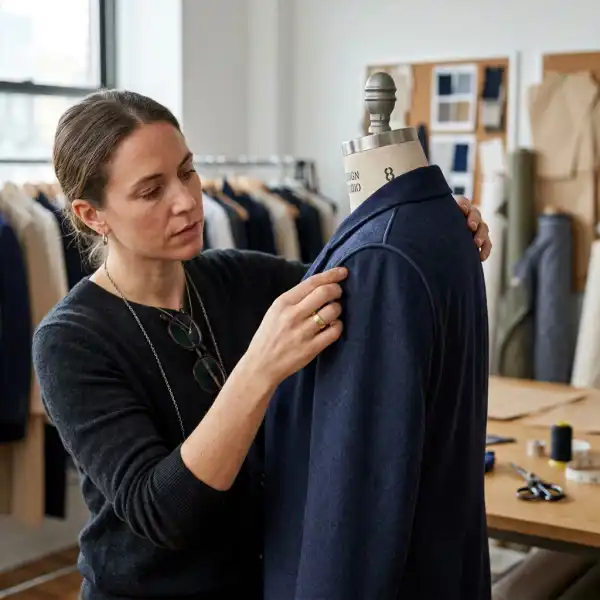
Comfort-first dressing influences more than styling. It changes how teams write product briefs, select materials, approve samples, describe fit, plan assortments, and interpret customer feedback.
Product development must begin with a use case
“Comfortable” is too vague to guide a pattern maker or supplier. A stronger brief describes the wearer, activity, duration, climate, layering, desired appearance, and likely sources of discomfort. For example: a warm-weather commuter trouser that remains polished after two hours of sitting, allows stair climbing, does not bind at the waist, and can be machine washed without excessive growth.
That brief leads to measurable development questions. Does the waistband pressure remain acceptable when seated? Does the fabric recover after knee flexion? Does the lining breathe sufficiently for the target climate? Can the pocket hold a phone without distorting the silhouette? Does the size range preserve comparable ease rather than merely scaling dimensions mathematically?
Sourcing decisions require more than a soft handfeel
Fabric buyers often make early judgments from a small swatch. This is necessary, but insufficient. The finished garment may behave differently after fusing, sewing, washing, printing, garment dyeing, or adding a lining. Softness created by a finish may also change after repeated home laundering.
A practical comfort-validation plan can include:
- Fabric weight, stretch, recovery, dimensional stability, air permeability, and moisture behavior where relevant to the product claim.
- Review of seam bulk, label placement, trim edges, elastic tension, closure pressure, and areas of repeated skin contact.
- Fitting in standing, seated, walking, reaching, bending, and stair-climbing positions rather than a static mirror pose alone.
- Wear trials in the intended climate and for a realistic duration.
- Care testing followed by another fit and handfeel review.
The exact laboratory tests should be chosen for the product and claim; not every casual garment needs an expensive performance-testing program. What matters is that the validation method matches the promise being made.
Merchandising must balance ease with visual clarity
Comfort-led assortments can become visually flat if every product is soft, neutral, and oversized. A commercially coherent range needs contrast: fitted with fluid, crisp with soft, matte with sheen, minimal foundations with stronger focal pieces. Comfort should broaden outfit possibilities, not remove the reason to desire the product.
Merchandisers also need category discipline. Relaxed weekend clothing, polished travel wardrobes, and sensory-friendly essentials serve different needs. Combining them under a generic “comfort collection” can weaken navigation and forecasting. Clear use cases show why an item belongs in the range.
E-commerce must make an invisible quality legible
Online shoppers cannot touch a fabric or test a waistband. Product pages therefore need evidence rather than empty descriptors. Useful information includes garment measurements, model measurements, fit notes, fabric weight or thickness guidance, stretch direction, lining, opacity, close-up texture, movement video, care instructions, and reviews organized by fit and wear experience.
The language should be precise. “Buttery soft” may sound appealing but says little about warmth, cling, durability, or recovery. “Midweight double-knit with four-way stretch and a smooth interior” gives the shopper a more usable expectation—provided the description is accurate.

How Can Brands Apply Comfort-First Thinking Without Losing Identity?
The strongest approach is selective. A fashion house known for sculptural eveningwear, a mass-market basics retailer, and a technical outdoor label should not express comfort in the same way. Each brand needs to decide which sources of discomfort are inconsistent with its promise and which forms of structure are essential to its identity.
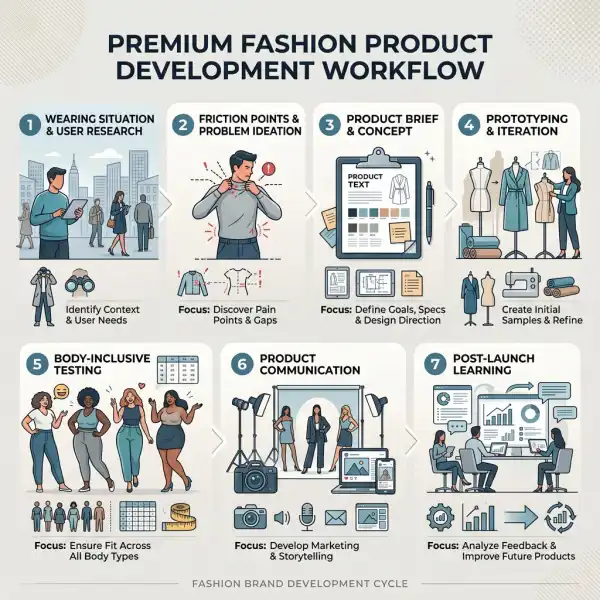
A useful implementation sequence is:
- Define the wearing situation. Specify where, how long, and in what climate the product will be worn.
- Identify friction points. Use returns, reviews, customer service logs, fittings, and wear trials to locate restriction, heat, scratchiness, gaping, slipping, or care-related problems.
- Translate the insight into the brief. Set construction, fit, material, and testing requirements that address those problems.
- Prototype the trade-offs. Compare options such as more ease versus silhouette control, softness versus durability, or stretch versus recovery.
- Validate on relevant bodies. Test across the intended size range and with people whose routines resemble the target customer's.
- Communicate specific benefits. Explain what moves, stretches, breathes, adjusts, or feels smooth, and state important limitations.
- Track post-launch evidence. Review reasons for return, repeat purchases, ratings, complaints, and care performance before scaling.
This sequence makes comfort an operational discipline. It also prevents the creative team from being handed a vague instruction to “make it more casual.” The deeper commercial response—how to segment comfort-led consumers, build propositions, and interpret demand—belongs in what fashion brands should learn from comfort-led consumers.
Common Mistakes in Comfort-Led Fashion
Treating oversized as a synonym for comfortable
Extra volume can reduce pressure in one area while creating weight, drag, exposure, or awkward movement elsewhere. An oversized sleeve may restrict work at a desk; a very low armhole can pull the whole garment upward when the wearer raises an arm. The better approach is to engineer ease where the body needs it and preserve balance across the pattern.
Assuming stretch solves poor fit
Stretch can mask fit problems during a short fitting, especially in close-to-body garments. It cannot reliably correct poor proportion, inadequate grading, misplaced seams, or excessive tension. Too much dependence on stretch may also produce rolling waistbands, compression, transparency, or loss of shape. Pattern correction should come before stretch is used as a rescue mechanism.
Equating softness with total comfort
Softness is a tactile property, not a complete performance profile. A soft fabric can be hot, clingy when damp, unstable, prone to pilling, or too heavy for the intended garment. Teams should consider the complete wearing environment and the effects of finishing and laundering.
Copying casual cues without understanding the customer
Elastic waists, dropped shoulders, and sneakers do not carry the same meaning in every market, workplace, age group, or price tier. Some customers want visible relaxation; others want hidden comfort within a conventional silhouette. Research should distinguish the desired experience from the preferred appearance.
Making broad claims that the product cannot substantiate
Terms such as breathable, ergonomic, all-day comfort, adaptive, or temperature-regulating imply specific performance. If the evidence is only a soft swatch and a short sample fitting, the claim may outrun the product. Narrow, verifiable language usually builds more trust than ambitious copy.
What Comfort-First Dressing Does Not Mean
Comfort-first dressing is influential, but it should not be used as a totalizing explanation for modern fashion. Consumers still buy clothing for ceremony, identity, seduction, status, cultural practice, protection, work requirements, and creative expression. In some contexts, a deliberately rigid or exaggerated silhouette is the point.
Several caveats keep the trend in perspective:
- Comfort is subjective. Body shape, sensory sensitivity, disability, climate, activity, culture, and past experience alter what feels comfortable.
- Relaxation is not universal. Dress codes and expectations differ across industries, communities, and occasions.
- Natural does not automatically mean comfortable or sustainable. Fiber type is only one variable; construction, processing, sourcing, care, durability, and end of life all matter.
- Synthetic does not automatically mean uncomfortable. Engineered yarns and fabric structures can deliver useful stretch, moisture transport, lightness, or abrasion resistance, depending on design and use.
- Comfort claims need context. A garment that works in an air-conditioned office may perform poorly outdoors in high heat and humidity.
- More comfort does not guarantee fewer returns. Incorrect sizing, color expectations, quality, styling, price, and changed preference can still drive returns.
The practical lesson is to avoid universal promises. Brands should identify whose comfort they are designing, under which conditions, and which compromises remain.
Frequently Asked Questions
Is comfort-first dressing the same as casual fashion?
No. Casual fashion describes a level of formality or a style category, while comfort-first dressing describes a design priority. A tailored dress, formal trouser, uniform, or occasion shoe can be comfort-first if its materials, pattern, construction, and fit support the intended wearer and activity. A casual garment can still be uncomfortable because it overheats, scratches, binds, slips, or loses shape. The distinction helps product teams avoid reducing comfort to a visual code. The more useful question is whether the garment delivers ease while maintaining the appearance and function required for its setting.
Did the pandemic create the comfort-first fashion trend?
The pandemic accelerated demand for at-home dressing and made comfort more visible, but it did not create the underlying trend. Sportswear, knitwear, casualized workplaces, sneakers, stretch denim, and less rigid tailoring were influential before 2020. What changed was the speed and breadth with which consumers experienced alternative ways of dressing. Hybrid routines then helped preserve demand for adaptable wardrobes in some professional segments. The effect is not uniform across countries or occupations, so brands should avoid building future assortments on a pandemic narrative alone. Current customer behavior and product-level evidence are more useful than a broad historical assumption.
Which fabrics are best for comfortable clothing?
There is no universally most comfortable fabric. The right choice depends on climate, activity, skin contact, garment shape, care, and customer expectation. Cotton may feel familiar and soft, linen can support air movement in some constructions, wool can manage moisture and temperature across conditions, and engineered synthetics can provide stretch, lightness, or moisture transport. Each also has limitations. Fabric weight, yarn, knit or weave structure, finish, seams, and fit can matter as much as fiber content. Brands should evaluate the finished garment after care rather than make a comfort decision from composition alone.
Does a relaxed fit automatically improve comfort?
Not automatically. Additional ease may reduce pressure and improve air movement, but excess volume can interfere with movement, add weight, expose the body unintentionally, or distort the intended silhouette. Comfort depends on where the ease is placed. Shoulder slope, armhole depth, rise, seat shape, crotch extension, waistband construction, and garment length can all affect movement. A well-balanced close fit may be more comfortable than a poorly balanced oversized fit. Fit sessions should include sitting, walking, reaching, and bending so teams can see how the pattern behaves beyond a static pose.
Can comfort-first design support premium positioning?
Yes, when comfort is delivered through credible materials, refined construction, consistent fit, and a distinctive design language. Premium comfort may appear in an exceptionally balanced trouser block, a lightweight tailored jacket, an elegant knit structure, carefully finished seams, or footwear built on a well-developed last. The value must be perceptible over time, not only soft at first touch. If the product quickly bags, pills, twists, or loses recovery, the comfort story weakens. Premium brands should explain craftsmanship and use case without turning the product page into unsupported performance advertising.
How should a brand measure whether a comfort-led product succeeds?
Use a combination of product testing and commercial evidence. Before launch, conduct movement-based fittings, extended wear trials, care tests, and relevant laboratory checks. After launch, monitor return reasons, reviews mentioning fit or feel, complaint themes, repeat purchase by style, size exchanges, and repurchase in additional colors. Compare results with a suitable control product rather than judging a single item in isolation. Sales alone are ambiguous because promotion, color, distribution, and trend exposure can influence demand. The best evidence connects a defined comfort intervention—such as a redesigned waistband—to a measurable change in wear feedback or returns.
Is comfort-first dressing inherently more sustainable?
No. A comfortable garment may be worn frequently and kept longer, which can support better use outcomes, but that result is not guaranteed. A product can feel excellent while relying on resource-intensive processing, poor labor practices, weak durability, or materials that are difficult to recycle. Conversely, a technically durable garment may still be discarded if its fit or style does not work for the owner. Sustainability claims require evidence across sourcing, production, use, care, durability, and end-of-life conditions. Comfort can contribute to longevity, but it should not be presented as proof of environmental benefit.
Conclusion
Comfort-first dressing is influencing modern fashion because it answers a practical tension: people want clothes that support real movement and varied routines without surrendering identity, polish, or desire. That expectation is reshaping categories from tailoring and denim to knitwear, intimates, and footwear.
The lasting change is not a single silhouette. Relaxed proportions will move in and out of fashion. What is more durable is the customer's awareness that restriction, irritation, poor temperature management, or awkward maintenance are design outcomes—not unavoidable costs of looking presentable.
For fashion businesses, that raises the standard of execution. Comfort has to be translated from a marketing adjective into a product brief, validated in the finished garment, tested across relevant bodies and conditions, and explained with enough specificity for customers to make an informed choice. Brands that do this well can make comfort part of their identity without allowing every collection to look the same. The opportunity lies in better design judgment, not simply softer fabric or more volume.




Comments 0
Leave a CommentSend Comment
Anda harus Login terlebih dahulu untuk dapat memberikan komentar.