

Opportunities and Challenges of On-Demand Manufacturing in Fashion
Quick Answer
On-demand manufacturing gives fashion businesses the opportunity to produce closer to actual demand rather than relying entirely on seasonal forecasts. It can reduce exposure to unsold finished inventory, support product personalization, make smaller market tests possible, extend size availability, and create a faster connection between customer orders and production decisions.
The model is not automatically cheaper, faster, or more sustainable. Producing garments individually or in small batches can increase unit costs, create frequent machine changeovers, complicate cutting and sewing schedules, and require customers to wait longer for delivery. Inventory risk may also move upstream into fabrics, trims, blank garments, or reserved production capacity.
The strongest on-demand systems combine controlled product options with accurate digital patterns, bills of materials, material availability, production scheduling, quality control, and realistic customer communication. Technology is important, but product architecture and operational discipline usually determine whether the model works.
For many apparel companies, the most practical strategy is hybrid: use forecast-led production for predictable core products and on-demand production for uncertain designs, extended sizes, personalized products, limited editions, or replenishment after real demand becomes visible.

Why Are Fashion Businesses Considering On-Demand Manufacturing?
Fashion businesses traditionally make important inventory decisions before they know exactly what customers will purchase. Product teams select designs, materials, colors, size ratios, and production quantities based on historical sales, market research, merchandising judgment, supplier minimums, and predicted trends.
That system can work well for stable products. Basic uniforms, proven denim fits, recurring schoolwear, or core black T-shirts may have enough historical demand to justify planned production.
The difficulty increases when the assortment contains many uncertain combinations. A brand may correctly predict that a blouse will sell but misjudge which colors or sizes customers prefer. It may identify a trend but enter the market after customer attention has moved elsewhere. A product may perform well online but only after large quantities of a weaker variation have already been manufactured.
On-demand manufacturing offers a different timing structure. Some production activities are postponed until the business has a stronger demand signal, such as:
- A paid customer order
- A completed customization
- A wholesale commitment
- A preorder threshold
- A short-cycle replenishment request
- Confirmed demand from a specific market
- A production batch assembled from several individual orders
This approach does not remove forecasting. Brands still need to estimate fabric demand, labor requirements, capacity, cash flow, delivery volume, and likely order patterns. What changes is the point at which materials are committed to a particular finished garment.
The broader production model is explained in on-demand fashion production for modern apparel brands. The central strategic question is whether delaying production creates more value than the additional complexity it introduces.
The Main Opportunities for Fashion Brands
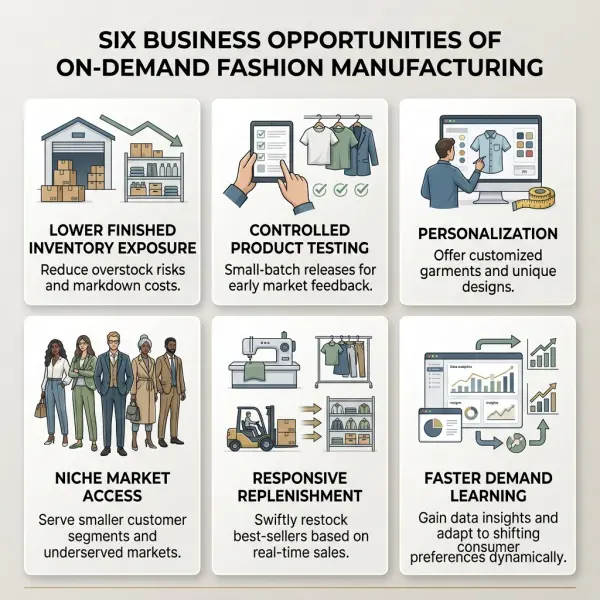
Lower exposure to unsold finished inventory
The most direct opportunity is reducing the quantity of finished garments produced without confirmed demand.
Finished fashion inventory is relatively inflexible. Once a fabric has been cut, sewn, colored, printed, labeled, and packaged into a particular style and size, the number of alternative uses becomes limited.
Materials or semi-finished products may retain more flexibility. A roll of black jersey could support several tops, dresses, or leggings. An undecorated sweatshirt could receive different graphics after purchase. A standard trouser may be hemmed to a selected length only after the customer orders.
By postponing product differentiation, businesses may reduce the risk of committing too early to the wrong combination of design, color, size, or market.
The European Environment Agency estimates that approximately 4–9% of textile products placed on the European market are destroyed before being used for their intended purpose, although it also notes that available evidence is fragmented. The estimate covers returned and unsold textiles and should not be treated as a universal global overstock rate.
The relationship between this production model and inventory reduction is explored more deeply in how made-to-order technology helps reduce overstock and waste.
More controlled product experimentation
On-demand production may allow a brand to test a wider range of concepts without manufacturing a full collection in advance.
A graphic apparel business could offer 20 designs using the same approved blank garment. A dress brand might test several print options on one validated silhouette. A sportswear company could offer club-specific colors and names while retaining a standardized jersey construction.
The opportunity is strongest when products share a common platform:
- The same pattern or garment body
- A limited number of approved fabrics
- Shared trims
- The same printing or embroidery process
- Common packaging
- Similar quality standards
- Repeatable production times
This lets the brand vary selected elements without rebuilding the entire supply chain for every product.
Product experimentation becomes less attractive when each variation requires unique fabric development, specialist trims, separate testing, new patterns, or different manufacturing partners. In that situation, a larger digital assortment may hide substantial physical complexity.

Personalization within controlled boundaries
On-demand manufacturing can support personalization because customer selections are captured before production is completed.
A brand may allow customers to choose:
- Color
- Embroidery
- Name or number
- Garment length
- Sleeve configuration
- Fabric from an approved range
- Standard fit profile
- Selected measurements
- Packaging or gifting details
Personalization can strengthen the product proposition when the choices are meaningful and production rules remain controlled.
The phrase “controlled boundaries” matters. A customer configurator should not become an unrestricted design request form. Each option needs a tested pattern, cost, material specification, process sequence, quality standard, and production time.
Research on mass customization identifies customer configuration, modular product structures, delayed differentiation, and digitally connected processes as important enablers. It also identifies decision overload, implementation costs, legacy-system integration, and real-time data management as recurring barriers.
Better access to niche and long-tail demand
Forecast-led manufacturing naturally favors products expected to sell in sufficient volume. This can leave smaller customer segments underserved.
On-demand manufacturing may improve access to:
- Extended sizes
- Less common proportions
- Regional designs
- Specialist uniforms
- Small community merchandise
- Limited-interest prints
- Modest-wear variations
- Adaptive clothing options
- Products for clubs, schools, or organizations
- Slow-selling replacement items
A brand does not need thousands of identical orders when its process can economically produce smaller quantities.
This does not mean every underserved segment automatically becomes profitable. Additional pattern development, fit testing, customer support, and quality control may still be required. The opportunity exists when the selling price and customer value can support those costs.
Shorter learning cycles between sales and production
When orders are transmitted directly into production planning, the business receives more immediate information about what customers are actually buying.
This can reveal:
- Which configurations are popular
- Which sizes receive consistent demand
- Which products require repeated remakes
- Which materials create production delays
- Which options customers rarely choose
- Which designs sell only after discounting
- Which orders generate the highest contribution margin
- Which lead-time promises are realistic
A connected data flow can help decision-makers refine future product development and production rules.
The concept resembles the broader manufacturing “digital thread,” in which product-definition information is connected with manufacturing, inspection, and quality activities. NIST emphasizes that the value of such integration depends on trustworthy, traceable, and interoperable product information rather than isolated digital files.
Brands should not confuse more data with better decisions. A high number of orders may result from a temporary promotion. A popular configuration may have poor margin. A low-selling item may suffer from unclear photography rather than weak product-market fit.
Sales, production, cost, return, and customer-service data need to be interpreted together.
More responsive replenishment
On-demand manufacturing does not have to mean producing every garment individually. Brands can also use demand-responsive short batches.
A retailer might hold a small opening quantity, monitor actual sales, and release replenishment orders for the best-performing sizes and colors. Confirmed demand can be grouped over several days to improve cutting and production efficiency.
This model sits between conventional bulk production and one-piece manufacturing. It may offer:
- Faster response to actual sell-through
- Lower opening inventory
- Better allocation by size or location
- Reduced dependence on large seasonal commitments
- Improved use of short production windows
- Greater flexibility to stop weak products
The manufacturer must still be able to reserve materials and capacity. A rapid replenishment promise is not credible when fabric takes three months to arrive or the factory has no available sewing capacity.
Potential for near-market production
Shorter production runs and digital workflows may support manufacturing closer to the customer market, particularly for products with high transport costs, short trend windows, personalization, or premium delivery expectations.
Near-market production can shorten some replenishment and communication loops. It may also help brands test a regional market before making a larger international commitment.
It is not guaranteed to lower total cost. Labor, facilities, compliance, materials, machinery, and technical expertise may be more expensive in the destination market. Many apparel processes also remain difficult to automate fully because soft, flexible materials are harder to handle consistently than rigid industrial components.
The International Labour Organization has found that automation penetration in apparel and footwear manufacturing remains limited compared with what is sometimes implied in public discussion. Its research highlights practical bottlenecks in handling variable textile materials and garment operations.
The realistic opportunity is selective localization, not necessarily full replacement of established global production networks.
Potentially stronger working-capital discipline
Made-to-order and preorder models may reduce the amount of cash tied up in completed products before they are sold. Customer deposits or full payment can also support production financing in some business models.
This benefit is conditional.
The brand may still need to pay in advance for:
- Fabric
- Trims
- Blank garments
- Machine capacity
- Software
- Sampling
- Factory setup
- Packaging
- Production staff
- Quality testing
A business can reduce finished-goods inventory while creating expensive upstream material stock or underused machinery. Working-capital improvement should therefore be measured across the entire operation rather than only the finished-goods warehouse.
The Main Challenges of On-Demand Manufacturing
Higher unit costs
Bulk manufacturing spreads setup, planning, supervision, machine preparation, and administrative work across many units. On-demand production may repeat some of those activities for every garment or small batch.
Costs can rise through:
- Frequent machine changeovers
- Smaller fabric markers
- Individual material handling
- More production job tickets
- Separate quality checks
- Additional customer-service activity
- Personalized packaging
- More fragmented shipping
- Lower machine utilization
- Higher software and integration costs per unit
- Increased remake exposure
The comparison should not stop at factory cost per garment. Bulk production may have a lower unit cost but create markdowns, storage costs, and unsold inventory. On-demand production may have a higher unit cost but lower finished-stock exposure.
The relevant measure is the contribution margin and risk-adjusted economics of the complete model.
Production efficiency can fall when orders are fragmented
Apparel factories are often organized around repeated operations and planned production lines. A line producing the same garment can balance tasks, assign machines, train workers, and control output around a known sequence.
On-demand orders may arrive in different fabrics, sizes, colors, constructions, and deadlines. Without careful grouping, the factory can spend more time switching between requirements than producing.
Consider a sewing unit receiving five orders:
- A cotton T-shirt
- A stretch sports jersey
- A woven blouse
- A personalized hoodie
- A tailored trouser
These are not simply five garments. They may require different needles, threads, machines, seam types, operators, quality checks, pressing, and finishing.
A workable system often groups compatible orders rather than processing them strictly in the sequence they were purchased.
Fabric and trim minimums remain
A fashion brand may be ready to produce one garment, but its material suppliers may not operate that way.
Custom fabric colors, printed textiles, zippers, buttons, labels, packaging, and chemical processes often have minimum order quantities or minimum charges. Some materials also require long development and testing periods.
This creates a structural tension:
- The finished garment is produced after demand.
- The materials may still be purchased according to a forecast.
Brands can manage the problem through core material platforms, stock-supported supplier collections, shared trims, common packaging, greige materials, or blank garments. These solutions reduce variety upstream, which may limit the amount of variety available to the customer.
Lead times compete with immediate availability
Customers accustomed to purchasing available stock may expect same-day or next-day dispatch. On-demand products still need to enter a production queue.
The lead time may include:
- Payment verification
- Customer-detail validation
- Artwork or measurement approval
- Material allocation
- Printing or cutting
- Sewing
- Finishing
- Inspection
- Rework
- Packing
- Carrier collection
A print added to an available T-shirt may take a few days. A made-to-measure jacket may require several weeks and one or more fittings.
The business must decide whether its customer proposition justifies the wait. Personalization, fit, craftsmanship, local production, or limited availability may support a longer timeline. A basic commodity product has less room to make customers wait.
Order and product data must be precise
Bulk production can sometimes absorb minor administrative errors because teams work repeatedly with the same style. On-demand production creates many order-level instructions, making data accuracy critical.
A production error may come from:
- An obsolete pattern
- Incorrect measurement data
- An unapproved artwork version
- Missing personalization
- Wrong material allocation
- Conflicting color names
- Incorrect care labels
- Incomplete packaging instructions
- An unrealistic completion date
- Duplicate order release
Digital systems need consistent product identifiers, revision control, access permissions, validation rules, and exception handling.
NIST’s work on manufacturing digital threads emphasizes that information must remain connected, traceable, protected, and usable across multiple systems. Interoperability and product-data governance remain significant implementation challenges.
Technology systems may not integrate cleanly
A fashion business may use separate systems for:
- Ecommerce
- Product lifecycle management
- Inventory
- Patternmaking
- Artwork
- Production scheduling
- Quality control
- Shipping
- Customer service
- Finance
The systems may use different product codes, file formats, field names, and update rules. Some suppliers may still rely on email, messaging applications, spreadsheets, or printed documents.
Integration does not always require one large platform. It does require clearly defined ownership of each data element and a reliable method of transferring information.
An expensive system can still fail when:
- Product data are inconsistent
- Staff bypass required fields
- Suppliers cannot access the platform
- Interfaces are not maintained
- Production exceptions are handled outside the system
- No one reconciles digital records with physical inventory
For small and medium-sized enterprises, digital adoption is often constrained by financing, skills, interoperability, cybersecurity, and uncertainty about how technology should change business processes.
Sewing remains difficult to automate fully
Digital printing and automated cutting receive considerable attention because their workflows can be controlled through digital files. Sewing is less straightforward.
Garment pieces are flexible, deformable, and sensitive to handling. Different fabrics stretch, slip, curl, fray, or respond differently to tension. Operators also perform judgment-based adjustments that are difficult to reduce to one standardized machine movement.
Some sewing operations can be automated or semi-automated, especially for stable, repeated products. Full automation across varied fashion products remains much more difficult.
This means on-demand manufacturing still depends heavily on skilled operators, line planning, training, communication, and quality control. Technology changes the work; it does not automatically remove the human production system.
Capacity planning becomes more dynamic
On-demand businesses may experience unpredictable order peaks after a campaign, influencer mention, seasonal event, or viral product.
Production capacity cannot always expand at the same speed as digital demand.
A brand may receive 1,000 orders in one weekend but have capacity for only 200 garments per week. If it advertised a five-day production time, the commercial success becomes an operational failure.
Capacity planning should account for:
- Available machine hours
- Qualified operators
- Material availability
- Setup and changeover time
- Inspection capacity
- Rework
- Maintenance
- Staff absence
- Peak campaign volume
- Supplier delays
- Shipping collection limits
Order caps, scheduled preorder windows, dynamic delivery estimates, and controlled batch releases can protect the operation from demand it cannot fulfill.
Quality errors become order-specific
A defect in a bulk product may sometimes be replaced from warehouse inventory. A personalized or made-to-measure garment may need to be remade.
The replacement cost may include:
- New materials
- Repeated production labor
- Additional inspection
- Expedited shipping
- Customer compensation
- Lost production capacity
- Potential disposal of the original garment
First-pass quality is therefore a critical metric.
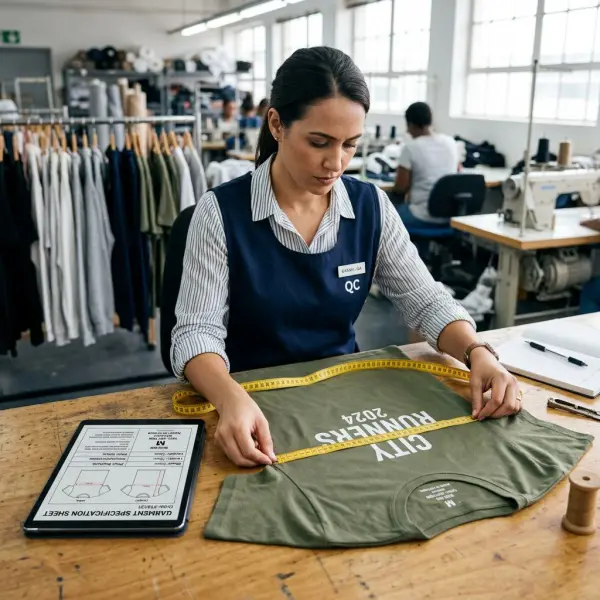
Quality control should verify both general workmanship and order-specific requirements, including size, measurements, print placement, name spelling, color, configuration, labels, and packaging.
Returns are more difficult to manage
A standard garment can often return to available inventory if it remains in sellable condition. A personalized garment may have little or no resale value.
This makes accurate product information especially important. Customers need clear:
- Size charts
- Measurement instructions
- Product dimensions
- Fabric descriptions
- Color representation
- Production timelines
- Personalization previews
- Cancellation terms
- Return and alteration policies
Policies must comply with the applicable consumer laws in each market. Brands should not assume that labeling a product “custom” automatically removes every cancellation or return obligation.
The European Environment Agency reports that online clothing returns are substantial in Europe and identifies fit and style as major reasons. Exact rates differ by retailer, product category, market, and return policy.
Customer configuration can become confusing
More choice does not always create more value.
Customers may struggle when asked to select unfamiliar construction details, provide complex body measurements, compare too many fabrics, or imagine combinations that have not been photographed.
This can create “mass confusion”: customers abandon the purchase, make unsuitable selections, or become dissatisfied because the finished product does not match what they imagined. Research on mass customization recognizes customer decision complexity as an important design challenge.
A strong configurator guides customers through meaningful choices while hiding unnecessary technical complexity.
For example, a customer may choose “relaxed fit” rather than manually determine ease allowance at the chest, waist, and hip. The technical translation belongs in the product system.
Skills and organizational change are often underestimated
An on-demand system changes more than the production schedule.
Designers need to understand modularity and production rules. Merchandisers need to manage a configurable assortment. Patternmakers must maintain reliable digital versions. Production planners work with dynamic orders. Operators handle smaller batches and greater variation. Customer-service teams must explain lead times and resolve configuration problems.
Training is therefore not limited to software buttons.
The ILO has emphasized that technological upgrading in apparel requires both technical and interpersonal skills, particularly because workers must respond to changing production methods, quality requirements, and workplace coordination.
Poor implementation can place the burden on production workers without giving them enough information, training, decision authority, or time.
Cybersecurity, privacy, and intellectual property risks increase
Connected production involves valuable data:
- Customer names and addresses
- Body measurements
- Payment status
- Original artwork
- Product patterns
- Material specifications
- Supplier pricing
- Production capacity
- Sales performance
- Factory instructions
The brand should define who can access these data, how long they are retained, which parties may reuse them, and what happens when a supplier relationship ends.
A body-measurement database should not be treated like a basic product catalog. Customer-created artwork may also contain personal, licensed, copyrighted, or trademarked content.
Digital integration creates commercial value, but it also increases the consequences of weak access control, insecure file transfers, or unclear data ownership.
Opportunity Versus Challenge: What Changes Operationally?
|
Business area |
Opportunity |
Corresponding challenge |
|
Inventory |
Lower finished-goods exposure |
Materials and components may still require advance purchase |
|
Assortment |
More designs can be tested |
Excessive options create complexity |
|
Personalization |
Greater customer relevance |
Configuration errors and higher support requirements |
|
Sizing |
Actual orders can guide size production |
Fit mistakes may create costly remakes |
|
Production |
Smaller releases can follow demand |
Frequent changeovers may reduce efficiency |
|
Data |
Faster feedback from orders |
Systems must exchange accurate information |
|
Fulfillment |
Product is linked to a specific customer |
Customers must wait for production |
|
Sustainability |
Potential reduction in overproduction |
Benefits must be measured across the lifecycle |
|
Localization |
Production may move closer to demand |
Local capacity and costs may be limiting |
|
Cash flow |
Less capital in completed stock |
Technology and raw materials still require investment |
|
Customer relationship |
Transparent production can build trust |
Late orders can damage trust quickly |
|
Scalability |
Digital workflows can support growth |
Volume peaks can overwhelm physical capacity |
This balance explains why on-demand manufacturing performs differently across businesses. A strong opportunity in one category can become the primary constraint in another.
Which Fashion Products Are Most Suitable?
On-demand manufacturing is most practical when the product has a stable base and a limited number of controlled variations.
Suitable early-stage categories often include:
- Printed T-shirts and sweatshirts
- Personalized sports jerseys
- Embroidered uniforms
- Community or event merchandise
- Standard bags and accessories
- Selected knitwear
- Artist collaboration products
- Extended-size basics
- Standard garments with configurable length
- Occasionwear with controlled fabric choices
- Replacement garments for recurring programs
The model becomes more difficult when the product requires:
- Custom-milled fabric
- Long dyeing or washing processes
- Extensive handwork
- Highly variable fitting
- Numerous unique components
- Specialist machinery
- Several external production partners
- Regulatory testing for every configuration
- Very short customer delivery expectations
- A price point that cannot absorb small-run costs
A premium made-to-order dress and an inexpensive printed T-shirt may both use on-demand principles, but their operational systems should not be evaluated as though they were identical.
When Is a Hybrid Model More Practical?
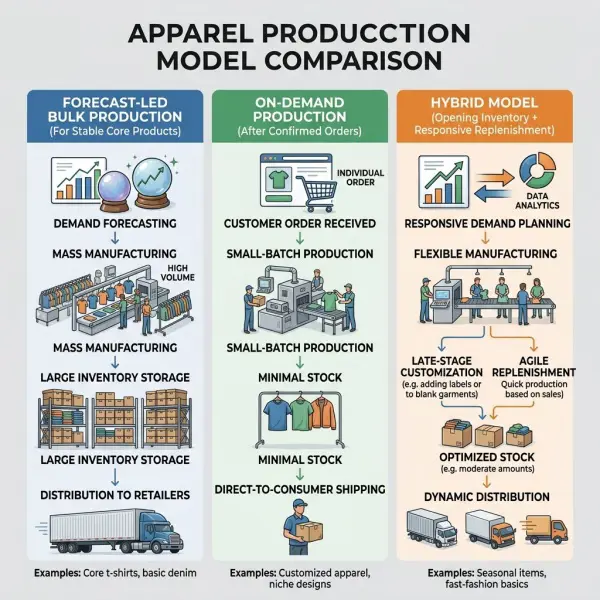
A hybrid model combines forecast-led production with demand-triggered production.
For many apparel brands, this is more realistic than choosing one system for the entire assortment.
Core products can remain forecast-led
Products with stable demand, predictable size ratios, efficient bulk economics, and immediate-delivery expectations may still be produced in planned quantities.
Examples include proven basics, school uniforms, recurring workwear, or established bestsellers.
Uncertain variants can be produced on demand
The brand can use on-demand production for:
- Fashion colors
- Experimental prints
- Personalized options
- Extended sizes
- Limited editions
- Regional variations
- Slow-moving configurations
Opening stock can be followed by responsive replenishment
A small quantity is available immediately at launch. Further production is based on actual sell-through.
This preserves some delivery speed while limiting the size of the initial commitment.
Standard components can be finished after purchase
The business may stock a stable garment body and postpone printing, embroidery, labeling, hemming, or packaging.
This is often more efficient than producing every garment entirely from scratch after ordering.
How Should Brands Evaluate Financial Viability?
A made-to-order product should be costed at the order level, not only by comparing fabric and sewing costs with a bulk quotation.
Include the complete variable cost
The calculation should include:
- Fabric and trims
- Printing or embroidery
- Cutting
- Sewing
- Finishing
- Individual handling
- Inspection
- Packaging
- Payment processing
- Fulfillment
- Customer service
- Return or alteration allowance
- Remake risk
- Supplier minimum charges
Allocate operating and technology costs
The model may also require:
- Ecommerce configuration
- Software subscriptions
- Integration development
- Pattern digitization
- Data management
- Equipment depreciation
- Machine maintenance
- Production planning
- Technical support
- Staff training
- Cybersecurity
- Backup systems
Low order volume can make these costs high per garment. Higher volume may improve allocation but create new capacity requirements.
Compare avoided costs realistically
On-demand production may avoid or reduce:
- Finished-goods storage
- Markdown losses
- Liquidation
- Product write-offs
- Transfers between warehouses
- Capital tied up in unsold stock
- Large opening production commitments
- Obsolescence of specific finished variants
Avoided costs should be based on the brand’s actual historical performance rather than optimistic assumptions.
Measure contribution margin, not revenue alone
A personalized item may sell at a premium but require more customer support and production handling. A product may generate many orders while consuming scarce capacity that could be used for more profitable work.
Useful commercial measures include:
- Contribution margin per order
- Contribution margin per production hour
- Customer acquisition cost
- Remake-adjusted margin
- Return-adjusted margin
- Cash conversion cycle
- Revenue per constrained machine
- Revenue per operator hour
A Practical Readiness Framework
A brand should evaluate readiness across product, customer, supply chain, technology, operations, and finance.
|
Readiness area |
Questions to answer before implementation |
|
Product |
Is the construction repeatable? Are configurations controlled and tested? |
|
Customer |
Will customers accept the lead time and price? Do they understand their choices? |
|
Materials |
Are core fabrics and trims available in practical quantities? |
|
Pattern and specification |
Are approved digital patterns, measurements, and bills of materials reliable? |
|
Production |
Can orders be grouped, scheduled, tracked, and inspected? |
|
Technology |
Can sales, inventory, product, and production data exchange correctly? |
|
Quality |
Can each order be verified without excessive cost? |
|
Capacity |
Can the operation manage demand peaks and rework? |
|
Fulfillment |
Are production and shipping promises realistic? |
|
Financial |
Does the contribution margin cover small-run complexity? |
|
Data governance |
Are access, ownership, privacy, and backups defined? |
|
Sustainability |
Can claimed improvements be measured using clear boundaries? |
A company does not need maximum maturity in every area before running a pilot. It does need enough control to understand why the pilot succeeds or fails.





Comments 0
Leave a CommentSend Comment
Anda harus Login terlebih dahulu untuk dapat memberikan komentar.