
How Traditional Textiles Inspire Contemporary Fashion Collections
A fashion collection can begin with an unexpected detail: the softened edge of an ikat pattern, the raised texture of a handwoven fabric, or the way a traditional textile border frames a garment. These characteristics may seem decorative at first, but they can influence much more than the appearance of a finished piece.
Traditional textiles provide designers with established systems of color, pattern, craftsmanship, and material construction. Some are distinguished by yarn-dyeing techniques, others by intricate weaving methods or surface decoration. Their proportions, textures, and manufacturing processes can shape decisions about silhouette, fabric placement, garment construction, and collection development.
For contemporary fashion brands, the creative opportunity lies in translating these textile characteristics into products suited to modern wardrobes. A traditional woven cloth might become the focal point of a minimalist jacket, while the color composition of a historic textile could inform an entire collection without reproducing its original motifs.
This translation requires more than aesthetic inspiration. Designers must understand how the textile behaves, whether it can be sourced consistently, and how its original context relates to the intended product.
The most effective collections use textile heritage as part of their design thinking, rather than simply adding recognizable traditional patterns to otherwise unrelated garments.
Quick Answer: How Do Traditional Textiles Inspire Contemporary Fashion?
Traditional textiles inspire contemporary fashion collections through their patterns, colors, textures, weaving structures, dyeing techniques, and craftsmanship. Designers study these characteristics and translate selected elements into modern garments, accessories, and coordinated collections.
Inspiration may involve using authentic traditional cloth, adapting textile construction methods, creating original patterns informed by established design principles, or collaborating with artisans to develop new materials. A handwoven textile can determine the silhouette of a garment, while an intricate decorative border may influence seam placement or the arrangement of fabric panels.
For fashion businesses, traditional textiles can provide a distinctive visual direction and support craftsmanship-focused product development. However, their commercial application depends on material performance, sourcing availability, production capacity, pricing, and accurate communication about cultural origins.
The distinction between authentic textile production and visual reinterpretation is particularly important. A printed fabric inspired by traditional weaving may reproduce some aesthetic qualities, but it does not necessarily share the structure, craftsmanship, or cultural significance of the original material.
Traditional Textiles Offer More Than Decorative Patterns
Traditional textiles are fabrics associated with established cultural or regional making practices, often involving techniques and knowledge transmitted through generations. They may include handwoven fabrics, resist-dyed cloth, embroidery, supplementary-weft weaving, and other specialized textile constructions.
What makes these textiles valuable as design references is the connection between appearance and production method. A decorative pattern is not always something applied after fabric construction. In many traditions, the pattern is created through the arrangement of yarns, the weaving process, selective dyeing, or skilled manipulation of threads.
This difference affects how contemporary designers interpret the material. A motif printed onto finished fabric behaves differently from a motif woven into its structure. The two may produce similar photographs, but their surface texture, weight, flexibility, and manufacturing requirements can differ considerably.
The wider relationship between cultural identity, traditional dress, and modern apparel is explored in Cultural Heritage Fashion Explained for Modern Apparel Design. When developing actual collections, however, the next question is more practical: which characteristics of a textile can become useful design decisions?
Pattern Composition and Visual Rhythm
Textile patterns can influence a collection through their scale, repetition, symmetry, spacing, and relationship to the fabric's edges.
Some traditional textiles feature small motifs arranged in regular repeats. Others have large central compositions, alternating bands, or prominent borders. A designer can study these arrangements as examples of visual organization rather than treating each motif as an isolated graphic.
For instance, a cloth with strong vertical pattern bands may suggest elongated garment panels or a restrained use of decorative fabric along the front opening of a coat. A textile with a distinct border might inform the placement of details around a hem or sleeve opening.
These choices create a relationship between fabric and silhouette. Instead of forcing an existing textile into a conventional pattern layout, the garment can be designed around the textile's visual structure.
Color Relationships and Textile Identity
Traditional textiles often contain established color combinations associated with particular materials, dyeing practices, or cultural aesthetics.
These combinations can become references for contemporary collection palettes. Designers may examine the balance between light and dark colors, the proportion of dominant and accent tones, or the contrast between dyed and undyed areas.
A collection inspired by an indigo-dominant textile, for example, might use deep blue as its principal color and introduce neutral or warmer accents through coordinating garments. Such an approach allows the color relationship to influence the collection without requiring every piece to reproduce the source textile.
Color research should nevertheless avoid treating culturally significant combinations as universal visual trends. The meaning of a palette may differ between communities, and some combinations are associated with specific traditions or occasions.
Texture, Structure, and Material Character
A traditional textile's construction can be more influential than its decorative appearance.
Handwoven fabrics may contain irregular yarn thickness, visible slubs, distinctive surface relief, or variations arising from the weaving process. Other textiles may be exceptionally fine, open, dense, or structured depending on fiber selection and technique.
These characteristics affect garment design directly. A fabric with substantial body may suit a structured vest or jacket, while a lightweight textile may be better suited to a relaxed blouse, overlay, or flowing dress.
The relationship is not automatic. Designers need to evaluate fabric weight, drape, extensibility, dimensional stability, and finishing before selecting a silhouette. A lightweight handwoven fabric may still have limited stretch, while a visually substantial textile may become unstable when cut on the bias.
Understanding these physical qualities allows heritage inspiration to extend beyond surface styling into the actual construction of contemporary clothing.
Traditional Textile Techniques That Influence Modern Collections
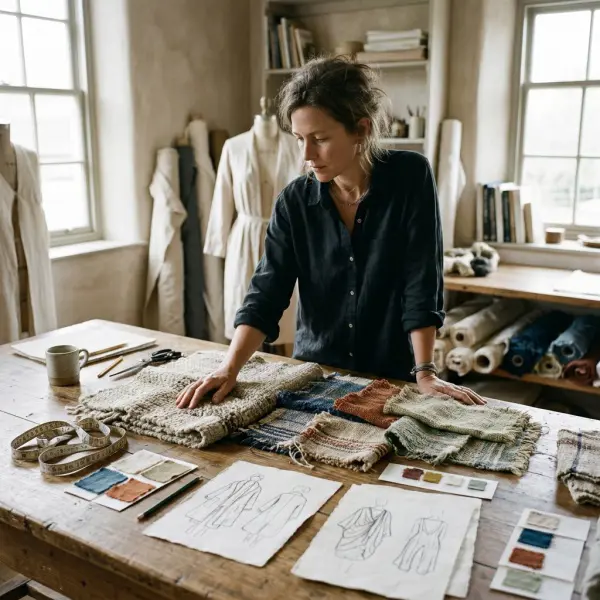
Different textile traditions offer different design possibilities. Their relevance to contemporary fashion depends on both visual characteristics and the techniques used to create them.
Understanding the distinction between a woven pattern, a dyed pattern, and an applied decorative surface is especially important when choosing how to incorporate a heritage reference into new garments.
Ikat: Translating Yarn-Dyed Patterns Into Modern Silhouettes
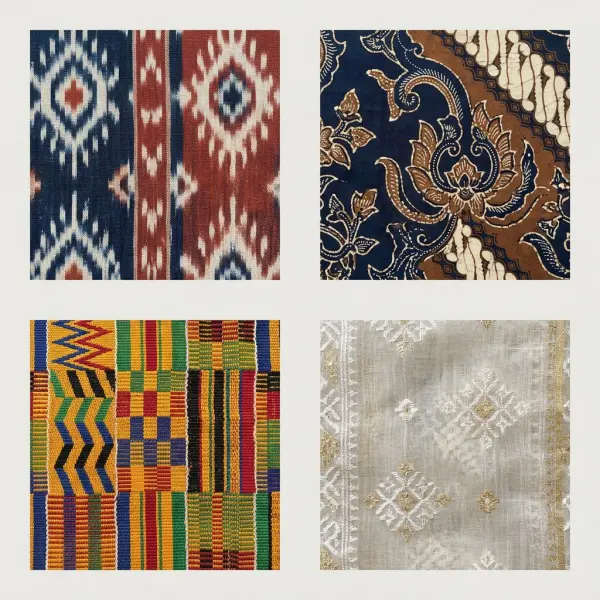
Ikat is a resist-dyeing technique in which selected yarns are bound and dyed before weaving so that the arrangement of colored threads creates a pattern in the finished cloth. Depending on the tradition, the process may involve warp yarns, weft yarns, or both.
The Metropolitan Museum of Art's explanation of ikat textiles describes how the technique creates patterns before fabric construction, often producing characteristically softened edges where differently dyed yarn sections meet.
For contemporary designers, that visual quality can influence the design of outerwear, relaxed trousers, dresses, and accessories. The relationship between pattern scale and garment silhouette is particularly relevant because large motifs may be disrupted by narrow pattern pieces or curved seams.
Imagine a contemporary womenswear collection built around a wide-scale ikat textile. Instead of using the fabric across every garment, a designer could create one statement jacket, then coordinate it with solid-colored trousers and tops that reflect the textile's palette.
The resulting collection has visual continuity without relying on identical patterns throughout the assortment.
However, directly using culturally specific ikat textiles requires attention to their origins and meanings. Ikat is a technique practiced in multiple regions and traditions, not a single universal decorative style.
Batik: Using Resist-Dyed Surfaces to Guide Print Placement
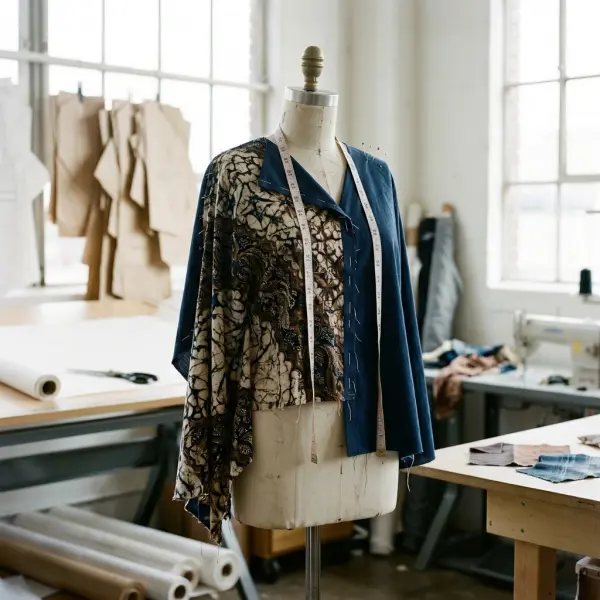
Batik offers a different relationship between pattern and material because its resist-dyeing process is applied to cloth rather than necessarily patterning yarns before weaving.
Traditional Indonesian batik uses wax to resist dye penetration, allowing makers to develop detailed patterns through successive applications and dyeing processes. UNESCO's documentation of Indonesian Batik describes both its making techniques and the cultural symbolism associated with different designs.
For collection development, batik can provide inspiration through patterned fabric placement, contrast between decorative and plain surfaces, and the coordination of garments around a shared color palette.
A designer might use authentic batik for a relaxed shirt, a coordinated skirt, or an accent panel on a modern dress. In each case, the garment pattern should account for the scale and direction of the decoration.
The technical distinction also influences sourcing and pricing. Genuine wax-resist batik and machine-printed batik-inspired fabric have different production processes and should be described accordingly.
Kente: Learning From Woven Strips and Geometric Composition
Traditional Kente from Ghana demonstrates how textile construction and visual arrangement can work together.
Kente cloth is made from woven strips, which are assembled to create larger textiles. Its designs may combine colored stripes, geometric compositions, and woven motifs, with some patterns and color arrangements carrying social and cultural meanings.
UNESCO's documentation of traditional Kente craftsmanship identifies its strip-weaving methods and relationship to community knowledge, identity, and social traditions.
From a design perspective, strip construction introduces useful questions about rhythm, panel width, and the relationship between repeated sections.
A contemporary jacket incorporating an appropriately sourced handwoven panel, for example, may be designed around the textile's original dimensions. Alternatively, a brand might explore an original geometric arrangement informed by general principles of strip composition rather than reproducing culturally significant Kente designs.
The decision between using authentic woven cloth and creating a new composition affects both the manufacturing process and the legitimacy of product descriptions.
Jamdani: Delicate Woven Motifs for Lightweight Apparel
Jamdani provides another approach to textile patterning. In this tradition, decorative motifs are created during weaving through a discontinuous supplementary-weft technique rather than being printed onto a finished fabric.
UNESCO's description of traditional Jamdani weaving identifies the technique with skilled weaving communities around Dhaka, Bangladesh, and emphasizes its fine, patterned cotton textiles.
For contemporary fashion, the relationship between lightweight fabric and selectively placed woven motifs can inform blouses, dresses, overlays, and occasionwear. The relative openness of the fabric and arrangement of motifs may create a subtle decorative effect without extensive additional embellishment.
The material requires careful design assessment. Depending on the textile, transparency, seam strength, fabric handling, and care requirements may limit suitable garment applications.
A collection using genuine Jamdani fabric should respect both the craftsmanship and the practical characteristics of the material rather than treating it as interchangeable with a generic patterned lightweight cloth.
How Textile Characteristics Shape Collection Design
The four examples above demonstrate that traditional textiles influence fashion in different ways. Some provide distinctive surfaces, while others establish a construction logic that can shape the garment itself.
Before selecting fabrics or developing silhouettes, designers need to identify which characteristics are central to the collection concept.
|
Textile characteristic |
Contemporary design opportunity |
Practical consideration |
|
Repeated motifs |
Coordinated prints, garment panels, and decorative accents |
Motif scale, direction, matching, cultural significance |
|
Distinctive color palettes |
Collection-wide color coordination and contrasting separates |
Dye consistency, colorfastness, customer preferences |
|
Handwoven texture |
Tailored separates, jackets, accessories, statement pieces |
Fabric thickness, drape, dimensional stability |
|
Decorative borders |
Hem details, sleeve accents, jacket openings |
Pattern placement, cutting efficiency, usable fabric width |
|
Lightweight patterned weaving |
Blouses, dresses, overlays, occasionwear |
Transparency, seam strength, handling requirements |
|
Traditional surface decoration |
Embroidery details, decorative panels, specialized finishes |
Production time, durability, skilled labor requirements |
|
Narrow woven construction |
Panel-based garments and accessories |
Seam placement, joining methods, fabric utilization |
The most effective application depends on what the designer wants the garment to communicate. A minimalist brand might use a small amount of textured traditional fabric as a focal point. A brand specializing in expressive prints may concentrate on original color and composition studies.
It is also possible for the traditional textile to determine the garment's overall structure. If a material is available only in narrow strips or has a large-scale border design, the designer may need to build the silhouette around those limitations.
This is where heritage textile research becomes genuine fashion design development rather than simple surface decoration.
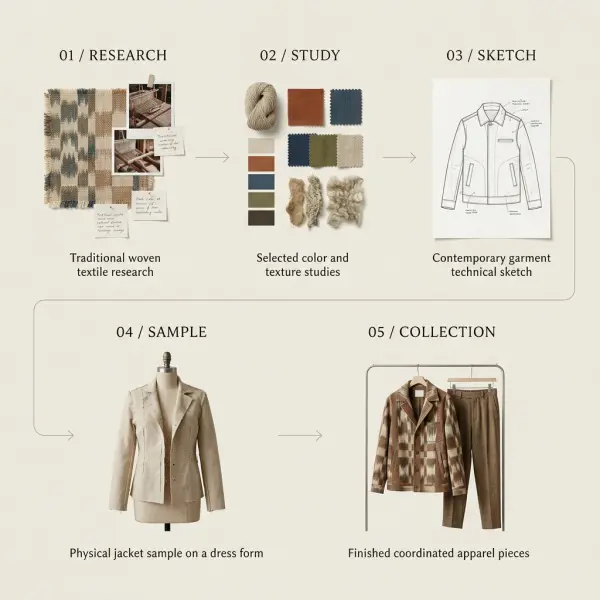
From Textile Research to a Contemporary Fashion Collection
A traditional textile reference becomes commercially useful when it can be translated into a coherent design brief, material specification, and workable product range.
There are two broad starting points. In a textile-led collection, the designer begins with a particular fabric and develops garments suited to its characteristics. In a concept-led collection, the designer starts with a broader creative direction inspired by textile traditions, then sources or develops materials to support that idea.
Neither approach is inherently preferable. The first can preserve more of the physical character of a traditional textile, while the second can offer greater flexibility in silhouettes, material selection, and production planning.
Step 1: Identify the Design Reference and Its Purpose
A useful research process goes beyond collecting images of attractive fabrics.
Designers should investigate the textile's construction, material composition, geographic and cultural context, and typical applications. Physical samples are particularly valuable because photography rarely communicates fabric thickness, stiffness, transparency, or surface relief accurately.
The design team should then determine what makes the reference relevant to the intended collection. It may be the movement of an irregular woven pattern, the placement of a decorative border, the relationship between contrasting colors, or the texture created by a particular weaving technique.
A clear direction prevents the collection from becoming an assortment of unrelated heritage-inspired details.
For example, a concept built around the geometry of narrow woven strips could inform panel construction across jackets, skirts, and accessories. The same design principle would appear in different ways while keeping the collection visually connected.
Step 2: Develop a Textile-Focused Mood Board
A textile-focused mood board should connect source materials to contemporary fashion applications.
Alongside reference images, designers can include actual fabric swatches, yarn samples, color studies, material specifications, and proposed garment silhouettes. The objective is to understand how a particular textile characteristic could influence the finished product.
A useful distinction is to separate original references from proposed interpretations. This makes it easier to identify which elements come from a specific tradition and which are newly developed design decisions.
The mood board should also reflect the brand's established identity. A heritage reference may be visually compelling but unsuitable for a collection if it conflicts with the brand's intended customer, price positioning, or product categories.
Design consistency requires selection. Not every interesting pattern, color, or technique needs to appear in the final collection.
Step 3: Decide Where the Textile Should Appear
Once the design direction is established, the next challenge is determining how the textile interacts with garment construction.
Large patterned areas can create a strong visual statement, but they may also increase cutting waste or complicate motif alignment. Smaller panels can reduce material requirements, although additional seams and joining operations may increase labor costs.
The intended placement should account for garment proportions. A broad woven motif may become difficult to recognize when divided across narrow sleeve panels. A decorative border may work well along a straight hem but become distorted when forced around curved pattern pieces.
For textiles with meaningful or directional motifs, the patternmaking team needs clear placement instructions. Leaving the decision entirely to the cutting room can produce inconsistent visual results or inappropriate use of the source design.
Step 4: Translate the Concept Into a Material and Garment Specification
A visually convincing concept still needs to be converted into information that patternmakers, suppliers, and manufacturers can use.
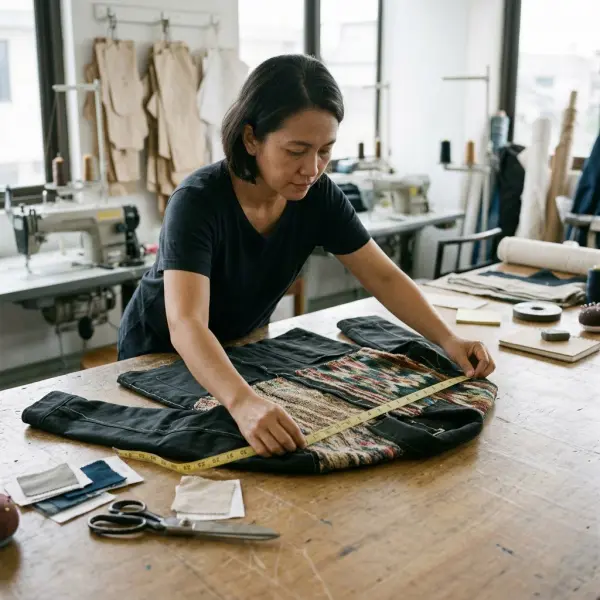
The technical specification should include garment measurements, construction details, approved materials, textile placement, and quality requirements. When using traditional textiles, additional information may be needed concerning fabric direction, pattern repeat, usable width, edge construction, and acceptable surface variation.
For example, a handwoven fabric may have slight variations in thickness that are part of its character. Those variations should not automatically be treated as defects. However, areas with inadequate strength, damage, or excessive dimensional variation may still be unsuitable for garment construction.
The design team should define acceptable variation using approved samples and measurable requirements wherever possible.
This distinction helps protect authentic material character without compromising basic garment quality.
Step 5: Build a Collection Rather Than a Group of Statement Pieces
An effective fashion collection needs internal relationships between products.
If every garment uses a complex textile pattern, the assortment may become visually overwhelming or difficult to coordinate. A more balanced approach may include one or two statement products supported by simpler garments that reflect the same color palette, material character, or silhouette direction.
Consider a hypothetical six-piece capsule collection inspired by traditional weaving. The principal piece might be a contemporary jacket featuring authentic woven fabric. A matching skirt could use a smaller amount of the same textile, while coordinating shirts, trousers, and layering pieces provide more versatile styling options.
Such a collection allows the heritage material to remain distinctive without requiring every product to carry the same manufacturing complexity.
The exact assortment should follow customer demand, intended occasions, production costs, and the brand's existing product strategy.
Authentic Textiles vs Heritage-Inspired Materials
Fashion brands need to distinguish between incorporating an actual traditional textile and developing a new material inspired by its appearance or construction.
Both approaches can contribute to contemporary design, but they create different product identities and sourcing requirements.
Using Authentic Traditional Textiles
An authentic traditional textile is made within an identifiable craft tradition using the relevant techniques and production practices. This does not necessarily mean that every process must be manual or that all materials must be historically unchanged. Authenticity depends on the specific tradition and the claims being made.
For example, working with handwoven Kente involves a different sourcing process from commissioning an industrial print with a similar visual arrangement. The authentic textile carries the physical characteristics of its weaving method and a connection to the makers and production context.
For fashion businesses, this approach can support craftsmanship-led collections and specific provenance claims when adequately documented.
It may also introduce constraints involving price, production capacity, batch consistency, material dimensions, and delivery lead times.
Developing New Fabrics Inspired by Traditional Design Principles
A brand may instead create a new textile that draws on broader principles found in traditional materials.
Such a project might explore irregular geometric rhythm, contrasting yarn colors, textured weave structures, or decorative placement without reproducing a particular cultural pattern. Modern weaving, printing, embroidery, or finishing processes can then be selected according to the required fabric performance and production scale.
This approach provides flexibility, but it should not be presented as equivalent to authentic traditional craftsmanship.
The distinction becomes particularly important for product naming and marketing. Customers should be able to understand whether they are purchasing a traditional textile, a contemporary collaboration, or a modern fabric with heritage-related inspiration.
Co-Developing Textiles With Craft Practitioners
A third approach is to collaborate with textile makers to develop materials specifically for contemporary products.
The designer may contribute garment requirements, target dimensions, and a collection palette, while the craft practitioner contributes technical expertise and knowledge of appropriate patterns or methods.
This can result in materials that retain meaningful craft characteristics while becoming more suitable for a particular apparel application.
Successful collaboration also requires realistic negotiation of development costs, sample approvals, production quantities, creative contributions, and usage rights. Some techniques or motifs may not be appropriate for all commercial purposes.
The World Intellectual Property Organization's guidance on traditional cultural expressions in fashion emphasizes the importance of dialogue and appropriate engagement with Indigenous Peoples when their cultural expressions are involved.
Detailed questions about cultural permissions, attribution, and the boundaries between appreciation and appropriation belong to Why Heritage-Inspired Style Needs Respectful and Thoughtful Design.
What Traditional Textiles Mean for Apparel Sourcing and Manufacturing
Textile heritage can provide a strong creative direction, but commercial production depends on translating that idea into consistent specifications and reliable supply arrangements.
Traditional textiles may have characteristics that require more careful handling than standard industrial yardage. This is not a universal limitation: their production methods and material quality vary significantly. The relevant question is whether the selected fabric meets the requirements of the intended garment.
Fabric Width, Pattern Direction, and Cutting Efficiency
Fabric width and pattern layout can substantially affect garment manufacturing.
Narrow woven textiles may require additional joining seams or specially planned panel construction. Fabrics with large motifs may need more material to accommodate pattern matching. A directional border can further restrict how pattern pieces are arranged during cutting.
These decisions influence material utilization, sometimes described through fabric yield or consumption per garment.
For example, a conventional jacket pattern might be efficiently placed across standard-width fabric. Replacing a panel with a narrower traditional textile could require a different cutting plan and increase the number of components.
An efficient marker should not be the only objective, however. Poor motif placement can undermine the intended aesthetic or interrupt culturally significant imagery.
The designer and production team need to balance material utilization with the appearance and integrity of the finished product.
Color Consistency and Material Testing
Color variation can be an intentional characteristic of some traditional dyeing and weaving processes. At the same time, significant differences between fabric batches can create problems for apparel brands supplying multiple stores or replenishing products.
Before production, sourcing teams should establish acceptable shade variation and determine whether garments need to be cut from coordinated fabric batches.
Testing should reflect the material and intended garment use. Depending on the fabric, relevant evaluations may include dimensional change after laundering, colorfastness to washing or rubbing, seam strength, abrasion resistance, and appearance after care.
The appropriate test methods and acceptance criteria depend on the garment category, fabric construction, customer requirements, and applicable standards.
A visually distinctive material still needs to perform adequately for its intended use. A garment marketed for regular laundering, for example, requires different validation from a delicate occasionwear piece sold with specialized care instructions.
Production Capacity and Supplier Coordination
Handcrafted and specialized textile production may involve longer or less predictable lead times than conventional industrial fabric procurement, particularly when skilled labor or complex processes are involved.
Brands should verify actual supplier capacity rather than assuming that a successful sample can be reproduced immediately at larger volumes.
Planning should account for raw material procurement, textile production, finishing, inspection, transportation, and potential replacement requirements. Where artisan groups are involved, order schedules should also reflect their working arrangements and agreed production capabilities.
For a limited capsule collection, smaller volumes may be commercially appropriate. For a continuing product line, businesses need a clearer assessment of repeatability and the ability to fulfill future orders.
Early coordination helps avoid an attractive design being approved before its material supply is adequately understood.
How Fashion Brands Can Apply Traditional Textile Inspiration Strategically
Traditional textiles become commercially valuable when design teams connect their creative characteristics to a clear product strategy.
The objective is not to include as many cultural references as possible. It is to decide how a specific material or technique can support the brand's design identity and target market.
Select a Suitable Collection Positioning
Different fashion businesses can use textile inspiration in different ways.
A premium independent label may develop a limited collection centered on authentic handwoven materials and documented craftsmanship. A contemporary ready-to-wear brand might use one distinctive traditional textile as an accent within an otherwise versatile assortment.
An accessories company could focus on small products using carefully sourced textiles, while an occasionwear label might explore lightweight patterned weaving or specialized embroidery.
The commercial positioning should be decided before extensive design development. This helps the team establish acceptable material costs, garment price ranges, production volumes, and the level of craftsmanship required.
A complex handwoven material may be suitable for a premium statement garment but difficult to support within a low-priced, high-volume product category.
Create a Cohesive Assortment With Controlled Complexity
Collection planning should consider how different products support one another.
If heritage textiles are used only in statement pieces, complementary garments can extend styling possibilities and create additional purchasing options. Plain fabrics may repeat colors found in the main textile, while simpler silhouettes can provide visual balance.
This creates a more coherent assortment than treating each traditional pattern as a separate design theme.
The team also needs to manage stock complexity. Multiple textile variants, unpredictable replenishment, and highly specific product components can complicate purchasing and inventory management.
A smaller range with clearly differentiated hero products may be easier to produce and merchandise than a broad assortment of unrelated heritage-inspired styles.
Maintain Accurate Material Records
Textile information should remain accessible across design, sourcing, production, and merchandising teams.
For each heritage-related material, useful records may include the supplier, claimed origin, production technique, fiber composition, width, weight, approved colors, material testing, care requirements, and permitted product applications.
Images of approved swatches and finished samples can help teams distinguish similar-looking materials with different construction methods.
These records also support accurate product descriptions. Marketing teams are less likely to confuse woven patterns with printed imitations when material provenance and production processes are clearly documented.
Businesses developing larger collections can use digital fabric libraries for fashion design teams to organize textile information and maintain more consistent communication between departments.
Communicate Craftsmanship Without Exaggeration
Product storytelling should reflect what the brand can substantiate.
If a garment incorporates fabric handwoven by a documented supplier, that information may be relevant to the customer. The brand can explain the technique, identify the material's origin where appropriate, and describe its relationship with the makers.
If a product uses an industrially manufactured textile influenced by historical weaving, the description should reflect that distinction.
Avoid presenting heritage inspiration as proof of environmental sustainability, ethical production, or community benefit without supporting evidence.
Customers benefit from specific information about textile construction, garment care, and design purpose. Such details are generally more informative than broad claims about timeless craftsmanship or ancient inspiration.
Common Mistakes When Designing With Traditional Textiles
Heritage-based collection development can become challenging when design teams concentrate on visual appearance without considering how materials, garments, and production systems interact.
The most consequential errors are often discovered during sampling or sourcing, when changing the design becomes more expensive.
Copying a Textile Pattern Without Understanding Its Structure
A designer may reproduce the appearance of a traditional woven motif through printing without recognizing that the original pattern is created during textile construction.
This can lead to misleading product descriptions or unrealistic expectations about texture and material quality. A flat print may visually resemble woven fabric while behaving very differently in the finished garment.
The better approach is to identify the intended design objective. If the goal is to reproduce physical texture, an appropriate woven construction may be necessary. If the goal is an original graphic interpretation, the production method and product description should make that distinction clear.
Letting the Pattern Overwhelm the Garment
Complex textile patterns can lose impact when applied indiscriminately across multiple garment components.
A large motif might become visually fragmented around darts, pockets, seams, or gathers. Combining several unrelated textile references within one collection can also weaken the overall design identity.
Designers should evaluate motif placement on actual patterns and garment samples rather than relying exclusively on flat mood boards.
In many cases, controlled fabric placement and coordinated plain materials allow the original textile characteristics to remain more visible.
Ignoring Fabric Behavior During Product Development
A visually attractive textile may be difficult to sew, press, stabilize, or care for.
Some fabrics require special seam finishes or reinforcement, while others may be sensitive to moisture, heat, or abrasion. Using conventional construction specifications without testing the actual material can result in distorted seams, inconsistent fit, or poor garment durability.
Material testing and garment sampling should therefore inform the design process from the beginning.
When a traditional textile does not meet the requirements of a particular silhouette, adapting the garment construction or selecting a different application may be more appropriate than forcing the original concept into production.
Planning Production Before Confirming Supply
A supplier may be able to create an excellent development sample without having the capacity to deliver a large bulk order within the desired timeline.
If collection planning proceeds without capacity verification, brands may face delayed launches, inconsistent materials, or pressure to substitute fabrics at a late stage.
Sourcing discussions should establish realistic quantities, delivery schedules, quality expectations, and possible variation before production commitments are made.
For particularly specialized textiles, a smaller release or limited product range may be a more practical starting point.
What Should Designers Verify Before Finalizing a Collection?
Before approving a heritage-inspired collection, fashion teams should evaluate both the authenticity of their references and the operational feasibility of the planned garments.
The following review questions provide a practical starting point:
- Design reference: Is the textile's technique, source, and cultural context correctly understood?
- Creative interpretation: Which characteristics are being retained, adapted, or replaced?
- Material suitability: Does the selected fabric meet the garment's intended performance and care requirements?
- Manufacturing feasibility: Can the design be cut, sewn, finished, and inspected consistently?
- Supply reliability: Are production quantities and delivery schedules realistic?
- Product communication: Do names, descriptions, and craftsmanship claims accurately reflect the material?
- Cultural considerations: Have any necessary permissions, agreements, or consultations been addressed?
These checks should be integrated into the normal product approval process rather than added only before the collection launches.
They also help distinguish genuine design innovation from superficial imitation. A well-developed contemporary garment should be able to demonstrate both the purpose of its heritage reference and the quality of its final execution.
Frequently Asked Questions About Traditional Textiles in Modern Fashion
How do traditional textiles influence modern clothing design?
Traditional textiles influence modern clothing through their colors, patterns, textures, construction techniques, and material proportions. Designers can translate these characteristics into garment silhouettes, decorative panels, coordinated palettes, and original textile designs.
For example, the scale of a handwoven pattern may determine where a textile panel is placed on a jacket. The color relationships in a resist-dyed fabric might influence the coordinating pieces in a collection.
The most suitable application depends on the textile's physical properties, the intended garment, and the brand's design direction. Using traditional inspiration does not require reproducing a complete traditional outfit.
What is the difference between traditional textiles and heritage-inspired prints?
Traditional textiles are associated with identifiable making traditions and may involve specialized weaving, dyeing, embroidery, or other production techniques. Heritage-inspired prints are surface designs influenced by visual elements found in those traditions.
A printed imitation may resemble the pattern of a woven textile but does not necessarily reproduce its physical construction, production process, or cultural associations.
This distinction affects sourcing, garment performance, pricing, and product descriptions. Neither format is automatically suitable for every collection. The appropriate choice depends on the design objective and whether the brand intends to use an authentic textile, develop an original interpretation, or pursue a collaboration.
Can traditional textiles be used in minimalist fashion collections?
Yes. Traditional textiles can work particularly well as controlled accents within minimalist apparel, provided their use is appropriate to the cultural context and intended design.
A simple jacket may feature one handwoven panel, while a neutral dress might incorporate a decorative textile border. The remaining garment can use restrained proportions and plain materials to allow the textile's character to remain visible.
This approach can also help manage fabric consumption when authentic materials are expensive or available in limited quantities. However, additional pattern pieces, special handling, or motif placement requirements may offset some material savings.
Are handwoven traditional textiles suitable for mass production?
Some handwoven textiles can support significant production volumes, while others are better suited to limited collections. Suitability depends on the complexity of the technique, available workforce, production infrastructure, material supply, and agreed delivery requirements.
A successful sample does not establish that a supplier can reproduce the textile consistently at scale. Brands should verify capacity, specifications, lead times, and quality controls before committing to large orders.
Where production constraints are substantial, businesses may choose smaller releases, longer lead times, or alternative designs. Industrially manufactured interpretations are another possible approach, but they should not be presented as equivalent to authentic handwoven products.
How can designers use traditional textile colors without copying cultural motifs?
Designers can study general relationships between colors, such as contrast, balance, saturation, and the proportion of dominant and secondary tones. These observations can inform an original collection palette without reproducing specific symbolic patterns.
For example, a collection might combine deep blue, warm neutrals, and small contrasting accents after researching a textile tradition. The resulting garments could use original shapes and fabric arrangements.
However, some color combinations carry specific cultural meanings. Designers should verify whether a reference is associated with particular ceremonies, identities, or restrictions before incorporating it into commercial products.
What are the biggest production challenges with heritage textiles?
Common challenges include unusual fabric widths, large pattern repeats, limited supply, material variation, and specialized handling requirements. Depending on the textile, garment manufacturers may need to modify cutting layouts, seam construction, reinforcement, or finishing methods.
Decorative motifs can also complicate production when they require precise alignment across garment panels. These requirements may increase fabric consumption or labor time.




Comments 0
Leave a CommentSend Comment
Anda harus Login terlebih dahulu untuk dapat memberikan komentar.