

Digital Fabric Libraries Explained for Fashion Design Teams
Fabric selection has always been a tactile part of fashion design. Designers examine color, feel the surface, compare weight, and observe how a material folds before deciding whether it belongs in a collection. Physical swatch books remain useful for these judgments, but managing hundreds of fabrics across designers, sourcing specialists, product developers, and external suppliers becomes more complicated when information is scattered across sample cabinets, spreadsheets, emails, and individual computers.
A digital fabric library brings these references into a more accessible and organized environment. Instead of searching through disconnected files or requesting the same material information repeatedly, fashion teams can work with identifiable fabric records that connect visual references, technical specifications, sourcing information, and, where available, digital simulation assets.
The value is not simply having fabric images on a screen. A well-managed library gives teams a shared way to identify materials, communicate design decisions, and connect creative work with the fabrics that can actually be sourced and produced.
Quick Answer: What Are Digital Fabric Libraries?
A digital fabric library is an organized collection of fabric records and digital assets that fashion teams use to search, evaluate, visualize, and manage textile materials throughout product development. Depending on the system, each record may contain fabric images, color options, fiber composition, construction details, weight, supplier information, physical properties, and files compatible with three-dimensional garment design software.
Digital fabric libraries range from simple databases of photographed swatches to specialized platforms containing scanned textures and measured mechanical properties. More advanced libraries allow designers to apply digital materials to virtual garments, helping them explore appearance and simulated drape before evaluating physical samples.
For fashion businesses, the main benefit is having a consistent material reference that design, sourcing, technical development, and production teams can understand and reuse. This can reduce confusion over fabric identities, make existing materials easier to locate, and support more coordinated product decisions.
However, digital fabrics are not automatically accurate representations of physical textiles. Their usefulness depends on the quality of the images, specifications, measurements, and material records they contain.
What Is a Digital Fabric Library?
A digital fabric library works as a centralized reference system for textile materials. It connects each fabric to a recognizable identity and organizes the information needed to understand where that material comes from, how it looks, what characteristics it has, and how it may be used in garment development.
Imagine a fashion brand developing several seasonal collections. Its designers may work with cotton poplin, viscose twill, polyester crepe, stretch jersey, linen blends, and various lining materials. Without a common system, one designer might store fabric photographs in a personal folder while the sourcing department records supplier codes and prices in a spreadsheet. The technical team may then create a separate material entry inside its garment simulation software.
A digital fabric library can connect these references through a shared material identifier. A designer searching for a lightweight woven fabric can review available options, inspect images, compare relevant specifications, and identify the supplier record without starting the search from the beginning.
The library becomes particularly useful when fabrics are reused across product categories or development seasons. A material previously approved for a blouse collection, for example, may also be considered for a dress or relaxed shirt. Maintaining an accessible record allows teams to revisit that option while checking whether its specification, color availability, and sourcing status remain valid.

A Digital Library Is More Than a Folder of Fabric Images
Photographs are useful for recognizing colors, prints, and surface textures, but they explain only part of a textile's identity. Two fabrics may look similar in an image while behaving differently when cut, sewn, stretched, or draped over the body. A flat photograph also provides limited information about thickness, flexibility, recovery, or the way a fabric responds to movement.
A more developed digital library connects the visual reference to technical information. This may include fiber composition, knit or woven construction, fabric weight, supplier codes, and measured properties where those are available. The aim is to give users enough context to distinguish materials that might otherwise appear interchangeable.
Specialized libraries can also contain materials prepared for three-dimensional garment simulation. In these cases, visual surface data and mechanical properties are brought together so the virtual fabric can be used in a compatible garment design application.
For example, Browzwear's fabric-library documentation describes creating shared libraries that combine fabric textures with physical property information for use in its garment design environment.
Digital References and Physical Swatches Serve Different Purposes
Digital fabric records improve access to material information, while physical swatches remain necessary for assessments that depend on direct material observation or testing.
A designer may use digital previews to narrow a selection from twenty fabrics to five promising candidates. The team can then examine physical samples to assess handfeel, actual color, transparency, surface finish, and suitability for the proposed garment. Where needed, fabric testing provides evidence that cannot reliably be obtained from visual inspection alone.
These methods are complementary rather than competing alternatives. A digital library helps teams identify and organize options, while physical materials provide a basis for confirming important design and production decisions.
What Information Does a Digital Fabric Library Contain?
The information inside a digital fabric library depends on its intended use. A small apparel studio may need only a searchable catalog of fabric photographs and sourcing specifications, while a company operating a mature 3D development workflow may require additional texture maps, mechanical measurements, and software-compatible material files.
A useful way to understand these systems is to separate their contents into four information layers.
Fabric Identity and Classification
Every material needs an identity that distinguishes it from other fabrics in the library. This usually begins with an internal material code or supplier reference, supported by a descriptive name and classification.
Common fields include fabric name, supplier material code, fiber composition, fabric construction, and intended application. Depending on the workflow, brands may also record the collection or product categories in which a material has been considered or approved.
Consistent naming matters because textile trade names are not always precise technical descriptions. A fabric listed as "premium crepe" or "soft satin" may describe its appearance or commercial positioning without clearly identifying its fiber content, construction, or performance characteristics.
A structured record allows the team to retain the supplier's terminology while adding the information needed for meaningful comparison.
Visual Appearance and Digital Textures
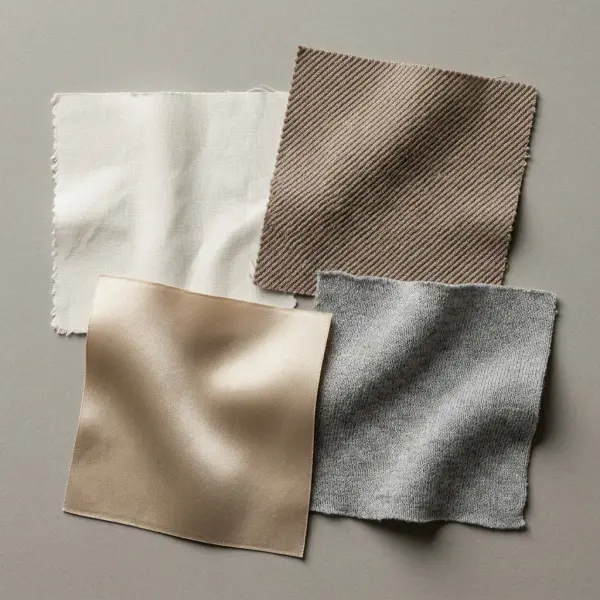
The visual layer represents what the fabric looks like. It may include photographs, flat scans, repeatable textures, color variations, and rendering information used by compatible 3D applications.
Basic libraries may rely on well-lit photographs with consistent framing. More advanced systems can use high-resolution texture scans and physically based rendering (PBR) material channels that help software reproduce surface characteristics under virtual lighting.
PBR materials may use information such as base color, surface roughness, normal maps, and height maps. These describe different aspects of material appearance rather than the textile's mechanical behavior. Adobe's Substance 3D material documentation explains how these visual parameters influence digital surface rendering.
For printed textiles, the scale and repeat of a pattern also matter. A floral print may look appropriate in a small thumbnail but appear too large when mapped onto a garment. Recording the correct pattern scale helps designers assess proportions more realistically.
Physical Properties for Garment Simulation
Digital fabric libraries used in 3D garment development may also store measured physical properties. These help simulation software estimate how a fabric responds to gravity, bending, stretching, and other forces.
Typical information can include fabric mass per unit area, thickness, bending behavior, stretching characteristics, and shear properties. The relevant measurements depend on the textile and the simulation system being used.
For instance, a lightweight woven fabric with limited stretch may behave very differently from an elastic knit, even if both have similar surface colors. Without suitable physical parameters, virtual garment behavior may fail to represent the intended material.
CLO's material digitization service documents a workflow involving weight, thickness, physical-property measurement, texture scanning, and validation against physical fabric behavior.
It is important to distinguish these measurements from visual texture files. A detailed fabric scan can make a virtual material look convincing without establishing that its simulated drape or deformation accurately matches the physical textile.
Sourcing and Commercial Information
A digital fabric library can also connect design references to sourcing decisions. This is especially valuable when designers need to distinguish materials that are visually appealing from options that are commercially feasible.
Relevant information may include supplier identity, material availability, indicative price, minimum order quantity, lead time, color availability, and development or approval status.
However, commercial details require maintenance. Prices, lead times, and minimum orders can change, so older records should not be treated as current purchasing commitments. Teams benefit from recording when supplier information was last confirmed and who is responsible for updating it.
Understanding Different Levels of Digital Fabric Assets
Not every fabric stored digitally has the same level of detail or intended purpose. Teams should distinguish simple visual references from material records prepared for technically informed garment simulation.
The following comparison illustrates the practical differences.
|
Material reference |
Typical contents |
Best suited for |
Main limitation |
|
Digital swatch image |
Photograph or scan of fabric |
Initial visual exploration and identification |
Does not establish physical behavior |
|
Specification-linked fabric record |
Images, identity, composition, weight, supplier details |
Material selection, sourcing communication, documentation |
May lack simulation-ready data |
|
3D-ready digital fabric |
Surface appearance data and compatible simulation parameters |
Virtual garment visualization and development |
Accuracy depends on input quality and validation |
|
Physical fabric swatch |
Actual textile sample |
Tactile assessment, physical testing, final material comparison |
Requires handling, storage, and distribution |
These categories should not be interpreted as a strict progression that every brand must follow. A fabric record containing reliable supplier specifications may be more useful to a sourcing manager than a highly detailed virtual texture without a confirmed supplier identity.
Similarly, 3D-ready material files are valuable only when the receiving design software can interpret them appropriately. File format, software compatibility, and the origin of simulation parameters all influence whether an asset can be reused effectively.
This distinction matters when businesses evaluate technology investments. The most useful library is not necessarily the one with the most elaborate images. It is the one that provides information appropriate to the decisions its users need to make.
How Fashion Design Teams Use Digital Fabric Libraries
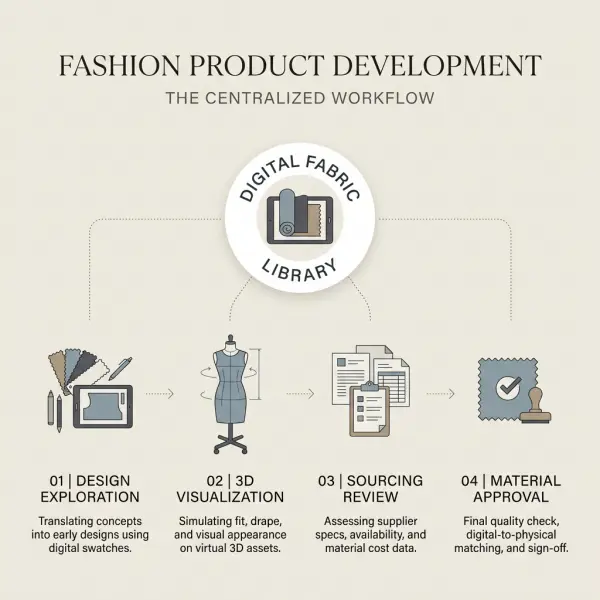
Digital fabric libraries can support several stages of product development, but their role changes depending on the people using them. Designers usually approach materials through appearance and garment concepts, while sourcing teams focus on supplier feasibility and technical developers examine construction-related requirements.
A shared library helps these teams work with the same fabric identity without requiring every user to interpret the same details.
Exploring Materials During Concept Development
Early collection development often involves gathering references for color, texture, silhouette, and material direction. A digital library gives designers a way to explore fabrics already available within the business rather than relying exclusively on external inspiration images.
Suppose a womenswear team is planning a collection of relaxed shirts and coordinated separates. The designers may search for lightweight woven fabrics in neutral shades, then compare previously used poplins, linen blends, and viscose options.
At this stage, the library supports exploration rather than final approval. It helps the team identify potentially suitable materials and recognize which choices require further investigation.
The more detailed discussion of how reusable digital material swatches can influence collection development belongs in [internal-link]How Digital Material Swatches Support Faster Collection Development|https://fitinline.com/article/read/how-digital-material-swatches-support-faster-collection-development/[/internal-link].
Applying Fabrics to Virtual Garments
When the design team uses 3D garment software, compatible digital materials can be assigned to virtual pattern pieces. The software then displays the garment with the selected fabric appearance and, where supported, simulates its behavior using the available material parameters.
This creates a useful connection between textile selection and garment visualization. Designers can examine how a material contributes to a silhouette, whether a print scale appears proportionate, and how different fabric options affect the overall design presentation.
For example, a structured cotton twill may produce a different simulated skirt silhouette from a softer viscose fabric. The distinction can help a team discuss material direction before investing in further physical development.
Nevertheless, a convincing virtual appearance does not automatically confirm fit, comfort, manufacturing feasibility, or production performance. These judgments still require appropriate validation.
Connecting Design Decisions With Sourcing
Material choices influence procurement decisions long before bulk production begins. A design team might select a fabric because its appearance matches the collection concept, only to discover that the supplier cannot meet the intended quantity, color requirement, or production schedule.
Connecting the material record to sourcing information allows these constraints to enter the discussion earlier. The sourcing team can review supplier references, identify available alternatives, and communicate which options require further confirmation.
This also supports more consistent fashion vendor management, particularly when several suppliers offer fabrics with similar commercial names but different specifications.
Supporting Technical Development and Approval
Once a material is selected for development, the team needs a dependable connection between the fabric used in a design and the material specified for sampling or production.
A shared fabric identifier can be referenced in a product specification, material list, or bill of materials. Technical designers and sourcing specialists can then confirm that the intended fabric corresponds to the correct supplier reference and approved specification.
The library does not replace the product specification or the bill of materials. Instead, it provides material information those documents can reference.
Why a Shared Library Is Different From Individual Fabric Collections
A designer's personal folder may contain useful material references, but it rarely provides the governance required for a team to use those references consistently. Images may have informal filenames, supplier codes may be missing, and multiple versions of the same material may exist without clear distinctions.
A shared digital fabric library addresses these problems by establishing a common location and identification system. Instead of asking which file represents the approved fabric, team members can refer to a specific material record.
This is particularly relevant when product development involves separate design, technical, merchandising, and sourcing departments, or when external manufacturers participate in the process. Each group may use different tools, but the underlying material identity should remain consistent.
Consistent Material Identifiers
Material identifiers help prevent confusion between visually similar fabrics and different versions of the same textile.
Consider a supplier offering two cotton-polyester twills with different weights. If both are informally labeled "cotton twill beige," designers may confuse one with the other. Assigning distinct material codes allows records, samples, and product documentation to refer to the correct option.
The identifier should remain stable even when descriptive names change. Color variations, revisions, and alternative suppliers should be handled according to a clear naming and record-management policy rather than by creating unrelated files without explanation.
Approval Status and Version Control
A material that looks suitable during early design exploration should not automatically be treated as approved for production. A useful library makes its status visible so that users know whether they are viewing a reference, a tested material, or an approved option.
A practical status system might include:
- Reference: Material used for inspiration or preliminary design exploration.
- Under Review: Material being evaluated for technical or commercial suitability.
- Approved: Material accepted for a defined product, application, or development purpose.
- Inactive: Material no longer intended for current use.
- Archived: Historical material retained for reference and traceability.
The meaning of approval should be defined internally. A material approved for visual design exploration is not necessarily approved for bulk production, and the status should not imply otherwise.
Browzwear and CLO-SET provide examples of shared material management approaches. The CLO-SET Company Library, for instance, supports centralized digital assets with different access permissions for users.

How to Build a Practical Digital Fabric Library
Fashion brands do not necessarily need a complex enterprise platform to begin organizing their materials digitally. The first requirement is a repeatable method for identifying fabrics and storing information that other team members can understand.
A small studio may start with a spreadsheet, shared storage, and consistently photographed swatches. A larger business may integrate its fabric records with product lifecycle management (PLM), digital asset management, or 3D apparel design systems. The appropriate solution depends on the number of materials, the team's workflow, and the technical capabilities already available.
Start With Materials That Are Actually Used
The initial library should reflect the fabrics most relevant to ongoing development. Digitizing every historical swatch immediately may create unnecessary work, particularly when supplier details are outdated or the materials are unlikely to be reused.
A practical pilot could focus on fabrics used repeatedly across a few product categories. For example, a brand specializing in shirts might begin with its core poplins, oxfords, lightweight twills, and interfacing references.
The objective is to establish a dependable process before expanding the number of records. A smaller, well-maintained library is generally more useful than a large collection of unidentified images.
Establish a Minimum Material Record
Before uploading assets, the team should agree on which fields are required. Mandatory information should be limited to what users genuinely need, while specialized data can remain optional until it becomes relevant.
A reasonable starting structure includes:
- Unique material identifier and descriptive name.
- Supplier name and supplier material reference.
- Fiber composition and fabric construction, where confirmed.
- Fabric weight, including measurement units and source.
- Representative fabric image and available color references.
- Material status, record owner, and last verification date.
Additional information can be introduced gradually, including fabric width, finishing details, care requirements, test results, and compatibility with digital garment software.
The distinction between measured, supplier-declared, estimated, and unverified data should be preserved. A team should not present approximate information as though it came from laboratory testing or supplier documentation.
Capture Visuals Consistently
Photographing fabric swatches under consistent conditions makes a library easier to navigate and compare. Differences in lighting, camera settings, scale, and framing can make otherwise similar materials appear unnecessarily different.
For routine catalog images, teams should use a neutral background, controlled lighting, and a consistent viewing distance. Where possible, photographs should include enough surface detail to reveal fabric construction without creating misleading color or texture effects.
A fabric photograph remains a visual reference, not a substitute for controlled color measurement. If accurate color matching is required, suitable color-management procedures, calibrated devices, or physical color standards may still be necessary.
For teams working in 3D, texture capture becomes more demanding because repeat quality, surface reflectance, and the relationship between visual and mechanical material data affect the resulting garment visualization.
Define Ownership and Update Responsibilities
A shared library should have identifiable record owners. Without ownership, material specifications may remain unchanged after suppliers revise their products, and outdated options may continue appearing in active projects.
A design coordinator might manage images and material classifications, while the sourcing team maintains supplier information. Technical development staff may be responsible for validating physical properties or confirming which digital files are appropriate for garment simulation.
These responsibilities do not require a large administrative structure. Even a small business can benefit from clear rules about who creates a record, who verifies its information, and who can change its approval status.
Connect the Library to Existing Workflows
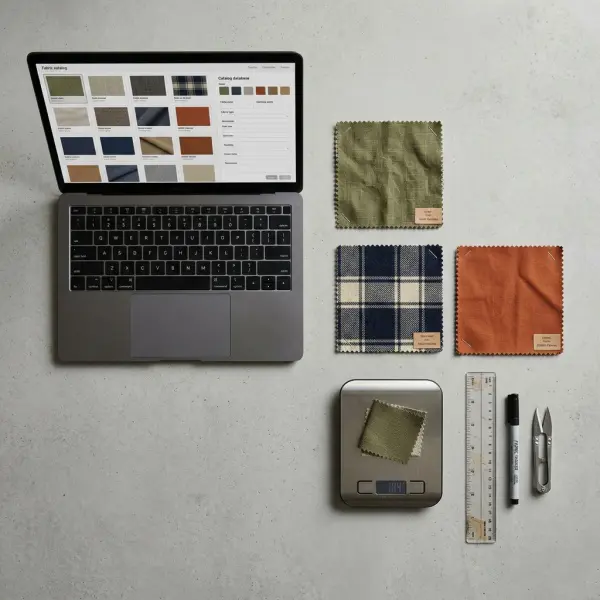
The library becomes useful when people can reach it during normal product development activities. If users must repeatedly download assets, recreate material names, or maintain separate versions for every application, the system may add work rather than reduce it.
Teams should therefore evaluate how material identifiers and files connect with design documents, sample requests, supplier communication, and existing software.
For organizations using specialized 3D tools, interoperability deserves particular attention. A material that appears correctly in one application may require conversion, remapping, or additional parameter adjustments before it behaves appropriately in another.
Choosing the Right Digital Fabric Library System
The choice of software should follow the team's actual needs rather than the number of features offered by a platform. A business mainly interested in organizing supplier swatches may need strong search and record-management functions, while a team developing garments virtually will also require compatible material assets and simulation capabilities.
Some fashion businesses use dedicated material platforms such as swatchbook. Others manage shared assets within a broader product development environment, including CLO-SET or the material libraries available through Browzwear tools.
These solutions do not necessarily perform identical functions. Some emphasize material discovery and management, while others are closely connected with garment visualization and technical development.
Before selecting a system, teams should assess several practical questions: Can users search by meaningful material attributes? Can supplier records and visual assets remain connected? Are material versions clearly distinguished? Can users export or exchange the data they need? Does the system support appropriate access permissions?
Cost should also be evaluated beyond the subscription price. The total effort may include preparing images, cleaning existing records, measuring materials, migrating files, training staff, and maintaining information over time.
For smaller brands, a simple, consistently maintained database may be sufficient. More advanced infrastructure becomes appropriate when its additional capabilities solve identifiable operational problems.
Common Mistakes When Managing Digital Fabric Libraries
A digital library can become an unreliable collection of files if teams treat asset creation as a one-time project rather than an ongoing information-management process.
Treating Every Fabric Image as a Verified Material
A photograph uploaded from a supplier website may be useful for design inspiration, but it does not necessarily represent a confirmed, available, or physically tested material. Problems arise when teams reuse these images in production-oriented workflows without checking their origin.
The result can be a mismatch between the fabric shown in a design and the textile eventually supplied. A better approach is to distinguish visual references from verified supplier materials and identify the source of each record.
Creating Duplicate Records Without Clear Relationships
Duplicates often develop when several departments maintain their own material files. One supplier fabric may appear under different names in design, sourcing, and technical-development records, making it difficult to identify which entry should be used.
Rather than deleting records indiscriminately, teams should establish a canonical material identity and link legitimate variations to it. Different colors, finishes, constructions, or supplier revisions may require separate records or version references, depending on their technical significance.
Prioritizing Realistic Rendering Over Reliable Information
An impressive digital texture can create confidence that a virtual fabric closely matches its physical counterpart. Yet visual realism does not confirm that mechanical properties, actual dimensions, or supplier specifications are correct.
This can lead to inappropriate material comparisons or premature development decisions. The safer approach is to label digital assets according to their intended purpose and validation status, especially when they are used in simulation-dependent workflows.
Neglecting Supplier and Version Updates
Libraries gradually lose value when discontinued materials, obsolete color references, or outdated sourcing information remain active. Designers may continue selecting fabrics that are no longer available under the original specification or commercial conditions.
Periodic review is therefore necessary, particularly for frequently used materials. Keeping an audit trail and recording verification dates makes it easier to decide which information can still be trusted.
Building a Library Without Designing for Actual Users
A technically sophisticated system may still fail if designers cannot find materials quickly or if sourcing teams must duplicate every update in another database. Excessive mandatory fields and unclear navigation discourage consistent use.
Teams should test the library against ordinary tasks before expanding it. Finding a previously approved fabric, checking its supplier, reviewing available alternatives, and identifying the correct digital asset are more meaningful usability tests than simply counting uploaded records.
Important Technical Caveats
Digital fabric libraries should not be confused with complete digital representations of every property a textile possesses. Their accuracy and usefulness depend on what has been captured, measured, and verified.
Three distinctions are particularly important.
Visual accuracy is not mechanical accuracy. A detailed texture scan may reproduce the appearance of a fabric without providing reliable information about its stretch, bending behavior, or drape. These characteristics require suitable measurement and simulation methods.
Simulation is not the same as physical validation. Research on fabric mechanical parameters in apparel computer-aided design has identified continuing limitations in simulation accuracy and the relationship between measured properties and virtual garment behavior. A systematic review published in Computer-Aided Design examines these challenges. Simulation results should therefore be interpreted within the capabilities of the selected software and the quality of its material inputs.
Digital availability does not establish commercial availability. A fabric can remain in a material library after a supplier changes its construction, discontinues a color, or revises its order requirements. Digital records need a defined process for checking information against current supplier documentation.
Additional limitations may apply to unusual textiles, heavily embellished surfaces, multilayer structures, and materials whose mechanical behavior is difficult to characterize with a particular testing system. Teams should confirm whether their digitization methods are appropriate for the fabric types they intend to use.
Businesses should also verify the rights attached to supplier images, scans, and proprietary digital material files before redistributing them across teams, customers, or third-party platforms.
These qualifications are central to the distinction explored further in Why Accurate Fabric Data Matters in Digital Fashion Workflows.
Frequently Asked Questions About Digital Fabric Libraries
Can a Small Fashion Brand Build a Digital Fabric Library Without 3D Design Software?
Yes. A digital fabric library does not require 3D garment simulation software. Small brands can begin with organized fabric photographs, consistent material codes, supplier references, and a searchable spreadsheet or shared database.
The important requirement is consistency rather than software complexity. Each material should have a recognizable identity, reliable core information, and a clear relationship to its physical sample or supplier reference.
If the business later adopts 3D garment design tools, some material records and image assets may be reused. However, additional texture processing, mechanical measurements, or format conversion may be necessary before those assets become suitable for realistic simulation.
Is a Digital Fabric Swatch the Same as a Digitized Physical Fabric?
Not necessarily. A digital swatch may be a photograph, scan, or visual representation of a textile, while a digitized physical fabric intended for garment simulation may also include measured mechanical properties.
The distinction affects what the asset can reliably communicate. A scanned surface can help designers inspect color, weave, or pattern details, but it cannot by itself establish how a garment will stretch, bend, or drape.
Brands should clarify whether an asset is intended for visual selection, product documentation, or technically informed simulation. The term "digital fabric" is used in different ways across software platforms, so the contents and validation status are more informative than the label alone.
What Fabric Information Should Every Library Record Include?
At minimum, a reusable material record should identify the fabric, its source, and the information needed for the team's intended decisions. Common starting fields include a unique material code, descriptive name, supplier reference, representative image, fiber composition, construction, and material status.
Fabric weight and width may be essential for apparel development, while additional fields depend on the product category and workflow. Unknown values should remain explicitly unverified rather than being guessed.
A useful record also includes ownership and verification information. Knowing when a specification was checked can be just as important as knowing the specification itself, particularly when suppliers revise materials between development seasons.
How Many Fabrics Should a Company Digitize First?
There is no universal starting quantity. The appropriate number depends on the team's product categories, the materials already in regular use, and the resources available to prepare reliable records.
A useful approach is to begin with a manageable selection of core or frequently reused fabrics. This provides enough variety to test search, naming, image quality, sourcing references, and access permissions without creating an unnecessarily large maintenance burden.
After the pilot, the team can identify missing fields or workflow problems before importing additional materials. The quality of the records and their usefulness to actual product decisions are more meaningful measures of progress than the total number of fabric thumbnails uploaded.
Can Digital Fabric Libraries Eliminate the Need for Physical Swatches?
They can reduce some unnecessary material searches and exchanges, but they cannot universally replace physical swatches. Digital records are particularly useful for reviewing existing options, communicating material identities, and preparing virtual design explorations.
Physical samples remain relevant when teams need to evaluate handfeel, confirm color and finishing characteristics, conduct textile tests, or validate production-critical properties. The amount of physical evaluation required depends on the garment, material, supplier relationship, and established quality procedures.
The strongest workflow generally uses digital information to make physical sampling more selective and purposeful rather than assuming every assessment can be completed virtually.
How Should Digital Fabric Libraries Handle Supplier Changes?
Supplier changes should be reflected through controlled record updates rather than silent replacement of existing information. If a supplier modifies a fabric's composition, construction, weight, finish, or other significant characteristic, the team should determine whether the change requires a new material version or identity.
Commercial information such as pricing and lead time may need more frequent verification without necessarily changing the material's technical identity. Keeping specification changes separate from routine commercial updates improves traceability.
A practical maintenance policy identifies the person responsible for verification, records the source and date of the update, and preserves historical information when it remains relevant to earlier products.
Should Fashion Brands Ask Suppliers to Provide Digital Fabric Assets?
Suppliers can be valuable sources of digital material information, especially when they already maintain standardized photographs, textile specifications, or simulation-ready assets. Requesting these files may reduce duplicate preparation work and improve consistency between the brand's material records and supplier references.
However, not every supplier has the equipment or workflow required to create suitable digital fabrics. Brands should define which information is essential and which advanced assets are optional.
When simulation files are provided, the receiving team should confirm the file format, software compatibility, measurement method, and validation status. Supplier-provided digital assets should still be checked against the requirements of the intended garment development process.
Conclusion: Treat Digital Fabrics as Shared Product Knowledge
Digital fabric libraries are most valuable when they turn scattered material references into information that fashion teams can identify, retrieve, evaluate, and maintain with confidence.
Their applications range from simple visual catalogs to shared material databases and advanced libraries supporting three-dimensional garment development. These systems differ in technical complexity, but the underlying objective is similar: ensuring that the people developing a fashion product understand which materials they are considering and what information supports those choices.
For a small brand, that may mean creating a consistent catalog of supplier fabrics and approved material references. For a larger design organization, it may involve connecting digitized textiles with technical development tools, sourcing systems, and controlled material records.
The next challenge is not simply collecting more digital swatches. It is making material information dependable across teams and usable in the decisions that connect design ideas with physical products.
A thoughtfully managed library can help achieve that without replacing the experience and judgment required to evaluate real fabrics.





Comments 0
Leave a CommentSend Comment
Anda harus Login terlebih dahulu untuk dapat memberikan komentar.