

How Fit Algorithms Help Reduce Fashion Return Rates
Online apparel returns are often treated as a logistics problem that begins after a customer sends an item back. In reality, many avoidable returns begin much earlier—when the shopper is trying to decide which size to order without touching, trying on, or comparing the garment physically.
Fit algorithms address part of that uncertainty. They analyze customer, product, transaction, and fit-feedback data to estimate which size is more likely to work, whether a garment tends to run small or large, or when there is insufficient evidence to make a reliable recommendation.
Their business value does not come from eliminating returns altogether. Fashion products are returned for many reasons, including style, color, fabric feel, quality, delivery problems, changed preferences, and deliberate ordering of several alternatives. Fit algorithms focus more narrowly on reducing preventable mistakes connected to size and fit.
Even within that narrower objective, results depend on more than model accuracy. The recommendation must reach the right shopper, describe the right product, appear at the right moment, communicate uncertainty clearly, and influence the customer’s final size choice. A technically capable algorithm that customers ignore will have little effect on actual return rates.
Quick Answer
Fit algorithms can reduce fashion return rates by helping shoppers choose a more suitable size before placing an order. They compare information about the customer—such as usual size, body measurements, previous purchases, retained items, and fit preference—with information about the garment, including its size system, measurements, category, silhouette, material behavior, and past return patterns.
Some systems recommend a personalized size. Others identify product-level sizing behavior and warn that a garment tends to run small, large, short, narrow, or loose. More advanced systems combine both approaches.
The commercial effect occurs when the advice changes a poor size decision into a better one. This may reduce items returned as “too small” or “too large,” unnecessary exchanges, and some forms of size bracketing.
However, lower prediction error does not automatically produce lower returns. Customers may ignore recommendations, order for another person, prefer a different fit, or return the product for reasons unrelated to size. Retailers must therefore measure real post-purchase outcomes through controlled experiments, not rely only on offline model accuracy.
What Is a Fit Algorithm in Fashion Ecommerce?
A fit algorithm is a rules-based or statistical decision system that estimates how a specific garment size is likely to fit a shopper in order to support a better purchase decision.
The term can refer to several different technical functions. A personalized size recommender predicts which available size a particular customer is most likely to retain or find suitable. An article-level fit model estimates whether a product generally runs small or large. A return-risk model predicts the probability that a customer-product combination will be returned. A review-based system extracts fit patterns from customer feedback.
These systems may use fixed decision rules, Bayesian probability models, collaborative filtering, machine learning, deep learning, computer vision, or hybrid methods. The method itself is less important than the prediction target and the quality of the evidence used to support it.
The foundational technology is explained in greater detail in fashion size recommendation technology. This article focuses specifically on how algorithmic guidance may influence return behavior and what retailers must do to establish whether it is producing a genuine reduction.
Why Are Fit-Related Returns a Distinct Business Problem?
Not all returns should be analyzed as one category. A dress returned because the waist is too tight presents a different operational problem from a dress returned because the customer dislikes its color.
Fit-related returns are often more actionable because the retailer may be able to improve the decision before purchase. Better measurements, product-specific fit notes, clearer photographs, customer reviews, garment comparison tools, and size recommendations can all reduce uncertainty.
Returns remain a substantial retail issue more broadly. The National Retail Federation estimated that 19.3% of online retail sales in the United States would be returned during 2025, although that figure covers retail as a whole rather than fashion specifically. NRF 2025 retail returns research
For apparel businesses, the cost of a return may include:
- Outbound and reverse transportation.
- Inspection, cleaning, steaming, repackaging, or relabeling.
- Payment-processing and customer-service costs.
- Lost full-price selling time.
- Markdown exposure for seasonal products.
- Inventory imbalance across sizes.
- Products that cannot be resold in their original condition.
- A second shipment when the customer exchanges for another size.
The exact cost varies by market, product value, logistics agreement, return route, and resale outcome. It should not be assumed that every returned item becomes waste or that every prevented return creates the same financial benefit.

How Do Fit Algorithms Reduce Returns?
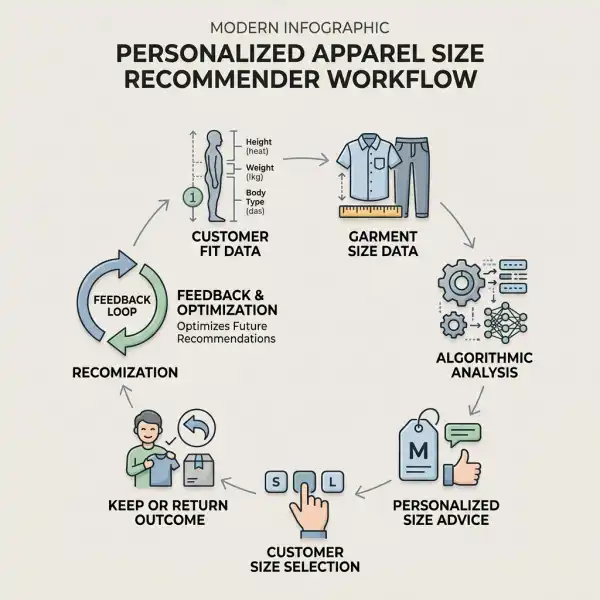
Fit algorithms reduce returns through a sequence of decisions rather than one isolated prediction. The system must recognize a fit risk, generate useful advice, communicate that advice, and influence the customer before the order is completed.
They Estimate the Customer’s Most Plausible Size
A personalized recommendation model can learn from the shopper’s previous size choices and outcomes.
Suppose a customer usually purchases size M but has repeatedly returned fitted woven dresses in that size as too small while retaining size L. When the customer views a new dress with similar product characteristics, the system may recommend L rather than relying on the customer’s generic usual size.
The recommendation may use:
- Sizes previously purchased.
- Products retained or exchanged.
- Explicit “too small,” “fits well,” or “too large” feedback.
- Height, weight, or body measurements.
- Known size in another brand.
- Product category and fit family.
- Similarities with other customers’ outcomes.
The algorithm is not discovering a permanent universal size. It is estimating a likely outcome for a specific customer-product relationship.
They Detect Products That Behave Differently From Their Size Labels
Some systems focus on the product rather than the individual customer.
For example, if a particular shoe receives an unusually high proportion of “too small” returns compared with similar shoes, the system may flag it as running small. The product page can then advise customers to consider a larger size.
This approach is valuable when the retailer has limited personal information about a shopper. It can also identify problems caused by brand conversion, pattern differences, supplier variation, or a product’s unusual construction.
The SizeFlags research developed at Zalando used order and return data, expert feedback, and visual product information to estimate whether articles had systematic sizing issues. Its production experiments illustrate an important distinction: product-level fit warnings can affect returns differently from personalized size advice. SizeFlags research on size-related fashion returns
They Translate Fit Data Into an Actionable Customer Message
A probability score has little value to a shopper unless it is translated into a clear decision.
An effective recommendation might say:
- “Size M is recommended for a regular fit.”
- “This style tends to run small; consider one size larger.”
- “Choose size S for a close fit or M for additional room.”
- “Customers with a similar profile usually keep size 38.”
- “We do not yet have enough information to recommend a size.”
The wording matters. “Your size is M” suggests certainty and permanence. “M is recommended for a regular fit in this style” makes the advice product-specific and leaves room for personal preference.
Fit algorithms reduce returns only when shoppers understand the message and use it. Recommendation acceptance is therefore an operational metric, not merely a user-interface detail.
They Learn From Post-Purchase Outcomes
Once an order has been delivered, the system can receive new information.
A retained item may provide a positive signal. An exchange from M to L may suggest that M was too small. A structured return reason can identify whether the issue involved length, width, waist, bust, hip, shoulder, sleeve, rise, or another fit dimension.
Over time, these signals may improve:
- Customer fit profiles.
- Product-level size behavior.
- Brand-to-brand mappings.
- Category-specific recommendation rules.
- Confidence estimates for future predictions.
- Identification of recurring product-development problems.
The quality of the learning loop depends on how accurately the retailer records outcomes. A generic “did not fit” reason provides less usable information than “waist too tight while hips fit correctly.”
Four Main Algorithmic Approaches to Reducing Fit Returns
Different algorithms intervene at different points in the customer journey. Retailers should not treat them as interchangeable.
|
Algorithmic approach |
Main prediction |
Customer-facing output |
How it may reduce returns |
|
Personalized size recommendation |
Best size for one customer and product |
“Recommended size: M” |
Reduces customer-specific size-selection errors |
|
Product size-behavior detection |
Whether a style generally runs small or large |
“This style runs small” |
Warns customers about systematic product variation |
|
Fit-risk prediction |
Likelihood that a customer-product-size combination will fail |
Recommendation, warning, or request for more data |
Avoids high-risk size selections |
|
Review and feedback analysis |
Patterns within customer fit experiences |
Aggregated fit guidance or personalized review relevance |
Helps shoppers interpret subjective fit information |
Personalized Recommendations
Personalized systems are attractive because they promise individual guidance. They can work well when a retailer has enough relevant history for the customer and product.
The difficulty is that customer identity does not always correspond to one wearer. A household may share an account, a customer may be buying a gift, or the customer’s body and preferences may have changed. The system must therefore avoid treating historical behavior as permanently valid.
Product-Level Size Flags
Product-level models are less personalized but may have broader coverage. They ask whether the article itself is behaving unusually compared with its category.
This can be useful for new customers because it does not require a detailed personal profile. It may also be easier to explain: the advice concerns the product rather than making a potentially sensitive claim about the customer’s body.
Customer-Product Fit Models
A customer-product model estimates the interaction between the wearer and the garment. It may combine customer history, product attributes, size labels, and return outcomes.
This approach can capture more nuance but is highly vulnerable to data sparsity. Many customers make only a few purchases, while new products have little or no return history.
A hierarchical Bayesian study using anonymized fashion purchase data highlighted the trade-off between prediction accuracy and coverage. When stricter confidence thresholds were used, accuracy improved, but the model could provide recommendations for only a limited share of purchases. hierarchical Bayesian size recommendation research
Review-Aware Fit Models
Customer reviews can add context that transactions alone do not contain. A return record may indicate “too small,” but a review may explain that the shoulders were narrow while the waist was correct.
Research on apparel fit opinions found that “runs small” or “true to size” assessments become more useful when shoppers can also interpret the reviewer’s reference information, such as body size and purchased garment size. The combination helps customers judge whether another person’s experience is relevant to them. research on fit context and online product returns
This suggests that fit information works best when it is contextual rather than presented as a universal verdict.
What Does Research Show About Return Reduction?
The available evidence supports cautious optimism, not a universal promise that all fit recommenders reduce returns.
In the SizeFlags study, a personalized recommendation baseline was tested with more than 300,000 customers in each experimental group. The personalized advice increased conversion, products added to the cart, and revenue per visit, but the observed reduction in size-related returns was below 0.5% and was not statistically significant.
The same paper reported stronger return outcomes from product-level size flags. In a live footwear test, the advice produced a 3.8% relative reduction in size-related return rate. In a textile test, reductions of 4.3% for “too small” flags and 6.6% for “too big” flags were reported. These results came from one platform’s systems, categories, markets, interfaces, and measurement definitions, so they should not be treated as guaranteed benchmarks for other retailers.
The comparison is commercially important.
A model can improve conversion without reducing returns. It can also accurately predict a customer’s likely size while failing to persuade the customer to order it. Conversely, a simple product warning may influence behavior more effectively because it is understandable and directly connected to the garment being viewed.
Algorithm quality and intervention quality are not the same thing.
Why Prediction Accuracy Is Not Enough
Offline accuracy measures whether a model predicted a recorded outcome correctly within historical data. Return reduction measures whether deploying the system changed customer behavior and post-purchase outcomes.
The distinction matters because historical data does not reveal what would have happened without the recommendation. A customer who retained size M after receiving advice might have selected M anyway.
A model may achieve respectable offline performance but have little commercial effect because:
- Only a small percentage of shoppers are eligible for recommendations.
- Customers do not open the tool.
- The recommendation appears too late.
- The wording is unclear.
- Customers do not trust the advice.
- Low-stock conditions make the recommended size unavailable.
- Shoppers intentionally order several sizes.
- The return occurs for a non-fit reason.
- The system recommends a technically wearable size that conflicts with personal fit preference.
Controlled A/B testing is therefore valuable. Eligible shoppers can be randomly assigned to receive the intervention or the existing experience, allowing the retailer to compare outcomes more credibly.
Even then, testing must be designed carefully. Product mix, promotions, seasonality, geography, stock availability, return windows, and customer composition can influence the result.
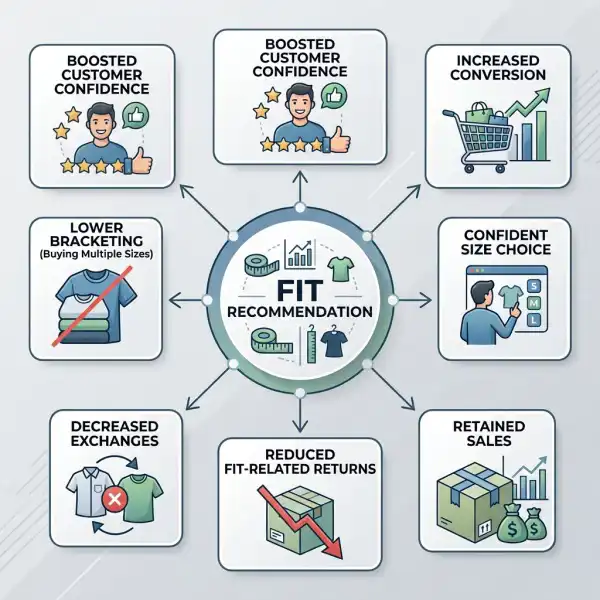
Fit Algorithms Can Change More Than Return Rates
A recommendation system may affect several behaviors simultaneously. Reducing one metric while worsening another can create a misleading impression of success.
Conversion May Increase
Size uncertainty can prevent customers from buying. A recommendation may provide enough confidence for the shopper to complete the purchase.
This can be commercially valuable, even when the return rate remains unchanged. A retailer should nevertheless distinguish additional retained sales from additional orders that are later returned.
Size Bracketing May Increase or Decrease
Size bracketing occurs when a customer orders several sizes of the same item with the intention of returning those that do not fit.
It may seem logical that better recommendations always reduce this behavior. The SizeFlags footwear experiment, however, reported increases in orders containing multiple sizes after customers received “too small” or “too big” advice.
One plausible interpretation is that the warning made customers more aware of uncertainty, leading some to protect themselves by ordering alternatives. This illustrates why retailers must measure actual customer behavior instead of assuming the direction of the effect.
Interface design may influence the result. A vague warning such as “runs small” can create uncertainty, while a more specific message such as “choose one size larger than your usual size” may provide a clearer action.
Exchanges May Replace Refunds
A customer who would previously have returned an item for a refund may instead exchange it for another size.
From a relationship perspective, this can be positive because the sale is retained. Operationally, however, the exchange still creates reverse-logistics and handling costs.
Retailers should report refunds, exchanges, and replacement shipments separately.
Customer Confidence May Improve
A useful fit experience can reduce hesitation and repeated consultation of inconsistent size charts. It may also help customers learn how a brand’s products fit over time.
Confidence should not be increased through false certainty. A recommendation that admits low confidence can build more durable trust than a precise-looking answer repeatedly contradicted by the delivered product.
Which Metrics Should Fashion Retailers Measure?
A fit project should use a metric framework rather than one headline percentage.
Primary Outcome Metrics
The central metrics should reflect post-purchase fit outcomes:
- Size-related return rate: proportion of eligible ordered items returned specifically because they were too small, too large, too short, too long, too narrow, or otherwise unsuitable in fit.
- Size exchange rate: proportion exchanged for another size.
- Retained-item rate: proportion retained after the applicable return period.
- Multi-size order rate: frequency of two or more sizes of the same product being ordered together.
- Net retained revenue: revenue remaining after returns, refunds, exchanges, discounts, and relevant handling costs.
The retailer must define the denominator consistently. Measuring returns per item, order, customer, or recommendation exposure can produce different results.
Recommendation Performance Metrics
These explain why the commercial outcome changed:
- Coverage: percentage of eligible customer-product interactions for which the system provides advice.
- Tool adoption: percentage of shoppers who open or complete the recommendation process.
- Acceptance: percentage selecting the recommended size.
- Override behavior: frequency and direction of customer decisions that differ from the recommendation.
- Confidence distribution: percentage of high-, medium-, and low-confidence outputs.
- Offline predictive accuracy: performance against retained, exchanged, or fit-labeled outcomes.
High accuracy with very low coverage may have limited commercial value. High coverage with weak accuracy can expose many customers to poor advice.
Guardrail Metrics
Guardrails help prevent the project from improving one metric by damaging another:
- Conversion rate.
- Cart abandonment.
- Customer-service contacts about sizing.
- Refund processing time.
- Customer satisfaction.
- Repeat purchase behavior.
- Complaint rate.
- Return-policy usage.
- Performance across body-size and product-size segments.
- Recommendation availability for extended sizes.
A model should not be considered successful if it reduces recorded returns by discouraging legitimate customer claims or making the return process unnecessarily difficult.
A Practical Measurement Example
Consider an online trousers retailer testing a fit recommender for eight weeks.
The retailer should not compare all customers who used the tool with all customers who did not. Tool users may already differ in important ways; they may be more uncertain, more engaged, or more likely to return products.
A stronger test would randomly assign eligible product-page visitors to:
- A control experience with the existing size chart.
- A treatment experience with the size chart plus algorithmic fit advice.
The retailer could then compare:
|
Measurement |
Control group |
Treatment group |
Interpretation |
|
Eligible product views |
Baseline |
Baseline |
Confirms comparable exposure |
|
Purchase conversion |
Measured |
Measured |
Shows effect on buying confidence |
|
Recommendation acceptance |
Not applicable |
Measured |
Shows whether customers follow advice |
|
Fit-related return rate |
Measured |
Measured |
Main outcome |
|
Exchange rate |
Measured |
Measured |
Detects movement from refunds to exchanges |
|
Multi-size order rate |
Measured |
Measured |
Detects bracketing effects |
|
Net retained margin |
Measured |
Measured |
Evaluates commercial value |
The final analysis should be segmented by product type, size range, new versus returning customer, recommendation confidence, and available stock. An overall average may hide strong performance in one category and poor performance in another.
How Fashion Businesses Can Implement Fit Algorithms Strategically
Build a Reliable Return-Reason Taxonomy
The model needs to distinguish size-related failure from other return reasons.
A useful taxonomy might include:
- Too small overall.
- Too large overall.
- Too short.
- Too long.
- Tight in a specific area.
- Loose in a specific area.
- Incorrect fit expectation.
- Uncomfortable construction.
- Material or stretch different from expectation.
- Style, color, quality, damage, or delivery reasons unrelated to fit.
Customer forms should remain simple enough to complete, but internal data can map the answers into more detailed categories.
Connect Product Data With Actual Garment Measurements
A fit model cannot reliably evaluate a garment described only as “regular fit.”
The retailer should connect ecommerce products with:
- Size specifications.
- Point-of-measure definitions.
- Finished garment measurements.
- Measurement tolerances.
- Pattern or fit families.
- Fabric stretch and recovery information.
- Intended ease and silhouette.
- Supplier and production batch where relevant.
Errors in garment measurements used for apparel production can travel through the entire recommendation process. The algorithm may be mathematically correct relative to its inputs while the physical product still differs from the data.
Start With a Narrow Prediction Target
A first pilot may focus on one clear objective:
Identify products that generate an unusually high rate of “too small” returns and display a validated size-up message.
This is narrower than building a complete personalized body-fit model. It may also be easier to validate, explain, and operate.
Once the system performs consistently, the retailer can add customer personalization, fit-preference modeling, category-specific guidance, or more detailed measurement inputs.
Design the Recommendation Around the Customer Decision
The tool should appear close to the size selector, before the customer commits to an option.
The message should answer:
- What size is suggested?
- Is the recommendation specific to this product?
- What fit assumption is being used?
- How confident is the system?
- What should the shopper do when between sizes?
- Can the customer adjust for a looser or closer fit?
- What data informed the recommendation?
The interface does not need to disclose the entire model. It should disclose enough to support an informed decision.
Validate Before Scaling Across Categories
A model that works for footwear may not transfer to dresses, bras, jeans, or tailored jackets.
Each category has different controlling dimensions, customer expectations, fit vocabulary, and return behavior. Validation should take place before expanding to a new product family.
Feed Findings Back Into Product Development
Fit algorithms should not become a permanent layer covering recurring product errors.
When a style consistently receives “too small at the shoulder” feedback, the business should investigate:
- Pattern dimensions.
- Grading between sizes.
- Fabric behavior.
- Seam construction.
- Measurement tolerance.
- Supplier consistency.
- Product-page description.
- Intended fit and target body profile.
The best outcome may be to correct the next production run rather than improve the warning indefinitely.

Common Mistakes That Prevent Return Reduction
Optimizing Only for the Size Customers Usually Buy
The most frequently purchased size is not necessarily the size most likely to be retained.
Customers may habitually choose the wrong size, purchase several sizes, or follow a label convention that does not transfer between brands. The model should connect size choice with post-purchase outcome.
Treating Every Retained Product as a Perfect Fit
Customers keep imperfect garments for many reasons. The return process may be inconvenient, the product may have been discounted, or the customer may plan to alter it.
Retention is a useful signal, but explicit fit satisfaction and exchange data provide additional context.
Treating Every Return as an Algorithm Failure
A correctly sized product can still be returned because of style, color, delivery timing, quality, or buyer preference.
Evaluation should isolate the type of return the algorithm was designed to prevent.
Forcing Recommendations When Confidence Is Low
New products and new customers often create insufficient evidence. A forced answer increases coverage but can reduce trust and accuracy.
The system should be permitted to abstain and show measurements or request another input.
Applying One Fit Logic to Every Category
A chest-based rule may be relevant for a shirt but insufficient for trousers. Height and weight may help with general sizing but fail to capture proportions required for fitted garments.
Category-specific features and evaluation are essential.
Assuming a Return Reduction Automatically Improves Profit
An algorithm may reduce returns while lowering conversion, increasing discount dependence, or shifting customers toward more expensive exchanges.
Commercial evaluation should use retained margin and customer outcomes rather than return percentage alone.
Hiding Product Problems Behind Better Recommendations
A product that repeatedly runs smaller than its specification may require pattern, production, or labeling correction.
The recommendation system should expose recurring defects, not normalize them as permanent customer inconvenience.
Important Caveats: What Fit Algorithms Cannot Solve Alone
Fit algorithms can address size uncertainty, but they cannot eliminate the many other reasons customers return fashion products.
They cannot fully reproduce:
- The tactile perception of fabric.
- The comfort of seams, labels, fastenings, or support structures.
- How a garment moves during real activity.
- The customer’s reaction to color in different lighting.
- Styling preferences after seeing the complete outfit.
- Product quality or manufacturing defects.
- Differences between listed and delivered measurements.
- Changes in customer preference after ordering.
- Deliberate use of flexible return policies.
They may also create new behavioral effects. A warning can make one shopper choose the correct size but make another shopper order two sizes for reassurance.
The most important technical and ethical boundaries—including data bias, privacy, body-shape estimation, sparse data, and false confidence—are discussed in the limits of AI size recommendations in online apparel retail.
Frequently Asked Questions
Do fit algorithms reduce all fashion returns?
No. Fit algorithms are designed primarily to reduce returns caused by incorrect size or fit expectations.
Customers may still return garments because of style, color, fabric feel, product quality, damage, delivery timing, or changed preferences. Some shoppers also order multiple alternatives intentionally.
Retailers should therefore evaluate size-related returns separately from total returns. A successful system may produce a meaningful decline in “too small” and “too large” returns while having a smaller effect on the overall return rate.
How quickly can a retailer see lower return rates?
The retailer must wait until enough exposed orders have passed through delivery and the applicable return period.
A high-volume retailer may collect usable evidence relatively quickly, while a small brand may need several months. Seasonal products and long return windows extend the evaluation period.
The business should avoid drawing conclusions from early orders whose returns have not yet been completed. It should also account for promotions, stock shortages, category mix, and customer acquisition campaigns that may change the test population.
Is a personalized size recommendation more effective than saying a product runs small?
Not necessarily. The more effective approach depends on the retailer’s data and how customers respond to the advice.
A personalized recommendation may be useful when the system understands the shopper and product well. A product-level “runs small” flag may achieve wider coverage and be easier to explain.
Published production research has shown that personalized advice can improve conversion without producing a statistically significant return reduction, while product-level warnings reduced size-related returns in the same research setting. That result should be treated as evidence from one implementation, not a universal rule.
Can small fashion brands use fit algorithms without millions of orders?
Yes, but they may need a simpler method.
A small brand can begin with reliable garment measurements, category-specific rules, customer fit surveys, known-size comparisons, and product-level fit notes. These systems may not require large-scale machine learning.
The challenge is ensuring that the rules reflect actual garments rather than generic industry assumptions. Small brands can also benefit from their controlled catalog and direct customer feedback, although low order volume makes statistical validation slower.
Should a recommendation system use return history as training data?
Return history can be valuable when the reason is recorded accurately.
The system should distinguish “too small” and “too large” from unrelated reasons. It should also account for exchanges, multi-size orders, purchases for other people, and customers who keep products despite imperfect fit.
Return data is often noisy rather than objectively correct. Combining it with garment specifications, product attributes, expert assessment, and explicit customer feedback usually provides a stronger foundation than relying on returns alone.
What is the difference between model accuracy and return-rate impact?
Model accuracy describes how often a prediction matches a recorded outcome in a dataset. Return-rate impact describes whether showing the recommendation caused fewer returns in real shopping conditions.
A highly accurate model may have limited impact when few customers receive or follow its recommendations. A simpler model may produce greater commercial value when its advice is clear and widely used.
Return-rate impact should ideally be evaluated through controlled experiments and measured after the full return window.
Can fit algorithms reduce size bracketing?
They may, but the effect is not automatic.
Clear personalized guidance can reduce the need to order several sizes. A vague warning may have the opposite effect by making customers more conscious of uncertainty.
Retailers should measure multi-size orders directly. They should also test whether the interface provides a decisive action, such as “choose one size larger,” rather than merely announcing that sizing is unusual.
What should happen when the recommended size is out of stock?
The retailer should not silently recommend another size unless the model supports that alternative.
The interface can offer a restock alert, explain whether an adjacent size would create a closer or looser fit, suggest a genuinely comparable product, or state that the recommended option is unavailable.
Changing the recommendation to match inventory can damage trust and contaminate performance data. Fit advice should remain separate from stock-clearing priorities.
Conclusion
Fit algorithms can reduce fashion returns when they convert uncertain sizing information into advice that genuinely improves the customer’s decision before purchase.
The mechanism is straightforward in principle: identify relevant customer and garment characteristics, estimate fit or size risk, communicate an actionable recommendation, and learn from the eventual outcome. The operational reality is harder. Product data may be inconsistent, return reasons may be noisy, customers may ignore advice, and a recommendation can change conversion, exchanges, and multi-size ordering at the same time.
The strongest evidence does not suggest that every sophisticated recommender will automatically lower returns. It shows that carefully designed interventions can reduce specific size-related return behavior under measurable conditions. Product-level warnings may sometimes outperform more personalized advice, while an accurate offline model may produce little real-world change.
Fashion businesses should therefore treat fit recommendation as a cross-functional operating system connecting product development, ecommerce, customer service, data analysis, and returns management. The goal is not simply to predict a size. It is to help more customers choose successfully—and to use the resulting evidence to improve the garments, data, and retail experience behind that choice.





Comments 0
Leave a CommentSend Comment
Anda harus Login terlebih dahulu untuk dapat memberikan komentar.