
How Streetwear Moved From Subculture to Everyday Style
Quick Answer
Streetwear moved from subculture to everyday style through a gradual process of cultural diffusion. Clothing associated with hip-hop, skateboarding, surfing, punk, sports, and local youth communities first gained influence through musicians, athletes, independent brands, specialist shops, magazines, and word of mouth. Television, music videos, celebrity visibility, sneaker marketing, international retail, online forums, e-commerce, and social media then carried those styles beyond their original communities.
The change was not simply a case of large fashion companies discovering hoodies and sneakers. Streetwear also altered how fashion value was created. Community endorsement could matter as much as runway recognition. Limited product releases could create stronger attention than large seasonal collections. Collaborations could connect audiences that previously belonged to different cultural and commercial worlds.
As streetwear entered luxury fashion and mass retail, its core garments became normal components of everyday wardrobes. However, wider adoption also created tensions around cultural appropriation, inflated scarcity, declining product quality, and the separation of visual codes from their original meaning. Modern brands should therefore study not only which streetwear products became popular, but also why certain communities made them culturally valuable in the first place.
What Does It Mean for Streetwear to Become Mainstream?
Streetwear became mainstream when clothing and business practices once associated mainly with specific subcultures began appearing across general retail, workplaces, schools, luxury collections, department stores, online marketplaces, and ordinary daily wardrobes.
Mainstream adoption does not mean that every consumer understands the cultural history behind the clothes. A person may wear sneakers, a hoodie, a graphic T-shirt, and relaxed trousers because the combination is comfortable and widely available, not because they identify with skateboarding, hip-hop, or an independent streetwear scene.
This distinction matters. Streetwear’s visual language can travel much faster than its cultural meaning.
The foundations of the culture—including its relationships with music, skating, surf communities, sport, art, and independent creative networks—are explored in streetwear culture explained for modern fashion. The present article focuses on what happened after those cultural codes began moving into wider markets.
Mainstream Adoption Is Not a Single Event
There was no precise moment when streetwear stopped being a subculture and became ordinary fashion. Adoption occurred differently across product categories, regions, generations, and price levels.
Sneakers entered everyday wardrobes through sport, school, music, and leisure before many luxury houses treated them as major fashion products. Graphic T-shirts became common retail items while certain designs remained meaningful mainly within specific music, skate, or art communities. Hoodies moved between sportswear, work clothing, university merchandise, youth culture, political symbolism, luxury fashion, and mass-market basics.
Streetwear therefore did not move through one straight line:
subculture → fashion industry → mass consumer
A more realistic pattern involved constant exchange:
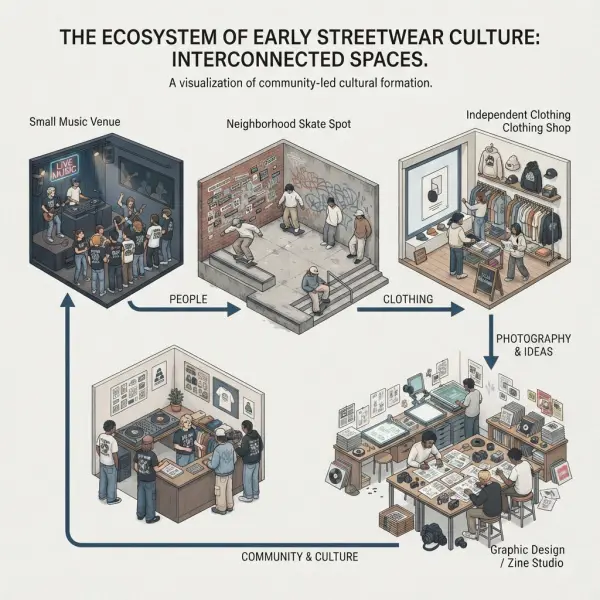
community → musician or athlete → specialist brand → media → retailer → broader audience → reinterpretation by another community
The same product could move through this cycle several times.
Streetwear Began With Communities, Not Trend Forecasts
The early influence of streetwear came from people adapting available clothing to their own environments. The garments were often familiar. Their cultural arrangement was new.
Hip-hop communities transformed sportswear, outerwear, sneakers, denim, jewelry, luxury references, and customized clothing into recognizable systems of self-presentation. The Museum at the Fashion Institute of Technology describes hip-hop style as an important force behind streetwear, athleisure, logo-focused fashion, customization, and the mixing of casual sportswear with luxury products. It also stresses that many of these innovations emerged from Black and Brown working-class communities before being adopted, adapted, or appropriated by mainstream culture. Readers can consult the Museum at FIT’s overview of fifty years of hip-hop style.
Skateboarding developed its own clothing preferences around movement, abrasion, footwear grip, loose or practical proportions, local graphics, and independent shop culture. Videos, magazines, board graphics, photography, and sponsored skaters helped turn functional choices into a wider visual language. The Design Museum’s history of skateboard design describes the development of the board, associated media, and community as interconnected rather than separate stories. The Design Museum skateboard archive provides useful historical context.
Surfing, punk, club culture, basketball, workwear, military clothing, graffiti, and independent music contributed other elements. None of these communities followed a central design authority. Their influence came from repeated use, peer recognition, local credibility, and cultural visibility.
This bottom-up system would eventually challenge the conventional assumption that fashion influence should begin with designers, runway shows, or major retailers.
Independent Brands Translated Community Style Into Products
Subcultultural style becomes commercially scalable only when someone turns informal dressing practices into repeatable products, sizes, prices, and distribution systems.
Independent streetwear brands played this translation role. They did not necessarily invent every garment they sold. Instead, they combined familiar items with specific graphics, proportions, cultural references, collaborators, and methods of release.
A T-shirt could become a portable piece of visual communication. A skate shop could function as both a retailer and a meeting point. A limited run could reflect the actual financial capacity of a small business rather than a manufactured scarcity campaign. A founder could build a label through direct relationships with artists, musicians, photographers, or local customers.
Stüssy is frequently discussed as an important example of this development. The company describes its beginnings in the Southern California surf scene and its later influence on the appearance and ideology of casualwear. Its history illustrates how a locally grounded label could communicate across surf, skate, music, and international youth networks without operating like a conventional fashion house. The brand’s own account is available through the official history of Stüssy.
Its 1989 World Tour T-shirt also offers a useful example of how streetwear connected major fashion capitals with neighborhoods associated with active street culture. The design referenced London, Paris, Los Angeles, New York, and Tokyo while also naming places such as the Bronx, Brooklyn, Compton, Santa Ana, and Venice. It was not simply decoration; it presented an alternative map of where cultural influence was being produced.
Specialist Retailers Acted as Cultural Filters
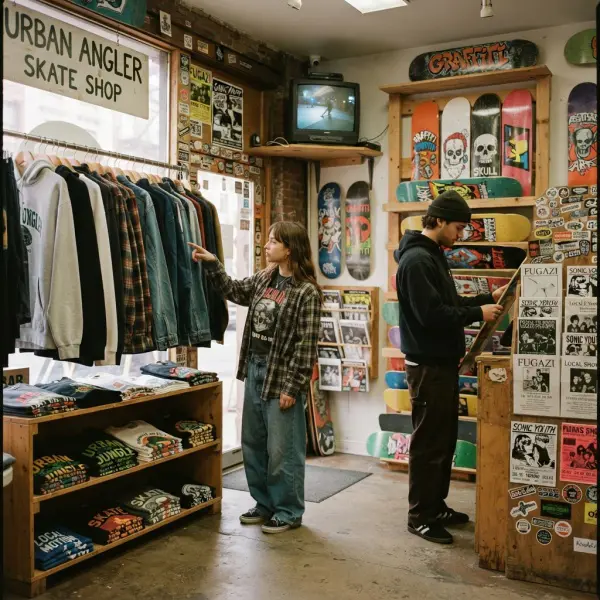
Before streetwear became widely searchable online, specialist shops helped customers discover products, music, magazines, videos, and local scenes. Shop owners and staff selected which labels deserved space. Their decisions gave customers a form of cultural guidance.
A good independent retailer did more than process transactions. It could:
- Introduce a local audience to products from another city or country.
- Provide a meeting place for skaters, musicians, artists, and collectors.
- Support small labels with limited wholesale reach.
- Explain the meaning or construction behind unfamiliar products.
- Organize launches, exhibitions, video screenings, or community events.
- Create its own clothing line based on local demand.
This role was commercially valuable because early streetwear discovery depended heavily on trust. Customers were often buying into a cultural position before the brand had conventional advertising reach.
Magazines, Zines, Videos, and Music Expanded the Audience
Streetwear travelled through media created inside or near its originating communities.
Skate videos showed clothing in motion and connected products with recognizable personalities. Music videos placed artists, sportswear, sneakers, jewelry, and luxury products in front of global audiences. Independent magazines and zines documented people who were rarely represented by mainstream fashion publications. Album covers, tour merchandise, flyers, photography, and concert appearances gave garments cultural exposure long before formal brand campaigns became sophisticated.
The fashion industry did not control all of these channels. That was part of their appeal.
A consumer could discover a jacket through a musician, a shoe through a skateboard video, or a T-shirt through a record shop. The product gained meaning because it appeared inside a wider cultural experience.
Music and Sport Gave Streetwear Mass Visibility
Music and sport were among the most powerful routes through which streetwear moved beyond local communities.
Artists and athletes already occupied a space between performance, entertainment, commerce, and identity. Audiences did not only observe what they did. They also studied what they wore.
Hip-hop artists made particular sneakers, tracksuits, hats, jackets, jewelry, denim fits, and luxury labels culturally visible. Different cities developed different combinations. These choices were rarely passive endorsements. Artists frequently restyled garments, altered proportions, customized products, and combined price levels in ways conventional fashion merchandising had not anticipated.
Basketball produced another strong connection. Shoes designed for performance could acquire meaning through a player, team, advertisement, local court, or music association. Once worn outside sport, the sneaker became both a practical object and an identity product.
The Metropolitan Museum of Art’s discussion of basketball and sneaker literature shows how sport, advertising, urban courts, famous players, and footwear became intertwined within American culture. The relationship did not stop at technical performance; it helped make athletic footwear part of everyday style.
Celebrity Visibility Accelerated Adoption but Did Not Create the Culture
Celebrities helped expose streetwear to larger audiences, but it would be inaccurate to treat them as its sole originators.
A musician or athlete usually amplified styles that were already meaningful within a community. Their visibility then attracted retailers, media companies, sponsors, and consumers who had not previously encountered those styles.
This created a repeating commercial pattern:
- A community develops or adopts a particular style.
- A visible artist or athlete wears it.
- Media coverage increases public recognition.
- Demand grows beyond the original audience.
- Larger brands and retailers produce related products.
- The original community either develops a new variation or rejects the overexposed version.
This pattern explains why streetwear can appear to change quickly even when its underlying garments remain relatively stable.
Endorsement Changed the Economics of Sneakers and Casual Apparel
As footwear and sportswear companies recognized the influence of music and lifestyle communities, products were marketed through a wider range of cultural associations.
Performance remained important, but customers could also be attracted by:
- An athlete’s public identity.
- A musician’s styling.
- A limited colorway.
- A local or national team connection.
- An artist-designed graphic.
- A retailer collaboration.
- A historical reissue.
- A story linked to a city, community, or event.
This expanded the commercial meaning of a sneaker or tracksuit. The product no longer needed to be purchased solely for its original athletic purpose.
Global Cities Reinterpreted Streetwear Rather Than Simply Copying It
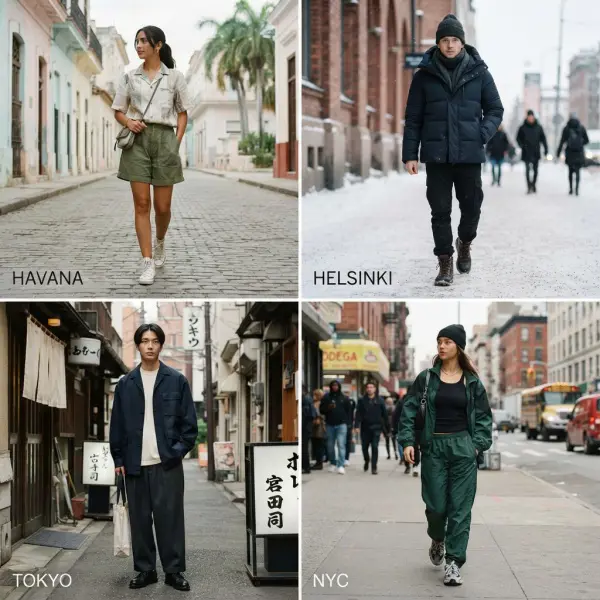
Streetwear’s movement into everyday fashion was international, but it did not produce one identical global style.
Tokyo, London, Paris, Seoul, Jakarta, Shanghai, Lagos, Johannesburg, São Paulo, Melbourne, and many other cities developed their own relationships with sportswear, music, local street cultures, weather, retail, and fashion history.
Japan became especially influential because designers and retailers did not merely reproduce American streetwear. They studied, collected, refined, and recontextualized elements of vintage Americana, hip-hop, military clothing, workwear, skate culture, graphic design, and traditional craft.
NIGO’s career is a clear illustration. The Design Museum describes his work as connecting Harajuku street style with music, global fashion, vintage collecting, craft, and luxury. His progression from founding A Bathing Ape in the 1990s to leading KENZO demonstrates how a creator associated with streetwear could eventually occupy a central role within an established international fashion house. The Design Museum’s NIGO retrospective documents this cross-cultural development.
This international movement had two consequences.
First, streetwear became a flexible global language. A hoodie, graphic T-shirt, work jacket, or sneaker could be understood across markets.
Second, local interpretation became a source of competitive advantage. The strongest brands did not simply reproduce an American formula. They adapted materials, fits, references, and communication to their own communities.
The Internet Removed Geographic Barriers
Streetwear previously depended heavily on physical access. Customers often needed to live near a specialist shop, know the right people, receive an imported magazine, or travel to find particular products.
The internet changed that structure.
Brand websites, message boards, blogs, online magazines, digital photography, e-commerce, and later social media allowed consumers to discover products from other cities almost immediately. Customers could compare releases, discuss authenticity, share outfits, trade products, and learn the history of a brand without entering its physical retail environment.
This did not eliminate cultural gatekeeping. It relocated some of it.
Influential forum members, bloggers, photographers, collectors, resellers, stylists, and content creators became new intermediaries. Their posts could give a small brand international visibility or expose product weaknesses quickly.
Research on fashion communication supports the broader role of social media and online brand communities in diffusing fashion information and electronic word of mouth. These platforms make consumers active participants in circulation rather than passive recipients of advertising.
E-Commerce Allowed Small Brands to Reach Global Niches
A streetwear label no longer needed a large network of department-store accounts to reach customers in multiple countries. A direct-to-consumer website could connect a small inventory with a geographically dispersed audience.
This created important opportunities:
- Higher control over product presentation.
- Direct access to customer data.
- Faster feedback on releases.
- The ability to test small quantities.
- Greater pricing control.
- Communication without depending entirely on fashion media.
- Access to customers beyond the brand’s local city.
It also transferred operational responsibilities to the brand. International shipping, payment processing, fraud, tax, customs documentation, returns, sizing communication, inventory accuracy, and customer service could no longer be delegated completely to a retailer.
Streetwear’s digital expansion therefore lowered some distribution barriers while creating new operational demands.
Social Media Turned Styling Into Continuous Distribution
Traditional fashion media worked through scheduled publication cycles. Social media allowed outfits, releases, queues, events, and collaborations to circulate continuously.
A customer’s photograph could become marketing. A creator’s styling video could make an older item desirable again. A product could appear in several cultural contexts within a single day.
This speed helped casual clothing enter wider wardrobes because consumers saw products worn in realistic combinations rather than only in formal campaigns.
It also encouraged imitation. Once an emerging silhouette, accessory, or graphic format gained visibility, mass retailers could identify and reproduce its surface characteristics quickly. Cultural origin and commercial scale became increasingly disconnected.
Sneakers Made Collecting Part of Fashion Consumption
Sneakers helped streetwear enter everyday style because they combined several commercially powerful qualities.
They were functional but expressive. They could be worn across many settings. Their models and colorways were easy to identify. They could connect sport, music, design, technology, geography, and celebrity in one object.
Unlike a full designer outfit, a sneaker could also provide a relatively focused entry point into a brand. The customer might combine one distinctive pair with ordinary jeans, workwear trousers, a school uniform, or simple casual clothing.
This made sneakers particularly effective as gateway products.
Release Culture Turned Product Availability Into Communication
Scheduled sneaker launches and limited colorways taught consumers to follow product calendars, register for access, join queues, monitor stock, and discuss resale value.
This release behavior later spread to clothing, accessories, collectibles, and collaborations.
For brands, the model offered several advantages:
- Concentrated attention around a specific date.
- A clear story for media and retail partners.
- Better demand testing than a very broad collection.
- Lower inventory exposure when quantities remained controlled.
- Stronger perceived distinction between releases.
However, high demand did not always translate into a good customer experience. Bots, overselling, payment failures, speculative purchasing, unclear allocation, and immediate resale could frustrate the people a brand intended to serve.
Scarcity could generate attention, but it also introduced distribution risk.
Resale Markets Made Demand Publicly Visible
Secondary marketplaces made product prices and availability easier to observe. This gave customers a visible—although incomplete—signal of desirability.
A high resale price could indicate low supply relative to demand. It could also result from speculation, regional scarcity, temporary publicity, or a very small transaction volume.
Fashion businesses should not treat aftermarket price as a complete measure of brand strength. Repeat purchase, product satisfaction, full-price sell-through, contribution margin, customer retention, and delivery performance remain more useful indicators of commercial health.
Luxury Fashion Turned Streetwear Into Institutional Fashion
One of the clearest signs of streetwear’s mainstream acceptance was its movement into luxury fashion.
Luxury houses began incorporating sneakers, hoodies, graphic products, casual silhouettes, sports references, and release-oriented collaborations. Streetwear designers and culturally influential creative directors moved into roles that once seemed distant from subcultural fashion.
The process had developed before any single collaboration, but the 2017 Louis Vuitton and Supreme project became a highly visible symbol of the shift. Vogue’s coverage described the collaboration as part of Louis Vuitton’s menswear presentation and noted the breadth of products created, including clothing, footwear, bags, and accessories. The project placed a New York skate-associated label directly inside the collection of an established luxury house.
This mattered for more than publicity. It demonstrated that streetwear’s logos, products, audiences, launch behavior, and cultural value could operate within the highest price levels of the fashion system.

Luxury Adoption Changed Streetwear’s Price Structure
Streetwear had never existed at only one price level. Still, its luxury adoption expanded the acceptable price range for products such as hoodies, sneakers, T-shirts, caps, and utility jackets.
Price could now reflect:
- Luxury-house positioning.
- Designer reputation.
- Specialist materials.
- European or Japanese manufacturing.
- Limited production.
- Collaboration rights.
- Complex embellishment.
- Retail environment.
- Collectible demand.
The danger was that price sometimes became separated from product value. A familiar silhouette with prominent branding could command a premium even when construction or material improvement was limited.
For buyers and retailers, the relevant question is not whether a product is categorized as streetwear or luxury. It is whether design, make, cultural contribution, scarcity, and brand positioning justify the final price for the intended customer.
Institutional Recognition Did Not Resolve Cultural Tension
Streetwear’s presence in museums, runway collections, luxury companies, and fashion awards increased its institutional status. It did not erase the unequal treatment experienced by many of the communities that shaped it.
Hip-hop style, for example, was often criticized or stereotyped before fashion companies adopted its silhouettes, logos, jewelry, sneakers, and celebrity relationships. The Museum at FIT describes how hip-hop moved from being treated as outside the fashion establishment to influencing fashion from its center.
For modern businesses, this history creates a responsibility to distinguish appreciation, collaboration, and fair commercial participation from extraction.
Mass Retail Normalized the Streetwear Uniform
Luxury adoption gave streetwear institutional approval, but mass retail made its products ordinary.
Hoodies, joggers, sneakers, puffer jackets, graphic T-shirts, cargo trousers, oversized sweatshirts, baseball caps, and crossbody bags became widely available across price levels.
These products were commercially attractive because they could serve several needs at once:
- Physical comfort.
- Easy styling.
- Gender-flexible merchandising.
- Casual workplace dressing.
- Travel and commuting.
- Layering.
- School or university wear.
- Brand and graphic communication.
- Compatibility with sneakers.
- Broad size and age appeal.
Once consumers built wardrobes around these products, streetwear no longer needed to be presented as a distinct fashion statement. It became part of the basic grammar of casual dressing.
The Pandemic Accelerated Casual Dressing but Did Not Create It
The COVID-19 pandemic increased demand for clothing suitable for home, remote work, short errands, and flexible routines. Sweatshirts, relaxed trousers, knitwear, and sneakers fit those conditions.
However, it would be inaccurate to say the pandemic created mainstream streetwear. Casualization had already been developing through sportswear, music, workplace change, sneaker culture, digital lifestyles, and shifting social expectations.
The pandemic accelerated an existing movement. It did not originate it.
Everyday Adoption Reduced the Visibility of Streetwear’s Origins
When a style becomes normal, consumers often stop recognizing it as a cultural influence.
A casual office outfit built around sneakers, a sweatshirt, and relaxed trousers may owe something to sportswear and streetwear without being marketed under either label. A luxury sneaker may borrow release logic from streetwear while appearing in a conventional boutique. A mass retailer may use skate-influenced proportions without mentioning skate culture.
This is how streetwear became most influential: not only through visible logos, but through the normalization of its assumptions.
Comfort could be stylish. Sneakers could carry status. A T-shirt could anchor an entire brand. Casual garments could appear at premium prices. Community approval could precede industry approval.
What Did Streetwear Change About the Fashion Business?
Streetwear’s mainstream transition altered more than product design. It influenced the operating model of fashion companies.
|
Streetwear practice |
Wider fashion-business impact |
|
Limited product drops |
Encouraged launch calendars outside conventional seasons |
|
Direct community communication |
Reduced complete dependence on magazines and wholesale buyers |
|
Artist and brand collaborations |
Turned audience exchange into a repeatable commercial strategy |
|
Sneaker release systems |
Made access, registration, and scarcity part of retail design |
|
Graphic identity |
Allowed simple garment blocks to support strong brand recognition |
|
Specialist retail |
Demonstrated the value of curation and cultural knowledge |
|
Online community participation |
Made customers active in product discovery and interpretation |
|
Archive reissues |
Created commercial value from brand history and past designs |
|
Mixing high and low price levels |
Weakened rigid separation between luxury and casual fashion |
|
Creator-led branding |
Increased the influence of musicians, artists, athletes, and cultural figures |
Many of these practices are now used by brands that do not describe themselves as streetwear companies.
How Can Fashion Brands Apply the Lessons Without Copying the Look?
The most useful streetwear lessons concern market structure, not graphic imitation.
A brand can study how streetwear created relevance, tested demand, built communities, and organized product releases without copying another community’s visual codes.
Build From a Specific Customer Context
A credible product begins with a defined environment.
The business should understand:
- Where customers wear the product.
- Which music, sport, profession, or lifestyle influences them.
- What climate they live in.
- How much they can realistically spend.
- Which garments they already own.
- Which fit or sizing problems they experience.
- How they discover brands.
- Whether they value availability or exclusivity.
- Which cultural references require permission or collaboration.
This context prevents the brand from treating “streetwear” as an abstract mood.
Use a Core-and-Drop Product Structure
A practical streetwear-influenced assortment can combine reliable products with controlled experimentation.
Core products may include stable T-shirt, hoodie, trouser, or cap silhouettes that customers can repurchase. These products build fit confidence and recurring revenue.
Drop products may introduce a collaboration, special fabric, seasonal color, local event, or limited graphic. These products create novelty and allow the brand to test demand.
The model is usually more resilient than making every product scarce.
It also improves fashion inventory management because replenishable items and experimental items can be forecast, purchased, and evaluated differently.

Treat Collaboration as Shared Creation
A collaboration should have a clear reason.
The strongest projects usually involve complementary contributions. One partner may provide design language, another manufacturing capability, another community credibility, and another distribution.
Before signing an agreement, the partners should define:
- Intellectual property ownership.
- Design approval authority.
- Product categories.
- Production quantities.
- Quality responsibilities.
- Revenue or royalty structure.
- Marketing commitments.
- Use of names and images.
- Unsold inventory handling.
- Geographic and time limitations.
Without these details, cultural enthusiasm can turn into operational conflict.
Develop Distribution Before Creating Hype
Attention is useful only when the company can convert and fulfill demand.
Before a major launch, brands should verify product quantities, quality-control completion, checkout capacity, stock synchronization, payment methods, packaging, customer-service staffing, and delivery timelines.
A small label may be better served by a controlled pre-order, member access window, or staged regional release than by encouraging demand it cannot fulfill.
The most damaging outcome is not failing to sell out. It is selling products that cannot be delivered accurately and on time.
Document the Brand’s Real World
Streetwear became influential partly because photography, music, videos, shops, and events documented actual communities.
Modern brands can apply this principle through fashion brand storytelling. However, the content should reflect real relationships and processes.
A small brand can document:
- Sample development.
- Fit testing.
- Local customers.
- Creative collaborators.
- Product use.
- Fabric decisions.
- Community events.
- Manufacturing partners where appropriate.
- Repairs, aging, and long-term wear.
This material often builds stronger credibility than generic aspirational campaigns.
Common Mistakes When Mainstream Brands Use Streetwear
Copying the Product but Ignoring the Community
A company may reproduce a graphic T-shirt, hoodie, cargo trouser, or sneaker shape without understanding why the original version mattered.
This produces visually correct but culturally empty products. Customers may recognize the imitation even when they cannot explain the difference technically.
The better approach is to develop products from the brand’s own audience, history, capabilities, and relationships.
Using Scarcity to Hide Weak Demand
Some brands limit quantities and describe every release as sold out, even when production was extremely small or demand was uncertain.
Scarcity can be operationally sensible. It becomes misleading when used to suggest market strength that the business has not demonstrated.
Management should track absolute units, gross margin, repeat customers, waitlist conversion, returns, and demand after restocking—not only the percentage sold.
Entering a Collaboration Without Clear Contribution
Logo placement alone rarely creates a durable partnership.
Customers increasingly expect to understand why two parties are working together. If neither contributes a distinctive design, product capability, story, or community relationship, the launch may feel transactional.
The collaboration brief should explain what could be created together that neither partner would produce independently.
Raising Prices Without Improving the Product
Streetwear’s movement into luxury made high prices seem possible across familiar garment categories.
That does not mean every heavyweight T-shirt or oversized hoodie can command a premium. Fabric quality, cut, testing, construction, print execution, finishing, packaging, service, and brand credibility must support the price.
A large logo is not a substitute for product development.
Removing Cultural References From Their Original Owners
Mainstream adoption can turn community-created symbols into commercial design assets. This is particularly risky when references come from marginalized groups, traditional cultures, political movements, local languages, or identifiable artists.
Brands should verify origin, meaning, legal rights, permission, credit, and compensation before commercial use.
What Streetwear’s Mainstream Success Does Not Prove
Streetwear’s widespread adoption does not prove that every limited product will become desirable.
It does not prove that social-media reach creates long-term customer loyalty.
It does not prove that a luxury collaboration is culturally credible.
It does not prove that casual clothing requires less technical development.
It does not prove that a high resale price reflects a healthy business.
It does not prove that global visibility removes the need for local relevance.
Most importantly, mainstream success does not mean that subcultures have stopped producing new fashion ideas. Once one set of visual codes becomes widely commercialized, communities often develop different combinations, references, and ways of dressing.
The deeper relationship between clothing, belonging, and younger consumers will be examined in why casual identity still shapes youth fashion trends.
Frequently Asked Questions
When did streetwear become mainstream?
Streetwear did not become mainstream in one specific year. Its adoption developed over several decades.
Hip-hop and sportswear influenced wider fashion strongly during the 1980s and 1990s. Skate, surf, sneaker, and independent-label cultures expanded through specialist retail and media. Online stores, blogs, forums, and social media increased global access during the 2000s and 2010s. Luxury collaborations and the appointment of streetwear-connected designers to major fashion houses later gave the category stronger institutional recognition.
The timing also differed by region and product. Sneakers and graphic T-shirts became everyday items earlier than some high-priced streetwear categories.
Did luxury fashion make streetwear mainstream?
Luxury fashion accelerated institutional acceptance, but it did not create streetwear’s popularity.
Streetwear already had large audiences through hip-hop, skating, sport, music, independent retail, and sneaker culture. Luxury houses recognized that cultural influence and incorporated parts of it into collections, collaborations, pricing, and creative leadership.
Projects such as Louis Vuitton x Supreme made the relationship highly visible, but the audience and design language existed beforehand. Luxury’s role was partly to confirm that the established fashion industry could no longer treat streetwear as commercially or creatively marginal.
Why did hoodies and sneakers become everyday clothing?
Hoodies and sneakers combine practical use with identity value.
Hoodies provide warmth, layering, movement, and a clear surface for graphics or branding. Sneakers provide comfort, recognizable design, sport associations, and compatibility with many types of clothing. Both categories are adaptable across genders, ages, and price levels.
Their everyday adoption was also supported by music, sport, school culture, casual workplaces, digital lifestyles, travel, and changing expectations around formal dress. The final suitability still depends on context; some professional or ceremonial environments maintain stricter clothing standards.
How did social media change streetwear?
Social media increased the speed and geographic reach of product discovery.
Consumers could see releases, styling, store events, collaborations, and archive pieces without visiting the brand’s original city. Customers also became distributors of brand meaning by sharing outfits, reviews, unboxings, and resale information.
The trade-off was faster imitation and greater dependence on platform visibility. A product could become widely copied before a small brand had recovered its development cost. Brands therefore need recognizable design systems, direct customer channels, and consistent product quality rather than relying only on viral exposure.
Is streetwear still a subculture?
Some streetwear products and practices are completely mainstream, while particular communities, labels, and styles remain subcultural.
The term now covers a broad market ranging from mass retail to luxury. However, local skate scenes, music communities, independent shops, collectors, and creative groups continue to develop styles with limited mainstream visibility.
It is therefore more accurate to say that streetwear contains both mainstream and subcultural layers. The commercially visible surface may be widely adopted, while new cultural meanings continue to form in smaller communities.
Can a new brand still enter the streetwear market?
Yes, but a new brand needs more than familiar graphics and oversized garments.
It should serve a defined audience, solve a product or fit problem, establish credible cultural relationships, and maintain operational reliability. The market is crowded with labels that look similar, so specificity matters.
A new entrant may compete through local relevance, climate-appropriate materials, better sizing, distinctive construction, accessible pricing, fair collaboration, or a community that is poorly served by existing brands. The objective should not be to imitate the largest labels. It should be to become valuable to a particular group.
Has streetwear replaced traditional fashion?
No. Streetwear has influenced traditional fashion, but tailoring, occasion wear, formal dress, heritage clothing, luxury craft, uniforms, and regional dress remain important.
What changed is the boundary between categories. Sneakers may be worn with tailoring. A luxury house may produce hoodies. Workwear details may appear in designer collections. A formal brand may use drop-based releases.
Modern wardrobes are more likely to combine categories than to belong exclusively to one system. Streetwear contributed significantly to that flexibility, but it did not eliminate other ways of dressing.




Comments 0
Leave a CommentSend Comment
Anda harus Login terlebih dahulu untuk dapat memberikan komentar.