
Why Casual Identity Still Shapes Youth Fashion Trends
Quick Answer
Casual identity shapes youth fashion because informal clothing gives young people a practical way to negotiate comfort, self-expression, social belonging, and cultural difference at the same time. Sneakers, T-shirts, hoodies, denim, relaxed trousers, sportswear, workwear, and lightweight layers are physically adaptable, but they also function as visible signals of music taste, community affiliation, lifestyle, brand knowledge, and personal values.
The term casual identity is used here as an editorial description rather than a formal fashion category. It refers to an identity expressed through adaptable everyday clothing instead of a single prescribed or highly formal look.
Youth fashion still changes quickly, especially across digital platforms. Yet many short-lived aesthetics are built on the same stable casual foundation. A new trend may alter the proportion, color, graphic treatment, accessories, or cultural reference, while the underlying wardrobe remains familiar.
For fashion businesses, this means the lasting opportunity is not simply to chase each viral aesthetic. It is to understand how young customers use everyday garments to balance individuality with belonging. Brands that provide credible design, reliable fit, realistic pricing, and room for personal styling are more likely to remain useful after a specific microtrend loses visibility.

What Is Casual Identity in Youth Fashion?
Casual identity is the way a person uses informal, adaptable clothing to communicate who they are, which communities they relate to, and how they want to move through everyday life.
The concept includes more than physical comfort. A loose T-shirt, worn sneaker, team jersey, secondhand jacket, plain hoodie, or carefully selected cap may carry cultural and personal meaning. The wearer may be communicating familiarity with a music scene, sport, local community, creative profession, religious practice, digital aesthetic, or particular approach to consumption.
Clothing therefore operates at two levels. It performs a practical function, but it also becomes a symbolic resource through which people position themselves socially.
A 2025 qualitative study involving Brazilian participants aged 16 to 20 examined branded clothing as part of an ongoing negotiation between individual aspiration and social expectation. The authors identified tensions between authenticity and belonging, personal style and conformity, and consumption and criticism of overconsumption. Because the study used only five participants in one national context, it should not be generalized to all young consumers. It is nevertheless useful for showing how clothing can become part of identity negotiation rather than a purely functional purchase. Readers can examine the study of branded clothing and adolescent identification.
Casual Does Not Mean Unconsidered
Casual clothing is sometimes treated as the absence of fashion: whatever is easiest, cheapest, or most comfortable. In practice, a casual outfit can involve considerable judgment.
Young consumers may pay close attention to:
- The width and length of a T-shirt.
- Whether trousers stack over a shoe or stop above it.
- The condition and age of a sneaker.
- The weight and drape of a hoodie.
- The relationship between fitted and oversized garments.
- Whether a logo is current, archival, ironic, local, or overexposed.
- How accessories alter an otherwise basic outfit.
- Whether an item feels discovered rather than widely promoted.
A garment may appear simple to an outside observer while communicating precise information to people familiar with the same visual language.
Identity Is Expressed Through Combination
Casual identity rarely depends on wearing one complete branded look. It is often built through combination.
A young customer might wear a secondhand work jacket, an inexpensive plain T-shirt, locally made trousers, a premium sneaker, and a handmade accessory. Another might combine modest layering with sportswear. Someone else may pair a football jersey with tailored trousers or style an older family garment with contemporary shoes.
The meaning comes from the relationship among the pieces.
This combinational approach is one reason casual fashion remains adaptable. Consumers can update a wardrobe by changing one or two elements rather than replacing an entire outfit.
Why Does Clothing Matter So Much During Youth?
Clothing matters during adolescence and early adulthood because these periods often involve changing relationships, greater independence, experimentation, and the formation of social identity.
Young people are not simply deciding what looks attractive. They are also learning how different appearances are interpreted in schools, universities, workplaces, families, friendship groups, religious communities, and digital spaces.
Research on clothing and social identification supports the view that garments can function as social symbols. A 2026 study of school-uniform imagery, for example, examined how students interpret design characteristics in relation to collective identity and belonging. The research concerns school uniforms rather than casual fashion, so its conclusions should remain within that context. It nevertheless demonstrates that clothing design can affect how people interpret their position within a group.
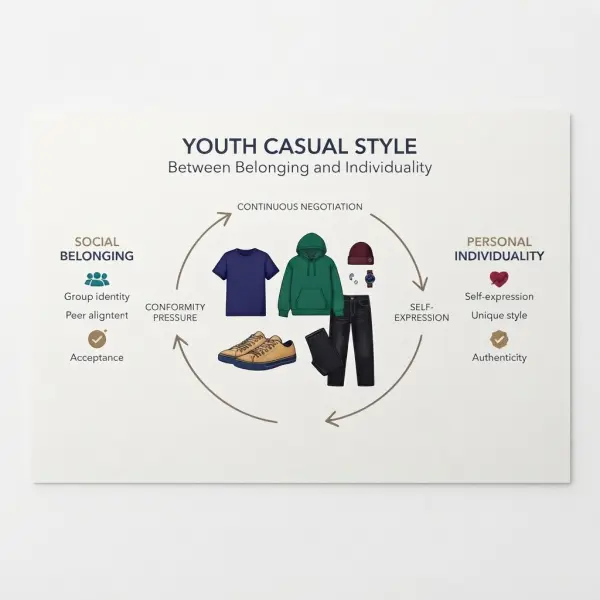
The tension is familiar: young people want to belong, but they do not want to appear interchangeable.
Casual fashion helps manage that tension because common garments can be personalized without becoming socially unreadable. A hoodie is widely understood. Its fit, color, graphic, styling, condition, and source can still make it individual.
Belonging Requires Recognizable Signals
For clothing to communicate belonging, other people must be able to interpret at least part of the signal.
Team colors, music merchandise, skate shoes, university sweatshirts, local brand graphics, modest silhouettes, sports jerseys, and particular forms of workwear can all provide social recognition. The meaning varies by region and community.
The wearer does not need to look identical to everyone else. They need enough shared visual language to be understood.
This is where casual garments are especially useful. Their familiar structure makes small differences visible. A change in proportion, fabric, graphic placement, or styling can carry more meaning because the base object is already recognizable.
Differentiation Happens Inside the Group
Youth style is often described as rebellion against convention. That explanation is incomplete.
Many young people differentiate themselves while remaining legible to a chosen group. A person may reject mainstream fashion but carefully follow the codes of a music scene. A sneaker collector may avoid a widely promoted model while valuing another design recognized by fellow collectors. A thrift shopper may reject complete branded outfits while developing a highly specific vintage vocabulary.
Individuality is therefore not always independence from all influence. It is often a selective negotiation with influence.
How Streetwear Made Casual Identity More Visible
Streetwear helped turn everyday casual clothing into a recognized cultural language.
Hip-hop, skateboarding, surfing, sports, punk, workwear, music, and independent retail demonstrated that T-shirts, sneakers, denim, caps, hoodies, and utility garments could communicate community knowledge and creative authority. This cultural foundation is examined in streetwear culture explained for modern fashion.
As these styles moved into wider retail and luxury fashion, they normalized the idea that informal clothing could carry status and design value. The historical and commercial process is discussed in how streetwear moved from subculture to everyday style.
Youth fashion now extends far beyond conventional streetwear, but it continues to use many of the same principles:
- Ordinary garments can carry cultural meaning.
- Peer recognition can precede institutional fashion approval.
- Styling may matter as much as the individual product.
- Music, sport, and creators can shape demand.
- A community may determine what feels credible.
- A limited design change can reposition a familiar silhouette.
- High- and low-priced garments can coexist in one outfit.
Streetwear did not invent every casual garment. It changed how the fashion industry evaluated their cultural and commercial importance.
Why Do Casual Garments Remain So Adaptable?
Casual garments remain influential because they can respond to changing routines without requiring customers to adopt a completely new wardrobe system.
A T-shirt can function as an underlayer, a graphic statement, event merchandise, a uniform, or an independent product. Sneakers can move among sport, commuting, school, work, travel, and social occasions. A work jacket can communicate utility, vintage interest, local manufacturing, or refined minimalism depending on fabric and styling.
This flexibility creates both cultural and commercial durability.
Comfort Has Several Meanings
Physical comfort includes softness, breathability, stretch, thermal regulation, movement, garment weight, and the absence of irritating construction.
Psychological comfort is different. It refers to whether the wearer feels recognizable, appropriately dressed, secure, and able to behave naturally within a setting.
A physically soft garment may still feel socially uncomfortable if it appears too formal, too revealing, too conspicuous, or disconnected from the wearer’s identity. Conversely, a heavy jacket or rigid denim may be accepted despite limited physical softness because it provides confidence, protection, or cultural meaning.
Brands should therefore avoid treating comfort as one measurable material attribute. It is produced through the interaction of fabric, construction, fit, climate, activity, social context, and personal expectation.
Mobility Supports Everyday Use
Young customers may move between study, work, commuting, social activity, exercise, creative projects, worship, and online participation within the same day.
Clothing that supports these transitions has an advantage. This does not require every product to be technical sportswear. It requires realistic attention to movement, temperature, storage, layering, maintenance, and styling flexibility.
Practical design details may include:
- Pockets that securely hold a phone and small essentials.
- Sleeves that allow movement without excessive fabric distortion.
- Trousers that work while sitting, cycling, or using public transport.
- Fabrics appropriate to local heat, humidity, rain, or cold.
- Layers that can be removed without making the outfit incomplete.
- Care instructions suited to the customer’s laundry access and routine.
- Construction that remains presentable after repeated wear.
A garment becomes part of identity partly because it can accompany repeated daily experience.
Familiar Products Lower Styling Risk
Trying an unfamiliar silhouette can create financial and social risk. Customers may be uncertain about fit, styling, peer response, or whether the product will remain wearable after a trend declines.
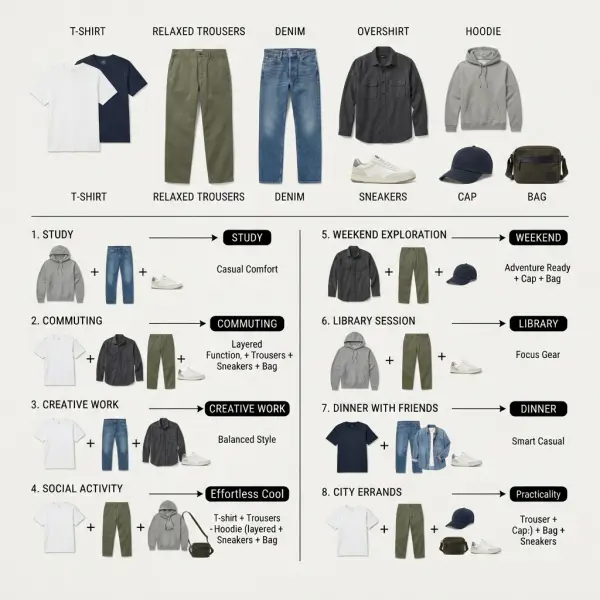
Casual wardrobe staples reduce that uncertainty. A consumer can experiment through color, proportion, graphics, accessories, or footwear while keeping the base garment familiar.
This helps explain why youth trends can appear visually new while relying on stable product categories.
Microtrends Change, but the Casual Foundation Remains
Digital fashion culture can produce highly visible aesthetics that rise and decline quickly. A style may be named, circulated, imitated, criticized, and replaced within a short period.
The names change faster than most wardrobes.
A microtrend might emphasize:
- A different trouser width.
- A particular shoe shape.
- Layered sports jerseys.
- Minimal neutral clothing.
- Archival outdoor products.
- Decorative accessories.
- Workwear details.
- A nostalgic decade.
- Feminine and masculine contrast.
- Academic, office, or uniform references.
Beneath these variations, many outfits continue to rely on familiar casual garments.
This distinction matters for product development. The cultural story and styling direction may change rapidly, while the garment construction, base pattern, and supplier capability can remain relatively stable.
Trends Often Modify Proportion Rather Than Product Category
One season may favor a cropped fitted top with wide trousers. Another may introduce a longer layered upper body with straighter bottoms. Sneakers may become slimmer, heavier, more technical, or more retro.
These shifts can create a visibly different silhouette without requiring an entirely new wardrobe.
For manufacturers and brands, proportion changes still require careful development. Simply enlarging or shortening an existing pattern may create poor balance. Shoulder position, armhole depth, sleeve width, rise, seat ease, pocket placement, hem circumference, and fabric behavior must be reconsidered together.
A casual product may look simple on the rack while requiring detailed pattern work to achieve the intended silhouette.
Accessories Allow Faster Identity Updates
Accessories are commercially useful because they allow customers to participate in a style shift without purchasing a complete outfit.
Bags, belts, caps, jewelry, scarves, socks, eyewear, key chains, and shoe accessories can alter the reading of basic garments. They are also frequently visible in close-up social content.
The strategic role of these details is explored further in how accessories transform simple outfits.
For brands, accessories can provide lower-priced entry products and creative variety. The business must still manage quality, safety, material claims, hardware testing, and intellectual property with the same care given to apparel.
Digital Platforms Turn Identity Into Continuous Performance
Youth fashion is now interpreted across both physical and digital spaces.
An outfit may be selected for daily wear, photographed for a profile, edited into a short video, discussed in a private group, saved to a visual board, and compared with content produced in another country. This expands the number of audiences involved in a clothing decision.
Digital platforms can increase creative access. Young people can discover independent designers, regional styles, pattern-making tutorials, historical archives, secondhand products, and communities that may not exist locally.
They can also intensify social comparison.
A 2024 review published in Frontiers in Psychology examined 14 studies concerning digital technology, adolescence, body image, and youth culture. The review identified concerns around idealized images, appearance-focused comparison, and pressure surrounding body standards. It did not establish that every young user experiences the same outcome, but it supports the need for caution when discussing social media as a purely empowering fashion environment. The review of body image and digital youth culture provides the full context.
Algorithms Accelerate Aesthetic Repetition
When platforms repeatedly show similar silhouettes, colors, products, and faces, an aesthetic may begin to feel more universal than it actually is.
Visibility is not the same as representative demand.
A product may appear dominant because it performs well within a particular recommendation system, creator network, or geographic audience. Another large group of consumers may have little interest in it.
Fashion teams should therefore avoid using their own feeds as market research. Platform content should be compared with:
- Actual search and site data.
- Customer interviews.
- Sales by size and region.
- Returns and product reviews.
- Retail staff observations.
- Repeat-purchase patterns.
- Community conversations.
- Competitor stock and discount behavior.
Digital visibility is useful evidence, but it is incomplete evidence.
Young Consumers Are Participants, Not Passive Trend Receivers
People reinterpret what they see. They combine products with local dress practices, climate requirements, school rules, religious expectations, economic limits, and existing wardrobes.
The same visual reference may produce different outcomes in Seoul, Yogyakarta, Lagos, London, São Paulo, or a smaller regional town.
This is why successful youth fashion often feels locally translated rather than globally copied. The brand provides a usable design language, while customers complete the meaning through styling.

Casual Identity Can Support Gender Flexibility
Many casual garments are less structurally tied to traditional formalwear rules. T-shirts, hoodies, overshirts, knitwear, sneakers, workwear, and relaxed trousers can be adapted across different gender expressions.
This flexibility does not mean one garment automatically fits every body.
A product marketed as unisex may still be developed around one body standard. Shoulder slope, chest allowance, hip accommodation, rise, sleeve length, garment length, and grading can affect people differently.
Brands should distinguish three separate decisions:
|
Decision |
What it means in practice |
|
Gender-neutral styling |
The product is presented without strongly prescribing one gendered look |
|
Inclusive sizing |
The size range and grading account for a wider variety of bodies |
|
Universal fit claim |
The brand suggests one cut works for nearly everyone, which is rarely realistic |
The first two can be valuable. The third should be treated cautiously.
A credible gender-flexible product strategy may require several fits, detailed measurements, diverse models, and clear guidance rather than a single oversized block described as universal.
Price and Access Shape Youth Fashion Identity
Young consumers do not build identity without economic constraints.
Income, family support, work status, tuition, housing, transport, and local product availability affect what can be purchased. A visible premium item may exist alongside inexpensive basics, borrowed clothing, secondhand products, uniforms, or repeated older garments.
Recent commercial research also suggests that price pressure affects many younger shoppers. McKinsey reported that 73% of surveyed US Generation Z consumers said they were changing spending habits because of increased prices, while 70% of surveyed UK Generation Z respondents prioritized affordability when buying clothes. These findings are country-specific and should not be treated as a global youth statistic.
Affordability does not eliminate interest in self-expression. It changes how self-expression is funded.
One Statement Product Can Anchor an Outfit
A customer may spend more on one shoe, jacket, bag, or piece of jewelry while keeping the rest of the wardrobe simple.
This creates a mixed-price outfit architecture:
- Low-cost or plain base layers.
- Repeated core trousers or denim.
- One visually important branded or specialist item.
- Secondhand or inherited garments.
- Small accessories used to change the overall impression.
Brands operating at a premium price should understand the role their product plays. It may be a complete wardrobe solution, but it may also be the one expressive purchase around which the customer organizes less expensive clothing.
Secondhand Fashion Expands Access and Difference
Secondhand shopping can offer lower prices, older construction, discontinued products, unusual fits, and garments that are less visible in current mass retail.
It can therefore serve several motives at once: affordability, discovery, nostalgia, differentiation, and sometimes environmental concern.
A study of 340 Generation Z respondents in Slovakia found that price and environmental considerations influenced attitudes toward online secondhand fashion. The authors explicitly noted that a sample from one country could not represent Generation Z globally. The research is useful as a regional example, not a universal behavioral rule. The study of Generation Z secondhand shopping in Slovakia provides methodological details and limitations.
Brands should also avoid presenting every resale activity as automatically sustainable. The outcome depends on whether purchases extend garment use, displace new production, create additional transport, or simply increase the total volume consumed.
Customization Creates Personal Ownership
Patches, embroidery, repair, dyeing, distressing, pins, screen printing, tailoring, and altered fit allow consumers to make common garments feel specific.
Customization can strengthen emotional attachment because the final product records effort, memory, or collaboration.
Commercially, brands can support customization through repair services, detachable components, blank areas, replacement parts, compatible accessories, workshops, or clear modification guidance.
The operational challenge is maintaining product safety, warranty boundaries, and construction integrity. A customizable product still needs robust seams, stable materials, and hardware that can tolerate the intended alteration.
What Casual Identity Means for Fashion Businesses
Casual identity gives fashion businesses an opportunity to build durable product systems, but only when the company looks beyond trend imagery.
The central task is to create products that customers can integrate into their own lives.
Develop a Stable Product Core
A youth-oriented label does not need to reinvent every pattern for every trend.
A stable core might include:
- One or two T-shirt blocks.
- A lightweight and a heavier upper layer.
- A relaxed trouser or denim fit.
- A versatile outerwear shape.
- A small accessory system.
- A clear footwear relationship.
- Climate-appropriate fabric options.
The brand can update color, surface design, finishing, styling, and collaboration while continuing to improve the underlying products.
This approach can reduce repeated sampling, improve fit consistency, and support better fashion inventory planning.
Make Fit Information Part of the Product
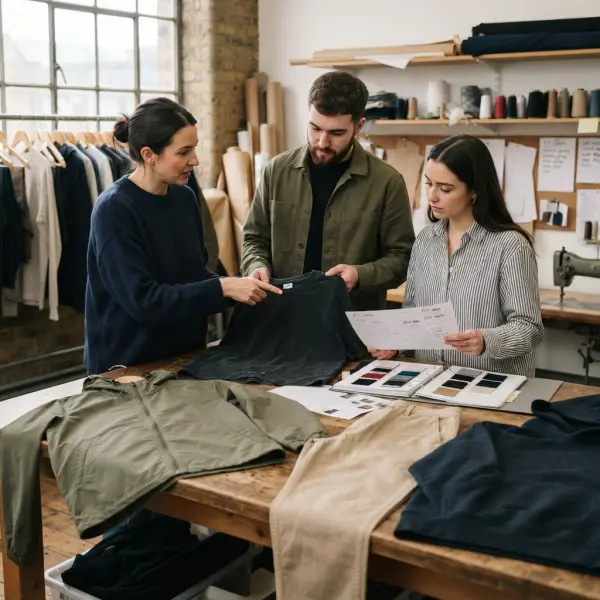
Young customers may deliberately choose oversized, fitted, cropped, stacked, or gender-flexible silhouettes. Conventional labels such as slim, regular, and loose may not provide enough information.
Useful product communication can include:
- Actual garment measurements.
- Model height and size worn.
- Front, side, and back images.
- Explanation of intended shoulder and trouser position.
- Fabric weight and stretch.
- Shrinkage expectations.
- Styling examples across body types.
- Comparison with another fit sold by the brand.
This reduces the distance between the designer’s intention and the customer’s interpretation.
Build Price Architecture, Not One Aspirational Price
A youth fashion brand needs to decide how customers enter and progress through its assortment.
Lower-priced accessories or T-shirts can offer access, but they should not be poorly made simply because they are entry products. Core garments may provide repeatability. Specialist outerwear or collaborations can occupy a higher level.
A useful price architecture explains why each step costs more through material, construction, production method, design contribution, licensing, service, or scarcity.
Without that logic, premium prices may feel like barriers rather than expressions of value.
Design for Personal Interpretation
Over-designed products can leave little room for the wearer.
A garment does not need to be visually empty, but the business should understand whether its audience wants a complete statement or a flexible styling component.
Designing for interpretation may involve:
- Controlled rather than excessive graphics.
- Colors that integrate with existing wardrobes.
- Adjustable or removable elements.
- Layering-compatible proportions.
- Repeated silhouettes in different materials.
- Accessories that alter the product without replacing it.
- Styling content that shows possibilities rather than one correct formula.
The goal is not to make every item neutral. It is to allow the customer to participate.
Use Community Insight Without Giving Up Strategic Control
Young customers can provide valuable feedback, but a brand should not outsource every design decision to polls and engagement metrics.
Customers are well positioned to explain:
- Fit problems.
- Missing sizes.
- Climate discomfort.
- Styling barriers.
- Price objections.
- Service failures.
- Which products they actually repeat.
- Which cultural references feel credible or forced.
The brand remains responsible for product coherence, technical feasibility, margin, legal compliance, and long-term positioning.
Community participation should improve judgment, not replace it.
Measure Usefulness Beyond Initial Sell-Through
A product may sell quickly because of novelty or creator exposure. That does not reveal whether it becomes part of the customer’s identity.
More useful indicators include:
|
Indicator |
What it may reveal |
|
Repeat purchase by product block |
Whether customers trust the fit and quality |
|
Return reason by size |
Whether fit communication and grading are working |
|
Customer styling content |
Whether the product supports personal interpretation |
|
Replenishment demand |
Whether the product has usefulness beyond launch hype |
|
Wear and care feedback |
Whether construction suits real routines |
|
Cross-category purchases |
Whether the brand is becoming part of a broader wardrobe |
|
Discount dependency |
Whether demand exists at the intended price |
|
Repair or replacement requests |
Where durability and service can improve |
These indicators are more operationally useful than visibility alone.
Common Mistakes When Targeting Youth Fashion
Treating Young Consumers as One Global Segment
Generation labels can be useful for broad analysis, but they do not erase differences in income, city size, climate, religion, gender expression, education, occupation, disability, family expectations, and cultural background.
A trend visible among university students in one major city may not apply to working young adults in another region.
Brands need defined customer groups, not an imagined universal youth.
Chasing Every Named Aesthetic
By the time a microtrend reaches a large planning meeting, it may already be highly exposed.
Building an entire production order around a short-lived online label can result in late delivery and markdowns. Apparel lead times are often longer than digital trend cycles.
A better approach is to identify the underlying product signal. Instead of copying a complete aesthetic, the brand might test one proportion, color, accessory, or styling direction within its established product system.
Using Oversizing to Avoid Proper Fit Development
An oversized product is still a designed fit.
Making one large pattern and applying a wide size label can create poor necklines, sleeves, rises, lengths, and pocket positions. It may also exclude customers whose bodies do not match the original block.
Brands should fit-test deliberately across sizes and explain the intended silhouette.
Assuming Casual Clothing Requires Lower Quality
Casual garments are often worn frequently and washed repeatedly. Weak rib recovery, twisting seams, unstable color, poor print curing, broken zippers, and inconsistent grading become visible quickly.
The simpler the garment appears, the more noticeable basic construction problems can become.
A plain T-shirt must rely on fabric, cut, sewing, finishing, and fit because there is little decoration to distract from weak execution.
Turning Social Values Into Campaign Decoration
Young consumers are often described as value-driven, but brands should not use that phrase as permission to make vague environmental or social claims.
A company should provide verifiable information about materials, suppliers, labor standards, durability, packaging, repair, or take-back systems before positioning a product around responsibility.
The appropriate claim may be limited. A product made with recycled content is not automatically circular. A small production run is not automatically low impact. Gender-neutral marketing does not guarantee inclusive fit.
Specific evidence is more credible than broad virtue language.
Designing for the Feed Instead of the Body
A garment may look powerful in a cropped image but perform poorly in movement.
Excessive sleeve volume can interfere with daily activity. Large prints can reduce breathability. Heavy garments can be unsuitable for humid climates. Decorative hardware can create noise, weight, or damage during washing.
Product teams should evaluate the garment while sitting, walking, reaching, carrying a bag, using a phone, and wearing common layers.
The customer experiences the entire product. The feed shows only a frame.
What Brands Should Verify Before Acting
Youth fashion research is frequently specific to one country, platform, age range, gender group, or commercial category. Businesses should verify whether the evidence applies to their actual market before converting it into product strategy.
Key checks include:
- Does the research include the region the brand serves?
- Is the sample large enough for the conclusion being made?
- Does the study examine intention or actual purchasing behavior?
- Does “youth” mean teenagers, university students, or adults in their twenties?
- Are findings influenced by one platform or one product category?
- Does the data distinguish interest from willingness to pay?
- Is the trend visible across sales, search, and community evidence?
- Can suppliers execute the required fit, material, and quantity?
- Will the product arrive while demand still exists?
- Are cultural and intellectual property references properly understood?
Evidence should guide decisions, but context determines whether it is usable.
Frequently Asked Questions
What is casual identity in fashion?
Casual identity is the expression of personality, belonging, and lifestyle through informal everyday clothing. It commonly involves products such as T-shirts, sneakers, denim, hoodies, knitwear, workwear, sportswear, relaxed trousers, and personal accessories.
The concept does not mean that the wearer is uninterested in appearance. Casual outfits may involve detailed decisions about fit, proportion, source, condition, graphics, and cultural references.
The term is best treated as an analytical description rather than an official garment category. Its meaning changes according to community, region, climate, age, and social setting.
Why do young people prefer casual clothing?
Many young people use casual clothing because it can support movement, repeated wear, layering, personal styling, and several daily activities. It may also feel more consistent with peer groups, music cultures, sports, digital life, and contemporary expectations around self-expression.
This does not mean all young consumers reject formal clothing. Tailoring, occasion wear, uniforms, traditional dress, and highly decorative fashion remain important in particular settings.
The strongest preference is often not for informality alone, but for clothing that allows the wearer to control how formal, visible, or culturally specific they appear.
Is youth casual fashion the same as streetwear?
No. Streetwear is one influential part of youth casual fashion, but the categories are not identical.
Streetwear is connected with specific histories involving hip-hop, skateboarding, surfing, sport, music, workwear, independent brands, sneakers, and community-led distribution. Youth casual fashion also includes athleisure, minimalist basics, outdoor clothing, modest fashion, vintage dressing, campus wear, local cultural styles, and informal tailoring.
The categories overlap because they share practical garments and relaxed silhouettes. The distinction lies in cultural history, community context, branding, and how the products are interpreted.
Does comfort matter more than appearance to young consumers?
Comfort and appearance are not usually separate decisions.
A garment may be physically comfortable but socially uncomfortable, while a less soft product may provide confidence or cultural meaning. Young customers often evaluate fabric feel, mobility, climate suitability, fit, appearance, peer interpretation, and styling potential together.
Businesses should therefore avoid assuming that adding stretch or softness automatically solves the comfort requirement. Pattern balance, size availability, temperature, opacity, seam placement, garment weight, and psychological confidence can be equally important.
Do social media trends determine what young people buy?
Social media can influence discovery and aesthetic familiarity, but it does not determine every purchase.
Income, product availability, size, climate, family expectations, school or workplace rules, personal values, and existing wardrobes can prevent online interest from becoming a transaction.
Algorithms may also exaggerate the apparent scale of a trend by repeatedly showing similar content to a narrow audience. Brands should combine social observation with sales, search data, interviews, returns, and regional evidence before making large inventory commitments.
Are young consumers loyal to fashion brands?
Youth brand loyalty is often conditional rather than automatic.
A customer may repeatedly buy a particular fit or shoe model while experimenting with graphics, accessories, and other labels. Loyalty can weaken when prices rise without product improvement, quality becomes inconsistent, a brand loses cultural relevance, or service fails.
Brands can strengthen retention through reliable fit, transparent product information, distinctive design, fair pricing, repair or support, and consistent treatment of their communities. Loyalty should be measured through repeat purchase and retention rather than assumed from social-media engagement.
How should brands respond to fast youth microtrends?
Brands should separate temporary aesthetic language from longer-term product demand.
A microtrend may reveal interest in a color, proportion, material, styling combination, or cultural reference. The company can test that signal through small quantities, digital styling, accessories, pre-orders, or modifications to an established product block.
Building a completely new assortment around every viral label is usually risky because production lead times may outlast online attention. The most resilient strategy combines a stable product identity with selective, evidence-based experimentation.
Can casual fashion remain relevant as consumers get older?
Yes. Casual identity can evolve rather than disappear.
As consumers age, they may retain familiar categories while changing material, construction, graphic intensity, fit, and price. A bold hoodie may become a refined knit. Skate-influenced trousers may become cleaner workwear. Sneakers may remain central but shift toward subtler designs.
Brands should not assume that casual fashion belongs exclusively to teenagers. Customers who participated in streetwear, sportswear, music, and digital cultures may continue to value comfort and personal styling while expecting improved quality and contextual versatility.
Conclusion
Casual identity continues to shape youth fashion because it solves more than a clothing problem.
It allows young people to move through daily life, belong to communities, test identities, respond to cultural influences, and communicate difference without abandoning familiar wardrobe forms. The same hoodie, sneaker, T-shirt, trouser, or jacket can carry different meanings depending on fit, styling, source, condition, and context.
Digital platforms have increased the speed at which visual trends circulate, but rapid aesthetics still depend heavily on stable casual products. This is why trend names may change faster than the wardrobes beneath them.
For fashion businesses, the strategic opportunity lies in durability of use rather than constant novelty. Reliable product blocks, credible pricing, detailed fit information, climate awareness, community understanding, and space for personal interpretation can remain valuable after a microtrend fades.
Young consumers do not only wear brands as complete identities. They select, combine, reject, repeat, customize, and reinterpret products.
The brands that understand this will design clothing as part of a person’s life—not as a finished identity that the customer is expected to purchase whole.




Comments 0
Leave a CommentSend Comment
Anda harus Login terlebih dahulu untuk dapat memberikan komentar.