

Fashion Inventory Management Explained for Retail Businesses
Quick Answer
Fashion inventory management is the coordinated process of planning, purchasing, receiving, tracking, allocating, replenishing, transferring, selling, returning, and retiring fashion products across stores, warehouses, and digital sales channels.
It is more complex than basic stock control because apparel inventory is divided into style, color, size, season, collection, location, and product-status combinations. A retailer may appear to have enough units of one dress, for example, while still losing sales because the most requested sizes are unavailable in the stores or online channels where customers want them.
Effective inventory management gives fashion businesses reliable visibility into what they own, where it is located, how quickly it is selling, what is becoming overstocked, and what should be replenished, transferred, promoted, marked down, or discontinued.
The objective is not simply to hold less inventory. It is to maintain the right inventory mix while protecting product availability, working capital, gross margin, and customer experience. The appropriate system depends on the retailer’s product lifecycle, supplier lead times, sales channels, replenishment capability, and level of demand uncertainty.

What Is Fashion Inventory Management?
Fashion inventory management is a retail operations discipline that controls the flow and status of apparel, footwear, accessories, and related merchandise in order to keep products available for sale without creating unnecessary excess stock.
The process begins before products physically arrive. It includes estimating demand, deciding how many units to buy or produce, selecting size and color quantities, assigning products to locations, and setting replenishment or markdown rules. Once goods enter the business, inventory management also covers receiving, stock counting, storage, transfers, order allocation, returns, damaged goods, and end-of-season disposition.
Oracle defines retail inventory management broadly as the process of forecasting inventory requirements and managing goods through ordering, storage, distribution, selling, and restocking across different locations and channels. Oracle’s retail inventory management overview provides a useful distinction between managing company-wide stock and controlling item-level availability at individual warehouses or outlets.
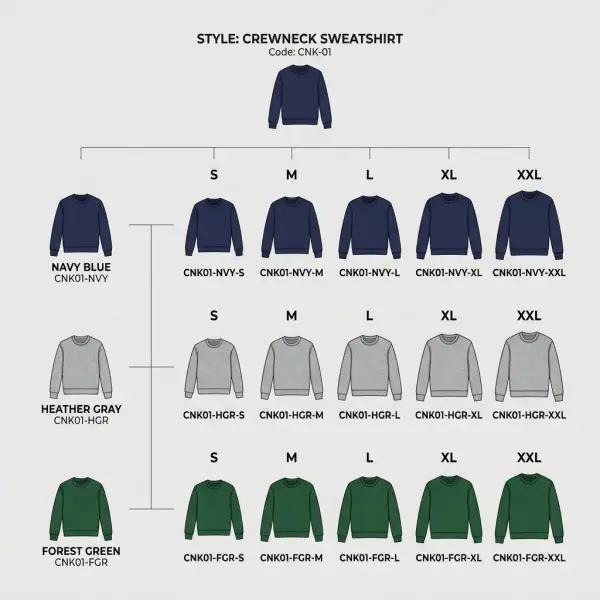
For fashion businesses, the item level is especially important. Inventory is rarely managed effectively by product name alone. A basic shirt may exist in four colors and six sizes, creating 24 separate stock-keeping units, or SKUs. If it is sold through three stores, one warehouse, and an e-commerce channel, the retailer must understand not only the total quantity but also the quantity and status of each SKU in every location.
That granular structure is where many inventory problems begin.
Inventory management is not the same as stock counting
Stock counting verifies how many physical units are present. Inventory management uses that information, together with sales, purchasing, product, and supply data, to make operational decisions.
A retailer may complete an accurate stock count and still manage inventory poorly. For example, the system may show 600 units available, but those units could be concentrated in slow-selling colors, broken size ranges, or stores with limited demand. Accurate quantities are necessary, but they do not automatically create an effective inventory mix.
Inventory management therefore asks broader questions:
- Do recorded quantities match physical stock?
- Are the right sizes and colors available?
- Is inventory located where demand is occurring?
- Are products selling at the expected pace?
- Can bestsellers be replenished before demand declines?
- Which products are aging or becoming commercially obsolete?
- How much stock is committed to open orders or customer returns?
- Which items should be transferred, promoted, marked down, or retired?
The quality of the answers depends heavily on product data, transaction discipline, and coordination between merchandising, buying, warehouse, store, finance, and e-commerce teams.
Why Is Fashion Inventory More Difficult to Manage?
Fashion inventory is difficult to manage because demand is fragmented across product attributes and often concentrated within a limited selling period. Retailers are not only predicting whether a jacket will sell. They are estimating which colors, sizes, locations, price points, and weeks will generate demand.
Many fashion products also have short commercial lifecycles. A garment does not physically expire in the way food does, but its full-price selling opportunity may decline after a season, campaign, event, or trend has passed. This creates inventory obsolescence risk even when the product remains wearable.
Several characteristics make fashion inventory unusually demanding.
Style, color, and size create SKU complexity
A retailer may buy the correct total quantity for a style but choose the wrong size curve. The business then experiences two problems at once: stockouts in popular sizes and excess inventory in less demanded sizes.
This matters because customers generally do not view another size as an acceptable substitute. A medium blouse cannot satisfy a customer who needs an extra-large blouse, even though the inventory report may still show that the style is “in stock.”
Product availability must therefore be evaluated at variant level rather than only at style level.
New products have limited sales history
Retailers can use historical sales to plan recurring basics, but new fashion items may have no direct sales history. A new silhouette, fabric, print, or price point may behave differently from the products used as planning references.
Research into fashion demand forecasting has repeatedly identified new-product forecasting as a difficult problem because fashion assortments change frequently and product demand can vary according to design attributes, launch timing, geography, and merchandising conditions.
Historical data still matters, but it must be interpreted. A planning team may compare the new product with similar styles, adjust for price and season, examine customer response to samples or campaigns, and then purchase conservatively where uncertainty is high.
Demand differs by location and channel
The same product may perform differently in a flagship store, suburban outlet, marketplace, brand website, or wholesale account. Climate, local demographics, store format, promotional activity, and customer purchasing behavior can all influence demand.
A fashion retailer may therefore have excess stock at one location while another location repeatedly sells out. Without timely inventory visibility and transfer processes, the company may discount products in one store while missing full-price sales elsewhere.

Lead times can outlast the trend opportunity
A product may begin selling quickly, but the retailer can only benefit if additional stock can arrive while demand is still active. Long material procurement, manufacturing, import, or transportation lead times reduce the value of rapid sales information.
This is why replenishment potential should be considered during product development and buying. Fashion businesses need to distinguish between:
- Never-out-of-stock basics that can be replenished repeatedly
- Seasonal products with a defined selling window
- Fashion items that may support one controlled reorder
- Limited-edition products that will not be replenished
- Experimental styles intentionally purchased in small quantities
A single inventory rule will not work equally well for all five groups.
Returns can distort available stock
Online fashion retail often creates additional stock states. A returned item may be physically present but unavailable because it is awaiting inspection, cleaning, repackaging, repair, or system processing.
Treating all returned goods as immediately sellable can overstate available inventory. Treating recoverable returns as permanently unavailable can understate it. Retailers need defined inventory statuses and a fast, controlled return-to-stock process.
What Does Fashion Inventory Include?
For a retail business, inventory is broader than the merchandise visible on the shop floor. It includes all goods owned or controlled by the business that are held for sale, in transit, under inspection, reserved, returned, damaged, or otherwise awaiting a decision.
A fashion brand that manufactures its own products may also manage raw materials, trims, packaging, work in progress, and finished goods. A retailer that purchases finished merchandise will usually focus more heavily on sellable units and their location or status.
A practical inventory classification may include:
|
Inventory category |
What it represents |
Operational concern |
|
Available stock |
Sellable units that can be promised to customers |
Must be accurate by SKU and location |
|
Reserved stock |
Units allocated to customer or wholesale orders |
Should not be offered to another buyer |
|
In-transit stock |
Products moving between supplier, warehouse, or store |
Requires expected arrival and ownership visibility |
|
Quarantine stock |
Units awaiting quality inspection or investigation |
Must remain unavailable until released |
|
Return stock |
Customer returns awaiting assessment or processing |
Delays can hide recoverable selling inventory |
|
Damaged stock |
Unsellable or restricted units |
Requires repair, downgrade, claim, or write-off decision |
|
Display or sample stock |
Units used for merchandising, fitting, photography, or sales samples |
May be physically present but not normally sellable |
|
Aging stock |
Merchandise held beyond its expected selling period |
May require transfer, promotion, markdown, or liquidation |
|
Work in progress |
Partially completed products owned by a manufacturer or vertically integrated brand |
Requires production-stage and cost tracking |
|
Raw materials and trims |
Fabric, yarn, buttons, zippers, labels, and packaging |
Must align with production commitments and lead times |
From an accounting perspective, inventory valuation is not simply a retail operations issue. Under International Financial Reporting Standards, IAS 2 generally requires inventories to be measured at the lower of cost and net realisable value. Net realisable value refers to the estimated ordinary selling price less expected completion and selling costs. Local accounting requirements may differ, so businesses should apply the standards relevant to their jurisdiction with qualified financial guidance. IAS 2 Inventories explains the principle and permitted cost treatment in more detail.
Inventory Management, Inventory Planning, and Assortment Planning: What Is the Difference?
These disciplines overlap, but they answer different business questions.
|
Discipline |
Primary question |
Typical decisions |
|
Assortment planning |
What products should the retailer offer? |
Categories, styles, colors, sizes, price architecture, collection breadth and depth |
|
Demand forecasting |
How much demand may occur and when? |
Expected unit sales by product, period, channel, or location |
|
Inventory planning |
How much stock should be available over time? |
Opening stock, receipts, ending inventory, stock cover, purchasing budget |
|
Inventory management |
How should actual stock be controlled and moved? |
Receiving, allocation, availability, replenishment, transfers, returns, markdown status |
|
Warehouse management |
How should stock be handled inside a facility? |
Put-away, bin locations, picking, packing, dispatch, labor workflow |
|
Merchandise financial planning |
How should sales, inventory, margin, and purchasing budgets be balanced? |
Sales targets, stock investment, open-to-buy, markdown budget |
Oracle describes assortment planning as deciding which seasonal styles should be offered and how they should be distributed across stores and other channels, including decisions at size and color level. Oracle’s explanation of retail assortment planning reinforces why assortment decisions should precede day-to-day inventory execution.
In practice, these functions should not operate in isolation. The assortment plan establishes the intended product mix. The forecast estimates demand. The inventory plan translates demand into stock requirements. Inventory management then controls what actually happens as goods arrive and customers begin buying.
How Does the Fashion Inventory Management Process Work?
A reliable fashion inventory process connects product setup, purchasing, receiving, selling, stock movement, and financial control. The exact workflow varies by business model, but most systems follow the same operational sequence.
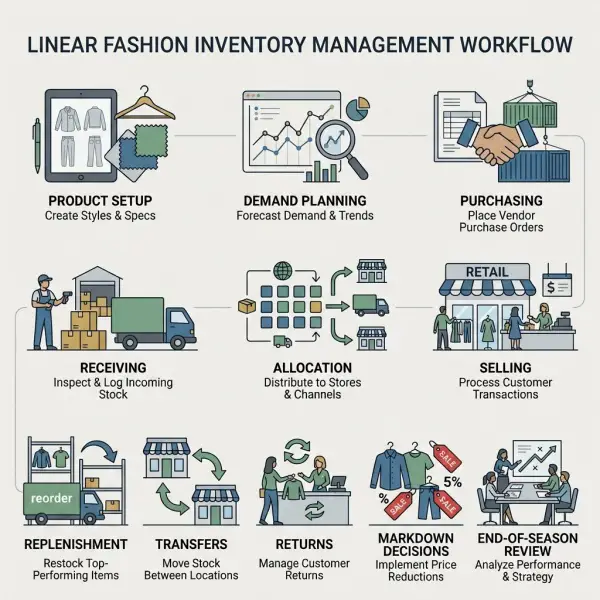
1. Build a reliable product and SKU structure
Every sellable variant should have a unique identifier connected to accurate product attributes. At minimum, the system normally needs:
- Product or style code
- SKU or variant code
- Product name and category
- Color and size
- Season or collection
- Supplier or manufacturing source
- Unit cost and selling price
- Barcode or other identification code
- Replenishment status
- Sales channel eligibility
- Launch and expected end-of-life dates
Poor master data creates errors that no forecasting tool can fully correct. Duplicate SKUs, inconsistent color names, missing sizes, incorrect unit costs, and reused barcodes can affect purchasing, sales reporting, fulfillment, and inventory valuation.
For many smaller fashion businesses, improving master data is more urgent than adopting advanced artificial intelligence. A sophisticated forecast built on unreliable product records will simply process unreliable inputs more quickly.
2. Estimate demand and set the initial buy
The initial order should reflect expected demand, supplier minimums, production economics, lead times, product novelty, channel requirements, and the cost of being wrong.
For proven basics, the retailer may use historical sales and stable replenishment rules. For a new fashion product, the buyer may rely on comparable styles, pre-orders, wholesale interest, campaign engagement, customer research, merchandising judgment, or controlled market testing.
The initial buy should be planned at SKU level where possible. Buying 1,000 units of a dress without deciding an appropriate size and color curve leaves a major part of the inventory decision unresolved.
3. Receive and verify products
Receiving establishes the first operational record of physical inventory. Teams should confirm:
- Purchase order or production order reference
- SKU identity
- Quantity delivered
- Size and color accuracy
- Product condition
- Quality inspection status
- Cost and landed-cost information where relevant
- Differences between ordered, shipped, and received quantities
Unrecorded shortages, substitutions, and receiving delays create inaccurate inventory from the beginning. The system may show products that never arrived or fail to show units that are physically available.
4. Allocate stock to locations and channels
Allocation determines where the opening stock should be placed. Equal distribution is simple, but it is rarely optimal when locations have different sales histories, customer profiles, floor capacities, or online fulfillment roles.
Allocation rules may consider:
- Historical demand by category or product attribute
- Store size and merchandising capacity
- Local climate or event calendar
- Channel-specific product strategy
- Size demand by location
- Launch priority
- Minimum display quantities
- Warehouse reserve requirements
- Ability to replenish or transfer quickly
An online channel should not automatically receive unlimited access to all stock. Retailers need rules for shared inventory, store-exclusive inventory, marketplace reservations, wholesale commitments, safety buffers, and customer-order priorities.
5. Maintain accurate stock records
Inventory accuracy is the degree to which system records match the physical quantity, location, identity, and status of actual goods.
Accuracy can be damaged by incorrect receiving, unrecorded transfers, theft, picking errors, returns, mislabeling, damaged items, canceled orders, or delayed sales synchronization. When records are wrong, replenishment systems may fail to order products that are physically out of stock or may order unnecessary stock that already exists.
Retailers commonly combine several controls:
- Point-of-sale integration
- Barcode scanning
- Cycle counting
- Periodic full stocktakes
- Transfer confirmation
- Return-status controls
- Exception reporting
- Radio-frequency identification, or RFID, where justified
RFID can allow multiple tagged items to be read without scanning every barcode individually. Its commercial value depends on tag costs, systems integration, process discipline, product economics, and operational scale. GS1 apparel case studies have documented substantial accuracy and receiving improvements in specific RFID implementations, but those outcomes should be treated as implementation examples rather than universal guarantees. GS1 apparel inventory management case study

6. Monitor sales and replenishment signals
Once selling begins, the retailer compares actual performance with the plan. Strong sales do not automatically justify a reorder. The team must determine whether the demand is repeatable, whether the product has enough selling time remaining, and whether replacement stock can arrive before the opportunity closes.
Replenishment decisions should consider current stock, sales velocity, outstanding orders, lead time, expected future demand, minimum order quantity, and target service level. A product selling quickly because it received a temporary marketing push may require a different response from a basic item with consistent weekly demand.
Automated systems can monitor inventory conditions and recommend orders or stock transfers, but human review remains valuable for launches, promotions, weather-sensitive categories, irregular events, and products with limited history. Oracle’s retail documentation describes replenishment as a process that continuously monitors stock conditions and creates orders or transfers according to demand and operating constraints.
7. Rebalance inventory between locations
Transfers can recover selling opportunities when inventory is in the wrong place. A store with excess units may send them to a location with stronger demand, or store inventory may be released for online fulfillment.
Transfers are not free, however. They introduce transport, handling, packing, system, labor, and potential damage costs. A transfer is commercially sensible when the expected improvement in selling opportunity exceeds the operational cost and the product still has enough selling life.
Modern inventory optimization systems can recommend store-to-store or warehouse-to-store rebalancing to support sell-through and reduce markdown exposure. The recommendation still needs business rules that prevent low-value or late-season products from being moved unnecessarily.
8. Manage returns, damages, and exceptions
Returns should move through a defined decision path:
- Receive and identify the returned SKU.
- Confirm the customer-order reference.
- Inspect condition and completeness.
- Classify the unit as sellable, repairable, restricted, or unsellable.
- Update the inventory status.
- Return eligible products to the appropriate sales channel.
- Record repair, liquidation, supplier claim, donation, recycling, or write-off decisions where required.
Slow exception processing creates “hidden inventory”—stock that the business owns but cannot confidently sell. This can be especially costly for seasonal products whose commercial value declines while they wait for inspection.
9. Review aging and end-of-season inventory
Inventory aging measures how long stock has remained unsold or inactive. The appropriate thresholds depend on the product category. A permanent core T-shirt may remain commercially relevant longer than a heavily themed holiday product.
Aging analysis should be performed at a sufficiently detailed level. A style may appear healthy overall while a particular color or size has stopped selling.
Possible responses include:
- Adjusting visual merchandising
- Improving product content or styling guidance
- Moving stock to a stronger channel or location
- Bundling complementary products
- Using targeted rather than universal promotions
- Marking down selected variants
- Selling through outlet or off-price channels
- Repairing, redesigning, recycling, donating, or responsibly disposing of unsellable goods
The financial consequences of weak purchasing and late action are explored more deeply in how poor stock planning reduces fashion brand profitability.
Which Inventory Metrics Matter Most?
No single metric can describe inventory health. A product can have strong sales but weak margin, high turnover but frequent stockouts, or high availability because the retailer bought far too much.
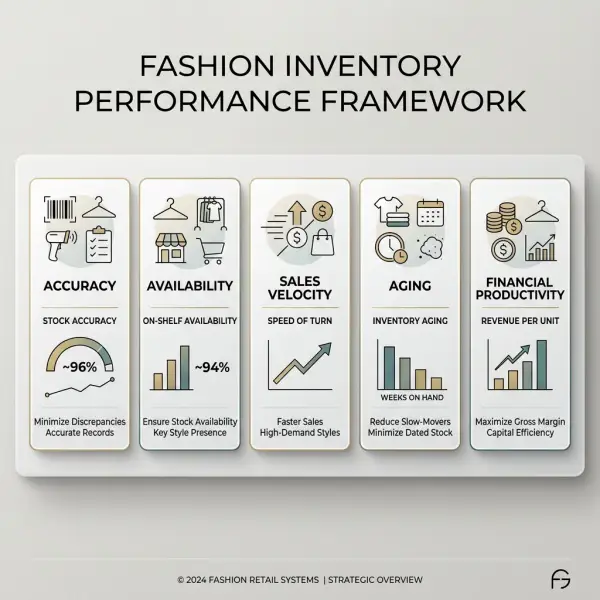
A useful inventory dashboard combines availability, velocity, accuracy, aging, and financial productivity.
|
Metric |
What it answers |
Practical caution |
|
Inventory accuracy |
Do system records match physical stock? |
Check quantity, location, SKU, and status—not quantity alone |
|
Sell-through rate |
What proportion of received or available inventory was sold during a period? |
Formula definitions can differ between systems |
|
Stock cover or weeks of supply |
How long might current stock last at the present sales rate? |
Past sales may not represent future seasonal demand |
|
Stockout rate |
How frequently is a requested SKU unavailable? |
Style-level reporting can hide missing sizes |
|
Inventory aging |
How long has inventory remained unsold? |
Thresholds should reflect product lifecycle |
|
Markdown rate |
How much merchandise requires price reduction? |
A planned promotion is not always equivalent to clearance |
|
Return-to-stock time |
How quickly can eligible returns become available again? |
Requires reliable inspection and status updates |
|
Inventory turnover |
How frequently inventory is sold and replaced over a period |
Very high turnover may coexist with lost sales |
|
Gross margin return on inventory investment |
How much gross margin is generated relative to inventory investment? |
Cost allocation and time period must be consistent |
|
Shrinkage |
How much inventory is lost through theft, damage, error, or other unexplained causes? |
Requires physical verification and disciplined adjustments |
Sell-through rate is generally used to express the proportion of inventory sold during a defined period. Different platforms may use different denominators, such as units received, beginning inventory, or units sold plus ending stock. Businesses should therefore document the formula used internally before comparing teams, products, or external benchmarks. Shopify’s inventory reporting documentation is one example of a platform-specific calculation. Shopify inventory report definitions
Inventory turnover deserves its own strategic treatment because a “good” turnover level depends on category, margin structure, supply lead time, replenishment reliability, and stockout tolerance. These decisions are covered in inventory turnover strategies for fashion businesses.
Practical Inventory Methods Used by Fashion Retailers
Inventory methods should support the operating model rather than being adopted because they sound advanced. A small online label and a multinational retailer do not need identical systems, but both need reliable product records and disciplined transaction control.
Perpetual inventory records
A perpetual system updates stock after purchases, sales, transfers, returns, and adjustments. It provides more timely visibility than relying only on periodic physical counts.
Perpetual records do not remove the need for counting. They must still be reconciled against physical inventory because transactions can be missed or recorded incorrectly.
Cycle counting
Cycle counting checks selected stock regularly rather than waiting for one annual stocktake. High-value, high-volume, high-risk, or frequently inaccurate SKUs may be counted more often.
This approach helps teams identify the causes of discrepancies while they are still operationally relevant. It can also reduce the disruption created by closing an entire operation for a complete count, although periodic full verification may still be required.
ABC classification
ABC analysis groups inventory according to importance, often using sales, consumption value, margin contribution, or another business criterion.
A-products may justify tighter control and frequent review. B-products receive moderate attention. C-products can use simpler controls, provided that the classification does not hide strategic products, new launches, or essential size availability.
The method is a prioritization tool, not a substitute for category knowledge. A low-revenue accessory may still be strategically important if it completes an outfit, supports gift purchases, or raises basket value.
Open-to-buy control
Open-to-buy, or OTB, is a retail budgeting method that estimates how much purchasing capacity remains after considering planned sales, stock targets, existing inventory, and merchandise already on order.
It helps prevent buyers from committing the entire budget too early and preserves flexibility for emerging demand. OTB can be managed at department, category, channel, or business level, depending on the company’s ty. Open-to-buy planning overview
OTB is most useful when purchase orders, cancellations, receipts, sales, markdowns, and stock valuations are updated consistently. An outdated OTB report can create a false sense of spending capacity.
Reorder points and safety stock
A reorder point indicates when a replenishable product should be reordered. It is commonly based on expected demand during the replenishment lead time plus a safety buffer.
This method works more naturally for repeatable products than for short-lived fashion collections. Applying a static reorder point to every garment can cause late reorders that arrive after the selling opportunity has weakened.
Safety stock should also be selective. More safety stock can reduce shortage risk, but it ties up capital and increases exposure to excess inventory. The appropriate level depends on demand variability, supplier reliability, lead time, margin, product lifecycle, and the consequences of a stockout.
Inventory identification technology
Barcodes remain a practical foundation for many fashion businesses because they support receiving, sales, picking, transfers, and counts at relatively low implementation cost.
Item-level RFID may support faster counting and greater visibility where unit economics, volume, infrastructure, and process design justify it. The decision should be based on a clear business case rather than the assumption that technology will automatically repair poor operating discipline.
How Can Different Fashion Businesses Apply Inventory Management?
Small direct-to-consumer brands
A small brand should begin with disciplined SKU data, purchase-order tracking, channel synchronization, and weekly exception review. A complicated planning platform is not the first requirement.
A practical weekly review can examine:
- Bestselling and slow-selling SKUs
- Missing core sizes
- Products approaching a reorder decision
- Outstanding supplier orders
- Unprocessed returns
- Inventory discrepancies
- Aging products
- Promotional commitments
- Cash already committed to future stock
The founder should avoid managing inventory from memory or disconnected spreadsheets once transaction volume becomes difficult to reconcile. The point at which a dedicated system becomes necessary depends less on total revenue than on SKU count, order volume, number of locations, and channel complexity.
Multi-store retailers
Multi-store businesses need location-level accuracy, allocation rules, cycle counting, and transfer discipline. They should identify whether weak sales are caused by low demand, poor placement, insufficient size availability, or stock being assigned to the wrong store.
Store teams should not make informal transfers without recording them. A product that physically moves but remains assigned to the original store can create false availability in two locations: the receiving store has invisible stock, while the sending store promises stock that no longer exists.
Omnichannel retailers
Omnichannel inventory management requires a shared understanding of available-to-promise stock. The system must account for store sales, online orders, marketplace reservations, wholesale commitments, returns, transfers, and safety buffers.
A single pool of inventory can improve flexibility, but only when synchronization is reliable. Otherwise, the retailer may oversell units that have already been purchased elsewhere.
Ship-from-store and click-and-collect models create additional requirements. Store stock must be accurate enough for customer promises, and store teams need procedures for locating, reserving, picking, packing, and canceling orders.

Wholesale and hybrid brands
Brands that combine direct retail with wholesale need to separate inventory ownership, availability, and commitments clearly. Units reserved for wholesale accounts should not appear freely available to direct customers unless the business has defined reallocation rules.
Wholesale cancellations, delivery windows, returns, and chargebacks can also influence inventory status. A product may technically exist but be commercially committed or temporarily unavailable for another channel.
Hybrid brands benefit from a consolidated view of direct-to-consumer, wholesale, marketplace, and warehouse stock, while preserving the rules that apply to each channel.
Common Fashion Inventory Management Mistakes
Managing only at style level
This mistake occurs when teams review total product quantities without identifying shortages and excesses at color and size level.
The consequence is misleading availability. A style may look adequately stocked even though its commercially important sizes are gone. The better approach is to monitor style performance for strategic context and SKU performance for operational action.
Treating every product as replenishable
A system may generate reorder recommendations based on recent sales, even when the replacement stock would arrive too late.
Retailers should assign each product a lifecycle and replenishment policy. Permanent basics, seasonal continuity products, fashion capsules, and limited editions should not use identical rules.
Using sales history without correcting for stockouts
Recorded sales show what customers bought, not necessarily everything they wanted to buy. A size that sold only ten units may appear weak because it was unavailable for most of the period.
Teams should interpret sales alongside availability. Otherwise, future purchasing may repeat the shortage and continue understating demand.
Buying total units before planning the size curve
This often happens when the team focuses on style-level budget and leaves size allocation until later.
The operational result can be a visually successful product with incomplete size availability and accumulated fringe sizes. Size curves should be informed by category, fit, customer profile, channel, region, and comparable products rather than copied mechanically across the assortment.
Allowing inventory adjustments without control
Manual adjustments are sometimes necessary, but unexplained adjustments can hide receiving errors, theft, return problems, or process failure.
Every adjustment should carry a reason code, user record, time stamp, and approval rule appropriate to its value or risk. Repeated adjustments should trigger root-cause investigation rather than becoming a routine method of making reports balance.
Delaying action on slow sellers
Teams sometimes wait for certainty before transferring, promoting, or marking down weak stock. By the time the pattern is undeniable, the product may have lost much of its full-price selling window.
The better approach is to set review milestones before launch. Decisions can then be based on planned checkpoints, expected sales curves, stock cover, margin, campaign activity, and remaining selling time.
Measuring inventory without linking it to margin
Unit sales can make a product look successful even when heavy discounts, returns, fulfillment costs, or low initial margin weaken its contribution.
Inventory reports should eventually connect units with gross margin, markdowns, return behavior, and stock investment. That does not mean every operational employee needs a complex financial dashboard, but buying and management teams should understand whether inventory is generating commercially useful returns.
Assuming software will correct weak processes
A system can automate rules and expose exceptions, but it cannot compensate indefinitely for duplicate SKUs, missing transfer records, late receiving, inconsistent returns, or unclear ownership.
Technology works best after the business defines who records each inventory event, when it must be recorded, which status should be used, and how discrepancies are resolved.
What Should Retailers Verify Before Choosing an Inventory System?
The correct inventory system is not necessarily the platform with the longest feature list. It is the system that can represent the retailer’s actual merchandise structure and transaction flow without creating excessive manual work.
Retailers should verify:
- Whether inventory is managed at style, color, and size level
- Support for multiple warehouses, stores, and selling channels
- Real-time or sufficiently frequent stock synchronization
- Purchase-order and receiving workflows
- Transfer and in-transit inventory handling
- Reserved and available-to-promise inventory
- Returns, damages, quarantine, and repair statuses
- Barcode or RFID compatibility
- Cycle-count and stocktake functions
- Role-based permissions and adjustment records
- Integration with point-of-sale, e-commerce, marketplace, accounting, and warehouse systems
- Reporting by product, SKU, location, channel, collection, supplier, and age
- Data export and ownership provisions
- Implementation, training, hardware, integration, and support costs
- Ability to scale with additional SKUs, transactions, channels, or locations
A vendor demonstration should use realistic fashion scenarios. Ask the provider to show a product with multiple colors and sizes, a partial delivery, a store transfer, an online reservation, a customer return, a damaged unit, and a stock discrepancy. Generic screenshots rarely reveal how well the system handles actual exceptions.
Important Technical and Commercial Caveats
Inventory data is never valuable merely because it is available in real time. It must also be complete, correctly structured, and operationally trusted.
Forecasts are estimates rather than guarantees. New fashion products, promotions, sudden weather changes, influencer exposure, competitor activity, and supply disruption can all produce results that differ fr





Comments 0
Leave a CommentSend Comment
Anda harus Login terlebih dahulu untuk dapat memberikan komentar.