
How Soft Structures and Relaxed Silhouettes Shape Everyday Style
Quick Answer
Soft structures and relaxed silhouettes shape everyday style by giving garments more freedom to move, drape, layer, and adapt to ordinary activities while preserving a deliberate visual form. The effect comes from more than making clothes larger. It depends on where ease is added, how a pattern is balanced, how the fabric bends and shears, and how much internal support is retained.
A softly tailored jacket, for example, may use lighter interlining and a more natural shoulder while keeping enough control at the collar, front edge, and pocket area. Relaxed trousers may provide room through the hip and thigh but still need a stable waistband, an appropriate rise, and a clean line from knee to hem. Without those anchor points, softness can become distortion rather than ease.
For fashion businesses, the practical task is to engineer a controlled relationship between body, pattern, material, and construction. Teams should distinguish wearing ease from design ease, test samples in motion, review the silhouette after laundering, and communicate fit with specific garment information. Relaxed style works best when comfort and appearance are developed together—not when extra volume is used to hide unresolved fit or material problems.
What Are Soft Structures and Relaxed Silhouettes?
Soft structure is a method of creating garment shape with less rigidity, weight, or internal reinforcement than a traditionally firm construction, while retaining enough control for the design to hang and function as intended. A relaxed silhouette is the visible outline created when a garment uses additional or redistributed volume to sit farther from parts of the body.
The two often appear together, but they are not the same. Structure concerns how a garment is supported. Silhouette concerns the overall shape seen around the body. A fluid bias-cut dress can have very little internal structure without being oversized. An oversized coat can have a strongly built shoulder, fused front, and crisp shell fabric. One is soft without being conventionally relaxed; the other is relaxed in volume but structured in construction.
This distinction is useful because the broad shift toward comfort-first dressing in modern fashion cannot be translated into one look. Comfort-led design may be close-fitting, tailored, voluminous, fluid, or layered. Soft structures and relaxed silhouettes are two important tools within that larger approach.
|
Design term |
Primary meaning |
Typical variables |
Common misunderstanding |
|
Soft structure |
Shape supported with reduced rigidity or weight |
Interlining, lining, shoulder treatment, seam construction, fabric body |
No support or craftsmanship |
|
Relaxed silhouette |
More visual and physical space around selected body areas |
Ease, pattern shape, length, proportion, volume distribution |
The same amount added everywhere |
|
Fluid silhouette |
Shape that falls and moves readily |
Drape, weight, bias direction, panel shape, fullness |
Always loose or lightweight |
|
Oversized fit |
Deliberate scale beyond a conventional fit |
Dropped shoulder, extended width, longer length, enlarged details |
Simply wearing the wrong size |
|
Unstructured garment |
Minimal internal shaping components |
Little or no canvas, padding, fusing, or rigid lining |
A garment that needs no pattern control |
The best everyday products use these ideas selectively. They may release the shoulder but stabilize the neckline, widen the leg while controlling the rise, or allow a dress to float from the body while securing the bust and armhole. Softness is most convincing when the wearer can sense ease and the viewer can still read intention.
Why Does Relaxed Style Depend on Pattern Engineering?
Relaxed style depends on pattern engineering because volume must be placed in relation to the body's proportions and movement. Adding circumference alone changes size; shaping that added space changes silhouette.
A pattern maker can create room through several routes: extending a shoulder, lowering an armhole, widening a body panel, adding pleats, changing a dart, increasing a crotch extension, opening a hem, or redistributing fullness through gathers and seams. Each choice affects movement and appearance differently. Ten centimeters added at the bust through side seams does not behave like ten centimeters introduced through a center-back pleat or a dropped shoulder.
Wearing ease and design ease solve different problems
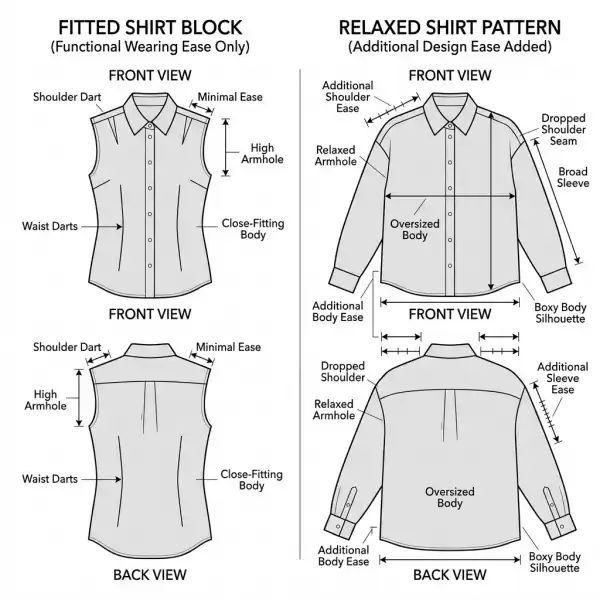
Wearing ease is the space required above body measurements for breathing, sitting, reaching, and other ordinary movements in garments that do not rely entirely on stretch. Design ease is additional space used to create the intended style and shape. Academic work on pattern construction makes this distinction explicitly and also notes that fabric properties influence whether a design needs positive or, in some stretch garments, negative ease: study of ease allowance and body posture.
These categories are conceptually separate, but they overlap in the finished garment. The customer does not experience “wearing ease” and “design ease” as two isolated quantities. They experience a sleeve that pulls, a waistband that accommodates sitting, a jacket that layers over a knit, or a dress that moves without exposing more than intended.
|
Pattern decision |
Functional purpose |
Visual effect |
Risk if poorly controlled |
|
Additional back width |
Reaching and forward arm movement |
Softer upper-back line |
Collapsing fabric or excess folds |
|
Dropped shoulder |
More scale and a casual shoulder line |
Broader, lower shoulder |
Restricted lift, sleeve twisting, excessive bulk |
|
Deeper armhole |
Room and layering capacity |
Relaxed body-to-sleeve transition |
Garment lifts when the arm rises |
|
Fuller hip and thigh |
Sitting and walking ease |
Straight, wide, or cocoon lower-body line |
Crotch drag, excess seat fabric, pocket gaping |
|
Pleats or gathers |
Local expansion and controlled fullness |
Volume from a defined point |
Unwanted bulk or placement over sensitive areas |
|
Wider hem |
Stride and visual movement |
A-line, flared, or fluid outline |
Excess weight, tangling, or poor balance |
Bodies do not expand uniformly during movement. In one small study of women in standing and sitting postures, lower-body circumferences changed with posture, illustrating why static measurements do not describe the full fitting problem. The authors also cautioned that their virtual model did not reproduce every real soft-tissue change accurately: research on trousers for sitting posture. The findings are not a universal ease chart; they reinforce the need to test the intended movements.
Balance determines whether volume looks intentional
Pattern balance describes how garment sections relate so the product hangs in the intended position. Poor front-to-back length, shoulder angle, grainline, or crotch shape may be amplified by extra ease. A shirt that swings backward may need balance correction rather than width; wide trousers that collapse between the legs may need changes to the rise, crotch extension, grain, or fabric.
Good relaxed design starts with a reliable block and a clear volume concept: where should the garment separate from the body, where should it reconnect, and which line should remain stable during movement?
How Fabric Drape Creates a Relaxed Silhouette
Fabric drape is the way a textile deforms under its own weight. It strongly influences whether added volume falls close to the body, forms broad waves, stands away from the figure, or collapses into dense folds. A 2025 textile study describes drape as a property directly relevant to garment fit, comfort, aesthetic flow, and visual appearance: fabric drape assessment research.
Drape is not a synonym for softness. A fabric may feel soft yet hold a boxy shape, or feel smooth while falling heavily around the body. Surface sensation and mechanical behavior need separate evaluation.
Bending and shear influence how cloth falls
Bending describes resistance to curving; shear describes how readily yarn directions change angle as fabric deforms. Both contribute to the formation of folds and the three-dimensional silhouette. Research comparing real nylon fabrics with virtual garments found bending and shear properties to be strongly related to the tested drape behavior, while also stressing the need for accurate physical inputs when reproducing cloth digitally: ACS Omega study on fabric properties and virtual silhouettes.
Fiber content alone cannot predict shape. Two 100% cotton fabrics may differ because of yarn, weave, density, weight, finishing, and laundering. Poplin may support a crisp oversized shirt, while double gauze creates softer, less regular volume. Each suits a different silhouette.
Several material variables deserve attention during development:
- Weight and thickness affect how strongly gravity pulls the material and how much bulk appears at seams, pleats, and layered areas.
- Bending behavior influences whether hems and folds appear crisp, rounded, or limp.
- Shear behavior affects how fabric conforms to three-dimensional forms and moves off-grain.
- Stretch and recovery determine how the material accommodates movement and whether it returns to its intended shape.
- Surface friction influences cling, layering, and how one garment slides over another.
- Dimensional stability affects whether the planned silhouette survives washing, steaming, and extended wear.
These properties interact: lightweight does not automatically mean fluid, and heavy does not automatically mean stiff. A full prototype or large drape sample is more informative than a small handloom swatch.
Direction and cut can change the same fabric
Grain, bias, panel geometry, and seam position also alter behavior. Bias cutting can increase apparent give and conformity, but may introduce growth, twisting, or unstable hems. Fullness released from a yoke behaves differently from width added at a side seam.
A relaxed silhouette is therefore a three-dimensional construction problem. Material testing must inform the pattern, and pattern trials must confirm the material choice.
Soft Construction Is Selective Support, Not the Absence of Structure
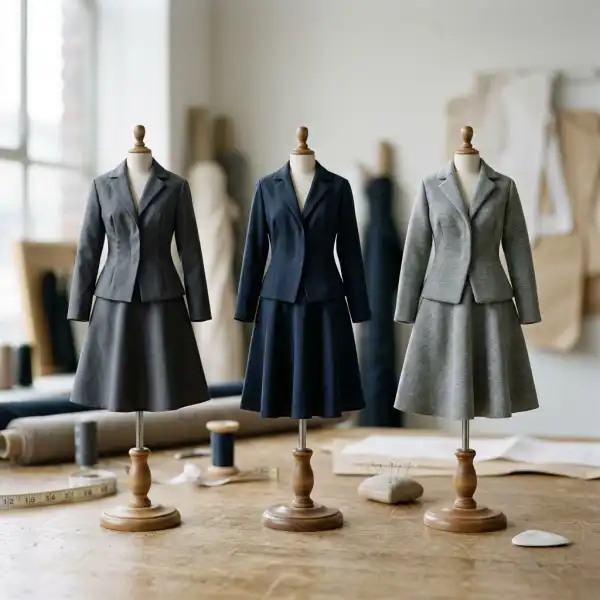
Soft construction works by reducing or relocating support rather than abandoning it indiscriminately. Even an unlined jacket needs stable edges, controlled seam behavior, a functioning collar, and pockets that do not distort the shell. A relaxed dress may need reinforcement around a neckline or closure even when the body is deliberately fluid.
Interlining changes more than stiffness
Interlining is a layer placed between the outer fabric and lining or facing to support shape, stability, appearance, and performance in selected areas. Fusible versions combine an interlining substrate with adhesive and are bonded to the shell under controlled heat, pressure, and time. A technical review notes that shell and interlining become a composite whose tensile, bending, and shear behavior matters to tailoring performance: review of fusible interlinings in garment manufacture.
Removing interlining may reduce weight but allow fronts to ripple, lapels to collapse, or pockets to sag. A lighter substrate, partial application, sew-in support, or localized reinforcement may work better. Fusing and care tests must check bubbling, strike-through, delamination, differential shrinkage, and unwanted stiffness.
Linings, seam finishes, and facings affect the result
Full lining helps a jacket slide over layers, conceals construction, and stabilizes wear, but adds material and warmth. Partial lining or finished unlined seams reduce bulk while exposing workmanship and moving stability demands elsewhere. Soft construction can therefore require more precise handling and cleaner internal finishing, not less skill.
Tailoring shows the trade-off clearly
Soft tailoring often combines reduced padding or lining with lighter fabrics, stretch, and travel-oriented care. A 2026 AATCC industry article describes menswear examples retaining tailoring cues with less internal structure and notes that conventional linings and interlinings add both shape and weight: AATCC overview of comfort-led suit tailoring. It is industry reporting, not independent market proof, but illustrates the design trade-off.
The important design question is not whether a jacket is structured or unstructured. It is which areas must remain controlled for that jacket to express its intended identity.
How Do Relaxed Silhouettes Work Across Everyday Garments?
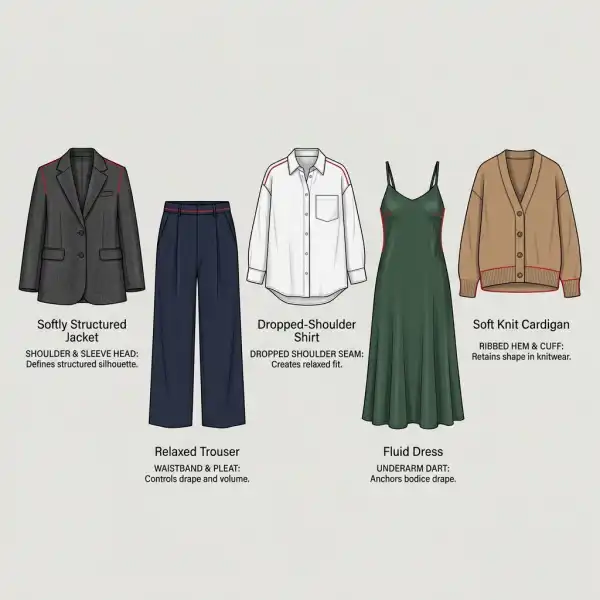
Relaxed silhouettes work differently across garment categories because each product has distinct anchor points, movement requirements, and visual expectations. A useful design vocabulary comes from examining those differences rather than applying one oversized block across an entire collection.
Jackets: release the body, control the frame
A softly structured jacket can release the shoulder and torso while controlling the neckline, front, sleeve pitch, and hem. Lighter chest pieces, patch pockets, knitted constructions, and partial linings reduce rigidity, but the jacket still needs enough support to resist pocket distortion or backward pull.
Fit samples over the intended underlayer. Simply lowering the armhole may create visual ease while causing the jacket body to lift when the wearer raises an arm.
Trousers: volume must begin with the rise and seat
Relaxed trousers need more than a widened leg. The rise, seat angle, crotch extension, hip shape, waistband, pleats, and pockets determine how they sit and move.
Pleats can provide local expansion, but their direction and depth determine whether they close cleanly when standing. Excessive back-waist elastic may pull side seams backward, while too much leg volume can become cumbersome on stairs or in wet weather.
Shirts and tops: shoulder geometry controls movement
Dropped shoulders, extended sleeves, back pleats, and wider bodies change both style and movement. Very low armholes may pull the body upward when the arms lift; back-pleat placement determines when added fullness releases.
The neckline and shoulder remain visual anchors. Stabilizing the neck seam and calibrating shoulder extension prevents sliding, gaping, or an unintentionally mis-sized appearance.
Dresses and skirts: drape, coverage, and stride interact
In dresses and skirts, hem width, panels, bias, gathers, slits, lining, and length shape movement. More sweep can look appealing while increasing weight, wind exposure, tangling, and material use.
Opacity should be reviewed in motion and backlighting. Lining can improve coverage but alter drape and thermal comfort, so warm-climate products may need selective rather than full lining.
Knitwear: softness still needs recovery
Knits provide stretch and conformability but still need recovery and stability. Cardigans may grow at shoulders and pockets, cuffs may flare, and heavy dresses may lengthen under their own weight.
Hanger tests, wear trials, seam-support decisions, and care testing are essential. A sample that looks excellent immediately after steaming may behave differently after several hours on the body or one home-laundry cycle.
A Practical Development Framework for Soft and Relaxed Products
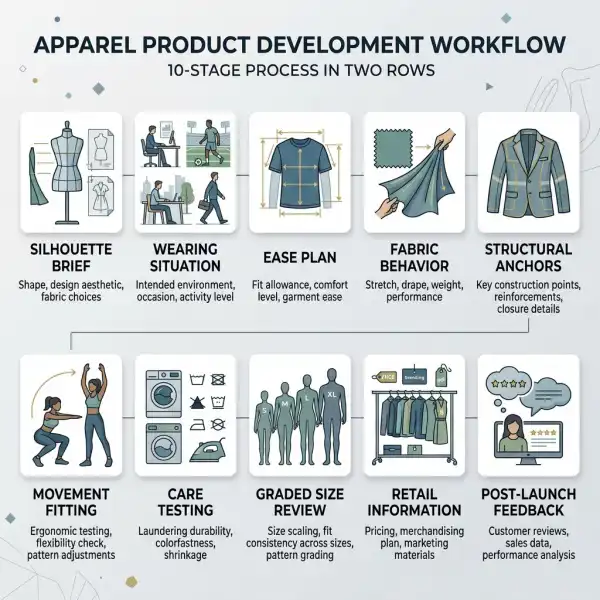
Fashion businesses need to translate creative intent into observable product criteria. This sequence keeps design, pattern, material, production, and retail communication connected.
- Define the silhouette. State where the garment sits close or releases and how it should look from front, side, and back.
- Specify the wearing situation. Record underlayers, climate, activities, footwear, and care because they affect ease, length, lining, and material.
- Separate functional and design ease. Establish movement room before adding stylistic volume, and document finished measurements.
- Shortlist fabrics by behavior. Compare drape, weight, thickness, stretch, recovery, opacity, friction, and care stability.
- Map structural anchors. Place interlining, facing, tape, lining, elastic, or stay stitching only where performance requires it.
- Fit statically and dynamically. Stand, sit, walk, reach, bend, climb steps, use pockets, and test intended layers.
- Test construction and care. Check seams, edges, fusing, pockets, shrinkage, twist, pilling, recovery, and post-care shape.
- Review the graded range. Inspect physical or high-confidence virtual samples in more than one size, paying special attention to shoulder, armhole, rise, pocket, and length relationships.
- Build accurate retail evidence. Show garment and model measurements, fit notes, material behavior, movement, and styling context.
- Learn from product feedback. Separate aesthetic-volume comments from restriction, slipping, heat, weight, and care complaints.
Virtual sampling supports comparison, but depends on reliable body, pattern, and fabric data. Research on virtual garment sizing treats accurate ease inputs as essential: study of ease preferences in virtual garment fitting. Physical samples and wear trials remain necessary when simulation confidence is limited.
The commercial interpretation of these product findings—who values which form of comfort, how demand differs by segment, and how a proposition should be positioned—belongs to the next cluster article on what fashion brands should learn from comfort-led consumers. At this stage, the team's responsibility is to make the product promise technically coherent.
Relaxed clothing also needs visual anchors: a controlled shoulder, stable neckline, defined waist, precise hem, or deliberate point of volume. Width and length should be reviewed together, and the silhouette must be checked beyond the base size. ISO 8559-1 supplies standardized anthropometric definitions for clothing development, but it does not prescribe finished garment measurements or replace target-market fit validation: ISO 8559-1 anthropometric measurement guidance.
Common Mistakes When Developing Relaxed Silhouettes
Enlarging a fitted pattern uniformly
Uniform enlargement changes shoulder, neckline, armhole, body, and length relationships without defining a silhouette. Start with the desired outline and allocate space by region.
Using a lower armhole as an easy shortcut
Excessive armhole depth may reduce mobility by pulling the body panel upward. Test reaching, then adjust sleeve shape, gussets, back width, or armhole geometry.
Approving fabric from handfeel alone
Handfeel says little about sewn drape, seam bulk, recovery, dynamic opacity, or care stability. Use relevant data, a large drape review, and a prototype.
Removing all internal support to save weight or cost
Removing support can create rippling fronts, unstable closures, sagging pockets, or stretched necklines. A support map and local reinforcement usually work better than indiscriminate removal.
Hiding poor fit behind volume
Extra cloth can conceal tension while leaving balance, rotation, gaping, and movement unresolved. Diagnose drag lines and hang before adding circumference.
Treating one sample size as proof of the concept
A base-size silhouette may become fitted at one end of the range and overwhelming at the other. Review grade rules, component scale, and length on intended body profiles.
Photographing the product without showing movement
Because relaxed garments sell through drape and motion, show front, side, back, seated or walking views, fabric close-ups, and intended layers. Visual evidence must match the shipped product.
What Soft and Relaxed Design Does Not Mean
Soft structure and relaxed silhouette are valuable design approaches, not universal solutions. Close tailoring, compression, crisp uniforms, protective apparel, and sculptural occasionwear may require different relationships between body and garment. Even within everyday fashion, some wearers prefer clear body definition or firmer support.
Important caveats include:
- Loose does not guarantee coolness. Air gaps can support ventilation in some conditions, but fabric permeability, layering, coverage, humidity, wind, and activity also affect thermal experience.
- Stretch does not replace ease in every product. Stretch can allow close fit, but recovery, transparency, pressure, and long-term deformation must be considered.
- Softness does not guarantee durability. Finishes can change after laundering, while loosely structured materials may pill, grow, snag, or abrade depending on use.
- Less construction does not automatically mean lower environmental impact. Material choice, processing, production waste, care, durability, repairability, and product lifetime all matter.
- Oversized fit is not automatically inclusive. Body proportions, mobility, sensory preferences, dress requirements, and access needs differ; a broad cut may solve one problem and create another.
- A virtual sample is not automatically an accurate sample. Simulation quality depends on the reliability of the body, pattern, fabric, seam, and motion inputs.
These cautions should sit close to product claims. “Relaxed fit” is a useful description when supported by garment measurements and fit context. “All-day comfort” is broader and requires stronger evidence because comfort varies by wearer, climate, activity, and duration.
Frequently Asked Questions
What is the difference between a relaxed fit and an oversized fit?
A relaxed fit provides additional ease in selected areas to create comfort or a less body-defined line. An oversized fit deliberately enlarges the scale of the garment beyond conventional proportions and may extend the shoulder, body width, sleeve, or length. The categories overlap, but a relaxed trouser can retain a conventional waistband and controlled hip while offering more thigh and leg room. An oversized coat may be broad throughout and designed for substantial layering. Product pages should use garment measurements and fit descriptions because neither label communicates the exact amount or location of volume.
Does more ease always make a garment more comfortable?
No. More ease can reduce pressure and support movement, but excess or poorly placed volume may add weight, twist around the body, catch during activity, expose the wearer, or make layering difficult. Comfort depends on the distribution of space as well as fabric behavior, seam placement, climate, and the task being performed. A high armhole with adequate sleeve shaping can allow more useful movement than an extremely low armhole. A balanced trouser with moderate hip ease may feel better than a much wider version with an incorrect rise. Ease should be tested through realistic movement, not judged by circumference alone.
Which fabrics work best for relaxed silhouettes?
There is no single best fabric. Fluid silhouettes may use textiles with lower resistance to bending and an appropriate weight, while boxy or cocoon shapes need enough body to stand away from the wearer. Knits can add stretch and softness but require recovery and growth control. Wovens can range from crisp poplin to heavy, flowing twill. The intended garment, climate, opacity, care method, seam construction, price point, and visual line should guide selection. Teams should evaluate full-width drape and a sewn sample because fiber composition and a small swatch cannot predict the finished silhouette reliably.
How should relaxed garments be measured on a product page?
Provide finished garment measurements at stable, clearly defined points, supported by a diagram or written measurement method. Depending on the product, useful dimensions may include chest or bust width, shoulder, sleeve, body length, waist, hip, front and back rise, thigh, inseam, and hem opening. Add model body measurements, worn size, intended underlayers, and a fit note explaining where the design is deliberately generous. Because size labels do not reveal design ease, comparing garment measurements with the customer's body or a familiar product gives a more realistic expectation.
Are unstructured garments easier and cheaper to manufacture?
Not necessarily. They may use fewer internal components and reduce some material or fusing operations, but soft shell fabrics can be harder to control during cutting and sewing. Unlined interiors also expose seams and finishing, requiring cleaner workmanship. Removing support can create stretching, puckering, or pocket distortion that demands alternative reinforcement. Cost depends on fabric handling, seam finish, pressing, labor skill, quality tolerance, and production volume. Brands should build a construction breakdown and trial the line rather than assume that fewer visible components automatically create a simpler product.
Can 3D garment simulation replace physical fittings for relaxed styles?
Not completely. Three-dimensional simulation is useful for comparing volume, lengths, colorways, and early pattern alternatives, especially when reliable fabric and avatar data are available. However, relaxed silhouettes depend on subtle drape, friction, seam behavior, layering, soft-tissue movement, and wearer perception that software may not reproduce fully. Virtual tension maps also require careful interpretation. A practical workflow uses simulation to narrow options, then validates critical sizes and materials through physical samples, movement fittings, wear trials, and care tests. The amount of physical validation should increase when the fabric, construction, body profile, or performance claim is difficult to model.
Conclusion
Soft structures and relaxed silhouettes have become important to everyday style because they create space for movement, layering, and visual adaptability without requiring garments to look purely casual. Their appeal, however, is easier to imitate than to execute.
The difference between a persuasive relaxed product and an unresolved large garment lies in control. Wearing ease must support the body; design ease must express the intended silhouette. Fabric must bend, shear, stretch, recover, and fall in ways that suit the pattern. Internal components must reinforce the areas that need stability without adding unnecessary rigidity. Length, scale, balance, and anchor points must continue to work across sizes and during movement.
For fashion businesses, this makes softness a technical design decision rather than a mood-board adjective. The strongest development process connects pattern, fabric, construction, fitting, care testing, and retail communication from the beginning. It also accepts that no amount of volume can compensate for weak balance or unverified material behavior.
Relaxed proportions will continue to change with fashion cycles. The more lasting capability is knowing how to control space around the body. Brands that develop that capability can make everyday clothing feel easier while preserving distinction, precision, and a recognizable point of view.





Comments 0
Leave a CommentSend Comment
Anda harus Login terlebih dahulu untuk dapat memberikan komentar.