
Fashion Brand Storytelling Explained for Modern Labels
Fashion customers rarely encounter a brand through one carefully controlled introduction. They may first see a dress in a creator’s video, notice a fabric claim on a product page, read the founder’s story weeks later, and finally handle the garment inside a store. Each interaction adds another piece to their understanding of what the label represents.
Fashion brand storytelling is the strategic system a label uses to connect its origin, values, design decisions, products, people, and customer experience into a coherent narrative. Its purpose is not merely to make marketing more emotional. A strong story helps customers understand why the brand exists, why its products look and feel the way they do, and why they should choose it over superficially similar alternatives.
For modern labels, storytelling must therefore extend beyond an “Our Story” page. It should be visible in product development, campaign direction, sourcing explanations, packaging, retail presentation, customer service, and the way collections evolve over time.

Quick Answer
Fashion brand storytelling is the deliberate use of narrative to explain what a fashion label stands for and how that point of view appears in its products, design language, operations, and customer experience. It combines factual elements—such as the founder’s background, material choices, production methods, or cultural influences—with a clear interpretation of why those elements matter.
A credible brand story normally includes a central belief, a relevant customer tension, recognizable product evidence, and a consistent role for the customer. It should help people connect the brand’s message with what they can actually see, wear, purchase, and experience.
Storytelling is different from writing a dramatic company biography. The strongest fashion narratives are often built through repeated details: a consistent silhouette, a disciplined color palette, a specific approach to fit, transparent production information, thoughtful repair services, or styling content that reflects the customer’s real life.
The story must also remain accurate. Heritage, craftsmanship, sustainability, community, and cultural claims should be supported by evidence rather than used as decorative marketing language.
What Is Fashion Brand Storytelling?
Fashion brand storytelling is a brand-management and communication approach that organizes a label’s identity, purpose, product evidence, and customer relevance into a connected narrative.
The “story” does not need to follow the structure of a film or novel. It does, however, need enough coherence for customers to recognize what the brand believes, what problem or aspiration it addresses, and how its products contribute to that narrative.
A contemporary fashion story may be built around ideas such as:
- making professional clothing more functional for women who commute;
- preserving a regional textile technique through commercially viable products;
- improving garment longevity through durable construction and repair support;
- offering adaptive clothing designed around specific mobility needs;
- creating expressive occasionwear for customers underserved by conventional sizing;
- simplifying everyday dressing through a disciplined modular wardrobe.
These are not complete stories by themselves. They become stories when the brand connects the idea to people, decisions, consequences, and visible proof.
A label claiming to simplify dressing, for example, should demonstrate that promise through compatible colors, repeatable silhouettes, styling guidance, predictable fit, and products that work across multiple situations. Without those elements, “effortless style” remains a slogan rather than a credible narrative.
Brand Storytelling Is Not the Same as Brand History
A brand’s history explains what happened. A brand story explains what those events mean and why they remain relevant.
A founder may have started a company after struggling to find well-fitting workwear. That fact belongs to the history. The larger story might concern the compromises customers are routinely expected to make between professional appearance, movement, climate, and fit. Product development then becomes the evidence that the label understands and addresses that tension.
The distinction matters because many fashion companies publish chronological biographies that contain dates and milestones but provide little strategic meaning. Customers learn when the company started, but not what makes its point of view distinctive.
|
Concept |
Main function |
Typical fashion example |
|
Brand history |
Records events and milestones |
Founded in 2018 after the designer completed fashion school |
|
Brand identity |
Defines recognizable verbal and visual characteristics |
Minimal tailoring, muted colors, architectural photography |
|
Brand positioning |
Establishes the label’s competitive place |
Premium modular workwear for tropical cities |
|
Brand story |
Connects purpose, tension, decisions, and customer meaning |
Helping urban professionals dress with less complexity and greater physical comfort |
|
Campaign concept |
Interprets part of the story for a specific launch |
A campaign following one wardrobe through a week of work and travel |
The elements overlap, but they are not interchangeable. A fashion label needs a stable brand story while allowing individual campaigns and collections to explore different chapters of it.
Why Storytelling Matters in a Product-Led Industry
Fashion is highly visual, but appearance alone does not always explain value. Two garments may appear similar in a social media post while differing significantly in fabric development, pattern engineering, production scale, craftsmanship, fit testing, after-sales service, or cultural context.
Storytelling helps make those less visible decisions understandable.
The World Intellectual Property Organization notes that trademarks, brand names, packaging, and distinctive design elements can help fashion businesses establish identity and differentiate products. A narrative does not replace those assets, but it can give them a shared meaning that customers recognize across collections and channels. WIPO’s overview of intellectual property in fashion
For a small independent label, this distinction can be commercially important. The company may not have the media budget, store network, or purchasing power of a global competitor. It can, however, explain its product decisions more precisely.
Consider two brands selling linen-blend shirts at a similar price:
- One describes the product as “timeless, sustainable, and made with love.”
- The other explains that the shirt was designed for humid urban conditions, uses a linen-viscose blend to balance texture and drape, includes additional ease across the back, and was wear-tested by customers who cycle or use public transport.
The second description is not automatically a better product. Yet it gives the customer a clearer reason to understand the design and evaluate whether it suits their needs.
Storytelling makes product logic legible.
The Core Components of a Fashion Brand Story
A useful fashion narrative is usually built from several connected components. Not every label needs an elaborate founder journey, a social mission, or decades of heritage. It does need a clear relationship between what it says and what it makes.
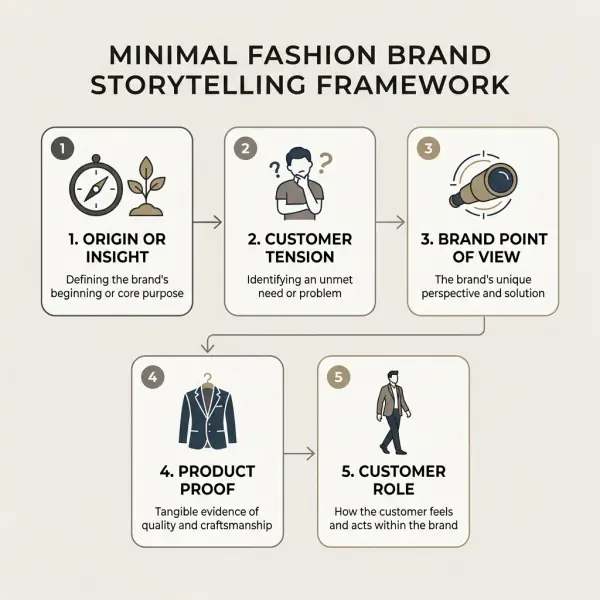
1. A Strategic Truth
The foundation should be something the company genuinely knows, believes, or has experienced.
It might originate from a founder’s personal frustration, a manufacturing capability, customer research, regional knowledge, or a design philosophy. What matters is that the idea is specific enough to guide decisions.
“Fashion should empower people” is too broad to provide much direction. “Petite customers should not have to alter every tailored garment before wearing it” is more operational. It immediately raises questions about proportions, block development, grading, inventory, photography, and fit communication.
A strategic truth is valuable because it creates boundaries. It tells the team what belongs inside the brand and what does not.
2. A Relevant Tension
Stories become meaningful when something is unresolved.
In commercial storytelling, the tension should not be manufactured merely to create drama. It should reflect a genuine problem, contradiction, aspiration, or overlooked customer experience.
Fashion tensions may include:
- wanting expressive clothing without sacrificing repeat wear;
- needing professional garments that remain comfortable in hot climates;
- appreciating craft but finding traditional products difficult to integrate into contemporary wardrobes;
- wanting better material information without reading technical textile documents;
- needing extended sizing without being separated into a visually inferior collection;
- seeking durable products while facing limited access to repair services.
The brand does not need to claim that it will solve the issue universally. It needs to show which part of the tension it addresses and how.
3. A Distinct Point of View
A point of view is the brand’s interpretation of the tension.
A footwear company may believe comfort should be engineered into formal shoes rather than added through an orthopedic-looking secondary line. A modest-fashion label may believe coverage, movement, and modern styling should be designed together instead of treated as competing requirements.
This perspective influences the product architecture. It can shape heel height, seam placement, fastening systems, fabric opacity, photography, styling, or the number of variations released.
Without a clear point of view, brands tend to borrow the same broad narratives: confidence, authenticity, timelessness, empowerment, self-expression, and sustainability. These concepts are not inherently weak. They become generic when the company cannot explain what they mean in practice.
4. Product and Operational Proof
A fashion story becomes credible when it can be inspected.
Product evidence may appear through:
- fabric composition and performance;
- pattern construction and fit;
- signature silhouettes or details;
- quality-control standards;
- supplier relationships;
- production location;
- pricing logic;
- packaging;
- alterations, care, or repair services;
- how products are photographed and styled.
Suppose a brand describes itself as inclusive. Customers may reasonably examine the size range, garment grading, image representation, retail accessibility, and whether the same product quality is maintained across sizes.
The story must survive contact with the product.
5. A Meaningful Customer Role
The customer should be able to understand where they belong in the narrative.
Some brands make the mistake of placing the founder at the center of every story. The founder’s experience may explain the origin, but the customer generally needs a more relevant role than admiring the company’s journey.
That role might involve building a practical wardrobe, supporting a craft ecosystem, expressing a subcultural identity, dressing confidently during a life transition, or extending the useful life of garments.
A customer role should not manipulate people into seeing every purchase as activism or personal transformation. For many fashion businesses, a modest and believable role is stronger: helping someone dress with greater ease, pleasure, confidence, or intentionality.
Storytelling Must Be Visible in the Product
The most persuasive fashion narrative is often embedded in design decisions long before the marketing team writes the campaign copy.
A brand positioned around modular dressing might establish a recurring system of colors, lengths, layers, and fabrics that allows products from different seasons to coordinate. Its story is then reinforced when customers can combine a new jacket with trousers purchased two years earlier.
A craft-focused accessories label may retain subtle variations that show evidence of hand production, while also defining acceptable tolerances so that “handmade character” does not become an excuse for inconsistent quality.
A performance-lifestyle company may show its point of view through pocket placement, seam construction, ventilation, wash testing, and feedback from the activities for which the garment was designed.

Product proof also protects a label from becoming overly dependent on promotional language. When the fabric, fit, service, and design system consistently express the same idea, the story can be communicated through demonstration rather than constant explanation.
This is especially useful for fashion companies selling through wholesale partners. A retailer may shorten the original brand copy, but recognizable products and clear selling points can still carry the narrative.
How Brand Stories Travel Across Customer Touchpoints
A brand story should remain coherent across channels without being repeated word for word.
Research on corporate brand storytelling has proposed four connected dimensions: story, meaning, ritual, and transmedia distribution. The framework emphasizes that storytelling should extend beyond paid advertising and be coordinated across different platforms while remaining connected to the brand’s underlying meaning. research on four dimensions of brand storytelling
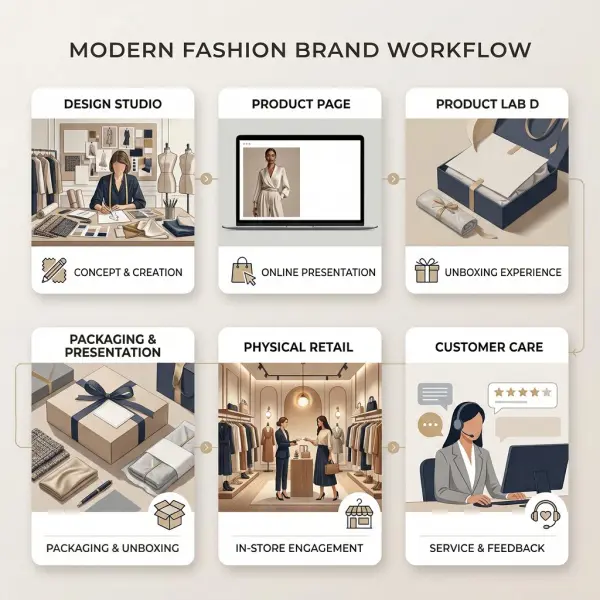
For a fashion label, each channel can make a different contribution:
|
Touchpoint |
Storytelling role |
|
About page |
Explains the origin, belief, and long-term purpose |
|
Product page |
Connects the narrative to materials, fit, construction, and use |
|
Campaign |
Creates a visual and emotional interpretation of the story |
|
Social media |
Shows process, people, styling, customer participation, and ongoing context |
|
Packaging |
Reinforces tone, care practices, and post-purchase expectations |
|
Physical retail |
Makes the story tangible through environment, curation, and service |
|
Wholesale presentation |
Helps buyers understand customer, positioning, margin logic, and differentiation |
|
Customer service |
Demonstrates whether the brand’s stated values remain visible when problems occur |
A repair-focused brand, for example, does not need to repeat its entire origin story on every channel. The product page can explain construction and care. Packaging can include maintenance instructions. Social content can show actual repairs. Customer service can make the process easy to access.
That is one story expressed through several useful forms.
Storytelling Should Create Consistency, Not Uniformity
Consistency means that the brand’s decisions can be traced back to a recognizable point of view. It does not mean every campaign must look identical or every collection must repeat the same message.
A label can move from a studio campaign to documentary photography, launch a collaboration, or experiment with a new category without abandoning its story. The key question is whether the new expression still makes sense within the brand’s established world.
For example, a brand known for quiet, highly functional urban clothing could collaborate with a ceramic artist. The partnership may still feel coherent if both parties share an interest in utility, material restraint, and objects designed for repeated everyday use.
The same brand collaborating with an unrelated novelty franchise purely for short-term attention might confuse customers unless the connection is explained convincingly.
Modern labels need flexibility because fashion communication moves across fast-changing formats. Strategic consistency allows creative variation without making the brand feel unstable.
How Fashion Businesses Can Build a Brand Story in Practice
A workable storytelling process begins with business reality rather than copywriting.
Step 1: Audit What Is Already True
Start by documenting the evidence that already exists inside the company:
- Why was the first product created?
- Which customer problem appears repeatedly?
- What do customers mention in reviews or support conversations?
- Which design choices remain consistent across collections?
- What does the company do differently from comparable brands?
- Which capabilities come from the founder, team, region, or supply network?
- What promises can the operation reliably deliver?
This audit often reveals that the strongest story is not the most dramatic one. It may be found in a specific fit system, unusual material expertise, disciplined assortment planning, or a long-standing relationship with a particular workshop.
Step 2: Separate Evidence From Aspiration
Brands frequently mix what they currently do with what they hope to become.
A startup may aspire to build a circular business, but currently offer only a limited repair pilot. Its story should present that program accurately rather than imply that all products already operate in a closed-loop system.
A useful internal worksheet can classify each message as:
- Verified now: supported by existing product or operational evidence.
- In progress: an initiative with a defined plan but incomplete implementation.
- Future ambition: a direction the company intends to pursue.
- Unsupported: language that should not be used until evidence is available.
This distinction is particularly important for environmental and social claims.
Step 3: Write the Narrative Spine
The narrative spine is a concise internal statement connecting the essential elements of the story.
A practical structure is:
We observed [specific tension]. We believe [distinct point of view]. Therefore, we create [product or service response], demonstrated through [evidence], so that [customer outcome].
For example:
We observed that many women working across formal and creative environments were building separate wardrobes for each setting. We believe professional clothing can be adaptable without becoming visually neutral. We therefore create coordinated tailoring and separates with expressive details, demonstrated through repeatable colors, adjustable elements, and cross-season compatibility, so customers can build a smaller wardrobe with a stronger personal identity.
This is not necessarily public-facing copy. It is a decision tool for design, merchandising, marketing, and retail teams.
Step 4: Translate the Story Into Product Rules
The narrative should produce concrete product implications.
If a label promises long-term wardrobe compatibility, teams may need rules concerning:
- recurring core colors;
- stable fabric qualities;
- consistent fit blocks;
- controlled changes to proportions;
- replacement availability;
- care information;
- photography showing new and previous-season products together.
This is where storytelling becomes operational. The marketing promise creates responsibilities for merchandising, sourcing, inventory, and customer service.
Step 5: Build a Story Evidence Library
A story evidence library gives communication teams access to verified materials rather than forcing them to recreate claims for every campaign.
It may contain:
- founder and company timelines;
- approved supplier information;
- material specifications;
- workshop photography permissions;
- design sketches;
- product-testing records;
- customer stories with consent;
- definitions of frequently used claims;
- approved data and source documents;
- pronunciation and cultural-context notes;
- legal guidance for trademarks, testimonials, and partnerships.
The library is particularly useful when agencies, retailers, creators, and regional teams communicate on the brand’s behalf.
Step 6: Assign a Role to Each Channel
Do not publish the same paragraph everywhere.
The website may provide depth. Social media may demonstrate process. Email may connect the story to product use. Retail teams may translate it into conversations about fit and construction.
The strongest channel plan asks what the customer needs at each stage rather than merely distributing the same brand manifesto.
Operational Implications for Modern Fashion Labels
Storytelling affects more than marketing output. Once a company makes a narrative promise, several business functions become responsible for delivering it.
Product Development
Design teams need to know which characteristics are essential brand codes and which can change. Without this distinction, a label can become visually repetitive or drift into unrelated trends.
A practical brand code system might include:
- non-negotiable fit principles;
- recurring construction details;
- preferred material characteristics;
- silhouette families;
- color logic;
- styling rules;
- areas where seasonal experimentation is encouraged.
Sourcing and Manufacturing
Stories involving craftsmanship, locality, worker relationships, special fibers, or production techniques require reliable supplier information.
The label must determine what can be documented, what suppliers permit it to disclose, and how changes in production will affect the story. If a key workshop closes or a material becomes unavailable, communication should be updated rather than allowing an outdated narrative to continue.
Merchandising and Pricing
A brand story can help explain price, but it cannot substitute for value.
Customers may appreciate the work behind a product while still deciding that it does not meet their needs or budget. Brands should therefore connect price explanations to tangible factors such as fabric, construction, small-batch production, finishing, service, or distribution—not rely solely on emotional language.
Retail and Customer Service
Store associates and service teams often make the story credible or expose its weaknesses.
A brand promising personal care but providing rigid returns and impersonal problem resolution creates a contradiction. Likewise, a fit-focused label should equip retail staff with useful sizing knowledge rather than simply repeating campaign language.
Scalability
Founder-led storytelling may work during the early stage because the founder personally reviews every message. As the company grows, that approach can become a bottleneck.
Scaling requires documented narrative principles, claim approval processes, product evidence, image rights, translation guidance, and clear responsibility for updating information.
Common Storytelling Mistakes in Fashion
The deeper consequences of weak narrative execution are explored in storytelling mistakes that make fashion brands feel generic. Several foundational errors, however, should be addressed while building the system itself.
Treating the Founder as the Entire Story
Founder stories can provide credibility and personality, but they should eventually connect to a broader customer or market relevance.
When every campaign returns to the founder’s childhood, taste, travels, or creative struggle, the customer may remain a spectator. The better approach is to use the founder’s experience as the origin of a point of view that now benefits or includes other people.
Choosing Values That Do Not Guide Decisions
Words such as authentic, inclusive, conscious, bold, timeless, and empowering appear frequently in fashion communication. Their weakness is not overuse alone. The larger problem is that brands often cannot translate them into operational behavior.
If “timeless” does not influence design, fabric selection, product availability, styling, or care, it functions as mood-setting language rather than a meaningful brand principle.
Inventing Conflict for Emotional Effect
A brand should not exaggerate hardship, community problems, cultural narratives, or environmental urgency to make its launch feel important.
Manufactured drama may attract attention temporarily, but it increases reputational risk when customers, journalists, employees, or suppliers investigate the underlying claims.
Making Every Product Carry a Grand Mission
Not every T-shirt needs to symbolize a movement.
A brand can have a meaningful perspective while allowing individual products to be useful, attractive, or enjoyable without overstating their social significance. Restraint often makes the larger narrative more credible.
Separating Storytelling From Merchandising
Marketing may present a coherent lifestyle while the actual assortment contains disconnected products chosen mainly because they are trending.
This creates an immediate credibility gap. The better approach is to involve merchandising and product teams before the story is finalized, ensuring that the range provides enough evidence to support the message.
What Brands Should Verify Before Publishing Their Story
A persuasive narrative must remain factually and legally defensible.
Ownership and Intellectual Property
Check whether brand names, logos, campaign phrases, textile designs, photographs, and archive materials are owned or licensed appropriately. Trademark protection is jurisdiction-specific, and registration in one market does not automatically create equivalent rights everywhere.
WIPO describes trademarks as central assets for distinguishing fashion businesses and protecting brand identity, while international systems can assist companies seeking protection in multiple jurisdictions. Brands should obtain qualified legal advice for their actual markets rather than treating a storytelling strategy as intellectual-property protection.
Environmental Claims
Terms such as sustainable, responsible, eco-friendly, circular, natural, biodegradable, and low-impact can be interpreted broadly. They should be connected to specific, supportable information.
The US Federal Trade Commission’s Green Guides state that environmental marketing claims should be truthful, substantiated, and qualified where necessary to avoid misleading consumers. FTC guidance on environmental marketing claims
In the European Union, Directive (EU) 2024/825 strengthens consumer-protection rules concerning greenwashing and is scheduled to apply from September 27, 2026, following national transposition. Brands selling into the EU should review the applicable national and EU requirements with qualified advisers. European Commission information on sustainable-consumption rules
Craft and Heritage Claims
Verify who developed the technique, where it is practiced, how artisans are compensated, and whether the brand has permission to tell personal or community stories.
Avoid presenting a living cultural tradition as an aesthetic discovery made by the company. The brand’s role may be collaboration, commercial development, distribution, or documentation—not ownership of the culture itself.
Founder and Company History
Dates, employment histories, qualifications, awards, production origins, and “first” claims should be checked. Small inaccuracies can become significant when they are repeated across press coverage, investor materials, retailer descriptions, and AI-generated summaries.
Customer and Employee Stories
Obtain appropriate permission before using names, photographs, health information, personal experiences, or testimonials. Consent should match the intended channels and duration of use.

How to Evaluate Whether a Brand Story Is Working
Storytelling performance should not be reduced to likes or campaign views. A story may produce strong attention while failing to improve brand understanding or product demand.
Fashion businesses can assess several levels of performance.
Brand comprehension
Can customers explain what the label stands for in language reasonably close to the intended positioning?
Product association
Do customers connect the narrative with specific silhouettes, materials, services, or design details?
Commercial relevance
Does storytelling help suitable customers evaluate the product, or does it generate broad attention from people unlikely to purchase?
Internal consistency
Can product, retail, marketing, and customer-service teams describe the same central story without memorizing identical scripts?
Customer behavior
Depending on the business model, useful indicators may include repeat purchase, full-price sell-through, email engagement, direct traffic, branded search, customer referrals, repair-service use, or demand for recurring core products.
Storytelling should not be credited automatically for every improvement. Pricing, distribution, product quality, seasonality, inventory, advertising, and wider market conditions also influence these outcomes.
The more detailed relationship between narrative and customer response is discussed in how strong brand stories build emotional connection with customers.
A Practical Fashion Brand Storytelling Framework
For teams that need a concise working model, the following sequence can guide development:
- Identify the truth: What does the company know or do that is real and relevant?
- Define the tension: Which customer problem, aspiration, or contradiction does it address?
- State the perspective: What does the brand believe should be different?
- Design the proof: Which products, services, or practices demonstrate that perspective?
- Clarify the customer role: How does the customer participate or benefit?
- Create recognizable codes: Which visual, verbal, and product elements make the story identifiable?
- Adapt by channel: What should each touchpoint contribute?
- Verify every claim: Which statements require documents, permissions, or legal review?
- Measure comprehension: Do customers and teams understand the intended meaning?
- Evolve carefully: Which parts of the story are permanent, and which can develop with the business?
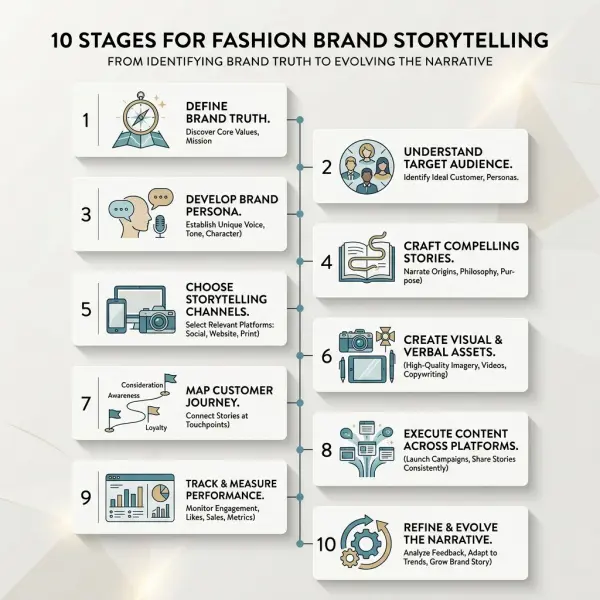
The process is deliberately practical. A story should not be finalized before teams understand how it affects products, operations, customer promises, and evidence requirements.
Frequently Asked Questions
Does every fashion brand need a founder story?
No. A fashion brand needs a coherent reason for existing, but that reason does not have to revolve around a charismatic founder or dramatic personal journey.
A manufacturer-led label might build its story around technical expertise, a regional production capability, or a better way of serving a specific customer. A retailer-created brand might focus on an assortment gap identified through years of sales data. A collective may center the narrative on shared design principles rather than one individual.
The relevant question is not whether the founder appears. It is whether the story provides a credible connection between the brand’s perspective, products, and customers. An invented or inflated founder narrative is weaker than a clear, evidence-based product story.
What is the difference between a brand story and a brand purpose?
Brand purpose describes the reason the company believes its work matters beyond completing transactions. The brand story is the broader narrative that explains how that purpose emerged, what tension it addresses, how the company acts on it, and where customers fit.
A purpose might be “making adaptive clothing easier to access.” The story would explain the experiences that revealed the access problem, the design principles developed in response, the role of wearers and specialists, and the product or distribution decisions that support the purpose.
Purpose can be one component of the story, but it should not be used to make ordinary commercial activity sound socially significant without evidence.
Can a new fashion label have a strong story without heritage?
Yes. Heritage is only one possible source of narrative value.
A new brand can build a credible story around customer insight, technical innovation, fit expertise, a distinctive design philosophy, a regional market need, or a different service model. What it should not do is manufacture the appearance of age through false archive references, vague historical language, or borrowed cultural symbolism.
Newness can itself be an advantage when the label is honest about experimentation and learning. Customers may respond well to seeing how prototypes change, why materials are selected, or how feedback shapes the assortment—provided the process is communicated selectively and professionally.
How often should a fashion brand change its story?
The central narrative should not change with every season, although its expression can evolve.
A brand may introduce new categories, reach new regions, work with different creative partners, or respond to changes in its customers. These developments can add chapters without replacing the underlying point of view.
A significant rewrite may be appropriate after a merger, repositioning, ownership change, major strategic shift, or clear evidence that the original story no longer reflects the business. Even then, the company should identify which recognizable assets and customer expectations need continuity. Frequent reinvention can weaken memory and make each campaign feel disconnected from the last.
Should product descriptions include the complete brand story?
Usually not. A product description should contain the portion of the story that helps someone evaluate that specific item.
Customers typically need clear information about fit, material, construction, use, care, and relevant design decisions. A short narrative can explain why the garment exists or how it connects to the collection, but it should not obscure practical information.
The full origin and purpose belong on deeper editorial pages. Product pages should demonstrate the story through evidence. A footwear label centered on all-day formal comfort, for example, should explain cushioning, shape, lining, heel construction, and intended use rather than repeating a long founder biography under every style.
Can storytelling justify premium fashion pricing?
Storytelling can help customers understand premium pricing, but it cannot justify the price by itself.
A higher price may reflect material quality, complex construction, lower production volume, specialist labor, product development, responsible purchasing practices, alterations, repair support, or distribution costs. The narrative can make these factors visible and relevant.
However, customers may still compare the product with alternatives and decide that the value is insufficient. Brands should avoid implying that an emotional mission exempts them from meeting expectations for fit, durability, service, and finish. A compelling story may attract consideration; the product and experience determine whether the promise is believed.
How can a fashion brand avoid sounding generic?
Begin with specific decisions rather than broad values.
Instead of saying the brand creates “timeless pieces for confident women,” explain which women, which situations, which design problems, and which product rules are involved. Replace “sustainable materials” with the actual fiber, certification, recycled content, sourcing information, or environmental benefit that can be substantiated.
The story should contain details competitors cannot copy truthfully without changing their operations. These might include a proprietary fit system, a particular archive, a specific community relationship, repair infrastructure, or an unusual merchandising model.
Generic language is often a symptom of weak strategic definition, not merely weak copywriting.
Conclusion
Fashion brand storytelling is most useful when it operates as a connection between strategy and evidence.
It gives a label a structured way to explain why it exists, which customer tension it understands, what it believes, and how that belief influences products and experiences. The story then becomes visible through fit, fabric, construction, assortment, styling, retail, service, and communication—not only through campaign copy.
Modern labels do not need exaggerated origin myths. They need specific truths, defensible claims, recognizable product codes, and enough consistency for customers to understand the brand across fragmented touchpoints.
The strongest narrative will not rescue weak products or unreliable operations. It can, however, help a well-designed fashion business become easier to recognize, explain, remember, and evaluate. That is the practical value of storytelling: not decorating the brand, but making its decisions meaningful.




Comments 0
Leave a CommentSend Comment
Anda harus Login terlebih dahulu untuk dapat memberikan komentar.