
Garment Fit Explained: Why Good Fit Matters in Fashion
Quick Answer
Garment fit describes how a finished item of clothing relates to the wearer’s body in appearance, comfort, balance, and movement. Good fit does not simply mean that a garment feels tight or follows exact body measurements. It means the pattern, fabric, construction, and intended silhouette work together so the garment sits correctly, allows appropriate movement, and creates the visual result the designer intended.
A fitted blazer, an oversized shirt, and a performance jacket can all fit well, even though they use very different amounts of ease. The correct fit therefore depends on garment category, target customer, material behavior, styling intention, and conditions of use.
For fashion businesses, fit affects far more than the fitting room. It influences pattern approval, size grading, production consistency, product photography, size communication, returns, reviews, and confidence in the brand. A technically sound fit system begins with reliable body data, but it must also account for garment measurements, posture, body shape, fabric stretch, shrinkage, layering, and customer fit preferences.
Good fit is not a single measurement. It is a coordinated product-development outcome.

What Is Garment Fit?
Garment fit is the relationship between a garment’s dimensions, shape, construction, and material behavior and the body of the person wearing it, evaluated against the garment’s intended appearance and function.
This definition contains an important qualification: fit must be judged against design intention. A coat designed to accommodate winter layers should not be evaluated using the same ease expectations as a close-fitting evening dress. Similarly, dropped shoulders on an oversized shirt may be intentional, while the same shoulder position on a classic tailored jacket could indicate a pattern or sizing problem.
Fit is therefore both technical and perceptual. The technical side involves measurements, pattern geometry, fabric performance, seam position, balance, and movement. The perceptual side involves how the wearer expects the garment to look and feel.
Two garments with identical chest measurements may not fit in the same way. Their fit may differ because of:
- shoulder width and slope;
- armhole depth and sleeve construction;
- front-to-back body distribution;
- fabric stretch and recovery;
- garment length and proportion;
- posture assumptions built into the pattern;
- the location and distribution of ease;
- intended layering; and
- silhouette preferences.
A meaningful fit assessment must look beyond circumference measurements. It must consider how the garment sits across multiple body regions and how those regions interact.
Garment Fit Is Not the Same as Garment Size
Size is a classification. Fit is the result experienced by the wearer.
A size label such as XS, M, 12, 42, or 34 does not describe every dimension of either the body or the garment. It identifies a position within a brand’s sizing system. That system may be based on selected body measurements, a proprietary fit model, historical sales data, regional conventions, or a combination of these inputs.
The distinction becomes clearer when three separate concepts are considered:
|
Concept |
What it describes |
Practical significance |
|
Body measurement |
A dimension taken from the human body, such as chest girth, waist girth, hip girth, body height, or arm length |
Used to define target customers and develop sizing systems |
|
Garment measurement |
A dimension taken from the finished garment or pattern, such as half-chest width, inseam, sleeve length, or back length |
Used in specifications, production control, and product comparison |
|
Size designation |
A code or label intended to indicate which body dimensions a garment is designed to accommodate |
Helps customers navigate the brand’s size range |
|
Garment fit |
The way the garment sits, moves, looks, and feels on a particular wearer |
Determines whether the product performs as intended |
The ISO 8559-1 anthropometric measurement standard defines body measurements used as a basis for physical and digital anthropometric databases. ISO 8559-2:2025 separately addresses primary and secondary body-dimension indicators for clothing size designation. The standard’s body-based approach does not prescribe the final garment dimensions, which remain dependent on cut, style, ease, and intended use.
This distinction matters operationally. A customer may have body measurements that correspond to a brand’s medium size but still find the garment unsuitable because the shoulder is too narrow, the rise is too short, or the garment does not provide enough room where that customer carries body volume.
The label may be correct within the size chart. The fit can still be wrong for the individual.
What Makes a Garment Fit Well?
A well-fitting garment generally achieves an appropriate relationship between ease, line, grain, balance, proportion, and movement. These are not rigid visual rules for every fashion style. They are diagnostic principles that help product teams distinguish an intentional silhouette from an unintended fit defect.
Appropriate Ease
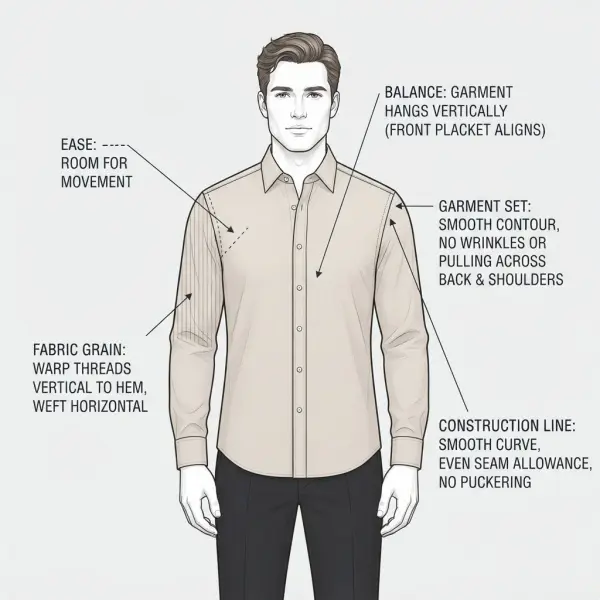
Ease is the difference between relevant body dimensions and garment dimensions. It gives the body room to breathe, move, sit, bend, or accommodate underlayers. Ease can also be used deliberately to create a silhouette.
Two forms of ease are particularly useful in product development:
- Wearing or functional ease provides room for movement, breathing, sitting, and normal activity.
- Design ease creates the intended silhouette beyond the minimum functional requirement.
A close-fitting woven blouse may need positive ease around the bust and upper arm even when the design looks relatively fitted. A stretch knit may use less positive ease or, in some cases, negative ease because the material is expected to extend when worn. Negative ease is not automatically uncomfortable, but it must be supported by suitable stretch, recovery, seam construction, and pressure distribution.
Ease should also be distributed, not merely added to a total circumference. Extra room placed only at the back of a shirt will behave differently from room divided between the front, back, armhole, and sleeve. This is why a garment can match its measurement specification and still pull, twist, or feel restrictive.
Correct Balance
Balance describes how the garment hangs around the body. In a conventionally balanced garment, the hem and key horizontal lines sit as intended while the garment does not pitch strongly toward the front or back.
Common balance problems include:
- a front hem that rises because insufficient length or volume has been allowed over the bust or abdomen;
- a back hem that drops because the pattern includes excess back length;
- side seams that swing forward or backward;
- a jacket that pulls away from the neck;
- trousers that tilt because the front and back rise are not suited to the wearer’s posture or shape.
Not every asymmetric line indicates bad fit. A deliberately uneven hem or asymmetric drape should be evaluated according to the design. The key question is whether the garment assumes the intended position rather than being displaced by strain, excess, or incorrect shaping.
Stable Grain and Garment Hang
In woven fabrics, grain direction influences how pieces hang, stretch, and interact. Lengthwise grain, crosswise grain, and bias each behave differently. When pattern pieces are cut off-grain unintentionally, a garment may twist, torque, or hang unevenly even when the pattern measurements are correct.
Grain problems can also originate outside pattern making. Fabric relaxation, spreading tension, inaccurate cutting, shrinkage, and sewing distortion may all affect the final result.
Knitted fabrics require a related but different assessment. Courses and wales, spirality, stretch direction, and recovery become particularly important. A T-shirt side seam that rotates after laundering may involve fabric spirality or processing behavior rather than a simple pattern-width error.
Fit diagnosis must therefore separate pattern problems from material and manufacturing problems.
Appropriate Line and Proportion
Seams and design lines should occupy the positions intended by the design. In a conventional set-in sleeve, for example, the shoulder seam and sleeve head normally relate closely to the anatomical shoulder. In a dropped-shoulder silhouette, that seam is intentionally displaced.
Other lines also influence perceived fit:
- waist seams;
- princess seams;
- darts;
- trouser crease lines;
- pocket placement;
- collar and neckline edges;
- armhole shape;
- yoke position;
- hem level.
Incorrect placement can change the garment’s appearance even when comfort remains acceptable. Bust darts that finish too high, pockets that sit too low, or a waist seam that falls above the intended level can make the entire garment look incorrectly proportioned.
A Clean Set Without Unintended Strain
A garment’s “set” refers to how smoothly and naturally it settles on the body. Unintended drag lines, collapsing areas, gaping, twisting, and bubbling often indicate tension or excess elsewhere.
Wrinkles are diagnostic, but they should not be interpreted mechanically. A diagonal line may point toward the area experiencing strain, yet its cause could be inadequate width, insufficient length, posture mismatch, incorrect seam shaping, fabric instability, or construction distortion.
Some wrinkles are also desirable. Linen trousers, softly tailored jackets, draped dresses, and casual washed garments are not expected to remain visually flat. Fit evaluation should distinguish natural material behavior from concentrated stress lines that interfere with appearance or movement.
Why Good Fit Matters in Fashion
Good fit matters because it connects the designer’s idea with the wearer’s actual experience. It determines whether the intended silhouette survives the transition from sketch to pattern, material, sample, production, and use.
A strong concept can be weakened by a poor armhole. Premium fabric cannot compensate for trousers that twist. Attractive product photography may generate an order, but it cannot make an unsuitable proportion feel right once the garment is worn.
Fit Determines Whether the Design Is Read Correctly
Fashion silhouettes communicate through proportion. Shoulder width, body volume, waist position, sleeve length, trouser break, and hem placement all shape how a design is perceived.
When these relationships are wrong, the customer may interpret a fit failure as a design failure. A cropped jacket may look accidentally short. A wide-leg trouser may appear simply oversized. A relaxed shirt may seem untidy rather than intentionally loose.
This distinction is commercially important. Customers rarely diagnose pattern balance or armhole geometry. They see a garment that does or does not look right.
Fit Influences Physical Comfort
Comfort is not created by looseness alone. A very loose garment can still restrict movement if the armhole is too low, the sleeve is poorly shaped, or the fabric binds during movement. Conversely, a close-fitting stretch garment can feel comfortable when pressure is controlled and extension is available in the required directions.
Fit-related comfort depends on several interacting factors:
- local garment dimensions;
- fabric stiffness, thickness, stretch, and recovery;
- seam bulk and placement;
- range of motion;
- pressure on sensitive areas;
- climate and moisture conditions;
- undergarments or base layers;
- duration of wear.
These factors become especially important in uniforms, workwear, activewear, maternity clothing, adaptive apparel, protective garments, and children’s products. For functional products, fit must support the task as well as the appearance.
Fit Shapes Perceived Product Quality
Customers often use fit as a practical signal of quality. When a collar stands correctly, sleeves fall cleanly, seams remain in position, and trousers move comfortably, the garment feels considered. When the product twists, gaps, binds, or rides up, the customer may question the pattern, workmanship, or brand.
Fit is only one dimension of garment quality. Material durability, colorfastness, stitching, finishing, and component performance also matter. Still, fit is unusually visible and personal. A customer can tolerate minor internal finishing differences more easily than a waistband that becomes uncomfortable after sitting.
Fit Creates Consistency Across Collections
For a fashion brand, a recognizable fit can become part of the product identity. Customers may return because they know how the brand’s shirts fit through the shoulder, how its trousers sit at the waist, or how much room its dresses provide through the hip.
Consistency does not require every category to use the same measurements. It requires a coherent fit logic. A relaxed knitwear collection and a tailored workwear collection can have different silhouettes while still serving the same target body profile and brand perspective.
Without this logic, customers may wear a small in one product, a medium in another, and a large in a third without a clear reason related to styling. Some variation between categories is technically reasonable. Unexplained inconsistency creates uncertainty.
Fit Affects Product Development Efficiency
Fit problems discovered late are expensive because they rarely remain isolated. Changing the shoulder width may require corresponding changes to the sleeve cap and armhole. Adjusting trouser rise can affect the waistline, inseam, outseam, and pocket position. Correcting length after grading may require updates across every size.
A disciplined fitting process reduces repeated sampling by identifying the root cause rather than repeatedly adjusting visible symptoms. This is closely connected to digital pattern development, specification control, and clear sample-comment procedures.
Poor fitting discipline creates a familiar development cycle: one issue is corrected, another appears, and the team cannot determine which pattern version reflects the approved fit.
Static Fit and Dynamic Fit Are Different
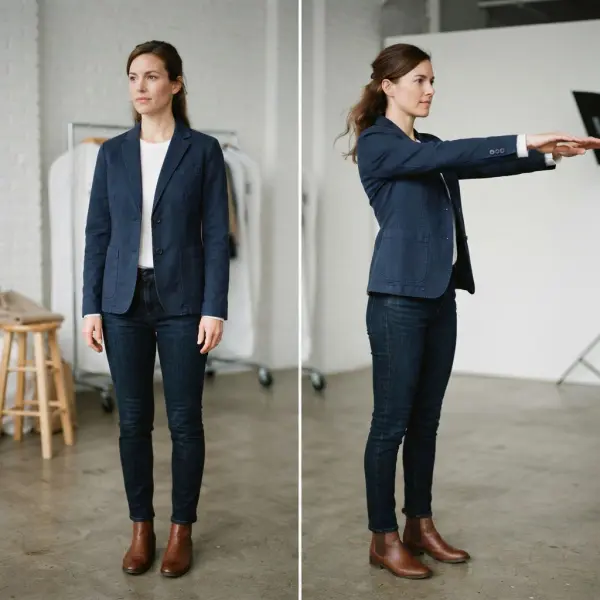
Static fit describes how a garment sits when the wearer is standing in a controlled position. Dynamic fit evaluates what happens when the wearer moves.
Both matter.
A jacket may look balanced during a front-view fitting but restrict driving or reaching. Trousers may appear smooth while standing yet pull sharply across the thigh when sitting. A uniform may meet its dimensional specification but expose the lower back during bending.
Dynamic assessment should reflect realistic use rather than generic movement alone. Useful test movements may include:
- sitting and standing;
- walking and climbing stairs;
- reaching forward and overhead;
- bending, squatting, or kneeling;
- crossing the arms;
- fastening and unfastening closures;
- accessing pockets;
- wearing required underlayers or equipment.
The movements selected for a cocktail dress should differ from those used for a warehouse uniform or cycling garment. A product does not need unrestricted movement in every direction. It needs an appropriate range for its intended purpose.
Recent fit-recommendation research also treats fit as a multidimensional problem rather than a single body-to-size match. A 2026 study on jacket recommendation assessed several garment regions separately and modelled deviations from an ideal-ease condition, illustrating why section-level fit feedback can be more informative than one overall size prediction.
Fit, Ease, and Silhouette Must Be Evaluated Together
A common mistake is to treat a measurement difference as proof of correct or incorrect fit. Measurements are essential, but their meaning changes with material and silhouette.
Consider three garments with similar chest dimensions:
- A rigid woven shirt may need enough positive ease for breathing and arm movement.
- A stretch jersey top may fit closer because the fabric extends across the body.
- A structured corset-inspired garment may use controlled shaping, internal support, and localized pressure rather than conventional wearing ease.
The same numerical allowance cannot be applied safely to all three.
Fabric Changes the Fit Outcome
Fabric properties influence how pattern dimensions become a three-dimensional garment. Important properties include:
- stretch percentage and direction;
- elastic recovery;
- drape;
- stiffness;
- thickness;
- compression;
- surface friction;
- dimensional stability;
- shrinkage;
- weight;
- bias behavior.
A soft fabric may collapse into excess ease, while a crisp fabric holds that same volume away from the body. A thick fabric can reduce internal space even when the external measurements remain unchanged. A fabric with high stretch but poor recovery may feel comfortable initially and become baggy during wear.
Fit approval should therefore use production-representative material. Evaluating a pattern in substitute fabric can be useful during early development, but it cannot fully validate the final fit.
Construction Changes Available Space
Seam allowances, interlining, lining, padding, elastic, rib, quilting, and internal support can alter the usable dimensions of a garment. A lined waistband may feel smaller than an unlined waistband with the same external circumference. A padded coat requires internal allowance for both insulation and underlayers.
Production methods also matter. Excessive seam tension can shorten or pucker an edge. Fusing can change stiffness or shrink a panel. Binding can reduce neckline stretch. Wash treatments can change dimensions and handfeel.
The approved pattern is only one contributor to final fit. Manufacturing must preserve the dimensions and behavior that the pattern was designed to create.
How Body Shape and Posture Affect Fit
Traditional size systems group people using selected measurements, but people with similar girths can have different shapes, proportions, and posture.
Two customers with the same bust or chest measurement may differ in:
- shoulder breadth;
- shoulder slope;
- back width;
- torso length;
- bust projection;
- abdomen projection;
- hip shape;
- seat prominence;
- arm length;
- thigh distribution;
- posture.
These differences explain why increasing or decreasing the overall size does not solve every fit problem. A customer may need more front length without additional back width. Another may need more thigh room while keeping the same waist size.
International and national measurement standards can provide useful terminology and baseline tables. ASTM, for example, maintains separate body-measurement standards for several population and figure categories rather than treating one chart as universally representative. Its current terminology standard compiles body-dimension terms for apparel sizing, while category-specific tables cover groups such as adult female misses, petite figures, plus figures, and adult male short, regular, and tall ranges.
Standards are a starting point, not a substitute for brand-specific customer data. A company selling primarily to Southeast Asian consumers, tall European customers, petite professionals, or athletic men may need a base block and grading logic that reflect its actual market.
Fit Model, Dress Form, and Customer Are Not Interchangeable
A fit model is a person selected to represent the brand’s intended base size and body proportions. A dress form is a physical tool that provides stable dimensions for draping and preliminary evaluation. A customer population is a diverse group of people who will not all match either one perfectly.
Each serves a different purpose.
A dress form is valuable for checking balance, line, and volume, but it cannot report pressure or perform realistic movement. A fit model can describe comfort and mobility, but one person cannot represent every body variation within a size. Customer data reveals broader patterns, but it may contain inconsistent self-measurements or subjective language.
Reliable fit development uses several evidence sources:
- approved body and garment measurement charts;
- a controlled fit model or model group;
- calibrated dress forms;
- physical or digital samples;
- wear and movement testing;
- production measurement reports;
- customer reviews and return reasons;
- category-level sales data.
The fit model should remain sufficiently consistent throughout development. Frequently changing fit models without documenting body differences makes it difficult to determine whether comments reflect pattern improvement or simply a different body.
How Fashion Businesses Can Build a Better Fit Process
Good fit is rarely created by one talented pattern maker working in isolation. It comes from a repeatable process connecting design, technical development, sourcing, production, merchandising, and customer feedback.
1. Define the Target Wearer Before Building the Pattern
The first question is not “What size range should we sell?” It is “Whose body and fit expectations are we designing for?”
The answer should include:
- market and region;
- age or life-stage considerations where relevant;
- body proportions;
- garment category;
- intended styling;
- underlayers;
- activity level;
- preferred degree of ease;
- price and quality positioning.
A broad target such as “women aged 18–45” is not detailed enough to guide pattern development. Product teams need a clearer fit profile, even when the eventual size range serves substantial body diversity.
2. Establish a Controlled Base Size and Block
The base block translates target body dimensions and fit intention into pattern geometry. It should define the brand’s assumptions about posture, shoulder position, torso length, balance, ease, and proportion.
The block should not be treated as permanent merely because it has been used before. It should be reviewed when the brand enters a new region, changes its core customer, adopts different material categories, or repeatedly receives the same fit feedback.
A brand may require different blocks for:
- woven tops;
- knit tops;
- tailored jackets;
- dresses;
- trousers;
- denim;
- outerwear;
- performance products.
Trying to force every category from one generalized block often creates unnecessary corrections.
3. Separate Body Charts From Garment Specifications
The body chart defines the intended wearer. The garment specification defines the product.
Keeping these separate makes ease and design decisions visible. It also prevents teams from treating a finished-garment chest measurement as though it were a body measurement.
Specification sheets should clearly state:
- points of measurement;
- measurement method;
- sample size;
- tolerances;
- construction state;
- wash or finishing state;
- whether measurements are relaxed or extended;
- any category-specific instructions.
The ASTM terminology for body dimensions used in apparel sizing and the ISO clothing measurement framework can help teams use consistent terminology, although individual companies still need clear internal measurement diagrams and procedures.
4. Develop in Representative Materials
Fit samples should use materials with comparable stretch, recovery, weight, drape, and shrinkage to the intended production fabric.
Where exact material is not yet available, teams should record the limitations of the substitute. Comments such as “waist too loose” may be misleading when the development fabric is softer or more extensible than the approved fabric.
Material testing should inform fit decisions before final pattern approval, particularly for washed products, stretch denim, rib knit, compression apparel, fused tailoring, and padded outerwear.
5. Assess Both Measurement and Wear
A fitting should not become an unstructured discussion about whether the garment “looks good.” It needs a consistent review sequence.
A practical sequence is:
- Confirm the sample measurements and construction against specification.
- Place the garment on the intended model with the correct undergarments or layers.
- Review balance and key lines from front, side, and back.
- Check localized ease and strain.
- Perform category-relevant movement tests.
- Record the root issue, not only the visible symptom.
- Specify whether the correction belongs to pattern, construction, material, or specification.
- Photograph the issue consistently where useful.
- issue one controlled revision list.
This approach reduces contradictory comments such as increasing width in one section while requesting a closer silhouette elsewhere.
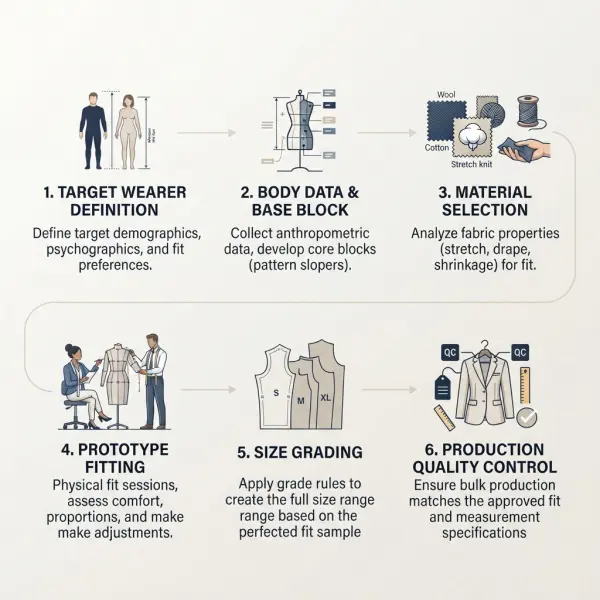
6. Validate Grading, Not Only the Base Size
An approved medium sample does not prove that extra-small or extra-large sizes will fit correctly. Grading changes the pattern between sizes, but body dimensions do not increase uniformly in every direction.
Critical sizes should be sampled or digitally reviewed, particularly when:
- the size range is wide;
- the garment is highly fitted;
- the category has complex shaping;
- stretch is limited;
- the pattern includes cups or structured support;
- the target population includes distinct stature groups;
- design details move visibly during grading.
Extending a size range by applying the same grade indefinitely can distort shoulder width, neckline shape, pocket position, rise, armhole depth, or overall proportion.
7. Protect Fit During Production
Fit approval has limited value if bulk production does not reproduce the approved dimensions and material behavior.
Production controls should cover:
- fabric relaxation;
- shrinkage allowances;
- marker and cutting accuracy;
- panel pairing;
- sewing tension;
- seam handling;
- pressing;
- washing or garment finishing;
- measurement tolerances;
- final garment inspection.
Measurements should be reviewed as a pattern of results, not only as isolated pass-or-fail points. Several dimensions near the same tolerance limit may collectively alter the garment even when each point technically passes.
8. Communicate Fit Clearly at Retail
Customers cannot interpret a size chart without context. Product pages should explain whether the garment is close, regular, relaxed, oversized, cropped, longline, high-rise, or low-rise.
Useful fit communication may include:
- model measurements and worn size;
- garment measurements for critical points;
- fabric stretch information;
- silhouette description;
- intended layering;
- category-specific fit notes;
- clear measurement instructions;
- guidance based on fit preference.
Retail communication cannot correct an unsuitable pattern. It can, however, help the right customer choose the right product and reduce confusion between intentional styling and unintended sizing inconsistency.
A deeper examination of the commercial consequences belongs in how fit problems affect customer satisfaction.
Common Garment Fit Mistakes
Treating “True to Size” as a Technical Standard
“True to size” is not a universal measurement system. It normally means that a product aligns with a customer’s expectation of the brand or market category.
The phrase becomes unreliable when the reference point is unclear. A customer comparing a fitted fashion blazer with a relaxed unisex jacket may consider one “small” and the other “large” even when both follow their intended specifications.
A better approach is to communicate body and garment dimensions, silhouette, stretch, and fit preference instead of relying on the phrase alone.
Correcting Every Problem by Changing Circumference
Adding width is one of the fastest pattern corrections, but many fit problems involve length, angle, shaping, balance, or distribution.
A blouse pulling toward the bust may require more front length or different dart shaping rather than a larger overall chest. Trousers pulling under the seat may involve back-rise shape, crotch extension, or thigh distribution rather than total hip circumference.
Increasing the whole garment can remove one strain line while making the shoulder, neckline, waist, or back too large.
Using Stretch to Conceal Weak Pattern Engineering
Stretch can accommodate variation, but it does not automatically create good fit. Excessive reliance on stretch may produce high pressure, transparency, seam strain, poor recovery, or distortion.
Stretch percentage alone is insufficient. The team should also evaluate recovery, growth during wear, fabric direction, garment dimensions, seam extensibility, and the body regions carrying the load.
A product that fits only because the fabric is stretched near its limit has little tolerance for body variation or production inconsistency.
Approving Fit Only on a Dress Form
Dress forms are useful development tools, but they remain static and standardized. They cannot reveal whether an armhole cuts into the wearer, a waistband becomes uncomfortable after sitting, or a sleeve limits reach.
Fit should be confirmed on an appropriate person or validated through other dynamic methods before production.
Changing the Sample Without Updating the Specification
Sometimes a sample room improves the fit directly during fitting, but the technical file is not updated. The approved physical sample and the production documents then contain different instructions.
This creates risk when the order moves to another factory, when a repeat order is placed, or when the pattern is graded. Every approved correction should be reflected in the controlled pattern, measurement specification, and construction documentation.
Assuming Alteration Can Fix Any Fit Problem
Alterations can improve many garments, but not every issue can be corrected economically or invisibly. Letting out a seam requires sufficient allowance. Changing a shoulder or armhole may affect the sleeve. Correcting trouser rise can require substantial reconstruction.
The feasibility and value of these adjustments are explored further in common clothing alterations that improve comfort and appearance.
What Brands Should Verify Before Acting
Fit decisions should not be based on one standard chart, one model, one customer complaint, or one software simulation.
Before revising a sizing system or base pattern, brands should verify:
- whether the issue appears repeatedly in the same garment region;
- whether affected products share the same block, supplier, material, or grade rule;
- whether the garment matches its approved measurements;
- whether shrinkage or fabric behavior changed;
- whether feedback relates to body compatibility or styling preference;
- whether the problem is concentrated in one size;
- whether product-page communication influenced expectations;
- whether the proposed correction creates new problems elsewhere.
Customer language must also be interpreted carefully. “Too small” may describe limited stretch, a short rise, a narrow shoulder, a tight upper arm, or simply a closer silhouette than expected.
The best correction follows diagnosis, not frequency counting alone.

Important Technical Caveats
Garment fit is partly objective and partly subjective. Measurements, strain, seam position, and movement can be observed, but wearers may prefer different silhouettes and pressure levels.
A technically balanced regular-fit shirt may still feel too loose to someone who prefers a slim silhouette. An intentionally oversized jacket may be judged too large by a customer expecting conventional tailoring. Neither reaction automatically proves that the pattern is defective.
Several limitations should remain visible:
- A sizing system cannot represent every human body shape.
- One fit model cannot represent an entire market.
- Anthropometric data may become less relevant when the target population differs from the surveyed group.
- Digital simulation depends on accurate body, pattern, material, and construction inputs.
- Size recommendation tools estimate compatibility; they do not guarantee personal satisfaction.
- Stretch allows accommodation but does not eliminate the need for pattern engineering.
- Broader size ranges often require additional blocks, grade strategies, or proportion groups rather than simple extension.
Good fit systems reduce avoidable mismatch. They do not remove human diversity.
Frequently Asked Questions
What is the simplest definition of garment fit?
Garment fit is how a garment sits, feels, and moves on the wearer relative to its intended design and function. It depends on the relationship between body dimensions, garment measurements, pattern shape, ease, fabric properties, construction, and posture.
A garment does not need to follow the body closely to fit well. An oversized shirt can have good fit when its volume, shoulder position, sleeve length, and balance match the designer’s intention. Fit should therefore be assessed against the product concept, not against tightness alone.
How is fit different from sizing?
Sizing organizes garments into categories, while fit describes the result on an individual wearer. A brand may use sizes XS–XL, numerical sizes, or body-dimension labels, but each size still represents a range of bodies.
Two customers can select the same size and experience different fit because their proportions, posture, and preferences differ. Similarly, two garments carrying the same size label may fit differently when they use different blocks, materials, silhouettes, or grade rules. Size helps the customer begin the selection process; fit determines whether the garment is actually suitable.
Does a larger garment always provide more comfort?
No. Additional circumference does not guarantee comfort. A larger garment may still restrict movement if the armhole, sleeve, rise, crotch shape, neckline, or shoulder geometry is unsuitable.
Excess size can also create new problems, such as slipping shoulders, unstable waistbands, low armholes, fabric bunching, or misplaced shaping. Comfort depends on where room is provided, how the fabric behaves, and which movements the garment must accommodate. The goal is appropriate ease and geometry rather than maximum looseness.
Can one size chart work for every country?
A single chart may support international sales, but it will not represent every population equally well. Body height, proportions, shape distribution, and customer fit expectations vary within and between markets.
Global brands often need to compare their base block and grade rules with actual customer and sales data from the regions they serve. The solution is not necessarily a completely different chart for each country. It may involve regional length options, petite or tall ranges, alternative blocks, localized guidance, or category-specific fit adjustments. Any change should be supported by reliable data rather than broad assumptions about nationality or ethnicity.
How much ease should a garment have?
There is no universal ease value because the appropriate amount depends on garment type, fabric, body region, intended silhouette, layering, and movement.
A rigid woven jacket generally requires different ease from a stretch knit top. Outerwear must account for underlayers, while compression products may use controlled negative ease. Ease should also be distributed across the pattern rather than treated as one total circumference.
Brands





Comments 0
Leave a CommentSend Comment
Anda harus Login terlebih dahulu untuk dapat memberikan komentar.