

Common Costing Errors That Reduce Fashion Profitability
Quick Answer
Common garment costing errors reduce fashion profitability by making products look more profitable than they really are. The most frequent mistakes include costing from incomplete product details, treating fabric price as total fabric cost, ignoring labor complexity, excluding overhead, comparing supplier quotes unfairly, forgetting freight and duties, using the same markup across different sales channels, and failing to update costs after sampling or production changes.
For fashion brands, these errors often appear small at first. A few cents missing from trims, a little extra fabric waste, a late packaging change, or an uncounted platform fee may not seem serious on one unit. Across hundreds or thousands of garments, those small gaps can reduce margin quickly.
The solution is not only a better spreadsheet. Brands need a costing discipline that connects design, sourcing, production, logistics, pricing, and post-season review. A cost sheet should be updated whenever product details, order quantities, delivery terms, or sales channels change. Profitability improves when the brand understands the real cost of making, delivering, and selling each garment.

Why Costing Errors Are So Damaging in Fashion
Costing errors are damaging because fashion products carry many small cost layers. Fabric, trims, sewing, finishing, packaging, freight, duties, warehousing, marketing, returns, markdowns, and overhead all affect profitability. When one layer is missing or underestimated, the product may still appear healthy in the first cost sheet but perform poorly once it reaches the market.
This is especially risky in apparel because many decisions are made before revenue is guaranteed. A brand may buy fabric, approve samples, place production orders, pay deposits, book campaigns, and set retail prices before knowing the final sell-through rate. If the initial costing is weak, the brand has less room to absorb production delays, quality issues, promotional discounts, or unsold inventory.
The first article in this cluster, garment costing explained for fashion brands, covered the basic costing structure. The second article, how fabric, labor, and overhead affect apparel costs, explained the major cost drivers. This article focuses on what goes wrong when costing discipline breaks down.
The central issue is not that fashion teams cannot calculate numbers. More often, the problem is that the numbers are based on incomplete assumptions.
Error 1: Costing From an Incomplete Product Specification
The first major costing error is calculating cost before the product specification is clear enough. A garment cannot be costed accurately if the fabric, trims, construction, size range, colorways, packaging, finishing, and order quantity are still vague.
This happens frequently in early product development. A designer may have a strong concept, a buyer may request a quick quote, or a founder may want to check whether a product idea is commercially possible. Early estimates are useful, but they should never be treated as final costs.
A vague specification usually creates vague costing. The supplier may assume a standard fabric when the final product requires a heavier material. The brand may forget lining, fusing, embroidery, care labels, spare buttons, hangtags, or retail packaging. The sewing cost may be based on a simpler construction than the approved sample. Once these details are added, the original cost is no longer reliable.
A basic specification should clarify:
- Garment category, style code, and season
- Fabric composition, weight, width, and finishing
- Size range and expected size ratio
- Construction details and seam finishes
- Trims, labels, interlining, and closures
- Printing, embroidery, washing, or special finishing
- Packaging and carton requirements
- Order quantity by color and size
- Delivery term, destination, and shipping expectation
The better approach is to label early numbers as estimates and update them as product details mature. Treating an estimate as a confirmed cost is one of the fastest ways to damage margin before production even begins.

Error 2: Treating Fabric Price as Total Fabric Cost
A common mistake is looking only at the fabric price per meter or yard. Fabric cost is not just the supplier’s quoted price. It also includes consumption, usable width, shrinkage, cutting waste, defect allowance, print direction, pattern matching, minimum order quantity, and leftover fabric risk.
This mistake often appears when brands compare two fabrics too quickly. Fabric A may cost less per meter than Fabric B, but if Fabric A is narrower, shrinks more, creates higher cutting waste, or has more defects, the final garment cost may be higher. The cheaper fabric may also increase return risk if it performs poorly after washing or wearing.
Fabric consumption should ideally be based on pattern and marker calculation, not only a rough visual estimate. This becomes especially important for garments with large panels, directional prints, checks, stripes, pile fabrics, bias cutting, oversized silhouettes, or long lengths.
A realistic fabric cost review should ask:
- How much fabric does the garment consume per size?
- What is the usable fabric width?
- Has shrinkage been tested or allowed for?
- Does the fabric require directional cutting?
- Are print, stripe, or check matching required?
- What cutting waste is realistic?
- Are defects or shade variation likely?
- Will the minimum order quantity create leftover stock?
Fabric can make or break the economics of a product. A fabric decision that looks small during sampling can become expensive once multiplied across the full production order.
Error 3: Ignoring Labor Complexity and Rework
Another costly mistake is assuming that similar-looking garments require similar labor. In reality, labor cost depends on construction complexity, sewing operations, operator skill, machine type, handling difficulty, finishing standards, inspection requirements, and factory efficiency.
A simple dress and a structured dress may look close in a product photo, but the second may require lining, fusing, careful pressing, invisible zipper insertion, more fit control, and more quality checking. A blouse with delicate fabric may require slower handling than a basic cotton blouse. A jacket with welt pockets and internal structure requires a different level of sewing skill from a simple unlined overshirt.
Labor cost also rises when rework appears. Rework happens when garments need correction because of stitching defects, wrong measurements, trim mistakes, fabric damage, poor pressing, shade problems, or late specification changes. Rework is expensive because it consumes time twice: once for the incorrect work and again for the correction.
Brands often create labor cost problems unintentionally. Late design changes, incomplete tech packs, unclear fit comments, rushed approvals, and inconsistent sample feedback all increase the chance of rework. A low cut-make-trim quote is not really low if it leads to defects, delays, or rejected garments.
Labor should also be treated responsibly. The International Labour Organization has reported on employment, wages, and productivity in the Asian garment sector, including ongoing decent work challenges. Cost control should therefore focus on better planning, efficiency, and supplier capability, not only downward pressure on labor rates. ILO employment, wages and productivity in the Asian garment sector

Error 4: Treating Supplier Quote as the Full Product Cost
A supplier quote is not always the full cost of the product. It may include only cut-make-trim. It may include fabric and trims but exclude freight. It may include packing but exclude duties. It may be based on a larger order quantity than the brand can actually place. It may assume standard packaging while the retailer requires special labeling, barcode stickers, carton marks, or polybag specifications.
This is why supplier quotes should be read carefully. A quote is only useful when the brand understands what is included, what is excluded, and what assumptions were used.
A supplier quote may exclude:
- Product development and sampling cost
- Pattern correction or grading
- Testing and inspection
- Special packaging
- Freight and insurance
- Import duty and tax
- Customs handling
- Warehouse receiving
- Platform commission
- Returns handling
- Marketing and selling cost
- Brand overhead
The supplier’s number may be accurate within its own scope, but that does not mean it represents the brand’s full commercial cost. A fashion business must build its own total cost view, especially when the product is sold through e-commerce, wholesale, marketplaces, or international retail channels.

Error 5: Comparing Supplier Quotes on Different Terms
Comparing supplier quotes without standardizing the terms is a serious costing error. One supplier may quote ex-factory, another may quote FOB, another may include local delivery, and another may include packing or trims. The lowest number may not be the lowest real cost.
This becomes more important in international sourcing. Incoterms rules are used in trade contracts to clarify tasks, costs, and risks between sellers and buyers; the ICC states that Incoterms help avoid costly misunderstandings by clarifying those responsibilities. ICC Incoterms rules
A brand comparing quotes should normalize them to the same basis. If the goal is landed cost, then every quote should be adjusted to include the same freight, duty, insurance, and destination handling assumptions. If the quote is only for cut-make-trim, it should not be compared directly with a full-package quote.
Rules of origin can also affect landed cost. The World Trade Organization explains that rules of origin are criteria used to determine the national source of a product, and that duties and restrictions may depend on the source of imports. WTO rules of origin explanation
For apparel brands sourcing fabric, trims, sewing, and finishing across different countries, this should not be guessed. The brand should verify trade terms, origin rules, duties, and documentation with qualified logistics or customs support.
Error 6: Excluding Overhead From Product Profitability
Many fashion brands count direct product cost but forget overhead. This creates a dangerous illusion: the product appears profitable because fabric, trims, and sewing are covered, but the business still loses money after operating costs are included.
Overhead includes the indirect costs required to run the brand. This may include design time, sample development, photography, marketing, website costs, payment processing, customer service, warehousing, returns management, software, rent, salaries, accounting, and administration. These costs do not always belong neatly to one garment, but they still need to be recovered through product margin.
The mistake is especially common in small brands because founders often absorb unpaid labor. They may handle design, sourcing, customer service, content, packing, and admin personally. The product looks profitable because the founder’s time is treated as free. That may be survivable at the beginning, but it becomes a problem when the brand needs to hire, scale, or reduce founder dependency.
Overhead allocation does not need to be perfect. It does need to be realistic. A brand can allocate overhead by product category, collection, sales channel, or expected unit volume. The important thing is to stop pricing garments as if the business has no operating structure.
Error 7: Using the Same Markup for Every Product and Channel
A fixed markup formula is simple, but it can be misleading. Different products and channels carry different cost structures, risk levels, and margin requirements.
A direct-to-consumer product may need to cover digital advertising, payment fees, packaging, fulfillment, returns, and customer service. A wholesale product may sell at a lower price to retailers but move larger volume. A marketplace product may carry commission fees and promotion costs. A made-to-order product may reduce inventory risk but require more labor handling and customer communication.
Using the same markup across all products can create hidden imbalance. Some products may quietly subsidize others. A high-return category may look profitable before returns. A low-volume statement piece may carry too much development cost. A core product may deserve sharper pricing because it drives repeat sales, while a premium item may need higher margin to justify complexity and inventory risk.
Markup should be connected to product role. A collection may include:
- Core margin products that must reliably support profit
- Entry-price products that attract new customers
- Statement products that strengthen brand image
- Premium products that justify higher cost through material or craftsmanship
- Test products that validate demand before scaling
Not every product needs the same margin logic. But every product needs a clear commercial purpose.
Error 8: Forgetting Markdown, Returns, and Sell-Through Risk
A product is not profitable simply because it has a healthy margin at full price. Fashion products may be discounted, returned, exchanged, repaired, or left unsold. If the costing model assumes every unit sells at full price with no additional handling cost, the forecast may be too optimistic.
Markdown risk is especially important for seasonal fashion. A winter coat, occasion dress, swimwear collection, or trend-led item may lose selling power after the season or trend window passes. If the brand must discount heavily to clear stock, the real margin may be much lower than the planned margin.
Returns can also affect profitability. A garment with fit inconsistency, unclear sizing, poor fabric recovery, weak stitching, or misleading product photos may generate more returns. Return handling can include shipping, inspection, repacking, cleaning, inventory adjustment, customer support, and sometimes unsellable stock.
A realistic costing review should ask:
- What percentage of units must sell at full price for the product to work?
- How much markdown can the margin tolerate?
- Is the category likely to have fit-related returns?
- Does the garment require special repacking after return?
- Is the product seasonal or evergreen?
- What happens if sell-through is slower than planned?
This is where costing connects directly to merchandising. A cost sheet that ignores markdowns and sell-through risk gives an incomplete view of product profitability.

Error 9: Ignoring Minimum Order Quantity and Assortment Complexity
Minimum order quantity can create costing problems when brands develop too many styles, colors, or sizes without enough demand. A fabric minimum, trim minimum, dyeing minimum, or factory production minimum may force the brand to buy more than it needs.
Assortment complexity also increases hidden cost. Each additional style, color, size, trim, label variation, or packaging requirement adds operational work. It affects sampling, approvals, purchase orders, quality control, inventory management, photography, product pages, warehouse picking, and customer service.
A small brand with 10 strong products may be easier to manage profitably than a brand with 60 weakly differentiated SKUs. The second brand may look more complete, but it may carry too much development cost, stock risk, admin work, and fragmented demand.
Costing should therefore consider assortment efficiency. The question is not only whether one garment is profitable. The question is whether the collection structure allows the business to produce, market, sell, and replenish products efficiently.
Error 10: Approving Late Design Changes Without Re-Costing
Late design changes are one of the most underestimated sources of margin loss. A change in fabric weight, lining, zipper type, button quality, seam finishing, print placement, packaging, or measurement tolerance can change cost. If the brand does not re-cost after the change, the approved margin may no longer be true.
This often happens because the change feels small. A better button, thicker interlining, extra pocket, longer length, improved packaging, or additional label may seem harmless. But apparel profitability is built unit by unit. A small added cost multiplied across production can reduce the margin significantly.
Late changes can also create indirect costs. They may delay production, require new samples, create trim shortages, disrupt factory planning, or increase rework. If the change happens after materials have been purchased, the brand may also create deadstock or cancellation charges.
A simple rule helps: every approved product change after costing approval should trigger a costing review. Not every change will materially affect cost, but the team should check before assuming.
Error 11: Not Reviewing Actual Cost After Production
Many brands create a costing sheet before production but never compare it with actual cost after production. This means they repeat the same mistakes season after season.
Actual cost may differ from planned cost because of fabric consumption changes, cutting waste, rejected pieces, rework, freight changes, exchange-rate movement, duty, rush charges, packaging changes, or lower-than-expected sell-through. If the brand does not review the difference, it cannot improve future costing accuracy.
A post-production costing review should compare:
|
Cost Area |
What to Compare |
Why It Matters |
|
Fabric |
Planned consumption vs actual consumption |
Reveals waste, shrinkage, or marker issues |
|
Labor |
Quoted sewing cost vs actual factory charge |
Shows construction or efficiency gaps |
|
Trims |
Planned trim usage vs final purchase |
Reveals overlooked components or MOQ waste |
|
Freight |
Estimated freight vs actual freight |
Helps improve landed cost planning |
|
Quality |
Expected rejection rate vs actual defects |
Shows supplier or specification problems |
|
Sales |
Planned margin vs margin after markdowns and returns |
Reveals real product profitability |
This review turns costing from a one-time calculation into a learning system. Over time, the brand becomes better at estimating, negotiating, pricing, and deciding which products deserve investment.

Error 12: Cutting Cost in Ways That Damage Product Value
Reducing cost is not always the same as improving profitability. A brand can reduce unit cost and still weaken the business if the product loses fit quality, durability, comfort, brand credibility, or customer trust.
For example, replacing a fabric with a cheaper alternative may protect margin in the short term, but if the garment shrinks, pills, feels harsh, or looks less premium, customers may not repurchase. Simplifying construction may be sensible if customers do not notice the difference. But removing a detail that defines the product’s value may damage the brand’s positioning.
Cost reduction should be evaluated through customer value. The right question is not “Can we make this cheaper?” It is “Which costs support value, and which costs do not?”
Costs that may support product value include better fabric handfeel, stronger seams, accurate fit, reliable zippers, good pressing, durable finishing, and clear packaging. Costs that may be reduced more safely could include excessive packaging layers, too many colorways, unnecessary decorative trims, inefficient sampling, or duplicated product development work.
Responsible Costing: The Risk of Unrealistic Price Pressure
A costing error can also happen when brands force prices below realistic production cost. This may appear to improve margin, but it can create supply chain risk. A supplier under pressure may reduce quality, rush production, subcontract without transparency, delay orders, or become financially unstable.
Responsible costing does not mean accepting every supplier quote. It means understanding how the cost is built and whether the price is commercially and operationally realistic. If one quote is far below the rest, the brand should verify whether the difference comes from genuine efficiency, lower material quality, excluded charges, weaker compliance, or unclear production scope.
The OECD’s Due Diligence Guidance for Responsible Supply Chains in the Garment and Footwear Sector helps enterprises implement due diligence recommendations across garment and footwear supply chains to avoid and address potential negative impacts. OECD garment and footwear due diligence guidance
For fashion brands, this means cost control should work together with supplier transparency, quality control, and responsible sourcing. A price that looks attractive but cannot be explained clearly should be treated carefully.
A Practical Costing Control Framework
Fashion brands can reduce costing errors by building a repeatable review system. The framework does not need to be complicated. It needs to be consistent.
A practical costing control process may follow five stages:
- Target cost before design finalization
The brand defines target retail price, expected margin, selling channel, and maximum allowable product cost before the design becomes too fixed. - Development cost during sampling
The team updates fabric consumption, trims, labor complexity, packaging, and finishing as the sample evolves. - Production cost before purchase order
The brand confirms supplier quote, quantity, size ratio, delivery terms, freight, duties, and packaging before committing to production. - Landed cost after shipment
The team checks whether freight, duty, customs handling, and receiving costs match the estimate. - Actual profitability after selling
The brand reviews margin after markdowns, returns, unsold stock, and operating expenses.
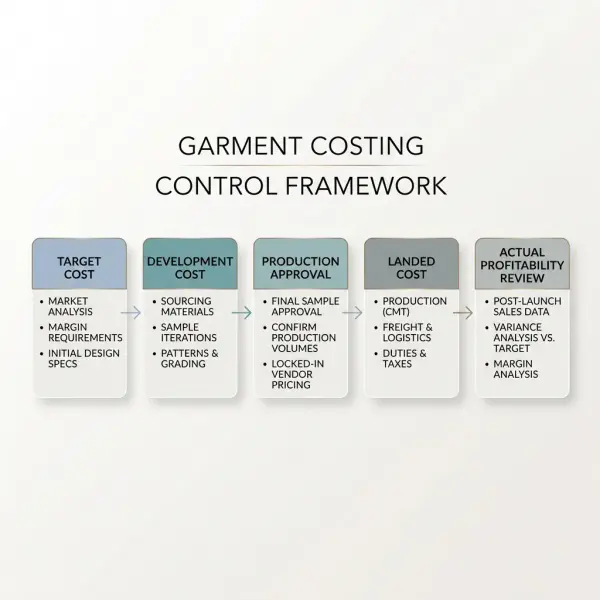
This framework works because it treats costing as a living process. Apparel cost changes when product details change. Profitability changes when selling reality differs from the plan. A costing system that updates at each stage gives the brand more chances to correct course.
What Fashion Brands Should Verify Before Final Cost Approval
Before approving final cost, fashion brands should verify both the numbers and the assumptions behind them. Most costly mistakes are not obvious calculation errors. They are missing details, outdated assumptions, or misunderstood quote terms.
A final cost approval checklist should include:
- Is the product specification final?
- Has fabric consumption been calculated from the approved pattern?
- Are shrinkage, cutting waste, and defect allowance included?
- Are all trims, labels, fusing, lining, thread, and packaging included?
- Does the sewing cost reflect the final construction?
- Are printing, embroidery, washing, pressing, and inspection included?
- Is the quote based on confirmed order quantity?
- Are delivery terms clearly stated?
- Are freight, duty, tax, insurance, and handling included where relevant?
- Are overhead and sales channel costs included in pricing logic?
- Has markdown and return risk been considered?
- Has every late product change been re-costed?
The checklist should be used before production approval, not after shipment. Once production starts, the brand has fewer options to protect margin.
How Costing Errors Affect Brand Strategy
Costing errors do more than reduce profit on one product. They distort brand strategy. If a brand does not know which products are truly profitable, it may scale the wrong items, discontinue the wrong items, or invest marketing budget into products that cannot support growth.
A product that sells well is not always profitable. It may rely on heavy discounting, high ad spend, expensive returns, or low-margin wholesale pricing. A product with slower volume may be more profitable if it has strong margin, low return rate, stable replenishment, and efficient production.
This is why costing should be connected to merchandising. The brand should know which styles are margin drivers, which are brand-building pieces, which are acquisition products, and which are operational distractions.
A mature fashion business does not judge products only by aesthetic appeal or sales volume. It reviews product profitability after cost, channel, inventory, discounting, and operational complexity are considered.
FAQ
What is the most common garment costing mistake?
The most common garment costing mistake is using an incomplete cost base. Many brands include fabric, trims, and sewing, but forget freight, duties, packaging, overhead, marketing, returns, markdowns, or platform fees. The product then appears profitable in the cost sheet but performs poorly once the full selling process is included. A stronger approach is to separate estimated cost, supplier quote, landed cost, and actual post-selling profitability.
Why can a profitable-looking garment still lose money?
A garment can look profitable if the calculation only includes direct production cost. It may lose money after freight, duty, warehousing, advertising, returns, markdowns, damaged stock, customer service, and overhead are included. This is common when brands calculate margin from supplier quote alone. True profitability should be reviewed after the product is delivered, sold, discounted if necessary, and adjusted for returns or unsold stock.
How do supplier quotes create costing errors?
Supplier quotes create costing errors when brands compare them without checking what each quote includes. One quote may include fabric and trims, while another only includes sewing. One may be FOB, while another may be ex-factory. One may assume a larger order quantity or simpler packaging. To compare fairly, brands should normalize all quotes to the same scope, delivery term, quality requirement, and order quantity.
Why should fashion brands re-cost after sampling?
Fashion brands should re-cost after sampling because the approved sample often differs from the original concept. Fabric consumption may change, construction may become more complex, trims may be upgraded, packaging may be revised, or fit corrections may add material and labor. If the brand continues using the original estimate, the margin may be inaccurate. Every major sample approval should trigger an updated costing review.
How do markdowns affect garment profitability?
Markdowns reduce garment profitability by lowering the selling price after production costs have already been committed. A product with a healthy full-price margin may become weak if a large share of units sells at discount. Seasonal products, trend-led items, poor-fit garments, and overproduced styles are especially exposed to markdown risk. Costing should include a realistic view of sell-through and discount tolerance, not only full-price margin.
Should small fashion brands include founder time in costing?
Small fashion brands should consider founder time when evaluating true profitability, even if they do not include it as a formal line item at the beginning. If the founder handles design, sourcing, packing, customer service, and marketing without pay, the product may look more profitable than it really is. As the business grows, those tasks may need paid staff or outsourcing. Ignoring this can make scaling financially painful.
How can brands reduce costing errors before production?
Brands can reduce costing errors by using complete tech packs, calculating fabric consumption from approved patterns, clarifying supplier quote scope, confirming delivery terms, including overhead, updating costs after every product change, and reviewing actual cost after production. They should also compare planned margin with real margin after markdowns and returns. The goal is not a perfect forecast, but a disciplined process that catches margin leakage early.
Is the cheapest supplier usually the best option?
The cheapest supplier is not automatically the best option. A low quote may reflect genuine efficiency, but it may also exclude important cost items, assume lower quality, depend on unrealistic timelines, or create production risk. Brands should compare suppliers based on total cost, capability, quality consistency, communication, delivery reliability, compliance expectations, and transparency. A slightly higher quote may protect margin better if it reduces defects, delays, and rework.
Conclusion
Costing errors rarely look dramatic at first. They often appear as small assumptions: a missing trim, an underestimated fabric allowance, a vague supplier quote, a late design change, a forgotten freight charge, or an overhead cost left outside the product calculation. In fashion, those small assumptions can quietly reduce profitability across a full production run.
A stronger costing process gives fashion brands better control. It helps teams understand which products deserve production, which designs need adjustment, which suppliers are quoting transparently, and which costs must be recovered through pricing.
The most profitable brands are not necessarily the ones that produce at the lowest cost. They are the ones that understand their real cost structure, protect product value, and make disciplined commercial decisions before margin disappears.





Comments 0
Leave a CommentSend Comment
Anda harus Login terlebih dahulu untuk dapat memberikan komentar.