

Size Specification Sheets: Why They Matter in Garment Development
A garment can look simple on a design sketch but require dozens of coordinated technical decisions before it can be produced consistently. Chest width, body length, shoulder position, sleeve proportion, waist placement, rise, inseam, neckline shape, and opening dimensions all need to be translated into values that a pattern maker and factory can follow.
Those values are usually organized in a size specification sheet.
A size specification sheet records the required finished-garment measurements for a style across its approved size range. It normally combines points of measure, target dimensions, grade rules or graded values, measurement tolerances, and instructions showing exactly how each dimension should be checked.
In practice, the sheet does more than describe size. It becomes a working control document used during pattern development, sample evaluation, fitting, pre-production approval, and quality inspection.
Without a reliable specification sheet, product decisions tend to remain scattered across sketches, sample comments, spreadsheets, messages, and individual memory. One factory may interpret “relaxed fit” differently from another. A revised sample may correct the chest but retain an outdated sleeve length. A production inspector may reject garments using measurement limits that no longer reflect the approved sample.
The result is not merely administrative confusion. Weak specification control can affect fit consistency, sampling costs, production efficiency, supplier accountability, and customer confidence.
Quick Answer
A size specification sheet is a technical apparel document that lists the required garment measurements for a style in each size. It normally identifies every point of measure, the approved base-size dimensions, the measurements for graded sizes, allowable tolerances, and instructions explaining how the garment must be positioned and measured.
The sheet matters because design descriptions alone cannot communicate fit precisely. Terms such as fitted, straight, oversized, cropped, or relaxed need to be translated into measurable dimensions that pattern makers, sample rooms, factories, and quality control teams can reproduce.
During development, the specification sheet helps teams compare a sample with the intended dimensions and record approved measurement changes. During production, it provides the reference used to determine whether finished garments remain within acceptable limits.
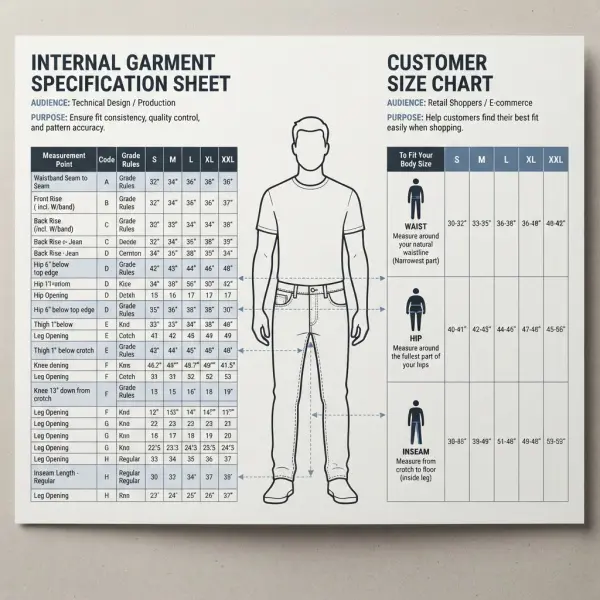
A size specification sheet is not the same as a consumer size chart. The internal specification contains finished-garment measurements and technical production information. A customer-facing size chart usually communicates body measurements, recommended size ranges, or selected garment dimensions intended to help customers choose a product.
The sheet is most reliable when it is linked to clear measurement diagrams, controlled revisions, fit comments, material information, and an approved sample.
What Is a Size Specification Sheet?
A size specification sheet is a structured table that defines the dimensions a finished garment should achieve across its size range.
It may also be called a measurement specification, garment specification sheet, measurement chart, spec sheet, measurement table, or graded specification. Terminology varies among brands, suppliers, software systems, and sourcing regions, but the core function remains similar: it converts the approved garment fit and proportions into measurable production requirements.
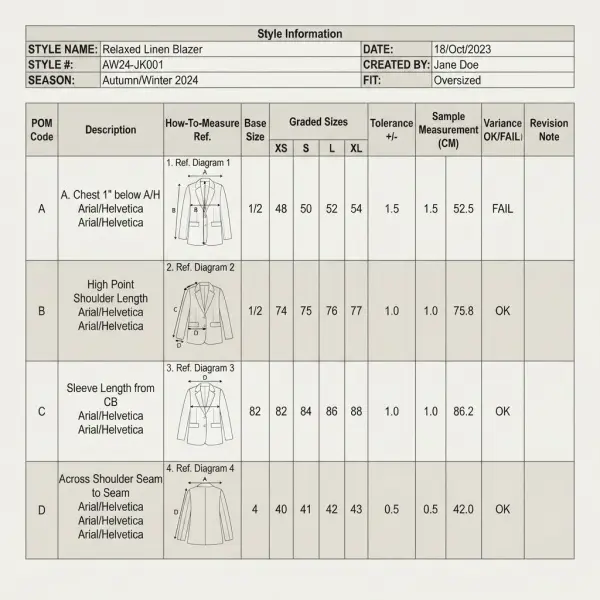
Each measurement is connected to a point of measure, commonly abbreviated as POM. A POM identifies what is being measured and should be supported by a method explaining where the measurement begins, where it ends, and how the garment is positioned.
For example, “body length” could mean:
- Side neck point to bottom hem.
- Center back neck seam to bottom hem.
- Shoulder seam at the neckline to bottom hem.
- Front body length measured through the bust.
- Back body length excluding a collar or neck trim.
A specification that says only “body length: 64 cm” is therefore incomplete. The number becomes operationally useful only after the measurement route has been defined.
ISO 18890:2018 provides a standardized reference for principal garment measurement points and methods. ISO describes these methods as useful for creating measurement tables, developing prototypes, approving samples, controlling production, and inspecting garments. It also recognizes that additional measurement points may need to be agreed between the parties involved.
The ISO standard method of garment measurement can support consistent terminology, but it does not remove the need for a brand-specific specification. A wrap blouse, padded jacket, tailored trouser, compression legging, and asymmetric dress require different measurement priorities.

Where Does the Size Specification Sheet Fit Within a Tech Pack?
A size specification sheet is usually one component of a broader technical package or tech pack.
A complete tech pack may also contain:
- Technical flats or garment drawings.
- Construction details.
- Bill of materials.
- Fabric and trim information.
- Colorways.
- Label and packaging requirements.
- Stitch and seam instructions.
- Artwork or placement specifications.
- Testing requirements.
- Sample comments and approval history.
The measurement specification focuses specifically on the garment’s measurable dimensions. It should be connected to the rest of the technical package because measurements cannot be interpreted separately from construction and material choices.
For example, a waistband measurement may depend on whether the waistband is straight, curved, elasticated, ribbed, faced, or partially adjustable. A neckline specification may depend on binding width, seam allowance, stretch ratio, and finishing method. A trouser hem opening may be affected by a cuff, turn-up, zipper, gusset, or elastic insertion.
A number entered in a spreadsheet cannot explain all of this by itself.
The best specification systems therefore connect the measurement row with a diagram, point-of-measure code, construction reference, or written measuring instruction. Product lifecycle management systems may also connect POM libraries, grades, tolerances, critical measurements, and quality assurance requirements within one controlled style record. Lectra’s YuniquePLM documentation, for example, describes measurement workflows containing POM codes, grading, tolerances, sample-size values, measurement instructions, and identification of critical POMs for quality assurance.
This does not mean a smaller brand needs enterprise software before it can develop garments professionally. A well-maintained spreadsheet can work. The important issue is whether the information is complete, controlled, understandable, and accessible to everyone responsible for the style.

What Information Should a Size Specification Sheet Contain?
A useful size specification sheet normally contains several layers of information. The exact format varies by company, but a measurement table that contains only size labels and numbers is rarely sufficient.
Style and Document Identification
The top of the sheet should make it clear which product and document version are being reviewed.
Common identification fields include:
- Brand or business unit.
- Style name.
- Style number or product code.
- Product category.
- Season or collection.
- Supplier or factory.
- Fabric reference.
- Sample stage.
- Base size.
- Size range.
- Unit of measurement.
- Revision number.
- Revision date.
- Document owner or approver.
These details prevent the measurement table from becoming separated from its production context. A factory may be developing several visually similar T-shirts in different fabrics, fits, or washes. A style number and revision status help avoid applying one product’s measurements to another.
Point-of-Measure Code
Each measurement should have a unique POM code.
The code may be numeric, alphabetical, or alphanumeric. Its purpose is to create a stable reference that can be used in diagrams, sample comments, emails, inspection reports, and software records.
For instance:
- A01: Half chest width.
- A02: Front body length from high point shoulder.
- A03: Across shoulder.
- A04: Sleeve length.
- A05: Sleeve opening.
The exact coding system is less important than consistency. Codes should not be reassigned casually because historical sample comments may depend on them.
Measurement Description
The description gives the POM a readable name. It should be specific enough to distinguish similar measurements.
“Waist” may be ambiguous. Better descriptions might include:
- Waistband relaxed, measured straight.
- Waistband extended to functional limit.
- Half waist measured at waist seam.
- Waist position measured from high point shoulder.
- Interior waistband circumference.
A concise description should be paired with a detailed method wherever interpretation remains possible.
How-to-Measure Instructions
The measuring instruction explains how to reproduce the value. It may be written as text, shown in a diagram, or provided through both.
A useful instruction normally clarifies:
- How the garment is positioned.
- Whether closures are fastened.
- Whether the garment is relaxed, smoothed, or extended.
- The start and end points.
- Whether the tape follows a curve or remains straight.
- Whether trim, binding, elastic, or seam allowance is included.
- Whether the value is a half measurement or full circumference.
- Any fixed distance used to locate the measurement line.
This is the part that converts a measurement name into a repeatable procedure.
The underlying methods are explained more fully in garment measurements for apparel production.
Base-Size Measurement
The base size is the size in which the garment’s fit and proportions are usually developed and approved first.
The base-size column contains the target values used by the pattern maker and sample room. These values may originate from an existing fit block, an earlier approved style, a reference garment, body-measurement research, or a newly developed pattern.
They should not be treated as final merely because they appear in the first specification. Early values are working assumptions that may change after pattern evaluation, fitting, material testing, and sample review.
Grade Rules or Graded Measurements
Grade rules determine how a measurement changes from one size to the next. Some sheets show the increment between sizes. Others display the final target dimension for every size.
For example, a basic top may have the following half-chest measurements:
|
Size |
XS |
S |
M |
L |
XL |
|
Half chest |
47 cm |
49 cm |
51 cm |
53 cm |
55 cm |
In this simplified example, the grade increment is 2 cm in the flat half measurement between adjacent sizes.
Real grade plans are often less uniform. Length measurements may change more slowly than circumferences. Smaller and larger ends of the range may require different increments. Product proportions may also need adjustment to avoid making every dimension grow at the same rate.
A graded specification should show the approved outcome clearly, regardless of whether the business stores increments or final values.
Tolerances
A tolerance defines the permitted deviation above or below the target measurement.
A target chest width of 52 cm with a tolerance of ±1 cm would allow an inspected value between 51 and 53 cm, provided the tolerance is applied symmetrically.
Not every tolerance is symmetrical. A company may allow a dimension to be slightly larger but not smaller, or the reverse, depending on fit, function, safety, assembly, or appearance. Such decisions should be stated explicitly rather than left to interpretation.
Tolerances are not extra design ease. They are manufacturing acceptance limits around an approved target.
Sample Measurements and Variances
During development, the supplier or technical team may enter the actual sample measurement beside the requested value.
The variance can then be calculated:
Actual sample measurement − requested specification = variance
If the required body length is 68 cm and the sample measures 69.2 cm, the variance is +1.2 cm.
This makes the problem visible, but it does not automatically determine the corrective action. The sample may be outside tolerance yet fit better than expected, indicating that the target itself needs reconsideration. Conversely, a sample may be inside tolerance and still fit poorly because the pattern shape or measurement distribution is wrong.
Comments and Revision Notes
A specification sheet should record meaningful changes rather than silently replacing old values.
A revision note might state:
- Chest increased by 1 cm after first fit.
- Front body shortened by 0.5 cm; back length unchanged.
- Sleeve opening tolerance reduced due to fit sensitivity.
- Waist measurement revised to post-wash condition.
- Hip POM relocated to 20 cm below waistband seam.
- Grade rule changed for XL and XXL only.
These comments preserve the reasoning behind the revision and make later troubleshooting easier.
Why Size Specification Sheets Matter in Garment Development
A size specification sheet matters because it creates continuity between design intent, pattern execution, sample approval, and bulk manufacturing.
Without that continuity, each stage can make technically reasonable decisions that gradually move the product away from the intended fit.
They Translate Design Intent Into Measurable Requirements
Designers often work through shape, proportion, reference imagery, sketches, drape, and visual balance. Manufacturers need dimensions.
A description such as “slightly oversized with a dropped shoulder” leaves several questions unanswered:
- How much wider should the chest be?
- How far should the shoulder extend?
- Should the armhole become deeper?
- Does the sleeve become shorter to compensate for the dropped shoulder?
- Is the garment longer, wider, or both?
- Should the hem remain straight or narrow slightly?
The specification sheet makes these decisions explicit.
This does not reduce design to a set of numbers. Rather, it records the dimensions that have been selected to create the desired result.
They Give Pattern Makers a Controlled Target
Pattern makers interpret measurements within the geometry of the garment.
A finished chest width does not tell the pattern maker how the volume should be distributed across front, back, and side panels. A finished hip measurement does not determine dart shaping, seam placement, or front-to-back balance. The specification provides the target, while pattern-making expertise determines how that target is achieved.
Once a pattern has been developed, the specification helps the team check whether the pattern and sewn sample remain aligned with the approved dimensions.
This is especially useful when pattern development is distributed across internal staff, freelance technicians, and external suppliers. Each contributor is less dependent on verbal instructions or the memory of the previous person.
They Make Sample Reviews More Objective
Fit reviews contain subjective judgment. A garment may look too long, feel restrictive, or appear unbalanced even when it technically matches the first requested measurements.
The specification sheet allows the team to compare visual observations with physical data.
A useful sample review asks:
- Does the sample match the current specification?
- Does the current specification create the intended fit?
- If not, which measurement or pattern relationship should change?
- Does the modification apply only to the base size or also affect grading?
- Will the fabric or finishing process alter the approved result?
This distinction prevents teams from blaming a factory for following a specification that was itself unsuitable.
They Preserve Decisions Between Sample Rounds
A style may go through several samples before approval. Each round can generate multiple changes.
Without controlled documentation, a later sample may accidentally combine current and outdated instructions. The chest may follow revision three, the sleeve revision two, and the neckline the original sketch.
The size specification sheet provides a consolidated reference. After a fitting, approved changes should be incorporated into a new revision so the next sample is made from one coherent set of instructions.
They Support Consistent Grading
Approving a medium sample does not prove that extra-small or extra-large will fit correctly.
The graded specification shows how the approved proportions are intended to change across sizes. It helps teams identify dimensions that grow regularly, those that change only in selected sizes, and those that remain constant.
For example, a pocket width may remain unchanged across several sizes while its position shifts. A neckline may grade minimally to protect appearance. Hip and waist dimensions may use different increments depending on the target body profile.
The specification does not replace a pattern-grade review or size-set fitting, but it provides the measurable framework for those activities.
They Establish a Production Acceptance Reference
Once the style is approved, the measurement specification becomes part of the production standard.
Factory quality control teams may use it during in-line checks. Brand inspectors or third-party inspectors may use it during final inspection. Suppliers may also refer to it when investigating whether sewing, pressing, washing, or finishing has changed the garment dimensions.
ISO 18890 identifies production control and garment inspection as applications for standardized garment measurement methods.
The sheet supports accountability only when the production team and inspector are using the same version and the same measurement method.
A Size Specification Sheet Is Not a Customer Size Chart
These documents are related, but they are created for different audiences.
A size specification sheet is an internal technical document. It may contain dozens of finished-garment measurements, detailed POM codes, tolerances, grades, sample results, and manufacturing notes.
A customer size chart is a simplified communication tool intended to help shoppers select a size. It usually provides one of three types of information:
- Recommended body-measurement ranges.
- Selected finished-garment measurements.
- General international size conversions.
The distinction should be stated clearly.
ISO 8559-1 defines anthropometric body measurements used in clothing size designation, while ASTM D5219 standardizes terminology relating to body dimensions for apparel sizing. These body dimensions are not the same as the finished-garment measurements listed in a production specification.
The ISO anthropometric definitions for clothing size designation provide a reference for measuring people, not a universal finished-garment chart.
|
Document |
Primary audience |
Main information |
Main purpose |
|
Size specification sheet |
Designers, pattern makers, suppliers, technical teams, quality inspectors |
Finished-garment dimensions, POMs, grades, tolerances, sample results |
Develop and control the product |
|
Body-measurement size chart |
Customers and fitting teams |
Recommended body dimensions for each size |
Match a wearer to a size |
|
Garment-measurement chart |
Customers, customer service, retail teams |
Selected dimensions of the actual product |
Help customers compare garment fit |
|
Size conversion chart |
International customers and retailers |
Approximate conversion among regional size labels |
Provide general size-label guidance |
Publishing internal garment measurements directly as a customer size guide can create confusion if half measurements, tolerances, or measuring methods are not explained. Conversely, using a consumer body chart as the factory specification omits ease, design volume, and product construction.
How Does a Size Specification Sheet Work During Sample Development?
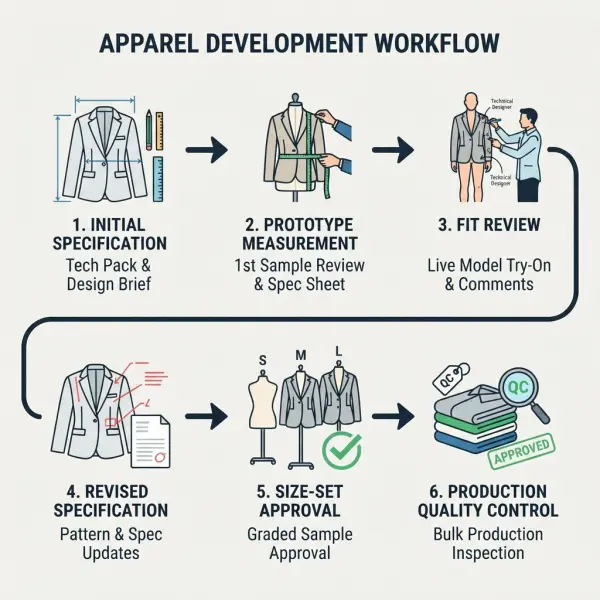
The specification evolves as the garment moves from initial concept to approved production standard.
It should not be considered a static form completed once at the beginning.
Initial or Proto Specification
The first specification translates the design into an initial set of measurable targets.
At this stage, some values may be based on:
- A previously approved block.
- A comparable style.
- A reference sample.
- Target body measurements.
- Desired ease and silhouette.
- Fabric stretch or structure.
- Design sketches and proportion studies.
The team should identify which values are established standards and which are provisional. False precision at this stage can cause suppliers to assume that every number has already been validated.
Prototype Sample Review
The first prototype is measured against the requested specification before or during the fit review.
Three outcomes are possible:
- The sample is outside specification and the requested measurement remains correct.
- The sample is outside specification but the actual dimension produces a better fit.
- The sample is within specification but the fit or proportion remains unsatisfactory.
Each outcome leads to a different response.
The first may require factory correction. The second may justify revising the specification to match the successful sample. The third indicates that the pattern, measurement selection, or original target needs deeper review.
Fit Sample Revisions
After fitting, the technical team updates the dimensions affected by the approved corrections.
A strong fit comment links the visual issue, requested pattern correction, and revised measurement. For example:
“Back body appears short when arms are raised. Increase center-back length by 1 cm while maintaining front length and hem level. Update POM B04 from 67 cm to 68 cm.”
This is more useful than writing “make back longer,” because it identifies both the desired result and the controlled dimension.
Size-Set Evaluation
A size set contains samples in selected sizes from the intended range. It is used to assess whether the grading produces acceptable proportions beyond the base size.
The specification sheet allows the team to compare:
- Actual measurements with graded targets.
- Grade increments between adjacent sizes.
- Length-to-width relationships.
- Neckline, armhole, and sleeve progression.
- Placement changes across sizes.
- Differences at the upper and lower ends of the range.
Size-set evaluation is particularly important when the range covers diverse body dimensions or when a product is sensitive to proportion.
Pre-Production Approval
The pre-production sample should reflect the intended production materials, trims, pattern, construction, and finishing.
At this stage, the measurement specification should be stable enough to serve as the bulk production reference. Any final change must be controlled carefully because it may affect patterns, markers, consumption, cutting, sewing, inspection, and delivery timing.
The approved specification should be linked to the approved sample and final pattern version.
Production and Final Inspection
During production, actual garments are measured against the final specification.
Results may be recorded by size, production line, color, wash, or batch. This is useful when materials or treatments behave differently across variants.
A denim style with several wash effects, for example, may require separate monitoring because finishing intensity can affect dimensional change. A knit garment made in several colors may also behave differently if dyeing and finishing conditions vary.
The specification creates the baseline, while production data shows whether the process remains capable of achieving it.
How Should Grade Rules Be Shown?
Grade rules can be shown as incremental changes or as completed measurements for every size.
An incremental grade displays how much a POM increases or decreases from one size to the next. A completed grade chart shows the final required value for each size.
Both approaches can work, but the final document sent to production should allow the supplier and inspector to identify the target value without additional interpretation.
Consider this simplified example:
|
POM |
XS |
S |
M |
L |
XL |
Tolerance |
|
Half chest |
48 |
50 |
52 |
54 |
56 |
±1.0 cm |
|
Body length |
63 |
64 |
65 |
66 |
67 |
±1.0 cm |
|
Sleeve length |
20 |
20.5 |
21 |
21.5 |
22 |
±0.7 cm |
|
Neck width |
17 |
17.5 |
18 |
18.5 |
19 |
±0.5 cm |
This table communicates the required finished values directly. It does not explain whether those grades are suitable for the target customer—that decision must come from the brand’s fit strategy, anthropometric references, pattern block, and testing process.
Grade increments should not be copied automatically from unrelated products. A stretch top, structured shirt, tailored jacket, and loose sweatshirt may use different grade relationships even when they share the same size labels.
Body-measurement standards can provide reference data for specific populations and size categories, but they do not automatically determine a brand’s garment grade. ASTM, for example, publishes separate body-measurement tables for several population and figure categories, illustrating that one universal body table is not sufficient for all customers or product markets.
What Is Measurement Tolerance?
Measurement tolerance is the permitted difference between the specified target and the measured result of a sample or production garment.
A target is the dimension the product is intended to achieve. A tolerance recognizes that textile materials and garment-manufacturing processes contain some variability.
The tolerance should be realistic, but it should not be used to conceal weak process control.
Tolerance Is Not the Same as Grade
A grade is the intentional dimensional difference between sizes. A tolerance is the permitted production variation within one specified size.
If the chest increases by 4 cm in circumference between medium and large, that is a grade decision. If a medium garment is allowed to finish 1 cm above or below its target chest width, that is a tolerance decision.
Confusing these concepts can cause adjacent sizes to overlap excessively or create inconsistent fit.
Tolerance Is Not the Same as Ease
Ease is the dimensional relationship between the body and garment that supports movement or creates a silhouette.
Tolerance is manufacturing variation around the chosen garment dimension.
A fitted shirt should not rely on production tolerance to provide essential movement room. The target measurement itself must contain the appropriate ease.
Why Tolerances Should Vary by POM
A universal tolerance applied to every measurement is administratively convenient but may not reflect product risk.
Different POMs vary in:
- Fit sensitivity.
- Functional importance.
- Construction difficulty.
- Material stability.
- Measurement repeatability.
- Visual impact.
- Safety or compliance relevance.
A collar stand height may need closer control than the sweep of a wide gathered skirt. The relaxed dimension of elastic may behave differently from a stable woven waistband. A pocket placement error may be visually obvious even when the pocket dimensions remain correct.
Tolerances should therefore be assigned deliberately rather than copied unchanged from an old template.
What Happens When a Sample Is Outside Tolerance?
An out-of-tolerance result should trigger investigation, not an automatic conclusion.
The team should determine whether:
- The garment was measured correctly.
- The correct document revision was used.
- The garment was conditioned or prepared appropriately.
- The sample was made from the correct pattern.
- Sewing or finishing changed the dimension.
- The material behaved differently from expectation.
- The target or tolerance is unrealistic.
- The deviation affects fit, function, or appearance.
A supplier may need to correct the sample. In other cases, the technical team may decide to revise the target after confirming that the sample represents the preferred fit.
The third article in this cluster examines measurement errors that cause fit and production problems in more detail.
How Fabric Behavior Affects the Specification Sheet
Fabric is not dimensionally neutral. Stretch, recovery, relaxation, shrinkage, growth, drape, thickness, and finishing can change how a pattern becomes a finished garment.
This means the specification must identify the condition in which measurements apply.
A garment may be measured:
- Before washing.
- After garment washing.
- After pressing.
- After steaming.
- After a defined relaxation period.
- After laundering and drying.
- In a relaxed state.
- Under a specified extension.
The appropriate condition depends on the product.
ISO 5077 specifies a method for determining dimensional change in fabrics, garments, and other textile articles after specified washing and drying procedures. The standard was reviewed and confirmed as current in 2022.
The ISO method for dimensional change after washing and drying can support controlled testing, although routine factory measurement and laboratory dimensional-change testing are not identical processes.
A product may need separate values for:
- Pattern or pre-treatment dimensions.
- Finished production dimensions.
- Post-wash dimensions.
- Extended elastic dimensions.
- Minimum recovery expectations.
PLM systems can store treatment and expected shrinkage information alongside measurement specifications, but software does not determine whether the assumptions are technically correct. Lectra’s measurement workflow documentation, for example, includes fields for expected fabric behavior and directional shrinkage before calculating or reviewing specifications.
For small brands, a simple version may be enough: state clearly whether the specification is before or after wash, record the tested shrinkage, and confirm the measurement condition with the supplier.

How Fashion Businesses Can Build a Better Specification Process
A stronger specification process does not begin with adding more columns. It begins by deciding who controls measurements, how changes are approved, and which document represents the current product standard.
Begin With a Product-Category Template
Templates reduce repeated work and help standardize terminology.
A business may create separate base templates for:
- T-shirts and jersey tops.
- Shirts and blouses.
- Dresses.
- Trousers and shorts.
- Skirts.
- Jackets and coats.
- Knitwear.
- Activewear.
- Underwear or swimwear.
Each template should include common POMs for the category, standard codes, measuring diagrams, default units, and initial tolerance guidance.
The template must then be adapted to the individual style. Keeping irrelevant POMs can confuse suppliers, while failing to add design-specific measurements can leave important features uncontrolled.
Define One Base Size
The specification should identify the base size used for fit development.
This base size should be connected to:
- The intended customer.
- The approved fit model or mannequin.
- The brand’s body-measurement standard.
- The product category.
- The desired fit.
- The pattern block being used.
Changing the base size during development can affect grading and sample interpretation, so the change should be documented rather than treated as a simple relabeling exercise.
Identify Critical POMs
Some measurements have greater influence on fit or function than others.
Critical POMs may include:
- Chest, waist, or hip dimensions.
- Front and back rise.
- Shoulder width.
- Armhole depth.
- Bicep width.
- Neck opening.
- Garment length.
- Inseam.
- Functional openings.
- Safety-related placements.
Critical status can guide fitting attention and production inspection. Lectra’s YuniquePLM documentation describes the ability to mark selected measurements as critical and require them in quality assurance sample requests.





Comments 0
Leave a CommentSend Comment
Anda harus Login terlebih dahulu untuk dapat memberikan komentar.