

Fashion Trade Shows Explained for Growing Apparel Brands
Quick Answer
A fashion trade show is a business-to-business industry event where apparel brands, buyers, retailers, suppliers, sales representatives, manufacturers, and other fashion professionals meet to evaluate products and develop commercial relationships. For a growing apparel brand, the primary value is usually not publicity alone. It is access to relevant wholesale buyers, opportunities to present a collection physically, market feedback, relationship building, and potential orders or follow-up appointments.
Trade shows vary significantly. Events such as COTERIE focus heavily on brands and retail buyers, while Première Vision is oriented toward materials, manufacturing, and fashion sourcing. Choosing the wrong type of event can therefore produce plenty of conversations without meaningful commercial results.
The strongest trade show strategy starts before booth design. A brand needs a wholesale-ready collection, coherent pricing, delivery expectations, production capacity, sales materials, samples, and a clear idea of which buyers it wants to meet. Exhibiting can be expensive once booth fees, travel, shipping, staffing, samples, and follow-up are included, so success should be measured against qualified buyer relationships and realistic wholesale opportunities rather than foot traffic alone.
What Is a Fashion Trade Show?
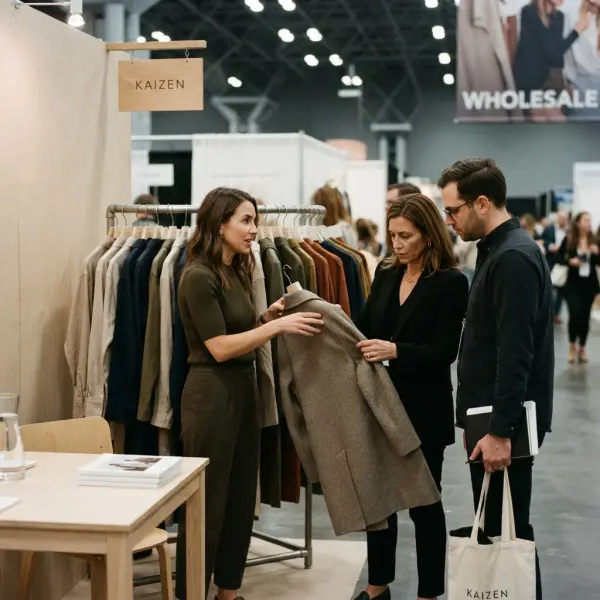
A fashion trade show is a professional marketplace designed to connect businesses within the fashion industry. Depending on the event, exhibitors may include clothing brands, footwear companies, accessory labels, textile mills, manufacturers, technology providers, sourcing companies, or service businesses. Attendees can include independent boutique buyers, department-store teams, e-commerce retailers, distributors, agents, designers, sourcing professionals, and other industry decision-makers.
The commercial purpose matters. A trade show is not simply a large fashion exhibition where brands display products and hope someone notices them.
At a wholesale-oriented apparel show, a buyer may examine a collection, discuss pricing and delivery windows, assess whether the brand fits the retailer's assortment, and decide whether to continue into a sales appointment or order process. At a sourcing event, the interaction could instead involve discussing minimum order quantities, fabric specifications, manufacturing capabilities, development timelines, certifications, or production services.
That distinction is visible in major industry events. COTERIE New York positions itself around contemporary fashion brands, retailers, and industry professionals, while Première Vision Paris spans yarns, fabrics, leather, accessories, manufacturing, and other sourcing categories.
So when someone says a brand should "go to trade shows," the first question should be: which trade show, for which commercial objective?
Fashion Trade Shows Are Part of the Wholesale Sales System
For a growing apparel brand, a trade show works best when treated as one stage in a wider wholesale sales process.
The show creates concentrated access. Instead of arranging separate travel and meetings with dozens of retailers, brands and buyers gather in one market environment. Buyers can compare collections efficiently, while brands can expose their products to accounts they might otherwise struggle to reach.
But access is not the same as conversion.
A buyer can like a collection without placing an order. The price architecture may not fit the store. Delivery dates may conflict with the retailer's buying calendar. The collection may overlap with another label already carried. The buyer may like three styles but consider the overall assortment too narrow. Or the retailer may simply have exhausted its open-to-buy budget for that category.
This is why experienced wholesale teams tend to view trade shows as pipeline-building environments rather than isolated sales events.
A simplified commercial path looks like this:
Target accounts → pre-show outreach → show appointment or discovery → collection review → commercial discussion → follow-up → order or further negotiation → production and delivery
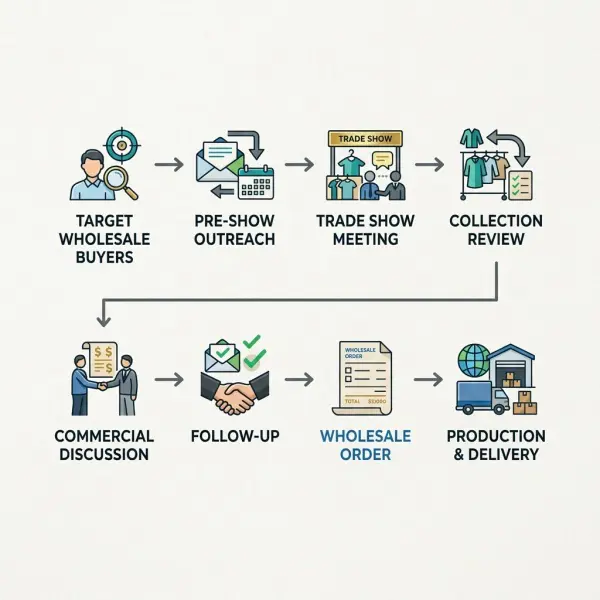
The show occupies only a small portion of that sequence. Brands that concentrate almost entirely on the three days of exhibition can overlook the work that determines whether those conversations become revenue.
The mechanics of preparing sales documents, samples and appointments deserve their own process. See how brands prepare line sheets, samples, and buyer meetings for the operational side of trade show preparation.
What Types of Fashion Trade Shows Do Brands Encounter?
Not every event serves the same part of the fashion value chain. This is one of the most important distinctions for emerging brands because event names and marketing materials can make very different gatherings sound similar.
|
Trade show type |
Main commercial purpose |
Typical participants |
Most relevant when a brand wants to |
|
Wholesale apparel show |
Connect brands with retailers and distributors |
Brands, buyers, agents, retailers |
Gain wholesale accounts |
|
Contemporary/designer market |
Present curated fashion collections |
Designers, premium brands, specialty retailers |
Reach a particular retail segment |
|
Sourcing show |
Find materials and production partners |
Mills, factories, trim suppliers, sourcing teams |
Develop or manufacture products |
|
Textile/material fair |
Evaluate fabrics, fibers, leather and components |
Mills, material developers, designers |
Source materials and discover developments |
|
Footwear/accessory market |
Connect category-specific brands and buyers |
Footwear or accessory brands and specialist retailers |
Build category-specific distribution |
|
Hybrid industry marketplace |
Combine selling, sourcing, education and networking |
Multiple fashion business segments |
Pursue several related objectives |
Première Vision illustrates the sourcing side particularly clearly. Its September 2026 Paris offer spans dedicated areas including yarns, fabrics, designs, accessories, leather, manufacturing and related fashion services; the organizer describes an offer of more than 900 exhibitors for that edition. (Première Vision Paris Septembre 2026)
A retailer-facing apparel market operates differently. Las Vegas Apparel, for example, describes itself as a market for wholesale buyers and exhibitors, with a focus on apparel and accessories. (Las VegasApparel)
Neither format is inherently more useful. They solve different business problems.
A label looking for boutiques to carry its Spring collection would gain little from judging a textile sourcing fair by the number of retail buyers present. Likewise, a product development team searching for a specialist technical fabric should not expect a retail-oriented wholesale show to provide the same supplier depth as a dedicated sourcing event.

Trade Show, Fashion Week, Showroom, or Online Marketplace?
These channels overlap, but they are not interchangeable.
A fashion show or fashion week presentation primarily presents a designer's collection through runway, presentation, or related events. Buyers may attend, but the format also involves media, influencers, stylists, guests and broader brand communication. CFDA material describing the fashion-week ecosystem distinguishes buyer activity such as showroom attendance, product review and ordering from the many other functions surrounding shows and events. (CFDA)
A showroom provides a more controlled selling environment. Brands may operate their own space or work through multi-brand sales showrooms, often arranging appointments with retail buyers.
A digital wholesale marketplace enables product discovery, communication and sometimes ordering without requiring buyer and seller to be physically present at the same event.
A trade show compresses a large number of market participants into a defined period and location, making discovery and relationship building unusually concentrated.
For growing brands, these channels can complement rather than replace one another. A buyer might first see a brand online, examine garments at a trade show, schedule a longer showroom appointment, and later place or replenish orders through a digital platform.
Why Do Fashion Trade Shows Matter for Growing Apparel Brands?
Physical product evaluation still matters
Apparel is unusually dependent on attributes that are difficult to communicate completely through a screen.
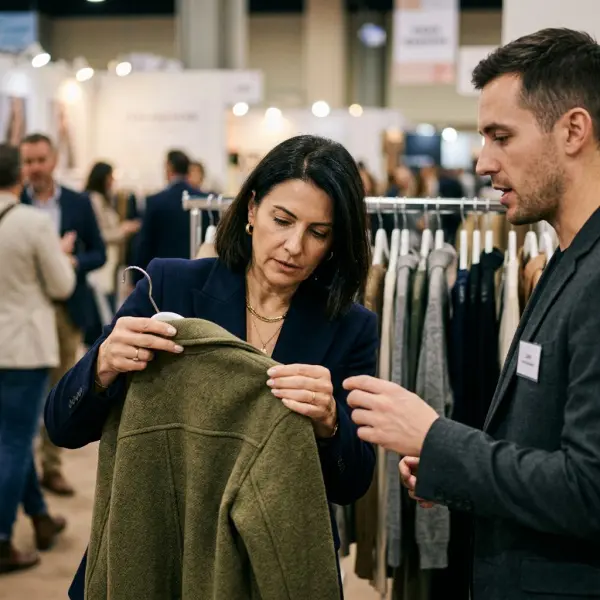
A buyer may want to feel fabric weight, examine seams, judge color in real conditions, inspect garment finishing, assess proportion, understand fit, or compare several styles next to one another. Physical evaluation does not guarantee an order, but it can reduce some of the uncertainty involved in reviewing an unfamiliar label.
That becomes particularly valuable for a new brand without an established wholesale reputation.
Buyers can discover brands outside their existing network
Retail buyers have limited time. Emerging labels face the additional challenge that the retailer may not know the brand exists.
Trade shows create structured discovery environments where buyers can move between categories and exhibitors. Current COTERIE materials, for example, list hundreds of participating brands across apparel, accessories, footwear and related categories, illustrating the breadth a buyer can encounter within a single market event. (COTERIE Fashion Events)
That exposure has value—but brands should distinguish visibility from qualified visibility.
One conversation with a retailer whose customer, price point and assortment genuinely match the brand may be commercially more important than dozens of casual booth visits.
Brands get unusually concentrated market feedback
Trade shows can expose patterns that are difficult to see from isolated sales calls.
Suppose six independent buyers respond positively to a brand's outerwear but repeatedly hesitate over the wholesale price of its knitwear. That does not automatically prove the knitwear is overpriced. Retail positioning, margin expectations, comparable products, market, fabrication and account type still matter.
But repeated objections are useful evidence.
The brand can begin asking better questions:
- Is the price architecture appropriate for the target retailer?
- Is the value of the material or construction visible enough?
- Is one product category stronger commercially than another?
- Are buyers requesting styles missing from the assortment?
- Do delivery dates align with buying requirements?
- Are particular colors or sizes repeatedly generating interest?
Trade shows therefore function partly as a market-sensing mechanism. The useful information is not "buyers loved us." It is the recurring pattern behind buyer reactions.
Relationships become easier to deepen
Wholesale selling is relationship-dependent because retailers and suppliers continue interacting after an initial order.
A retailer may need product information, order confirmation, production updates, logistics coordination, returns handling, replenishment, or markdown discussions. A brand therefore represents not only a product assortment but also a prospective commercial partner.
Meeting face-to-face can help both parties evaluate that relationship.
This does not make physical meetings automatically superior to digital selling. Many wholesale relationships can begin and continue remotely. The advantage of a trade show is concentration: multiple first meetings, existing-account conversations and new introductions can happen within a short market window.
What Actually Happens on a Fashion Trade Show Floor?
The visible scene is straightforward: booths, garment racks, samples, buyers and conversations.
Commercially, several things are happening at once.
A buyer may arrive for a scheduled appointment with a specific brand. Another may discover the booth while walking the floor. Sales representatives may introduce collections to existing accounts. Brand founders may qualify prospective retailers. Agents may discuss regional distribution. Buyers might photograph permitted products, make notes, request line sheets, or arrange a longer conversation later.
Not every meeting ends with a purchase order.
Depending on the brand and market, the outcome might instead be:
- an immediate order;
- a provisional product selection requiring internal approval;
- a request for pricing or additional information;
- a post-show showroom meeting;
- sample requests;
- an introduction to another buyer or distributor;
- interest for a later season; or
- a clear indication that the commercial fit is weak.
That final outcome is not necessarily failure. Discovering that a retailer is wrong for the brand before accepting an unsuitable account can prevent later problems.
A Trade Show Is Not Automatically a Good Investment
This is where many emerging brands need more disciplined thinking.
Exhibiting involves more than the published booth fee. Depending on location and format, the real budget can include booth construction or furnishings, samples, garment racks, graphics, freight, drayage or venue handling, travel, accommodation, insurance, staff, local transportation, meals, payment processing, internet, temporary labor and opportunity cost.
International participation can add customs documentation and temporary import considerations. Shipping apparel samples across borders also requires accurate product information and appropriate documentation; CFDA's logistics guidance with DHL, for example, emphasizes shipment classification and paperwork for apparel and textile goods. (CFDA)
The commercial question is therefore not:
"Can we afford the booth?"
It is:
"Can this event produce enough strategically relevant wholesale opportunity to justify its total cost and management attention?"
This is especially important for a small label with limited working capital. A prestigious event may look attractive but still be inappropriate if the brand cannot support the resulting wholesale production, has weak margins, or lacks the cash flow required to manufacture larger orders.
When Is an Apparel Brand Ready to Exhibit?
A brand does not need to be large, but it should be commercially coherent.
The minimum standard is not perfection. It is the ability to have a credible wholesale conversation and fulfil what the brand offers.
Before committing, a growing label should be able to answer questions such as:
- What collection is being sold?
- Who is the intended retailer and end customer?
- What are the wholesale and suggested retail prices?
- What is the ordering structure?
- What are the minimums, if any?
- When can orders be delivered?
- Where will production take place?
- Can the business finance and execute production if orders increase?
- How are orders confirmed and managed?
- What happens if production is delayed?
- Who follows up with buyers after the show?
A beautiful booth does not compensate for unclear commercial terms.
This is why wholesale readiness is more important than exhibition readiness.
How Should a Growing Brand Choose a Trade Show?
The most useful trade show is not necessarily the largest or most famous one. It is the event with the strongest alignment between the brand's commercial objectives and the people attending.
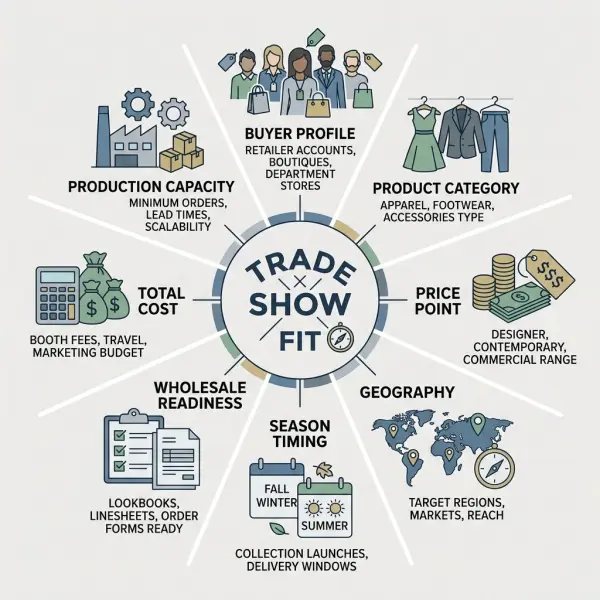
Several factors deserve priority.
Buyer relevance
Start with the retailer, not the event.
A contemporary women's label targeting independent boutiques needs a different buyer environment from a performance-apparel manufacturer seeking large sporting-goods accounts.
Ask organizers about attendee profile, retailer categories and geographic reach. Review exhibitor directories. Speak with brands that have previously participated where possible.
Category and price alignment
Trade shows often develop recognizable merchandising positions.
A premium label can struggle in an environment dominated by value-oriented products even if attendance is strong. Conversely, a commercially priced collection may gain little from exhibiting in a market where buyers expect luxury positioning.
Geographic strategy
A brand seeking U.S. accounts, European distribution, Middle Eastern partners or domestic retailers may need different events.
International visibility sounds appealing, but entering another wholesale market introduces questions around currency, duties, shipping, representation, delivery dates, returns, labeling requirements and customer service.
Geographic expansion should therefore follow operational capability rather than ambition alone.
Timing
The event must fit the brand's selling calendar.
Showing the right collection at the wrong point in buyers' purchasing cycles reduces relevance. Brands should understand when their target accounts review categories, when purchase decisions are made and when goods are expected to arrive.
Cost versus realistic opportunity
Instead of asking organizers only how many people attend, ask how many of the right people are likely to attend.
Large visitor numbers can be misleading if only a small proportion represents realistic accounts for the brand.
What Should Trade Show Success Actually Look Like?
Revenue matters, but evaluating a show only by orders written during the event can also understate its value.
Some wholesale deals take follow-up. Others may become opportunities in a subsequent season. A retailer may first discover the brand at the show and order later.
A practical scorecard can combine immediate and pipeline indicators:
|
Metric |
What it tells the brand |
|
Qualified buyer meetings |
Whether the event reached relevant accounts |
|
Target-account meetings |
Whether priority retailers were actually engaged |
|
Orders written |
Immediate commercial conversion |
|
Potential order value |
Size of credible post-show opportunities |
|
Follow-up requests |
Depth of buyer interest |
|
New account progression |
Whether leads advance after the event |
|
Repeat-account meetings |
Value for existing wholesale relationships |
|
Buyer feedback themes |
Product and merchandising intelligence |
|
All-in event cost |
True investment required |
|
Resulting contribution margin |
Whether converted business creates economic value |
A brand can then compare results across events rather than judging each show from atmosphere or booth traffic.
There is also an important quality filter: not all wholesale revenue is equally attractive.
A large order with difficult payment terms, unrealistic delivery requirements or poor margin can create more working-capital stress than a smaller account with healthier economics.
How Can Fashion Businesses Use Trade Shows Strategically?
For a growing brand, the strongest approach is usually to build the event into the commercial calendar rather than treating it as a standalone marketing campaign.
Use the show to support a defined market objective
"Get exposure" is too vague.
A stronger objective might be to secure ten meetings with independent U.S. boutiques, introduce a new category to existing accounts, test interest from distributors in a target region, or reconnect with dormant buyers.
The more precise the objective, the easier it becomes to choose an event and measure whether attendance was worthwhile.
Prioritize appointments before walk-in traffic
Some valuable discovery happens spontaneously, but depending only on random booth traffic creates unnecessary uncertainty.
Brands can research accounts in advance, identify relevant buyers and begin outreach before the show. An appointment schedule also helps the sales team allocate limited time more intelligently.
Connect sales ambitions to production capacity
A successful selling event creates obligations.
If a brand receives substantially larger wholesale interest than expected, management needs to know whether suppliers can secure materials, whether production capacity exists, whether quality control can scale, and whether sufficient working capital is available.
Growth that cannot be delivered reliably can damage buyer relationships.
Treat follow-up as part of the event
Trade show work does not finish when the racks are packed.
Contacts need to be categorized, notes reconciled, documents sent, questions answered and promising accounts prioritized. Speed matters, but relevance matters more: a buyer should receive the information connected to the actual conversation rather than a generic mass email.

Common Trade Show Mistakes to Recognize Early
Some mistakes occur repeatedly because exhibiting feels more like an event-production project than a sales project.
Brands can become preoccupied with booth decoration while neglecting buyer targeting. They may attend an event because competitors are present without verifying whether the audience fits their own price point. Others arrive with attractive samples but unclear wholesale pricing, delivery information or production capacity.
The commercial consequences are predictable: buyer interest becomes difficult to convert.
A few warning signs are particularly useful before committing:
- choosing a show primarily for prestige;
- assuming high attendance means high buyer relevance;
- relying entirely on walk-in traffic;
- presenting too many products without clear merchandising logic;
- being unable to explain prices or delivery expectations;
- spending heavily on display while underfunding samples and sales preparation;
- collecting contacts without recording context;
- failing to execute disciplined post-show follow-up.
These issues warrant deeper treatment because each can undermine otherwise promising wholesale activity. The companion guide on common trade show mistakes that limit wholesale opportunities examines those failure points in detail.
What Brands Should Verify Before Paying for a Booth
Trade show organizers naturally market their events positively. Brands still need their own due diligence.
Request current information rather than relying on reputation from several years ago. Event ownership, format, category mix, floor layout and buyer participation can change.
Useful questions include:
Who attends?
Look beyond total registration. Understand retailer type, buying authority, geographic mix and categories purchased.
Which brands exhibit?
The exhibitor mix helps reveal the show's real commercial positioning.
What costs sit outside the booth fee?
Ask about furniture, electricity, Wi-Fi, insurance, freight handling, badges, signage and other compulsory services.
What are the cancellation and payment terms?
Read contracts rather than relying on sales conversations.
Does the event vet buyers or attendees?
Credential policies vary. Las Vegas Apparel, for example, describes admission as being for qualified members of relevant trades and advises attendees to provide market credentials. (Las Vegas Apparel)
Can the organizer substantiate buyer claims?
If statistics are important to the decision, determine whether they represent registrations, unique attendees, multiple co-located events, historical editions or projected participation.
This last point matters because event metrics are not always directly comparable.
Important Commercial Caveats
Trade shows can create wholesale opportunities, but several assumptions should be avoided.
First, participation does not guarantee orders. Retail purchasing depends on assortment needs, budget, brand fit, price, timing and many other factors beyond the exhibitor's control.
Second, more wholesale accounts are not automatically better. Retailer quality, payment reliability, margin, territory considerations and operational requirements matter.
Third, trade shows are not mandatory for every growing fashion brand. Some labels may generate better economics through showrooms, agents, direct buyer outreach, digital wholesale platforms or existing distributor relationships.
Fourth, a buyer's enthusiasm should not be treated as confirmed revenue until the commercial process reaches an appropriate commitment, such as an accepted order under agreed terms.
Finally, event performance is highly context-dependent. What works for an established contemporary women's label may perform poorly for an early-stage streetwear business, a children's brand or a highly specialized technical apparel company.
Frequently Asked Questions About Fashion Trade Shows
Do small fashion brands need to attend trade shows?
No. A trade show is one wholesale sales channel, not a requirement for building a fashion brand.
It can be useful when the company has a wholesale-ready collection and needs concentrated access to appropriate buyers. But a small brand with limited inventory, weak production capacity or no clear wholesale pricing may gain more by strengthening those fundamentals first.
Alternatives include direct retailer outreach, sales representatives, showrooms and digital wholesale channels. The correct choice depends on the brand's target accounts, market, resources and commercial model.
Can a fashion brand get wholesale orders directly at a trade show?
Yes, some buyers may place orders during or immediately after a trade show, but this should not be assumed.
Other buyers use the event for product discovery and complete purchasing decisions later. They may require internal approval, assortment comparison, additional product information or a follow-up appointment.
For that reason, brands should track both confirmed orders and qualified opportunities. Treating every positive conversation as expected revenue can lead to unrealistic production planning and cash-flow assumptions.
How much does exhibiting at a fashion trade show cost?
There is no universal figure.
Costs vary substantially by event, booth size, city, travel distance, freight requirements and services included in the exhibitor package. The booth charge can be only one part of the budget.
Brands should calculate an all-in event cost covering registration, display, samples, shipping or freight handling, travel, accommodation, staffing, insurance and required venue services. International exhibitors may face additional logistics and customs considerations.
The more useful decision metric is therefore total cost relative to realistic commercial opportunity rather than booth price alone.
Is a fashion trade show the same as Fashion Week?
No.
Fashion Week usually centers on designer collection presentations, runway shows, press activity, industry visibility and broader fashion communication. Buyers can participate, but they are one of several stakeholder groups.
A wholesale trade show is more explicitly organized around business interaction between exhibitors and professional market participants such as retailers and buyers.
The two can overlap geographically or seasonally, and a brand may participate in both, but their commercial formats and objectives are different.
Should a direct-to-consumer fashion brand exhibit at a wholesale trade show?
It can make sense if the brand wants to add wholesale distribution and is operationally prepared for it.
A direct-to-consumer business moving into wholesale needs to understand retailer margins, wholesale pricing, order management, delivery calendars, production financing and account service. A strong DTC following can make the brand interesting to buyers, but it does not automatically mean the existing business model translates cleanly into wholesale.
Before exhibiting, management should model whether wholesale prices still support sustainable unit economics.
How many buyers should a brand meet at a trade show?
There is no reliable universal target.
Ten well-matched retail buyers can be more commercially valuable than 100 unqualified booth visitors. Targets should reflect the brand's sales capacity, category, event size and account strategy.
A practical approach is to separate priority accounts, qualified new prospects, existing retailers, and general contacts. This creates a more useful measurement system than counting total leads and makes post-show follow-up easier to prioritize.
Are large fashion trade shows always better than smaller events?
No.
Large events may offer greater breadth and discovery, but they also create more competition for buyer attention. Smaller or more specialized markets can sometimes offer stronger category alignment and easier access to relevant decision-makers.
The decision should be based on buyer fit, product category, price positioning, geography, timing and cost. Event size is useful context, but not a substitute for those factors.
Conclusion
Fashion trade shows remain a practical part of the fashion industry's wholesale and sourcing infrastructure because they concentrate products, buyers, brands, suppliers and commercial conversations in one place.
For growing apparel brands, however, the strategic value lies less in simply being present than in being present in the right market with a commercially prepared collection.
The strongest trade show decisions begin with buyer relevance, category fit, price positioning, selling calendar, production capacity and realistic economics. Booth design and visual presentation matter, but they cannot rescue a collection that lacks clear commercial terms or an audience fit.
Trade shows should therefore be treated as part of a broader wholesale system: identify target accounts, prepare the collection, initiate buyer outreach, conduct meaningful meetings, capture market intelligence and follow through until qualified opportunities either convert or close.
That perspective also makes the investment easier to judge. A crowded booth can feel successful. A smaller number of well-matched relationships that lead to profitable, deliverable wholesale business may be far more valuable.




Comments 0
Leave a CommentSend Comment
Anda harus Login terlebih dahulu untuk dapat memberikan komentar.