

How Neckline Finishing Affects Comfort, Shape, and Garment Quality
A neckline can look deceptively simple. On a finished dress, T-shirt, blouse, or sleeveless top, the visible result may be nothing more than a clean curved edge around the neck.
Behind that edge, however, the construction may involve a shaped facing, bias facing, visible binding, knit band, lining, interfacing, staystitching, understitching, clipped seam allowances, or several of these working together.
Those decisions matter because a neckline is both a visual edge and a functional opening. It needs to maintain its intended shape while sitting comfortably against the body and, in many garments, allowing enough room or stretch for dressing.
Poor finishing can produce a neckline that ripples, stretches out, flips outward, feels bulky against the skin, exposes the facing, or loses its shape after laundering. Good finishing is much less noticeable—which is precisely the point.
For fashion businesses, neckline finishing is therefore not a minor sewing detail. It affects sample approval, manufacturing consistency, perceived quality, garment comfort, returns caused by fit or appearance issues, and the amount of labor required to achieve the intended design.
Quick Answer: What Is Neckline Finishing?
Neckline finishing is the construction used to stabilize, cover, enclose, reinforce, or shape the raw edge of a garment's neck opening so that the neckline remains clean, comfortable, and dimensionally appropriate during wear.
Common methods include shaped facings, bias facings, bindings, knit bands, linings, and garment-specific combinations. The right method depends on the neckline shape, fabric weight, stretch and recovery, garment opening, desired visual appearance, production method, and intended level of structure.
A woven dress with an invisible inside finish may use a shaped facing or lining. A lightweight blouse may use a narrow bias finish to reduce bulk. A T-shirt normally requires a stretch-compatible band or binding. A tailored garment may combine facing, interfacing, collar components, and lining.
The critical point is that these methods are not interchangeable decorative options. Each controls the neckline differently.
For product-development teams, the goal is to select a finish that supports the garment's pattern geometry and material behavior without creating unnecessary stiffness, bulk, stretching, seam failure, or discomfort.
Why Does Neckline Finishing Matter?
The neckline sits in a high-visibility area close to the face, shoulders, and upper chest. A small amount of distortion there can change the appearance of the entire garment.
New Mexico State University's clothing-construction standards identify several basic characteristics of a well-finished neckline: it should be free from excess bulk, symmetrical, and—when a facing is used—the facing should remain flat and inconspicuous, with grading, clipping, and understitching applied where appropriate. New Mexico State University clothing construction standards
That technical standard translates into a simple commercial reality.
A neckline does not need decorative complexity to look expensive. It needs control.
A clean neckline should generally:
- preserve the intended pattern shape;
- lie smoothly against or around the body;
- avoid unnecessary seam bulk;
- remain visually balanced left to right;
- conceal internal construction where the design requires it;
- provide suitable stretch where the garment needs to pass over the head;
- avoid abrasive or excessively rigid edges against the skin;
- remain stable through intended wear and care.
Achieving all of those requirements with one finishing method is not always possible. Product development therefore involves trade-offs.
The Main Neckline Finishing Methods
Most garment necklines can be understood through a few broad finishing systems.
|
Finishing method |
Main construction role |
Typical advantage |
Typical risk |
|
Shaped facing |
Replicates neckline shape on inside |
Clean outer appearance and good shape control |
Facing may roll outward or add bulk |
|
Bias facing |
Narrow inside finish following curves |
Lower bulk than many shaped facings |
Can distort if stretched during application |
|
Binding |
Encloses neckline edge |
Durable, visible design detail or compact finish |
Uneven width or tension becomes obvious |
|
Knit neckband |
Stretches around knit neckline |
Recovery and comfortable pull-on opening |
Waviness, flaring, or excessive tightness |
|
Lining-to-edge |
Encloses neckline with garment lining |
Very clean interior and exterior |
Requires accurate lining and shell compatibility |
|
Facing + lining |
Structural facing with lining behind it |
Useful for tailored or structured garments |
More layers, operations, and seam bulk |
The correct choice depends on what the garment needs the neckline to do.
A bias finish may be ideal for a lightweight summer dress but unsuitable where the neckline needs substantial structural support. A knit rib band is efficient for a T-shirt but would fundamentally change the appearance of a silk woven blouse.
Shaped Facings: Clean Appearance With Controlled Structure
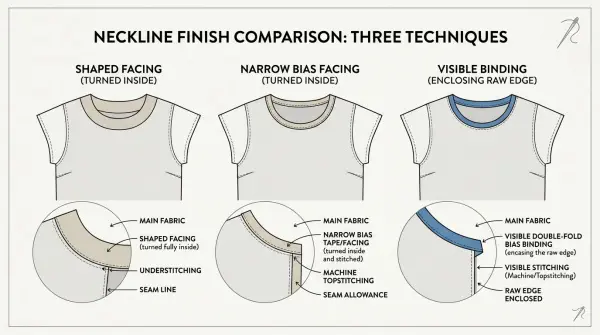
A shaped facing is a separate fabric component patterned to correspond with the neckline it finishes.
New Mexico State University defines a facing as fabric used to finish raw garment edges such as necklines and armholes. Its guidance recommends that a shaped facing match the shape and grain relationship of the garment edge it faces, with clipping, grading, pressing, and understitching used as required to keep the finished edge smooth. New Mexico State University guide to garment facings
Facings are particularly useful when the outside of the garment should show no visible binding or edge finish.
Common applications include:
- collarless woven dresses;
- blouses;
- sleeveless tops;
- tailored necklines;
- V-necks;
- square and sculpted necklines;
- garments with front or back openings.
Because a shaped facing follows the neckline geometry, it can provide more control than a narrow strip finish.
That can be valuable for angular necklines, deep V shapes, broad scoop necks, or designs where the edge needs to remain visually precise.
But a facing introduces another layer.
If the shell fabric, interfacing, facing fabric, seam allowances, and finish are all relatively heavy, the neckline may become thicker than intended. The result can be a ridge visible from the outside or an uncomfortable edge where the garment contacts the neck.
Why facings sometimes roll to the outside
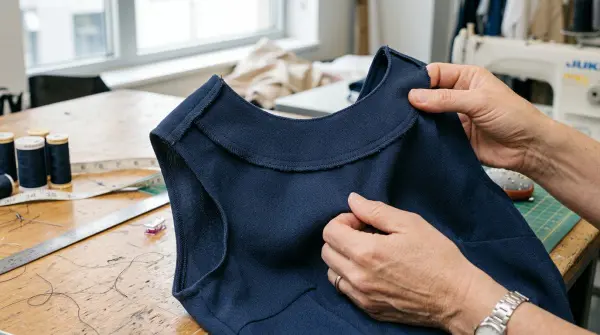
A well-patterned facing is supposed to remain inside the garment unless the design intentionally exposes it.
When a facing creeps outward, several factors may be involved:
- insufficient understitching;
- inadequate pressing;
- excessive bulk at the seam;
- mismatched facing geometry;
- unstable neckline edges;
- poorly secured facing edges;
- fabric behavior that encourages the seam to roll toward the outside.
This is why facing quality cannot be assessed simply by checking whether the piece has been attached.
The finishing operations around it matter just as much.
What Does Understitching Do?
Understitching helps keep a facing or similar internal layer from rolling toward the visible side of the garment.
The Sewing and Craft Alliance describes understitching as a line of stitching through the facing and underlying seam allowances that helps the facing remain flat and hidden from the exterior. It is commonly used around neckline and armhole facings and can also help control an undercollar. Sewing and Craft Alliance guide to understitching
This distinction matters because understitching is different from topstitching.
Topstitching is normally visible from the garment exterior. Understitching is intentionally positioned so that it remains on the inside.
That makes understitching useful when a brand wants a clean outer neckline without a visible stitch line.
It is not always possible to understitch every millimeter of a complicated neckline. Tight corners, narrow openings, or inaccessible seam sections may limit machine access. The objective is therefore to apply it where technically appropriate rather than treating it as an absolute requirement for every finish.
Grading and Clipping: Small Operations With a Visible Effect
Curved neckline seams create a geometric problem.
When a concave seam is turned right side out, the seam allowances need room to spread. If they cannot, the edge may pull, wrinkle, or refuse to lie flat.
Clipping creates that room by making controlled cuts into the seam allowance without cutting through the seam itself.
Grading addresses a different problem: bulk. Instead of leaving several enclosed seam allowances at identical widths, layers can be trimmed to different widths so they do not form one concentrated ridge.
New Mexico State University's facing instructions specifically combine seam grading, clipping of inward curves, pressing, and understitching as part of producing a smooth faced neckline.
These operations sound minor, but they become particularly important in:
- thicker fabrics;
- layered garments;
- interfaced necklines;
- tight curves;
- V-shaped necklines;
- high-contrast fabrics where surface ridges are visible;
- lightweight fabrics where bulk shows easily.
The correct amount of trimming depends on the material.
Cutting too close to the seam can weaken the construction or leave little margin for correction. Leaving everything untouched can create visible thickness.
This is one area where factory specifications should be material-sensitive rather than copied mechanically from another style.
Bias Facing and Binding: Similar Materials, Different Results
Bias strips are commonly used around curved necklines because fabric cut on the bias can conform more readily to curves than a straight-grain strip.
But bias facing and bias binding are not exactly the same finish.
A bias facing is typically turned entirely to the garment interior after attachment, creating a narrow invisible finish from the outside.
A binding wraps around or encloses the garment edge and remains visible at least at the edge, sometimes on both sides depending on the construction.
New Mexico State University's facing guidance describes bias-facing preparation and emphasizes shaping the strip to follow the curved garment edge, followed by trimming, clipping, understitching, and turning the finish inward.
When bias facing works well
Bias facing is useful where the design needs a narrow internal finish rather than the wider coverage of a shaped facing.
It often works well for:
- lightweight dresses;
- soft woven tops;
- curved collarless necklines;
- garments where a broad facing might show through;
- styles where reducing interior bulk matters.
The trade-off is reduced structural area.
A narrow bias finish does not support a broad region around the neckline in the same way a shaped interfaced facing can.
When binding works well
Binding is useful when the edge itself can become part of the design or when a compact enclosed finish is desirable.
It appears frequently in:
- casual woven tops;
- children's apparel;
- workwear details;
- athletic garments;
- lingerie;
- knitwear;
- reversible or contrast-finished garments.
Binding quality depends heavily on width control and tension.
A visibly uneven binding immediately draws attention because the finish sits directly on the garment edge.
Knit Neckbands: Finishing and Elastic Control in One Component
A knit neckline presents a different engineering problem from most woven necklines.
The garment may need to stretch substantially so the wearer's head can pass through the opening, but the finished neckline also needs to recover rather than remaining stretched.
A rib or self-fabric neckband can help provide that recovery.
Unlike a conventional woven facing, the band is often engineered to stretch as it is attached. The relationship between band length and neckline circumference therefore matters—but there is no universal reduction percentage that works for every knit.
The correct relationship depends on factors such as:
- fabric stretch;
- recovery;
- rib construction;
- band width;
- neckline circumference and shape;
- garment size;
- seam construction;
- desired tension against the body.
A band that is too long can stand away from the garment or produce a loose neckline. A band that is too short can gather the neckline, feel restrictive, or distort the garment around the shoulders and upper chest.
The seam must stretch too
It is possible to use stretch fabric but still create a neckline that fails because the seam does not extend sufficiently.
American & Efird's technical guidance notes that overedge and coverstitch seam constructions are widely used on stretch knit garments because of their seam elasticity. The same guidance warns that insufficient seam elasticity can lead to stitch cracking when stretch garments are extended. American & Efird technical guide to sewing stretch knit fabrics
Coats likewise identifies several coverseam and related stitch formations as useful for stretch garments and notes that certain class 600 stitches combine flat construction with high seam elongation. Coats guide to basic stitch types
For brands, this means the knit neckline specification cannot stop at “use rib collar.”
Band material, dimensions, stitch type, thread, feeding, and recovery all need to work together.
Why Knit Necklines Become Wavy
A wavy neckline is one of the most recognizable quality problems in jersey apparel.
It may be caused by several interacting factors:
- the garment edge stretching during sewing;
- excessive differential feeding;
- an unsuitable band-length relationship;
- poor fabric recovery;
- inappropriate thread tension;
- insufficient seam elasticity;
- excessive pressing or heat;
- incorrect handling before attachment.
The visual symptom does not identify the cause automatically.
For example, shortening the band may help if the existing band is too loose, but it can make the problem worse if the neckline is actually being stretched excessively by the sewing operation.
Production troubleshooting should therefore compare the approved pattern, cut measurements, material recovery, feeding, stitch formation, and pressing process before changing dimensions.
Lining as a Neckline Finish
A garment lining can sometimes finish the neckline directly rather than using a separate visible facing.
In this construction, shell and lining are joined at the neckline so that the raw edge is enclosed between the two layers.
This can create a particularly clean interior in:
- dresses;
- sleeveless garments;
- occasionwear;
- tailored products;
- some reversible constructions.
The lining cannot simply be treated as spare fabric inside the garment.
It must fit the shell correctly and have compatible care and dimensional behavior. New Mexico State University's construction standards note that garment linings should conceal inner construction without adding unnecessary bulk, fit smoothly inside the garment, and have care requirements compatible with the outer fabric.
Facing plus lining
More structured garments often use both systems.
A neckline or jacket front may have a facing that provides local structure and a lining that finishes the remaining interior.
This can improve shape and conceal internal construction, but it also adds components, sewing operations, and potential bulk.
For a premium tailored product, those additional operations may be justified.
For a low-cost lightweight dress, they may be unnecessary.
The decision should follow product requirements, not an assumption that more layers automatically equal better quality.
How Neckline Finishing Affects Comfort
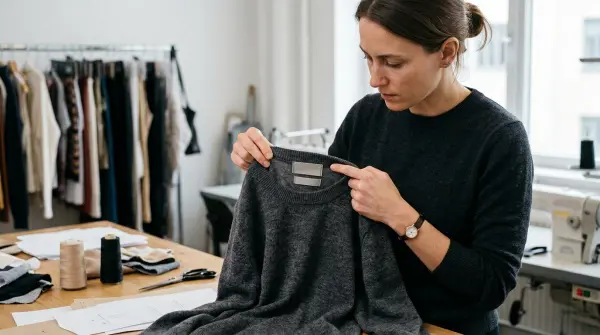
Garment comfort is often discussed in terms of fabric softness, breathability, or fit. Construction details deserve equal attention, particularly in areas that touch sensitive skin.
The neckline is one of those areas.
A technically secure finish can still be uncomfortable if it creates:
- a thick ridge against the neck;
- stiff fused edges;
- abrasive thread;
- exposed seam allowance;
- excessive tension;
- bulky labels added directly at centre back;
- rough overlocking;
- narrow bindings that curl or dig into the skin.
American & Efird notes that seam roughness can become a particular issue in tight stretch garments and that thread and stitch selection affect the tactile character of the seam.
Coats also treats seam softness as a specific performance requirement for next-to-skin apparel rather than as purely an aesthetic concern. Coats guidance on soft and secure seams for activewear and intimates
For a fashion brand, this matters most when the neckline is close-fitting.
A high mock neck, compression top, childrenswear neck opening, base layer, or tight crew neck may tolerate construction details very differently from a loose boat neck.
Comfort therefore needs to be checked on the body, not inferred from flat appearance.
How Finishing Changes the Shape of a Garment
A neckline finish does not merely follow the pattern. It can influence how the pattern behaves.
Consider a wide scoop neckline in lightweight woven fabric.
Without sufficient stabilization, the curved edge may lengthen during handling and begin to gape. A shaped facing can add more control, while a narrow bias finish may preserve a softer edge. Neither choice is automatically superior; they produce different structural outcomes.
A square neckline introduces another challenge. The corners must remain sharp enough to communicate the design, which means seam allowances and clipping need to be managed differently from a continuous round neckline.
A deep V-neck concentrates stress at the point of the V. The construction may require reinforcement and particularly careful clipping so the point turns cleanly without weakening the seam.
A knit crew neckline asks for something else entirely: enough tension and recovery to sit flat while remaining extensible.
This is why the neckline design and its finish should be developed together.
If the design team changes the neckline significantly but leaves the old finishing specification untouched, the previous solution may no longer be appropriate.
Stabilization Before Finishing
Some neckline problems occur before the facing, binding, or band is ever attached.
Curved woven edges can contain sections that are relatively vulnerable to distortion during handling. Traditional staystitching is one method for maintaining shape during construction.
The Sewing and Craft Alliance recommends directional staystitching for areas such as necklines where maintaining pattern shape is important, with the direction chosen to minimize distortion. Sewing and Craft Alliance guidance on staystitching
Industrial production may use different stabilization strategies depending on the garment, including:
- staystitching;
- fusible tapes;
- narrow interlining;
- clear or elastic reinforcement;
- lining or facing construction;
- controlled handling and bundling;
- engineered seam operations.
The appropriate solution depends on material and manufacturing method.
The useful principle is broader than any single technique:
Finish the neckline while it still has the intended geometry.
If the edge has already stretched substantially out of shape, later finishing may lock the distortion into the garment rather than correct it.
Interfacing Can Improve—or Overpower—a Neckline
Some facings and neckline areas use interfacing to add stability.
This can be useful around:
- structured collarless necklines;
- button or zipper openings;
- tailored facings;
- shaped V-necks;
- heavier garments;
- areas supporting closures.
But the objective is not maximum stiffness.
An interfacing that is too heavy for the shell fabric can produce a neckline that looks rigid, creates visible ridges, or feels uncomfortable.
A material that fuses poorly can create bubbling, delamination, strike-through, or changes in hand.
Product teams should therefore evaluate the shell and interfacing together rather than specifying interfacing only by generic weight class.
For a deeper discussion of the support system itself, see fusible vs sew-in interlining.
What Does Good Neckline Quality Look Like?
A technically successful neckline usually looks uneventful.
That is a compliment.
The eye should see the intended garment silhouette rather than construction problems.
Quality criteria vary by product, but an approval checklist may include:
- neckline shape matches the approved pattern and sample;
- left and right sides are visually balanced;
- curved edges are smooth;
- V or square corners are clean where applicable;
- facings remain inside and do not roll outward;
- bindings maintain consistent finished width;
- knit bands lie flat without unwanted waviness;
- seam allowances do not create visible ridges;
- edge stitching is even where visible;
- no skipped or broken stitches are present;
- the neckline is comfortable during normal movement;
- pull-on garments provide sufficient opening stretch;
- finished appearance remains acceptable after required care testing.
For bulk production, these requirements should be translated into specifications the factory can inspect.
“Neckline should look premium” is not a measurable quality standard.
Neckline Finishing and Production Cost
Finishing method also affects sewing time.
A shaped facing can require separate cutting, possible interfacing, shoulder joining, edge finishing, attachment, clipping, grading, understitching, pressing, and securing.
A simple knit band may appear operationally shorter, but it still requires controlled cutting, joining, attachment, seam elasticity, and sometimes topstitching or coverstitching.
Binding may reduce the number of large facing pieces but can require specialized folders and precise feeding for efficient production.
A fully lined neckline adds material and assembly operations but may eliminate another finish.
The cheapest construction therefore depends partly on factory capability.
A binding operation can be highly efficient in a facility equipped with the right folders and operators, yet slower and less consistent in a production line that rarely uses the technique.
Fashion businesses should cost the actual operation sequence, not assume that the visually simplest finish is automatically the least expensive.
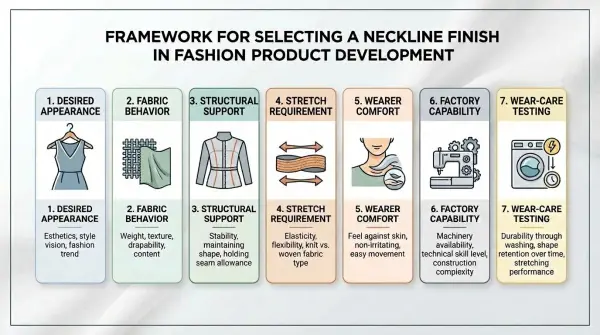
Practical Framework for Choosing a Neckline Finish
A useful decision process starts with the garment rather than with a preferred sewing technique.
1. Define the visible result.
Should the neckline edge appear completely clean, visibly bound, topstitched, soft, crisp, narrow, or structured?
2. Assess the fabric.
Consider weight, thickness, drape, fraying, stretch, recovery, transparency, heat sensitivity, and surface appearance.
3. Identify the structural requirement.
Does the edge need significant support or only a clean enclosure?
4. Check dressing requirements.
For pull-on garments, determine how much extension is required through the neckline and seam.
5. Evaluate next-to-skin comfort.
Review seam bulk, thread, labels, binding edges, interfacing, and internal finishes.
6. Match the process to factory capability.
Check folders, machine types, operator skill, pressing equipment, and expected output.
7. Test the complete garment.
Assess appearance, movement, repeated dressing, and intended laundering or cleaning.
A strong finishing specification balances these requirements rather than optimizing only one of them.
Common Neckline Finishing Mistakes
Many neckline failures are created by a mismatch between method, material, and product requirement rather than by poor stitching alone.
Using a heavy facing on a lightweight garment
A broad interfaced facing may control shape but can show through fine fabric or create a stiff perimeter.
Why it happens: teams prioritize structural stability without considering handfeel and transparency.
Operational consequence: visible ridges, bulky edges, or extra pressing.
Better approach: test lighter support, narrow facing alternatives, lining, or another finish appropriate to the design.
Skipping edge stabilization when the fabric needs it
A neckline may stretch during cutting, bundling, or sewing before the final finish is applied.
Operational consequence: the finished neckline gapes or no longer matches the facing.
Better approach: evaluate edge stability during sampling and specify appropriate handling or stabilization.
Assuming understitching is decorative
Understitching may be omitted because it is not visible from the garment exterior.
Operational consequence: a facing becomes more likely to creep toward the visible side.
Better approach: treat it as a functional construction operation where the facing system benefits from it.
Applying one neckband ratio to every knit
Fabric stretch and recovery can differ considerably even between visually similar knits.
Operational consequence: one style becomes tight while another neckline waves or flares.
Better approach: determine band dimensions through actual fabric trials rather than relying on a universal percentage.
Optimizing the neckline only for flat appearance
A garment can look perfect on the inspection table and still be uncomfortable or unstable in wear.
Operational consequence: pulling over the head cracks stitches, high necklines feel abrasive, or the edge shifts during movement.
Better approach: include dressing and movement tests during approval.
Adding too many layers because they appear “premium”
More interfacing, facing, tape, and lining does not automatically improve quality.
Operational consequence: greater bulk, longer production time, higher cost, and potentially less comfort.
Better approach: use only the structure required to achieve the approved performance.
What Fashion Businesses Should Verify Before Production
Before a neckline is released for bulk production, the brand and supplier should understand not only what the finish looks like but how it is expected to perform.
Verify:
- the approved neckline measurement and shape;
- required facing, binding, band, or lining components;
- material and grain direction;
- interfacing or stabilization specification where applicable;
- seam allowance and trimming requirements;
- stitch and seam construction;
- finished binding or band width;
- neckband dimensions for each relevant size;
- appearance around closures;
- pressing requirements;
- comfort against the skin;
- opening stretch for pull-on garments;
- appearance after intended care testing;
- factory capability and repeatability.
Changes to fabric or production location should trigger another review when they materially affect these conditions.
A finishing method approved on one fabric should not automatically be considered validated for another.
Important Technical Caveats
There is no single “best” neckline finish.
A shaped facing provides useful structure but may be unnecessarily heavy for a very lightweight garment. Bias finishing reduces coverage and bulk but provides different structural control. Binding can be efficient and decorative but makes width and tension consistency highly visible. Lining creates a clean enclosed edge but adds another material system. Knit bands provide elasticity but require careful balance between extension and recovery.
Likewise, common construction techniques are not universal rules.
Not every neckline requires staystitching. Not every facing can be understitched completely. Not every knit neckline uses the same band reduction. Not every collarless neckline needs interfacing.
The correct finish depends on pattern geometry, textile behavior, garment function, visual intent, production scale, factory capability, care process, and quality target.
That context matters more than the name of the sewing technique.
Frequently Asked Questions
What is the best way to finish a neckline?
There is no universally best neckline finish. The appropriate method depends on the garment and fabric.
A shaped facing works well when a clean exterior and relatively controlled shape are required. Bias facing can reduce bulk on lightweight woven garments. Binding is useful when an enclosed or visible edge is desirable. Knit bands are appropriate when stretch and recovery are part of the neckline function. Linings can create a very clean enclosed finish in dresses and structured garments.
The best choice is the one that produces the intended appearance while meeting comfort, stretch, durability, manufacturing, and care requirements.
What is the difference between a facing and binding?
A facing is generally an additional piece positioned on the inside of the garment to finish and sometimes support the neckline. It may be shaped to follow the neckline or created from a narrow bias strip.
Binding wraps around or encloses the raw garment edge and normally remains visible along the edge.
The distinction affects both appearance and structure. A broad shaped facing can support a larger area around the neckline, while binding creates a much narrower edge construction.
Neither is automatically better; they solve different design and production problems.
Why does a neckline facing keep flipping out?
A facing may roll outward because of insufficient understitching, poor pressing, excessive seam bulk, inaccurate facing geometry, inadequate stabilization, or fabric behavior.
Understitching is particularly useful because it anchors the seam allowances toward the facing side and encourages the neckline seam to remain slightly inside rather than rolling outward.
However, adding understitching will not correct a badly distorted neckline or incorrectly shaped facing.
When the problem persists, teams should review pattern geometry, seam allowances, clipping, pressing, fabric, and how the facing is secured inside the garment.
Why does a T-shirt neckline become stretched or wavy?
A knit neckline can become wavy when the neckline edge is stretched excessively during sewing, when the neckband dimensions do not match the fabric's recovery, or when stitch, thread tension, feeding, and pressing are poorly controlled.
Stretch knit seams also need enough seam elasticity. Technical guidance for knit sewing highlights stitch balance, seam construction, thread choice, and stitch density as factors in preventing stitch cracking and poor stretch performance.
A factory should therefore diagnose the complete sewing system rather than changing only the band length.
Does every neckline need interfacing?
No.
Interfacing is useful when the neckline or its facing requires additional stability, support for a closure, or more controlled shape. Many lightweight or stretch garments use little or no conventional interfacing around the neckline.
Adding unnecessary interfacing can increase stiffness, bulk, and visible ridging.
The decision should be based on the shell fabric, neckline geometry, finishing method, intended handfeel, and care requirements. When fusible interfacing is used, the actual shell-and-interfacing combination should be tested rather than approved independently.
Is binding cheaper than a facing?
Not necessarily.
Binding can reduce the size and number of facing components, but its production cost depends on whether strips must be cut, joined, folded, pressed, and attached manually or whether the factory has efficient binding equipment and folders.
A factory specializing in knitwear may apply binding rapidly and consistently. Another production line may find a conventional facing easier to control.
Cost comparisons should therefore include material consumption, component preparation, machine requirements, sewing time, pressing, rework risk, and quality expectations.
How can neckline finishing improve garment comfort?
Comfort improves when the finish minimizes unnecessary thickness, avoids abrasive edges, provides enough opening ease or stretch, and remains stable during movement.
This is particularly important for tight crew necks, childrenswear, activewear, base layers, and high collars because the construction stays close to sensitive skin.
Thread type, seam structure, labels, interfacing, binding tension, and edge thickness can all affect tactile comfort.
A neckline should therefore be evaluated on a wearer or appropriate fit form rather than judged only by how neat the inside construction looks.




Comments 0
Leave a CommentSend Comment
Anda harus Login terlebih dahulu untuk dapat memberikan komentar.