

Why Satin Remains Popular in Eveningwear, Lingerie, and Occasion Fashion
Quick Answer
Satin remains popular in eveningwear, lingerie, and occasion pieces because its smooth, light-reflective surface creates immediate visual distinction, while its many available weights and fiber combinations support both fluid and structured silhouettes.
Lightweight satin can follow the body in slip dresses, camisoles, robes, and draped gowns. Heavier satin can hold the volume required for bridal dresses, corseted bodices, bows, and sculptural skirts. Stretch versions extend its use into closer-fitting lingerie and occasion garments.
Its popularity is not based on appearance alone. Satin can be produced from silk, polyester, nylon, acetate, viscose, and blends, enabling brands to develop different price levels, care routes, and market positions around a recognizable visual language.
The same qualities also create risks. Satin can expose seam puckering, construction lines, pressure marks, snagging, poor fit, and inconsistent panel direction. Smoothness does not automatically mean breathability or comfort, and “satin” does not prove silk content.
For fashion businesses, satin works best when the specific construction supports the garment’s silhouette, wearer expectations, production capability, care requirements, and price promise.
Why Has Satin Retained Its Place in Occasion Fashion?
Satin has retained its place because it turns light and movement into part of the garment design. A relatively simple silhouette can appear visually complex when highlights travel across folds, gathers, pleats, or the contours of the body.
This characteristic has long connected satin with evening settings. Artificial lighting, candlelight, flash photography, and directional event lighting can all emphasize its reflective surface. Historical use does not prove that every satin style remains commercially relevant, but it shows that designers have repeatedly used the material for the same underlying reason: it responds dramatically to light.
The Victoria and Albert Museum notes that Jeanne Lanvin’s 1930s evening dresses used reflective satin to engage with light and surface sheen. The shapes and social settings have changed since then, but the material mechanism remains recognizable.
Satin also offers range. The term covers lightweight, liquid constructions as well as dense, structured qualities. It can look romantic, restrained, glamorous, minimal, sensual, ceremonial, or deliberately casual depending on color, finish, pattern, styling, and garment construction.
That flexibility is more important than any single seasonal trend.

The Material Creates Visual Value Before Decoration Is Added
Satin can give a garment visual presence without relying on print, heavy embellishment, or a complicated pattern. Its surface reacts as the wearer moves, producing areas of brightness and shadow that change continuously.
For a fashion brand, this can be commercially useful. A clean bias-cut dress in a well-chosen satin may communicate occasion value through material and silhouette rather than embroidery or extensive handwork. That does not necessarily make the garment inexpensive—the fabric, cutting loss, lining, sampling, and sewing may still be demanding—but it provides another way to build perceived distinction.
Color also behaves strongly on satin. Dark shades can appear deep and dramatic, jewel tones can look saturated, and pale shades may create a softer bridal or lingerie association. The outcome depends on fiber, dyeing, finishing, lighting, and photography; satin does not intensify every color in the same way.
The fabric’s visual identity can therefore support several design strategies:
- Minimal silhouette with material-led impact.
- Tonal dressing using changes in sheen instead of print.
- Contrast between satin and matte fabrics.
- Draping that directs highlights around the body.
- Structured volume that creates broad reflective planes.
- Small satin details used to signal polish on an otherwise restrained product.
These effects require discipline. When too many glossy materials, trims, and reflective embellishments compete within one garment, the result can lose focus. Satin is often most convincing when the design gives its surface enough space to work.
Why Satin Works Particularly Well in Eveningwear
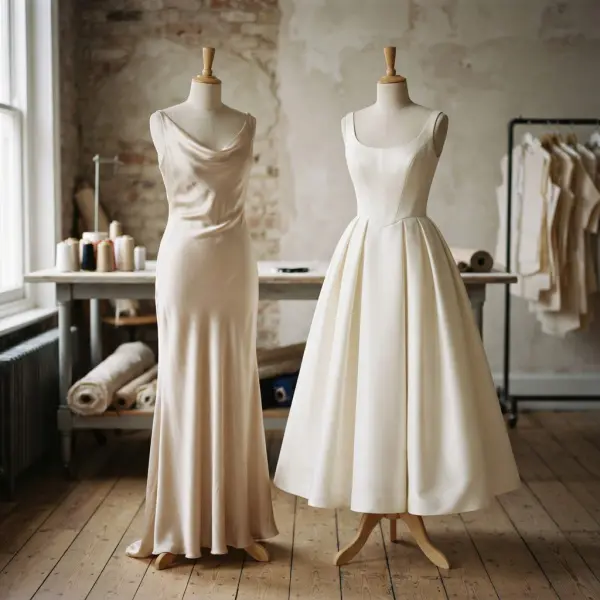
Satin works in eveningwear because it can combine movement, surface drama, and a strong relationship with the body. Depending on the quality selected, it can skim the figure, create controlled draping, or hold a formal silhouette.
Designers do not use one universal eveningwear satin. The product category may involve lightweight charmeuse, stretch satin, crepe-back satin, duchess satin, or other supplier-defined qualities. Their suitability varies substantially.
Fluid Satin Supports Body-Led Silhouettes
Lightweight satin can fall into soft folds and respond quickly to movement. This makes it suitable for slip dresses, cowl necklines, bias-cut skirts, gathered gowns, soft sleeves, scarves, and draped details.
The fabric may allow the body and material to shape each other rather than forcing the silhouette through heavy internal structure. The Victoria and Albert Museum describes how Madeleine Vionnet allowed fabric to influence garment shape and effect, with satin appearing among her evening designs.
Fluidity is not automatically flattering or easy to fit. Lightweight satin can reveal undergarments, seam allowances, facings, wrinkles, and minor fit problems. A bias-cut garment may also lengthen or distort during hanging and wear, depending on its construction.
Heavier Satin Creates Formal Structure
Dense satin can provide body for ball gowns, bridal dresses, corseted bodices, column dresses, fitted jackets, full skirts, trains, and oversized bows. Instead of falling closely against the body, it can create broader planes and more deliberate volume.
This makes heavier satin useful when the design needs a polished surface without the transparency of organza or the softness of chiffon. It can also support embroidery and embellishment, although the weight of decoration and risk of surface damage must be tested.
A heavy fabric can become uncomfortable if the garment also contains extensive boning, multiple lining layers, beads, or a long train. Product development should consider total garment weight, not fabric weight in isolation.

Satin Can Make Simple Construction Look Less Simple
A satin column dress may contain relatively few visible design lines, yet its surface creates changing visual information. This can suit brands built around minimalist occasionwear, where proportion, fit, color, and fabric quality carry most of the design.
There is little room for weak execution. Uneven hems, twisted side seams, mismatched panel direction, or pressing marks can become highly visible on a simple reflective garment.
Why Satin Is Closely Associated With Lingerie and Sleepwear
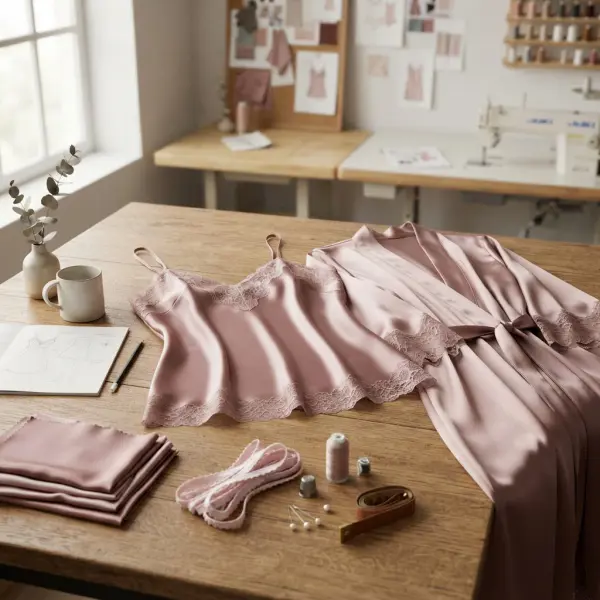
Satin suits many lingerie and sleepwear designs because its smooth face can glide across the body and other fabrics, while its luster communicates softness, intimacy, and visual polish. Comfort, however, depends on much more than surface smoothness.
The Museum at the Fashion Institute of Technology distinguishes between structured “hard” lingerie and softer, unstructured categories such as slips, nightgowns, and panties in its historical overview of lingerie. Satin and satin-faced materials have appeared across both structured and soft forms.
Smoothness Supports Layering
Slips, camisoles, robes, and certain foundation garments need to move under outer clothing without excessive friction. A smooth satin face can help garments slide across one another and reduce visible catching.
That benefit depends on fit and construction. Bulky seams, heavy elastics, rough lace, exposed labels, or poorly placed hardware can negate the smoothness of the main fabric. The complete product must be evaluated against the skin and under the clothing with which it is expected to be worn.
Satin Can Communicate Intimacy Without Complex Styling
In lingerie, fabric carries a large share of the product message. Satin’s sheen and soft folds can communicate sensuality, indulgence, or ceremony even in a relatively simple camisole or robe.
This creates merchandising flexibility. The same basic silhouette can be repositioned through color, lace, piping, embroidery, print, trim, or fabric weight. A dark satin set may feel dramatic, a pale neutral may appear bridal, and a washed satin may support a quieter loungewear direction.
These associations are cultural and market-dependent. Brands should avoid assuming that every audience interprets colors, exposure, modesty, or lingerie styling in the same way.
Smooth Does Not Automatically Mean Breathable
A smooth surface may feel pleasant initially, but thermal and moisture comfort depend on fiber composition, fabric density, finish, garment fit, climate, and activity.
A dense polyester satin robe may behave differently from lightweight silk or viscose satin. Neither the word “satin” nor visual softness proves that a product will feel cool, breathable, or comfortable throughout the night.
Product descriptions should therefore avoid unverified claims such as “temperature regulating,” “naturally cooling,” or “breathable all night.” If comfort performance forms part of the commercial promise, it should be supported by suitable testing and wear trials.
Why Satin Works in Bridalwear and Occasion Pieces
Occasion pieces must often look distinctive for a limited number of highly photographed events. Satin supports that requirement through sheen, color depth, shape, and movement.
Bridalwear is an obvious example, but occasion use also includes bridesmaid dresses, reception outfits, graduation dresses, cocktailwear, gala pieces, festive clothing, formal separates, evening suits, event accessories, and culturally specific ceremonial garments.
The material can serve very different product briefs:
|
Occasionwear brief |
Satin approach that may fit |
Main risk to evaluate |
|
Fluid destination-wedding dress |
Lightweight or crepe-back satin |
Transparency, clinging, wrinkles, and bias distortion |
|
Structured bridal gown |
Dense duchess-style satin |
Garment weight, pressing marks, and restricted movement |
|
Bridesmaid program |
Commercial satin with repeatable colors |
Shade continuity, sizing consistency, and reorder availability |
|
Fitted cocktail dress |
Stretch satin |
Recovery, seam stress, and surface marking |
|
Formal suit or corseted top |
Firm satin with stable construction |
Seam impressions, abrasion, and puckering |
|
Occasion blouse or skirt |
Medium-weight, lower-luster satin |
Static, care, snagging, and day-to-evening versatility |
|
Hair bow, bag, or shoe detail |
Dense satin suited to accessories |
Friction against hardware and localized wear |
These are starting points rather than fixed prescriptions. A supplier name such as “duchess” or “stretch satin” does not guarantee a standardized weight or performance level.
Satin Can Signal Ceremony Without Requiring Traditional Ornament
Some customers want an occasion garment that feels special but not heavily embellished. Satin can provide that distinction through material alone.
This is useful for minimalist bridal collections, civil-ceremony dresses, modern bridesmaid lines, evening separates, and products intended for styling beyond one event. A cleaner satin garment may also be easier to restyle than a heavily beaded piece, although versatility depends on silhouette and color as much as fabric.
Photography Strengthens Satin’s Occasion Value
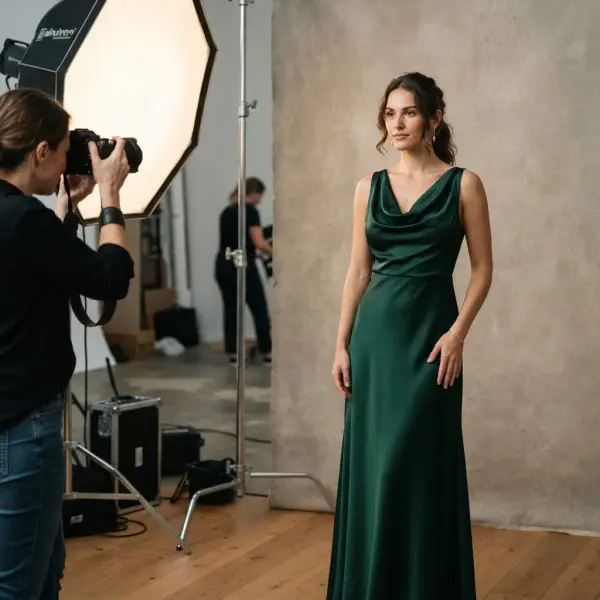
Weddings, graduations, galas, and other events are heavily documented. Satin’s interaction with light can make folds and silhouettes visually legible in photographs.
It can also create problems. Strong flash may produce blown highlights, reveal wrinkles, or make a pale fabric appear more transparent than expected. Dark satin can show dust, marks, or irregular pressing. E-commerce and campaign teams should test the actual garment under studio flash, daylight, warm indoor light, and mobile-phone photography.
A fabric that looks balanced to the eye may behave differently through a camera.
Why Brands Can Use Satin Across Different Price Levels
Satin is commercially flexible because the weave can be produced from different fibers and in numerous weights and finishes. This allows brands to develop related visual stories across luxury, premium, and broader commercial products.
A silk satin gown, polyester satin bridesmaid dress, acetate-blend lining, and stretch satin lingerie set may share a recognizable surface language without sharing the same composition, performance, or price.
The distinction between structure and fiber is examined in Satin vs Silk: Why Fabric Structure and Fiber Are Not the Same. From a merchandising perspective, the important issue is transparency. A lower-priced satin is not problematic because it is synthetic; it becomes problematic when the brand allows customers to believe they are purchasing silk.
Satin Supports Color-Based Collection Building
Satin works well in collections built around coordinated colors. A brand might offer a dress, camisole, skirt, scarf, bag, and hair accessory in related satin shades.
Color continuity should not be assumed across fiber types or suppliers. Polyester satin and silk satin may take dye differently, while surface reflection can make technically similar colors appear mismatched. Even separate dye lots of the same quality may not coordinate under every light source.
For bridesmaid or event programs, reorder continuity deserves particular attention. A customer purchasing an additional garment several months later may expect an exact match that the supplier cannot guarantee.
One Fabric Can Support Multiple Silhouettes—Within Limits
A commercially successful satin quality may be extended across slips, skirts, blouses, robes, and dresses, improving order volume and simplifying color coordination. This works only when the fabric’s weight, stretch, opacity, and performance suit each product.
Using the same lightweight satin for every category can create avoidable problems. A fabric appropriate for a loose camisole may not tolerate stress at the seat of a fitted skirt. A satin suitable for a lined dress may be too transparent for an unlined blouse.
Fabric consolidation should follow end-use testing rather than purchasing convenience.
Satin’s Familiarity Helps Customers Read the Product Quickly
Customers often recognize satin’s visual cues even when they do not understand its weave structure. The sheen signals that the product differs from a basic jersey, poplin, or matte crepe garment.
This visual familiarity can help e-commerce merchandising. A thumbnail can communicate some sense of occasion, drape, or polish without requiring extensive explanation.
It can also create inaccurate assumptions. Customers may believe that satin means silk, softness, luxury, breathability, or delicate care. Product pages need to clarify what the fabric actually is.
Useful information may include:
- Verified fiber composition.
- Whether the garment is lined.
- Fabric weight in understandable terms.
- Stretch or non-stretch construction.
- Fit and drape description.
- Opacity.
- Surface sheen level.
- Care instructions.
- Close-up photography of the face and reverse.
- Movement video under realistic light.
- Any tendency to crease, cling, or show undergarments that materially affects purchase decisions.
A glossy campaign image alone does not help a customer judge how the garment will behave at an event.
The Trade-Offs Behind Satin’s Appeal
The properties that make satin visually attractive can complicate manufacturing and wear. The long floats responsible for its smooth surface can be exposed to snagging, picking, and abrasion.
Cotton Incorporated notes that satin structures may offer good drape while presenting potential problems with snagging, skew, and seam slippage. These are tendencies requiring evaluation, not proof that every satin will fail.
Fit Errors Become More Visible
Reflective fabrics highlight tension lines, drag lines, puckering, and uneven shaping. In lingerie and fitted occasionwear, small fit problems may appear more severe than they would on a matte or textured fabric.
Sizing should be tested across the intended range rather than approved on one sample size. Stretch recovery, bust shaping, hip ease, lining, closure stress, and seam placement all require garment-level evaluation.
Construction May Show Through the Surface
Lightweight satin can reveal seam allowances, darts, pocket bags, facings, labels, boning channels, and uneven underlayers. Thick overlocked seams may create ridges, while poorly selected interfacing can alter drape or leave adhesive impressions.
A clean exterior may require more careful internal construction than the final garment suggests.
Snags and Marks Can Affect Returns
Customers may interpret a pulled filament, pressure mark, or visible needle hole as a manufacturing defect even when the fabric is inherently sensitive. Brands must decide whether that sensitivity is appropriate for the target customer and use context.
Occasion garments also pass through makeup, perfume, food, drinks, dance floors, vehicle seats, jewelry, handbags, and crowded storage. Wear trials should reflect those conditions instead of evaluating the garment only on a clean studio floor.
Care Can Be Inconvenient
Some satin garments may be washable, while others require delicate handling or professional cleaning. The correct route depends on fiber, dye, finish, garment construction, trims, embellishment, and test results.
Copying a care label from another satin product is not sufficient. Cleaning can reveal shrinkage, water marks, seam distortion, loss of finish, dye migration, or damage to internal components.
How Fashion Businesses Should Develop Satin Products
Satin product development should begin with the experience the garment needs to deliver. “Luxury satin” is not a usable technical brief.
Translate the Creative Idea Into Material Requirements
A design brief should define the silhouette, movement, shine, body contact, event context, care expectation, and price target. Only then should the team select fiber, construction, weight, stretch, and finish.
For example, a bridesmaid dress intended for warm outdoor weddings may require different opacity, moisture comfort, colorfastness, and recovery from a studio evening dress designed primarily for short indoor events.
Build a Category-Specific Test Plan
Not every satin product faces the same risks. Testing should reflect the product:
- Evening dresses need checks for seam slippage, snagging, drape, dimensional stability, and pressing.
- Lingerie needs stretch, recovery, skin-contact comfort, elastic compatibility, colorfastness, and wash performance.
- Bridalwear needs garment weight, support, long-duration wear, photography, floor contact, and pressing evaluation.
- Accessories need abrasion, hardware contact, shape retention, and stain resistance.
- Bridesmaid programs need shade continuity, repeat orders, sizing consistency, and bulk availability.
Test methods and acceptance criteria should be agreed with qualified laboratories, suppliers, factories, and target-market requirements.
Approve the Entire Garment Under Event Conditions
Fit sessions should include sitting, walking, climbing stairs, dancing, raising the arms, and wearing the intended undergarments and footwear. Longer trials can reveal comfort and recovery problems that a brief fitting misses.
Photography trials are equally useful. Examine the garment under multiple light sources and camera settings, including ordinary mobile-phone flash. This can identify transparency, highlight clipping, visible internal construction, and unexpected shade changes.
Protect the Surface Through Production
Satin can pick up oil, dust, pressure marks, or snags during cutting and sewing. Factory controls may need clean tables, careful bundling, protected machine surfaces, appropriate storage, controlled pressing, and reduced contact with rough fasteners.
Pressing is particularly consequential because reflective fabric records uneven heat and pressure. The broader relationship between pressing, shape, and perceived quality is explored in How Pressing Affects Garment Shape, Drape, and Perceived Quality.

Common Strategic Mistakes With Satin Collections
Selecting Satin From a Photograph
A digital image cannot communicate handfeel, weight, opacity, stretch recovery, snagging, or pressing response. Lighting and editing also change the apparent sheen and color.
Brands should approve physical fabric and garment standards. Video can support the review of movement but does not replace touch, measurement, or testing.
Using Maximum Shine as the Main Quality Standard
High reflectivity is not automatically more luxurious. Excessive or uneven shine can look harsh under flash, expose surface defects, or conflict with a brand’s positioning.
The appropriate sheen depends on silhouette, color, customer, event type, and styling. A softly lustrous satin may communicate more refinement than a highly polished version in some markets.
Reusing One Satin Across Unsuitable Products
Material consolidation can improve purchasing efficiency, but a fabric selected for a robe may lack the stability needed for a fitted skirt. A structured bridal satin may be uncomfortable for sleepwear.
Each product must meet its own performance requirements even when the collection needs visual coordination.
Treating Satin as a Substitute for Good Fit
Satin can make a design look polished on a hanger, but it cannot compensate for poor pattern balance, inadequate ease, weak bust shaping, or unstable seams. Its reflective surface may make those problems more obvious.
Fit and movement should be resolved before campaign photography or bulk approval.
Hiding Fiber Content Behind Material Language
Calling a product “luxury satin” while making composition difficult to find can cause customers to assume it contains silk. This affects trust, value expectations, and potentially regulatory compliance.
The distinction is not difficult to communicate: describe the satin appearance and state the verified fiber composition clearly.
Designing Only for the First Photograph
Occasionwear must survive the event, not merely the product shoot. A garment that looks strong in a standing pose may restrict sitting, crease immediately, show perspiration, or suffer abrasion from jewelry and handbags.
Longer wear trials should be part of approval for commercially important styles.
What Satin’s Popularity Does Not Mean
Satin’s continued presence in eveningwear and lingerie does not mean that every satin product will sell or that the material is suitable for every customer.
It does not mean:
- Satin must be highly glossy.
- Satin automatically contains silk.
- A smooth fabric will always feel cool or comfortable.
- Silk satin is universally superior to synthetic satin.
- Every occasion garment needs reflective fabric.
- Satin is inherently sustainable or unsustainable.
- Delicate appearance proves delicate performance.
- A supplier trade name guarantees a particular weight or quality.
- Historical use guarantees modern commercial demand.
The most reliable conclusion is narrower: satin offers a versatile combination of luster, movement, structure, and cultural familiarity that designers can adapt to several occasion-oriented categories. Commercial success still depends on relevance, execution, fit, price, customer communication, and operational control.
Frequently Asked Questions About Satin in Eveningwear and Lingerie
Why is satin commonly used for evening dresses?
Satin is commonly used for evening dresses because its smooth surface reflects directional light, making folds, draping, color, and body movement visually prominent. It can also be produced in lightweight fluid versions or heavier structured versions.
That flexibility supports slip dresses, bias-cut gowns, corseted bodices, full skirts, and minimalist columns. Suitability still depends on the individual fabric. Brands must evaluate opacity, seam stability, snagging, fit, pressing, garment weight, and appearance under flash photography before approving an eveningwear satin.
Is satin comfortable for lingerie and sleepwear?
Satin can be comfortable when its fiber, weight, finish, fit, and construction suit prolonged skin contact. Its smooth face may reduce friction and help garments move beneath outer clothing.
Smoothness alone does not guarantee breathability, cooling, or moisture management. Dense construction, synthetic fiber, tight fit, bulky seams, elastics, lace, labels, and climate can change the experience substantially. Lingerie and sleepwear should be wear-tested for movement, temperature, moisture, seam comfort, static, stretch recovery, and performance after the intended cleaning process.
Which type of satin is best for a formal dress?
There is no universally best satin. Lightweight charmeuse-style satin may suit fluid draping and bias-cut silhouettes, while dense duchess-style satin may suit structured bodices, full skirts, and architectural volume. Stretch satin may be more appropriate for close-fitting designs.
The decision should be based on silhouette, opacity, body, drape, recovery, garment weight, lining, care, embellishment, and price. Supplier trade names are not fully standardized, so a physical sample, technical specification, sewing trial, and finished-garment test are more useful than the fabric name alone.
Why does satin sometimes look cheap?
Satin may appear less refined when the luster is too harsh for the design, the fabric is thin or poorly supported, seams pucker, undergarments show through, panels reflect in different directions, or styling combines too many shiny elements.
Fiber composition is only one factor. A well-developed polyester satin can look more appropriate than a poorly selected silk satin. Brands should prioritize controlled sheen, suitable weight, clean construction, balanced fit, accurate pressing, considered color, and realistic photography instead of using price or fiber prestige as the only quality signal.
Does satin photograph well at weddings and events?
Satin can photograph effectively because highlights define folds and movement. However, strong flash or direct lighting may create excessive glare, reveal wrinkles, exaggerate transparency, or show construction lines beneath the surface.
Bridal and occasion brands should photograph the actual sample under daylight, warm indoor lighting, professional studio light, and mobile-phone flash. Pale colors need particular opacity checks, while dark colors may reveal dust or pressure marks. Photography testing should happen during product development, not only during the final campaign.
Can satin occasionwear be worn more than once?
Yes, depending on silhouette, color, durability, care, and styling flexibility. A minimally embellished satin skirt, blouse, slip dress, or tailored separate may move between different events more easily than a highly specific ceremonial gown.
Repeat wear should not be assumed from fabric choice alone. Brands that want to support versatility can use detachable details, restrained colors, adjustable styling, separates, repairable construction, and clear care guidance. Product claims about longevity should still reflect tested performance and realistic consumer use.
Is silk satin always the best choice for luxury occasionwear?
No. Silk satin may support premium positioning through its fiber identity, handfeel, and material story, but it is not automatically the most suitable choice for every garment.
A different satin may better meet requirements for stretch, washable care, color consistency, availability, production scale, or target price. Luxury perception also depends on design, fit, finishing, internal construction, trims, service, and communication. The most credible material choice is the one that supports the brand promise and performs consistently throughout production and use.
Conclusion
Satin remains relevant to eveningwear, lingerie, bridalwear, and occasion fashion because it gives designers several tools at once. It can reflect light, follow movement, create polished structure, deepen color, and signal that a garment belongs outside the ordinary rhythm of basic dressing.
Its range matters just as much as its appearance. Lightweight satin can create intimate, body-led silhouettes, while heavier qualities can support ceremony and volume. Multiple fiber options allow brands to develop different care routes, prices, and material stories around that visual language.
Yet satin is unforgiving when product development is weak. It can reveal poor fit, puckered seams, mismatched panel direction, internal construction, excessive pressure, and unrealistic comfort claims. Its strongest qualities need to be engineered into the product rather than assumed from the fabric name.
For fashion businesses, the strategic opportunity is not simply to add shine. It is to select the right satin for a clearly defined occasion, test it under real movement and lighting, manufacture it with control, and explain honestly what the customer is buying.





Comments 0
Leave a CommentSend Comment
Anda harus Login terlebih dahulu untuk dapat memberikan komentar.