

How Brands Evaluate Fabric Suppliers, Trims Vendors, and Production Partners
Quick Answer
Fashion brands evaluate suppliers by determining whether each vendor can consistently meet the specific technical, quality, capacity, delivery, commercial, communication, traceability, and risk requirements of the product being sourced. The evaluation should match the vendor's actual role: a fabric mill should not be assessed exactly like a zipper supplier, and neither should be evaluated exactly like a garment factory.
For fabric suppliers, brands typically examine material specifications, consistency, testing performance, color and finish control, minimum order quantities, lead times, and repeatability between production lots. Trims vendors require attention to dimensions, function, finish, color matching, durability, compatibility with the garment, tooling, and replenishment reliability. Production partners require broader assessment of machinery, workmanship, product-category experience, production planning, capacity, quality systems, subcontracting, and management capability.
The strongest evaluation process does not ask only, “Can this vendor make the product?” It also asks, “Can this vendor reproduce it reliably, at the required scale, under commercially workable conditions, with risks we understand and can manage?”
What Does Supplier Evaluation Mean in Fashion?
Supplier evaluation is the structured process of determining whether a potential or existing vendor is suitable for a defined sourcing requirement. It translates a fashion brand's product, operational, commercial, and risk expectations into criteria that can be examined before meaningful order volume is committed.
That definition matters because supplier evaluation is sometimes treated as little more than collecting quotations and samples. A good-looking fabric cutting, an attractive zipper sample, or a well-sewn prototype proves something, but not everything. It demonstrates that the vendor can produce at least one acceptable sample under a particular set of conditions. It does not automatically demonstrate bulk consistency, capacity, lead-time reliability, quality control, cost stability, or the ability to manage problems.
Evaluation therefore sits between supplier discovery and long-term fashion vendor management. Sourcing identifies possible partners. Evaluation determines whether those partners are fit for a particular role. Vendor management then monitors whether the approved supplier continues to perform as expected.

Why Different Fashion Vendors Need Different Evaluation Criteria
A common evaluation framework is useful, but a universal checklist is not.
Fabric, trims, and garment manufacturing occupy different positions in the product-development and production process. A fabric supplier can influence handfeel, drape, shade, shrinkage, cutting efficiency, appearance, and garment performance. A trim supplier may provide a component representing only a small part of unit cost yet become critical if the component cannot be substituted quickly. A garment factory coordinates multiple materials, people, machines, processes, and deadlines to convert approved inputs into finished goods.
The operational consequences of failure are therefore different.
Consider a cotton shirt. A slight fabric shade difference may become highly visible across panels. An incorrect button diameter may prevent compatibility with the approved buttonhole. A technically capable factory may still miss launch timing if its production capacity was overcommitted when the order was accepted.
Evaluation needs to identify those different failure modes before the brand becomes heavily dependent on the supplier.
A useful starting distinction is:
|
Vendor Type |
Primary Evaluation Question |
Typical Critical Risks |
|
Fabric supplier |
Can this material be reproduced to the required specification? |
Shade, shrinkage, width, weight, finish, performance, lot consistency, delivery |
|
Trims vendor |
Can the component consistently perform and remain compatible with the garment? |
Dimension, function, finish, color, durability, availability, tooling |
|
Production partner |
Can the factory reliably manufacture the garment at required quality, volume, and timing? |
Workmanship, capacity, planning, quality control, subcontracting, delivery |
These categories overlap. All three suppliers still need commercially workable prices, realistic lead times, communication discipline, and risk management. The weighting simply changes according to the role.
A Practical Framework for Evaluating Fashion Suppliers
Before looking at each vendor type separately, brands can establish a shared evaluation framework. Seven dimensions cover much of what matters operationally without pretending that every supplier should receive the same score.
1. Product and Technical Fit
The first question is whether the supplier is technically appropriate for what the brand actually intends to make.
For a fabric supplier, this involves fiber composition, fabric construction, weight, usable width, finishing, coloration, stretch characteristics, or other relevant performance requirements. For a trim supplier, the focus may be size, material, plating, pull strength, corrosion behavior, wash performance, or compatibility with the garment. For a factory, technical fit includes product category, construction complexity, equipment, operator skill, finishing capability, and production experience.
A supplier may be excellent and still be wrong for the project. A factory specializing in basic knit T-shirts should not automatically be assumed to perform equally well on tailored jackets simply because both are apparel products.
2. Quality Capability and Repeatability
Quality evaluation should ask whether acceptable performance can be repeated, not simply demonstrated once.
Brands can examine sample history, inspection practices, incoming-material controls, in-process checks, final inspection, record keeping, defect handling, and corrective-action capability. The depth of review should reflect the risk and complexity of the supplied item.
Where laboratory testing is required, the brand should also determine whether the laboratory and method are appropriate. ISO/IEC 17025 establishes requirements for the competence, impartiality, and consistent operation of testing and calibration laboratories and is widely used as a basis for laboratory accreditation. ISO/IEC 17025 laboratory competence
A test report itself should still be interpreted carefully. Brands need to check which sample was tested, which method was used, which result or tolerance applies, and whether that result is relevant to the intended end use.
3. Capacity and Lead-Time Reliability
Capacity means more than the supplier's theoretical maximum output.
A factory may state that it can sew 100,000 pieces per month, but the useful question is how much relevant capacity is available during the brand's required production window. Fabric mills may have dyeing or finishing bottlenecks. Trims vendors may depend on tooling, plating, molding, or imported raw materials that extend replenishment time.
Brands should therefore ask how capacity is planned, what other commitments compete for that capacity, which process forms the bottleneck, and what happens when quantity changes.
Lead time should also be broken into stages where useful. “30 days” may mean 30 days after purchase order, deposit, color approval, material availability, or some other trigger. Unless the starting condition is clear, two parties can agree to the same number while expecting different delivery dates.

4. Commercial Fit
The lowest quotation is not necessarily the strongest commercial fit.
Evaluation should consider unit price together with minimum order quantity (MOQ), minimum color quantity, sampling charges, mold or tooling costs, payment terms, currency exposure, freight implications, packaging, expected wastage, and the financial effect of the supplier's lead time.
A fabric costing slightly less per meter may require a much higher MOQ than the brand can sell comfortably. A factory offering a lower sewing price may require earlier deposits or larger production commitments. Those conditions affect working capital and inventory exposure, which connects vendor selection directly to fashion cash flow management.
The commercially appropriate supplier is therefore the one whose total conditions fit the business model—not automatically the supplier with the lowest line-item price.
5. Communication and Management Capability
Communication is difficult to quantify, but it has operational consequences.
Good suppliers do not necessarily reply instantly to every message. More important is whether the right information reaches the right people with enough clarity and timing to support decisions. Can the supplier identify emerging delays before they become emergencies? Are technical questions understood accurately? Are approvals documented? Does the team distinguish between a request, a revision, and a confirmed instruction?
During evaluation, sampling itself provides useful evidence. A vendor that repeatedly loses specifications, sends unclear confirmations, or fails to communicate delays during development may continue those patterns in bulk production.
Communication should therefore be treated as operational capability rather than merely customer service.
6. Risk, Due Diligence, and Supply-Chain Visibility
Vendor approval should not be interpreted as proof that every upstream risk has been eliminated.
Garment and footwear supply chains can be fragmented, multi-tiered, and dependent on intermediaries or subcontracted processes. The OECD's 2026 overview of garment and footwear due diligence specifically highlights the complexity of these supply chains and the variation in sourcing models, including direct suppliers, sourcing agents, vertically integrated businesses, and subcontracting.
The OECD framework recommends risk-based due diligence to identify, prevent, mitigate, track, communicate, and where appropriate address adverse impacts in company operations and business relationships. OECD guidance for responsible garment and footwear supply chains
Supplier evaluation can support this process, but questionnaires, audits, certifications, and declarations should be viewed as evidence inputs rather than automatic guarantees.
7. Strategic Fit and Scalability
A vendor can satisfy today's purchase order but still be poorly suited to the brand's direction.
If a label expects to move from 300-piece launches to 5,000-piece seasonal programs, the supplier's capacity, planning systems, cash requirements, material sourcing, and management structure may become more important. Conversely, a very large mill or factory may not be commercially interested in supporting small experimental runs.
Strategic fit includes the supplier's willingness and ability to support the type of relationship the brand actually needs: low-volume development, fast replenishment, technical innovation, long production runs, customized materials, private labeling, or geographic diversification.
The best vendor is not necessarily the biggest or most advanced. It is the one whose operating model aligns with the brand's requirements.
How Should Brands Evaluate Fabric Suppliers?
Fabric supplier evaluation begins with one principle: a swatch is not a specification.
Touch, color, and appearance are valuable during design development, but production teams need measurable or clearly defined requirements where performance matters. Depending on the fabric and garment, these can include composition, construction, weight, width, shrinkage, stretch and recovery, tearing or tensile behavior, pilling, abrasion, colorfastness, skew, spirality, surface appearance, or other product-specific attributes.
The correct requirements depend on the material and end use. ASTM maintains different textile test methods and performance specifications precisely because fabric performance cannot be reduced to one universal test. Its performance specification for woven blouse, dress, dress-shirt, and sport-shirt fabrics covers properties including strength, dimensional change, colorfastness, and appearance, while also explicitly noting that no single performance specification can apply to every fabric or end use.
Start With the Material Specification
The first evaluation should compare the proposed fabric with the brand's actual product requirement.
For example, two fabrics described commercially as “cotton poplin” can differ in yarn, density, weight, finish, width, handle, opacity, shrinkage, and appearance. A fabric name is therefore not sufficient production control.
Where appropriate, brands should establish an approved reference or specification covering the attributes that materially affect the garment. Not everything needs an unnecessarily tight tolerance. Over-specification can increase cost or rejection without improving the consumer product. The purpose is to control characteristics that matter.
Evaluate Bulk Repeatability, Not Only Development Yardage
Sampling quality and bulk quality are not automatically identical.
Brands should understand how the mill controls lot variation, coloration, finishing, usable width, and other relevant characteristics across production. Where repeat ordering matters, the ability to reproduce a material several months later can become strategically important.
Shade management deserves particular attention for products where garment panels must match visually. Color can also be affected by fiber, dye process, finishing, lighting, and lot variation, so color approval should use an agreed process rather than informal descriptions such as “slightly darker blue.”

Match Testing to Intended Use
Testing should answer a product question.
A washable everyday shirt may require attention to dimensional stability and colorfastness after laundering. Stretch garments may require relevant stretch, growth, or recovery assessment. Products exposed to high abrasion, sunlight, perspiration, or special care conditions may require different testing.
AATCC publishes established textile test methods, and its 2026 manual includes updated procedures across areas such as colorfastness and dimensional change. ASTM likewise maintains separate methods for properties such as tearing strength, pilling, stretch, wear, and care-related performance.
The important sourcing lesson is not that every fabric must pass every available test. It is that the brand should define the performance needed for the actual garment and use appropriate methods and tolerances to verify it.
Examine MOQ, Color Minimums, and Reorder Reality
A technically excellent fabric can still be commercially unusable.
Fabric suppliers may apply minimums by construction, color, dye lot, or order. Custom finishing can add further requirements. The brand should distinguish stock-service fabrics from made-to-order materials and understand whether future replenishment is realistic.
This becomes especially important for brands using fabric as part of product continuity. If a core trouser will be sold for several seasons, a material that disappears after one order creates a different risk from a trend fabric intended for a single capsule.
How Should Brands Evaluate Trims Vendors?
Trims evaluation is often underestimated because components are small. Their operational significance can be large.
Buttons, zippers, snaps, elastics, hooks, buckles, labels, cords, interlinings, threads, and other components interact directly with garment construction and use. A trim may need to withstand laundering, tension, friction, heat, pressing, finishing, or repeated opening and closing depending on its function.
Evaluation should therefore begin with compatibility rather than appearance alone.
Define the Component Precisely
“Gold zipper” or “black button” is not an adequate purchasing specification when consistency matters.
Useful specifications can include dimensions, material, construction, color reference, finish, branding detail, attachment method, tolerances, functional requirements, and approved sample references. A zipper additionally involves elements such as chain type, gauge, slider, puller, tape, length, and end configuration.
For branded hardware, tooling ownership and replacement lead time should also be understood. Losing access to a custom mold in the middle of a product lifecycle creates a very different risk from replacing a standard stock button.
Check Functional Compatibility With the Garment
A trim may look correct in isolation but fail when incorporated into the product.
Heavy hardware can distort lightweight fabric. Elastic can lose recovery or create excessive gathering. A zipper tape can react differently from the shell fabric during washing. Decorative finishes may change under laundering, rubbing, perspiration, or other relevant conditions.
This is why brands should evaluate critical trims on the actual garment or on representative material wherever practical rather than approving them solely from a component board.
Evaluate Availability as Seriously as Cost
A component representing a few cents of garment cost can hold an entire order if it arrives late.
Brands should understand standard versus customized lead times, raw-material dependencies, color or plating minimums, stock availability, replenishment timing, and whether reasonable alternatives exist.
Critical trims deserve stronger contingency planning than easily replaceable decorative components. This is one reason supplier evaluation should consider business impact rather than simply purchase value.

How Should Brands Evaluate Production Partners?
Evaluating a garment factory requires the broadest operational view because production partners integrate many separate inputs into the finished product.
A strong factory evaluation examines not only whether sewing operators can construct a sample, but whether the organization can plan materials, allocate capacity, control workmanship, manage production information, identify defects, coordinate finishing and packing, communicate deviations, and meet the required production window.
Begin With Product-Category Capability
Factories are not automatically interchangeable.
Different products require different machines, attachments, skills, production methods, finishing, and quality-control knowledge. Knitwear, tailored garments, lingerie, denim, activewear, outerwear, children's products, and technical apparel can create very different manufacturing requirements.
Brands should review products the factory actually manufactures rather than relying solely on a broad company capability presentation. Relevant questions include which operations are performed regularly, which machines are available, which processes are outsourced, and whether comparable construction has been produced at similar order quantities.
Sample making can then test whether the factory understands the brand's specification and quality expectations.
Separate Sample Capability From Bulk Capability
An excellent sample room does not guarantee an excellent production line.
Sample makers often work with more time and individual attention than bulk operators. Production introduces line balancing, operator allocation, material handling, target output, inspection routines, rework, and deadline pressure.
A production partner should therefore be assessed for both development capability and scalable execution. For a new factory or technically demanding garment, a pilot or limited initial order can reveal operational behavior before the brand commits a larger volume.
Understand Real Capacity
Factory capacity should be evaluated against the requested product and period rather than only total annual output.
Ask which lines or production areas are suitable for the product, when they become available, how capacity is reserved, what efficiency assumptions underlie the commitment, and which other production stages may constrain output.
Printing, embroidery, washing, pressing, finishing, or packing can become bottlenecks even when sewing capacity appears sufficient.
Brands should also understand the consequences of order changes. Increasing an order from 3,000 to 5,000 pieces after booking does not necessarily mean the factory can simply extend the same schedule.
Review Quality Management in Operation
Quality systems should be visible in the way the factory works.
Brands can examine how approved samples and specifications reach production, how measurements are controlled, how defects are categorized, how inline and final inspections operate, how rework is managed, and whether recurring problems generate corrective action.
The ISO 9001 Auditing Practices Group's guidance on external providers emphasizes defined supplier criteria, current approved-provider information, and verification that externally provided products and services meet requirements. Although written in the context of ISO 9001 auditing rather than fashion-specific factory selection, the underlying control principle is directly relevant: approval should be based on defined requirements rather than informal preference. ISO guidance on external providers

Ask Where Production Actually Happens
Subcontracting is not inherently evidence of poor manufacturing. Many apparel supply chains legitimately use specialized external processes.
The important issue is visibility and control.
A factory may outsource embroidery, printing, washing, pleating, special finishing, or even part of garment assembly. Brands should understand which processes are performed at the evaluated facility, which may be subcontracted, how subcontractors are approved or controlled, and whether this arrangement matches the brand's requirements.
The OECD notes that subcontracting is common within garment and footwear sourcing models and that companies may have less visibility further upstream. That makes the question “Who is our supplier?” more complex than simply reading the company name on the purchase order.
How Can Brands Compare Suppliers Without Creating False Precision?
Supplier scorecards are useful when they structure judgment, but they should not disguise uncertainty.
A brand might use a framework such as:
|
Evaluation Dimension |
Fabric Supplier |
Trims Vendor |
Production Partner |
|
Technical fit |
Very high |
Very high |
Very high |
|
Quality repeatability |
Very high |
High |
Very high |
|
Capacity and lead time |
High |
High |
Very high |
|
Commercial fit |
High |
High |
High |
|
Communication |
Medium–High |
Medium–High |
High |
|
Risk / due diligence |
Context-dependent |
Context-dependent |
High where relevant |
|
Strategic scalability |
High for core materials |
Depends on component |
Very high |
These are illustrative priorities, not universal weighting rules. A safety-critical trim could require stricter evaluation than the table suggests. A commodity fabric might need less strategic review. A highly customized fabric could become one of the brand's most critical suppliers.
Brands should therefore use scores to expose differences, not to automate the final decision.
A supplier scoring 86 does not automatically beat one scoring 82 if the first has an unacceptable weakness in a non-negotiable area. Critical criteria may need pass/fail gates before weighted scoring is even considered.
From Sample to Approved Vendor: A Practical Evaluation Sequence
A staged process reduces the risk of committing too much volume before enough evidence exists.
A typical sequence can be organized as follows:
- Define the sourcing requirement. Clarify product, specification, target volume, target cost, timeline, and critical risk criteria.
- Pre-screen potential suppliers. Review category capability, location, minimums, commercial fit, basic documentation, and relevant experience.
- Request development evidence. Evaluate fabrics, components, samples, technical responses, quotations, and lead times.
- Verify critical claims. Conduct appropriate testing, document review, reference checks, facility assessment, or other validation based on risk.
- Run development or pilot activity. Where justified, use a controlled initial order to observe real operational performance.
- Approve for a defined scope. Record what the supplier is actually approved to provide rather than treating approval as unlimited.
- Transfer into ongoing vendor management. Track delivery, quality, communication, corrective actions, and changing risks over time.
This staged approach also creates useful stopping points. A vendor that cannot meet a critical technical requirement does not need to proceed through every later step.
How Should Certifications, Audits, and Test Reports Be Used?
They should be treated as evidence, not substitutes for judgment.
Certifications can support supplier evaluation where their scope is relevant, current, credible, and connected to the requirement being assessed. But certification alone does not necessarily establish that every facility, process, material, subcontractor, or risk in a supply chain is covered.
The OECD examined this issue specifically in its 2025 paper on sustainability certifications in garment and footwear due diligence. The paper addresses how brands and retailers can use certifications as part of due diligence while considering their role and limitations rather than treating them as complete replacements for the company's own due-diligence responsibilities. OECD analysis of sustainability certifications and due diligence
Test reports require similar scrutiny. The brand should verify what was tested, when it was tested, whether the tested item corresponds to production material, which method was used, and what acceptance criteria apply.
An impressive stack of documents is not the objective. Relevant evidence is.
Where Does Traceability Fit Into Supplier Evaluation?
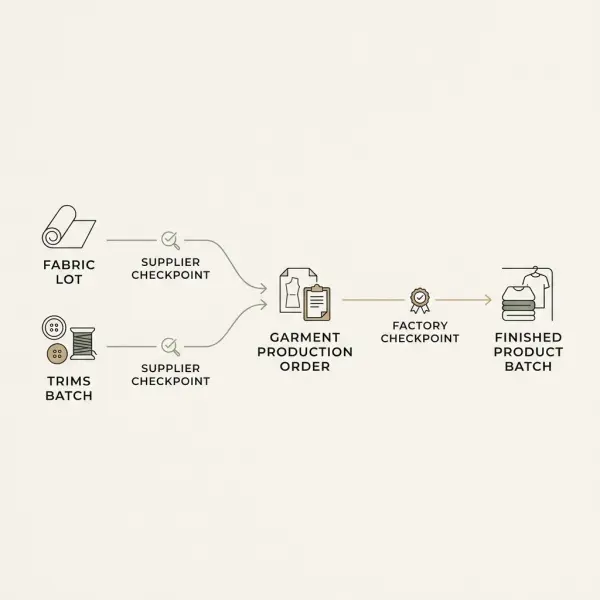
Traceability becomes important when the business needs to connect supplied materials, processes, locations, or product batches to reliable records.
GS1's Global Traceability Standard defines an interoperable framework using concepts including Critical Tracking Events—the events that happen to a traceable object—and Key Data Elements describing those events.
Fashion brands do not necessarily need to implement the full GS1 framework simply to evaluate suppliers. The underlying principle is useful, however: traceability depends on identifiable objects or batches, meaningful events, and data that can be connected across supply-chain stages.
During supplier evaluation, brands can therefore ask practical questions. Can the fabric supplier identify production lots? Can critical trims be connected to purchase and delivery records? Can a factory identify which material lot entered a particular production order? Can the supplier explain where key subcontracted processes occur?
The required depth should match the brand's product, market, claims, regulatory context, and risk profile.
What Should Small Fashion Brands Prioritize First?
Small brands rarely have the resources to perform heavyweight evaluations on every vendor. Prioritization is therefore more valuable than bureaucracy.
Begin with suppliers whose failure would materially damage the product or business. This often includes core fabric, technically important trims, and the primary manufacturing partner.
For those suppliers, answer five questions clearly:
- Can they make the required product correctly?
- Can they reproduce it consistently?
- Can they deliver within a realistic schedule?
- Are the commercial conditions compatible with the brand's scale and cash flow?
- Are there material risks or dependencies that the brand needs to understand before committing?
Then document the evidence.
A small company might manage this through a supplier file, specification sheet, sample approvals, test reports where needed, quotations, order history, quality records, and a concise evaluation form. More sophisticated systems can come later.
Good supplier evaluation is defined by decision quality, not paperwork volume.
Common Evaluation Errors to Avoid
Detailed operational mistakes belong in the next article on vendor management mistakes that disrupt fashion operations, but several errors are particularly relevant at the evaluation stage.
Approving From a Sample Alone
A strong sample demonstrates technical potential, not production reliability. Bulk capability, material consistency, actual capacity, and process control still need to be understood before large commitments are made.
Comparing Only Quoted Prices
Suppliers with different MOQs, lead times, payment terms, quality performance, freight requirements, and replenishment conditions are not economically equivalent simply because their unit quotations can be placed in one spreadsheet column.
Using the Same Scorecard for Every Vendor
Standardization is useful until it removes context. The critical characteristics of a fabric mill, zipper producer, and sewing factory are different enough that evaluation criteria should be adapted to the supplied product or service.
Treating a Certificate as Complete Supplier Approval
A certification may answer a particular question within a defined scope. It should not silently become evidence for unrelated technical, commercial, quality, capacity, or supply-chain claims.
What Brands Should Verify Before Approving a Supplier
Supplier approval should answer one final question: What exactly do we know, and what are we still assuming?
Before approval, verify that the supplier's demonstrated capability corresponds to the actual product, material, process, facility, volume, and production period under consideration. Confirm which specifications are final, which tolerances matter, how price and lead time were defined, what testing is required, where relevant production occurs, and who owns unresolved actions.
Also determine the scope of approval. A fabric supplier approved for one woven cotton construction should not automatically be assumed approved for every textile it sells. A factory approved for basic knit tops may need fresh technical evaluation before producing structured outerwear.
Finally, record remaining risks rather than hiding them behind an approval label. A vendor may be approved while still presenting high concentration risk, long replenishment lead times, limited backup capacity, or unresolved development actions.
Supplier evaluation is strongest when approval means “suitable for this defined purpose under these understood conditions,” not simply “this is a good company.”
Frequently Asked Questions About Fashion Supplier Evaluation
What is the most important factor when choosing a fashion supplier?
There is no single factor that applies to every supplier, but technical and operational suitability for the intended product is the first threshold. An inexpensive supplier is of little value if it cannot reproduce the required fabric, component, or garment reliably. Once basic suitability is established, brands can compare quality consistency, lead time, capacity, commercial terms, communication, risk, and scalability. The weighting changes by vendor type: repeatable material performance may dominate fabric sourcing, component compatibility may dominate critical trims, while production planning and quality control become central for garment factories.
Should brands choose the cheapest qualified supplier?
Not automatically. Once several vendors meet the technical threshold, price becomes important, but the comparison should include other cost drivers such as MOQs, payment terms, freight, defect risk, rework, lead time, tooling, inventory exposure, and replenishment flexibility. A lower purchase price can be commercially attractive when these conditions are comparable. When they are not, the cheaper quotation may produce higher operating costs elsewhere. Brands should therefore compare economically meaningful scenarios rather than assuming that unit cost alone represents total supplier value.
Is a factory visit necessary before placing an apparel order?
Not for every order, but a facility visit or equivalent assessment can provide valuable evidence when the supplier is strategically important, technically complex, high-risk, unfamiliar, or likely to receive substantial volume. A visit can help teams understand machinery, workflow, quality controls, production planning, finishing, storage, and where work actually occurs. Smaller brands may not always have the resources to visit every supplier, so the level of verification should be proportional to risk. Samples, references, documentation, video assessments, testing, third-party assessments, and limited pilot orders can supplement—but not always perfectly replace—direct observation.
How can a small brand evaluate fabric quality without its own laboratory?
A small brand can combine clear material specifications, supplier test reports, physical sample evaluation, wash or wear trials where appropriate, and independent laboratory testing for critical properties. The exact tests should reflect the garment's end use rather than copying a generic test list. When third-party testing is important, laboratories operating within relevant competence and accreditation frameworks such as ISO/IEC 17025 can provide stronger confidence in testing processes. The brand still needs to define what result it considers acceptable; a laboratory can measure performance, but it does not automatically determine whether that performance fits the product.
How many samples should be reviewed before approving a supplier?
There is no universal sample count. The amount of development evidence required depends on technical complexity, supplier history, product risk, and how much consistency matters. A stock button may require relatively simple approval, while custom hardware, performance fabric, or a complex tailored garment can require several iterations. The better question is whether the evidence covers the critical uncertainties: specification, function, appearance, repeatability, production feasibility, and relevant testing. Repeated sampling should not become an aim in itself; each round should resolve a defined technical or commercial question.
What is the difference between supplier qualification and supplier performance evaluation?
Supplier qualification determines whether a vendor is suitable to begin or expand a business relationship; performance evaluation determines whether it continues to meet expectations after work begins. Qualification usually examines capability, samples, commercial terms, capacity, quality systems, documentation, and relevant risks. Performance evaluation uses actual operating evidence such as quality results, delivery performance, responsiveness, corrective actions, and order execution. The two processes should connect: qualification creates the approval criteria, while ongoing vendor management tests whether those assumptions remain valid.
Should a brand use one factory or several factories?
The appropriate structure depends on volume, product diversity, supplier capability, bargaining power, management capacity, and risk. Concentrating production with one strong factory can simplify communication and improve relationship depth, but it also creates dependency. Using several factories can diversify risk and access different capabilities, although it increases coordination complexity and may dilute volume. Small brands often benefit from developing a manageable primary supplier network while identifying alternatives for genuinely critical products or processes rather than spreading small orders across too many factories.
Conclusion
Supplier evaluation in fashion is not a search for the company with the best sample, lowest quotation, largest factory, or longest certification list. It is an evidence-based attempt to determine whether a specific supplier can support a specific product and operating requirement with acceptable risk.
That requires different questions for different partners.
Fabric suppliers must demonstrate that materials can meet relevant specifications and remain sufficiently consistent from development through bulk production and reorder. Trims vendors need to prove dimensional, functional, visual, and supply compatibility with the garment. Production partners must show that technical capability can survive the transition from sample room to production floor, with adequate capacity, planning, quality control, communication, and visibility over relevant subcontracted processes.
The most useful evaluation process is therefore neither extremely simple nor unnecessarily bureaucratic. It is proportional.
Define what matters. Test the uncertainties that could materially affect the product. Verify significant claims. Document what the supplier has actually demonstrated. Start cautiously where risk remains. Then use real production performance to determine whether the relationship should grow.
That is how supplier evaluation becomes more than purchasing administration. It becomes one of the controls that protects product quality, operating continuity, cash, and the brand's ability to deliver what it has promised.





Comments 0
Leave a CommentSend Comment
Anda harus Login terlebih dahulu untuk dapat memberikan komentar.