

Digital Textile Printing Explained for Fashion and Apparel Production
Quick Answer
Digital textile printing is a computer-controlled printing process that applies colorants to fabric or finished garments from a digital artwork file, typically using inkjet technology rather than physical printing screens or engraved rollers. It is used across fashion, sportswear, garment decoration, sampling, custom products, short production runs, and increasingly some higher-volume textile applications.
Its main operational advantage is flexibility. Designs can be changed without manufacturing a new screen for every color or pattern, which can make sampling, multiple-SKU collections, personalization, and shorter runs more practical. That does not mean digital printing is automatically cheaper or more sustainable than conventional printing.
The production route depends heavily on fiber composition, fabric construction, ink chemistry, and end-use requirements. Polyester may be printed with sublimation or disperse systems, while cellulosic textiles such as cotton may use reactive dyes, pigment inks, or garment-focused direct-to-garment systems. Some processes require pretreatment, steaming, washing, drying, or heat curing after printing.
For fashion teams, the important question is therefore not simply, “Should we use digital printing?” It is: Which digital printing system matches the material, design, volume, quality target, and commercial model of the product?
What Is Digital Textile Printing?
Digital textile printing is a textile coloration process in which digital image data controls the placement of ink or dye onto a textile substrate, allowing patterns, graphics, photographs, or engineered designs to be printed without creating a separate physical screen for each color.
That definition covers several production routes.
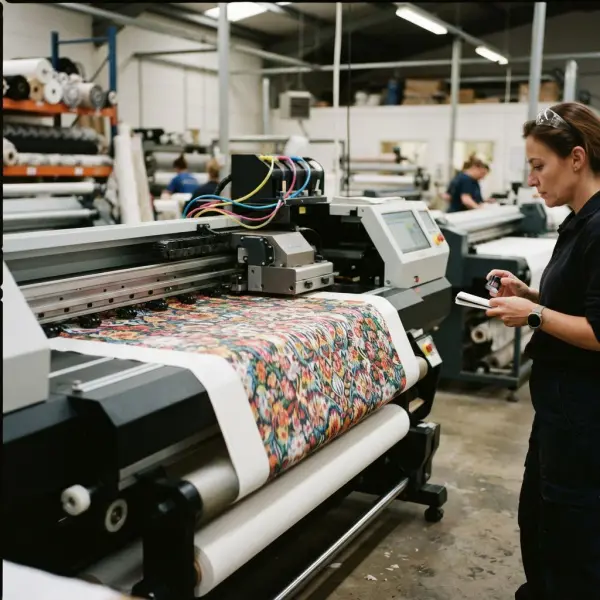
A printer may print directly onto a roll of fabric. Another system may decorate an already-sewn T-shirt. Sublimation may first print an image onto transfer paper before heat transfers the color into polyester. Reactive printing on cotton may involve fabric preparation, inkjet printing, steaming, washing, and drying.
So digital textile printing should not be treated as one machine or one chemistry.
It is better understood as a family of digitally controlled textile-printing technologies.
This distinction matters because fashion teams sometimes approve a digital-print concept before confirming whether the selected fabric and print chemistry actually work together. A floral artwork that prints beautifully on polyester sportswear through sublimation cannot simply be moved unchanged to cotton poplin using the same process.
The fiber-to-ink relationship changes.
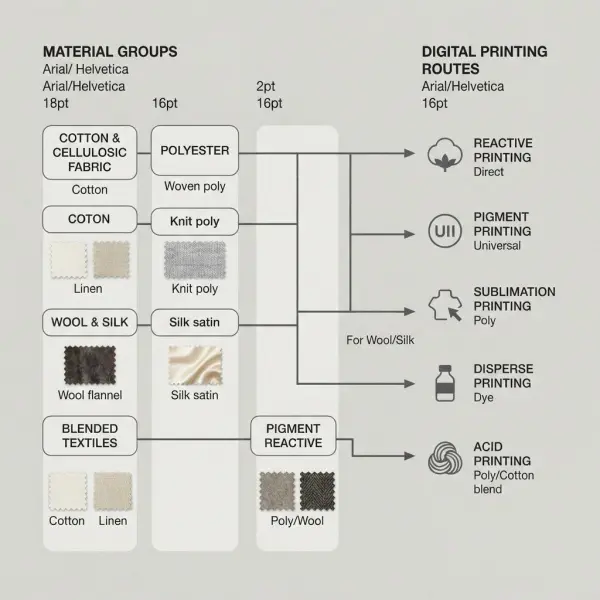
Manufacturer technical documentation illustrates this clearly. For example, Mimaki lists different ink families for different textile groups, including sublimation systems for polyester, reactive dyes for cotton and other cellulosic materials, and acid dyes for materials including wool, silk, and nylon. Mimaki textile ink compatibility guidance
How Does Digital Textile Printing Work?
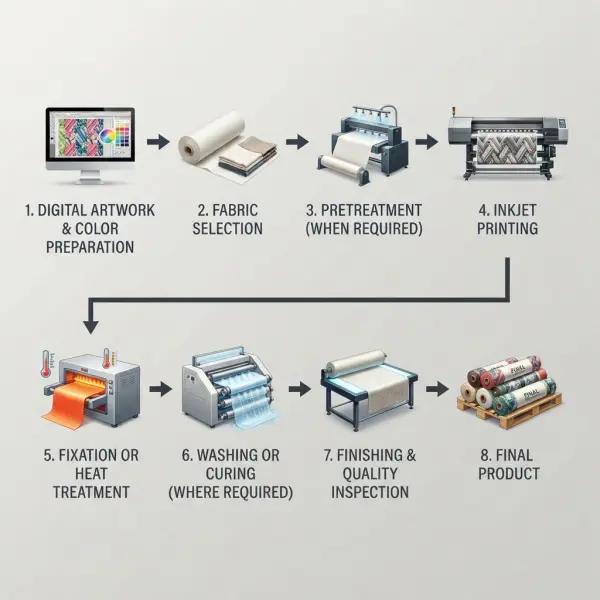
The precise workflow varies, but most industrial digital textile printing involves more than pressing “print.”
A commercially usable result usually depends on a chain of decisions covering artwork, color management, textile preparation, ink deposition, fixation, post-treatment, and quality control.
1. Artwork and print data are prepared
The process begins with a digital file.
Fashion surface designers may work with raster artwork, vector artwork, photographic imagery, repeat patterns, placement graphics, or engineered prints designed to align with particular garment panels.
At this stage, the production team needs to define more than image dimensions. Repeat size, fabric width, print direction, color profile, resolution, bleed requirements, and pattern placement can all affect the usable printed fabric.
Color deserves particular attention.
A monitor emits light. Fabric reflects light. Ink behavior is affected by substrate color, fiber chemistry, fabric surface, pretreatment, print density, curing conditions, and finishing. A color that looks correct on a calibrated display can therefore look different on the finished textile.
This is why professional digital textile workflows often rely on color profiling, controlled lighting, physical strike-offs, and approved production references rather than screen appearance alone.
2. The textile is qualified and, when required, pretreated
Before printing, the supplier must determine whether the textile is compatible with the intended ink system.
The same fiber content does not guarantee identical printing behavior.
Two 100% cotton fabrics may differ in yarn structure, weave, absorbency, optical brighteners, finishing chemicals, surface hairiness, weight, or preparation. These differences can affect sharpness, penetration, color yield, bleeding, and fixation.
Pretreatment may be used to control these variables.
In reactive digital printing, for example, treatment chemicals can help manage dye reaction and ink spreading before the printed material proceeds to fixation and washing. Older and current textile-printing technical documentation alike show that reactive, acid, and some disperse inkjet routes can involve pretreatment followed by printing and post-treatment.
Pretreatment is not a minor detail. Poor preparation can turn technically correct artwork into soft edges, inconsistent color, poor penetration, or unacceptable fastness.
3. Ink is jetted according to the digital file
During printing, microscopic droplets of ink are placed onto the textile in digitally determined positions.
Unlike traditional screen printing, the image does not need to be divided into a series of physical screens corresponding to individual print colors.
This changes what designers can economically attempt.
Photographic gradients, complex tonal transitions, numerous colors, irregular motifs, and frequent design changes can become easier to produce because the artwork itself does not require a matching set of physical screens.
It does not remove every production limitation.
Printhead performance, nozzle condition, ink viscosity, fabric feeding, print speed, resolution, ink coverage, and environmental conditions can all influence output.
For example, missing or unstable nozzles may produce visible banding. Fabric movement may distort repeats. Excessive ink deposition may create bleeding or drying problems.
Digital control improves flexibility. It does not eliminate process engineering.

4. Color must be fixed to the textile
Freshly deposited color is not necessarily ready for wear.
Depending on the technology, fixation may involve heat, pressure, steaming, chemical reaction, or curing.
Sublimation relies on heat to transfer or fix disperse dye into suitable polyester materials. Reactive dyes normally require conditions that allow the dye to react with compatible fibers. Pigment systems use binders to hold pigment particles on or near the textile surface and normally require curing.
These differences affect the production footprint as well as the appearance of the product.
They can influence:
- handfeel,
- color saturation,
- penetration,
- energy requirements,
- process time,
- washing requirements,
- equipment configuration,
- and final colorfastness.
The deeper differences between these technologies are covered separately in Sublimation, DTG, and Reactive Printing: Key Differences for Fashion Teams.
5. Some print systems require washing or additional finishing
One of the most common misconceptions about digital printing is that all digital systems are dry or one-step processes.
They are not.
Reactive, acid, and conventional disperse systems can include several wet-processing stages. Depending on the chemistry, printed fabric may need steaming and washing to remove unfixed dye and processing auxiliaries.
Pigment systems can have a shorter wet-processing route because the colorant is fixed using a binder and heat, although exact requirements still depend on the ink system and textile.
Mimaki, for example, describes its textile pigment system as heat-fixed and generally not requiring the same steaming and washing stages as reactive dye printing, while noting that requirements can vary by print type. textile pigment ink fixation process
6. Finished output is inspected against product requirements
Printing is only one part of textile quality.
The final material may still need inspection for color consistency, repeat accuracy, visible print defects, fabric distortion, fastness, width, shrinkage, handfeel, and suitability for cutting and sewing.
This becomes particularly important when a fashion collection uses the same print across several production batches.
A digitally printed sample can look excellent while bulk fabric drifts slightly in tone because the textile lot, pretreatment, machine settings, ink condition, or fixation conditions changed.
Good production systems therefore control both digital data and physical process variables.
Why Fiber, Fabric, and Ink Chemistry Matter
A digital printer does not determine print quality by itself.
The textile substrate and colorant system form an interacting system. Fiber chemistry influences whether a dye can bond with the textile. Fabric construction influences ink penetration and surface definition. Finishing chemicals can affect absorbency. Heat sensitivity can constrain curing conditions.
For sourcing and development teams, that means selecting “digital print fabric” is not specific enough.
A supplier needs substantially more information.
|
Textile or product context |
Common digital route |
Main technical consideration |
|
Polyester apparel |
Sublimation or disperse-based systems |
Heat response, dye migration, polyester type, colorfastness |
|
Cotton and cellulosic fabrics |
Reactive or pigment printing |
Pretreatment, fixation route, wash-off requirements, handfeel |
|
Cotton garments |
DTG systems, commonly pigment-based |
Garment pretreatment, curing, fabric surface, garment color |
|
Silk, wool, some nylon applications |
Acid dye systems |
Fiber compatibility, fixation, washing and fastness |
|
Blended fabrics |
Depends heavily on composition |
Different fibers may respond differently to the same colorant |
The table is intentionally simplified.
A 60/40 cotton-polyester blend, for example, is not automatically handled like pure cotton or pure polyester. The print provider may use a chemistry designed for blends, choose a pigment route, accept a different appearance, or use a specialized system.
Fabric structure matters too.
Heavy fleece, lightweight jersey, poplin, satin, twill, and brushed fabrics present different surfaces to a printhead. Their absorbency, texture, stretch, and thickness can influence print definition and production settings.
Fashion teams assessing printable substrates should therefore consider fiber composition alongside fabric weight and GSM, construction, finishing, stretch, and intended garment use.
Where Digital Printing Fits Into Apparel Production
Digital textile printing can enter the fashion production chain at different points.
That distinction affects everything from design development to inventory.
Roll-to-roll fabric printing
In roll-to-roll production, fabric is printed before garment cutting.
This approach is useful for all-over patterns, continuous repeats, engineered prints, dresses, shirts, scarves, sportswear panels, and other cut-and-sew applications.
Once printing and required finishing are complete, the fabric enters conventional garment processes such as inspection, spreading, cutting, sewing, pressing, and finishing.
For a fashion brand, this route behaves much like sourcing any custom-printed fabric. The critical difference is that the print file can be changed with relatively little physical setup compared with screen-based printing.
Direct-to-garment printing
Direct-to-garment, or DTG, printing decorates an already manufactured garment.
The most familiar application is a printed T-shirt, but industrial systems are used across additional garment categories.
DTG can be particularly useful when a business wants to keep blank garments in stock and print a design only after demand becomes clearer.
That changes inventory logic.
Instead of holding hundreds of finished garments across many graphics, a brand or fulfillment provider may hold fewer blank base products and convert them into specific designs later.
The approach is operationally attractive, but it shifts complexity into blank inventory management, order routing, color consistency, print scheduling, curing, packing, and fulfillment.
Engineered and placement printing
Digital printing also enables artwork to be designed around garment geometry.
A motif can be positioned for a front bodice, sleeve, pocket area, scarf panel, or sportswear piece rather than simply repeated across a roll.
This creates interesting design possibilities but requires stronger coordination between surface design and pattern cutting.
If the cutting position shifts, the visual design can shift with it.
The technology may therefore reduce print setup while increasing the importance of digital pattern accuracy and production alignment.
Why Fashion Businesses Use Digital Textile Printing
The strongest business case for digital textile printing is usually flexibility rather than printing speed alone.
Physical screen preparation creates setup work before conventional screen printing begins. When the same design is produced repeatedly in large quantities, that setup can be spread across many units.
Digital production changes that equation because a new print file does not necessarily require an entirely new set of screens.
For fashion businesses, several commercial possibilities follow.
Faster design iteration
Digital workflows can make strike-offs and design revisions easier to manage.
A design team might test three scales of the same floral pattern, adjust a background tone, change a motif placement, and produce another sample without rebuilding an entire screen set.
That does not make sampling free.
Fabric, ink, machine time, pretreatment, fixation, finishing, and labor still cost money. But the setup logic becomes more compatible with iterative product development.
More SKU variety without identical setup costs
Traditional fashion collections often face a trade-off between variety and production efficiency.
Every additional colorway or graphic may fragment order quantities.
Digital printing can make smaller design quantities technically feasible because different files can move through the same digital workflow without corresponding physical screen sets.
That can be useful for capsule collections, limited editions, localized prints, personalization, test launches, or ecommerce-driven product ranges.
FESPA has documented digital textile business models built around shorter runs and reduced finished stock, while print-on-demand technology providers similarly position digital production around producing closer to actual demand.
The deeper inventory and merchandising implications are explored in How Digital Printing Supports Small-Batch Fashion Production.

Personalization becomes operationally possible
Digital files can be altered without making new physical printing screens.
That makes applications such as names, numbers, localized graphics, individualized artwork, or small customer-specific orders possible.
But personalization is not primarily a printing problem.
At scale, it becomes a data and workflow problem.
A business must ensure that the correct artwork is connected to the correct order, garment size, blank color, production job, shipping label, and customer.
Printing one personalized garment is easy compared with routing ten thousand different personalized orders without production errors.
Production can move closer to demand
Digital printing can also support regional or near-market production where viable suppliers and equipment exist.
Instead of printing a very large quantity of finished designs months before sale, some businesses can delay the final decoration decision until closer to demand.
The commercial value is not guaranteed.
Local manufacturing may have higher labor, property, energy, or equipment costs. Capacity may also be limited. The relevant comparison is therefore total landed economics and inventory risk, not print cost in isolation.
Is Digital Textile Printing Cheaper Than Screen Printing?
Digital textile printing can be economically attractive for short, variable, or complex jobs, but it is not universally cheaper than screen printing.
The cost structure is different.
Screen printing carries setup costs associated with screens, separations, preparation, changeovers, and cleaning. Once the job is running at scale, however, those costs can be spread across a large production quantity.
Digital printing reduces or removes some physical setup requirements, but operating costs can include expensive inks, printhead maintenance, pretreatment chemicals, transfer paper in some sublimation workflows, steaming or washing in some dye systems, energy for heat fixation, software, machine depreciation, and skilled technical support.
The answer therefore depends on variables such as:
- order quantity,
- number and complexity of designs,
- number of colorways,
- print coverage,
- fabric type,
- machine utilization,
- labor costs,
- ink consumption,
- required finishing,
- waste and rework,
- turnaround requirements,
- and inventory risk.
This is why quoting a universal break-even quantity for “digital versus screen” is misleading.
A simple one-color logo repeated across a very large order presents a different economic problem from a collection containing twenty photographic prints across several small colorways.
Fashion teams should ask suppliers for a job-specific costing comparison, not a general technology claim.
Quality Control Matters as Much as Print Resolution
High print resolution is useful, but it is not a complete quality specification for apparel.
A consumer does not evaluate a garment at the printer.
They wear it, wash it, rub it against other surfaces, expose it to light, stretch it, iron it, and compare it with other pieces from the same collection.
Quality control therefore needs to follow the final product requirement.
Color consistency
A fashion brand should define how color is approved.
For commercially sensitive colors, relying on emailed photographs is risky because cameras, screens, lighting, and image processing alter appearance.
Physical strike-offs, controlled viewing conditions, colorimetric data where appropriate, and retained approval references provide stronger control.
Color consistency also needs to be checked between production lots.
Even when the digital file is identical, changes in fabric whiteness, pretreatment, humidity, ink behavior, fixation, or machine calibration may shift the final appearance.
Banding, bleeding, and print defects
Digital-print defects can include missing-nozzle lines, banding, unwanted ink spread, uneven density, head strikes, registration issues, repeat discontinuity, and contamination.
Some problems are clearly visible.
Others become apparent only after finishing.
A print that appears overly dark before washing may look correct afterward because unfixed dye is removed. Another print may appear excellent immediately after curing but fail a rub-fastness test.
This is why inspection needs to follow the complete production route.
Colorfastness
Colorfastness requirements should reflect garment use.
Frequently washed casualwear may prioritize wash and rub performance. Swimwear, outdoor products, uniforms, or home textiles may require additional testing depending on exposure conditions and buyer specifications.
The ISO 105 series includes established methods covering several colorfastness properties. For example, ISO 105-C10 specifies methods for assessing colorfastness to washing, while ISO 105-X12 addresses resistance to rubbing using dry and wet rubbing tests.
A print supplier saying that an ink has “good fastness” is therefore not enough.
The fashion buyer should define the required test method and acceptance level appropriate to the product.

Digital Printing Does Not Automatically Mean Sustainable Printing
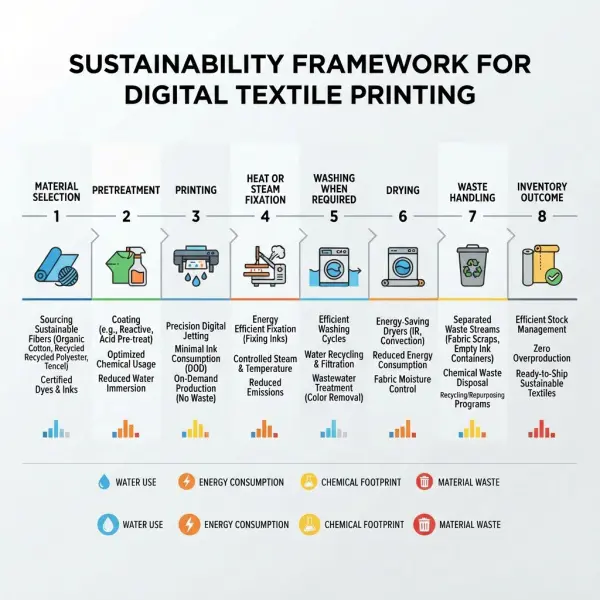
Digital textile printing can support lower-waste and demand-responsive production models, but calling the technology inherently sustainable is too broad.
There are two separate questions.
The first concerns printing process efficiency.
The second concerns the fashion business model enabled by that process.
Digitally changing artwork can reduce some setup waste associated with screens and make smaller quantities economically possible. Print-on-demand can also help businesses avoid producing some finished inventory before demand exists.
Those benefits can be meaningful.
They still do not tell us the full environmental impact of the textile.
Textile wet processing remains an important environmental hotspot. UNEP's global textile value-chain assessment identifies bleaching, dyeing, and finishing among significant impact areas, particularly for climate-related impacts. UNEP Sustainability and Circularity in the Textile Value Chain
Digital routes can also differ substantially from one another.
Reactive inkjet printing can require fabric preparation, steaming, washing, and drying. Pigment systems may avoid some wet post-treatment steps but rely on binders and curing. Transfer sublimation requires heat and normally consumes transfer paper. Direct sublimation avoids transfer paper but still requires suitable fabric preparation and thermal fixation. Mimaki's description of direct sublimation, for example, includes treated polyester followed by heat fixation.
A credible sustainability assessment therefore needs to ask:
- What fiber is being printed?
- Which ink chemistry is used?
- Is pretreatment required?
- Is washing required?
- How is wastewater treated?
- How much heat and electricity are used?
- Is transfer paper consumed?
- What is the reject rate?
- Does digital production actually reduce unsold inventory?
- What happens during garment use and end of life?
This is why claims such as “waterless digital printing” should be attached to a specific process, machine configuration, and system boundary—not digital textile printing as a whole.
How Fashion Businesses Can Apply Digital Printing Strategically
The most useful way to adopt digital textile printing is to begin with the product and commercial problem, not the machine.
A startup developing thirty units of a patterned dress has different priorities from a sportswear company producing thousands of polyester jerseys or an ecommerce business printing customer-specific T-shirts after purchase.
Start with the end product
Define what the garment must do before selecting the printing route.
A sourcing brief should ideally include:
- fiber composition and blend ratio,
- fabric construction,
- approximate GSM,
- base fabric color,
- stretch requirements,
- target garment category,
- artwork type and print coverage,
- expected care method,
- required colorfastness,
- approved color references,
- order quantity,
- number of designs and colorways,
- target lead time,
- and any relevant chemical or compliance requirements.
This information allows the printer to recommend a realistic production route instead of simply quoting the machine they happen to operate.
Develop the print together with the actual fabric
Avoid approving a critical print solely on a “similar” substrate.
A change from cotton poplin to cotton-viscose twill, for example, may change absorption, surface texture, color appearance, dimensional stability, or fixation behavior.
Where color or pattern accuracy matters commercially, approve the production substrate—or a properly controlled equivalent agreed with the supplier.
Use strike-offs before committing to production
A strike-off is not simply a miniature design preview.
It is an opportunity to test whether the artwork, fabric, ink system, color profile, and processing route produce an acceptable result together.
For important products, the approval process should consider:
- color,
- scale,
- repeat,
- line sharpness,
- penetration,
- handfeel,
- fabric appearance,
- and required fastness testing.
A beautiful strike-off that fails the garment's performance requirement is not an approved production solution.
Compare total cost, not only print price
A low price per printed meter can be misleading if it creates long lead times, high minimum quantities, poor yield, inconsistent quality, or expensive rework.
Likewise, a higher digital printing price may still work commercially if it removes inventory exposure or enables profitable small releases.
A useful costing model considers:
printed fabric + pretreatment + fixation + finishing + testing + cutting yield + rejects + logistics + inventory risk.
The print price is only one line.
Design the production model around what digital is good at
Digital textile printing is particularly useful when product value comes from flexibility.
That could mean:
- multiple prints sharing the same base fabric,
- frequent artwork updates,
- limited editions,
- customer personalization,
- rapid sampling,
- test-and-repeat merchandising,
- or demand-driven production.
Using digital printing simply to reproduce a stable, high-volume commodity design may still work, particularly on modern high-productivity equipment, but the business case should be calculated rather than assumed.
Common Digital Textile Printing Mistakes
Mistake 1: Selecting the artwork before confirming material compatibility
This often happens when a design team sees a digital print sample from another collection and assumes the same appearance can be reproduced on a different material.
The result may be weaker color, different handfeel, bleeding, reduced durability, or an entirely different process cost.
A stronger sequence is:
product requirement → material → compatible print route → artwork development → strike-off → testing.
Design and material decisions can still develop together, but neither should ignore process compatibility.
Mistake 2: Treating every digital printer as interchangeable
A supplier owning a digital textile printer does not automatically mean that supplier can produce every garment category.
Machine width, ink configuration, printhead technology, pretreatment capability, heat equipment, steaming, washing, color management, technical staff, and finishing equipment all matter.
Even machines from the same manufacturer may be configured for different ink sets and production applications.
Evaluate the entire print facility, not the word “digital” on the equipment list.
Mistake 3: Approving color from a laptop screen
This creates avoidable disputes.
Screens vary. Ambient light varies. Textile surfaces reflect light differently. Photographs sent by messaging apps may have automatic white-balance and compression changes.
Color-sensitive products should use an agreed approval system involving physical samples and defined viewing or measurement conditions.
Mistake 4: Comparing only printing cost per unit
A conventional print supplier may appear cheaper because the quotation assumes a large production run.
A digital supplier may appear expensive because its per-meter price is higher.
Neither comparison is complete until the brand considers how much stock must be ordered, how many designs can be tested, how much rework occurs, how quickly the product reaches market, and what happens to unsold units.
The appropriate metric is commercial outcome—not printing price alone.
Mistake 5: Assuming digital printing solves overproduction
Digital printing makes smaller or demand-driven production more feasible in many applications.
It does not force a company to use that capability.
A brand can still digitally print far more fabric than it sells.
Inventory reduction requires merchandising discipline, production planning, reliable replenishment, accurate product data, supplier responsiveness, and appropriate buying decisions.
Technology enables the operating model. Management determines whether the model is actually used.
What Brands Should Verify Before Choosing a Digital Textile Printer
Before approving production, fashion teams should be able to answer several practical questions.
Material: Has the exact fiber composition and fabric construction been qualified for the proposed print system?
Ink system: Which ink or dye chemistry will be used, and why is it suitable for the material?
Process route: What pretreatment, transfer, steaming, washing, curing, or drying steps are involved?
Color: How will strike-offs and bulk color be approved?
Fastness: Which wash, rub, light, perspiration, heat, or other tests are required for the intended product?
Consistency: How will the supplier control output between batches?
Capacity: Can the supplier maintain the required lead time once the order moves from sample quantity to production?
Finishing: Does the quoted service include all required post-print processing?
Compliance: Do inks, chemicals, and processing meet the brand's applicable market, restricted-substance, and buyer requirements?
Economics: Is the quotation based on the actual print coverage, fabric width, quantity, finishing, and testing requirements?
This verification matters more than comparing machine brochures.
A technically modest system operated by a disciplined print house can be a better sourcing partner than sophisticated equipment without reliable process control.
Frequently Asked Questions About Digital Textile Printing
Is digital textile printing the same as DTG printing?
No. Direct-to-garment printing is one category within the broader digital textile printing field.
DTG prints directly onto a finished or mostly finished garment, commonly using digitally controlled inkjet equipment. Digital textile printing also includes roll-to-roll fabric printing, reactive inkjet printing, pigment printing, sublimation, disperse printing, acid printing, and other textile processes.
This distinction matters for sourcing. A DTG shop designed around blank T-shirts is not automatically equipped to print and finish hundreds of meters of reactive-printed cotton fabric for cut-and-sew garments.
Can digital textile printing be used on cotton?
Yes, but the appropriate process depends on the desired result and production setup.
Cotton can be digitally printed using systems including reactive dye printing and pigment-based printing, while cotton garments are commonly decorated through DTG systems.
Reactive printing can produce color through dye-fiber interaction but typically involves pretreatment, fixation, and wash-off stages. Pigment systems use binders to attach pigment particles to the textile and can have a simpler post-printing route.
The correct choice depends on color requirement, handfeel, fastness, volume, fabric preparation, and supplier capability.
Can digital textile printing be used on polyester?
Yes. Polyester is widely digitally printed, particularly through sublimation and disperse-dye technologies.
In transfer sublimation, artwork is first printed to transfer media and then transferred to suitable polyester using heat. Direct sublimation systems can print directly onto appropriately prepared polyester before thermal fixation.
Polyester printing also requires attention to issues such as fabric heat response and potential dye migration from previously dyed fabrics, particularly in garment-decoration applications.
Testing the exact substrate remains important.
Is digital textile printing suitable for mass production?
It can be.
Digital textile printing originally gained strong commercial relevance in sampling, customization, and shorter production runs, but industrial systems now operate at substantially higher productivity than early-generation equipment.
Whether digital is economically appropriate for a large run depends on the job.
A complex multi-color print that changes frequently creates a different cost structure from a stable, simple repeat produced continuously for months. Conventional rotary or screen printing may remain highly competitive in certain long-volume applications, while digital can be attractive where flexibility, setup reduction, or SKU variation has measurable value.
Does digital textile printing use less water?
Some digital printing routes can reduce water use compared with certain conventional textile-printing processes, but this cannot be stated universally.
Pigment and some sublimation workflows can avoid extensive post-print washing, whereas reactive digital printing may still require pretreatment, steaming, washing, and drying.
Water consumption also occurs outside the printing machine in fabric preparation, cleaning, finishing, and wastewater treatment.
Any meaningful comparison therefore needs the exact print chemistry and system boundary. “Digital” by itself is not enough information to establish water performance.
Does digital printing produce better quality than screen printing?
Not universally.
Both digital and screen printing can produce excellent commercial results when the process is matched to the design, material, and required performance.
Digital printing is particularly strong at detailed imagery, gradients, complex color variation, design changes, and short runs without separate physical screens for each color.
Screen printing can be extremely effective for bold solid colors, specialty effects, stable repeat orders, and high-volume applications.
The better technology is the one that meets the product specification and commercial requirement reliably.





Comments 0
Leave a CommentSend Comment
Anda harus Login terlebih dahulu untuk dapat memberikan komentar.