

Fabric GSM Explained: What Fabric Weight Means in Fashion
Quick Answer
Fabric GSM is a measurement of fabric mass expressed in grams per square metre. A fabric rated at 180 GSM weighs 180 grams for every square metre of material under the stated testing conditions. In textile sourcing, GSM provides a standardized way to compare fabric weight without relying on roll width or sample size.
GSM can help fashion teams specify materials, compare supplier samples, estimate fabric consumption by weight, and check whether production fabric matches an approved standard. It does not, however, tell the whole story. Two fabrics with the same GSM can differ significantly in thickness, softness, opacity, stretch, air permeability, strength, and drape because those properties also depend on fiber, yarn, construction, finishing, and density.
For product development, GSM should therefore be treated as one measurable specification rather than a complete quality grade. A useful fabric specification combines GSM with composition, construction, usable width, finish, color, shrinkage, and performance requirements.
What Does GSM Mean in Fabric?
GSM stands for grams per square metre. It measures how much a fabric weighs relative to its surface area, making it a form of mass-per-unit-area measurement.
The basic definition is straightforward:
Fabric GSM is the mass, in grams, of one square metre of fabric.
A specification of 150 GSM means that one square metre of the tested fabric has a mass of 150 grams. A 300 GSM fabric contains twice as much mass per unit area as a 150 GSM fabric, although it will not necessarily be exactly twice as thick, warm, strong, or durable.
This distinction matters because “fabric weight” is commonly used as shorthand for GSM even though the technical measurement is mass per unit area. ASTM D3776/D3776M describes test methods for measuring fabric mass per unit area and applies to most fabrics. For woven fabrics, ISO 3801:1977 covers the determination of mass per unit length and mass per unit area.
GSM gives fashion businesses a common numerical reference. A fabric swatch from one mill and a production roll from another can be compared on the same area basis, even if their widths and roll lengths differ.
How Is Fabric GSM Calculated?
Fabric GSM is calculated by dividing the mass of a specimen in grams by its area in square metres.
GSM = specimen mass in grams ÷ specimen area in square metres
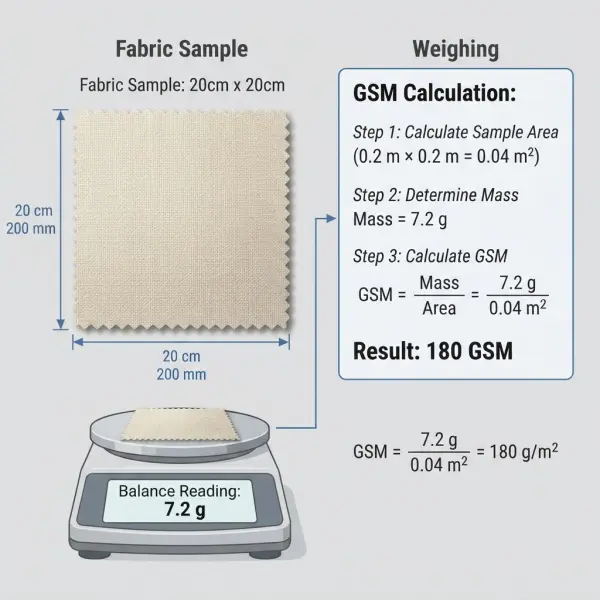
Consider a rectangular fabric sample measuring 20 centimetres by 20 centimetres. Its area is 400 square centimetres, or 0.04 square metres. If the sample weighs 7.2 grams, the calculation is:
7.2 g ÷ 0.04 m² = 180 GSM
When a 100-square-centimetre specimen is used, the calculation becomes especially simple because 100 square centimetres equals 0.01 square metres. If that specimen weighs 1.85 grams, its GSM is:
1.85 g ÷ 0.01 m² = 185 GSM
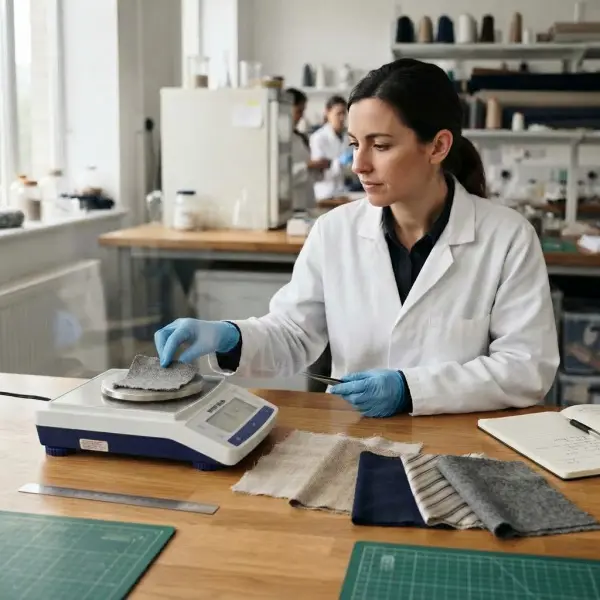
This is why many textile laboratories and factories use a GSM cutter that removes a specimen of a known area. The specimen is weighed on an appropriate balance, and the result is converted into grams per square metre.
The actual cutter area must still be verified. Not every cutting die produces the same specimen size, and blindly multiplying the measured weight by 100 can create an incorrect result when the cut area is not exactly 100 square centimetres.
Converting GSM to Ounces per Square Yard
Some suppliers, denim mills, and markets express fabric weight in ounces per square yard, usually written as oz/yd². The approximate conversion is:
1 oz/yd² = 33.906 GSM
Therefore:
GSM ÷ 33.906 = oz/yd²
A 340 GSM denim, for example, is approximately 10.0 oz/yd². Conversely, a 12 oz/yd² fabric is approximately 407 GSM.
The unit must be written clearly. “Ten-ounce denim” usually refers to ounces per square yard, not the weight of an entire garment or a linear yard of fabric.
GSM and Weight per Linear Metre Are Not the Same
GSM measures mass per area, while weight per linear metre depends on both GSM and fabric width. If a fabric is 180 GSM and 1.5 metres wide, one linear metre theoretically contains 1.5 square metres of material:
180 g/m² × 1.5 m = 270 grams per linear metre
This calculation is useful when mills quote fabric by kilogram while a production team plans consumption in metres. In the same example, one kilogram would theoretically contain about 3.70 linear metres:
1,000 g ÷ 270 g per metre = 3.70 metres
The figure is an estimate. Actual purchasing and production calculations should use the agreed width definition, measured roll weight, conditioning state, selvage treatment, and supplier tolerance.

Is GSM the Same as Fabric Thickness?
No. GSM measures mass per unit area, while thickness measures the distance between the two fabric surfaces under specified testing conditions. They are related in some materials, but they are not interchangeable.
A compact woven fabric made from dense yarns can have a relatively high GSM without appearing especially bulky. A brushed, lofted, or pile fabric may feel much thicker even when its GSM is similar. Spacers, fleeces, quilted structures, and compressible knits demonstrate why thickness cannot reliably be inferred from weight alone.
Thickness itself requires a separate measurement. ISO 5084:1996, for example, describes determining textile thickness under specified pressure. The reference to pressure is important because a compressible fabric can produce different readings depending on how firmly it is held during measurement.
The following distinctions help prevent specification errors:
|
Measurement |
What it describes |
What it does not establish by itself |
|
GSM |
Fabric mass per square metre |
Thickness, strength, warmth, or quality |
|
Thickness |
Distance between fabric surfaces under stated pressure |
Mass, durability, or fiber content |
|
Fabric width |
Distance across the fabric roll |
Mass per unit area |
|
Yarn count or linear density |
Relative fineness or mass per unit length of yarn |
Finished fabric GSM by itself |
|
Thread or course density |
Number of yarns, ends, picks, courses, or wales within a defined distance |
Fiber performance or total fabric quality |
|
Composition |
Fibers present in the textile |
Construction, GSM, or finished performance |
A specification becomes more reliable when these characteristics are recorded separately. Calling a fabric “thick 250 GSM cotton,” for instance, mixes a measured value with a subjective description and an incomplete composition statement. It does not identify whether the textile is woven or knitted, how it was finished, or what tolerance is acceptable.
Does a Higher GSM Mean Better Fabric?
A higher GSM does not automatically mean better quality. It means that the material has more mass per unit area under the conditions in which it was measured.
Whether that is desirable depends on the product. A high-GSM jersey may give a structured T-shirt a substantial handfeel, but the same weight could be unsuitable for a lightweight base layer intended for hot conditions. A lower-GSM lining may be appropriate because it reduces bulk, while a comparable material would be inadequate for a standalone garment requiring opacity.
Quality depends on whether the fabric meets its intended use and agreed specifications. Relevant factors may include:
- Fiber type and blend accuracy
- Yarn quality and consistency
- Woven, knitted, or nonwoven construction
- Dimensional stability
- Colorfastness
- Abrasion, tearing, tensile, or bursting performance
- Stretch and recovery
- Pilling resistance
- Surface finish and handfeel
- Defect level and shade consistency
GSM supports these evaluations but cannot replace them. A heavier fabric made with uneven yarns, unstable construction, or poor finishing may perform worse than a lighter material engineered for the same garment category.
The deeper relationship between mass, structure, and physical behavior is explored in how fabric weight affects drape, durability, and comfort. The central point here is simpler: GSM is a specification, not a quality score.
What Counts as Lightweight, Medium-Weight, or Heavyweight Fabric?
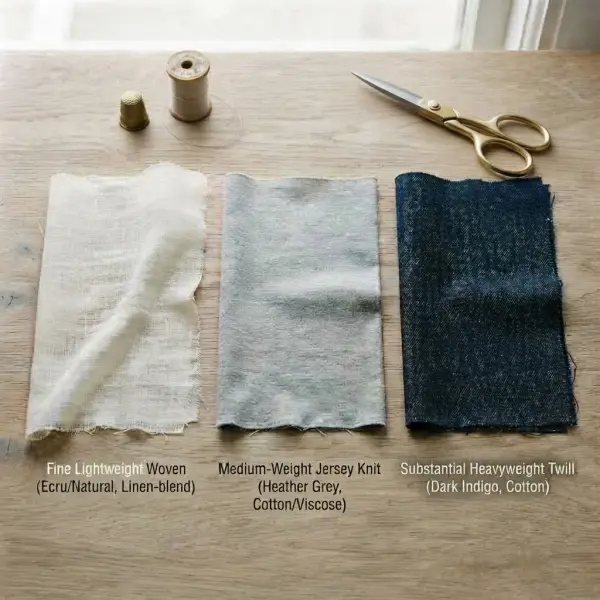
There is no universal GSM boundary that classifies every textile as lightweight, medium-weight, or heavyweight. The meaning changes by fabric construction, fiber, product category, supplier, and market.
A 200 GSM fabric may be relatively substantial for a shirting material but ordinary for a knitted T-shirt and light for some outerwear applications. A fabric merchant’s categories should therefore be treated as commercial guidance rather than globally standardized definitions.
The following ranges can serve as a broad working reference, not a technical classification:
|
Approximate GSM |
General commercial description |
Possible apparel contexts |
|
Below 100 GSM |
Very light to lightweight |
Some linings, sheer fabrics, lightweight performance shells |
|
100–160 GSM |
Lightweight |
Some blouses, shirts, summer dresses, lightweight jerseys |
|
160–220 GSM |
Medium-weight |
Many T-shirts, shirts, dresses, trousers, and casual fabrics |
|
220–300 GSM |
Medium-heavy to heavyweight |
Structured jerseys, sweatshirts, workwear, trousers, lighter denim |
|
Above 300 GSM |
Heavyweight |
Some denim, fleece, coatings, outerwear, and structured textiles |
These categories deliberately use “some” and “many.” Fiber type, yarn structure, knitting or weave pattern, finishing, and garment construction can shift the practical meaning of the same number.
A sourcing team should compare a candidate fabric with the approved product benchmark, not merely with a generic online weight chart. For a more application-focused decision framework, see lightweight versus heavyweight fabrics and how to choose between them.
Why GSM Matters to Fashion Businesses
GSM creates a measurable link between design intent, textile sourcing, production control, and commercial planning. Without an agreed value and tolerance, teams may use vague descriptions such as “slightly heavier” or “not too thin,” which different suppliers can interpret differently.
Product Development and Sample Approval
During development, GSM helps a designer and sourcing team define the physical direction of a material. If a prototype was approved in a 210 GSM cotton-elastane jersey, recording that value gives the supplier a clearer target for later lab dips, strike-offs, salesman samples, and bulk production.
The number is still only one part of the approved standard. A substitute fabric at 210 GSM may behave differently if its yarn, stitch construction, elastane content, finishing, or width changes. Physical swatches and performance results remain necessary.
Sourcing and Supplier Comparison
Supplier offers are difficult to compare when one quotation describes weight per linear metre, another lists GSM, and a third provides only a verbal category. Converting offers to a common area basis makes the comparison more meaningful.
GSM can also reveal whether two superficially similar quotations are based on materially different constructions. A lower price may reflect a lighter material rather than more competitive manufacturing. Conversely, a higher GSM does not automatically justify a higher price because fiber cost, yarn type, finish, minimum order quantity, dyeing process, width, and defect allowance also influence quotations.
Costing and Fabric Consumption
When material is purchased by weight, GSM and width help estimate how many linear metres a kilogram may provide. When material is purchased by metre, they help estimate shipment mass and compare the physical substance of alternative fabrics.
Garment consumption cannot be calculated from GSM alone. Marker efficiency, size ratio, garment dimensions, fabric width, shrinkage allowance, matching requirements, cutting loss, defects, and order quantity all affect the final requirement. GSM becomes valuable when connected to these production variables.
Freight and Handling
A change in fabric GSM can alter the estimated mass of a shipment or finished product. This may affect freight planning, carton weight, warehouse handling, and fulfilment costs, particularly for large orders or products sold through channels with weight-based logistics charges.
The real effect should be calculated from actual material consumption and packed product weight. Multiplying a garment’s flat surface dimensions by GSM would be misleading because garments contain overlapping panels, seams, facings, pockets, rib, linings, trims, and cutting waste.
Production Quality Control
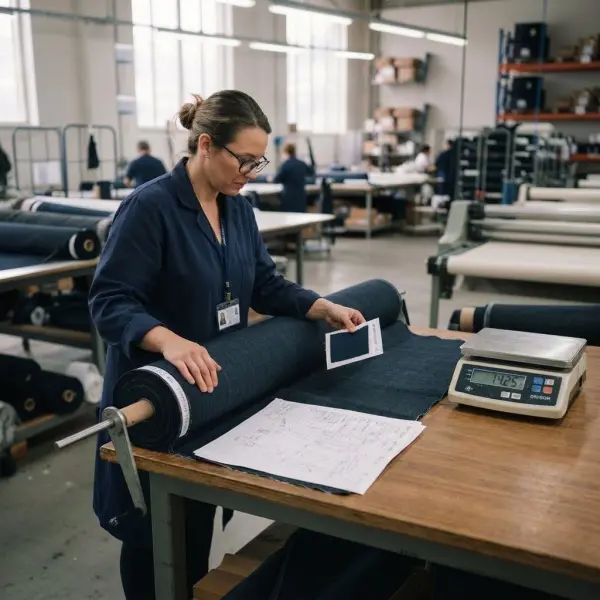
Bulk fabric can be tested against the approved standard before cutting. A significant GSM difference may indicate a change in construction, finishing, moisture condition, or dimensional state. It should trigger investigation, not an immediate assumption about the cause.
This check is particularly useful because a fabric discrepancy discovered before cutting is usually easier to contain than one identified after hundreds of garments have been assembled. GSM testing can sit alongside shade review, width measurement, defect inspection, shrinkage testing, and other checks in a broader fabric inspection process.
How Should GSM Be Measured in Practice?
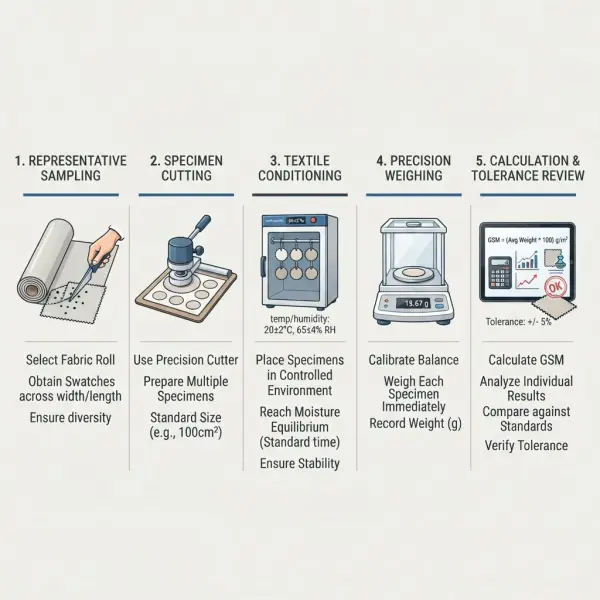
Reliable GSM testing requires more than cutting one convenient piece from the edge of a roll. The sampling method, specimen area, balance accuracy, conditioning, selvage treatment, and calculation method should be agreed and documented.
ASTM D3776/D3776M includes different approaches for full pieces or rolls, full-width samples, small swatches, and narrow fabrics. The appropriate option depends on the material supplied and the purpose of the test. A small laboratory swatch can characterize that sample, but it may not represent variation across an entire shipment.
For nonwoven materials, teams should use a method suited to that construction. ISO 9073-1:2023 specifically addresses determination of mass per unit area for nonwoven fabrics.
A practical mill or factory procedure should define:
- The applicable test method
- How rolls and specimen locations are selected
- Whether selvages are excluded
- Specimen dimensions and number of specimens
- Balance resolution and calibration requirements
- Conditioning and testing atmosphere
- How results are averaged and rounded
- Nominal GSM and permitted tolerance
- Actions required when a result falls outside tolerance
The conditioning requirement is not a minor laboratory detail. Textile fibers can absorb different amounts of moisture from the atmosphere, and that moisture contributes to measured mass. ISO 139:2005 defines standard atmospheres for conditioning and testing textile properties. When a formal standard is specified, the parties should follow its current requirements rather than inventing an informal room condition.
Why Can GSM Change Between a Sample and Bulk Production?
A small GSM difference does not necessarily prove that the supplier intentionally reduced fabric quality. Fabric production contains variation, and measured results are influenced by both manufacturing and testing conditions. The size of an acceptable difference should therefore be defined contractually rather than judged after delivery.
Variation may arise from:
- Yarn linear density or yarn-feed variation
- Differences in ends, picks, courses, or stitch length
- Tension during weaving, knitting, finishing, or inspection
- Shrinkage or relaxation that changes fabric area
- Applied coatings, resins, dyes, or other finishes
- Washing, compacting, raising, or mechanical finishing
- Moisture content and atmospheric conditioning
- Non-representative sampling
- Incorrect specimen dimensions or weighing equipment
Finishing can create effects that are not intuitive. If a process reduces the fabric’s dimensions more than its mass, the resulting mass per square metre may increase because similar material is concentrated into a smaller area. Another process may remove substances or fibers and reduce mass. The direction and scale of change depend on the construction and treatment.
A reasonable tolerance is product- and supplier-specific. Rather than copying a generic percentage, brands should agree on the nominal value, test method, sampling plan, acceptance limits, and escalation procedure before bulk production.
Common Fabric GSM Mistakes
Treating GSM as a Complete Material Specification
Ordering “200 GSM cotton” leaves major questions unanswered. It does not define the cotton percentage, construction, yarn specification, width, finish, stretch, shrinkage, shade, surface appearance, or acceptable defects.
A better specification uses GSM as one controlled field within a complete fabric data sheet. The approved physical swatch should also be clearly identified and retained.
Assuming Two Equal-GSM Fabrics Will Behave the Same
A 180 GSM plain woven and a 180 GSM single jersey do not become interchangeable because their numbers match. Construction changes stretch, stability, surface character, cutting behavior, and garment appearance.
Equal GSM is useful for comparing mass. It is not evidence of equal drape, comfort, opacity, strength, or suitability.
Testing Only One Specimen
One small cut may capture a local variation rather than the condition of the roll or lot. Edge-to-centre differences, roll-to-roll variation, or inconsistent finishing can go unnoticed.
The sampling plan should reflect the shipment size and the commercial risk. Multiple specimens and documented locations provide a more defensible result.
Ignoring Width When Comparing Cost
A lower price per metre may not represent better value if the fabric is narrower. Likewise, identical GSM values do not mean two linear metres contain the same material mass when their widths differ.
Cost comparisons should account for usable width, marker efficiency, defects, shrinkage, and the amount of fabric required per garment.
Measuring Unconditioned or Distorted Fabric
A stretched knit, damp swatch, creased specimen, or inaccurately cut sample can produce a misleading result. Testing immediately after an unstable process may also capture a temporary rather than settled condition.
Teams should follow the agreed method and document any deviation. If standard conditioning is impractical, that limitation should be recorded rather than presenting the result as directly comparable.
Using GSM to Support Unverified Sustainability Claims
Lower GSM may reduce material mass per unit area, but that does not prove that a fabric or garment has a lower overall environmental impact. Fiber production, durability, processing, dyeing, finishing, manufacturing yield, use, care, transport, and end-of-life pathways all matter.
Lightweighting can be commercially or environmentally useful in some contexts, but only when it does not create premature failure, excessive opacity problems, higher reject rates, or shorter product use.
How Fashion Businesses Can Use GSM Strategically
The strongest use of GSM is not choosing the highest or lowest number. It is creating a repeatable link between product intent and production control.
Begin with the approved garment outcome. A brand developing a structured premium T-shirt may prioritize body, opacity, recovery, and surface stability. GSM can help define that direction, but sample evaluation and relevant laboratory tests determine whether the material actually delivers it.
Next, build a complete fabric specification. At minimum, it may record:
- Supplier and fabric reference
- Fiber composition
- Woven, knitted, or nonwoven construction
- Nominal GSM and tolerance
- Test method and conditioning requirement
- Total and usable width
- Color and finish
- Dimensional change requirements
- Relevant strength, stretch, recovery, or colorfastness criteria
- Approved swatch and approval date
Use the same specification through development, purchase ordering, incoming inspection, and claim resolution. Changing the way GSM is measured between sample approval and bulk inspection weakens the comparison.
Finally, connect the measurement to decisions. If bulk fabric falls outside tolerance, the next step should not automatically be rejection. The team should confirm the result, assess variation across the lot, investigate the cause, and determine the effect on fit, appearance, cutting yield, performance, cost, and customer expectations.
This approach turns GSM from a number on a supplier quotation into a practical control point.
What Brands Should Verify Before Approving a Fabric
Before using GSM as the basis for approval, confirm what the number actually represents. A supplier-provided value may be nominal, typical, calculated, or laboratory-tested. Those are not necessarily equivalent.
Fashion teams should verify:
- Whether the stated value is GSM or another unit
- Whether it represents greige, dyed, finished, washed, or relaxed fabric
- Which test method was used
- Whether the fabric was conditioned
- How and where specimens were sampled
- Whether selvages were included
- How many readings were taken
- What tolerance applies to bulk production
- Whether width is total or usable width
- Which additional performance requirements must be met
The final question is especially important. GSM cannot determine whether a fabric will shrink excessively, pill, lose color, recover after stretch, resist abrasion, or suit a particular garment. Those decisions require additional tests and physical evaluation.
Frequently Asked Questions
What is a good GSM for fabric?
There is no universally good GSM because suitability depends on the garment, fiber, construction, climate, design intent, and target market. A relatively light woven fabric may suit a summer blouse, while a heavier knit may be needed for a structured sweatshirt. Even within T-shirts, brands may choose different weights to create lightweight, everyday, or substantial products. Start with the desired garment performance and compare candidate fabrics with an approved benchmark. GSM should then be combined with handfeel, opacity, drape, stretch, recovery, shrinkage, strength, and wear testing.
Is 200 GSM fabric thick?
A 200 GSM fabric is often described commercially as medium-weight, but the number does not establish thickness. A compact 200 GSM woven fabric may look comparatively thin, while a lofted or brushed 200 GSM knit may appear thicker. Thickness depends on yarn structure, fabric construction, finishing, and compression during measurement. If thickness is important for packaging, layering, sewing, insulation, or product appearance, it should be tested separately rather than estimated from GSM.
Does higher GSM mean warmer fabric?
Not necessarily. Higher mass per area can contribute to a more substantial textile, but warmth also depends on fiber properties, thickness, trapped air, porosity, wind resistance, moisture behavior, garment fit, and layering. A bulky fabric that traps air may provide different thermal behavior from a dense fabric of similar GSM. Brands developing cold-weather apparel should evaluate the complete textile and garment system. GSM alone is not a thermal-insulation rating.
Can fabric GSM change after washing?
Yes. Washing can change both the mass and dimensions of fabric. If the material shrinks, its area decreases, which may increase the measured GSM even if some mass is lost during laundering. Relaxation, finish removal, fiber loss, and moisture condition can also affect the result. For products sold as washed or expected to change during care, specifications should state whether GSM is measured before or after washing and identify the washing, drying, conditioning, and testing procedure.
Can GSM determine how much a finished garment will weigh?
GSM can support an estimate, but it cannot determine finished garment weight by itself. The calculation needs the actual area or consumption of every fabric component, including body panels, sleeves, pockets, facings, rib, lining, and reinforcement. Seams, thread, labels, zippers, buttons, elastic, and other trims also add weight. Marker efficiency and cutting waste affect material purchasing but do not all remain in the finished garment. A production sample or accurately calculated bill of materials provides a more reliable figure.
How much GSM variation is acceptable?
There is no single tolerance suitable for every fabric and order. Acceptable variation depends on the construction, manufacturing capability, end use, test method, buyer requirements, and effect on garment performance. The tolerance should be negotiated and written into the fabric specification or purchase agreement before production. It should also state whether compliance is based on individual readings, lot averages, or another sampling rule. When a result falls outside the limit, the buyer should confirm the test and assess its practical effect before deciding on acceptance or rejection.
Can GSM be used for woven, knitted, and nonwoven fabrics?
Yes, mass per unit area can be measured for woven, knitted, and nonwoven materials, but the applicable sampling and test procedures may differ. ASTM D3776/D3776M is applicable to most fabrics, ISO 3801 addresses woven fabrics, and ISO 9073-1 specifically addresses nonwovens. Stretchy, unstable, bulky, narrow, or coated materials may require particular handling or another agreed method. The test method should therefore be identified in the specification rather than recording only the final GSM number.
Conclusion
Fabric GSM gives fashion teams a common language for describing how much material exists within a defined area. That makes it valuable in product briefs, supplier comparisons, costing, logistics planning, bulk inspection, and quality discussions.
Its usefulness depends on interpretation. GSM is not thickness, durability, warmth, opacity, or overall quality. It cannot explain how a textile will behave without information about fiber, yarn, construction, finishing, width, and performance.
For fashion businesses, the practical standard is not simply “know the GSM.” It is to define when the measurement is taken, how it is tested, what tolerance applies, and which other specifications determine suitability. When those details are aligned from development through bulk production, GSM becomes a reliable control point rather than an isolated number.




Comments 0
Leave a CommentSend Comment
Anda harus Login terlebih dahulu untuk dapat memberikan komentar.