

Patch, Welt, and Side-Seam Pockets: Key Differences
Quick Answer
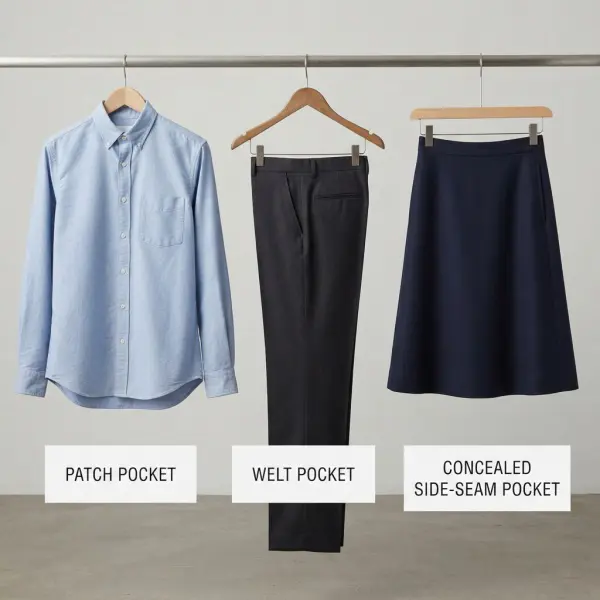
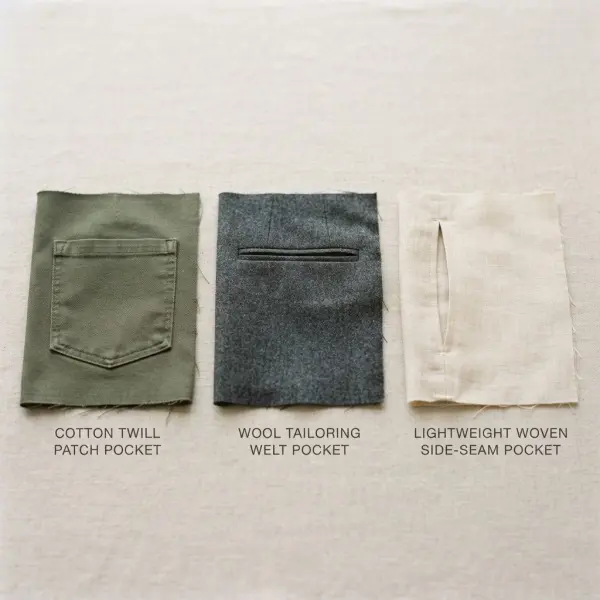
Patch, welt, and side-seam pockets differ mainly in how they are built into the garment, how visible they are, how much sewing precision they require, and what kind of product aesthetic they support. A patch pocket is applied onto the outside or inside surface of a garment panel, making its shape visible and relatively straightforward to construct. A welt pocket is created through a cut opening in the garment and finished with one or two narrow fabric lips, producing a cleaner and more tailored appearance but requiring greater sewing accuracy. A side-seam pocket uses an existing garment seam as the pocket opening, keeping most of the pocket visually concealed.
None of these constructions is universally better. A patch pocket can be ideal for casual shirts or workwear, a welt pocket for tailored jackets and trousers, and a side-seam pocket for dresses, skirts, or relaxed trousers where visual discretion matters.
For fashion teams, the choice affects more than appearance. It changes pattern complexity, sewing sequence, production time, reinforcement requirements, bulk, cost, and how the garment behaves during wear.
What Is the Main Difference Between Patch, Welt, and Side-Seam Pockets?
The simplest distinction is where the pocket structure sits in relation to the garment surface. A patch pocket sits on the garment surface. Its perimeter is usually stitched onto the garment panel, so the pocket itself becomes part of the visible design.
A welt pocket is constructed through an opening cut into the garment panel. The opening is finished with narrow welt pieces, while the pocket bag sits behind the outer fabric.
A side-seam pocket uses a seam line—usually the side seam—as the access point. The pocket bag is attached behind the seam, allowing most of the construction to remain hidden.
These structural differences strongly influence the garment's visual language. Patch pockets tend to look more casual, utility-driven, or decorative. Welt pockets generally create a more controlled and tailored surface. Side-seam pockets are comparatively discreet because the opening follows a seam that already exists in the garment. The underlying engineering of pocket depth, reinforcement, pocket bags, and load support is discussed separately in pocket construction for apparel design.
Patch Pocket: Visible, Versatile, and Relatively Direct to Construct
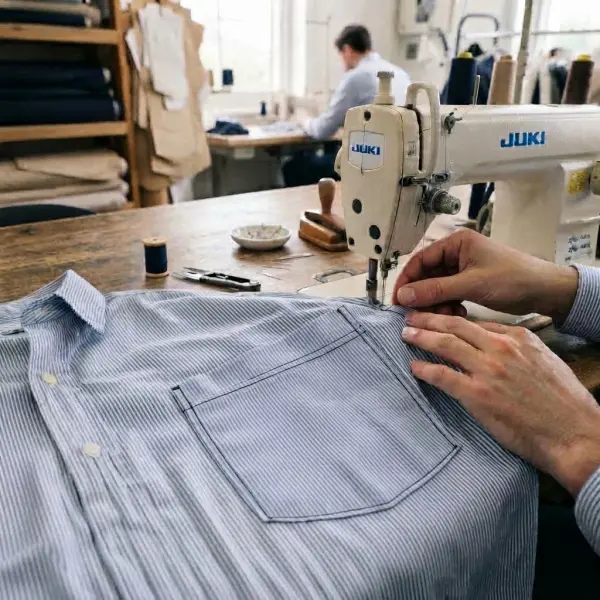
A patch pocket is a separate piece of fabric attached to the garment surface. Its edges may be turned and topstitched, lined, faced, shaped, pleated, expanded with gussets, covered with a flap, or reinforced depending on the product. The basic idea remains simple: the pocket body is visible.
This makes patch pockets especially useful when the pocket itself is intended to contribute to the design. They are common on shirts, jeans, jackets, uniforms, workwear, overshirts, childrenswear, and utility-inspired garments.
Why Designers Choose Patch Pockets
Patch pockets provide considerable visual flexibility.
Changing the shape alone can alter the character of a garment. A square chest pocket can feel practical and understated. Rounded lower corners may soften the appearance. Oversized patch pockets can become a dominant fashion detail. Bellows or gusseted versions add volume and reinforce a utility aesthetic.
Because the pocket is externally visible, designers can also use contrast stitching, fabric direction, printed pattern placement, trims, labels, or flaps deliberately. Operationally, simple patch pockets usually involve fewer hidden construction components than welt pockets. That does not mean they are automatically easy to manufacture well. The visible perimeter means crooked positioning, uneven corners, inconsistent topstitching, or mismatched pocket heights can be obvious on the finished garment.
Where Patch Pockets Work Best
Patch pockets are particularly suitable when the product can visually accommodate an external pocket. Typical applications include:
- casual shirts and overshirts;
- denim garments;
- chore jackets and workwear;
- safari and utility-inspired clothing;
- children's clothing;
- some dresses and skirts;
- cargo and field garments.
Their suitability still depends on fabric. Heavy denim or cotton twill can support clearly structured patch pockets. Lightweight fabrics may require smaller pockets, lining, different edge finishes, or careful handling to prevent sagging or visible distortion.
For a soft blouse, adding a large patch pocket in self-fabric may pull the surface downward or alter drape. The same dimensions in a stable workwear fabric may perform perfectly well.
Manufacturing Considerations for Patch Pockets
The simplest patch-pocket workflow generally includes cutting the pocket piece, preparing its upper edge, turning the remaining seam allowances, positioning it accurately, and stitching it to the garment. But production difficulty increases when a pocket includes:
- curved shapes;
- pointed corners;
- exact stripe or check matching;
- flaps;
- box pleats;
- bellows;
- lining;
- double-needle topstitching;
- decorative stitching;
- strict symmetry requirements.
So while patch pockets often offer relatively direct construction, complexity can rise quickly when the visual specification becomes detailed.

Welt Pocket: Minimal Appearance, Higher Construction Precision
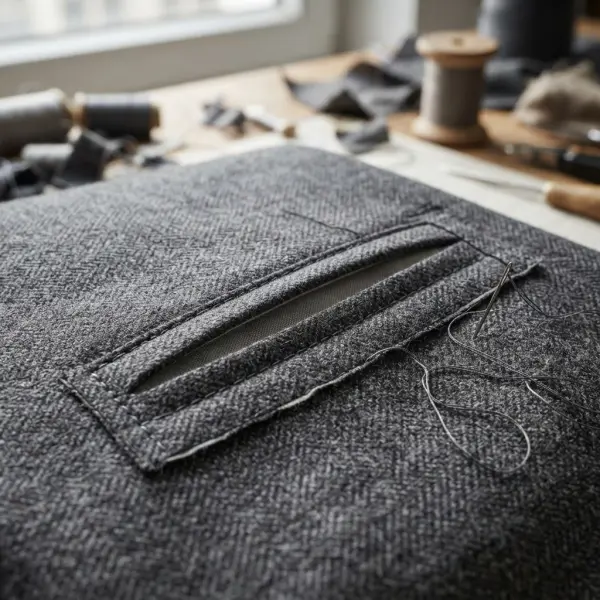
A welt pocket creates an opening through the garment surface and finishes that opening with a narrow strip or pair of strips known as welts. The pocket bag sits behind the garment. From the outside, only the pocket opening and its welt structure need to be visible.
This makes welt pockets especially associated with tailored or refined garments, although they are not limited to formalwear. They can appear in blazers, coats, trousers, skirts, waistcoats, casual jackets, and contemporary fashion pieces.
Single-Welt and Double-Welt Construction
Welt pockets are commonly described as single-welt or double-welt pockets. A single-welt pocket typically presents one principal visible welt edge. A double-welt pocket creates two narrow lips framing the opening.
The exact terminology and sewing sequence can vary somewhat across factories, pattern systems, and garment categories, so technical documentation should include a construction diagram rather than relying only on the name. That detail matters because a buyer, technical designer, pattern maker, and factory may not always visualize the same construction from a short text description.
Why Welt Pockets Require Greater Accuracy
Unlike a patch pocket, a welt pocket involves cutting into the main garment panel. That makes positioning and sewing accuracy particularly important. If the opening is cut incorrectly, the problem may be difficult to reverse without replacing the entire garment panel. Common quality issues include:
- uneven welt widths;
- misaligned ends;
- puckering around the opening;
- visible raw edges;
- poor corner turning;
- asymmetrical openings;
- distortion caused by inadequate stabilization.
Because the opening interrupts the garment surface, stabilization may be necessary depending on fabric weight, weave stability, stretch, and intended use. A tailored wool fabric, for instance, behaves differently from a lightweight stretch woven.
Where Welt Pockets Work Best
Welt pockets are useful when the designer wants the pocket function without adding a large external shape to the garment. Typical applications include:
- suit jackets;
- tailored coats;
- dress trousers;
- tailored skirts;
- waistcoats;
- clean minimalist outerwear;
- some premium casual jackets.
Their visual restraint can make them suitable for garments where a patch pocket would interrupt a clean surface. However, welt pockets are not automatically “more premium.” Quality depends on execution.
A well-sewn patch pocket can be entirely appropriate for a premium product, while a poorly executed welt pocket can visibly lower perceived quality. The design language and manufacturing standard should match.
Side-Seam Pocket: Function Hidden Inside the Garment Structure
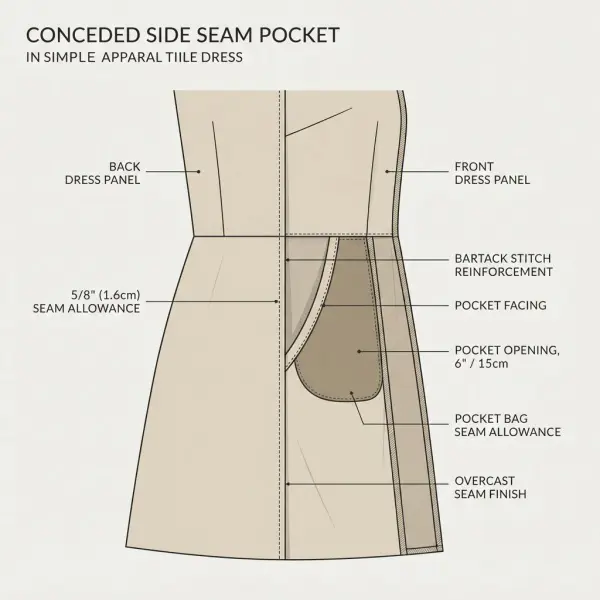
A side-seam pocket places its opening within an existing garment seam. The pocket bag sits inside the garment, usually attached to both sides of the seam opening. Because the opening follows the seam, the pocket can be almost invisible when the garment is viewed normally.
This makes side-seam pockets particularly useful where the designer wants storage without adding an obvious external feature. They are common in dresses, skirts, relaxed trousers, shorts, coats, and other garments with suitable seam locations.
Why Side-Seam Pockets Can Look So Clean
The visual advantage comes from using an existing structural line. Instead of adding a new visible pocket shape, the garment's side seam performs two functions: joining the garment panels and providing pocket access. The result can preserve a clean silhouette.
But visual discretion does not guarantee good performance. A side-seam pocket may gape if the opening is poorly stabilized, the garment is too fitted through the hip, or the pocket bag carries significant weight. This is particularly important in dresses and skirts. A phone placed into a side-seam pocket can sometimes pull the garment sideways if the fabric is light or the pocket lacks adequate structural support.
Where Side-Seam Pockets Work Best
Side-seam pockets are often suitable for garments where the pocket should remain visually secondary. Examples include:
- skirts;
- dresses;
- relaxed trousers;
- shorts;
- lightweight coats;
- casual outerwear.
The garment must still provide enough room around the opening for comfortable access. A side-seam pocket positioned in a very tight garment can be difficult to use and may create gaping. In that situation, the problem may not be the pocket construction itself. It may be the relationship between pocket placement and garment fit.
Patch vs Welt vs Side-Seam Pocket: Practical Comparison
The three constructions can be compared across the criteria that matter most to apparel development.
|
Factor |
Patch Pocket |
Welt Pocket |
Side-Seam Pocket |
|
Visibility |
High |
Low to moderate |
Very low |
|
Basic structure |
Pocket applied to garment surface |
Opening cut into garment and finished with welt |
Opening integrated into existing seam |
|
Visual character |
Casual, utility, decorative |
Tailored, refined, controlled |
Clean, discreet |
|
Sewing precision |
Moderate for simple versions |
High |
Moderate |
|
Risk if sewing goes wrong |
Often repairable, depending on fabric |
Higher because garment panel is cut |
Usually moderate |
|
Pattern complexity |
Low to moderate |
Moderate to high |
Moderate |
|
Typical bulk location |
On garment surface |
Behind opening |
Inside side seam |
|
Best-known uses |
Shirts, jackets, workwear |
Tailoring, trousers, coats |
Dresses, skirts, casual trousers |
|
Decorative potential |
High |
Moderate |
Low |
|
Production sensitivity |
Position and topstitching |
Cutting, alignment, stabilization |
Seam alignment and gaping |
|
Common fit concern |
Sagging or distortion |
Opening distortion |
Gaping or side pull |
This comparison is a starting point rather than a universal rule.
A simple welt pocket may be efficient in a factory that produces tailored garments every day, while the same pocket could be relatively difficult for a supplier whose production line specializes in basic knitwear. Manufacturing capability changes the practical answer.
Which Pocket Is Stronger?
There is no universal strength ranking between patch, welt, and side-seam pockets. Durability depends on the complete construction system: shell fabric, pocket material, thread, stitch type, seam allowance, reinforcement, opening geometry, attachment points, pocket dimensions, laundering, and expected load. A patch pocket stitched onto heavy denim may tolerate demanding use.
A welt pocket in tailored wool may be perfectly durable for carrying light personal items but was not necessarily designed to function like a workwear tool pocket. Likewise, a side-seam pocket can work well for everyday storage when its pocket bag is supported properly, but may distort a lightweight dress when heavily loaded.
The more useful question is: Is the pocket strong enough for the intended product and use case? That should be established during development and wear testing rather than inferred from the pocket name.
Which Pocket Is Easiest to Manufacture?
In basic form, a patch pocket is usually the most straightforward of the three because it can be prepared and sewn onto a garment panel without cutting an opening into the main fabric. A standard side-seam pocket is also comparatively familiar in many garment factories because it is integrated into ordinary seam assembly.
Welt pockets generally demand greater precision because the garment panel must be marked, stitched, cut, turned, aligned, and stabilized accurately. However, factory specialization matters. A tailored-jacket factory may produce welt pockets extremely efficiently using trained operators, folders, templates, or specialized machinery.
A casualwear factory producing mostly T-shirts may find the same operation much more disruptive. So manufacturing difficulty should be judged in relation to supplier capability rather than construction theory alone.
How Pocket Choice Affects Garment Style
Pocket construction communicates product character before the customer consciously analyzes it. Large patch pockets often signal practicality, utility, casual dressing, or workwear influences. Narrow welt pockets tend to preserve the garment surface and can reinforce a tailored or minimal aesthetic.
Side-seam pockets communicate very little visually, which is precisely their advantage in many products. These associations are not strict rules. Contemporary designers frequently use construction language deliberately against expectation. A formal fabric may be combined with oversized patch pockets, for example, to create a more relaxed or utilitarian interpretation. The more strategic discussion of how these elements influence product identity is covered in how functional garment details influence usefulness and style.
Fabric Compatibility: The Same Pocket Behaves Differently on Different Textiles
Pocket selection should always be reviewed after the main garment fabric is confirmed. A technically correct construction can still be a poor material match.
Stable Woven Fabrics
Cotton twill, denim, canvas, and similar stable fabrics can support many patch-pocket variations well. Their relative structure makes positioning, folding, and topstitching manageable, although heavy weights may create bulk.
Tailoring Fabrics
Wool and wool-blend suiting fabrics are often compatible with welt pockets because the construction aligns with tailored garment aesthetics and pressing techniques. Stabilization and pressing remain important for achieving a clean result.
Lightweight and Fluid Fabrics
Fluid fabrics can make large patch pockets sag or distort the garment surface. Side-seam pockets can preserve the outer appearance, but pocket-bag weight must still be controlled. Some lightweight fabrics may require reinforcement around pocket openings.
Stretch Fabrics
Stretch changes the stability of the opening. A pocket opening may grow during use unless its construction controls excessive extension. The correct solution depends on the fabric's stretch percentage, recovery, garment fit, and pocket location.
Pocket Choice and Garment Fit
Pocket construction should be reviewed together with garment fit. This is particularly important around the chest, hip, and waist because these areas may already be under tension. A chest patch pocket placed on a closely fitted shirt may distort when the wearer moves.
A welt pocket crossing a high-tension region can gape. A side-seam pocket in narrow trousers may become difficult to access. The product team should therefore evaluate the pocket during actual fit sessions. For apparel development, the most useful questions include:
- Does the opening remain flat while standing?
- Can the wearer use the pocket naturally?
- What happens when the wearer sits?
- Does the pocket bag become visible?
- Does carrying a realistic object alter the garment silhouette?
- Does the opening recover after repeated use?
The pocket should be evaluated as part of the fitted garment, not as an isolated sewing sample.
How Pocket Construction Influences Cost
Pocket type affects cost through fabric, trims, sewing operations, pressing, pattern development, and quality control. A basic patch pocket may require relatively few components. A welt pocket may involve welt pieces, pocket bags, interfacing or stabilization, additional marking, accurate cutting, turning, pressing, and inspection.
A side-seam pocket can appear extremely simple externally while still adding pocket-bag pieces and sewing operations internally. The final cost therefore depends on construction detail rather than category alone. A lined patch pocket with flap, pleat, snap, and decorative double topstitching can easily involve more work than a standardized side-seam pocket. Fashion brands should cost the approved construction rather than assume “patch is cheap” and “welt is expensive.”
Choosing the Right Pocket for a Product
The strongest decision starts with the garment's intended use and design language. A useful framework is to evaluate five questions.
1. Should the Pocket Be Visible?
If the pocket should become part of the design, a patch construction offers substantial flexibility. If the outer surface should remain clean, a welt or side-seam pocket may be more appropriate.
2. What Will the User Carry?
Large objects and frequent use create different structural requirements from a pocket intended mainly for occasional hand placement.
3. What Fabric Is Being Used?
Thickness, drape, stretch, stability, transparency, and surface texture all affect construction.
4. How Fitted Is the Garment?
Close-fitting styles provide less internal room and can expose pocket bulk or gaping more easily.
5. Can the Factory Produce It Consistently?
A design that works beautifully in one sample is not yet a successful production solution. The supplier must be able to reproduce the pocket accurately across the entire order.
Practical Application for Fashion Businesses
Pocket selection should ideally happen during concept and early development, not after the garment pattern is nearly complete. For a small apparel brand, the workflow can remain simple.
Start with the customer use case. If developing an everyday trouser, decide whether the customer should comfortably carry a phone and keys. If designing a tailored blazer, decide whether pockets are intended to be functional, visually subtle, or primarily part of the tailoring language.
Next, compare construction options against fabric and price point. Then make a physical prototype. The prototype should be tested for:
- access;
- pocket depth;
- opening stability;
- capacity;
- garment distortion;
- sewing consistency;
- visual proportion;
- production time.
After approval, document the pocket clearly in the technical package. The aim is not to choose the most technically impressive construction. It is to choose the construction that best supports the garment's intended use, appearance, cost, and manufacturing system.
Common Mistakes When Choosing Between Pocket Types
Choosing Welt Pockets Only Because They Look “Premium”
Welt pockets can support a refined aesthetic, but they also require accurate execution. Adding them to a low-cost product without sufficient sewing capability can create quality problems that are more visible than a simpler, well-made construction would have been.
Assuming Patch Pockets Are Always Simple
Shape, pattern matching, decorative stitching, flaps, pleats, and symmetry can make patch pockets highly demanding. The visible nature of the construction means small sewing inconsistencies may become prominent.
Hiding Side-Seam Pockets in Garments That Are Too Tight
A concealed pocket still needs space. If the garment is closely fitted through the hip, pocket access and gaping can become problematic.
Copying Pocket Dimensions Between Unrelated Garments
Pocket width and depth should respond to garment category, body location, user needs, and size range. A pocket developed for a coat should not automatically be transferred to a lightweight dress.
Ignoring Factory Capability
A construction that is common for one supplier can be unfamiliar for another. Early factory feedback can identify machine, operator, stabilization, or sequence requirements before the design reaches bulk production.
What Brands Should Verify Before Final Approval
Before locking a patch, welt, or side-seam pocket for production, confirm three areas.
- Function: Can the target wearer use the pocket naturally, and can it hold the intended objects?
- Construction: Are material, reinforcement, seam allowance, pocket bag, stitching, and attachment details technically resolved?
- Manufacturing: Can the supplier produce the pocket consistently at the approved quality and price?
If one of these remains unclear, the design is not fully resolved. A pocket that works visually but fails during use is incomplete. A pocket that works beautifully in a single development sample but creates unacceptable inconsistency on a production line is equally incomplete.
FAQ
What is the difference between a patch pocket and a welt pocket?
A patch pocket is a separate piece of fabric attached to the garment surface, while a welt pocket is created through an opening in the garment and finished with one or two narrow welt edges. Patch pockets are generally more visible and can become a decorative design feature. Welt pockets tend to preserve a cleaner outer surface and are common in tailoring. Their manufacturing requirements also differ: basic patch pockets are usually more direct to construct, while welt pockets require greater precision during marking, cutting, stitching, turning, and finishing.
What is the difference between a welt pocket and a side-seam pocket?
A welt pocket creates its own opening in a garment panel, while a side-seam pocket uses an existing seam as the opening. Welt pockets usually remain visible as a narrow finished detail on the garment surface. Side-seam pockets can be almost hidden when closed. Both typically use internal pocket bags, but their pattern structure and sewing sequence differ. Which is more suitable depends on the garment style, fabric, fit, required appearance, manufacturing capability, and expected pocket use.
Are patch pockets cheaper than welt pockets?
Often, but not automatically. A basic patch pocket generally requires fewer precision operations than a traditional welt pocket, which may reduce sewing time and complexity. However, elaborate patch pockets with lining, pleats, flaps, pattern matching, decorative stitching, or hardware can become costly. Factory specialization also matters. A tailored-garment factory may manufacture welt pockets efficiently because the operation is already standardized. Actual costing should therefore be based on the final construction and production environment.
Which pocket type is best for dresses?
Side-seam pockets are widely suited to dresses when designers want storage without interrupting the garment surface. However, they are not appropriate for every dress. Very fitted silhouettes may gape around the opening, and lightweight fabrics may distort when the pocket carries heavy items. Patch pockets can work well when they are intentionally part of the design, particularly on casual dresses. The choice should be evaluated against silhouette, fabric weight, pocket capacity, and how the dress behaves during movement.
Which pocket construction is most suitable for tailoring?
Welt pockets are strongly associated with tailored jackets, trousers, coats, and waistcoats because their narrow openings maintain a controlled surface. Patch pockets are also used in tailoring, particularly on more relaxed jackets, and can intentionally make a tailored garment feel less formal. The correct choice depends on the desired design language rather than tailoring rules alone. Precise sewing, appropriate reinforcement, pressing, proportion, and alignment generally matter more to perceived quality than simply choosing one pocket category.
Can side-seam pockets carry a smartphone?
They can, provided the pocket bag has sufficient depth and width and the garment structure can support the weight. A phone may cause visible pulling in lightweight skirts or dresses, so usability should be tested on the actual garment. Pocket placement also matters because a phone positioned directly over the hip can affect comfort when walking or sitting. For products marketed around practical storage, brands should test the dimensions and weight of realistic devices during development rather than assuming that any side-seam pocket is sufficient.
Which pocket type is the most durable?
Durability cannot be determined from pocket type alone. Fabric strength, pocketing material, seam construction, reinforcement, stitch quality, opening geometry, load distribution, garment fit, and user behavior all influence service life. A properly engineered patch, welt, or side-seam pocket can be durable within its intended application. Apparel teams should therefore define what the pocket is expected to carry and validate the complete construction through sample evaluation and, where appropriate, additional performance testing.
Conclusion
Patch, welt, and side-seam pockets solve the same basic problem—giving the wearer storage—but they approach it in very different ways. Patch pockets put the structure on display. Welt pockets create a controlled opening within the garment surface.
Side-seam pockets hide much of the construction within an existing seam. Those differences affect aesthetic character, pattern development, sewing precision, production cost, fit, fabric compatibility, and quality control. For apparel teams, the best pocket is therefore not the one that appears most sophisticated.
It is the one whose construction makes sense for the fabric, silhouette, customer use, factory capability, and intended price point. Once that foundation is correct, the pocket can do something more interesting than simply hold an object: it can reinforce the character of the garment itself. That broader relationship between utility and visual design is the focus of the next article in this cluster, how functional details affect garment usefulness and style.





Comments 0
Leave a CommentSend Comment
Anda harus Login terlebih dahulu untuk dapat memberikan komentar.