
Why Knit Fabrics Are Essential in Comfortable Everyday Clothing
Quick Answer
Knit fabrics are essential in comfortable everyday clothing because their interconnected yarn loops can change shape as the body moves. This structural flexibility allows many knitted garments to bend, extend, and conform to the wearer with less restriction than a comparably specified non-stretch woven fabric.
That is why knit constructions are widely used in T-shirts, underwear, socks, sweaters, polo shirts, leggings, sweatshirts, loungewear, babywear, base layers, and casual dresses. Depending on their design, they can provide stretch, softness, drape, easy dressing, reduced pressure, and freedom of movement.
Comfort does not come from knit construction alone. Fiber composition, yarn quality, fabric density, weight, finishing, moisture behaviour, recovery, seams, garment pattern, size, climate, and care all affect the wearing experience. A lightweight cotton jersey, dense polyester interlock, brushed fleece, wool rib knit, and nylon-elastane tricot may all be knitted, but they offer very different forms of comfort.
For fashion businesses, the practical lesson is that “comfortable knit” is not a sufficient product specification. Brands need to define the type of comfort required, translate it into measurable fabric and garment properties, and test the complete product under realistic wear and laundering conditions.
Why Does Knit Construction Support Comfort?
Knit fabric is formed by intermeshing yarn loops. Unlike a conventional woven structure, in which warp and weft yarns cross one another, a knitted structure can extend as its loops open, narrow, rotate, or shift under force.
This loop mobility enables many knits to follow body movement without requiring the yarn itself to elongate by the same amount. CottonWorks identifies body conformity, flexibility, stretch, movement, and comfort as characteristic advantages of many knitted constructions.
A garment made from knit fabric can therefore respond to ordinary movements such as sitting, reaching, bending, walking, breathing, and raising the arms. The body is rarely static, even when a person appears to be resting. Clothing must continually accommodate small changes in posture, muscle position, joint angle, and body circumference.
This ability to adapt helps explain why knitted products have become foundational to modern wardrobes. The commercial importance of knits does not depend on a single fashion trend. It comes from their compatibility with repeated daily movement.
Structural Stretch Reduces Restriction
Many weft-knitted fabrics provide significant widthwise extensibility because their loops can deform under tension. Rib knits may expand substantially, while jersey, interlock, piqué, fleece, and double knits provide different degrees of flexibility.
This extensibility can reduce the amount of rigid space that must be engineered into a garment. A knit T-shirt, for example, can accommodate chest expansion and shoulder movement without the same pleats, gussets, or tailoring ease commonly required by a stable woven shirt.
The result can feel less restrictive, but only when the pattern is appropriate. A knit garment that is too small may produce excessive pressure. One that lacks recovery may become loose and distorted. Stretch creates the possibility of comfort; it does not guarantee it.
Body Conformity Can Improve Fit
Knitted loops allow fabric to follow curved body areas such as the shoulder, bust, waist, hip, elbow, and knee. This can help a garment maintain contact without requiring extensive darts or shaped seams.
Body conformity is valuable in products such as underwear, socks, base layers, leggings, fitted tops, sweaters, and sleepwear. It can also make pull-on garments easier to wear because openings can expand temporarily and then return toward their original dimensions.
The amount of conformity must still suit the product. A relaxed T-shirt should not behave like compression wear, while a fitted base layer should not hang away from the body. Comfortable fit depends on the relationship between garment measurements, body measurements, fabric stretch, recovery, power, and intended silhouette.
Loop Structures Can Create Softer Transitions
Knits often bend easily because yarns are arranged in curved loops rather than held exclusively in straight interlaced paths. This can create a more pliable fabric that follows the body and folds without forming sharp resistance points.
The softer mechanical character is useful around areas that repeatedly flex, including underarms, elbows, knees, waistlines, necklines, and ankles.
Yet softness cannot be inferred from structure alone. A coarse yarn, rough finish, exposed filament, dense construction, hard print, or abrasive seam can make a knit uncomfortable. Conversely, a well-finished lightweight woven can feel exceptionally soft.
Knit construction should therefore be viewed as one part of the comfort system.
Clothing Comfort Has More Than One Meaning
Comfort is not a single fabric property. It is the wearer’s combined response to fit, movement, temperature, moisture, touch, pressure, garment weight, seams, and the surrounding environment.
Two consumers may describe the same garment differently. One may value warmth and enclosure, while another experiences the garment as heavy and hot. A close-fitting knit can feel secure during exercise but restrictive during sleep. A fluid jersey may feel pleasant when standing but cling uncomfortably when damp.
For product development, it is helpful to divide comfort into several practical dimensions.
|
Comfort Dimension |
What the Wearer Experiences |
Relevant Knit Variables |
|
Movement comfort |
Ability to bend, reach, sit, and walk without restriction |
Stretch, recovery, pattern ease, seam extensibility |
|
Pressure comfort |
Whether the garment feels supportive, neutral, or restrictive |
Fabric power, elastic tension, fit, edge construction |
|
Tactile comfort |
How the material feels against the skin |
Fiber, yarn hairiness, surface texture, finishing, seams |
|
Thermal comfort |
Whether the wearer feels too warm or too cold |
Thickness, density, trapped air, fiber, garment coverage |
|
Moisture comfort |
How the product responds to sweat or humidity |
Absorbency, wicking, spreading, drying, ventilation |
|
Weight comfort |
Whether the garment feels light, balanced, or heavy |
GSM, garment size, moisture uptake, trim weight |
|
Dressing comfort |
How easily the product can be put on and removed |
Opening stretch, recovery, closure design, silhouette |
|
Long-term comfort |
Whether fit and feel remain acceptable after wear and care |
Shrinkage, growth, pilling, recovery, seam durability |
Comfort claims should identify which of these dimensions the product is designed to address. “Ultra-comfortable” provides little technical direction to a mill, pattern maker, factory, quality team, or customer.
How Knit Fabrics Support Freedom of Movement
Everyday Movement Requires Continuous Fabric Adjustment
The body changes dimensions during ordinary activity. Sitting increases tension across the hip and knee. Reaching affects the shoulder, chest, and back. Breathing changes the torso circumference. Walking repeatedly bends the hip, knee, and ankle.
A rigid garment must accommodate these changes through additional space, shaped panels, pleats, openings, or engineered stretch. A knit can often absorb part of the movement through loop deformation.
This is especially useful in garments worn for long periods. A person may wear a T-shirt, underwear, socks, or polo shirt for ten or more hours while shifting between commuting, working, sitting, eating, walking, and resting. Small restrictions that seem acceptable during a brief fitting can become uncomfortable over a full day.
Stretch Direction Must Match Body Movement
Fabric does not necessarily extend equally in every direction. Many weft knits stretch more across their width than along their length. Rib structures may expand substantially across the ribs, while stable double knits may provide more controlled movement.
Pattern pieces must be oriented so the required stretch follows the relevant body circumference. In leggings, for example, sufficient extension is needed around the hip, thigh, knee, and calf. In a close-fitting top, stretch may be most important across the chest, back, and upper arm.
Rotating pieces only to improve marker efficiency can change fit, drape, opacity, or recovery. Comfortable movement therefore depends on correct fabric orientation as well as material selection.
Seam Extensibility Must Support the Fabric
A flexible fabric joined by a rigid seam can still restrict movement. The seam may feel tight, break under extension, or concentrate pressure along the body.
Apparel manufacturing offers many stitch and seam combinations, including lockstitch, chainstitch, overlock, coverstitch, and flatlock systems. The correct choice depends on the fabric, stretch requirement, garment location, visual standard, and skin contact. CottonWorks notes that garment construction involves numerous stitch and seam combinations rather than one universal method.
A shoulder seam in a relaxed T-shirt, the inseam of a legging, the underband of a sports bra, and the toe area of a sock experience different forces. Each needs its own balance of extension, strength, bulk, and softness.
This connection between fabric flexibility and seam engineering is discussed further in Seam Finishing Techniques Explained for Better Garment Quality.

Stretch, Recovery, and Pressure Must Be Balanced
Stretch describes how far a fabric can extend. Recovery describes how effectively it returns after the force is removed. Fabric power describes the force the material applies while stretched.
These properties create very different wearing experiences.
A soft cotton rib may stretch easily but recover weakly, allowing the neckline or waistband to become enlarged. A high-elastane knit may recover strongly but produce excessive pressure if the pattern uses too much negative ease. A stable interlock may feel comfortable in a relaxed top yet lack the extension needed for a pull-on fitted garment.
The most comfortable solution is rarely the fabric with the greatest stretch. It is the material whose extension, recovery, and force correspond to the body area and product function.
Low Recovery Can Undermine Comfort
A garment that loses recovery may initially feel comfortable but deteriorate during use. Knees can bag, elbows can enlarge, waistbands may slip, and necklines may become wavy.
This affects more than appearance. A sagging garment may require repeated adjustment, while loose openings can expose areas the wearer expected to remain covered.
Recovery should therefore be assessed after repeated extension and laundering, not only through a single manual stretch during fabric selection.
Excessive Compression Can Also Be Uncomfortable
Elastic yarns can improve fit retention, but more elastane does not automatically create a better product.
High fabric power may be appropriate for compression garments, selected sports products, or supportive waistbands. The same force may feel restrictive in sleepwear, loungewear, children’s clothing, or clothing intended for prolonged seated use.
Pressure can also become concentrated at narrow elastics, cuffs, seams, armholes, waistbands, or leg openings. Product teams should evaluate both the fabric body and each edge treatment.
Negative Ease Requires Product-Specific Decisions
Negative ease means the garment measurement is smaller than the corresponding body measurement so the fabric stretches during wear.
The amount should be based on:
- Fabric extension in the relevant direction
- Recovery after repeated loading
- Required garment pressure
- Opacity when extended
- Garment length and weight
- Body-area sensitivity
- Customer size range
- Intended wearing duration
- Ease of dressing and removal
A pattern reduction that works in resilient nylon-elastane interlock may fail in cotton jersey with lower recovery. Fabric performance and garment construction must be developed together; CottonWorks uses fit examples to demonstrate how pattern changes can reduce excessive strain in knit garments.
Tactile Comfort: What the Fabric Feels Like Against the Skin
Tactile comfort is shaped by the interaction between skin and garment surface. The wearer may perceive softness, roughness, cling, coolness, warmth, prickling, friction, or pressure.
Knit structure can help create a flexible surface, but fiber and yarn choices are equally important.
Fiber Type Influences the Sensation
Cotton knits are widely used for everyday basics because they can offer a familiar, absorbent, and soft hand. Wool can provide warmth and moisture buffering, but comfort against the skin depends heavily on fiber diameter and surface character. Polyester and nylon can create smooth, lightweight performance fabrics, while regenerated cellulosic fibers are often used for fluid, soft knits.
None of these fiber categories has a universal comfort advantage. A coarse cotton yarn can feel rougher than a fine synthetic filament. A soft wool knit may feel pleasant to one wearer and irritating to another. A smooth viscose jersey can drape comfortably yet become heavy or clingy when wet.
Product claims should reflect the tested garment rather than assumptions about fiber names.
Yarn Quality Changes the Surface
Staple length, yarn twist, spinning system, filament shape, texturing, hairiness, and yarn evenness all affect the fabric surface.
Longer, well-controlled staple fibers can contribute to a smoother yarn. Short or loosely secured fibers may create a fuzzier surface and potentially influence pilling. Textured filament yarns can add bulk and softness, while smooth filaments can produce a cooler and more slippery sensation.
The chosen yarn must also work with the knit gauge and stitch length. A fine yarn in a dense construction may feel smooth and compact. A bulky yarn in an open structure may feel warm and soft but more vulnerable to snagging.
Finishing Can Improve or Disguise Handfeel
Enzyme treatments, softeners, brushing, sueding, washing, compacting, heat setting, and other finishing processes can alter softness, surface texture, thickness, and drape.
A soft showroom sample may not maintain the same hand after repeated laundering. Some finishes gradually diminish, while brushing can increase pilling or linting if the fabric is poorly engineered.
Brands should evaluate handfeel before and after the intended care cycles. Initial softness is commercially useful, but retained comfort is more meaningful to the customer.
Thermal Comfort Depends on Construction and Context
Knit fabrics can support both warm and cool clothing because their structures range from fine, open jersey to thick, brushed fleece.
Thermal comfort depends on heat transfer between the body, clothing, and environment. Fabric thickness, trapped air, moisture, wind exposure, garment fit, layering, activity, and climate all contribute.
A thick fleece can trap insulating air and support warmth. A lightweight open jersey may allow more air movement. A rib knit can create variable thickness across its surface, while mesh structures can support localized ventilation.
These outcomes are not guaranteed by the word “knit.”
Lightweight Does Not Always Mean Cool
A lightweight fabric may still feel warm if it has low air permeability, clings closely when damp, or is used in a tight garment that limits ventilation.
Conversely, a slightly heavier but more open fabric may feel more comfortable in some conditions. Color, garment coverage, activity level, humidity, and wind also alter the experience.
Fashion businesses should avoid using fabric weight as the sole indicator of thermal suitability.
Loft Can Support Warmth
French terry, fleece, sweater knits, and other dimensional structures can create thickness and trap air. Brushing raises fibers from the surface, increasing apparent bulk and softness.
Warmth must be balanced against garment weight, drying time, breathability, pilling, and climate. A heavy hoodie may perform well in a cool, dry environment but feel impractical in a humid tropical market.
Product design should be localized around realistic wearing conditions rather than generic seasonal labels.
Fit Changes Heat and Air Movement
A close-fitting base layer transfers heat and moisture differently from a loose T-shirt. A fitted knit may maintain contact with the skin, while a relaxed silhouette can create spaces through which air circulates.
Neither route is always more comfortable. Close contact may support moisture transfer in an engineered product, while loose fit may feel less restrictive and less clingy during casual wear.
Comfort evaluation should therefore include the complete garment silhouette.
Moisture Comfort Requires Specific Testing
Moisture comfort includes several different processes: absorption, liquid spreading, vertical or horizontal wicking, water-vapor transmission, drying, and moisture retention.
These properties are related but not interchangeable. A fabric that absorbs a large amount of liquid may remain wet for longer. A low-absorbency fabric may dry quickly but leave liquid against the skin unless its structure or finish transports moisture effectively.
AATCC maintains separate methods for absorbency, liquid moisture management, vertical and horizontal wicking, drying time, drying rate, and water-vapor transmission. Its 2026 moisture-management proficiency program lists methods including TM79, TM195, TM197, TM198, TM199, TM200, TM201, TM204, and TM213.
This is why “moisture-wicking” should not be approved through visual inspection or supplier language alone.
Absorbency Is Not the Same as Wicking
Absorbency concerns the uptake of liquid into a material. Wicking concerns liquid movement through or along a textile structure.
Cotton may absorb moisture into its fibers. Engineered synthetic yarns may transport liquid through capillary spaces while absorbing relatively little into the fiber itself. Finishes can alter both behaviours.
The garment’s success depends on the use case. Everyday underwear, a running shirt, sleepwear, and a winter base layer may require different moisture profiles.
Drying Time Changes the Wearing Experience
A fabric that remains wet may become heavy, cling to the body, increase friction, or produce a chilling sensation when activity stops.
ASTM’s method for measuring cooling associated with liquid movement and evaporation notes that environmental conditions substantially influence results. It also cautions that fabric measurements alone do not establish complete clothing-system performance because thermal comfort depends on multiple interacting variables.
Drying claims should therefore state or reference the test conditions and should not be generalized beyond the relevant product environment.
Ventilation Can Be Engineered Through Knit Structure
Mesh, tuck stitches, jacquard structures, body-mapped zones, and variable density can create areas with different levels of openness.
Seamless and integral knitting technologies can place ventilation, support, stretch, and texture in selected garment zones. CottonWorks describes body mapping and seamless construction as methods that can improve fit, movement, and comfort while reducing some conventional seams.
These systems still require testing. Open zones can become transparent, snag easily, lose support, or create visual distortion when stretched.

Seams, Labels, and Trims Can Override Fabric Comfort
A brand may invest in a soft fabric but lose the comfort benefit through poor garment construction.
Potential irritation points include:
- Thick overlock seams
- Hard thread
- Rough labels
- Exposed zipper tape
- Narrow elastic
- Bulky bindings
- Hard screen prints
- Embroidery backing
- Poorly placed pocket edges
- Uneven seam allowances
- Heat-sealed components with sharp edges
These details matter most in products worn close to the skin or for extended periods.
Fewer Seams Can Reduce Irritation
Seamless and whole-garment knitting can reduce the number of assembled joins. This may improve comfort by reducing bulky or high-friction areas and by allowing garment zones to be knitted with different structures.
CottonWorks describes seamless circular knitting as a route that can improve range of motion and body conformity while reducing seam-related chafing.
The word “seamless” should still be used accurately. Some products marketed as seamless contain finishing seams, gusset joins, elastic attachments, or other assembled components. A reduced-seam garment is not necessarily entirely seam-free.
Seam Placement Is as Important as Seam Type
Moving a seam away from a high-friction area can be more effective than merely changing the stitch.
In socks, for example, toe-seam placement can influence pressure and rubbing. CottonWorks notes that some sock constructions position the toe seam above the toes rather than at the tip or underneath for better comfort.
Similar decisions apply to shoulder seams under backpack straps, underarm seams, inner-leg seams, waistbands, and bra underbands.
Labels and Branding Need Wear Testing
A heat-transfer label may feel smoother than a woven label, but it can crack, peel, or become rough. A soft satin label may still irritate if its cut edge is exposed. Embroidery and patches may create stiffness on the reverse.
Brand identity should not compromise the skin-facing surface. Wear tests should include the complete garment with all trims, prints, labels, and care information installed.
Why Different Everyday Products Need Different Knits
T-Shirts and Casual Tops
Single jersey is widely used for T-shirts because it can provide softness, flexibility, drape, and efficient production. Interlock offers a smoother, thicker, and often more stable alternative. Rib can support closer-fitting silhouettes.
Comfort priorities commonly include:
- Soft handfeel
- Shoulder and arm movement
- Neckline recovery
- Appropriate opacity
- Manageable garment weight
- Dimensional stability
- Surface durability
- Climate suitability
A very lightweight jersey may feel airy but become transparent or unstable. A heavy jersey may feel substantial but too warm. The ideal balance depends on the market and silhouette.
Underwear and Base Layers
Underwear requires close body contact, recovery, soft seams, stretch openings, moisture response, and compatibility with elastic trims.
Fabric power should be sufficient to retain fit without creating excessive pressure. Waistbands and leg openings should expand during dressing but remain secure during use.
Opacity, hygiene-related care, colorfastness to perspiration, and drying also matter. AATCC maintains a specific method for evaluating colorfastness to perspiration across textile fibers, yarns, and fabrics.
Leggings and Close-Fitting Bottoms
Leggings require more than high stretch. They need recovery, opacity under extension, abrasion resistance, seam compatibility, waistband stability, and control of growth at the knee and seat.
A fabric that feels soft on a hanger may become sheer when stretched. A high-recovery material may feel excessively compressive if the pattern is too small. Heavy fabric can improve cover but increase heat and garment weight.
The product should be tested while standing, sitting, squatting, walking, and bending—not only measured on a flat table.
Sweatshirts and Loungewear
French terry, fleece, interlock, and soft sweater knits are commonly used for loungewear.
The desired comfort may include warmth, relaxed movement, softness, and a sense of enclosure. Yet excessive garment weight, linting, pilling, slow drying, bulky seams, and weak rib recovery can reduce long-term satisfaction.
A brushed fleece should be evaluated after laundering because surface softness and fiber shedding may change.
Sweaters and Cardigans
Sweater comfort depends on yarn softness, gauge, garment weight, fit, seam quality, thermal performance, and surface sensitivity.
Fully fashioned knitting shapes garment pieces during production and can create smoother joins and more controlled fit. CottonWorks notes that full fashioning can support fit and smoother seams, although manufacturing quality still depends on linking, finishing, and product engineering.
A very soft sweater may still become uncomfortable if it grows, pills heavily, traps excessive heat, or places too much weight on the shoulder.
Socks
Socks must stretch over the foot, recover around the ankle, remain secure, manage friction, and accommodate repeated flexing.
Comfort can be influenced by:
- Toe-seam placement
- Cuff pressure
- Terry cushioning
- Heel and toe reinforcement
- Moisture behaviour
- Shoe compatibility
- Size accuracy
- Recovery after laundering
An overly tight cuff can leave pressure marks, while weak recovery can allow the sock to slip or bunch.
Polo Shirts and Uniform Knits
Piqué and interlock are frequently used for polo shirts and uniforms because they can balance casual comfort with a more structured appearance.
Products worn for work or school may require repeated laundering, stable collars, low shrinkage, color consistency, abrasion resistance, and climate suitability.
Comfort must remain consistent across the service life. A polo that feels comfortable during fitting but shrinks, twists, pills, or develops a rigid collar after washing has not delivered durable comfort.

What Determines Whether a Knit Garment Is Truly Comfortable?
Knit structure provides a foundation, but the complete comfort outcome depends on several connected decisions.
Construction
Single jersey, rib, interlock, piqué, French terry, fleece, Ponte, tricot, and sweater knits do not provide the same performance.
Their structural differences are explained in Knit Fabric Explained: Types, Properties, and Fashion Uses.
Product teams should select the construction according to movement, drape, warmth, recovery, opacity, texture, and care requirements.
Fiber and Yarn
Fiber influences moisture response, thermal behaviour, resilience, touch, and care. Yarn design influences surface smoothness, bulk, strength, stretch, and pilling.
The composition label provides only part of the answer. Two fabrics with identical percentages may perform differently because their yarns, knitting, density, and finishing differ.
Fabric Weight and Density
Fabric weight affects opacity, thermal sensation, drape, garment mass, and cost. Density affects cover, stretch, stability, and air movement.
Higher GSM does not automatically mean higher quality. The appropriate weight is the one that supports the garment’s use without unnecessary bulk, heat, transparency, or instability.
Finishing
Finishing can influence softness, shrinkage, moisture response, static, pilling, surface appearance, and dimensional control.
Performance should be checked after realistic laundering because finishes and fabric dimensions may change.
Pattern and Fit
The same fabric can produce a comfortable or uncomfortable garment depending on its pattern.
Fit determines pressure, range of motion, body coverage, dressing ease, and ventilation. Good fit requires coordination between body measurements, fabric properties, garment measurements, grading, and construction.
The broader relationship is covered in Garment Fit Explained: Why Good Fit Matters in Fashion.
Sewing and Trims
Needles, threads, seams, elastic, labels, closures, prints, and stabilizers can change how the product feels.
Testing only an unfinished prototype can conceal irritation that appears after the commercial trims are installed.
Care and Dimensional Stability
Comfort must survive laundering. Knit fabrics can shrink, grow, twist, lose recovery, or change surface character as production stresses are released.
CottonWorks identifies fiber, yarn, construction, processing tension, wet processing, finishing, garment manufacturing, care labeling, and laundering as contributors to dimensional behaviour.
AATCC maintains separate methods for dimensional changes in fabrics and finished garments after home laundering, reflecting the difference between material-level and product-level performance.
Business Implications for Fashion Brands
Sourcing: Replace “Comfortable” With Measurable Requirements
A sourcing brief should not stop at “soft stretch knit.”
Useful specifications may include:
- Exact knit construction
- Fiber composition
- Yarn description
- Finished fabric weight and width
- Stretch by direction
- Recovery or residual growth
- Fabric power where relevant
- Dimensional change after laundering
- Spirality or skew
- Pilling and abrasion performance
- Air permeability
- Moisture-management requirements
- Drying performance
- Colorfastness
- Surface and handfeel reference
- Restricted-substance requirements
- Care method
- Approved physical standard
The test package should reflect the garment. Moisture-management testing may be important for active underwear but unnecessary for a loose decorative cardigan.
Product Development: Start With the Wearer’s Day
Comfort becomes easier to define when teams describe how the product will actually be used.
A useful product brief might state:
The garment will be worn for eight-hour workdays in a warm, humid climate. It must allow seated movement, remain opaque, avoid excessive cling, recover at the elbow, tolerate frequent washing, and feel soft against bare skin.
This is more actionable than asking for a “premium comfortable top.” It guides construction, weight, fit, finishing, and testing decisions.
Manufacturing: Control Tension and Relaxation
Knits can stretch during spreading, cutting, sewing, pressing, and handling. If panels are cut while extended, they may contract later and become smaller than intended.
Relaxation, low-tension spreading, differential feed, appropriate needles, compatible seams, and controlled pressing help preserve the intended dimensions.
Fabric quality cannot be corrected entirely through sewing. CottonWorks emphasizes that weak fabric quality cannot be compensated for by downstream manufacturing controls alone.
Quality Assurance: Test Comfort-Related Failure Modes
Comfort complaints do not always appear under the word “comfort.” Customers may report:
- The neckline became loose
- The waistband feels tight
- The garment twists after washing
- The fabric feels hot
- The surface became rough
- The knees became baggy
- The label scratches
- The shirt clings when wet
- The seams feel bulky
- The garment became too short
Each complaint corresponds to a technical variable that can be reviewed during development.
Retail Communication: Make Specific Claims
Instead of generic statements such as “ultimate comfort,” product descriptions can communicate specific characteristics:
- Soft cotton-rich jersey
- Stretch rib designed for close fit
- Brushed interior for additional warmth
- Lightweight open knit for warm conditions
- Smooth interlock with enhanced coverage
- Flat seams positioned to reduce bulk
- Pull-on construction with flexible openings
Any performance claim involving moisture management, cooling, compression, ultraviolet protection, odor control, or drying should be supported by appropriate testing.
Merchandising: Comfort Must Match Market Context
A comfortable product for one consumer or climate may be unsuitable for another.
Brands should consider:
- Climate and season
- Indoor versus outdoor use
- Activity level
- Customer age and mobility
- Cultural fit preferences
- Size range
- Care infrastructure
- Expected product lifetime
- Price position
- Layering habits
A dense long-sleeved knit may be commercially appropriate in a cool market but poorly aligned with tropical everyday wear. Local product use should guide the material decision.
A Practical Comfort-First Development Framework
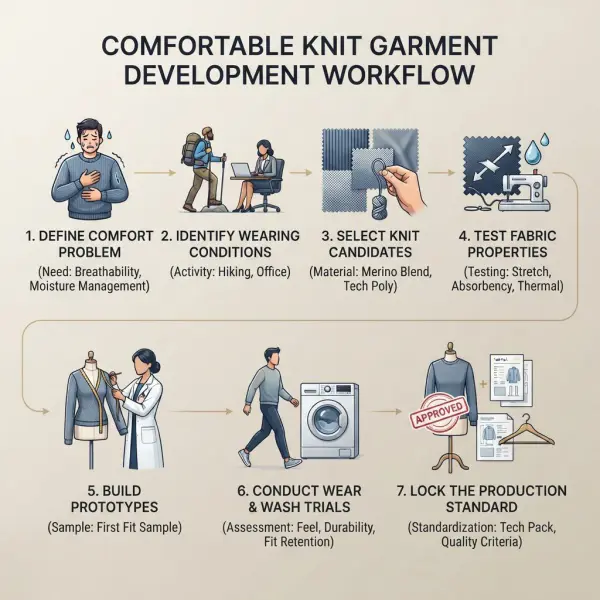
Step 1: Define the Comfort Problem
Identify what the garment needs to improve:
- Restricted movement
- Skin irritation
- Excessive heat
- Moisture discomfort
- Pressure
- Difficult dressing
- Heavy garment weight
- Poor recovery
- Unstable fit after laundering
Do not attempt to optimize every comfort dimension equally. A winter sweater and summer base layer require different priorities.
Step 2: Define the Wearing Conditions
Document the climate, activity, wearing duration, layering, laundering frequency, and likely sources of friction.
This provides context for evaluating fabric test results.
Step 3: Select Candidate Knit Systems
Choose two or three realistic constructions rather than committing immediately to one fabric.
For a work polo, the team might compare lightweight piqué, smooth interlock, and performance jersey. For loungewear, it might compare French terry, brushed fleece, and double-knit jersey.
Step 4: Measure the Relevant Properties
Depending on the product, measure:
- Stretch and recovery
- Fabric power
- Weight and thickness
- Dimensional change
- Spirality
- Air permeability
- Moisture movement
- Drying time
- Pilling
- Abrasion
- Colorfastness
- Opacity under extension
AATCC’s standards directory includes established methods for dimensional change, colorfastness, moisture behaviour, surface appearance, and related textile properties.
Step 5: Build Fabric-Specific Prototypes
Develop patterns using the actual performance of each candidate fabric. Use production-representative seams, elastics, labels, prints, and trims.
A prototype without final construction details cannot fully represent the commercial wearing experience.
Step 6: Conduct Wear and Care Trials
Wear trials should include the positions and movements relevant to the product.
Useful observations include:
- Pressure after prolonged wear
- Range of motion
- Temperature sensation
- Dampness and cling
- Seam irritation
- Opening recovery
- Knee and elbow growth
- Dressing ease
- Garment weight when wet
- Appearance after laundering
Laboratory data and wearer evaluation serve different purposes. Neither should automatically replace the other.
Step 7: Lock the Complete Comfort Standard
The approved standard should include the fabric, pattern, construction, trims, care method, and test results.
Changing yarn, elastane content, stitch length, finishing, fabric width, supplier, or factory may affect the final comfort and require reapproval.




Comments 0
Leave a CommentSend Comment
Anda harus Login terlebih dahulu untuk dapat memberikan komentar.