

How Digital Printing Supports Small-Batch Fashion Production
Quick Answer
Digital printing supports small-batch fashion production because designs can be changed from digital files without creating a separate physical screen set for every pattern or color configuration. This reduces some of the setup barriers that make very short textile-printing runs difficult or expensive with conventional printing methods.
For fashion businesses, the bigger advantage is not simply producing fewer pieces. Digital printing can support a different operating model: brands can sample more designs, launch smaller initial quantities, test customer response, replenish stronger sellers, personalize products, and postpone some design decisions until demand becomes clearer.
That can reduce inventory exposure, but it does not automatically reduce total cost or eliminate overproduction. Fabric minimums, garment blanks, pretreatment, printing, finishing, cutting, sewing, logistics, machine utilization, and supplier minimum charges still matter.
Small-batch production works best when digital printing is connected to disciplined merchandising and replenishment. A brand that prints 50 units instead of 500 gains flexibility only if it can learn from those 50 units and react quickly enough to what sells.
The technology changes the production constraint. The business still needs to make good decisions.
What Does Small-Batch Fashion Production Mean?
Small-batch fashion production is a manufacturing approach in which products are made in relatively limited quantities rather than committing immediately to large-volume runs.
There is no universal industry number that defines a “small batch.”
For one direct-to-garment supplier, a batch might be five T-shirts. For a small apparel factory, 100 garments per style may already be considered a short run. For an industrial textile mill accustomed to thousands of meters per design, an order of a few hundred meters may be relatively small.
The meaningful distinction is therefore relative production commitment.
Small-batch production allows a fashion company to commit less inventory before it has complete information about market demand.
That can be particularly useful when:
- launching an unfamiliar silhouette,
- testing a new print,
- entering a new geographic market,
- introducing seasonal capsules,
- working with uncertain demand,
- producing limited-edition products,
- serving niche audiences,
- or validating a new fashion business concept.
Digital textile and garment printing can support this model because design changes do not necessarily require new physical screens.
Mimaki, for example, describes direct-to-textile inkjet systems as suitable for small-scale and on-demand textile requirements because screen preparation is not required. Mimaki digital textile printing for small-scale and on-demand production
That does not make every small order economical. It changes one important part of the cost structure.
Why Traditional Print Setup Can Push Fashion Brands Toward Larger Orders
To understand the value of digital printing in small-batch fashion, it helps to separate unit production cost from production commitment.
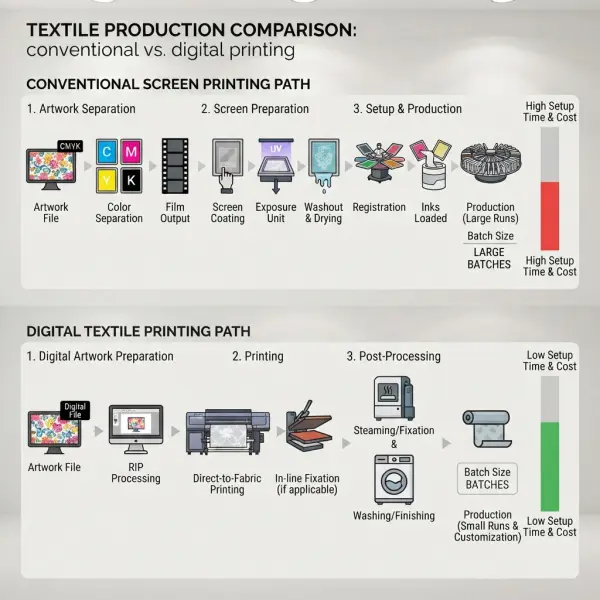
Conventional textile screen printing involves preparation before production begins. Artwork may need color separation, individual screens, screen preparation, registration, color setup, test printing, and eventually screen cleaning.
Those setup activities are not inherently inefficient.
Quite the opposite: when the same print is produced repeatedly at high volume, the setup cost can be distributed across thousands of meters or garments. Conventional printing can therefore remain commercially strong for stable, high-volume orders.
The problem appears when a fashion brand wants only a small quantity.
If a print job requires substantial setup regardless of whether the brand orders 100 meters or 5,000 meters, the first 100 meters carry a relatively heavy share of those fixed costs.
That creates pressure to increase order quantity.
The logic may sound financially sensible:
“If 100 meters costs almost as much to set up as 1,000 meters, we should order more.”
But that shifts risk from production cost to inventory.
The additional 900 meters are only economical if they eventually become products customers actually buy.
Digital printing changes this equation because artwork exists primarily as data rather than as a corresponding set of physical print screens.
Digital Printing Changes the Economics of Variety
A fashion collection does not create inventory complexity only through quantity.
It also creates complexity through variety.
Consider a brand launching four printed blouses.
Each blouse is available in:
- 3 prints,
- 2 colorways,
- 5 sizes.
That creates 30 possible style-color-size combinations before the brand has sold one garment.
If the brand must make a large production commitment to every design, inventory expands rapidly.
Digital printing can reduce some of this pressure because a different print file does not necessarily require a separate physical setup infrastructure comparable to screen preparation.
EFI Reggiani positions digital textile equipment across both smaller-scale and industrial applications, illustrating that digital textile printing is not limited to prototyping; equipment ranges now span relatively small-scale production through high-throughput industrial systems. EFI Reggiani digital textile printing systems
The commercial consequence is important.
Fashion brands can sometimes afford to experiment with more designs at lower initial quantities.
That does not mean they should create unlimited SKUs.
Every SKU still produces operational work:
- product photography,
- product-page setup,
- size allocation,
- SKU coding,
- stock tracking,
- merchandising,
- warehouse space,
- forecasting,
- customer service,
- and eventually markdown management.
Digital printing reduces one constraint on assortment variety. It does not remove the managerial cost of variety.

How Digital Printing Supports Test-and-Repeat Merchandising
One of the strongest applications of small-batch digital production is a test-and-repeat model.
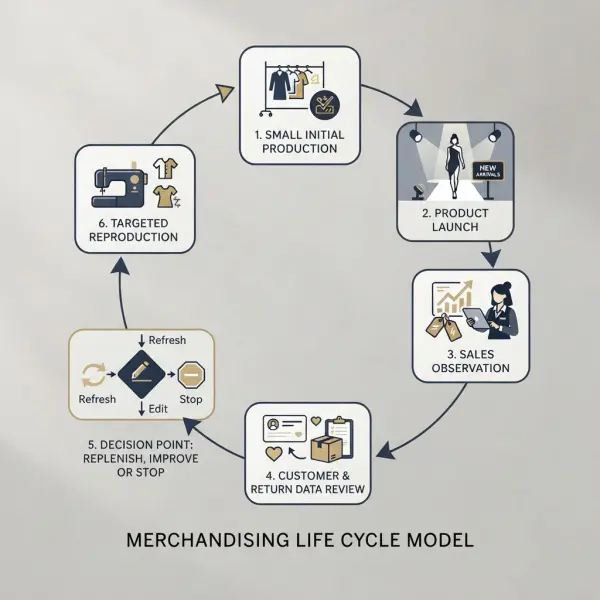
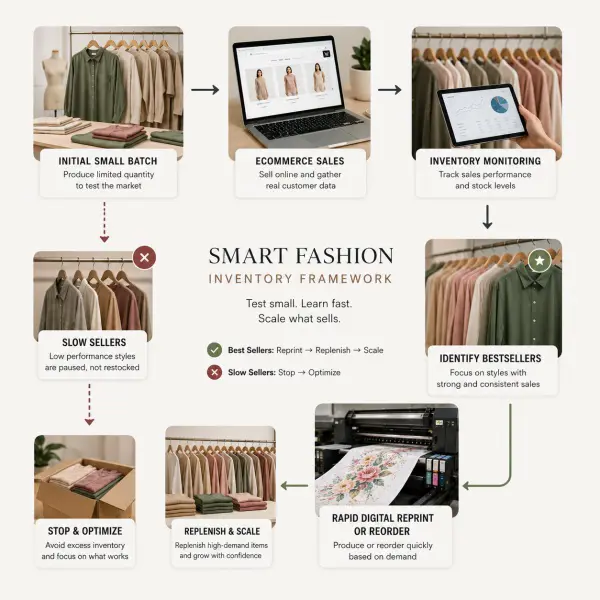
Instead of forecasting the full seasonal demand before launch, a brand produces a limited initial quantity, observes market response, and then replenishes the stronger products.
This changes the sequence of decision-making.
A traditional model can look like:
forecast → large order → launch → discover demand
A more responsive model can look like:
forecast → small initial order → launch → observe → replenish or stop
The second model does not remove forecasting.
It reduces how much of the forecast must be financially committed before real customer behavior becomes visible.
A simple fashion example
Imagine a womenswear startup planning six printed summer dresses.
Under a large-batch model, the company might commit significant inventory to all six prints before knowing which ones customers prefer.
With a viable small-batch digital supply chain, it may instead produce a smaller launch quantity for each print.
After launch:
- Design A sells quickly.
- Design B performs steadily.
- Design C receives traffic but weak conversion.
- Design D has strong conversion but returns are unusually high.
- Designs E and F barely move.
The brand now has better information.
The logical response is not simply “reprint every design.”
It may replenish A, investigate fit or quality problems on D, maintain B, and stop producing E and F.
This is where small-batch production becomes strategically useful.
The value comes from learning before recommitting capital.
Small Batches Can Reduce Inventory Exposure—Not Inventory Risk to Zero
This distinction matters.
Digital printing can enable a brand to produce closer to demand. Technology suppliers and printing businesses frequently describe on-demand production as a way to reduce finished inventory requirements. Kornit, for example, positions its digital systems around producing ordered products in shorter runs and reducing dependence on pre-produced finished inventory. Kornit on-demand textile production model
But “can reduce inventory” is more accurate than “eliminates inventory.”
A fashion business still needs materials somewhere in the system.
Depending on its model, it may hold:
- greige or prepared fabric,
- blank T-shirts,
- unprinted polyester garments,
- trims,
- zippers,
- packaging,
- finished garments,
- or reserved production capacity.
Inventory is often postponed or repositioned, rather than disappearing completely.
Postponement can be more valuable than zero inventory
Suppose a company sells 20 graphic T-shirt designs using the same black and white blank garments.
Instead of stocking every completed graphic-size combination, the company could theoretically stock a smaller number of common blanks and print the graphic after demand becomes clearer.
The business is postponing one decision:
Which design should this garment become?
That flexibility has value.
A blank medium black T-shirt could potentially become Design A, B, C, or D.
Once Design A is printed onto it, its future use becomes narrower.
The same principle can apply upstream in roll-to-roll fashion production, although execution is more complex. A company may hold common base fabrics and delay some printing decisions instead of committing every meter to a finished pattern far in advance.
But postponement is only useful when the later process can respond quickly enough.
If printing, finishing, cutting, sewing, and shipment still take ten weeks, delaying the print decision may provide less commercial agility than the brand expects.
Digital Printing Can Lower Design-Level Minimums, but MOQ Does Not Disappear
“Digital printing has no MOQ” is a phrase that needs careful interpretation.
A machine may technically be capable of printing one garment or a few meters of fabric.
The supplier operating the machine still has costs.
These can include:
- artwork checking,
- RIP and color preparation,
- material loading,
- machine setup,
- pretreatment,
- ink,
- transfer paper,
- steaming or washing,
- curing,
- fabric handling,
- operator labor,
- cleaning,
- finishing,
- inspection,
- packing,
- and administrative processing.
A supplier may therefore impose a commercial minimum order even when the printing technology itself does not require hundreds of identical pieces.
This is particularly relevant for reactive digital textile printing.
As explained in Sublimation, DTG, and Reactive Printing: Key Differences for Fashion Teams, reactive printing may still involve pretreatment, steaming, washing, and drying. Producing five meters is technically different from running five printed T-shirts through a DTG workflow.
For sourcing teams, “What is your MOQ?” is therefore not specific enough.
Ask instead:
- What is the sampling minimum?
- What is the minimum production quantity?
- Is the minimum per design or across the whole order?
- Is there a minimum per colorway?
- Is there a minimum number of meters per fabric?
- Is there a fixed setup or handling charge?
- What changes on a reorder?
- Can multiple artworks share the same fabric batch?
- Does the MOQ change if the base fabric is already in stock?
These questions expose the real small-batch economics.
Sampling Becomes More Closely Connected to Production
Fashion sampling traditionally has an awkward problem.
A sample can sometimes be produced through a method that differs from bulk production because creating the final production setup for one garment is too expensive.
That can create discrepancies.
The sample looks one way, but production behaves differently.
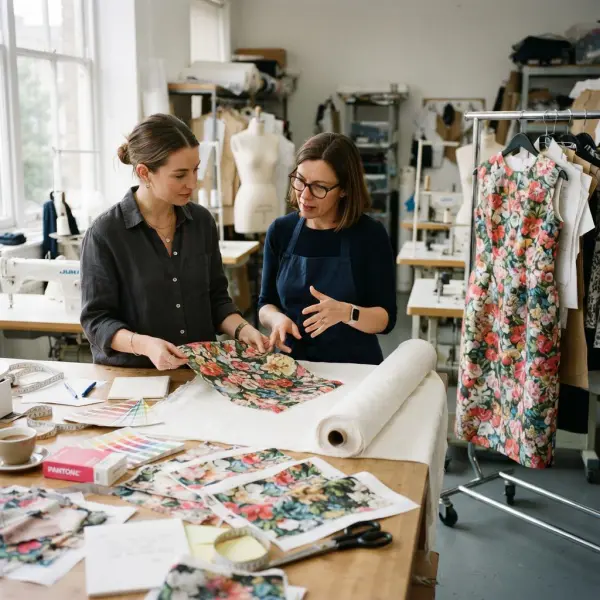
Digital printing can narrow this gap in some workflows because the same artwork data and broadly similar print technology can potentially be used from strike-off through production.
That is valuable for:
- print scale testing,
- colorway development,
- placement decisions,
- photographic prints,
- repeat adjustment,
- engineered prints,
- and rapid design iteration.
A designer can test several motif scales before committing to the final version.
However, sampling consistency should not be exaggerated.
A sample printed on a different machine, fabric lot, pretreatment, resolution, speed mode, ink batch, or fixation system can still differ from production.
Small-batch brands should therefore ask whether the approved strike-off represents the intended production process.
Small-Batch Production Creates Better Opportunities for Product Validation
A fashion product is a bundle of assumptions.
Before launch, the company is making assumptions about:
- silhouette,
- fit,
- print,
- color,
- fabric,
- price,
- size distribution,
- customer segment,
- styling,
- timing,
- and channel demand.
Producing a large batch means placing substantial financial confidence behind all those assumptions simultaneously.
A small batch narrows the cost of being wrong.
This can be particularly useful for younger fashion businesses that do not yet have enough historical sales data to forecast a product accurately.
But small-batch validation only works if the business knows what it is testing.
If a product performs poorly, the problem may be:
- the design,
- price,
- photography,
- product-page content,
- fit,
- launch timing,
- fabric,
- advertising,
- customer targeting,
- or insufficient traffic.
A weak launch therefore does not automatically mean the print is unpopular.
Small-batch production provides an affordable opportunity to gather evidence. It does not make the evidence self-explanatory.
Digital Printing Can Support Faster Product Development
Removing physical screen preparation from design changes can shorten some development cycles.
A fashion team that wants to test a revised floral repeat, background color, logo position, or photographic print can send an updated file rather than rebuilding a physical screen set for every variation.
That gives designers and merchandisers more room to iterate.
The practical benefit can show up in three areas.
More design options can reach physical sampling
A design team may create twenty digital concepts but historically limit physical sampling because every printed version creates setup cost.
Digital workflows can make it more realistic to move several candidates into physical textile form before narrowing the collection.
This is useful because artwork often changes once it reaches fabric.
A motif that looks balanced on a monitor may feel too large on a blouse. A pale color may lose contrast against the fabric. A dense repeat may become visually overwhelming once it covers an entire dress.
Physical validation still matters.
Colorways can be tested before committing to all of them
A brand could sample a botanical print in navy, terracotta, sage, and cream without necessarily committing to a large quantity of each version.
That supports more informed range building.
It also creates a temptation to over-design.
If every colorway is technically possible, teams may approve too many.
Merchandising discipline becomes more—not less—important.
Print changes can happen later in development
When the print data remains flexible, some artwork decisions can remain open longer.
This can help brands respond to buyer feedback, market information, or product-development changes.
But later decisions also compress approval time.
If design teams repeatedly revise artwork until immediately before production, digital flexibility can create workflow instability rather than agility.
Fast technology still needs a freeze point.
Digital Printing Supports Limited Editions Without Requiring Artificial Scarcity
Limited collections are a natural application for small-batch digital production.
A brand may want to release:
- artist collaborations,
- event-specific graphics,
- regional collections,
- seasonal capsules,
- influencer collaborations,
- anniversary editions,
- or experimental print concepts.
Digital printing can make such products easier to produce without manufacturing large identical print runs.
The commercial discipline is to separate real production logic from artificial scarcity marketing.
A collection can genuinely be limited because the brand intends to produce only a defined quantity or production window.
There is no need to claim that a product is “rare” merely because digital printing made a small run possible.
For brands, the stronger value proposition is often creativity and relevance: a print can exist for a narrower audience without needing mass-market volume to justify its production setup.
Personalization Takes Small-Batch Production to the Extreme
At the far end of small-batch production is a batch size of one.
Digital garment printing can support products where artwork changes from customer to customer.
Examples include:
- names,
- initials,
- team numbers,
- event information,
- customer-uploaded artwork,
- localized graphics,
- or selected design components.
FESPA describes textile print-on-demand as production in which a product is printed or personalized after the order is placed, and notes that digital production can make very small quantities technically viable. FESPA overview of textile print-on-demand
At that point, the printing technology is no longer the hardest part of the system.
Order data becomes critical.
The workflow must reliably connect:
customer → artwork → product → size → color → print file → production job → QC → shipping
One mismatch can produce a garment that is perfectly printed and completely wrong.
Brands considering personalization therefore need workflow automation and data validation as much as print capability.
Small-Batch Production Can Improve Replenishment Decisions
Many fashion businesses focus on the initial order.
The more interesting question may be the second order.
Small-batch digital production becomes significantly more valuable when the supply chain can replenish quickly.
Consider two sourcing scenarios.
Supplier A accepts an initial order of 30 units but requires eight weeks for every reorder.
Supplier B requires 60 units initially but can replenish a successful design in ten days.
Depending on sales velocity, Supplier B may create the more agile commercial system.
MOQ alone is therefore an incomplete measure of flexibility.
Fashion teams should evaluate:
- initial MOQ,
- reorder MOQ,
- production lead time,
- reorder lead time,
- base-material availability,
- printing capacity,
- sewing capacity,
- shipping time,
- repeat color consistency,
- and capacity during peak periods.
The point of test-and-repeat is not merely to test.
It is to repeat while demand still exists.
Why Small Batches Do Not Automatically Mean Lower Costs
This is one of the most important commercial caveats.
Producing fewer units usually means fewer dollars committed to one style, but that does not mean each unit becomes cheaper.
Small runs often have higher per-unit costs.
Fixed work must be allocated across fewer products.
Depending on the production route, this can include:
- sampling,
- pattern preparation,
- cutting setup,
- print preparation,
- operator time,
- QC,
- sewing line changeovers,
- packaging,
- administration,
- and freight.
A 30-unit dress run can therefore cost substantially more per garment than a 3,000-unit run.
The financial advantage is somewhere else:
less capital may be exposed to a product before demand is known.
That is a different economic benefit.
A business should compare:
margin per sold unit × expected sell-through
against:
production cost + markdowns + unsold inventory + working capital + reordering cost + lost sales from stockouts.
This is a more useful framework than simply asking whether digital printing is cheaper per meter.
The Hidden Cost: Losing Sales Because You Ordered Too Little
Small batches reduce overstock risk, but they introduce another risk—stockouts.
Suppose a brand launches 20 units of a dress, expecting modest demand.
A social post performs unexpectedly well and the entire stock sells within hours.
That sounds ideal.
But if replenishment takes eight weeks, the brand may miss most of the demand opportunity.
A conservative initial order has protected inventory capital but created a lost-sales problem.
This is why small-batch fashion should not be confused with permanently keeping inventory extremely low.
A stronger system uses different quantities based on uncertainty.
Products with little demand history may start small.
Established bestsellers with predictable sales may justify deeper inventory.
Small-batch production is therefore a risk-management tool, not an ideology.
Small-Batch Fashion Requires Better Data, Not Less Forecasting
On-demand terminology sometimes creates the impression that forecasting becomes unnecessary.
That is rarely true.
Even businesses that print only after orders are received must forecast something.
They may need to forecast:
- blank garment demand,
- base fabric demand,
- size distribution,
- ink usage,
- machine capacity,
- labor,
- trims,
- packaging,
- shipping capacity,
- and seasonal peaks.
The uncertainty moves.
A DTG business holding blank garments has less design-specific finished inventory but still needs enough blanks in the correct sizes.
A roll-to-roll printer may delay artwork decisions but still need prepared base fabrics.
A cut-and-sew fashion company may print fabric quickly yet remain constrained by sewing capacity.
Digital printing therefore works best when paired with good product and operational data.
Small-Batch Production Does Not Fix a Slow Sewing Factory
Printing is only one production stage.
This sounds obvious, but it is an important operational limitation.
A supplier may digitally print fabric in a day.
If the fabric then waits:
- five days for finishing,
- a week for cutting,
- three weeks for sewing,
- and another week for final inspection and freight,
the brand does not have a four-day supply chain.
It has a multi-week supply chain with a fast printing stage.
Small-batch fashion works best when the downstream system is also designed for smaller, faster flows.
That can require:
- smaller cutting batches,
- flexible sewing lines,
- reserved production capacity,
- standardized base patterns,
- common trims,
- faster approval,
- reliable QC,
- and responsive logistics.
Digital printing can remove one bottleneck while exposing another.
How Fashion Brands Can Apply Small-Batch Digital Production Strategically
The best application is not to move every product to tiny production runs.
It is to match production commitment to uncertainty.
Use small batches for high-uncertainty products
A new silhouette, experimental print, unfamiliar customer segment, or seasonal concept carries more demand uncertainty.
These are logical candidates for smaller initial commitments where suppliers allow it.
Keep proven products on a different production logic
A black T-shirt that has sold consistently for three years does not require the same testing strategy as a new graphic dress.
Larger production quantities may be commercially sensible for established products if demand is stable and scale lowers cost.
A sophisticated fashion business can therefore operate multiple production models simultaneously.
Standardize what customers do not need to see
Flexibility becomes easier when the underlying platform is stable.
For example, a brand might standardize:
- three blank T-shirt bodies,
- a core set of fabrics,
- common packaging,
- several approved trims,
- and existing size blocks,
while varying graphics and prints digitally.
This reduces operational complexity behind the assortment.
Customers see variety.
The supply chain sees repetition.
Design for replenishment from the beginning
Do not wait for a bestseller before asking whether it can be reordered.
Before launch, confirm:
- supplier capacity,
- reorder minimum,
- fabric availability,
- print-file retention,
- approved color references,
- trims,
- sewing capacity,
- production lead time,
- and freight options.
A bestseller that cannot be reproduced quickly is not operating within a genuine test-and-repeat model.
Track sell-through at design level
If several prints share the same garment body, analyze performance by print—not merely by total product family.
One artwork may be driving most of the demand.
Small-batch production creates more useful decisions when data is granular enough to reveal that difference.
The same logic applies to product launches more broadly: production flexibility has the most value when the brand systematically learns from each launch rather than treating every collection as an isolated event.
Common Mistakes in Small-Batch Digital Fashion Production
Mistake 1: Assuming small MOQ automatically means low risk
A supplier may accept ten units.
That does not mean the product is commercially low-risk.
If sample development, photography, advertising, packaging, freight, and administrative costs are high, a ten-unit run can still be expensive.
Small MOQ reduces one category of financial exposure. It does not eliminate launch cost.
Mistake 2: Creating too many designs because printing makes it possible
Digital printing increases creative flexibility.
That can encourage collections with excessive pattern variation.
The production team may cope, but marketing and inventory systems still need to explain, photograph, list, forecast, and manage every product.
More variety is only useful when customers value it enough to justify the complexity.
Mistake 3: Ignoring reorder lead time
A brand celebrates an MOQ of 20 but discovers after launch that reorders require six weeks.
The initial production was flexible; the supply chain was not.
Always evaluate MOQ and replenishment together.
Mistake 4: Printing before validating the garment itself
A beautiful print cannot rescue poor fit, weak construction, or unsuitable fabric.
Brands sometimes become excited by easy artwork iteration while leaving the base product underdeveloped.
The correct sequence is still product development.
Print flexibility is one component.
Mistake 5: Treating print-on-demand as zero inventory
A POD business may avoid holding a finished Design A T-shirt, but someone still needs the blank garment, ink, machine, packaging, labor, and capacity.
The inventory and capital structure has changed—not disappeared.
Mistake 6: Calling every small batch sustainable
Producing fewer unsold garments can reduce waste if actual overproduction is avoided.
But environmental performance still depends on the material, ink chemistry, pretreatment, energy, water, finishing, logistics, garment durability, and what ultimately happens to the product.
UNEP specifically identifies overproduction and overconsumption among issues that need to be addressed within a more circular textile economy. UNEP sustainable and circular textiles initiative
A small production quantity is therefore one possible inventory strategy, not a complete sustainability claim.
What Fashion Businesses Should Verify Before Moving to Small-Batch Digital Production
Before changing the sourcing model, brands should verify the entire operating system rather than the printer alone.
Start with five questions.
1. Can the selected material actually use the intended digital printing route?
The fundamentals covered in Digital Textile Printing Explained for Fashion and Apparel Production still apply. Fiber, ink chemistry, pretreatment, and fixation cannot be ignored simply because the order is small.
2. What is the true minimum economical batch?
Separate machine capability from supplier commercial terms.
3. Can successful products be replenished quickly enough?
Small initial production without responsive replenishment can exchange overstock risk for lost sales.
4. What inventory must still be held upstream?
Map blank garments, fabrics, trims, packaging, and capacity rather than looking only at finished goods.
5. Does the expected margin absorb higher unit costs?
Smaller runs can reduce commitment while increasing unit cost. The model must still support the brand's price positioning and margin structure.
If these five questions cannot be answered, the business does not yet have a small-batch production strategy. It simply has a supplier willing to accept small orders.





Comments 0
Leave a CommentSend Comment
Anda harus Login terlebih dahulu untuk dapat memberikan komentar.