

Blind Hem, Rolled Hem, and Double Fold Hem: When to Use Each
Two garments can have identical silhouettes and still look noticeably different because of how their edges are finished. A tailored skirt with barely visible hem stitching communicates a different design intention from a lightweight blouse with a delicate rolled edge or a cotton dress finished with a clearly defined line of topstitching.
These differences are not simply decorative. The construction of a hem affects how fabric hangs, how much bulk develops along an edge, how the garment responds to movement, and how efficiently the finish can be reproduced during manufacturing.
Among the many techniques used in garment construction, blind hems, rolled hems, and double fold hems represent three useful approaches to managing fabric edges. Each addresses a different combination of visual requirements, material behavior, and production needs. Although some applications overlap, treating these methods as interchangeable can create problems during sampling or bulk production.
For fashion brands, pattern makers, sewing professionals, and garment manufacturers, understanding when to use each technique makes finishing decisions more predictable. It also helps prevent unnecessary revisions when a hem that looks attractive in a sample proves difficult to reproduce on the intended production fabric.
Quick Answer: What Is the Difference Between Blind Hem, Rolled Hem, and Double Fold Hem?
A blind hem minimizes visible stitching on the garment exterior, a rolled hem creates a compact narrow edge, and a double fold hem encloses the raw fabric edge through two folds before stitching. Each technique serves a different finishing purpose, although their applications can overlap depending on fabric and garment construction.
Blind hems are often selected for tailored trousers, skirts, dresses, and other garments where visible stitching would interrupt a smooth outer surface. They are particularly useful when a relatively discreet finish is more important than decorative topstitching.
Rolled hems are generally associated with lightweight fabrics such as chiffon, georgette, and certain fine dress materials. Their narrow construction helps avoid the additional weight and bulk of a wider hem, although the result depends on whether a sewn, hand-rolled, or overlocked rolled hem is used.
Double fold hems are versatile finishes commonly applied to woven shirts, casual dresses, skirts, and other garments requiring an enclosed raw edge. They are practical when the fabric can accommodate the folded layers without undesirable thickness or distortion.
The correct selection depends on fabric weight, fraying tendency, hemline shape, stitch visibility, desired drape, and available sewing equipment. No single technique is universally superior.
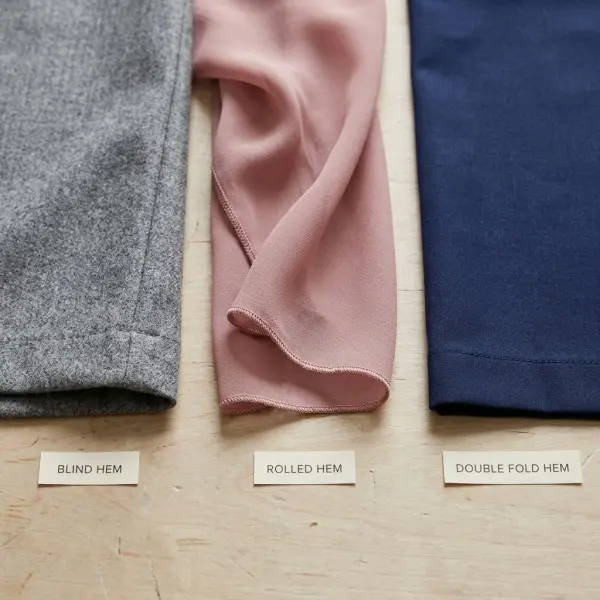
Understanding the Three Hem Construction Methods
All three techniques finish a garment edge, but they achieve their results through different constructions. The distinction is important because two hems can appear similarly neat while having different internal structures, stitching requirements, and production characteristics.
A blind hem is primarily defined by how the stitching attaches the hem with minimal visibility from the outside. A rolled hem is defined by the narrow rolled or turned edge and its method of securing or covering that edge. A double fold hem is defined by the two fabric turns that enclose the raw edge before stitching.
These definitions also explain why garment finishing terminology sometimes overlaps. A very narrow double-turned hem may resemble a sewn rolled hem, while a blind hem can be constructed using different raw-edge treatments. Understanding the actual fabric arrangement is more reliable than relying only on a technique's commercial name.
Blind Hem: Finishing Without Prominent Exterior Stitching
A blind hem attaches the turned-up allowance to the garment using stitches designed to be minimally visible on the right side of the fabric. Instead of producing an obvious continuous line of topstitching, the construction catches small portions of the outer fabric at intervals.
Blind hemming can be performed by hand, with a domestic sewing machine using a blind-hem stitch, or with specialized industrial blindstitch equipment. These approaches share the objective of discreet attachment but do not necessarily create identical stitch formations.
On domestic machines, the fabric is commonly folded back into a particular arrangement that allows the needle to catch only a small amount of the garment body. The BERNINA sewing guide for blind hems describes adjusting the stitch width so the needle just penetrates the folded edge. This helps keep visible stitch points small.
The technique is associated with tailored garments because it preserves a relatively uninterrupted fabric surface. However, the result is not necessarily completely invisible. Fabric texture, stitch depth, thread contrast, and lighting can make individual stitch catches noticeable.
Rolled Hem: Creating a Narrow, Compact Edge
A rolled hem finishes the fabric edge by turning or rolling it into a narrow formation that is held in place by stitching. The method is commonly used where a broad folded allowance would introduce unwanted weight or interfere with soft fabric movement.
There are several ways to produce a rolled hem. A conventional sewing machine may use a narrow hemmer foot that turns the fabric edge while stitching. Hand sewing can create a delicate rolled finish, while an overlocker or serger can form a narrow edge using closely spaced looper threads.
These constructions should not be treated as technically identical. A sewn narrow rolled hem generally encloses the cut edge within a small fabric fold, whereas a serger rolled hem typically wraps looper threads around a tightly turned or rolled edge. The resulting appearance, thread coverage, and edge stiffness can differ.
The Brother instructions for setting up a serger rolled hem illustrate how rolled hemming on an overlocker requires a specific machine configuration rather than simply using the settings for an ordinary overlock seam.
Double Fold Hem: Enclosing the Raw Edge With Two Turns
A double fold hem is constructed by folding the fabric edge toward the wrong side, folding it again to enclose the raw edge, and securing the folded layers with stitching. This produces a clean interior finish without leaving the cut edge exposed.
Unlike blind hemming, the standard machine-sewn double fold hem often features a visible line of stitching on the garment exterior. That stitching may be subtle when a matching fine thread is used or intentionally prominent as a design detail.
The technique can be adapted to different hem widths. A narrow version may be suitable for shirts and lightweight woven garments, while a wider version can add weight or structure to skirts, dresses, and selected household textiles.
The Threads guide to sewing a double-fold hem also demonstrates how preparation and controlled easing can help when the hem follows a curve.
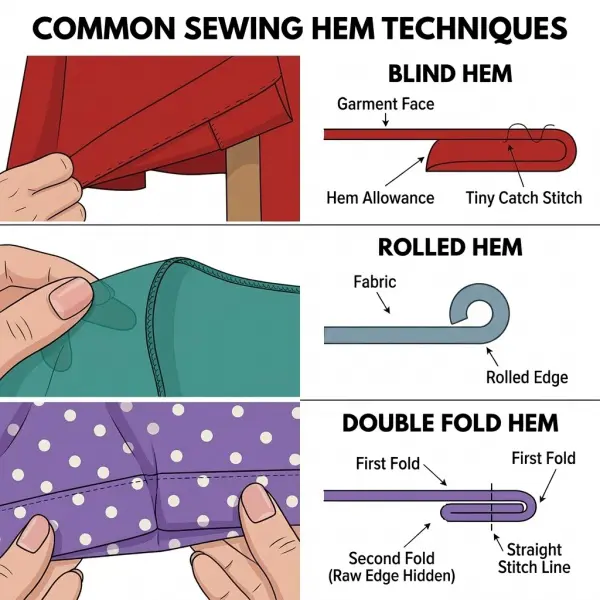
Blind Hem vs Rolled Hem vs Double Fold Hem: Key Differences
The most useful comparison considers what each construction is intended to achieve rather than which one appears more sophisticated.
A blind hem prioritizes discreet attachment, a rolled hem prioritizes a compact edge, and a double fold hem prioritizes an enclosed raw edge with a relatively straightforward folded construction. Each approach can produce a professional result when it matches the material and garment design.
|
Comparison factor |
Blind Hem |
Rolled Hem |
Double Fold Hem |
|
Primary purpose |
Minimize visible hem stitching |
Create a very narrow finished edge |
Enclose the raw edge securely |
|
Typical stitch visibility |
Minimal on the exterior |
Usually visible along the narrow edge |
Usually visible topstitching |
|
Common fabric applications |
Stable woven and tailored fabrics |
Lightweight and delicate fabrics |
Many lightweight to medium-weight wovens |
|
Typical garment uses |
Dress trousers, tailored skirts, formal dresses |
Chiffon dresses, scarves, lightweight blouses |
Shirts, casual dresses, skirts, sleeves |
|
Raw edge treatment |
Commonly prefinished or enclosed in an adapted construction |
Rolled, enclosed, or thread-wrapped depending on method |
Enclosed within two folds |
|
Bulk considerations |
Depends on hem depth and fabric thickness |
Generally low fabric bulk |
Increases with fold width and thickness |
|
Equipment |
Hand needle, domestic blind-hem stitch, or industrial blindstitch machine |
Hand sewing, narrow hemmer foot, or serger |
Conventional sewing machine, sometimes with folding attachments |
|
Main technical challenge |
Controlling stitch penetration and visibility |
Maintaining a consistent narrow edge |
Controlling fold width and accumulated bulk |
|
Production suitability |
Strong when equipment and fabric are compatible |
Depends on material handling and machine setup |
Often straightforward for repeatable woven-garment production |
The table is a general guide rather than a fixed rule. Some fabrics require adaptations, and specialized machinery can alter the production practicality of each technique.
For example, an industrial blindstitch machine may make blind hemming efficient for repeated tailored-trouser production, while a skilled operator using a narrow-hem attachment may produce lightweight rolled hems consistently. The equipment, garment design, and expected output volume should be evaluated together.

When Should You Use a Blind Hem?
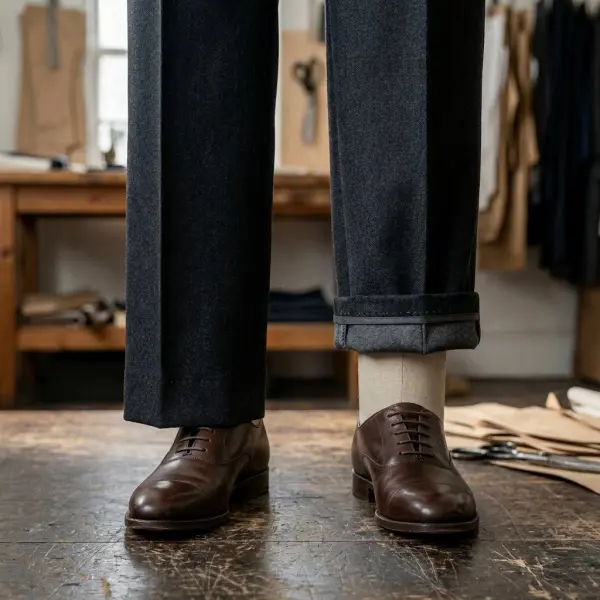
A blind hem is most appropriate when the garment requires a clean exterior appearance without a prominent line of stitching near the lower edge. It is particularly relevant to tailored clothing, where visible topstitching may conflict with the intended finish.
The technique works best when the fabric can tolerate small stitch catches without pulling, marking, or revealing excessive thread on the right side. Medium-weight woven fabrics and some textured materials can be suitable, although the specific construction must be tested.
Tailored Trousers and Formal Bottoms
Dress trousers are among the familiar applications for blind hemming. A concealed or minimally visible hem attachment allows the trouser leg to maintain a smooth exterior, which is often desirable in formal tailoring.
The folded hem may provide some weight to the lower leg, helping the fabric hang according to the intended silhouette. However, the appropriate depth depends on fabric weight, trouser design, and the required finished length.
For manufacturing teams, the hem should remain securely attached while avoiding obvious stitch impressions. A blind hem that catches too much exterior fabric can create a dotted or puckered appearance, defeating the visual purpose of the technique.
Industrial use of blindstitch hemming in trousers is documented in the Coats technical application guidance for trousers, which identifies blindstitch hemming as one of the construction operations used in trouser manufacturing.
Structured Skirts and Dresses
Blind hemming can also suit skirts and dresses made from fabrics with sufficient stability to support the folded allowance. The method is particularly useful when the designer wants the outer fabric surface to remain visually uninterrupted.
A tailored A-line skirt, for example, may use a blind hem to preserve a polished appearance. The construction must account for the change in circumference between the finished hemline and the folded allowance, especially where the skirt widens toward the bottom.
When the hem curve is pronounced, the operator may need controlled easing or another construction adjustment. Simply folding the fabric upward without accommodating the shape can create unwanted fullness or tension inside the hem.
When Blind Hemming Is Less Suitable
Blind hemming is not automatically the best option for every garment that requires a refined appearance. Highly transparent materials may reveal internal hem allowances, and delicate fabrics can show marks where the stitching catches the outer surface.
Very thin or slippery materials can also be difficult to control, depending on the equipment and method. Conversely, particularly thick fabric may produce an excessively bulky turned-up edge.
The technique may be unnecessary when visible topstitching is a deliberate design feature. Casual cotton dresses, workwear, and denim garments can look entirely appropriate with visible stitched hems.
When Should You Use a Rolled Hem?
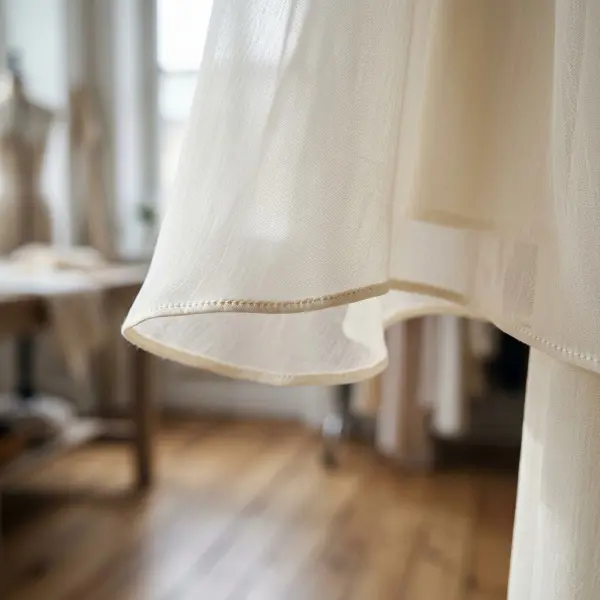
A rolled hem is particularly useful when the garment requires a narrow finish that does not noticeably interfere with lightweight fabric movement. It is commonly associated with delicate dresses, scarves, blouses, and other products where a wide hem could appear heavy or visually distracting.
The method can also be used as a decorative edge treatment, especially when an overlocker produces a thread-covered rolled finish. The resulting appearance depends on stitch configuration, thread type, and fabric properties.
Lightweight Dresses and Flowing Garments
Chiffon, georgette, and selected lightweight crepes often benefit from narrow edge finishing. These materials may lose some of their fluid appearance if a wide folded hem introduces too much weight or stiffness along the lower edge.
A carefully sewn rolled hem can preserve a relatively delicate finish while securing the raw fabric edge. This makes it useful for flowing garments, particularly where the hemline is visible during movement.
However, not every lightweight fabric behaves identically. Some materials are slippery, loosely woven, or easily distorted by stitching. Testing remains necessary to determine whether the proposed rolled construction creates a smooth edge or an unintended ripple.
Scarves, Ruffles, and Decorative Edges
Rolled hems are useful for scarves and certain decorative garment components because the finish occupies relatively little fabric width. On a scarf, this can allow the edge to remain visually light while presenting a more refined appearance than an unfinished cut edge.
Ruffles and flounces introduce additional challenges because their edges may follow pronounced curves. A rolled hem can be appropriate, but the construction must accommodate changing fabric grain direction and the shape of the edge.
In some designs, the slight firmness produced by the thread arrangement may influence the way the ruffle moves. This can be desirable or undesirable depending on the intended silhouette.
Choosing Between a Sewn and Serged Rolled Hem
A sewn rolled hem and a serger rolled hem can both create compact edge finishes, but their appearance and manufacturing requirements differ.
A conventional machine-sewn rolled hem generally produces a narrow folded edge secured with stitching. The visible finish may be relatively understated when fine, matching thread is used.
A serger rolled hem uses a specialized overedge stitch configuration to wrap threads around a narrowly rolled fabric edge. It may create a more thread-defined border, particularly when decorative thread or dense stitching is selected.
The choice depends on the design's tolerance for visible thread coverage, desired edge flexibility, and available machinery. Manufacturers should approve the actual production sample rather than assuming the two methods will look identical.
Situations Where Rolled Hemming Can Be Difficult
Rolled hemming becomes more challenging when fabric is thick, highly unstable, or difficult to feed evenly. Heavy canvas or denim, for example, is generally unsuitable for a delicate narrow rolled finish because its thickness interferes with compact folding.
Extremely slippery materials may require additional handling or preparation to maintain a consistent width. Tight curves and changes in fabric grain can also complicate the operation.
For bulk production, a rolled hem should be assessed not only for sample appearance but also for repeatability. A finish that requires constant manual correction may increase handling time and produce greater variation between garments.
When Should You Use a Double Fold Hem?
A double fold hem is a practical choice when the fabric can accommodate two folded layers and the garment requires a neatly enclosed raw edge. It is widely applicable to woven garments, particularly when a visible stitch line is acceptable or intentionally part of the design.
Because the edge is enclosed within the folds, a separate raw-edge overlocking operation is often unnecessary. This can simplify some sewing sequences, although the construction may still require pressing, measuring, or fabric handling.
Casual Shirts and Woven Blouses
Woven shirts and casual blouses commonly use narrow double fold hems. The construction provides a neat finish on both sides while allowing the hem to follow the garment's intended shape.
For a cotton poplin shirt, the relatively stable fabric can make controlled folding and stitching easier than on a lightweight slippery textile. The result is a visible but orderly line of stitching that complements casual or everyday garments.
The relationship between hem width and curvature should still be considered. A narrow double fold often accommodates gently curved shirt hems more easily than a broad fold because less excess material needs to be managed inside the curve.
For an overview of the relationship between fabric structure and garment construction, see Poplin Fabric Explained: Structure, Feel, and Common Uses.
Casual Dresses, Skirts, and Children's Clothing
Double fold hems are also common on casual woven dresses and skirts, especially when the garment design accepts visible topstitching. The construction is relatively easy to explain in technical specifications and can be produced with standard sewing equipment.
For children's clothing, it can provide a neatly enclosed finish without requiring a specialized hemming machine. However, the appropriate width depends on the fabric and garment design rather than age category alone.
A wider double fold may create useful weight at the bottom of certain skirts, but excessive width can become problematic on strongly flared shapes. This is why a hem that works on a straight skirt may not transfer directly to a circular skirt.
Denim and Structured Woven Garments
Double fold hems can be used on denim and other structured woven garments, although their suitability depends on fabric thickness and the desired finishing style.
The main concern is accumulated bulk. At side seams, the folded hem may contain several layers of fabric, making the area more difficult to feed through the machine and stitch evenly.
Denim manufacturers sometimes use specialized machinery and construction methods to maintain consistent topstitching around thick seam intersections. A double fold hem can be appropriate, but it should not be assumed that a conventional lightweight-fabric setup will handle heavyweight denim effectively.
When a Double Fold Hem Is Not the Best Choice
A double fold hem can become unsuitable when the fabric is too thick, the hem curve is difficult to control, or the additional layers interfere with the garment's intended drape.
On very lightweight flowing fabrics, a relatively wide double fold may create a stiff-looking edge. On heavily flared garments, excess fabric inside the folded allowance may cause irregular fullness or puckering.
For stretch fabrics, a double-turned construction may be possible, but the stitching must accommodate the required extension. A conventional straight lockstitch is not automatically suitable merely because the raw edge is neatly enclosed.
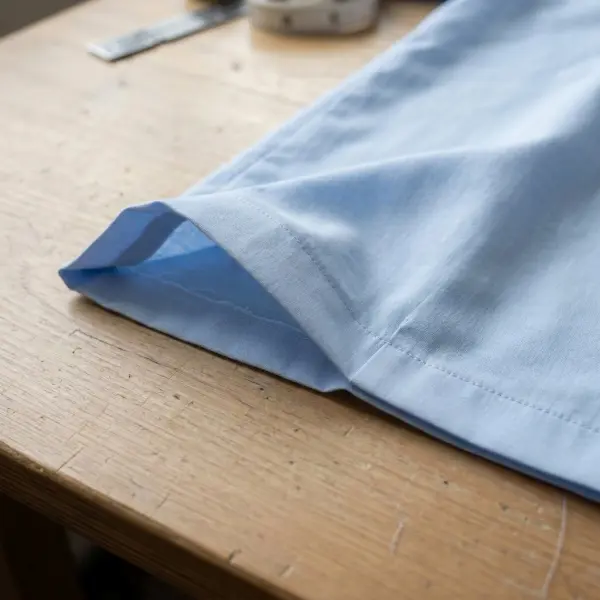
How Hem Width and Allowance Affect the Final Result
Hem width is not merely a visual preference. It affects fabric consumption, the amount of material folded toward the garment interior, and the way the edge hangs.
Blind hems commonly use enough allowance to create a stable turned-up section, although the amount depends on fabric, silhouette, and construction. Rolled hems generally require a relatively narrow edge treatment. Double fold hems can vary from narrow shirt finishes to wider constructions intended to provide greater weight.
Measuring a Double Fold Hem Correctly
A double fold hem requires enough allowance for both fabric turns. If the first turn is 6 mm and the second turn is 19 mm, the pattern requires approximately 25 mm of allowance beyond the intended finished edge, assuming the construction follows that folding sequence.
The visible interior hem depth in this example is approximately 19 mm, while the smaller first fold remains enclosed inside the larger turn.
This distinction can create confusion when specifications identify only a single hem width. The pattern maker and sewing operator need to know whether the stated measurement refers to total allowance or the final folded depth.
The exact relationship should be established in the garment construction drawing and verified through sampling.
Controlling Allowance on Curved Edges
Curved hemlines create geometric challenges because the fabric edge and the line where it is attached may have different lengths. When a flared skirt hem is folded upward, the turned allowance may need to fit into a smaller circumference.
If the difference is not managed, the allowance can create excess fullness, especially with wider folds. Controlled easing, careful pressing, a narrower finish, or an alternative construction may be required.
The opposite relationship can occur on concave edges, where the turned allowance may need additional room to lie flat. Forcing the fabric into position without accounting for its shape can create tension or distortion.
Choosing the Right Hem Based on Fabric Characteristics
Fabric behavior should be a central part of hemming selection. Fiber composition alone is not sufficient because weave structure, thickness, mechanical stretch, surface finishing, and fabric weight all affect the way a hem performs.
A lightweight polyester chiffon and a structured polyester suiting fabric, for example, may share a broad fiber category while requiring very different finishing decisions.
The following framework provides a useful starting point for sample development.
|
Fabric or construction characteristic |
Hem option to evaluate first |
Important limitation |
|
Medium-weight wool-blend suiting |
Blind hem |
Stitch catches must remain discreet |
|
Lightweight chiffon or georgette |
Rolled hem |
Narrow edge requires careful handling |
|
Stable cotton poplin |
Double fold hem |
Curves must be accommodated |
|
Medium-weight cotton twill |
Double fold or blind hem |
Choice depends on design and bulk |
|
Lightweight flowing crepe |
Narrow rolled or carefully tested blind hem |
Drape and surface marking need review |
|
Heavy denim |
Double fold or another denim-specific finish |
Thick seam intersections require suitable equipment |
|
Stretch jersey |
Specialized stretch-compatible hem construction |
Conventional straight stitching may lack extension |
This comparison should not be treated as a universal specification. The actual material must be evaluated through sample sewing, pressing, and appropriate performance testing.
When fabric substitutions occur, manufacturers should reconsider the hem rather than assuming an approved method will perform identically on the replacement material.
Equipment Requirements and Production Efficiency
The equipment used for hemming influences repeatability, operator skill requirements, and production capacity. A technique that appears complex when performed manually may be efficient with specialized machinery, while a seemingly simple fold can require considerable handling on an unstable fabric.
Fashion businesses should therefore distinguish between the inherent construction requirements and the capabilities of the selected production facility.
Blind Hemming Equipment
Blind hemming can be performed with a hand needle, a compatible domestic sewing machine, or an industrial blindstitch machine. Hand sewing provides direct control and may be appropriate for bespoke work, repairs, or certain high-end applications.
Domestic blind-hem stitches can produce good results when fabric preparation, folding, and stitch penetration are controlled. Industrial blindstitch equipment is designed for repeated operations and may be more suitable for manufacturing large numbers of similarly constructed garments.
However, equipment availability alone does not guarantee a clean result. Operator setup, material thickness, stitch formation, and correct fabric guidance remain important.
Rolled Hemming Equipment
Rolled hemming can be produced using a narrow hemmer attachment on a conventional sewing machine, a serger with rolled-hem capability, or hand-sewing techniques.
Machine attachments can reduce the need for manually forming every section of the fold, but they require suitable fabric feeding and consistent control. Certain lightweight fabrics may shift out of the attachment or form uneven folds when fed too quickly.
A serger rolled hem has different machine requirements because its edge formation depends on overedge stitching and the machine's configuration. The finishing result must therefore be approved specifically for the chosen equipment.
Double Fold Hemming Equipment
Double fold hemming generally requires conventional sewing equipment rather than a dedicated blindstitch machine. Depending on production volume, the factory may use pressing guides, folders, and other attachments to control the two turns.
For a small production run, manually measuring and pressing the allowance may be reasonable. In larger operations, an appropriate folding attachment can help produce consistent results, provided the fabric feeds reliably.
Thick or irregular materials may still require manual handling or modified machinery. The suitability of automation depends on the fabric and the complexity of the garment edge.
Why Production Cost Cannot Be Judged by Technique Alone
It is tempting to assume that double fold hemming is always cheaper than blind hemming or that rolled hemming is inherently slower. Such comparisons overlook the influence of production equipment, fabric behavior, operator proficiency, and order volume.
A dedicated blindstitch setup may complete repeated trouser hems efficiently, while a difficult lightweight fabric can make a narrow rolled hem labor-intensive. A basic double fold hem may also require extra pressing or handling when the fabric does not hold its shape.
For a realistic cost comparison, manufacturers should examine the complete operation rather than machine sewing time alone.
Relevant factors include preparation, folding, stitching, pressing, inspection, defect frequency, and potential rework. The selected technique should achieve the required appearance and performance at an acceptable total production cost.
Practical Hem Selection for Fashion Brands and Manufacturers
Selecting a hem is easier when the decision begins with garment requirements rather than technique names. The design team should first establish the expected exterior appearance, the required movement of the fabric edge, and the finishing standard appropriate to the product.
Only then should the production team evaluate the most suitable construction and equipment.
Start With the Visual Requirement
The first question is whether visible stitching is acceptable. If the design requires an uninterrupted exterior surface, a blind hem may be a logical option.
If visible stitching is part of the garment's casual appearance, a double fold hem can be appropriate. If the fabric is extremely lightweight and the desired edge is delicate, a rolled hem may deserve consideration.
The visual requirement should include both sides of the garment. For certain designs, the interior appearance becomes visible during movement, making raw-edge treatment and stitch coverage important.
Evaluate Fabric Thickness, Drape, and Stability
Once the appearance is defined, evaluate whether the fabric can support the selected construction.
A folded hem that looks excellent on medium-weight cotton may become bulky on thicker twill. A delicate rolled hem may preserve the movement of chiffon but become difficult to control on a slippery fabric with an unstable edge.
Material-specific testing should include the actual sewing thread, needle, pressing conditions, and machine setup expected in production.
Confirm the Hemline Geometry
The shape of the hemline can be as influential as fabric weight. Straight hems are generally easier to control, while strongly curved, circular, or bias-oriented edges may require additional preparation.
A narrow finish may simplify some curved-edge applications because less fabric must be accommodated within the fold. However, extremely narrow finishing can also be difficult where the material shifts or stretches.
Garment teams should review how the hem behaves when the product hangs naturally rather than judging the result only while it lies flat on a table.
Validate the Finish Before Bulk Production
Before approving a production method, request a representative sample using the actual or equivalent bulk fabric. The sample should demonstrate the intended hem width, stitch appearance, and garment drape.
For washable apparel, the hem should also be reviewed after appropriate laundering or finishing tests. Some stitching or dimensional problems become visible only after the fabric responds to moisture, heat, or mechanical action.
A successful sample provides the basis for technical documentation and quality acceptance criteria.
Common Mistakes When Selecting a Hemming Technique
Hemming defects are not always caused by poor sewing. In many cases, the underlying problem is an unsuitable construction decision made earlier in the development process.
Recognizing these mistakes can reduce unnecessary sampling revisions and help manufacturers produce more consistent garment finishes.
Selecting a Blind Hem Without Considering Fabric Transparency
A blind hem may minimize stitch visibility on an opaque woven fabric, but that does not mean the internal allowance will disappear on a transparent textile. The folded material may remain visible through chiffon or another sheer fabric, even when the stitching is discreet.
This can create a heavy-looking band along an otherwise delicate edge. A more suitable narrow finish may be preferable when the design requires transparency and softness. The final decision should be made by examining the actual garment under normal lighting conditions.
Using a Wide Double Fold Hem on a Strongly Curved Edge
A wide double fold hem can become difficult to distribute evenly around a pronounced curve. The inner fold may contain excess material when turned toward a narrower circumference, creating unwanted fullness or distortion.
This problem often appears when a hem width used successfully on a straight garment is copied into a circular skirt or flared dress. Reducing the width, controlling fullness, or selecting another construction may provide a cleaner result. Pattern geometry should be reviewed before production rather than relying on pressing to correct the finished edge.
Assuming Rolled Hemming Always Produces the Softest Edge
Rolled hems are narrow, but narrowness does not guarantee softness. A serger rolled hem with dense thread coverage may create a more defined or slightly firmer edge than a finely sewn narrow hem.
On some lightweight fabrics, that effect can support a decorative ruffle. On other garments, it may interfere with the intended drape. The sewing team should compare the actual finish against the design reference rather than assuming all rolled-hem constructions behave identically.
Ignoring Fabric Thickness at Seam Intersections
A double fold hem that appears flat on a single fabric layer may become bulky where it crosses a side seam. Multiple layers can interfere with fabric feeding, produce irregular stitch length, or make the finished edge uneven.
This is particularly relevant to heavier wovens and denim. Appropriate machinery, seam preparation, and localized bulk control may be required. The construction should be tested at the thickest expected intersection rather than only along a flat section of the fabric.
Copying a Hem Specification Across Different Fabrics
Standardization can improve manufacturing consistency, but only when products share compatible construction requirements. Using one hem width and stitch type across poplin, crepe, chiffon, and heavy twill may create unnecessary quality problems.
The appropriate approach is to standardize decision criteria and approved construction options rather than insisting on a single technique for every fabric. Product development teams can then select from validated finishes while preserving consistent documentation.
For additional guidance on recognizing and addressing stitching irregularities, refer to Common Hem Problems That Affect Garment Quality and Appearance.
What Should Brands Verify Before Approving a Hem?
A hem that looks attractive immediately after sewing may not maintain the same appearance during pressing, washing, wearing, or bulk manufacturing. Approval should therefore account for both visual quality and the intended use of the garment.
Several technical considerations deserve particular attention.
Stitch Visibility and Fabric Damage
For blind hems, the stitching should catch enough fabric to secure the fold without producing conspicuous marks on the garment exterior. The allowable visibility depends on material texture, thread color, and product positioning.
Fine, smooth fabrics can show needle penetrations more readily than textured materials. Excessive stitch depth may also distort the garment surface.
Inspection should evaluate the hem under realistic lighting and at an appropriate viewing distance. A close-up view may reveal individual stitch catches that are not noticeable during ordinary wear, so the acceptance criteria should remain proportional to the product specification.
Edge Stability and Thread Coverage
For rolled hems, the edge should remain consistent without irregular thread loops, uncontrolled fraying, or sections that have escaped the fold. The quality of a serged rolled hem also depends on balanced thread coverage.
A narrowly finished edge must still be stable enough for the garment's intended use. Scarves and lightweight fashion garments may experience different handling stresses from frequently washed everyday apparel.
The selected construction should be tested for the expected conditions rather than judged solely on its initial appearance.
Fold Consistency and Garment Length
For double fold hems, the most visible issues often involve uneven folding, inconsistent stitching distance, or changes in finished garment length.
Accurate pattern allowances and controlled folding reduce the risk of variation. However, even with correct measurements, distortion can occur if fabric is stretched or pulled during sewing.
Quality teams should inspect the finished garment on a suitable surface or form and confirm that the hemline matches the approved measurements and silhouette.
Performance After Care and Finishing
Hemming methods should be evaluated under the care conditions expected for the garment. Washing, drying, ironing, and other finishing processes can affect thread tension, fabric dimensions, and the appearance of folded edges.
The result may differ according to fabric composition, weave or knit construction, finishing treatment, and stitch type. A hem that remains smooth on one cotton fabric may behave differently on another material with greater dimensional change.
Manufacturers should avoid making durability assumptions based only on the construction name. Material-specific performance testing offers a more reliable basis for approval.
Frequently Asked Questions About Blind, Rolled, and Double Fold Hems
Is a blind hem stronger than a double fold hem?
A blind hem is not inherently stronger than a double fold hem because the two techniques use different attachment methods and can be constructed with different threads, stitch formations, and materials. Blind hemming is primarily selected to reduce visible stitching, whereas a conventional double fold hem encloses the raw edge and commonly uses a continuous line of topstitching.
The durability of either construction depends on stitch security, fabric characteristics, thread suitability, and the stresses experienced during wear. For clothing subjected to frequent mechanical strain, manufacturers should evaluate the actual seam performance rather than assuming that one hem name guarantees superior strength.
Can a rolled hem be sewn without a serger?
Yes. A rolled hem can be produced without a serger using a conventional sewing machine or suitable hand-sewing techniques. A narrow hemmer foot can help turn the fabric edge into a small fold as stitching is applied, although some materials require careful preparation and feeding.
Hand-rolled hems may be used for delicate textiles or specialized finishing, particularly when precise control is required. The result can differ from a serger rolled hem because the latter uses overedge threads to cover and secure the edge. When selecting a method, consider the desired appearance, fabric handling difficulty, available equipment, and production volume.
Which hem is most suitable for chiffon fabric?
A narrow rolled or similarly delicate hem is often a useful choice for chiffon because it can finish the edge without introducing the bulk of a wide folded allowance. This helps preserve the lightweight appearance and movement of the fabric.
However, the suitability of a particular rolled construction depends on the chiffon type, its stability, and the equipment being used. A densely thread-covered serger finish may look different from a narrow machine-sewn rolled hem. For transparent garments, the visibility of internal layers should also be considered. Testing the actual fabric is the most reliable way to identify the preferred finish.
Can a double fold hem be used on curved edges?
Yes. Double fold hems can be used on curved edges, but the ease of construction depends on the curve's shape and the width of the folded allowance. A gently curved shirt hem may be relatively straightforward to finish, particularly when the fold is narrow.
A strongly flared or circular hem can be more challenging because the turned-up fabric edge may contain excess material relative to the line where it is stitched. Controlled easing, careful pressing, or a narrower hem may help. The goal is to preserve the intended curve without creating unwanted fullness, puckering, or distortion.
Why are blind hems commonly used on formal trousers?
Blind hems are commonly used on formal trousers because they can secure the lower edge without creating a prominent line of topstitching on the garment exterior. This supports the smooth appearance often associated with tailored clothing.
The folded allowance can also influence how the trouser leg hangs, although the effect depends on fabric weight and hem depth. A successful blind hem requires careful control over stitch penetration and attachment security. It should not leave obvious stitch catches, puckering, or an uneven hemline. Casual trousers may intentionally use visible stitching, making blind hemming a design choice rather than a universal quality requirement.





Comments 0
Leave a CommentSend Comment
Anda harus Login terlebih dahulu untuk dapat memberikan komentar.