

Why Return Policies Shape Customer Trust and Profit Margins
Quick Answer
Return policies shape customer trust because they tell shoppers who carries the risk when an online purchase does not fit, look, or feel as expected. A clear and workable policy can reduce purchase anxiety; an unclear, hidden, or unexpectedly restrictive policy can make the customer question the brand before checkout. Trust, however, does not require unlimited free returns. It depends on transparent terms, fair treatment, consistent execution, and a resolution process appropriate to the product and market.
The same policy affects profit through several routes at once. Greater flexibility may support conversion, exchanges, repeat purchase, and customer retention, but it can also increase return transport, handling, refund, fraud, markdown, and inventory costs. Restriction may lower some return expenses while discouraging legitimate buyers or creating service disputes.
The commercially sound policy is therefore not the most generous or the strictest. It is the policy whose sales benefit, customer value, processing cost, merchandise recovery, abuse exposure, and legal obligations make sense together. Apparel brands should evaluate those effects by product category and customer cohort rather than relying on one headline return rate.

What Is a Fashion Return Policy?
A fashion return policy is a set of customer-facing terms that explains whether, when, how, and under what conditions apparel, footwear, or accessories may be returned, exchanged, refunded, or otherwise resolved. It translates a brand's legal obligations and commercial choices into a promise customers can understand and operations can execute.
That final point is essential. Policy is not only website copy. If the product page says returns are easy, the checkout adds an undisclosed fee, customer service gives conflicting instructions, and the warehouse rejects items using unpublished criteria, the real policy is the combined experience. Trust depends on alignment between the written terms and what happens after purchase.
A complete policy usually addresses:
- which products and sales channels are eligible;
- the return window and the event that starts it;
- acceptable product condition, packaging, tags, and proof of purchase;
- available resolutions, such as refund, exchange, store credit, repair, or replacement;
- who pays for return transport and whether any fee is deducted;
- how the customer starts and tracks a request;
- when the refund is issued and how it is paid;
- exceptions for final sale, personalization, hygiene, defects, gifts, promotions, or cross-border orders;
- the customer's statutory rights, which cannot simply be replaced by a commercial policy.
The detailed physical and financial workflow belongs in the companion guide to fashion returns management for online apparel brands. This article focuses on the strategic promise: how policy terms alter perceived risk, buying behavior, cost, and margin.
Why Does a Return Policy Influence Customer Trust?
Online fashion purchases contain unresolved product risk
Customers cannot fully test fit, comfort, drape, color, fabric handfeel, opacity, or movement through a product page. Size charts, photography, video, reviews, and fit tools can reduce uncertainty, but they cannot remove personal variation. A return policy tells the shopper what happens if the remaining uncertainty produces a poor outcome.
This makes the policy a form of risk allocation. A customer-paid return with a short window places more economic and practical risk on the buyer. A prepaid return with a longer window places more on the retailer. Neither arrangement is automatically unfair, but each changes the value proposition. A low-priced cross-border item, made-to-order dress, luxury handbag, and core T-shirt do not necessarily support the same allocation.
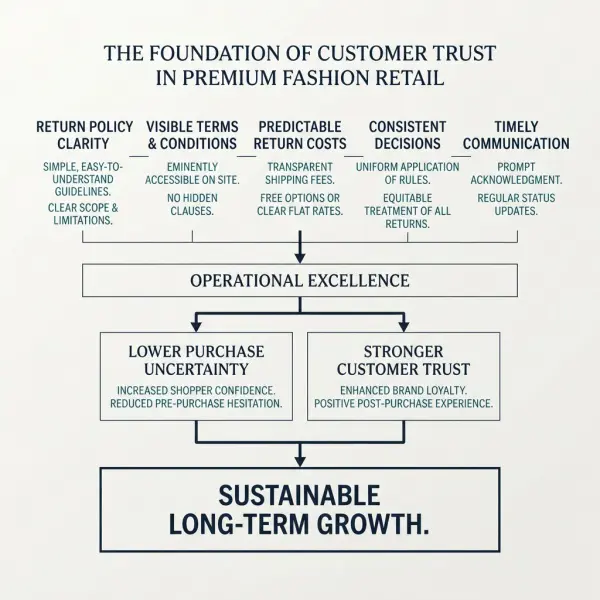
Clarity signals competence and fairness
A policy can be restrictive yet understandable. It can also appear generous while hiding exclusions in legalistic language. The latter often damages trust more because the customer discovers the real terms only after committing money.
Useful policy information should be visible where uncertainty occurs: on relevant product pages, near purchase decisions, at checkout, and in post-purchase communication. Baymard Institute reports that its US e-commerce research found 15% of surveyed customers had abandoned orders in the prior quarter because they considered the return policy unsatisfactory. This figure is not fashion-specific or universal, but it shows that returns information can influence purchase completion before a return exists. Baymard research on e-commerce product-page experience
Clarity also reduces avoidable disputes. If “30-day returns” means the item must reach the warehouse within 30 days, but customers reasonably interpret it as 30 days to initiate the request, disappointment is built into the wording. The policy should name the starting event, required action, and deadline in plain language.
Consistent execution turns a promise into evidence
The first return experience can confirm or overturn everything the customer believed about the brand. Status silence, surprise deductions, repeated requests for the same evidence, or an unexplained denial can make a legitimate customer feel suspected. Conversely, a prompt and well-explained resolution shows that the business can handle problems without improvisation.
Consistency does not mean every case receives the same result. Defects, preference returns, suspected fraud, and statutory claims may require different handling. It means similar cases follow documented rules, exceptions are explainable, and customers have a route to human review when an automated decision is wrong.

Return-Policy Leniency Has More Than One Dimension
“Strict” and “generous” are too crude for policy analysis. A peer-reviewed meta-analysis in the Journal of Retailing examined five dimensions of return-policy leniency: time, money, effort, scope, and exchange. Across the studies reviewed, overall leniency was associated with increased purchases as well as increased returns, but the effects varied by dimension; the purchase effect was larger overall in the meta-analysis. This does not guarantee the same profit outcome for every brand, category, or period. meta-analysis of return-policy leniency and consumer decisions
The five dimensions can be translated into practical fashion decisions:
|
Policy dimension |
More lenient example |
More restrictive example |
Commercial issue to test |
|
Time |
Longer period to initiate a return |
Short return window |
Customer decision comfort versus seasonality and inventory aging |
|
Money |
Full refund to original payment method |
Fee deduction or store credit |
Conversion and trust versus direct cost and cash recovery |
|
Effort |
Prepaid label, portal, or nearby drop-off |
Customer arranges and documents shipment |
Convenience versus service, carrier, and platform cost |
|
Scope |
More categories or conditions accepted |
Final-sale, hygiene, wear, or promotion exclusions |
Product risk and fairness versus recovery and abuse exposure |
|
Exchange |
Easy size or color replacement |
Refund and repurchase required |
Revenue retention versus replacement stock and extra fulfillment |
A brand can be flexible in one dimension and controlled in another. For example, it may offer a longer window but require the item to be unworn with intact tags, or provide free exchanges while charging for preference-based refunds. These combinations should be tested against customer expectations and law rather than copied from a competitor.
How Do Return Policies Affect Profit Margins?
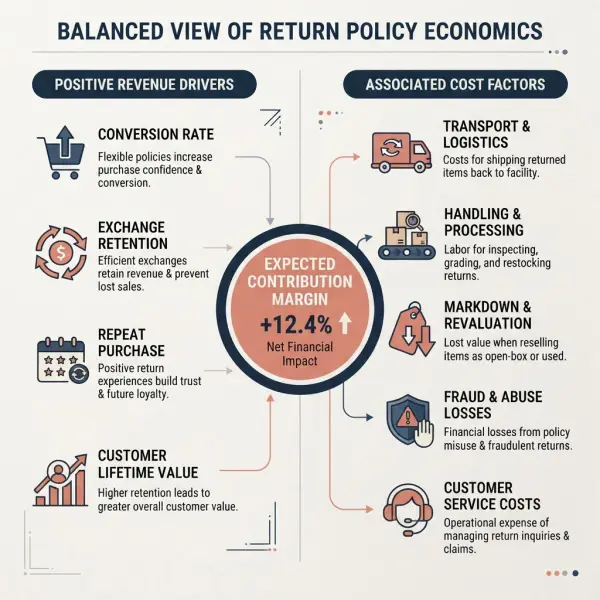
Return policies influence margin through both demand and cost. Looking only at return expense ignores the possibility that the policy helped generate the original sale. Looking only at conversion ignores the cost of processing, value loss, and abuse. The correct unit of analysis is incremental contribution over the customer and product lifecycle.
Purchase conversion and demand
A credible policy may give uncertain customers enough confidence to buy, especially when fit or product evaluation is difficult. The National Retail Federation's 2025 US retail study estimated that 19.3% of online sales would be returned and reported that 82% of consumers considered free returns important when shopping online. The research covers retail broadly, so apparel brands should not adopt those percentages as their own targets. It does show why a return promise can influence demand as well as cost. NRF 2025 Retail Returns Landscape
The incremental sale is valuable only if its expected contribution remains positive after returns. A policy that raises conversion among good-fit customers may be commercially healthy. A promotion that encourages customers to order multiple sizes and keep one can create apparent top-line growth while increasing outbound parcels, return units, payment activity, and inventory handling.
Direct cost per return
Depending on contracts and policy design, the merchant may absorb outbound fulfillment, return transport, customer service, inspection, repackaging, payment fees, and refund administration. Free returns do not remove these costs; they shift visible payment away from the customer and into the brand's economics.
A practical policy model is:
Expected policy contribution = incremental gross contribution from additional and retained purchases - incremental return processing cost - returned merchandise value loss - incremental abuse and exception cost
This is a decision formula rather than an accounting standard. Finance should define each input, prevent double-counting, and compare customers or products exposed to different policy treatments where lawful and methodologically sound.
Merchandise recovery and timing
Policy terms affect whether a returned unit can re-enter inventory while demand remains. A long window may improve purchase confidence but increase the chance that a seasonal product returns after its full-price selling period. A short window may accelerate recovery but be impractical for gifts, international delivery, or customers who cannot try the item immediately.
Condition rules matter just as much. Requiring intact hygiene seals or prohibiting worn merchandise may protect safety and resale value where lawful, while demanding pristine outer courier packaging can be unreasonable if that packaging has no bearing on the product. The rule should protect a real operational or product need.
Exchanges, store credit, and retained revenue
An exchange can preserve revenue when the customer's problem is size, color, or a defective unit rather than loss of interest in the brand. Store credit may also retain value, but it transfers the decision into a future purchase and may not satisfy statutory refund rights. Neither should be described as equivalent to a cash refund without clear consent and legal basis.
Exchange-first design can become manipulative if the refund option is hidden, visually suppressed, or burdened with unexpected steps. A more defensible approach makes eligible choices visible, explains timing and cost, and may offer a genuine incentive for exchange without obscuring the customer's other rights.
Customer lifetime value and service recovery
A single return may be unprofitable while the customer relationship remains valuable. That does not justify approving every claim, but it does mean policy evaluation should include repeat purchase, complaint rate, contact volume, exchange completion, and post-return retention—not only the refund amount.
Lifetime-value analysis needs caution. High historical spend should not become a license for abuse, and new customers should not receive unexplained inferior treatment. Segmentation is most defensible when it reflects product economics, risk evidence, service choices, or loyalty benefits disclosed in advance.
Fraud and policy abuse
Return fraud can include returning a different item, counterfeit substitution, fabricated non-delivery, altered receipts, or collusive behavior. Abuse can also include wardrobing—using a product with the intention of returning it—or systematic bracketing beyond ordinary fit uncertainty. These cases increase cost, but aggressive fraud controls can also reject legitimate returns and damage trust.
Controls should use proportionate evidence, preserve an appeal path, and distinguish a pattern from a one-off anomaly. A restrictive policy is not a substitute for accurate item identification, inspection, account security, and exception review.
Free Returns Are a Pricing Decision, Not a Free Service
“Free returns” usually means the customer is not charged a separate return-shipping fee for an eligible case. The brand, marketplace, logistics partner, or another party still bears the cost. That cost may be absorbed in margin, reflected in product pricing, negotiated with a carrier, reduced through store drop-off or consolidation, or offset by retained revenue.
This does not make free returns inherently misleading. It means the offer should be evaluated as part of pricing and customer acquisition. A high-margin brand with compact parcels and strong recovery may support prepaid returns more easily than a low-margin cross-border seller of bulky outerwear. Defective, incorrect, and preference-based returns may also justify different cost treatment, subject to law.
Charging customers can reduce direct expense, but the fee must be visible before purchase and understandable in context. A low headline price combined with a surprisingly expensive international return can create more distrust than a higher product price with a clearly funded return option.
How Should Fashion Brands Design a Balanced Return Policy?
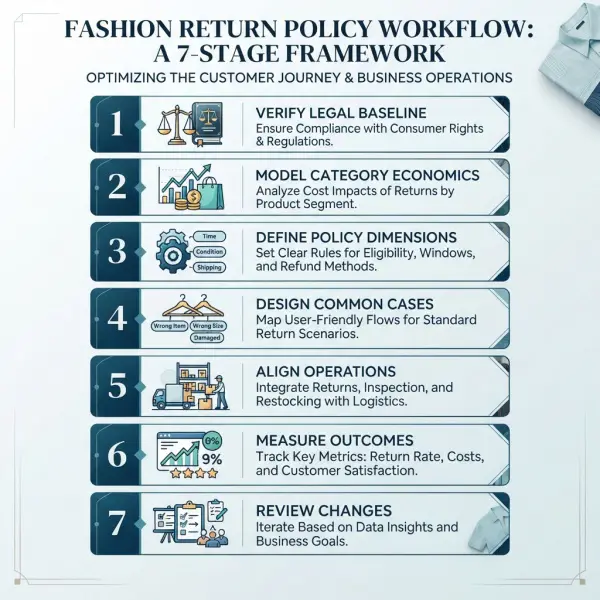
A balanced policy starts with product and customer economics, then translates them into terms a shopper can understand. It should not begin with a competitor's wording. The following sequence keeps commercial, operational, and trust considerations connected.
1. Separate statutory rights from commercial benefits
Identify what the business must provide in each market and what it voluntarily offers beyond that baseline. Do not present a legal right as a special brand benefit, and do not let commercial exclusions override defect, warranty, or withdrawal rights where they apply.
2. Model the economics by category
Compare contribution margin, average parcel cost, return rate, condition on receipt, time to restock, markdown exposure, and recovery value. Intimates, occasionwear, footwear, accessories, made-to-order products, and basics may require different rules because their hygiene, fit, seasonality, and resale economics differ.
3. Define each policy dimension explicitly
Set the time window, refund method, customer effort, eligible scope, exchange option, and cost allocation. Avoid vague labels such as “easy returns” unless the page immediately explains what easy means.
4. Design for the most common legitimate cases
If size mismatch dominates, make size exchange straightforward. If customers regularly miss the window because cross-border delivery is slow, check whether the clock starts at order, dispatch, or delivery. Policy should address actual friction without granting unrelated exceptions automatically.
5. Align systems, teams, and partners
Customer service, marketplace settings, warehouse grading, carriers, finance, and website content must execute the same rules. If an operation cannot meet the promised refund time or exchange stock reservation, revise the process or the promise before launch.
6. Test outcomes beyond return rate
Measure conversion, policy-page engagement, contacts per return, exchange uptake, repeat purchase, refund time, merchandise recovery, complaint rate, and contribution margin. A lower return rate is not an improvement if qualified customers stopped buying or defects were reclassified as non-returnable.
7. Review policy changes as controlled commercial decisions
Record the change date, products and markets affected, customer communication, and expected outcome. Allow enough time for the return window to mature before judging results. Seasonal demand, promotions, customer mix, and product launches can otherwise be mistaken for policy effects.
Common Policy Mistakes That Damage Trust or Margin
Hiding important costs and exclusions
A fee disclosed only after purchase may produce an immediate saving but create complaints, abandoned future purchases, or payment disputes. Put material conditions near the purchase decision and repeat them in the full policy.
Assuming the longest window is automatically the best
Longer windows can support confidence, gifts, and delayed try-on, but may also increase inventory aging and uncertainty. Test the window against seasonality, category, delivery time, and recovery data.
Using “final sale” as a broad margin fix
Final-sale terms can be appropriate for disclosed clearance or particular products, but broad use can transfer too much quality and fit risk to customers. It may also conflict with statutory rights. Define the reason, scope, and exceptions clearly.
Offering store credit as though it were a refund
Store credit can retain revenue, but customers may see it as money trapped with the merchant. Present it as a distinct option, not a semantic substitute for an eligible refund.
Making the written policy better than the real experience
Promising “hassle-free” returns while requiring repeated emails, inaccessible forms, or unexplained deductions creates a credibility gap. Audit actual customer journeys, not only policy copy.
Copying a competitor without matching its economics
A large omnichannel retailer may use stores as low-cost drop-off points and spread returns infrastructure across high volume. A small digital brand may not have those advantages. Match the promise to the brand's channels, margins, carrier terms, and recovery capability.
What Legal and Ethical Limits Should Brands Verify?
Commercial return policy and consumer law are not the same. Rules vary by jurisdiction, sales channel, product category, defect status, and how the item was purchased. A policy may offer more than the law requires, but it should not remove mandatory rights.
For example, EU guidance states that consumers generally have 14 days to withdraw from online and other distance purchases, subject to conditions and exceptions. The seller must also provide prescribed information, including advance notice when the customer is expected to bear eligible return costs. This example should not be generalized worldwide; brands need qualified review in every market they serve. EU guidance on returns and the right of withdrawal
Ethically, the policy should avoid dark patterns: hiding refund options, preselecting less favorable resolutions, making cancellation easier to promise than to use, or using legal jargon to obscure a material cost. Fraud prevention should also be proportionate and provide a review path. A customer should know the evidence required and receive a meaningful explanation when a claim is rejected.

Frequently Asked Questions
Does a generous return policy always increase sales?
No. Greater leniency may reduce purchase risk and support conversion, but the effect depends on which term changes, the product, customer, market, price, and existing level of trust. A longer window, prepaid label, wider eligibility, cash refund, and easy exchange are different interventions. They also create different cost and behavior effects. Brands should measure incremental contribution, not conversion alone. If additional sales come primarily from multi-size ordering with low merchandise recovery, revenue can rise while margin weakens. Legal obligations and competitor expectations also constrain which tests are appropriate.
Is a strict return policy always bad for customer trust?
No, but it must be transparent, proportionate, and appropriate to the product. Customers may understand restrictions for personalization, hygiene, made-to-order production, or disclosed final-sale clearance. Trust deteriorates when the restriction is hidden, broader than necessary, inconsistent with law, or applied differently after purchase. A controlled policy can still feel fair when customers see material terms before paying, understand the reason, receive accurate product information, and have a clear route for defects or fulfillment errors.
Should fashion brands charge a return fee?
It depends on margin, parcel cost, category, customer expectations, reason for return, and local law. A visible preference-return fee may make sense for some low-margin or cross-border models, while charging for the brand's own error can appear unfair and may be unlawful. The brand should model conversion loss as well as carrier savings. Alternatives include free exchanges, store drop-off, consolidated returns, loyalty benefits, or a limited number of prepaid returns. Any charge or deduction should be disclosed clearly before purchase.
How long should an online apparel return window be?
There is no universal ideal. The window should account for legal minimums, delivery time, customer try-on needs, gifts, seasonality, product condition, and how quickly inventory loses value. The wording must also state whether the customer must initiate, hand over, or deliver the return by the deadline. Brands should evaluate conversion, contact volume, return timing, recovery, and markdowns across mature sales cohorts. A longer window may not increase late returns proportionally, but that outcome should be measured rather than assumed.
Are free exchanges better for margin than refunds?
They can be when the customer still wants the product and the replacement preserves enough contribution after extra fulfillment and handling. Exchanges also help distinguish a size or color mismatch from complete product rejection. They are not costless: the brand needs replacement inventory, outbound shipping, return processing, and protection against duplicate or unresolved movements. Make the exchange attractive and easy, but do not hide an eligible refund. Track physical returns, exchange completion, retained revenue, and the condition of the original item separately.
Can return policies be personalized by customer risk?
Some brands use account history, item value, fraud signals, or loyalty status to vary refund timing, returnless resolutions, or review requirements. This can reduce loss, but it creates fairness, privacy, explainability, and discrimination risks. Rules should rely on relevant evidence, comply with applicable law, be monitored for false positives, and include human review. Core statutory rights should not depend on a hidden score. Benefits such as extended windows for an openly defined loyalty tier are generally easier for customers to understand than unexplained restrictions applied only after a request.
What should a brand measure after changing its return policy?
Measure conversion, eligible sales, unit and value return rates, exchange uptake, retained revenue, cost per return, time to refund, time to restock, merchandise recovery, markdown loss, service contacts, complaints, repeat purchase, and contribution margin. Match returns to the original sales cohort and separate products, markets, and customers exposed to the change. Allow the return window to mature before concluding. The related guide to reducing fashion returns without hurting customer experience explains how policy data can support wider prevention work.
Conclusion
A return policy is a visible statement about risk, fairness, and operational competence. In online fashion, where customers cannot completely resolve fit and product uncertainty before purchase, that statement can influence whether they trust the brand enough to buy.
The margin effect is not captured by counting refunds. A policy can create additional purchases, preserve revenue through exchanges, and support retention while also generating transport, handling, markdown, abuse, and inventory costs. Those effects differ by policy dimension and product category.
The strongest policy is therefore not the one with the most generous headline. It is one customers can find and understand, operations can deliver consistently, law permits, and unit economics can support. Brands that measure both customer outcomes and merchandise recovery are better equipped to adjust the promise without confusing short-term cost reduction with long-term profitability.





Comments 0
Leave a CommentSend Comment
Anda harus Login terlebih dahulu untuk dapat memberikan komentar.