

3D Body Scanning Explained for Apparel Fit and Sizing
Quick Answer
3D body scanning is a digital measurement method that captures the external surface of the human body and converts it into a three-dimensional representation from which body dimensions, proportions, and shape information can be extracted. In apparel, this data can support size-chart development, fit analysis, digital avatars, made-to-measure workflows, uniform programs, and customer size recommendations.
The important distinction is that a body scan measures the person—not the garment. Good apparel fit still depends on how a brand translates body measurements into pattern dimensions, ease allowances, grading rules, silhouettes, materials, and intended fit.
Modern scanning systems may use structured light, time-of-flight sensing, stereo vision, photogrammetry, laser-based systems, or computer-vision methods that estimate body shape from images. Their outputs and measurement accuracy are not automatically interchangeable.
For apparel businesses, the main value of 3D scanning is therefore not simply collecting more measurements. It is obtaining better structured information about body size and shape and connecting that information to a repeatable sizing and product-development system.
What Is 3D Body Scanning in Apparel?
3D body scanning is a non-contact or minimally contact digital measurement process that captures the external geometry of a human body and reconstructs it as three-dimensional surface data. Software can then identify body landmarks and calculate measurements such as heights, lengths, widths, depths, and circumferences.
International standards distinguish between acquiring a 3D body surface and extracting reliable anthropometric measurements from that surface. ISO 20685-1, for example, addresses evaluation protocols for dimensions extracted from 3D body scans, while ISO 8559-1 defines anthropometric measurements relevant to clothing and the creation of physical and digital anthropometric databases.
This distinction matters commercially. A visually impressive digital body model is not necessarily an apparel-ready measurement system. A fashion brand ultimately needs measurements that correspond consistently to the anatomical definitions used by its pattern makers, technical designers, sizing specialists, and garment specifications.
How Does 3D Body Scanning Work?
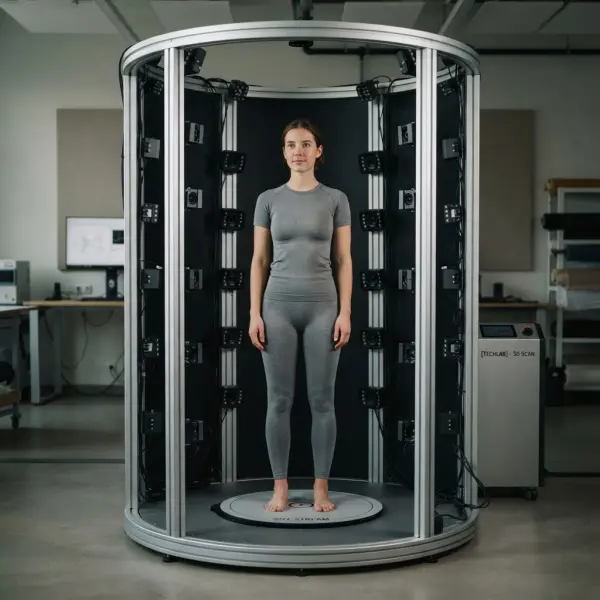
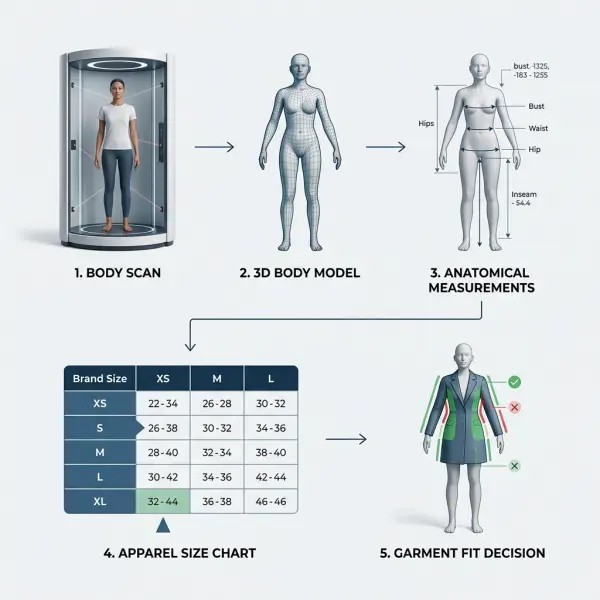
A typical apparel body-scanning workflow moves through several distinct stages: capture, reconstruction, landmark detection, measurement extraction, and interpretation. The scanner first records information about the visible surface of the body. Depending on the technology, this may involve projected light patterns, depth sensors, multiple photographs, stereo cameras, laser illumination, or combinations of optical sensing and computer vision. The captured information is then reconstructed into a digital surface, commonly represented initially as a point cloud or mesh.
From there, software must determine where relevant anatomical landmarks are located. That step is more significant than it may appear. Apparel measurements such as waist girth, hip girth, crotch height, back length, or shoulder-related dimensions are not simply arbitrary geometric distances. Their definitions depend on anatomical and apparel measurement conventions. Research on automated measurement pipelines shows this progression clearly: scanner data can be fitted to a standardized body model, after which circumference paths and other anthropometric measurements are calculated from the fitted surface.
A simplified workflow looks like this:
|
Stage |
What Happens |
Apparel Relevance |
|
Body capture |
Sensors or cameras record the body's visible surface |
Creates raw geometry |
|
3D reconstruction |
Images or depth data become a point cloud or mesh |
Produces a digital body representation |
|
Landmark detection |
Software identifies anatomical reference locations |
Establishes measurement positions |
|
Measurement extraction |
Lengths, girths, widths, heights, and other dimensions are calculated |
Creates usable anthropometric data |
|
Sizing interpretation |
Measurements are mapped against brand sizing rules |
Supports size allocation or size-chart development |
|
Product application |
Data informs patterns, fit testing, recommendations, or custom production |
Connects scanning to commercial apparel decisions |
What happens after measurement extraction is largely an apparel problem rather than a scanning problem. A scanner may tell a company that a customer has a particular waist, hip, torso, or inseam measurement. It does not independently determine how much ease a tailored trouser should contain, how a relaxed hoodie should drape, or whether a stretch dress should use negative ease. Those decisions belong to pattern engineering, materials, garment construction, and brand-specific fit strategy.
What Technologies Are Used for 3D Body Scanning?
There is no single technical architecture behind everything marketed as a 3D body scanner. Common approaches include structured light, time-of-flight sensing, stereo vision, photogrammetry, and laser-based scanning. Recent reviews of digital anthropometry also show that body-scanning systems differ considerably in hardware, acquisition methods, algorithms, and processing pipelines.
Structured Light
Structured-light systems project a known pattern of visible or infrared light onto the body. Cameras observe how the pattern deforms across the body's surface, and geometric calculations are used to estimate depth. The technology has been widely applied in 3D surface measurement because it can acquire detailed surface geometry quickly without physical contact.

Time-of-Flight Sensors
Time-of-flight, or ToF, systems estimate distance by emitting light and measuring properties associated with its return from the subject. These sensors can produce depth information directly and are used in various computer-vision applications. Spatial resolution, acquisition conditions, and hardware performance vary among systems, so the technology name alone does not establish apparel measurement accuracy.
Stereo Vision and Photogrammetry
Stereo systems estimate depth by comparing images captured from different viewpoints. Photogrammetric approaches reconstruct three-dimensional geometry from multiple photographs. These techniques are particularly relevant as body measurement moves beyond dedicated scanning booths and toward camera-based and mobile workflows.
Laser-Based Scanning
Laser scanning has also been used for human surface measurement. Earlier generations of commercial whole-body scanners frequently used laser stripe projection, although contemporary systems now span a much broader range of optical technologies.
Smartphone and Camera-Based Body Measurement
Mobile body measurement deserves a separate distinction. Some smartphone solutions use dedicated depth-sensing hardware, while others rely primarily on photographs, computer vision, statistical body models, artificial intelligence, or combinations of these methods to estimate a three-dimensional body representation. A review of mobile body-scanning applications for apparel found considerable variation in what different applications capture and calculate. Mobile approaches can improve accessibility, but they should not automatically be treated as technically identical to controlled multi-camera or dedicated scanning systems.
For a fashion company evaluating a vendor, asking simply whether a solution is "3D scanning" is therefore not enough. The more useful questions are: What does the system actually capture, how are measurements calculated, and how have those measurements been validated?
Why Does 3D Body Scanning Matter for Apparel Fit?
Clothing fit depends on the relationship between a human body and a garment. That sounds obvious, yet apparel businesses often possess far more structured information about their products than about the bodies expected to wear them. Traditional anthropometry can provide excellent body measurements when performed correctly. The limitation is not that measuring tapes suddenly became obsolete. The difference is that a 3D scan can preserve far more information about body geometry in a single acquisition.
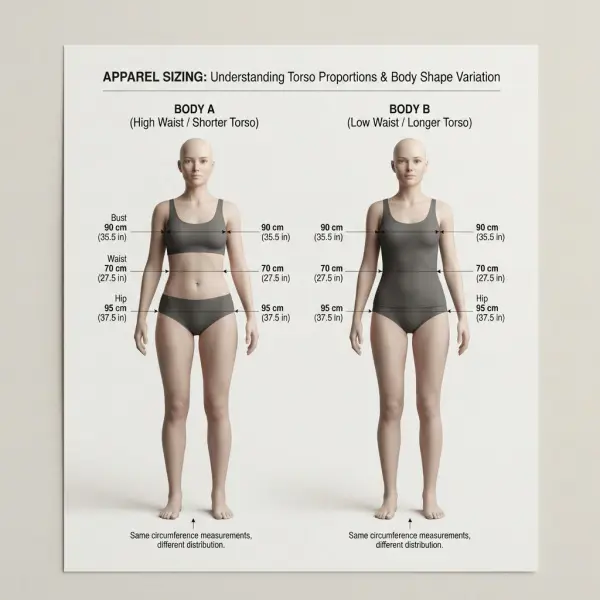
Instead of recording only a selected set of measurements, a scan can potentially preserve surface shape from which additional dimensions and shape characteristics can later be derived. This matters because two people can share several headline measurements while having visibly different body proportions.
For example, similar bust, waist, or hip girths do not necessarily imply identical:
- torso lengths,
- shoulder configuration,
- cross-sectional body shape,
- waist-to-hip transition,
- abdominal projection,
- posture,
- front-to-back proportions.
For pattern engineers and sizing specialists, that additional shape context can sometimes explain fit problems that a small set of circumference measurements does not fully describe.
Body Measurements and Garment Measurements Are Not the Same
This is one of the most important concepts in digital sizing. Body measurements describe the wearer. Garment measurements describe the finished product. A person's 90 cm hip circumference does not imply that the corresponding garment should also measure 90 cm at the same location.
Garment dimensions depend on factors such as:
- intended silhouette,
- wearing ease,
- stretch and recovery,
- fabric thickness,
- garment construction,
- layering requirements,
- movement requirements,
- design intent.
ISO's clothing-size framework similarly treats size designation as being based on body dimensions rather than finished garment dimensions. The current ISO 8559-2:2025 specifies primary and secondary dimensions used in body-measurement-based clothing size designation. That distinction is particularly important when body scanning is connected to automated size recommendations. Comparing customer measurements directly with finished garment dimensions without a properly designed fit model can produce misleading recommendations.
The scanner supplies evidence about the body. The brand still needs to define what "fits" means for each product.
How Can 3D Scan Data Improve Ready-to-Wear Sizing?
For ready-to-wear apparel, the goal is usually not to manufacture a unique pattern for every scanned individual. Instead, body data can inform decisions about the size system used to serve a population. ISO 8559-3 describes a methodology for creating body measurement tables and intervals using body-dimension data for ready-to-wear garments. It also recognizes that body shape and proportions differ across targeted population groups, which is why sizing systems need to be related to the population they are intended to serve.
In practice, scan-derived anthropometric datasets can support questions such as:
- Which waist and hip combinations actually occur among target customers?
- Is one base body shape being used to represent customers whose proportions differ materially?
- Where does the current size range provide strong coverage, and where might customers repeatedly fall between sizes?
Those questions move beyond the scope of the scanner itself and into anthropometric data analysis—the focus of how body scan data helps brands understand real customer measurements. For this introductory discussion, the essential point is simpler: 3D scanning can provide a richer raw material for sizing decisions, but the sizing architecture still has to be designed.
From Body Scan to Size Recommendation
Retail size recommendation is another application frequently associated with body scanning.
The basic workflow appears straightforward:
customer body data → brand size data → fit rules → recommended size.
The difficult part sits in the middle. A reliable recommendation system has to understand not only the customer's body but also the dimensions and intended fit of the specific garment.
Consider a customer whose body measurements sit between two nominal sizes. The correct recommendation could change depending on whether the product is:
- a fitted woven blazer;
- a relaxed jersey T-shirt;
- stretch leggings;
- an oversized coat;
- compression sportswear.
Fabric behavior, garment construction, fit preference, and design intent all matter. This is why 3D measurement should not be confused with the entire fit-recommendation system.
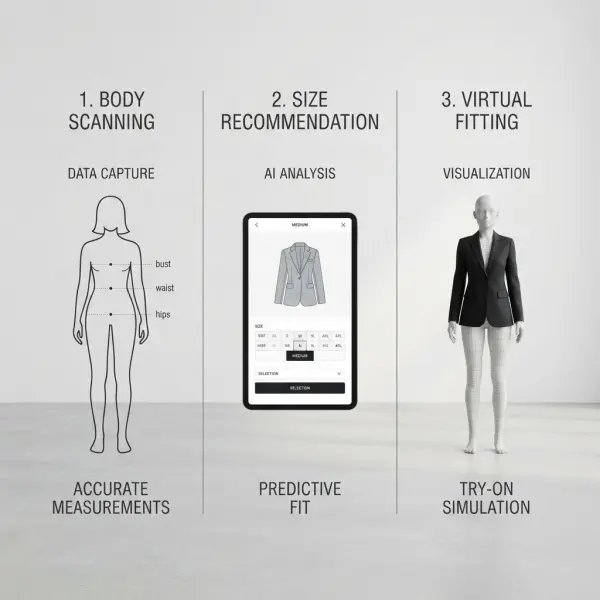
3D Body Scanning, Size Recommendation, and Virtual Try-On Are Different
These technologies frequently appear together in fashion technology discussions, but they solve different problems.
|
Technology |
Primary Question |
Typical Output |
|
3D body scanning |
What are the customer's body dimensions and shape? |
Body model and measurements |
|
Size recommendation |
Which available garment size is likely to suit this customer? |
Suggested size |
|
Virtual garment fitting |
How might a digital garment interact visually or geometrically with a digital body? |
Simulated garment-on-avatar result |
|
Virtual try-on |
What might the product look like on the user? |
Visual representation of product appearance |
They can be connected, but one does not automatically provide the others. A high-quality body avatar can improve the input available to some digital-fitting workflows, yet accurate garment simulation also requires reliable digital patterns, material parameters, construction information, and simulation assumptions. Similarly, a visually convincing virtual try-on image should not automatically be interpreted as a technically validated fit assessment. This is also why garment grading remains relevant even when companies introduce advanced body-data technologies. Commercial size ranges still require deliberate pattern development and controlled changes between sizes.
Where Does 3D Body Scanning Fit Into Apparel Product Development?
The strongest applications are usually those where body information is connected to a specific operational decision.
Building or Updating Size Charts
Anthropometric scan surveys can provide data for evaluating whether an existing size system represents the intended population. This does not mean that every measured body dimension should become a new size variable. A commercially workable sizing system has to balance fit coverage with manufacturing complexity, inventory requirements, and customer comprehension.
Developing Fit Mannequins and Digital Avatars
Body data can help product-development teams examine the dimensions and shapes represented by physical fit mannequins or digital avatars. A company may discover that its nominal size-medium fit form represents a narrower set of proportions than its actual customers. That finding does not automatically prescribe a new mannequin, but it gives technical teams evidence to investigate.
Made-to-Measure and Custom Apparel
Custom apparel presents a more direct use case because the measurements of a specific customer can potentially feed individual pattern-adjustment rules. Even here, scan-to-pattern automation is not trivial. Measurement definitions must align with the pattern system, and automated alterations still need constraints based on garment construction and design.
Uniform Programs
Organizations fitting large numbers of employees can use digital measurement systems to standardize data capture and map individuals to uniform sizes. The business case may be stronger when hundreds or thousands of people have to be measured repeatedly across multiple locations, provided the scanning method has been validated for the measurements being used.
E-Commerce Size Guidance
Consumer-facing scanning may provide additional body information for remote size recommendations. The commercial result depends on the quality of both sides of the equation: body data and product fit data. Collecting precise customer measurements while maintaining weak or inconsistent garment specifications will not solve the underlying problem.

How Should Fashion Businesses Apply 3D Body Scanning Strategically?
A useful implementation begins with a fit problem, not with the scanner. A company should first decide what decision the body data is expected to improve. If the objective is redesigning a ready-to-wear size chart, the company needs representative population data and a statistical sizing methodology. If the objective is e-commerce size recommendation, the company needs customer measurements connected to accurate product-level fit data. If the objective is made-to-measure production, it needs reliable measurement-to-pattern transformation rules.
A practical implementation sequence is:
- Define the fit or sizing decision that needs improvement.
- Identify which body dimensions or shape characteristics actually influence that decision.
- Establish consistent measurement definitions.
- Evaluate whether the scanning technology can measure those dimensions reliably.
- Validate scan outputs against an appropriate reference method.
- Connect body measurements to pattern, garment, or size-chart data.
- Test recommendations or sizing changes on actual garments.
- Monitor results and revise the fit rules when necessary.
The technology becomes useful when this chain remains intact. A company that begins by collecting hundreds of body variables without knowing how those variables will change a pattern, size chart, or customer recommendation may simply create a larger dataset without improving fit.
Common Mistakes When Using 3D Scanning for Apparel Sizing
Mistaking Measurement Quantity for Measurement Quality
Some systems can generate very large measurement sets. More measurements are not automatically more useful. An apparel team needs measurements that correspond to clearly defined anatomical landmarks and have a known relationship to product development. Twenty validated measurements that connect directly to pattern decisions may be commercially more valuable than hundreds of variables that nobody knows how to use.
Assuming a Scan Produces a Universal Clothing Size
There is no universal mathematical conversion from human body geometry to "size M." Sizing is brand- and product-specific. The same individual can legitimately wear different nominal sizes across different brands—or even across products from the same brand—because patterns, silhouettes, materials, and fit intentions differ.
Treating the Avatar as Proof of Fit
A realistic digital body image can look technically persuasive. But appearance is not validation. For apparel decision-making, teams should examine whether the underlying measurements, landmarks, pattern data, and garment simulation assumptions have been validated.
Mixing Measurement Definitions
A waist measurement taken at one anatomical position should not silently be compared with a waist measurement defined at another location. The problem can occur between manual measurements and scans, between two scanner vendors, or between scanning software and a company's existing technical specifications. Standardized terminology is therefore operationally valuable, not merely academic.
Ignoring Scan Protocol
Posture, clothing, hair, movement, scanner configuration, calibration, landmarking, and software processing can affect measurements. ISO 20685 exists partly because scanner performance and measurement extraction require systematic evaluation rather than an assumption that all 3D scanning systems produce equivalent results.
Collecting Body Data Without a Data-Governance Plan
Detailed body scans can represent highly personal information. Companies should determine what raw images, meshes, measurements, account identifiers, and derived information actually need to be retained; how long they are kept; who can access them; and what consent, security, and regulatory requirements apply in the relevant markets. Collecting less data may sometimes be the better design decision.
Important Technical Caveats
3D scanning should not be framed as an automatically superior replacement for every conventional measurement method. The correct question is whether a particular scanning system provides measurements that are sufficiently accurate, repeatable, and operationally appropriate for the intended application. A 2026 systematic review of markerless camera-based 3D and 4D anthropometry found substantial methodological heterogeneity across devices, software, and study procedures. That makes blanket comparisons between "3D scanning" and conventional measurement difficult.
Accuracy also varies by measurement. A system may perform well for major body circumferences while producing weaker results for measurements that rely on difficult-to-detect anatomical landmarks.
Human factors remain relevant too. A person who shifts posture during capture is not a rigid object. Loose clothing, hair, occluded areas between limbs, and inconsistent positioning can affect surface reconstruction. These issues do not make body scanning unsuitable for apparel. They explain why validation matters.
The operational constraints, adoption barriers, cost considerations, privacy issues, and situations where scanning may provide limited value deserve deeper treatment in the practical limits of 3D scanning in fashion retail and production.
What Should Brands Verify Before Choosing a 3D Body Scanning System?
The most important procurement questions are not about how impressive the avatar looks. They concern whether the resulting data can support the business decision the company wants to make.
|
Question to Verify |
Why It Matters |
|
What capture technology is being used? |
Clarifies what the system actually measures versus estimates |
|
Which measurements are directly available? |
Determines compatibility with existing technical specifications |
|
How are anatomical landmarks identified? |
Landmark errors can change measurement locations |
|
How has measurement accuracy been validated? |
Marketing claims alone are insufficient for technical adoption |
|
How repeatable are repeated scans? |
Sizing systems need consistent data |
|
Which scan protocol is required? |
Clothing, posture, environment, and positioning can affect results |
|
Can measurement definitions be mapped to the brand's existing system? |
Prevents incompatible data from entering product workflows |
|
Can data integrate with CAD, PLM, e-commerce, or manufacturing systems? |
Determines operational usefulness |
|
What data is retained? |
Affects privacy, governance, storage, and security |
|
Can the company export its data? |
Reduces dependence on a closed vendor ecosystem |
ISO 20685-1 provides a useful reference point because it specifically addresses evaluation of dimensions extracted from 3D body scans. The standard was reviewed and confirmed in 2024 and remains current. Fashion teams may also find ISO 8559-1 relevant when aligning scan measurements with clothing anthropometry; that standard was most recently confirmed in 2026.

FAQ: 3D Body Scanning for Apparel Fit and Sizing
Is 3D body scanning more accurate than measuring with a tape?
Not automatically. A validated scanner can capture measurements quickly and consistently, but accuracy depends on the device, measurement definition, software, subject positioning, landmark detection, and scan protocol. Manual anthropometry also depends on the skill and consistency of the person measuring. For apparel businesses, the useful comparison is therefore measurement-by-measurement rather than "scanner versus tape" in general. A company should determine how closely scan-derived dimensions agree with an appropriate reference method and whether repeated scans produce sufficiently consistent results for its intended sizing or manufacturing application.
Can a 3D body scan replace a professional fit model?
Usually not. A scan can provide valuable information about dimensions and body shape, while a professional fit model contributes something different: physical assessment of movement, comfort, balance, pressure, dressing behavior, and how the garment feels when worn. Digital avatars and scan data can reduce some dependence on repeated physical measurement and can help teams investigate broader body populations, but physical garment testing remains important for many product categories. The most effective workflow may combine population-level body data, digital development, fit mannequins, and appropriate wear testing rather than treating one method as a complete replacement for the others.
What measurements can be extracted from a 3D body scan?
Depending on the scanner and software, outputs may include body heights, lengths, circumferences, widths, depths, surface measurements, volumes, and shape-related information. Examples relevant to apparel can include chest or bust girth, waist girth, hip girth, inseam-related dimensions, torso lengths, shoulder-related dimensions, and limb circumferences. The number of available measurements varies significantly by system. Fashion companies should focus less on the headline number of measurements and more on whether the measurements they actually use have clear definitions, acceptable accuracy, and compatibility with their pattern and sizing workflows.
Can customers use a smartphone instead of visiting a scanning booth?
Yes, some body-measurement platforms allow consumers to provide body data using smartphones or tablets. However, mobile systems use different technical approaches. Some use depth-sensing hardware, while others reconstruct or estimate body dimensions from photographs using computer vision and statistical models. Research reviewing mobile apparel scanning applications shows substantial variation among solutions. A brand considering mobile scanning should therefore validate the specific system under realistic customer conditions rather than assuming that all smartphone body-measurement tools deliver the same type or quality of data as controlled professional scanners.
Does a 3D scan tell a customer which clothing size to buy?
Not by itself. The scan supplies body measurements or a body model. A separate decision system must compare that information with a brand's size chart, garment dimensions, intended ease, fit rules, material characteristics, and sometimes the customer's fit preferences. This is why two brands receiving identical body measurements can legitimately recommend different nominal sizes. The quality of a size recommendation depends as much on the product data and fit logic as it does on the accuracy of the body measurement.
Is 3D body scanning only useful for custom clothing?
No. Custom and made-to-measure clothing is an obvious application because individual measurements can be connected directly to pattern adjustments. However, 3D body data can also support ready-to-wear size-chart development, anthropometric surveys, uniform allocation, fit-form development, digital avatars, e-commerce sizing, and analysis of customer body populations. The business case differs by application. A mass-market brand may gain more value from analyzing patterns across thousands of customers than from producing individualized garments for each scan.
Does 3D body scanning solve apparel fit problems automatically?
No. Body scanning addresses one part of the fit system: information about the wearer. Poor fit can also originate from inappropriate size-chart architecture, weak base patterns, inconsistent grading, unsuitable ease, fabric behavior, sewing tolerances, inaccurate garment specifications, production variation, or a mismatch between design intent and customer expectations. For that reason, scanning technology works best when it is integrated into a disciplined apparel product-development process rather than introduced as an isolated technology project.
Conclusion
3D body scanning gives the apparel industry a more comprehensive way to observe human body dimensions and shape than a short list of conventional measurements alone. It can support digital anthropometry, sizing research, customer measurement, fit-form development, custom clothing, uniform programs, and increasingly consumer-facing sizing applications. But the scan is only the beginning. Apparel fit emerges from the relationship between the body, the pattern, the garment, the material, and the intended silhouette. No scanner can determine those relationships without an apparel sizing and product-development system around it.
For fashion businesses, the strongest reason to invest in body scanning is therefore not that the technology can produce sophisticated avatars or hundreds of measurements. It is that relevant, validated body data can improve specific decisions—from defining the population behind a size chart to matching customers with garments more systematically. The next layer of the discussion is what brands can learn when scans are collected across many real customers. That is where body scanning shifts from measuring individuals to understanding populations—and where anthropometric data becomes a strategic sizing asset.





Comments 0
Leave a CommentSend Comment
Anda harus Login terlebih dahulu untuk dapat memberikan komentar.