

How Size Grading Turns a Base Pattern Into a Full Size Range
A fit-approved sample represents one size. An apparel business, however, usually needs that design to work across several sizes without losing its silhouette, construction logic, or practical function. Size grading is the technical process that makes this transition possible.
The work involves more than drawing larger and smaller outlines. A grader translates body measurements and finished-garment increments into coordinated movements at specific pattern points. Every related component—from a bodice panel to its facing, lining, collar, or pocket—must remain compatible.
Quick Answer
Size grading turns a base pattern into a full size range by applying planned horizontal and vertical movements, known as grade rules, to selected points on every pattern piece. These movements create smaller and larger patterns that correspond with the brand's size chart and graded garment specifications while preserving the original design and construction relationships.
The process usually begins only after the base-size fit has been approved. The grader confirms the required range, studies the measurement increments between sizes, assigns movements to cardinal points, applies the rules manually or in computer-aided design (CAD) software, and checks the resulting pattern nest. Finished measurements, adjoining seams, notches, internal components, and design-detail positions must then be reconciled. Representative sizes may be sampled to verify fit and proportion before production release.
Grading is therefore not uniform enlargement. A 4 cm increase in garment circumference, for example, must be deliberately distributed among the relevant pattern pieces; it does not mean adding 4 cm to every edge. The correct distribution depends on the block, product category, target body, ease, and design intent.
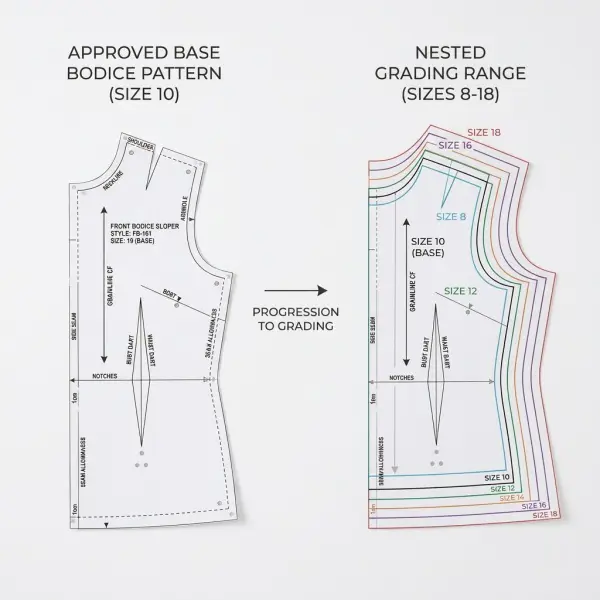
Start With an Approved Base, Not Merely a Finished Pattern
A base pattern is the reference size from which the other sizes are developed. It may be called a sample size, master size, or base size. The label varies, but its function is the same: it contains the approved shape, balance, ease, construction, and styling decisions that the grade will carry into the rest of the range.
If the shoulder angle, armhole, rise, or garment balance is still being corrected, grading creates multiple versions of an unresolved problem. Later corrections must be made in every size or reapplied to the base and regraded, adding work and version risk.
Before grading starts, the technical team should confirm checked seam relationships, grainlines, notches, drill points, dart legs, fold lines, construction lines, and identified pattern pieces. The finished-garment specification should match the approved sample and pattern version.
This sequence builds on the foundation explained in garment grading for apparel production: grading scales approved fit logic; it does not create a reliable sizing strategy from incomplete inputs.
The base size should sit inside a deliberate size architecture
There is no universal base-size rule. A business may choose a size near the center of its commercial range to limit grade steps in either direction, or select the size best supported by its block library, fit model, customer data, or buyer requirements.
The choice must be documented. A pattern labeled “base M” is insufficient if its body measurements, finished measurements, ease, and relationship to adjacent sizes are unclear.
Define the Size Range and Measurement Framework
The full size range is the set of sizes the style will offer, such as XS–XXL or 4–20. The labels alone do not tell a grader how the patterns should change. They must be connected to defined body dimensions, size intervals, and garment measurements.
ISO 8559-1:2017 provides anthropometric definitions that can support clothing body-measurement databases and size-and-shape profiles. The current ISO 8559-2:2025 addresses primary and secondary body dimensions for size designation. These standards support consistent measurement language, but they do not prescribe one universal set of retail labels or one grade rule library for every brand.
The technical team typically works across three connected measurement layers:
|
Measurement layer |
What it describes |
How it informs grading |
|
Body measurement chart |
Dimensions of the intended wearer or size population |
Establishes the sizing framework and body intervals |
|
Finished-garment specification |
Measured dimensions of the completed garment at defined points |
Sets the required garment result, including intended ease and styling |
|
Pattern measurement |
Dimensions taken from pattern pieces using stated conventions |
Confirms that graded pattern geometry can produce the specification |
These layers are connected but not interchangeable. A finished chest measurement reflects body size and ease. Pattern calculations may adjust for darts, pleats, gathers, elastic, seam allowances, or the measurement method.
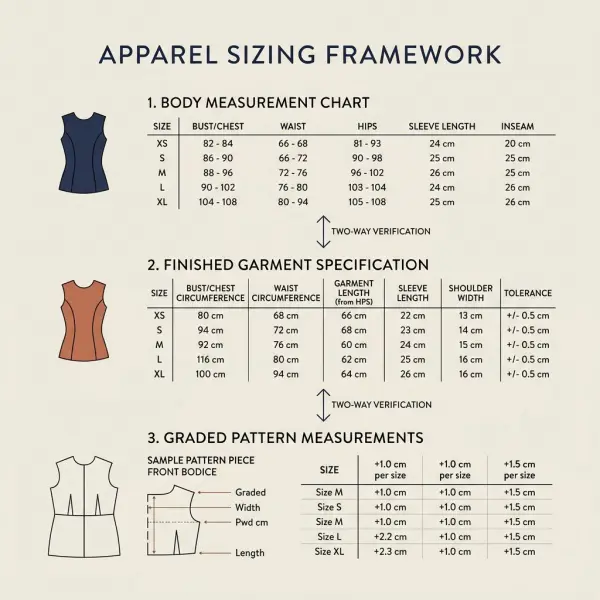

Determine the size-to-size increments
A size interval describes the difference between adjacent values in a body measurement table. ISO 8559-3:2018 defines an interval in that context and sets out principles for building body measurement tables for ready-to-wear population groups. The ISO 8559-3 methodology is useful because it makes clear that measurement tables arise from population and sizing decisions, not from arbitrary multiplication.
The body interval does not automatically become the same garment interval at every point of measurement. A brand may preserve the same ease between sizes, increase or reduce it selectively, or adjust increments to maintain a silhouette. The decision depends on the product. A close-fitting stretch top and a relaxed woven coat can serve the same body chart while using very different finished-garment measurements.
Some ranges use consistent increments throughout. Others change increments after a size break or use more than one base block when one extended rule system cannot represent the target proportions. A changed rule is not inherently wrong; an undocumented or unvalidated change is.
Translate Measurement Changes Into Grade Rules
Once the required measurement progression is known, the grader converts it into point movements on the pattern. A grade rule tells a specific pattern point how far to move horizontally and vertically from one size to the next. These directions are commonly recorded as X and Y values, although axis orientation and sign conventions can differ between software systems and company practices.
The locations receiving instructions are called cardinal or grade points. They control pattern shape and measurement at shoulders, necklines, armholes, side seams, waists, hips, rises, hems, darts, and corners. Curves need enough control to retain a usable contour.
A garment increment must be distributed across pattern pieces
Consider a simple illustrative bodice with a half-front pattern and a half-back pattern, both cut on the fold. If the finished bust circumference is intended to increase by 4 cm between adjacent sizes, the assembled half-garment must increase by 2 cm. If the increase is divided equally between front and back, the half-front pattern gains 1 cm in width at the bust level and the half-back gains 1 cm. Once both pieces are cut on the fold, those changes produce 4 cm around the full garment.
This illustrates distribution, not a universal rule. A design may allocate more room to the front, distribute it through princess seams, modify darts, or use another block strategy. The grader must follow the actual construction and measurement convention.
Vertical changes are also distributed deliberately. Increasing total length does not mean lowering every feature equally. Change may belong above the bust, through the armhole, between waist and hip, through the rise, or below a key level, influencing balance and feature placement.
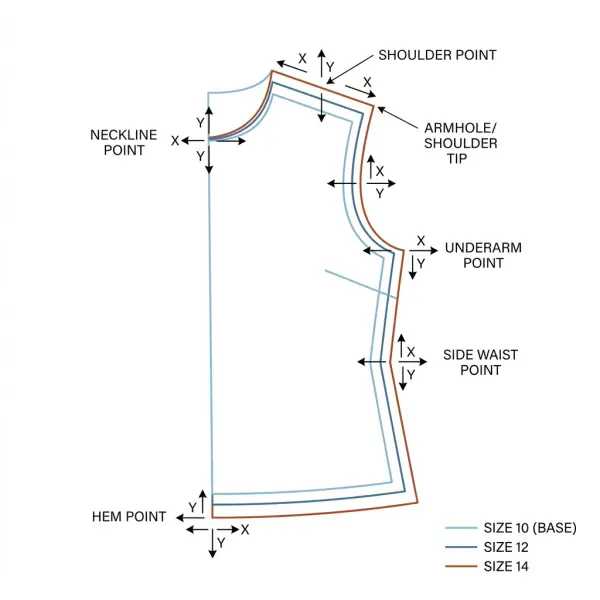
Measurement grades and coordinate movements are related, not identical
A finished measurement grade states how much a garment dimension changes between sizes. A coordinate rule states how one pattern point moves. Several coordinate movements may contribute to one finished measurement, and a single movement may affect more than one measured dimension or seam shape.
For example, moving an underarm point outward can add width, but its vertical movement also influences armhole depth and side-seam geometry. Changing a shoulder tip can affect shoulder length, armhole contour, and sleeve compatibility. This is why grade rules must be reviewed as a connected system rather than a spreadsheet of isolated numbers.
Apply the Rules Across the Complete Pattern Set
After the rule plan is established, the grader applies it to every size and every relevant pattern component. Main pieces usually receive the most attention, but smaller dependent pieces are often where production problems appear. A collar must follow the graded neckline. A cuff must remain compatible with the sleeve opening. A facing, lining, waistband, fly, binding, or pocket bag must still connect to the shell it supports.
Pattern details also require rules. These can include:
- notches that identify balance points or matching seams;
- drill holes for darts, pockets, pleats, or hardware;
- button and buttonhole positions;
- pocket and flap placements;
- internal lines for folds, elastic, topstitching, quilting, or bonding;
- artwork, embroidery, print, and label placement references.
Not every detail should scale. Button diameter, seam allowance, zipper width, label size, or a minimum pocket opening may remain constant. Other details move without changing size or follow separate rules beyond a size break. The grading brief should distinguish these cases.
Preserve sewing relationships
Pattern pieces must still form one sewable garment. Seam walking compares adjoining seam lengths and shapes. The goal is not always equality: sleeve caps, eased seams, gathers, and stretched components can require controlled differences. The intended relationship must remain in every size.
Critical dependencies vary by category:
|
Garment area |
Relationship to check |
Possible consequence if ignored |
|
Sleeve and armhole |
Seam length, notches, sleeve-cap shape, intended ease |
Twisting, puckering, restricted movement, or assembly difficulty |
|
Collar and neckline |
Sewing length, stand shape, neckline balance |
Collar failing to sit or close correctly |
|
Waistband and garment waist |
Seam length, overlap, closure position, elastic behavior |
Mismatched assembly or incorrect waist fit |
|
Front and back rise |
Inseam, outseam, crotch curve, waist level |
Poor balance, drag lines, or mobility problems |
|
Shell and lining |
Seam compatibility plus intended lining ease |
Pulling, excess bulk, or distorted drape |
The table highlights why a pattern cannot be graded piece by piece in isolation. Each coordinate belongs to a construction relationship.
Build and Inspect the Graded Pattern Nest
Overlaying the sizes produces a graded nest. In a well-constructed nest, the outlines progress in an intelligible way from one size to the next. Technicians can use this view to identify unusual jumps, crossed lines, stationary points that should move, or details that have drifted away from the garment.
A visual check is insufficient. Smooth lines can still use the wrong measurement progression. Each size must be measured at specified points and reconciled with the graded garment specification, with differing calculation methods documented.
CAD makes this review faster by storing rule tables, displaying multiple sizes, and calculating pattern measurements. Current apparel systems may also include dedicated views for comparing graded geometry; CLO, for example, describes a 2D Grading Review function for reviewing pattern and graphic positions across sizes. Such tools improve visibility, but they do not determine whether the underlying body chart or grade logic is appropriate.
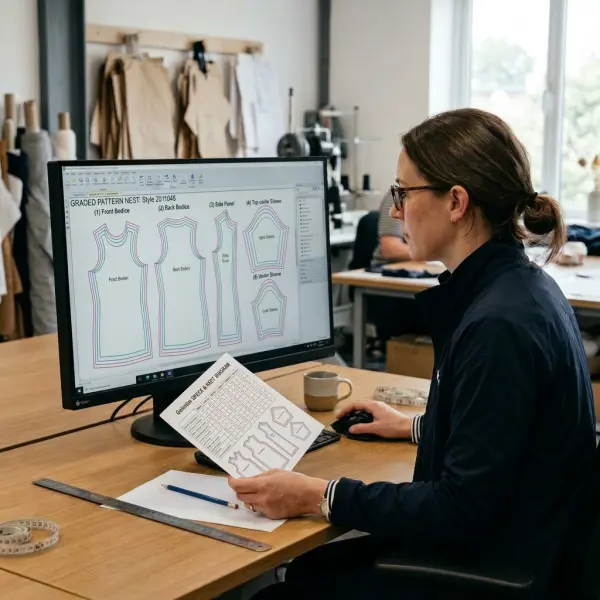
Reconcile patterns with the graded specification
The reconciliation process should answer three questions. Does each pattern size produce the intended finished measurements? Do the differences between sizes match the approved grade? Do all related pieces and details remain compatible?
When a discrepancy appears, the team should identify its source before changing the pattern. The pattern may be wrong, the specification formula may be wrong, or the two documents may use different measurement definitions. Quietly changing one number to make a table match can create a later conflict with the fit sample, quality manual, or factory inspection method.
Measurement tolerances should not be used to excuse a grading discrepancy. A tolerance defines acceptable manufacturing variation around a target measurement. A grade defines the intended difference between sizes. They serve different purposes.
Validate the Range Beyond the Computer Screen
The grade needs appropriate product validation before bulk production. Pattern measurement confirms dimensional logic but cannot fully show how stretch, recovery, thickness, shrinkage, drape, support, or construction affects the garment on a body.
Brands often use a size set to assess measurements, assembly, fit, and proportion. A buyer may require every size; another team may check the base plus selected lower and upper sizes. Scope should reflect risk.
Factors supporting broader validation include:
- a new block, sizing system, supplier, or target population;
- a wide or recently extended size range;
- a fitted or highly engineered garment;
- stretch, compression, structured tailoring, or sensitive fabric behavior;
- complex internal construction or many dependent components;
- large order quantities or a high cost of post-cutting correction;
- repeated historical fit issues in non-base sizes.
A familiar relaxed T-shirt on a proven block may justify a lighter sampling plan than a new tailored jumpsuit spanning multiple size segments. In either case, all digital sizes still require pattern and measurement checks.

Fit should be assessed against intended bodies and intended use
A sample can match its specification and still fit poorly if the size chart does not represent the wearer, the ease is unsuitable, or the fit model is not aligned with the customer. Validation should therefore consider both technical targets and real use: sitting, walking, reaching, layering, fastening, and any task the garment is designed to support.
Visual continuity also matters. Teams should compare neckline scale, pocket position, lapel width, print placement, crop proportion, and other design features across sizes. The aim is not to make bodies appear identical. It is to ensure that the product continues to deliver the same design proposition and function.
Handle Size Breaks and Extended Ranges Deliberately
As a range expands farther from its base size, assumptions become more consequential. Repeating one increment indefinitely may produce excessive shoulder width, misplaced shaping, unsuitable lengths, or details that no longer function. The issue is not that every extended range needs a separate block. It is that the decision must be supported by target-body data and fit validation.
Three architectures are common in practice:
- Continuous grading: one base pattern and one largely continuous rule system cover the complete range.
- Segmented grading: increments or selected rules change at defined size breaks while maintaining a controlled transition.
- Multiple blocks: separate base patterns serve different size or shape segments, sometimes with overlapping sizes for comparison and merchandising continuity.
None is universally superior. Continuous grading can simplify pattern management and factory use. Segmented rules add flexibility but require careful documentation. Multiple blocks can better reflect different proportion groups, yet they add development, fitting, inventory, and version-control demands. The appropriate choice depends on customer morphology, range width, product sensitivity, sales opportunity, and available development resources.
Release Controlled Files for Production
Once the patterns and selected samples are approved, the range moves into production preparation. The handoff should make it impossible—or at least difficult—for a supplier to confuse draft files with approved files.
A controlled grading package commonly contains:
- the approved graded pattern set in the agreed native and exchange formats;
- the graded finished-garment specification and measurement method;
- the grade-rule table or documented size increments where contractually appropriate;
- pattern-piece inventory, size range, and base-size identification;
- seam allowance, shrinkage, and material-treatment status;
- size-set comments, corrections, and approval status;
- a revision number, release date, owner, and clear supersession record.
The factory then uses the approved sizes for marker planning and cutting. If shrinkage or process compensation is applied, ownership of that adjustment should be explicit. Otherwise, a factory may modify a graded pattern while the brand continues to assess the unmodified specification, leaving the two parties with different technical truths.
A Practical Implementation Framework for Fashion Businesses
For a small brand, the priority is not to build an elaborate grading department immediately. It is to create an auditable chain of decisions. The brand should own its target size chart and fit intent even when a freelance grader or factory performs the pattern work.
A practical implementation can be organized into four controls:
- Input control: approve the base sample, body chart, finished specification, size range, material, and rule brief before grading.
- Execution control: identify who applies rules, which software or manual method is used, and how dependent pieces and details are handled.
- Validation control: measure every pattern size, inspect the nest and seams, and define which physical sizes require approval.
- Release control: issue one versioned package and record any factory-side pattern or shrinkage adjustment.
Larger businesses can extend this framework through block and rule libraries, role-based approvals, product lifecycle management integration, automated measurement reports, and structured fit-data analysis. Technology adds value when it protects approved logic and makes exceptions visible. It adds less value when teams cannot identify which chart, pattern, or rule version is authoritative.
Feed production and customer evidence back into the system
The grading workflow should not end at file release. Production measurements, sewing difficulties, alteration records, fit reviews, returns, and customer-service reasons can reveal patterns worth investigating. Evidence should be separated by style, material, supplier, size, and body area where possible.
One complaint does not prove that a grade rule is wrong. Repeated sleeve restriction in upper sizes across several styles built from the same block is more meaningful. The team can then compare the customer signal with the body chart, garment specification, graded pattern, sample history, and production measurements before deciding what to change.
Mistakes to Watch Without Diagnosing Too Quickly
Several failures recur during base-to-range development: grading before base approval, confusing body and garment increments, applying rules only to main pieces, ignoring size breaks, failing to reconcile pattern measurements, and approving a range from a base-size sample alone. Each can create fit or production problems, but visible symptoms do not always identify the source.
A tight armhole in a larger size could result from the rule, sleeve compatibility, sewing tolerance, fabric shrinkage, or the underlying block. A misplaced pocket might come from an ungraded drill point rather than the body grade. Diagnosis should compare the source data, pattern, sample, and manufacturing result instead of editing the most obvious line.
The next cluster article examines common grading mistakes that affect fit across sizes in detail, including why they happen, how they appear, and how teams can isolate the actual cause.
What Should Be Verified Before the Full Range Is Approved?
Before approval, confirm that the base pattern is the final fit version; the body chart and finished specifications use consistent definitions; size intervals and any breaks are documented; every shell, lining, facing, trim-support, and placement detail is included; and all seam relationships remain intentional.
The final review should also acknowledge several caveats:
- A clean mathematical progression does not prove good fit on the target population.
- The same body interval can lead to different garment grades because ease and design differ.
- CAD applies rules consistently but cannot validate the brand's sizing strategy by itself.
- Stretch, recovery, shrinkage, and construction can alter the physical result even when pattern measurements are correct.
- Tolerances are not substitutes for grade increments.
- A broader range may require new data, different rules, or additional blocks rather than more grade steps.
Approval is strongest when the body chart, garment specification, graded patterns, sample findings, and production file version all tell the same story.
Frequently Asked Questions
What must be approved before a base pattern is graded?
The base fit, pattern geometry, construction, key finished measurements, and material direction should be approved or controlled before grading begins. The team also needs a defined size range, body measurement framework, and size-to-size measurement increments. All main and dependent pattern pieces should belong to the same version. If wash shrinkage, bonding, pleating, or another process will change dimensions, the responsible party and compensation method should be documented. Grading an unstable base creates more files to revise and makes it harder to distinguish a fit correction from a grade correction.
How are grade rules calculated from a size chart?
The grader compares adjacent body and finished-garment measurements, determines the required change at each point of measurement, and distributes that change across the relevant pattern pieces. The resulting movements are assigned horizontally and vertically at cardinal points. The calculation must account for pattern symmetry, the number of cut pieces, darts, seams, gathers, and measurement conventions. Body increments provide a foundation, but garment ease and styling determine how those increments translate into finished dimensions. There is therefore no single formula that can be applied unchanged to every garment.
Can one base pattern create every size in a wide range?
It can in some product systems, but suitability should be tested rather than assumed. A continuous grade works when the rule progression, proportions, and fit remain appropriate for the target bodies throughout the range. Other products may need changed increments, size breaks, or a second block because body shape and garment requirements are not adequately represented by continued grading. The decision has operational consequences: additional blocks cost more to develop and manage, while an overextended single block may weaken fit at the range edges.
Why do pattern pieces move in both horizontal and vertical directions?
Bodies and garments change in width and length across a size range. Horizontal movements can affect girth, shoulder width, neck width, and other cross-body dimensions. Vertical movements can affect body length, armhole depth, rise, waist position, and feature placement. Many points require both movements because pattern geometry is interconnected. Moving an underarm outward without reviewing its vertical position, for example, may alter the armhole shape and sleeve relationship. X and Y rules allow the grader to distribute changes where the pattern needs them rather than expanding the outline uniformly.
Is a graded specification enough without graded patterns?
No. A graded specification alone defines target finished measurements but does not provide the shapes needed for cutting and assembly. Different pattern geometries can sometimes produce the same headline measurement while fitting and sewing differently. Conversely, graded patterns without an approved specification make it harder for product and quality teams to verify the intended results. The two deliverables should be reconciled: specifications state what the garment should measure, while patterns encode how those measurements and construction relationships will be achieved.
Which sizes should be included in a size-set sample?
The answer depends on buyer requirements and product risk. A team may sample every size or select the base plus sizes near the lower and upper ends. Broader testing is more valuable for new blocks, wide ranges, fitted products, complex construction, sensitive fabrics, compression garments, or styles with a costly production commitment. The sampling decision should be documented before approval. Even when physical sampling is selective, technicians should measure and review every graded pattern size and confirm all seam and component relationships digitally or manually.
Does digital grading eliminate the need for a skilled grader?
No. Digital systems apply stored coordinate rules, generate nests, calculate measurements, and make revisions easier to manage. They do not independently determine whether the size chart represents the customer, whether ease is suitable, or whether a collar, pocket, and armhole remain functional and visually balanced. Skilled judgment is needed to translate garment increments into pattern movements, manage exceptions, and interpret validation results. Software reduces repetitive work and improves consistency when inputs are sound; it can also repeat a poor rule rapidly when they are not.
Conclusion
Turning a base pattern into a full size range is a controlled translation process. The brand's target body measurements and size architecture establish the framework. Finished-garment specifications define the intended product dimensions. Grade rules distribute those changes across cardinal points, and the complete pattern set must preserve seam compatibility, construction, function, and visual intent.
The process succeeds when each layer is traceable. An approved base leads to documented increments; those increments lead to coordinated X and Y movements; the resulting nest reconciles with the specification; representative samples validate the physical outcome; and one controlled file package reaches production.
This discipline becomes more important as ranges widen and products become more technically sensitive. The answer is not automatically more software or more samples. It is better sizing evidence, clearer rule ownership, proportionate validation, and a production handoff in which every team works from the same approved version.





Comments 0
Leave a CommentSend Comment
Anda harus Login terlebih dahulu untuk dapat memberikan komentar.