

How Contribution Margin Shapes Fashion Business Decisions
Quick Answer
Contribution margin shows how much revenue remains after the variable costs associated with generating a sale have been deducted. For fashion brands, that remaining amount helps pay fixed operating expenses and, once those are covered, contributes to profit.
This makes contribution margin more useful for many day-to-day commercial decisions than looking only at retail price or gross margin. A garment with a high gross margin can still produce weak contribution if selling it requires heavy discounts, marketplace commissions, payment fees, fulfillment expenses, shipping subsidies, costly returns, or expensive customer acquisition. Conversely, a product with a more modest headline margin may contribute strongly if it sells at full price, moves efficiently through the operation, and requires little incremental marketing expenditure.
Contribution margin can therefore help fashion businesses evaluate questions such as whether a promotion is worth running, how much they can afford to spend on customer acquisition, which channel deserves more inventory, whether a SKU should be reordered, and how much additional sales volume is needed to cover fixed costs.
The critical requirement is consistency: brands must define clearly which costs are considered variable and calculate contribution at the appropriate level—product, order, customer, channel, or collection.

What Is Contribution Margin in a Fashion Business?
Contribution margin is the amount of sales revenue remaining after variable costs have been deducted, representing the amount available to cover fixed costs and ultimately contribute to operating profit.
At unit level, the basic formula is:
Contribution Margin per Unit = Selling Revenue per Unit − Variable Costs per Unit
The contribution margin ratio expresses the same idea as a percentage:
Contribution Margin Ratio = Contribution Margin ÷ Sales Revenue × 100
Managerial accounting guidance from OpenStax defines contribution margin as the amount by which selling price exceeds total variable cost per unit and explains that the resulting margin first contributes toward fixed costs before becoming profit. OpenStax contribution margin guidance
For apparel businesses, however, the practical calculation is often more nuanced than the textbook formula suggests. A fashion brand may need to consider the product cost, payment processing, marketplace commission, fulfillment, shipping support, sales commission, and other costs that change when another product or order is sold.
The purpose is not to force every cost into one number. It is to understand what happens economically when sales activity changes.
That distinction separates contribution margin from the broader fashion unit economics framework, which can examine economics at several levels including products, orders, customers, and sales channels.
Contribution Margin Is Not the Same as Gross Margin
Gross margin and contribution margin answer related but different questions.
Gross margin primarily shows how much revenue remains after cost of goods sold. Contribution margin goes further by deducting variable operating costs associated with generating and fulfilling sales.
Consider a dress sold for $100 with a $30 product cost. Looking only at those two figures suggests a $70 gross profit before considering the precise accounting presentation.
But suppose selling that dress also creates:
- a $3 payment-processing cost;
- $5 of fulfillment expense;
- a $6 shipping subsidy; and
- an expected $4 of variable return-related cost.
The contribution available from the transaction would be materially lower than the $70 product-level spread.
This distinction matters because gross margin is often used to evaluate merchandise economics, while contribution margin helps management evaluate incremental business decisions.
A brand may therefore need both.
Gross margin can reveal whether product architecture and sourcing costs are appropriate. Contribution margin can reveal whether the way the product is actually sold remains economically attractive after channel and transaction costs are included.
Why Contribution Margin Changes the Way Fashion Brands View Revenue
Revenue tells a brand how much it sold. Contribution margin helps show how economically useful those sales were.
That sounds like a small distinction, but it can completely change management decisions.
Imagine two online campaigns.
Campaign A generates $100,000 in revenue.
Campaign B generates $70,000.
Looking only at revenue, Campaign A appears clearly stronger. But suppose Campaign A relied on substantial discounts, expensive paid advertising, free shipping, and a product mix with high variable fulfillment costs. Campaign B, by contrast, generated more full-price purchases from existing customers.
It is entirely possible for Campaign B to create more contribution despite producing lower revenue.
The strategic question therefore shifts from:
“How much revenue did this activity generate?”
to:
“How much incremental contribution did this activity generate?”
That is a better question when management is deciding whether to repeat a promotion, expand an advertising budget, open another marketplace channel, or reorder a product.
How Contribution Margin Shapes Pricing Decisions
Pricing is one of the clearest applications of contribution margin because changing price usually changes contribution immediately.
Suppose a fashion brand sells trousers for $80 and incurs $44 of relevant variable costs. Contribution margin is therefore $36 per unit.
If the retail price increases to $85 while variable costs remain unchanged, contribution rises to $41. If price falls to $70 because of a promotion, contribution declines to $26.
The effect looks simple when evaluated per garment, but price also influences demand. A $5 increase that reduces conversion substantially may produce less total contribution, while a carefully selected price increase that leaves demand largely intact can improve economics considerably.
This is why pricing decisions should not be based on margin percentage alone. Brands need to consider unit contribution, contribution ratio, expected sales volume, competitive positioning, perceived value, and price elasticity.
The most useful question is not necessarily:
“What price gives us the highest margin percentage?”
It is:
“At realistic demand levels, which price is likely to create the strongest total contribution while remaining consistent with the brand's positioning?”
Fashion adds another layer because consumers often compare products based on design, brand, material, fit, exclusivity, and perceived quality rather than manufacturing cost. Contribution margin therefore informs pricing but does not determine market willingness to pay.

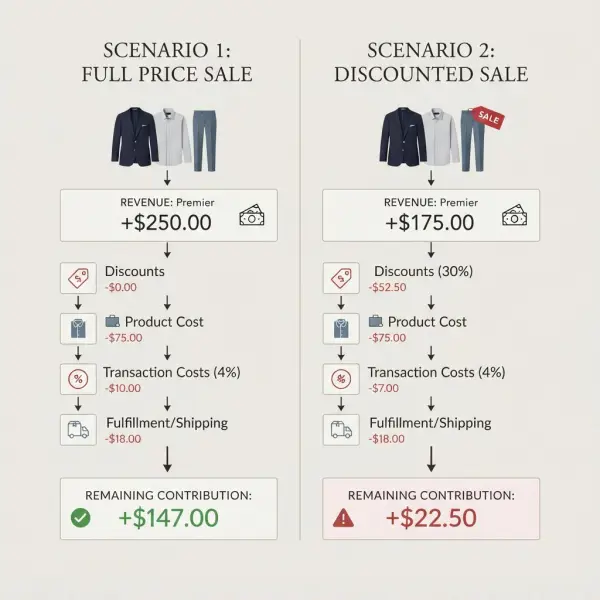
Discounting Looks Very Different Through a Contribution-Margin Lens
Discounts can increase orders while simultaneously compressing contribution much faster than many brand teams expect.
Consider a garment with these simplified economics:
|
Item |
Full Price |
20% Discount |
|
Selling price |
$100 |
$80 |
|
Variable costs |
$50 |
$50 |
|
Contribution per unit |
$50 |
$30 |
|
Contribution ratio |
50% |
37.5% |
A 20% reduction in selling price has reduced unit contribution from $50 to $30—a 40% decline in contribution dollars per unit.
That does not mean the discount is automatically a bad decision. It means the brand needs substantially more sales volume to generate the same total contribution.
At full price:
100 units × $50 contribution = $5,000 total contribution
At the discounted price:
$5,000 ÷ $30 ≈ 167 units
The brand would therefore need to sell roughly 67% more units in this simplified example to produce approximately the same contribution.
This is one of the most important commercial uses of contribution analysis in fashion. Promotions should be judged not simply by how much conversion or revenue increased, but by whether incremental volume compensated for the lost margin.
Markdowns can still be economically rational when the alternative is holding aging merchandise, paying additional storage costs, or eventually liquidating inventory at an even lower price. The decision depends on inventory position, expected future demand, seasonality, opportunity cost, and recoverable selling price.
Accounting treatment of inventory is a separate matter, but it reinforces why declining inventory value deserves attention: IAS 2 requires inventory under IFRS to be measured at the lower of cost and net realizable value. IFRS IAS 2 inventory guidance
Contribution Margin Helps Set a Rational Customer Acquisition Budget
Paid acquisition creates a common dilemma for direct-to-consumer fashion brands: advertising can increase sales quickly, but the resulting customers may not generate enough contribution to justify the acquisition expense.
Contribution margin creates a financial boundary around this decision.
Assume a new customer's first order produces:
Net order revenue: $120
Variable product and transaction costs: $65
Contribution before acquisition cost: $55
If acquiring that customer costs $20, the first transaction leaves $35 of contribution after acquisition.
If CAC rises to $50, only $5 remains.
At $70 CAC, the company loses $15 on the first order before considering fixed operating expenses.
Customer acquisition cost is generally calculated by dividing acquisition expenditure by the number of new customers acquired, although what is included in acquisition expenditure must be defined consistently. Shopify similarly describes CAC as the cost of acquiring a customer and notes that acquisition spending can include more than advertising alone. Shopify guide to customer acquisition cost
The conclusion should not be that CAC must always remain below first-order contribution. Some fashion businesses intentionally accept lower or negative first-order economics because customers make profitable repeat purchases.
But that strategy requires evidence.
If a brand assumes customers will return without measuring retention, repeat contribution, and the time required to recover acquisition expenditure, it is effectively financing growth based on an unverified expectation.
First-Order Profitability vs Customer-Level Economics
The distinction between an order and a customer becomes important here.
A customer acquired for $50 who generates $40 of first-order contribution appears unattractive if management looks only at the initial transaction. If that customer later generates another $100 of contribution without requiring another $50 acquisition expense, the customer-level economics can become attractive.
The opposite can also happen. A brand may tolerate expensive acquisition because it expects strong customer lifetime value, only to discover that most customers purchased once because of an introductory discount and never returned.
Contribution margin therefore provides the numerator that makes customer acquisition analysis commercially meaningful. Revenue-based customer lifetime value can look impressive while concealing weak margin economics.
Contribution Margin Can Reveal Which Sales Channels Really Perform
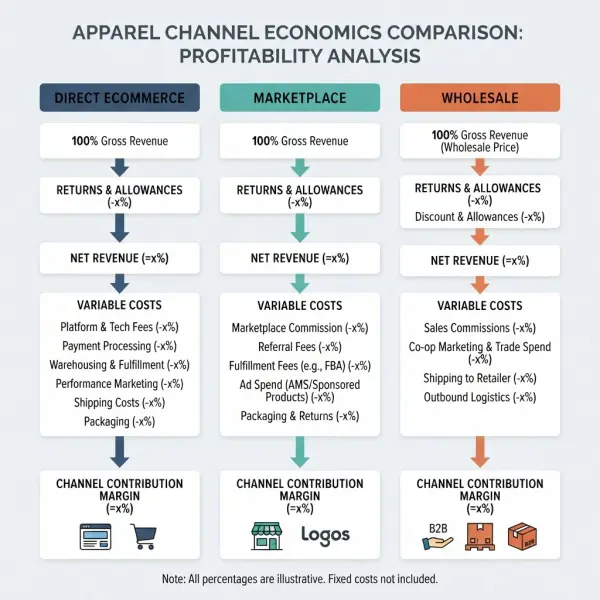
Fashion brands increasingly sell through combinations of direct ecommerce, marketplaces, wholesale accounts, social commerce, physical stores, pop-ups, and distributors. Comparing these channels only by revenue can lead to poor decisions because their cost structures are different.
A marketplace may charge commission but provide demand that the brand would otherwise need to acquire through paid marketing.
Direct ecommerce may preserve the retail selling price but require the brand to pay for traffic, payment processing, fulfillment, customer support, and returns.
Wholesale may produce substantially lower revenue per unit but simplify customer acquisition and shift certain retail activities to the wholesale partner.
A physical store creates another structure entirely: store rent and permanent staff may be largely fixed within a relevant operating range, while payment fees, packaging, or sales commissions may vary more directly with transactions.
Contribution margin allows the brand to normalize some of these differences by asking what remains after each channel's relevant variable costs.
A useful channel analysis might compare:
|
Channel |
Net Revenue |
Variable Costs |
Contribution |
Contribution Ratio |
|
Own ecommerce |
$100 |
$45 |
$55 |
55% |
|
Marketplace |
$100 |
$58 |
$42 |
42% |
|
Wholesale |
$55 |
$30 |
$25 |
45% |
These figures are illustrative only. The important insight is that the highest contribution percentage, the highest contribution dollars per unit, and the highest total contribution may point to different channels.
A marketplace producing $42 contribution on 10,000 sales may be more important economically than a direct channel producing $55 on only 1,000 sales. Capacity, brand control, working capital, return policy, inventory requirements, and customer ownership also matter.
Contribution Margin Changes Assortment and Product-Mix Decisions
Fashion brands rarely sell one product. They operate portfolios of SKUs with different prices, cost structures, demand patterns, return rates, markdown risk, and contribution margins.
That makes sales mix important.
Managerial accounting defines sales mix as the relative proportions in which different products are sold. Because products can have different contribution margins, changes in mix can alter total contribution even when overall sales volume remains similar. OpenStax sales mix and contribution terminology
Consider a fashion brand selling two products:
Product A: $60 contribution per unit
Product B: $20 contribution per unit
Selling 1,000 units does not tell management much without knowing the mix.
If 800 units are Product A, contribution is very different from a month in which only 200 units are Product A.
This can explain a frustrating situation familiar to retailers: sales units increase, yet profitability appears to weaken. The problem may not be volume. The business may simply be selling more of its lower-contribution assortment.
Contribution analysis can therefore influence merchandising choices such as assortment width, visual merchandising, homepage placement, recommendation algorithms, bundling, promotional inclusion, and inventory allocation.
This does not mean lower-contribution products should automatically be eliminated. Some products may attract customers, complete outfits, improve basket size, create repeat purchases, or support a broader brand proposition. Their strategic role should simply be understood rather than assumed.
How Contribution Margin Helps With Reorder Decisions
A fast-selling fashion product is not automatically a good reorder.
The first question is whether continuing to sell additional units is economically attractive under the expected next production and selling conditions.
Suppose a blouse is nearly sold out and historically generates $30 contribution per unit. Reordering appears obvious.
But the next production run may be different. The supplier may raise the manufacturing price. Airfreight may be required to restock quickly. The selling season may be nearing its end. Paid acquisition may become more expensive once the easiest customers have already converted.
The next batch may therefore generate only $18 contribution per unit.
That can still justify a reorder, but management should make the decision using forward-looking incremental economics, not the margin achieved by the first production run.
Inventory quantity also matters. A reorder of 100 units may sell comfortably at full price. A supplier minimum order of 1,000 units might create substantial end-of-season markdown exposure.
Contribution margin is most useful here when combined with sell-through expectations and inventory risk rather than treated as an isolated product metric.
Returns Can Change Contribution More Than Gross Margin Suggests
Returns are particularly relevant to ecommerce fashion because the economic impact goes beyond reversing the original sale.
A returned garment may generate reverse freight, inspection, repacking, payment-processing consequences, customer-service time, and potential loss of resale value. If a product returns frequently because of inconsistent fit or misleading photography, its realized contribution can be materially weaker than its gross margin initially suggests.
The scale of online returns makes the issue commercially relevant. The National Retail Federation and Happy Returns estimated that 19.3% of U.S. online sales would be returned during 2025, although this is an aggregate online-retail estimate rather than a fashion-specific or global benchmark. NRF 2025 Retail Returns Landscape
Brands should therefore use their own SKU- and channel-level return data wherever possible.
A dress with a $45 contribution before returns may outperform another with $55 only if both have comparable return behavior. If the second product has a materially higher return rate and returned items frequently require markdown, the ranking can reverse.
This is another reason contribution margin should evolve from a theoretical product calculation into an actual realized-performance metric.

Break-Even Analysis Turns Contribution Margin Into a Management Target
Contribution margin becomes especially powerful when combined with fixed costs.
The standard break-even relationship is:
Break-Even Units = Fixed Costs ÷ Contribution Margin per Unit
Suppose a small clothing brand has $30,000 of monthly fixed operating expenses and its average contribution margin is $30 per unit.
The simplified break-even volume is:
$30,000 ÷ $30 = 1,000 units
If average contribution increases to $40 without increasing fixed expenses:
$30,000 ÷ $40 = 750 units
The business would need fewer units to cover the same fixed-cost base.
OpenStax defines break-even as the sales or production level at which total revenue equals total costs and explains how contribution margin supports cost-volume-profit analysis. OpenStax cost-volume-profit terminology
Real apparel businesses are more complicated because they sell many products with different contribution margins. The calculation therefore often needs a weighted average based on expected sales mix rather than assuming one identical garment.
Still, the logic is extremely useful.
It reveals that profitability can improve through several routes: higher contribution per unit, more volume, lower fixed costs, or a more favorable sales mix. Revenue growth is only one of them.
Contribution Margin Helps Brands Decide Whether to Scale
Scaling a fashion business magnifies what is already happening economically.
If each incremental order generates healthy contribution and the operation has spare capacity, adding volume may allow total contribution to grow faster than some fixed costs.
But if each new customer requires expensive paid acquisition, deep promotional pricing, free shipping, and increasing fulfillment complexity, scaling can amplify weak economics instead.
This is where the distinction between variable and fixed costs needs care.
A warehouse lease may appear fixed when a brand ships 1,000 to 5,000 orders per month. If order volume reaches 6,000 and requires a second facility, the cost changes abruptly. Managerial accounting describes this concept as the relevant range: costs classified as fixed can remain fixed only within a certain level of activity.
Fashion businesses experience these step changes frequently. Additional volume may require another warehouse shift, more customer-support staff, upgraded software, larger minimum manufacturing commitments, or a higher level of quality-control infrastructure.
Contribution margin therefore should not be extrapolated infinitely.
A business with attractive economics at 500 orders per month should model what happens at 2,000, 10,000, or 50,000 orders before assuming that the same contribution structure will remain intact.
A Contribution-Margin Decision Framework for Fashion Brands
A useful way to apply contribution margin is to calculate the economics before and after a proposed decision rather than treating margin as a passive reporting metric.
For example, suppose management is considering a 15% promotional campaign.
The analysis should estimate:
- expected net selling price after discount;
- variable product and transaction costs;
- expected contribution per unit;
- expected change in sales volume;
- total contribution under the promotion;
- incremental acquisition or campaign expense;
- potential effect on returns or fulfillment;
- likely effect on inventory position;
- contribution compared with the no-promotion scenario.
The same framework can evaluate marketplace participation, free-shipping thresholds, influencer campaigns, wholesale orders, new SKUs, bundle pricing, reorder quantities, or clearance strategies.
What matters is the comparison.
Management should ask:
What contribution does the business expect if it takes the action, and what contribution does it expect if it does not?
That makes contribution margin a decision tool rather than merely another KPI on a dashboard.
Contribution Margin Should Not Be Maximized Blindly
A high contribution margin is desirable, but maximizing the percentage at all costs can create poor strategic decisions.
Consider a niche jacket producing a 65% contribution ratio but selling only 50 units per month. Another product may produce a 40% ratio but sell 1,000 units.
The first contributes:
50 × contribution dollars per unit
while the second may create far more total contribution despite its lower ratio.
The brand therefore needs to distinguish between:
Contribution margin per unit — how much one additional unit contributes.
Contribution margin ratio — what percentage of revenue remains after variable costs.
Total contribution margin — how much contribution the complete sales volume generates.
Each metric answers a different question.
The ratio is helpful for evaluating revenue efficiency. Per-unit contribution matters for individual products. Total contribution determines how much the business actually has available to cover its fixed cost base.
Strategic decisions should consider all three where relevant.
What Contribution Margin Cannot Tell You
Contribution margin is powerful precisely because it simplifies part of the financial picture. That also means it has limitations.
It does not automatically show whether inventory was overproduced. It does not measure cash timing. It does not reveal whether a customer will purchase again. It does not determine what consumers are willing to pay. It does not replace a profit-and-loss statement or cash-flow forecast.
A brand can have positive contribution but still fail to cover fixed costs.
It can also have positive accounting profitability while running into working-capital pressure because manufacturing deposits and inventory purchases occur months before customer receipts. That is why contribution analysis should be connected to fashion cash flow management rather than treated as a substitute for it.
Another limitation is cost classification. Some expenses behave differently depending on the time horizon and volume level being analyzed. A salaried warehouse employee may be fixed in a short-term decision but become avoidable if the entire fulfillment operation is outsourced. Management should therefore define the purpose and time horizon of the contribution model before classifying costs mechanically.
Common Contribution-Margin Mistakes Fashion Brands Should Avoid
Comparing Revenue Instead of Contribution
A sales channel, campaign, or promotion with the highest revenue is not necessarily producing the strongest economic result. Discounts, commissions, fulfillment, shipping, returns, and acquisition costs can change the ranking. Brands should compare decisions using consistent contribution definitions rather than treating top-line revenue as a proxy for profitability.
Using the Same Variable-Cost Assumption for Every Channel
Marketplace, wholesale, physical retail, and direct ecommerce rarely have identical economics. Applying one variable-cost percentage across all channels hides commissions, fulfillment differences, return arrangements, and customer-acquisition requirements. Channel-specific contribution analysis is usually more informative.
Treating CAC as a Product Cost
Customer acquisition cost occurs at the customer level, not automatically at the SKU level. Assigning the full CAC to whichever product happens to appear in the first order can distort product profitability, particularly when customers purchase multiple items or return for subsequent orders. Product contribution and customer economics should be connected without confusing their units of analysis.
Evaluating Discounts Only by Conversion Lift
A promotion that increases conversion by 30% may still reduce total contribution if unit margin falls more sharply. Before celebrating higher conversion, brands should calculate how much incremental volume is required to compensate for the lost contribution per unit.
Ignoring Sales Mix
Average contribution can improve or deteriorate simply because customers buy a different mixture of products. A month dominated by high-contribution outerwear may look stronger than one dominated by lower-contribution basics even if total units are identical. SKU and category views therefore remain important alongside company averages.
Assuming Fixed Costs Never Change
Fixed costs are fixed only within the relevant context and operating range. Growth may eventually require additional warehouse space, management staff, systems, or facilities. Contribution projections that assume unlimited scale without step-cost increases can substantially overstate future profitability.
What Brands Should Verify Before Using Contribution Margin for Decisions
The most important requirement is not a particular contribution-margin percentage. There is no universal percentage that makes every fashion business healthy.
Business models differ too much.
A vertically integrated premium label, marketplace seller, made-to-order studio, wholesale-driven brand, fast-turn ecommerce operation, and independent boutique can have very different variable costs, fixed costs, working-capital requirements, and acceptable economics.
Brands should instead verify that their calculation uses consistent definitions.
Product costs should be understood clearly before contribution is calculated. This becomes especially important because the next article in this cluster examines why fashion brands need to understand cost per product sold in more detail.
Management should also distinguish historical data from assumptions. Actual payment fees may be known precisely, while expected return cost for a new product may be estimated. Expected conversion lift from a future promotion is a forecast, not a fact.
Scenario analysis is therefore useful.
Rather than calculating one contribution number for a future launch, a brand can model conservative, expected, and stronger-demand cases using different selling prices, unit volumes, return behavior, or acquisition costs.
Contribution margin becomes most valuable when it improves the quality of decisions, not when it creates a falsely precise spreadsheet.
Frequently Asked Questions About Contribution Margin in Fashion
What is a good contribution margin for a fashion brand?
There is no single contribution-margin percentage that is appropriate for every fashion business. The required level depends on fixed operating costs, product category, sales channel, customer acquisition strategy, return rates, inventory risk, and expected sales volume. A brand with substantial fixed retail infrastructure may need different economics from an online business with a lean cost base. Instead of relying on a generic benchmark, management should determine whether expected total contribution is sufficient to cover its own fixed expenses and produce an acceptable return.
Should shipping be included in contribution margin?
Shipping should be included when it behaves as a variable cost relevant to the unit being analyzed. If the brand pays $6 each time an order ships, that amount is usually relevant to order contribution. If customers pay shipping separately, the shipping revenue and associated cost should be treated consistently. Warehouse leases or fixed logistics contracts may require a different classification. The correct treatment therefore depends on the business model and the decision being evaluated rather than a universal rule.
Should marketing costs be included in contribution margin?
It depends on the level of contribution being measured. Product contribution can be calculated before customer acquisition to compare merchandise economics. A customer-level or campaign-level contribution analysis may then subtract acquisition expenditure to determine whether incremental customers remain economically attractive. Keeping these layers separate is often more useful than forcing every marketing expense into product cost because it allows management to see whether the problem lies in merchandise margin or acquisition efficiency.
Can a fashion brand accept negative first-order contribution?
Yes, but only when there is credible evidence that future customer contribution is likely to recover the initial loss and generate an acceptable return. Subscription businesses and high-retention ecommerce brands sometimes tolerate weak first-order economics because repeat purchases improve customer-level profitability. Fashion brands should be cautious, however, because repeat purchasing varies substantially by product category and customer segment. Lifetime-value assumptions should therefore come from actual retention and contribution data rather than optimistic revenue projections.
How does contribution margin help decide whether to run a sale?
Contribution margin shows how much margin is lost per unit when price is reduced and therefore how much additional volume is needed to compensate. If a discount reduces contribution from $50 to $30 per unit, the brand needs substantially more units to generate the same total contribution. The sale may still make sense if it clears aging inventory, attracts strategically valuable customers, or prevents deeper later markdowns. Management should compare the expected promotional scenario against the economic result of not discounting.
Is a high contribution-margin SKU always worth reordering?
No. Contribution per sold unit is only one part of the reorder decision. The brand must also consider expected demand, supplier minimum order quantity, lead time, seasonal relevance, cash requirement, potential markdowns, and whether the next production run will have the same cost structure. A product with excellent historical contribution can become a weak reorder if a large minimum quantity leaves substantial inventory unsold. Forward-looking contribution and inventory risk should be evaluated together.
How often should contribution margin be reviewed?
The review frequency should reflect how quickly prices and costs change. Ecommerce brands with active paid marketing and frequent promotions may monitor contribution at least weekly at channel or campaign level, while assortment-level analysis may be more useful monthly or by collection. A review should also be triggered by meaningful changes in product cost, freight, commissions, shipping rates, discounts, return behavior, or acquisition costs. The goal is not constant calculation but detecting when the economics underlying previous decisions have changed.
Conclusion
Contribution margin gives fashion businesses a way to see beyond sales volume and headline gross margin.
It answers a practical question: after the costs that change with a sale have been covered, how much economic value remains to support the rest of the business?
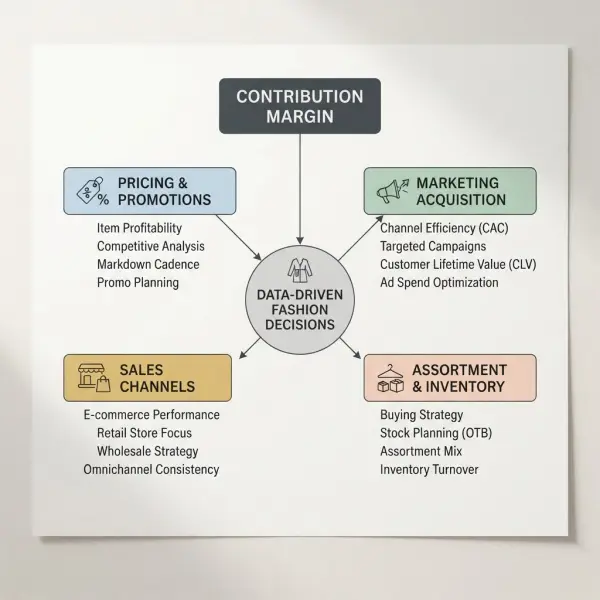
That answer can reshape pricing, promotions, customer acquisition, marketplace participation, assortment planning, inventory allocation, reorders, and growth strategy.
A discount may look attractive until the required increase in volume is calculated. A high-revenue marketing campaign may look less impressive after acquisition and fulfillment costs are included. A marketplace may appear expensive because of commission yet still generate valuable incremental contribution. A fast-selling SKU may not deserve a reorder if the next production run introduces higher costs and greater markdown risk.
The strongest fashion businesses therefore do not use contribution margin merely as a finance metric reported after the season ends. They use it before decisions are made, compare expected scenarios, and revisit the assumptions once actual sales data arrives.
Contribution margin does not replace product costing, inventory management, cash-flow planning, or full profitability analysis. Its value lies in connecting them. By showing how individual commercial decisions contribute toward fixed costs and profit, it provides a clearer economic foundation for deciding where a fashion brand should sell more, spend more, discount less, or simply walk away.





Comments 0
Leave a CommentSend Comment
Anda harus Login terlebih dahulu untuk dapat memberikan komentar.