


Storytelling Mistakes That Make Fashion Brands Feel Generic
Many fashion labels describe themselves with remarkably similar language.
They create “timeless pieces” for “modern individuals.” They believe in “confidence, authenticity, and self-expression.” Their collections combine “quality craftsmanship” with “contemporary design.” Their purpose is to “empower customers” while making a “positive impact.”
None of those ideas is inherently wrong. The problem is that they give customers almost no information that could distinguish one label from another.
A fashion brand feels generic when its story could be transferred to a competing company without materially changing the meaning. Its language may sound polished, but the customer cannot connect it to a specific product philosophy, customer tension, cultural context, operational capability, or recognizable point of view.
This usually happens because storytelling is treated as a copywriting exercise. The team begins by looking for attractive words rather than identifying what the business understands, believes, and does differently.
The result is not merely forgettable marketing. A generic story can weaken product development, campaign consistency, merchandising decisions, customer trust, wholesale presentations, and the brand’s ability to explain why its products deserve attention.

Quick Answer
Fashion brand storytelling feels generic when it relies on broad values, familiar founder narratives, copied aesthetics, and emotional claims that are not supported by distinctive products or business practices.
The most common problem is a lack of specificity. Statements such as “designed for the modern woman,” “inspired by everyday life,” or “committed to sustainability” do not explain which customer situation the brand understands, what it believes should change, or how that belief affects fabric, fit, construction, pricing, sourcing, service, and retail.
A distinctive story does not need to be dramatic. It needs to be identifiable and verifiable. Customers should be able to connect the narrative to decisions they can see or experience.
For example, a label promising wardrobe simplicity should demonstrate compatible colors, stable fit, repeatable silhouettes, and cross-season styling. A brand claiming to support craft should identify the technique, the makers’ role, and the commercial relationship accurately.
Generic storytelling is therefore not solved by more emotional copy. It is solved by stronger strategy, clearer customer relevance, more specific evidence, and consistent execution across the business.
What Makes a Fashion Brand Story Feel Generic?
A generic fashion brand story is a narrative that uses broadly appealing ideas without enough specific meaning, evidence, or distinctive expression to identify the company behind it.
The story may contain attractive values, professional photography, and technically competent writing. Yet it remains interchangeable because it does not answer several basic questions:
- Which customer tension does this label understand particularly well?
- What does it believe that comparable brands do not express as clearly?
- How does that belief change the product?
- Which capabilities or experiences give the company credibility?
- What can customers expect consistently?
- Which parts of the story are factual and verifiable?
- What would the brand refuse to do because it conflicts with its point of view?
Distinctiveness does not require every idea to be unprecedented. Few fashion companies are the first to value quality, comfort, craft, creativity, or inclusion.
What matters is the combination and interpretation of those ideas.
A brand might not be the only company producing clothing for hot climates. It can still become recognizable through its understanding of professional dress in tropical cities, its fabric criteria, pattern allowances, styling system, care recommendations, and specific customer situations.
The strategic foundation of a coherent narrative is discussed in fashion brand storytelling explained for modern labels. The present issue is narrower: why that narrative often becomes indistinguishable once it is translated into public communication.
Why So Many Fashion Stories Sound the Same
Generic storytelling is rarely caused by one poor sentence. It usually reflects several deeper business conditions.
The Brand Was Built From a Mood Board
Some labels begin with colors, typography, reference brands, campaign poses, and social-media aesthetics before defining the customer problem or product point of view.
The visual identity may be attractive, but it has no strategic center. When the team later writes the brand story, it reverse-engineers a narrative around the aesthetic.
A neutral palette becomes “timelessness.” Minimal photography becomes “intentional living.” Vintage-inspired imagery becomes “heritage.” None of these interpretations is necessarily supported by product development or company history.
A mood board can guide creative execution. It should not replace positioning.
The Category Has a Shared Vocabulary
Fashion businesses frequently operate inside recognizable category conventions.
Luxury labels discuss heritage, rarity, artistry, and permanence. Activewear brands use performance, movement, strength, and community. Sustainable labels emphasize responsibility, transparency, nature, and better choices. Streetwear may rely on culture, independence, creativity, and limited access.
Category vocabulary helps customers understand the type of brand they are encountering. The problem begins when the label stops at the category level and never adds its own interpretation.
“Designed for movement” could describe yoga leggings, commuter trousers, adaptive clothing, children’s apparel, dancewear, or technical hiking garments. The phrase becomes meaningful only when the brand explains which movement, under what conditions, and through which design decisions.
Social Platforms Reward Compressed Messages
Short videos, image captions, creator briefs, and paid advertisements often require simplified messages. Over time, the shortened version can replace the more precise strategy.
A detailed proposition about adaptable tailoring for women moving between formal and creative workplaces becomes “confidence for modern women.” A material program involving specific supplier requirements becomes “better for the planet.”
Compression is sometimes necessary. Dilution is not.
The team still needs a detailed internal narrative from which shorter messages can be derived. Without that foundation, every channel defaults to the most familiar language in the category.
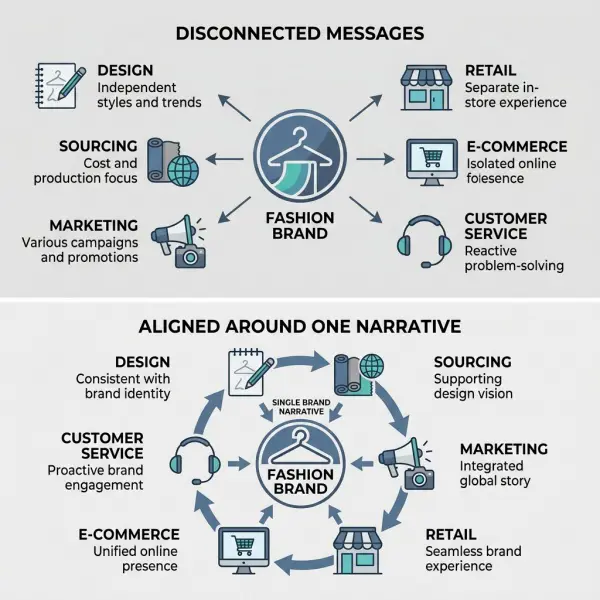
Teams Work in Isolation
Design, sourcing, marketing, retail, public relations, e-commerce, and customer service may each understand the brand differently.
The design team talks about proportion. The founder talks about personal struggle. Marketing promotes empowerment. The retail team emphasizes versatility. Wholesale buyers hear mainly about price and margin.
Each interpretation may be reasonable, but together they create an unfocused brand.
A coherent story does not require everyone to use identical sentences. It requires a shared hierarchy: one central point of view, a small number of supporting themes, and evidence appropriate to each function.
Mistake 1: Beginning With Attractive Adjectives
A common storytelling process begins by selecting desirable descriptors:
- timeless;
- authentic;
- elevated;
- inclusive;
- conscious;
- effortless;
- modern;
- bold;
- refined;
- empowering.
The team then attempts to build a story that proves the adjectives.
This reverses the more useful sequence. A brand should start with a relevant observation, point of view, or capability. Descriptive language can be chosen later.
“Effortless” is not a strategy. It might refer to easy garment care, minimal styling decisions, forgiving fit, coordinated colors, comfortable construction, simple purchasing, or a visual impression that conceals complex tailoring.
Until the company defines which interpretation it intends, the word gives product and marketing teams little direction.
Operational Consequence
Designers, copywriters, photographers, and retail staff create their own versions of the idea. The output may remain visually consistent for one campaign but become unstable across collections.
Better Approach
Replace each adjective with a concrete question.
Instead of asking, “How do we communicate effortless style?” ask:
- Which dressing decisions are we trying to simplify?
- What makes those decisions difficult now?
- Which product features reduce the difficulty?
- What must remain visually sophisticated despite that practicality?
- How will customers experience the benefit after purchase?
The answers create a story that competitors cannot reproduce merely by choosing the same adjective.
Mistake 2: Using “For the Modern Woman” as a Customer Strategy
“Modern woman,” “modern man,” and “modern consumer” are among fashion’s most flexible—and least informative—audience descriptions.
They may refer to almost any age, occupation, location, body type, income, routine, or aesthetic preference. The phrase sounds inclusive, but it avoids making a useful strategic choice.
A demographic profile alone is not enough either. “Women aged 25–40 living in major cities” still does not explain what those customers are trying to accomplish through clothing.
A stronger customer story identifies a situation or unresolved tension.
For example:
- professionals who need clothing to move between client meetings and informal studio environments;
- customers who enjoy expressive silhouettes but need them to work with flat shoes and public transport;
- people rebuilding a wardrobe after significant body changes;
- modest dressers who want coverage without excessive layering in humid conditions;
- small-business owners who need consistent uniforms in low production quantities.
These descriptions make the customer easier to imagine and the product easier to evaluate.
Business Impact
When the target customer is vague, assortment planning becomes trend-led. Marketing may generate broad reach, but the company has difficulty learning why suitable customers buy, return, or disengage.
Better Approach
Build the narrative around a customer context rather than an abstract identity. A customer can belong to several demographic segments while sharing the same practical or emotional job.
Mistake 3: Copying the Familiar Founder-Journey Formula
Many brand stories follow the same sequence:
- The founder could not find the right product.
- They became frustrated with the industry.
- They decided to create something better.
- They overcame challenges.
- The brand now invites customers to join the journey.
This structure can be accurate. It becomes generic when the specific insight disappears beneath the familiar format.
A founder’s inability to find “stylish yet comfortable clothing” says little because thousands of brands could make the same claim. The meaningful information lies in what was uncomfortable, which occasions were underserved, what existing products got wrong, and how the founder’s response influenced development.
Research on authenticity in consumption indicates that consumers interpret authenticity through particular cues that signal whether an offering feels genuine or true to its claimed source and meaning. Authenticity is therefore not produced simply by using personal language or showing behind-the-scenes images.
consumer research on authenticity cues
Operational Consequence
The founder becomes the only source of meaning. As the company grows, the story becomes difficult to scale because products, employees, customers, and services remain secondary characters.
Better Approach
Use the founder’s experience to establish credibility, then move toward a larger and more durable customer relevance.
The founder may have encountered the problem first. The customer should understand why the problem matters to them now.
Mistake 4: Treating Broad Values as Differentiation
Quality, authenticity, confidence, creativity, inclusivity, and responsibility are expectations or aspirations shared by many companies. Listing them does not constitute positioning.
Values become distinctive when they create observable priorities and trade-offs.
A brand that values fit consistency might limit unnecessary changes to core blocks even when new silhouettes become fashionable. A company prioritizing material traceability may accept a smaller fabric selection. A label committed to repairability might avoid construction methods that make common repairs unnecessarily difficult.
Trade-offs matter because they reveal what the company values when two attractive options conflict.
Without this evidence, values become decorative.
|
Generic value |
Weak expression |
More specific operational meaning |
|
Quality |
“Made to the highest standard” |
Defined construction tolerances, fabric testing, inspection criteria, and after-sales response |
|
Inclusivity |
“Designed for every body” |
A stated size range, intentional grading, fit testing, representation, and stock availability |
|
Timelessness |
“Made beyond trends” |
Repeatable silhouettes, cross-season compatibility, care support, and controlled design evolution |
|
Transparency |
“Nothing to hide” |
Specific supplier, material, production, pricing, or limitation information |
|
Craft |
“Celebrating artisans” |
Accurate attribution, maker involvement, compensation structure, and production realities |
|
Sustainability |
“Kind to the planet” |
A qualified claim tied to a particular material, process, service, or measured improvement |
The table does not imply that every company must disclose every operational detail publicly. It shows that a value needs a practical interpretation before it can support storytelling.
Mistake 5: Writing a Story the Product Cannot Prove
The most serious storytelling gap often appears between campaign language and the garment itself.
A brand claims versatility, but products work only with one highly styled look. It promises comfort, but provides no information about fit, fabric handfeel, movement, lining, or intended conditions. It promotes longevity while changing core sizing and color systems every season.
Fashion storytelling becomes credible when customers can inspect the evidence.
A narrative about functional urban clothing might be demonstrated through:
- useful pocket placement;
- ease through movement areas;
- fabric selected for the stated climate;
- styling across several realistic occasions;
- wash and care information;
- product compatibility across seasons;
- photographs that show the garment standing, sitting, and moving.
Without product evidence, the story becomes a layer placed on top of the collection rather than an explanation of why the collection exists.

Operational Consequence
Marketing must continually create new emotional language because the product itself is not carrying the narrative. Customers may remember the campaign but remain unable to explain what is distinctive about the garment.
Better Approach
For every major story claim, identify at least one visible, functional, sensory, or service-based proof.
The product does not need to prove every aspect alone. Retail, packaging, customer service, sourcing information, and after-sales support can also provide evidence. The complete experience must remain coherent.
Mistake 6: Confusing Visual Consistency With a Distinctive Story
A label can have consistent beige backgrounds, restrained typography, natural lighting, and minimalist packaging while remaining strategically interchangeable.
Visual consistency helps recognition. It does not automatically explain meaning.
The same problem occurs with more expressive aesthetics. Bright colors, unusual casting, nostalgic photography, or experimental styling can become category conventions once enough brands adopt them.
Distinctiveness requires a relationship between the visual choice and the brand’s point of view.
A documentary production image may support a story about manufacturing transparency. The same image becomes decorative when the company gives no context about the people, location, process, or reason it matters.
The World Intellectual Property Organization describes trademarks, brand names, and distinctive design elements as mechanisms that help businesses distinguish their goods and build recognition. Storytelling can give these brand assets meaning, but a narrative does not itself replace formal intellectual-property protection.
WIPO guidance on intellectual property in fashion
Better Approach
Develop recognizable brand codes at several levels:
- Product codes: silhouettes, proportions, materials, construction details, or fit principles.
- Visual codes: composition, color logic, casting, location, and styling.
- Verbal codes: vocabulary, sentence rhythm, subjects the brand discusses, and claims it avoids.
- Behavioral codes: service standards, repair practices, collaboration principles, or community conduct.
A competitor may imitate one code. It is harder to copy a coherent system without exposing the lack of operational substance.
Mistake 7: Following Every Cultural and Platform Trend
A fashion brand may move rapidly from one popular narrative to another:
- minimalism;
- radical self-expression;
- nostalgic femininity;
- quiet luxury;
- dopamine dressing;
- community;
- wellness;
- climate responsibility;
- artificial intelligence;
- local craftsmanship.
Responding to culture is part of fashion. The mistake is allowing trend language to replace the brand’s established perspective.
When a label changes its beliefs to match each campaign, customers struggle to understand what remains stable. Employees and partners face the same problem.
A corporate-brand storytelling framework published in the International Journal of Business Communication proposes managing storytelling through connected dimensions including story, meaning, ritual, and distribution across platforms. The framework reinforces the need to coordinate narrative meaning rather than treating every channel as an isolated campaign.
research framework for managing brand stories across platforms
Operational Consequence
Product development chases cultural moments that may have passed before inventory reaches the market. Existing customers encounter contradictory messages, while new customers see only fragments.
Better Approach
Distinguish between the brand’s enduring narrative and its seasonal interpretation.
An enduring story about adaptable dressing can respond to changing workplace culture without abandoning its foundation. A craft-led label can experiment with contemporary forms while maintaining accurate attribution and material expertise.
Trends should provide context or creative tension—not a replacement identity.
Mistake 8: Using Sustainability as a General Personality Trait
Sustainability language is often used as if it describes the moral character of the entire company.
A brand may call itself sustainable because one collection uses a recycled fiber, its packaging contains less plastic, or products are made in small quantities. These initiatives may be relevant, but they do not automatically establish that the complete business has a lower environmental impact.
Environmental performance depends on multiple factors, including fiber and material production, dyeing and finishing, manufacturing, transport, product use, durability, repair, inventory, and end-of-life conditions. The relative importance of those factors varies by product and supply chain.
The US Federal Trade Commission’s Green Guides state that environmental marketing claims should be truthful, substantiated, and qualified where necessary to prevent consumers from being misled. The guidance specifically warns marketers about broad, unqualified environmental benefit claims.
FTC Green Guides for environmental marketing claims
Operational Consequence
The story becomes difficult to defend. Marketing language may exceed the available supplier documentation, internal data, or actual scope of the initiative.
Overclaiming can also obscure useful progress. A specific improvement—such as replacing one material, extending a repair service, or reducing a particular packaging component—is easier to understand than an unsupported claim that the brand is “saving the planet.”
Better Approach
Replace identity-level environmental language with claim-level evidence.
State:
- what changed;
- which product or process is covered;
- compared with what baseline;
- which evidence supports the claim;
- which limitations remain;
- whether the result applies to the full range or only selected items.
Specificity makes the story more credible and more informative.
Mistake 9: Using Craft, Heritage, or Culture as Visual Decoration
Traditional textiles, historic garments, regional techniques, religious symbols, and community stories can give fashion communication depth. They can also be simplified into aesthetic material detached from the people and context that produced them.
A generic craft story often follows a predictable formula: an ancient technique is “rediscovered,” combined with modern design, and presented as being “kept alive” by the brand.
This framing can overstate the company’s role while reducing makers to background characters.
A responsible narrative should clarify:
- the name and origin of the technique;
- whether several communities practice it;
- who designed and produced the work;
- how knowledge and authorship are attributed;
- what the commercial relationship involves;
- which elements are traditional and which are newly developed;
- whether community members approved personal stories or images;
- what production limitations affect availability and consistency.
Heritage also needs careful management. Research has shown that emphasizing brand longevity can sometimes create expectations of continuity, causing consumers to respond less favorably when enhanced products appear inconsistent with the brand’s established heritage. This finding is context-dependent, but it illustrates that heritage is not automatically beneficial in every innovation story.
Better Approach
Present the brand’s role accurately. It may be a collaborator, buyer, designer, distributor, investor, archive user, or platform—not the owner or rescuer of a culture.
Mistake 10: Making the Brand the Hero and the Customer the Audience
Some stories focus almost entirely on the company’s courage, creativity, mission, and achievements.
The customer is invited to admire the journey, purchase the outcome, and “join the movement.” They have no meaningful role beyond supporting the brand.
This can create attention around a charismatic founder, but it limits emotional relevance.
The deeper mechanisms through which customers identify with a fashion narrative are examined in how strong brand stories build emotional connection with customers. The essential point is that customers need to understand how the story connects to their lives, identities, situations, or aspirations.
Better Approach
Frame the company as a useful participant:
- a specialist solving a neglected design problem;
- a guide helping customers navigate a category;
- a curator reducing unnecessary choice;
- a tool for self-expression;
- a connector providing access to a community or practice;
- a custodian supporting knowledge, craft, or an archive.
The brand can remain important without claiming to transform every customer who purchases a garment.
Mistake 11: Explaining Every Meaning Instead of Letting Customers Participate
Overwritten storytelling can be as generic as vague storytelling.
The brand repeatedly tells customers what every garment symbolizes, how every campaign should make them feel, and what purchasing the product says about their values.
This leaves little room for personal interpretation.
Fashion products acquire meaning through use. Customers combine garments with existing wardrobes, wear them in contexts the designer did not anticipate, and associate them with personal experiences.
A strong story creates a recognizable world without controlling every interpretation.
Better Approach
Communicate enough meaning to establish relevance, then let products, imagery, customer styling, and lived experience extend the narrative.
Instead of saying, “This dress empowers every woman to own her confidence,” explain the design intention and show it worn in different situations. Customers can decide what the garment means to them.
Mistake 12: Trying to Tell Too Many Stories at Once
A brand may simultaneously describe itself as:
- a craft-preservation initiative;
- a technology company;
- an inclusive community;
- a sustainable alternative;
- an affordable essentials label;
- a luxury design house;
- a founder-led personal journey;
- a platform for artistic collaboration.
Each theme may be connected to some part of the business. Together, they create competition for attention.
The problem is not complexity. Established fashion businesses often have several meaningful dimensions. The problem is a lack of hierarchy.
Customers need one clear entry point.
Better Approach
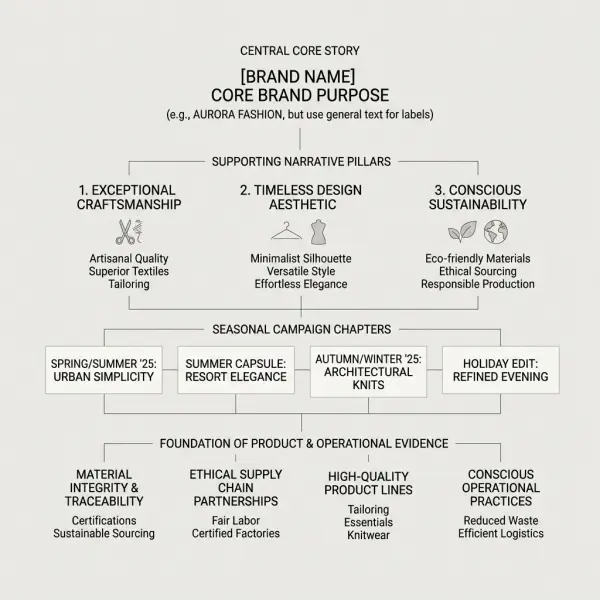
Create a narrative architecture:
- Core story: the central customer tension and brand point of view.
- Supporting pillars: two or three areas that prove or deepen the story.
- Seasonal chapters: campaign, collaboration, collection, or cultural interpretations.
- Evidence library: facts, products, people, processes, and services supporting each claim.
A technology initiative should not displace the core story unless technology is genuinely central to why customers choose the brand.
A Diagnostic Test for Generic Fashion Storytelling
Brands can use the following questions to identify whether their narrative is specific enough.
|
Diagnostic question |
Warning sign |
Stronger evidence |
|
Could a competitor use the same statement? |
The wording still makes sense after changing the brand name |
The statement contains a specific customer tension, capability, or decision |
|
Does the story affect product development? |
Designers can ignore it without changing the collection |
It influences fit, material, construction, category, or assortment rules |
|
Can customers see the proof? |
Evidence exists only in campaign copy |
Products, service, sourcing, retail, or policies demonstrate the idea |
|
Does the target customer recognize a situation? |
The audience is defined only by age, gender, or lifestyle adjectives |
The story names a real context, trade-off, or unmet need |
|
Are values translated into behavior? |
Values appear only on the About page |
Teams can explain the operational standards each value creates |
|
Are claims verifiable? |
Marketing cannot locate documents or responsible owners |
Evidence, scope, methodology, and limitations are recorded |
|
Can the story survive a new visual style? |
Meaning disappears when campaign aesthetics change |
The point of view remains clear across creative interpretations |
|
Is there a narrative hierarchy? |
Every initiative competes to become the main story |
One core narrative organizes supporting themes |
|
Can employees explain it naturally? |
Teams memorize a slogan but interpret it differently |
Different functions express the same strategic meaning in relevant language |
|
Does the customer have a role? |
The founder and company receive all attention |
Customers can connect the narrative to their own use or identity |
A brand does not need perfect answers to every question. The test helps reveal whether the weakness lies in language, evidence, internal alignment, or the underlying business strategy.
How to Repair a Generic Fashion Brand Story
Adding more expressive vocabulary will not solve the problem. The repair process should begin with evidence and decisions.
Step 1: Remove the Brand Name
Take the main website story, campaign statement, and product description. Replace the brand name with the name of a close competitor.
If the copy still fits, mark every interchangeable sentence.
This simple exercise exposes category language that the team may have mistaken for positioning.
Step 2: Circle Every Abstract Claim
Highlight words such as quality, timeless, conscious, empowering, authentic, innovative, inclusive, premium, responsible, and community.
For each one, ask:
- What exactly does this mean here?
- Which decision does it influence?
- What evidence can customers inspect?
- What limitation should be disclosed?
- Would every department define it the same way?
Remove claims that cannot be made specific.
Step 3: Return to the Customer Tension
Interview suitable customers, review support questions, examine returns, study fit feedback, and speak with retail teams.
Look for repeated situations rather than compliments.
“The fabric is beautiful” may be useful product feedback. “I can wear this to a client meeting and still feel like myself” reveals a potentially stronger narrative territory.
Step 4: Audit Product and Operational Evidence
Document what the business already does that is difficult to see from the outside:
- pattern development;
- fit testing;
- fabric criteria;
- supplier capability;
- quality-control methods;
- production quantities;
- repair or alteration support;
- merchandising systems;
- customer education;
- regional knowledge;
- accessibility features;
- unusual service practices.
The most distinctive story may already exist inside operations.
Step 5: Choose a Point of View
A point of view states what the brand believes should be different.
It should create a practical consequence.
Examples include:
- occasionwear should be designed for repeated use rather than one event;
- extended sizing should be integrated into the same collection and visual world;
- professional clothing for tropical cities should begin with climate rather than adapt cold-weather tailoring;
- traditional techniques should be presented with named authorship and contemporary commercial relevance;
- wardrobe essentials should remain compatible across several seasons.
A point of view is stronger than a slogan because it can guide action.
Step 6: Build the Narrative Around Proof
Use a simple internal structure:
Customer situation → unresolved tension → brand belief → product response → operational evidence → customer role.
This sequence keeps the story connected to commercial reality.
Step 7: Define Recognizable Brand Codes
Select a manageable set of product, visual, verbal, and behavioral codes.
Codes should reinforce the story without forcing every collection to look identical.
For example, a modular-wardrobe label may retain:
- recurring core colors;
- a stable trouser block;
- styling that combines seasons;
- product names based on function;
- photography showing repeated wear;
- restock communication;
- repair or replacement support.
Step 8: Establish Claim Governance
Assign owners to factual claims.
Sourcing should verify supplier and material information. Product teams should approve construction and performance statements. Legal or qualified advisers should review regulated or high-risk claims. Marketing should document wording, scope, sources, and expiration or review dates.
This is particularly important for sustainability, heritage, health, performance, labor, certification, and geographic-origin claims.
Step 9: Test Memory, Not Just Preference
Do not ask only whether customers like the new story.
Ask them later:
- What does this brand believe?
- Who is it designed for?
- Which product detail represents it?
- What makes it different?
- Which statement do you trust least?
- What would you expect it to launch next?
A distinctive narrative should improve accurate memory, not merely produce a favorable immediate reaction.





Comments 0
Leave a CommentSend Comment
Anda harus Login terlebih dahulu untuk dapat memberikan komentar.