

Garment Closures Explained: Buttons, Zippers, Hooks, and Snaps
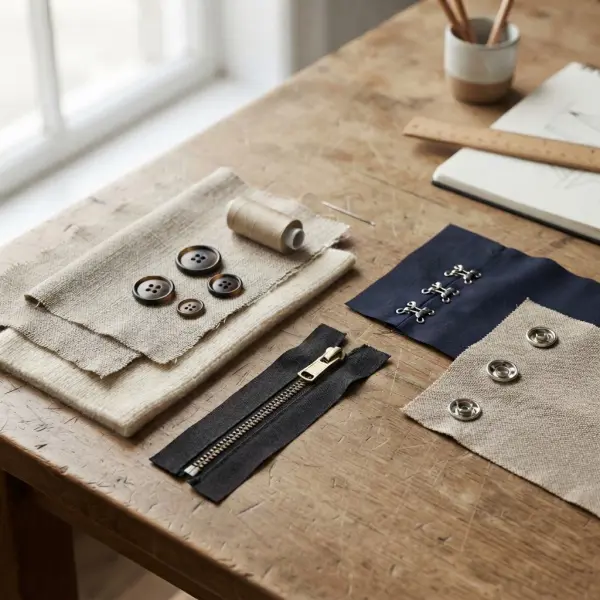
Garment closures are components that hold two sections of a garment together while allowing the wearer to open, close, or adjust the garment when needed. Buttons, zippers, hooks, and snaps perform the same broad function, but they differ considerably in appearance, operating method, installation, strength, bulk, and suitability for different fabrics.
A closure may look like a small trim decision. In practice, it affects how easily someone can dress, how cleanly a garment sits on the body, how the opening is constructed, and how the product should be manufactured and maintained.
A concealed zipper supports a different silhouette from a row of shirt buttons. A trouser hook creates less visible bulk than a waistband button. A snap can make a jacket faster to open, but its attachment requires the right combination of hardware, fabric reinforcement, and setting pressure.
Understanding these differences helps designers, product developers, sourcing teams, and manufacturers select components that make sense for the garment—not merely for the design sketch.
Quick Answer
The four common garment closure systems are buttons, zippers, hooks, and snaps. Buttons pass through buttonholes or loops and can function as both practical fasteners and visible design elements. Zippers connect two tapes through interlocking elements operated by a slider, making them suitable for openings that need continuous and relatively secure closure. Hooks engage with eyes, bars, or loops and are commonly used where a discreet, low-profile fastening is required. Snaps consist of interlocking male and female components that close under pressure and release when pulled apart.
No closure is universally better. Selection depends on the garment opening, fabric weight, stress at the fastening point, required appearance, wearer dexterity, care process, production capability, and target cost. The closure must also be evaluated as part of the complete construction. Even strong hardware can fail when it is attached to an unstable fabric or placed on an opening that has not been properly reinforced.
What Is a Garment Closure?
A garment closure is a functional component or construction system used to secure an opening so that a garment can be put on, removed, adjusted, or held in its intended position. Depending on the design, the closure may be fully visible, partly concealed, or hidden inside the garment.
The term covers both the fastener and the construction around it. A button is not a complete closure without a compatible buttonhole or loop. A zipper depends on its tapes, elements, slider, stops, and—in separating styles—a retainer box and insertion pin. A hook requires an eye, bar, or fabric loop. A snap uses mating components that must align correctly.
Closures usually appear at functional access points such as:
- Center-front or center-back openings
- Side seams
- Waistbands and trouser flies
- Cuffs, collars, and neck openings
- Jacket plackets
- Pocket openings
- Lingerie and foundation garments
- Convertible or adjustable garment sections
The same garment may use several systems. Tailored trousers, for example, may combine a zipper fly, an internal button, and a hook-and-bar waistband closure. Each component handles a slightly different part of the opening.
The Main Differences at a Glance
The practical distinction is not simply that one closure is decorative and another is functional. Each system manages the opening in a different way.
|
Closure |
How it works |
Common applications |
Typical visual effect |
Key construction requirement |
|
Button |
Passes through a buttonhole or loop |
Shirts, blouses, coats, cuffs, waistbands |
Visible or intentionally decorative |
Accurate spacing, compatible buttonhole, secure attachment |
|
Zipper |
Slider joins or separates two rows of elements |
Trousers, dresses, skirts, jackets, activewear |
Exposed, lapped, centered, or concealed |
Stable opening, suitable zipper type and length |
|
Hook |
Hook engages with an eye, bar, or loop |
Waistbands, dresses, lingerie, concealed openings |
Discreet and low profile |
Precise alignment and reinforced attachment |
|
Snap |
Male and female parts interlock under pressure |
Jackets, shirts, childrenswear, workwear |
Visible hardware or concealed fastening |
Correct component set, reinforcement, and setting method |
These categories overlap. A jacket could technically use buttons, snaps, or a zipper, but the resulting product would not behave or look the same. The choice changes the opening construction, the dressing experience, and often the machinery or operations required on the production line.
Buttons: Traditional Closures With Structural and Visual Roles
Buttons are fastening components designed to pass through a buttonhole, fabric loop, or cord loop. They are among the most visually expressive closures because their size, material, color, shape, and attachment can contribute directly to the garment’s identity.
A button closure is intermittent rather than continuous. Each button secures one point along the opening, while the placket or overlapping fabric between buttons helps keep the garment closed. This makes button spacing important. Excessive distance between buttons can allow the opening to gape, particularly across the bust, abdomen, or another area under tension.

Sew-Through Buttons
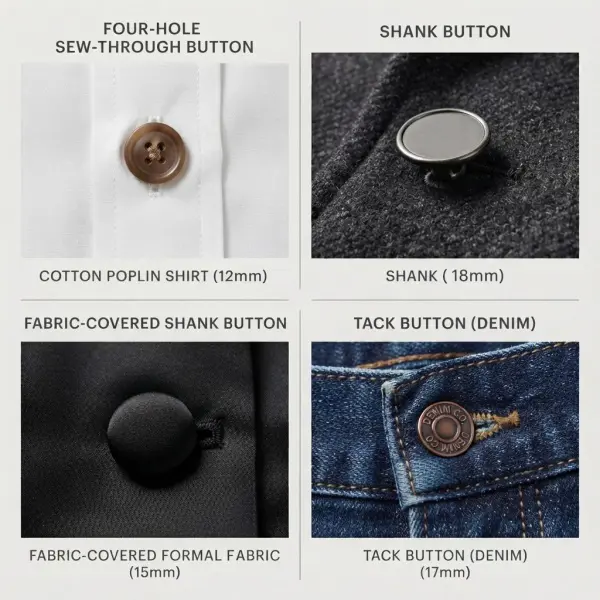
Sew-through buttons contain two or more holes through which thread passes. Two-hole and four-hole versions are common, although decorative arrangements vary.
The thread may be stitched in parallel lines, a cross pattern, or another formation appropriate to the holes and desired appearance. Some garments need a thread shank—a small stem formed from thread beneath the button—to provide space for the buttonhole layer. Thicker fabrics generally need more clearance beneath the button than thin shirt fabrics.
Sew-through buttons are frequently used on:
- Shirts and blouses
- Casual dresses
- Cardigans
- Cuffs
- Lightweight jackets
- Internal garment positions
Their apparent simplicity can be deceptive. Button diameter, hole size, thread type, stitch count, buttonhole dimensions, and attachment security must work together.
Shank Buttons
A shank button has a loop or protruding stem on its underside rather than visible holes through the face. The shank provides space between the button and garment, allowing thicker fabric or a substantial buttonhole edge to sit beneath it.
Shank buttons are common on coats, jackets, uniforms, and decorative garments. Because the attachment point is concentrated at the back, the shank and sewing thread must tolerate the forces created during fastening and wear.
Covered buttons are often built around a shank-style base. Their outer surface may be wrapped in the garment fabric, creating a coordinated formal or couture-inspired appearance.
Tack Buttons
Tack buttons, widely associated with denim waistbands, are mechanically attached rather than sewn on with conventional thread. A button component and tack are pressed together through the fabric.
This construction can provide a firm attachment on suitable materials, but it requires compatible components, appropriate setting equipment, and sufficient fabric support. It should not automatically be applied to a lightweight or unstable fabric simply because the finished appearance is desirable.
Button Materials and Finishes
Buttons may be made from polyester, nylon, urea resin, metal, wood, shell, horn, corozo, coconut shell, or other natural and manufactured materials. Material names alone do not establish quality or suitability. A component must be assessed for the intended care process, color stability, impact resistance, dimensional consistency, finish, and compatibility with the garment.
A decorative metallic finish, for instance, may change after repeated laundering or dry cleaning. A natural button may show variation that suits an artisanal product but conflicts with a buyer expecting close color and surface consistency.
For childrenswear sold in the United States, accessible metal and plastic components can be subject to product-specific chemical requirements. The US Consumer Product Safety Commission identifies buttons, snaps, and zippers among the components that may need compliance assessment for children’s wearing apparel. See the CPSC guidance for clothing businesses for the applicable context. Requirements vary by product and market, so suppliers should not assume one trim specification is compliant everywhere.
Zippers: Continuous Closure Along an Opening
A zipper is a fastening system in which a slider engages or separates two rows of elements attached to textile tapes. Unlike buttons or hooks, a zipper closes the opening continuously along most of its installed length.
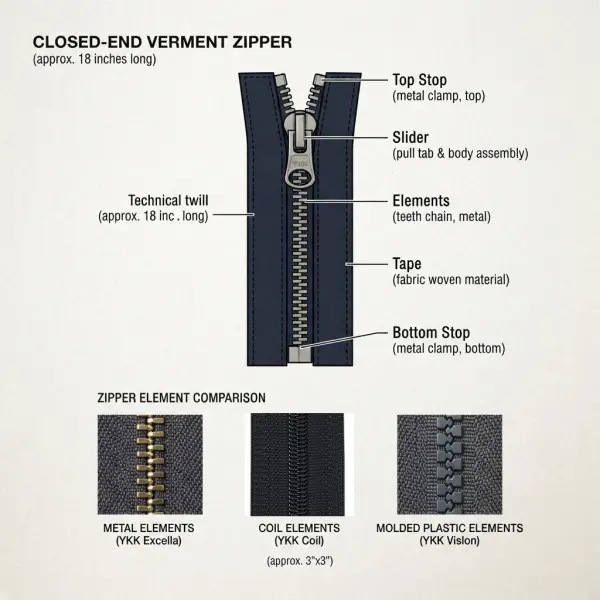
The system includes more than the visible teeth. Typical zipper parts include:
- Two textile tapes
- Interlocking elements, sometimes informally called teeth
- A slider and pull tab
- Top and bottom stops
- A retainer box and insertion pin on many separating zippers
Zipper terminology matters during sourcing. “Metal,” “coil,” and “molded plastic” describe element constructions, while “closed-end,” “open-end,” and “two-way” describe how the completed zipper operates. An order that specifies only color and length leaves several essential decisions unresolved.
Metal Zippers
Metal zippers have individual metal elements fixed to the tapes. Common substrate and finish choices include brass-toned, nickel-toned, aluminum, and deliberately aged or darkened appearances.
They are closely associated with denim, leather garments, workwear, and outerwear, although suitability depends on zipper size, garment construction, care method, and desired weight. YKK describes metal zippers as the traditional element type and offers them in multiple metal substrates, as shown in its standard metal zipper documentation.
Metal hardware can reinforce a rugged or premium visual language, but it also adds weight and may feel too rigid for delicate fabric. Finish performance and potential interaction with laundering, moisture, or chemicals should be evaluated for the intended product.
Coil Zippers
A coil zipper uses a continuous spiral element, commonly made from synthetic polymer, attached to each tape. Coil constructions are flexible and are used across dresses, trousers, bags, sportswear, and other product categories.
Standard coil zippers may be installed visibly or under a flap. Invisible zippers are a specialized coil construction designed so that the elements roll toward the back of the tape, leaving little more than the seam line and pull visible when correctly installed.
The term “nylon zipper” is sometimes used broadly in trading conversations, but it is better to confirm the actual material and construction. YKK notes that standard coil elements may be made from plastics such as polyester or nylon in its technical overview of coil zippers.
Molded Plastic Zippers
Molded plastic zippers have individual polymer elements molded onto the tapes. Their teeth are more visibly defined than a coil, creating a bolder appearance often used in casual jackets, childrenswear, bags, and outdoor-inspired garments.
The elements can be produced in different colors, making this category useful when the zipper should coordinate with or contrast against the garment. Molded plastic does not mean weak by definition. Performance depends on element size, polymer, attachment, zipper design, supplier quality, and application.
Closed-End, Separating, and Two-Way Zippers
A closed-end zipper remains joined at the bottom when opened. It is commonly used in trouser flies, skirts, dresses, pockets, and other openings that do not need to separate completely.
A separating or open-end zipper disconnects into two halves, allowing a jacket or similar product to open fully. The wearer inserts a pin into the retainer box before moving the slider.
A two-way zipper uses two sliders. Depending on its configuration, it may open from both ends or separate in a specific direction. It can be useful on long coats, luggage, uniforms, and functional garments where access or movement needs to be managed at more than one point.
The correct category must be established before sampling because these constructions are not interchangeable at the sewing stage.
Hooks and Eyes: Small Closures for Controlled, Discreet Fastening
A hook closure uses a curved or shaped component that catches an eye, bar, or loop. It secures a concentrated point rather than the full length of an opening.
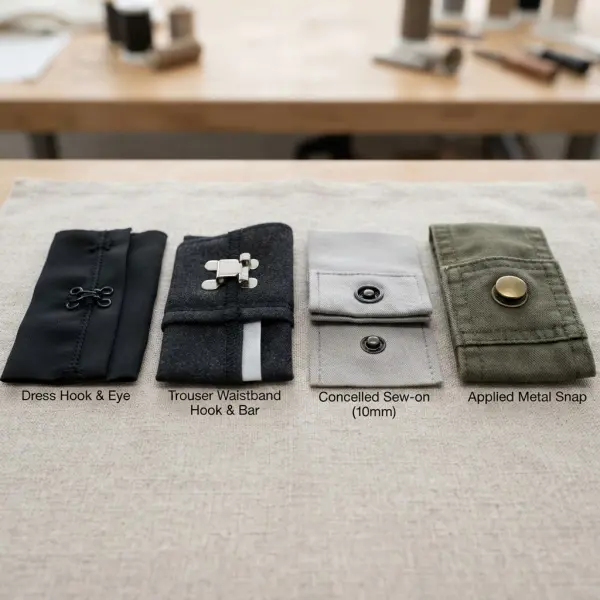
Hooks are useful when a low-profile fastening is needed or when another closure requires support. The small hook above a dress zipper, for example, can bring the top edges together and reduce strain while the zipper is being operated. On trousers, a hook-and-bar system can close the waistband without the visible bulk of a prominent button.
Sew-On Hook and Eye
Traditional hooks and eyes are separate metal components sewn to the garment. The receiving side may be a rounded eye, straight eye, or thread loop, depending on the required overlap and appearance.
They are found on dresses, skirts, lingerie, costumes, and formal garments. Installation requires careful alignment. Even a small mismatch can twist the opening or make the closure difficult to engage.
Trouser Hook and Bar
Trouser hooks and bars are generally flatter and more substantial than delicate dress hooks. They may be sewn on or mechanically attached, depending on the design.
A waistband can use an extended tab with a hook-and-bar closure to create a smooth front. Some trousers combine this with an internal button, distributing the fastening function across more than one component.
Hook-and-Eye Tape
Hook-and-eye tape contains repeated rows of hooks and eyes mounted on textile tapes. It is commonly associated with bras, corsetry, shapewear, and adjustable foundation garments.
This format allows several adjustment positions. The tape must be selected for the garment’s width, required extension, expected load, skin contact, color, and care method. It should also lie comfortably against the body without hard edges or poorly finished ends.
Snaps: Pressure-Activated Fasteners for Quick Opening
A snap fastener consists of mating components that lock together when pressed and separate when pulled apart. Snaps are also called press studs, press fasteners, poppers, or snap buttons, although terminology varies between markets and suppliers.
Most applied snaps use multiple pieces: a cap or post on one side and a socket or stud arrangement on the other. Sew-on snaps usually contain two main discs, each stitched directly to the garment.
Sew-On Snaps
Sew-on snaps have holes around their edges for thread attachment. They can be hidden inside a placket, facing, or overlapping garment section, making them useful when the fastening should not dominate the exterior.
Because they are individually sewn, they may suit sampling, alteration, or low-volume production. They are less efficient for some high-volume applications than machine-applied systems and can become visible through very fine fabrics if the snap is too heavy or bulky.
Ring-Spring and S-Spring Snaps
Applied metal snaps can use different internal spring mechanisms. A ring-spring system generally provides firmer holding force and is often considered for heavier garments, while an S-spring construction can suit lighter or medium-weight applications. YKK’s product documentation distinguishes an S-spring snap for medium-to-thin garments from its stronger ring-spring snap for heavier garments.
These supplier descriptions are useful starting points, not substitutes for testing. Holding strength also depends on snap size, fabric layers, reinforcement, setting accuracy, and the direction and frequency of the applied force.
Prong Snaps
Prong snaps have projecting legs or teeth that penetrate the material and are set into a mating component. Certain systems can be attached without pre-punching, but this depends on the product design and supplier’s instructions.
Prongs must engage properly and remain contained. Incorrect die selection, poor alignment, inadequate pressure, or unsuitable fabric thickness can leave the component loose or damage the material.
What Do These Closures Have in Common?
Buttons, zippers, hooks, and snaps all depend on the relationship between hardware, fabric, pattern, and assembly. The fastener cannot be evaluated in isolation.
Three shared principles matter:
- The closure must support the forces placed on the opening.
- The surrounding fabric must remain stable during fastening and release.
- The wearer must be able to operate the closure in the expected context.
A snap that holds firmly in a supplier sample may tear out of an unreinforced lightweight fabric. A properly manufactured zipper can still appear wavy if its tape and the garment opening respond differently during sewing or laundering. A button may remain securely attached while its oversized buttonhole allows it to slip open.
The deeper effects of these choices on movement, fit, product life, and end use are examined separately in how closure choice affects garment function, fit, and durability.
How Fashion Businesses Can Specify Closures More Clearly
A useful closure specification should identify more than the generic component name. The technical package and bill of materials should give the factory enough information to source, sample, install, and inspect the intended system.
For buttons, the specification may include type, diameter, thickness, number of holes, material, color, finish, logo orientation, attachment method, thread color, stitch requirements, and placement.
For zippers, relevant details often include:
- Element construction and size
- Closed-end, separating, or two-way operation
- Finished length and measurement method
- Tape and element color
- Slider type, puller, and finish
- Locking or non-locking slider requirement
- Top and bottom component configuration
- Installation style, such as concealed, centered, lapped, or exposed
- Intended care process and end use
Hook and snap specifications should identify the complete mating set. They may also need component size, base metal, finish, attachment style, setting die, placement, fabric thickness range, reinforcement, and required opening force.
Approved physical samples are valuable because color names and finish descriptions are not always interpreted consistently across suppliers. A reference sample, approved trim card, and supplier code reduce the chance that a production substitute will merely look similar while behaving differently.

Important Technical Caveats
Closure terminology and performance categories are not perfectly standardized across every supplier and region. Terms such as snap, press stud, popper, invisible zipper, reverse coil, and two-way zipper should therefore be supported by a supplier code, drawing, photograph, or approved physical sample.
Performance also cannot be inferred reliably from appearance. Testing may cover several distinct properties rather than produce one universal “strength” result. ASTM, for example, lists separate methods addressing zipper strength and operability, snap resistance to unsnapping, snap attachment, button attachment, button impact resistance, and performance after care processes in its textile fastener standards catalogue.
Which tests are necessary depends on the product, buyer specification, market, garment category, risk level, and applicable regulation. A standard used for denim work trousers may not answer every question about a delicate dress, infant garment, or protective uniform.
Common Misconceptions About Garment Closures
“A Stronger Closure Is Always Better”
A very high opening force can make a snap difficult to operate and place greater stress on the fabric each time it is opened. Similarly, a heavy zipper may overwhelm a lightweight garment. The suitable closure balances security, usability, fabric support, and intended wear.
“The Same Closure Can Be Moved to Any Fabric”
A closure approved on denim cannot automatically be transferred to lightweight viscose, stretch jersey, coated fabric, or leather. Thickness, extensibility, fraying, recovery, surface finish, and reinforcement all influence attachment.
“Decorative Components Do Not Need Functional Evaluation”
If a decorative button, tab, or snap can be pulled, caught, washed, or handled, its attachment and material performance still matter. This becomes especially sensitive in products for young children or garments exposed to industrial care.
“Matching the Color Is Enough”
Two visually similar components may differ in substrate, coating, dimensions, attachment design, or care resistance. Substituting one for another without approval can alter both appearance and performance.
Detailed faults such as zipper puckering, broken buttonholes, loose snaps, and misaligned hooks belong to the construction stage. They are covered more fully in common closure construction problems and how to prevent them.
A Practical Selection Framework
At the initial design stage, teams can narrow the options by asking a short sequence of questions:
- Where is the opening, and how far must it open?
- Does the garment need a continuous closure or fastening at selected points?
- Should the closure be visible, concealed, or part of the styling?
- What fabric layers and reinforcement will sit beneath it?
- What forces will it experience during dressing and wear?
- Can the intended wearer operate it comfortably?
- Is the factory equipped to install it consistently?
- Will it tolerate the specified washing, drying, ironing, or dry-cleaning process?
- Are there market-specific chemical, mechanical, or product safety requirements?
- Can replacement components be sourced consistently for production and after-sales repair?
This framework does not select the closure automatically. It exposes conflicts early. A designer may want a concealed fastening, while the target wearer needs a large, easy-to-grip pull. A low-cost snap may appear suitable until the factory identifies a new setting operation, reinforcement layer, and testing requirement.
Closure decisions are most efficient when they are resolved during product development, not after the sample opening and seam allowances have already been finalized.
Frequently Asked Questions
What is the simplest difference between buttons, zippers, hooks, and snaps?
Buttons pass through buttonholes or loops, zippers join two continuous rows of elements, hooks catch onto an eye or bar, and snaps lock two mating components together under pressure. Buttons and snaps usually secure separate points, while a zipper closes most of the opening continuously. Hooks are often selected for discreet fastening or as support for another closure. The best option depends on the opening design, fabric, force, appearance, wearer, production method, and care conditions.
What is the difference between a snap and a button?
A button normally passes through a buttonhole or fabric loop, while a snap closes by pressing together male and female components. Buttons can allow more tolerance in the opening and are often visually prominent. Snaps open quickly and do not need a traditional buttonhole, but applied snaps require compatible parts, setting equipment, and supported fabric. One is not automatically more durable. Performance depends on component quality, attachment, material, frequency of use, and the direction in which the wearer opens it.
What is the difference between a coil zipper and a molded plastic zipper?
A coil zipper uses continuous spiral elements attached to its tapes, giving it a relatively flexible construction. A molded plastic zipper has separate polymer elements molded directly onto the tapes, creating more visibly defined teeth. Coil zippers are widely used in dresses, trousers, pockets, and bags, while molded plastic zippers are common in casual outerwear and products where a bolder element appearance is appropriate. Selection should consider zipper size, flexibility, garment weight, installation style, supplier specification, and testing—not appearance alone.
Why do some garments use both a zipper and a hook?
The two fasteners can perform complementary jobs. A hook at the top of a dress or skirt may align the opening and reduce tension while the zipper is being moved. Tailored trousers may use a zipper for the fly and a hook-and-bar system for the waistband. This arrangement can distribute forces and create a cleaner exterior. It only works when all components are positioned accurately; a misaligned hook can pull the waistband out of shape or make the zipper harder to operate.
Are invisible zippers suitable for every dress?
No. An invisible zipper can create a discreet seam-like finish, but suitability depends on fabric stability, seam position, garment tension, zipper size, sewing accuracy, and care requirements. Very heavy fabric may overwhelm a fine zipper, while delicate or unstable material may need reinforcement and careful handling. An invisible zipper should not be expected to correct a poorly fitted opening. The zipper, seam allowance, interfacing, and pattern must work as one construction.
Can a factory substitute a similar closure during production?
Only after the replacement has been reviewed and approved. A visually similar zipper, button, hook, or snap may use different materials, dimensions, finishes, or attachment systems. The substitute can change opening force, care performance, appearance, machine settings, or regulatory documentation. The safest process is to compare supplier specifications, test the component on the actual garment material, update the bill of materials, and retain an approved reference sample before bulk installation.
What should be checked when closures are used on childrenswear?
Teams should verify attachment security, sharp edges, accessible component materials, coating composition, intended age group, garment use, and the requirements of every sales market. Small hardware deserves particular attention even where a specific small-parts rule contains exemptions or distinctions for functional apparel components. Chemical limits and certification requirements can also differ by jurisdiction. Product developers should work from current regulations and buyer protocols rather than relying solely on a trim supplier’s general compliance statement.
Conclusion
Buttons, zippers, hooks, and snaps all close garments, but they do so through different mechanical and construction principles. Buttons work with buttonholes or loops, zippers create a continuous joined opening, hooks provide concentrated and often discreet fastening, and snaps connect mating components through pressure.
The practical lesson is straightforward: specify the complete closure system, not just the visible trim. Its materials, dimensions, counterpart, attachment method, reinforcement, position, care compatibility, and compliance requirements must be considered together.
When that work is done early, the closure supports the garment’s design instead of becoming a late production compromise. When it is overlooked, one of the smallest components in the product can create disproportionately large problems in sampling, manufacturing, wear, or customer use.




Comments 0
Leave a CommentSend Comment
Anda harus Login terlebih dahulu untuk dapat memberikan komentar.