

How Fashion Brands Reduce Returns Without Hurting Customer Experience
Quick Answer
Fashion brands can reduce returns without hurting customer experience by preventing avoidable mismatches before purchase and correcting operational failures after they appear in return data. The strongest levers are more consistent fit, accurate garment measurements, realistic product visuals, specific fabric and fit descriptions, dependable quality, correct fulfillment, and product-level analysis of return reasons.
The goal is not the lowest possible return rate. Customers still need a fair resolution when an item does not fit, arrives damaged, differs materially from its description, or is sent incorrectly. A falling rate may be misleading if it results from hidden fees, confusing exclusions, slow refunds, or customers abandoning the purchase because they lack confidence.
Brands should instead target avoidable returns while protecting conversion, trust, and statutory rights. That requires diagnosing the cause by SKU, size, supplier, batch, channel, and customer cohort; selecting an intervention that matches the evidence; and measuring contribution margin, exchanges, customer contacts, repeat purchase, and merchandise recovery alongside return rate. Prevention works best as a product and operations discipline, not as a stricter policy campaign.

What Does “Reducing Fashion Returns” Actually Mean?
Reducing fashion returns means lowering the number and cost of preventable product returns by improving product suitability, information, quality, and execution—without blocking legitimate customer remedies. It is different from merely making returns harder.
That distinction protects both analysis and customer experience. If a brand adds a high return fee, its recorded return rate may fall because customers keep unsuitable items, sell them elsewhere, complain publicly, dispute the transaction, or stop purchasing. The dashboard looks better, but the underlying product mismatch remains. By contrast, correcting an inaccurate size chart can reduce returns because more customers receive the size they expected.
The working objective should be:
Reduce avoidable returns while maintaining fair resolution, customer confidence, and positive contribution margin.
“Avoidable” does not mean every return can be prevented. Bodies, preferences, styling needs, gifting, and online perception vary. Even excellent product information cannot guarantee that a silhouette will feel right to every customer. The task is to remove failures the brand can reasonably control.
Why Do Customers Return Fashion Products?
Online fashion returns rarely have one cause. The European Environment Agency reports that recent studies estimate around 20% of online clothing and 30% of online footwear purchases in Europe are returned, with about 70% of those returns attributed to poor fit or style. These estimates have methodological and geographic limits, but they show why product suitability deserves attention. European Environment Agency briefing on returned and unsold textiles
Fit and style are broad labels, not root causes. “Too small” may come from an unsuitable size choice, an inaccurate chart, inconsistent grading, shrinkage, a tight design feature, production outside tolerance, or a customer preference for more ease. “Did not suit me” may reflect silhouette, length, color, opacity, fabric weight, or the difference between a styled photograph and everyday wear.
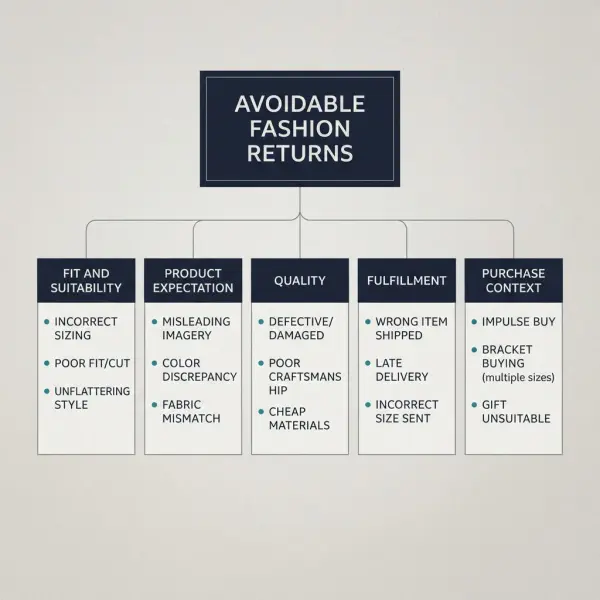
A useful diagnosis separates five return families:
|
Return family |
Typical customer signal |
Possible business cause |
Primary owner |
|
Fit and suitability |
Too small, too large, wrong length, poor shape |
Size architecture, grading, measurements, fit communication, or customer selection |
Product, technical design, merchandising |
|
Expectation mismatch |
Color, fabric, drape, opacity, or detail differed |
Photography, copy, display variation, sample inconsistency, or omitted information |
Content, product, e-commerce |
|
Product quality |
Damage, seam failure, hardware problem, finish issue |
Materials, construction, production variance, packing, or transit |
Quality, sourcing, supplier, logistics |
|
Fulfillment and delivery |
Wrong item, missing part, duplicate, late arrival |
Picking, labeling, inventory, carrier, or order-system error |
Warehouse, operations, technology |
|
Preference and context |
Changed mind, occasion cancelled, ordered several options |
Ordinary uncertainty, promotion behavior, bracketing, or customer circumstances |
Commercial, marketing, policy |
The categories overlap. A customer may call a dress “poor quality” because the fabric is lighter than expected even though it meets the approved specification. That still indicates an expectation problem worth correcting. Customer language and inspection findings should be retained separately rather than forcing one to replace the other.
Diagnose the Problem Before Choosing a Solution
A brand cannot reduce what it has not defined. Begin by separating returns, exchanges, cancellations, undeliverable parcels, warranty claims, and fulfillment errors. Then calculate unit, value, and order return rates using stable denominators and mature sales cohorts. The companion article on fashion returns management for online apparel brands explains the operational data structure in detail.
Return reasons should be reviewed at variant level. An overall dress return rate may appear normal while one color is returned for sheerness and one size for a tight armhole. Useful cuts include SKU, size, color, supplier, production batch, channel, country, campaign, promotion, and first-time versus repeat customer.
Quantitative patterns need qualitative evidence. Review customer comments, support conversations, photographs, product reviews, and a sample of physical returns. Compare the claimed reason with garment measurements and inspection. A spike of “too small” does not prove the pattern should be enlarged; it may reveal that the wrong chart was published or the customer received the wrong labeled size.
Before acting, ask four questions:
- Is the problem concentrated or broad?
- Does the evidence point to product, information, quality, fulfillment, or customer selection?
- Can the proposed change solve that cause without creating a new fit or experience problem?
- Which metric should move if the diagnosis is correct?
This discipline prevents expensive but irrelevant interventions, such as buying a size-recommendation tool when the actual issue is inconsistent factory measurements.

Improve Fit Consistency Before Adding More Guidance
Fit guidance cannot compensate for a product that varies unpredictably. The foundation is a controlled fit system: defined target customer, fit blocks, grade rules, points of measurement, tolerances, sample approval, and production verification.
Review the size architecture
Size labels are not measurements. “M” can represent different body and garment dimensions across brands, categories, fits, and markets. A brand should define who each size is intended to fit, how ease changes by silhouette, and how measurements progress between sizes. It should also check whether the range forces materially different bodies into too few options.
Expanding the size range can improve access, but adding labels without validating blocks, grading, proportions, and production capability may create more inconsistency. New sizes should be developed and tested as products, not extrapolated mechanically from the middle of the range.
Use garment measurements and fit sessions together
Body measurements help a customer select a size; finished-garment measurements explain the actual item. The relationship between the two includes intended ease, stretch, construction, and silhouette. A fitted woven blazer, oversized sweatshirt, compression legging, and bias-cut dress cannot use the same decision rule.
Fit sessions should test movement as well as a static pose. Sitting, walking, reaching, bending, fastening, and layering can reveal restriction, gaping, riding, or balance problems. Wear trials may be useful for selected products where recovery, slippage, shrinkage, comfort over time, or component performance matters.

Control production against the approved fit
A correct development sample does not guarantee consistent bulk production. Fabric relaxation, cutting, fusing, sewing, washing, finishing, and measurement technique can alter dimensions. Brands should identify critical points of measurement, set realistic tolerances, standardize the measurement method, and review production evidence by size and batch.
Tolerance is not an excuse for cumulative distortion. Several measurements can sit individually within tolerance while their combination changes the way a garment fits. Technical and quality teams should investigate patterns in returns alongside measurement reports instead of treating each data set separately.
Make Product Information More Decision-Useful
Product content reduces returns when it helps the right customer choose the right product. More content is not automatically better. A long generic description can bury the few facts that determine suitability.
Baymard Institute's apparel usability research reported that only 17% of benchmarked desktop sites and 13% of mobile sites provided sufficient sizing information at the time of its 2022 publication. The percentages may change as sites evolve, but the underlying usability point remains relevant: shoppers need conventional sizes, measurements, fit context, and accessible guidance near size selection. Baymard apparel sizing research
Publish product-specific fit information
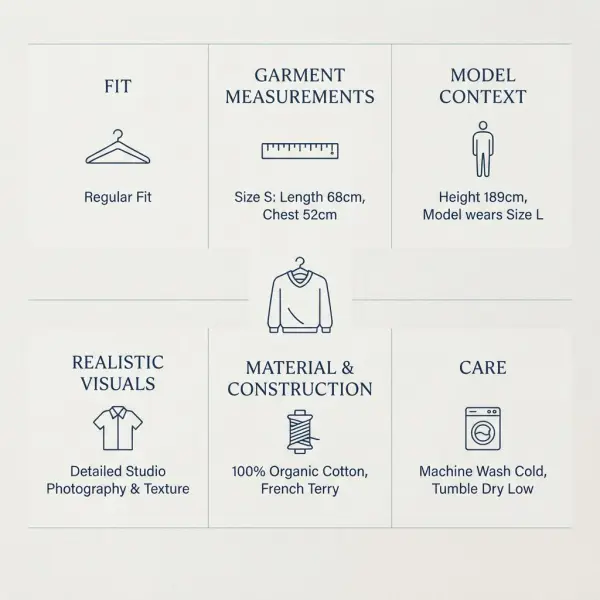
A useful product page can include:
- a size chart appropriate to the product or fit block, not only a generic brand chart;
- finished-garment measurements for decision-critical dimensions;
- instructions showing how and where measurements are taken;
- model measurements, size worn, and relevant fit observation;
- a clear fit note such as close, regular, relaxed, oversized, cropped, high-rise, or low-stretch;
- stretch, recovery, lining, structure, and intended layering information;
- a note when the style differs materially from the brand's usual fit.
The page should distinguish fact from recommendation. “Garment chest measures 104 cm in size M” is a measurement. “Choose your usual size” is advice that may fail for customers between sizes or outside the tested body assumptions.
Show what photographs often hide
Use consistent front, back, side, and detail views, with enough resolution to assess texture, construction, and print scale. Video can show movement, drape, sheerness, volume, and how a garment behaves when walking or sitting. Color should be managed carefully across capture and editing, but brands should acknowledge that customers' displays and lighting conditions vary.
Styling should inspire without obscuring the product. A tucked shirt, clipped waist, hidden back, heavy color grading, or jacket covering a key detail can create an attractive campaign image but a weak buying reference. Editorial photography and technical product views serve different jobs; strong pages use both.
Describe material and construction concretely
Fiber content alone does not explain handfeel or performance. Customers may need to know whether a fabric feels crisp or soft, light or substantial, fluid or structured, brushed or smooth, stretchy or stable, lined or unlined, and prone to visible texture or transparency. Claims should reflect the actual product, not a reusable fabric template.
Care information also affects suitability. A customer who cannot support dry cleaning, hand washing, special storage, or high-maintenance pressing may be better served by learning that before purchase.
Use Reviews and Customer Questions as Fit Evidence
Reviews are most useful when customers can find information relevant to their body and intended use. A general five-star average combines fit, quality, delivery, styling, and service into one number. It does not tell a shopper whether a trouser runs small through the waist or whether a knit relaxes during wear.
Baymard's 2026 apparel survey found that size accuracy and fit details were the most sought-after information in customer reviews among respondents, at 48%. This is survey evidence about information sought, not proof that a particular review feature will reduce a brand's returns. It supports making fit feedback easier to locate and interpret. Baymard 2026 apparel and accessories quantitative insights
Structured review fields can capture usual size, purchased size, perceived fit, height range, or other relevant context, provided the questions are optional, respectful, and privacy-conscious. Aggregate “runs small–true to size–runs large” indicators can help, but they should not replace the size chart. The sample size, distribution, and product version matter; ten reviews from one body profile are not a universal fit standard.
Customer questions can expose missing product information before it becomes a return pattern. If shoppers repeatedly ask whether a white dress is lined, whether a trouser stretches, or whether a shirt accommodates a larger upper arm, the product page should answer directly rather than leaving the information inside scattered support replies.
Apply Size-Recommendation Technology Carefully
Size finders, fit algorithms, body scanning, virtual try-on, and recommendation tools can support decisions, but they solve different problems. A size recommender may estimate the most suitable available size from customer inputs and product data. A visual try-on may help with styling or appearance without accurately predicting pressure, comfort, or garment behavior.
Tool quality depends on input quality. Inconsistent SKU measurements, vague fit labels, unrecorded pattern changes, sparse return reasons, and biased historical data can produce confident but unreliable recommendations. The brand should validate performance by category, size, and customer group rather than relying on an overall vendor claim.
Customers also need a non-personalized route. Some will not know their measurements, may not want to share body data, or may not fit the assumptions used by the model. Explain what data is collected, why it is needed, how the recommendation is produced at a useful level, and whether the tool predicts body fit, garment fit, or only size likelihood.
Technology should augment reliable charts and product data, not replace them.
Correct Quality and Fulfillment Failures at the Source
Returns caused by damage, construction defects, wrong items, or missing components are not preference problems. They are preventable operational failures, and asking customers to absorb their cost damages experience.
Quality teams should connect return findings to SKU, supplier, batch, and defect type. A cluster of failed zippers may require component review; seam opening in one size may indicate stress, construction, or measurement issues; color transfer may involve material, finishing, or care communication. The correct response could include containment, supplier corrective action, specification change, additional testing, or a product hold. More final inspection is not always the answer if the process itself remains unstable.
Fulfillment accuracy needs similar discipline. Barcode control, location accuracy, pick verification, pack checks, and correct product labeling can prevent wrong-size, wrong-color, duplicate, and incomplete orders. Delivery-promise accuracy also matters for occasionwear: an item that arrives after the event may be returned even when the product is correct.
Align Marketing and Merchandising With Product Reality
Marketing can create returns when acquisition messages oversimplify fit, exaggerate performance, or attract customers whose expectations do not match the product. “Fits everyone,” “completely opaque,” “wrinkle-free,” or “true to size” are risky claims unless the evidence and conditions support them.
Promotion design also changes behavior. Deep discounts, free-shipping thresholds, buy-more mechanics, and urgency can encourage customers to add uncertain items or multiple sizes. That may be commercially acceptable, but the brand should evaluate net contribution after returns rather than celebrating gross order value alone.
Merchandising can help by recommending alternatives based on real suitability: a longer inseam, wider fit, higher neckline, more structured fabric, or different rise. This is more useful than presenting every similar-looking item as interchangeable.
Preserve Customer Experience While Reducing Returns
Return prevention should make decisions easier, not shift hidden risk to customers. The related article on how return policies shape customer trust and profit margins examines that balance in depth. In practice, brands should protect five experience principles.
First, keep policy terms and return costs visible before purchase. Second, preserve a fair route for defects, wrong items, and legitimate dissatisfaction. Third, do not slow refunds simply to discourage future use. Fourth, offer exchange or fit support as a helpful choice rather than hiding the refund. Fifth, avoid language that blames customers for problems the brand's data, product, or content helped create.
Proactive support can reduce uncertainty without pressuring the customer. Examples include measurement guidance, pre-purchase chat for complex fit, clear order confirmation, a short window to correct a size before fulfillment, care reminders, and an easy size exchange when the product remains wanted.
A Practical 90-Day Return-Reduction Plan
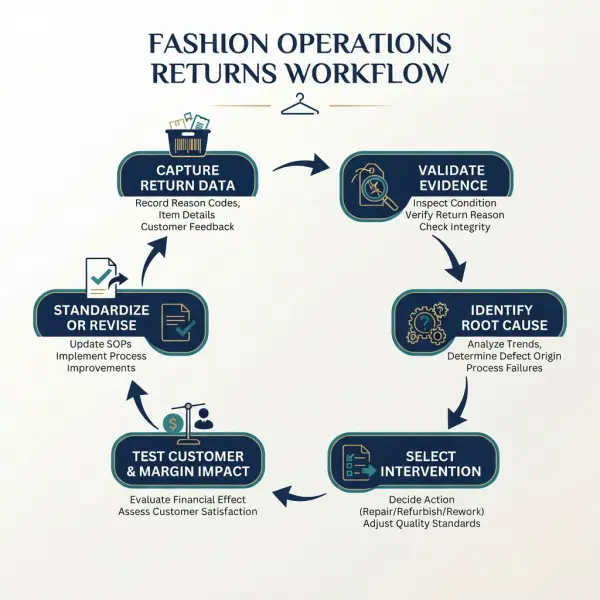
A growing brand does not need to fix every SKU at once. It needs a repeatable learning cycle focused on the largest controllable losses.
Days 1–30: Establish the baseline
Define return events and formulas, match returns to sales cohorts, and rank products by returned value, return rate, and customer contact volume. Review reason codes, comments, inspection findings, and measurements for the highest-impact SKUs. Confirm that the product pages, approved samples, and bulk goods describe the same item.
The output should be a short root-cause list, not a large dashboard. Select one or two problems with sufficient evidence and clear ownership.
Days 31–60: Correct the most likely cause
Apply the smallest credible intervention. That might mean correcting a chart, adding a garment measurement, reshooting a misleading color, clarifying sheerness, adjusting future production tolerance, fixing a pick-location error, or updating a supplier control. Avoid changing product, content, policy, and recommendation logic simultaneously, because the result will be difficult to interpret.
Days 61–90: Measure and decide
Compare mature cohorts exposed to the change with an appropriate earlier baseline. Review return reasons, conversion, exchange rate, customer contacts, complaints, recovery, and contribution—not only return rate. Check whether the improvement is broad or limited to one size, channel, or customer group.
If the evidence supports the intervention, standardize it in product-development, content, quality, or fulfillment procedures. If not, revise the diagnosis. A failed test is useful when it prevents an ineffective practice from spreading.
Common Return-Reduction Mistakes
Treating every “too small” return as a customer sizing error
The chart, grading, tolerance, label, shrinkage, or product description may be wrong. Validate the physical product and data before adding more customer instructions.
Publishing more information without prioritizing it
Customers can still miss a critical fact inside a long accordion or generic copy. Place decision-relevant fit, fabric, and condition information where the choice is made.
Using one intervention across every product category
A fit tool may help jeans but contribute little to scarves; more video may clarify drape but not resolve inconsistent shoe sizing. Match the solution to the root cause and category.
Rewarding a lower rate without checking conversion
Returns can fall because customers lose confidence and stop buying. Track qualified demand, contribution, and repeat behavior alongside the rate.
Hiding legitimate returns behind exchanges or store credit
An exchange retains revenue but the original product still returned. Preserve the physical return and reason signal instead of redefining the metric to look better.
Trusting technology before validating product data
Algorithms cannot reliably correct inconsistent measurements or undocumented pattern changes. Improve the underlying data and test the tool by category and customer group.
What Brands Should Verify Before Acting
Return reduction can affect consumer rights, accessibility, privacy, safety, and product claims. Local legal review is essential. For example, EU rules generally give online shoppers a 14-day cancellation right after receiving goods, subject to conditions and exceptions. A prevention strategy should not obstruct rights that apply in the market. European Commission guidance on EU e-commerce rules
Fit and personalization tools also require privacy assessment. Collect only data with a clear purpose, protect it, define retention, and provide meaningful alternatives. Avoid assuming body shape, gender, disability, or fit preference from weak proxies.
Product changes need technical validation. Adjusting a pattern to reduce one return reason can create restriction, imbalance, excess fabric, or new failures elsewhere. Test across relevant sizes, materials, movements, and production conditions before scaling.
Finally, do not describe fewer returns as automatically sustainable. The environmental result depends on whether customers buy fewer unsuitable products, how retained items are used, the resources required by the intervention, and what happens to returned merchandise. A lower recorded rate caused by customers discarding unwanted garments would not represent the same outcome as better product suitability.
Frequently Asked Questions
What is the fastest way for a fashion brand to reduce returns?
Start with the highest returned value or most concentrated product problem, then validate its leading reason with customer comments, physical inspection, product measurements, and page content. Correcting one inaccurate chart, misleading image, labeling error, or production deviation can be faster and more credible than a site-wide technology project. The fastest intervention depends on the cause. Brands should avoid imposing a broad return fee or restriction simply because it changes the headline rate quickly; that may suppress legitimate returns while harming conversion and trust.
Do better size charts reduce apparel returns?
They can reduce size-selection errors when the chart is product-relevant, accurate, accessible, and explained clearly. A generic chart may not help if individual styles differ in ease, length, stretch, rise, or proportion. Combine body-size guidance with decision-critical garment measurements, measurement instructions, fit notes, and model context. Then monitor whether size-related returns change by SKU and size. A chart cannot compensate for inconsistent production, incorrect labels, unsuitable grading, or a silhouette that does not work for a particular customer's preference.
Should brands encourage customers to order multiple sizes?
Not as a default substitute for good fit information. Multi-size ordering can help customers manage uncertainty, especially with unfamiliar products, but it increases outbound units, reserved inventory, return handling, and the chance that another shopper cannot buy the held size. Brands should first improve measurements, fit notes, reviews, and exchange support. If bracketing remains common, analyze whether it is concentrated in particular styles or customer groups. The commercial result should be assessed through contribution and merchandise recovery, not gross order value.
Can virtual try-on or AI size recommendations eliminate fashion returns?
No. These tools may improve decision support, but they cannot remove personal preference, production variation, tactile expectations, delivery errors, defects, or every aspect of comfort and movement. Their accuracy depends on customer inputs, product measurements, fit definitions, training data, and category. Validate recommendations against actual outcomes by size and customer group, explain limitations, protect personal data, and keep conventional size information available. Technology is most useful when it builds on disciplined product data rather than replacing it.
How should a brand use return reasons from customers?
Treat them as evidence, not final diagnosis. Customer wording reveals perception and can identify missing information, but available options, refund rules, and individual interpretation influence the selected code. Preserve the original reason, then compare it with inspection, garment measurements, batch data, support notes, and product reviews. Look for repeated patterns relative to sales of the same SKU and size. One comment may identify a serious defect, while a high percentage can still mislead if the denominator is small.
Will charging for returns reduce return rates?
It may reduce recorded preference returns, but it can also reduce conversion, increase dissatisfaction, cause customers to keep unsuitable products, or shift complaints to other channels. The outcome depends on disclosure, amount, category, customer expectations, reason for return, and local law. If a brand tests a fee, it should measure contribution, abandonment, support contacts, repeat purchase, disputes, and customer sentiment—not only carrier savings. Brand-caused errors and statutory claims may require different treatment.
Which metrics show that a return-reduction strategy is working?
Use a balanced set: mature cohort return rate, returned value, reason rate by SKU and size, conversion, exchange completion, customer contacts, complaints, repeat purchase, time to restock, merchandise recovery, markdown loss, and contribution margin. The expected metric should match the intervention. A corrected size chart should affect size-related returns, while a warehouse verification change should affect wrong-item returns. Segment results to detect whether an apparent overall improvement hides a worse outcome for one size, market, or customer group.
Conclusion
Fashion brands reduce returns sustainably when they improve the purchase outcome, not when they make the remedy harder to use. That begins with identifying whether the real failure is fit, expectation, quality, fulfillment, or purchase context.
The most durable interventions sit inside everyday product and operating decisions: controlled measurements, validated grading, realistic visuals, specific material descriptions, fit-aware reviews, reliable quality, accurate picking, and marketing that matches the product. Technology can support these foundations, but it cannot replace them.
A balanced measurement system completes the work. Return rate matters, yet conversion, contribution, exchanges, customer contacts, recovery, and repeat purchase reveal whether the brand actually improved the experience. The right result is fewer unsuitable purchases, fair handling of the returns that remain, and better evidence for the next product decision.





Comments 0
Leave a CommentSend Comment
Anda harus Login terlebih dahulu untuk dapat memberikan komentar.