


On-Demand Fashion Production Explained for Modern Apparel Brands
Quick Answer
On-demand fashion production is a manufacturing model in which garments are produced only after confirmed demand is recorded, such as a customer order, retailer commitment, preorder threshold, or verified replenishment signal. Instead of manufacturing a complete seasonal forecast months in advance, brands connect order data more directly with printing, cutting, sewing, finishing, quality control, and fulfillment.
The model can take several forms. A print-on-demand business may decorate a blank T-shirt after each purchase. A digitally connected factory may cut and sew individual garments from standardized patterns. Another brand may hold unfinished fabric or semi-finished components and complete products only when demand becomes clearer.
On-demand production can reduce exposure to finished-goods inventory, improve assortment flexibility, and support personalization. It does not automatically eliminate inventory, waste, production delays, or financial risk. Fabric, trims, blank garments, packaging, production capacity, and logistics may still need to be secured in advance.
For most apparel brands, success depends less on buying one advanced machine and more on creating a reliable flow of product data, order information, production instructions, quality standards, and delivery commitments.
What Is On-Demand Fashion Production?
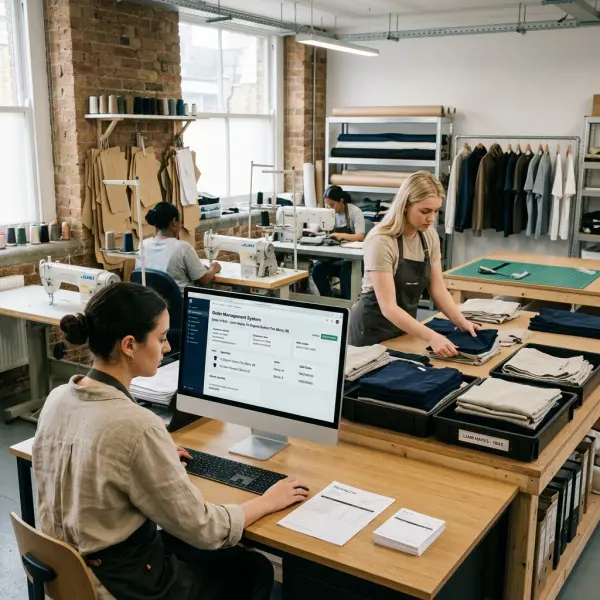
On-demand fashion production is a demand-triggered manufacturing system that delays some or all production activities until a real commercial signal is received. That signal may be an individual online purchase, a group of preorders, a wholesale commitment, an approved customization request, or a short-term replenishment requirement.
The central principle is postponement. Rather than deciding every finished product quantity before the selling period begins, the business postpones printing, cutting, assembly, customization, or final finishing until it has better information about what customers actually want.
This makes on-demand production different from conventional forecast-led manufacturing, where a brand predicts demand, places a bulk order, receives finished stock, and then attempts to sell that inventory. Forecasting does not disappear in an on-demand system, but its role changes. Forecasts may be used to reserve fabric, labor, machine time, trims, or blank products rather than determine the exact number of finished garments.
The term is sometimes used too broadly. A factory producing 300 pieces after receiving a wholesale purchase order may describe the work as made-to-order, even though every garment is standardized. A direct-to-consumer brand producing one customized dress per customer is also operating on demand, but with a much more complex product and production configuration.
Both are demand-triggered. Their economics, technology, lead times, and operational risks are very different.
On-Demand, Made-to-Order, Print-on-Demand, and Mass Customization
Several related production terms are often treated as interchangeable. They overlap, but they do not describe exactly the same model.
|
Production model |
What triggers production? |
Degree of variation |
Typical apparel example |
|
On-demand production |
Confirmed demand or a reliable demand signal |
Low to high |
A brand produces a garment after an order or preorder threshold is reached |
|
Made-to-order |
A specific customer or buyer order |
Usually moderate |
A dress is cut and sewn only after the customer selects a standard size |
|
Print-on-demand |
A confirmed order for a printed design |
Usually low at garment-construction level |
A graphic is printed on an existing blank T-shirt after purchase |
|
Made-to-measure |
Customer measurements applied to an existing pattern system |
High in fit configuration |
A standard jacket pattern is adjusted to an individual’s measurements |
|
Bespoke production |
A new or extensively developed pattern for an individual |
Very high |
A tailor creates a unique suit pattern and fitting process |
|
Mass customization |
Configurable options delivered through repeatable processes |
Moderate to high |
Customers choose sleeve, fabric, color, and length within controlled options |
|
Demand-responsive replenishment |
Sales or inventory data triggers a short production run |
Usually low |
A retailer reorders a fast-selling style in small batches |
Print-on-demand is therefore only one branch of on-demand fashion. It usually focuses on digital decoration and is well suited to products such as T-shirts, hoodies, tote bags, sportswear, or selected home-textile items.
Cut-and-sew on-demand production is more demanding. The system must coordinate fabric availability, marker planning, cutting, bundling, sewing operations, finishing, inspection, and dispatch. Personalized sizing adds another layer because body measurements or fit selections must be converted into usable pattern instructions.
Research into mass customization identifies modular product design, customer configuration, flexible processes, integrated supply chains, and reliable data exchange as important technological and organizational enablers. It also recognizes that greater variety creates complexity that must be actively controlled rather than simply passed to the factory.
How Does On-Demand Fashion Production Work?
A functioning on-demand system connects the customer-facing transaction with the physical manufacturing workflow. The exact sequence depends on the product, but a typical process includes order capture, product configuration, production-file preparation, material allocation, manufacturing, quality control, and fulfillment.
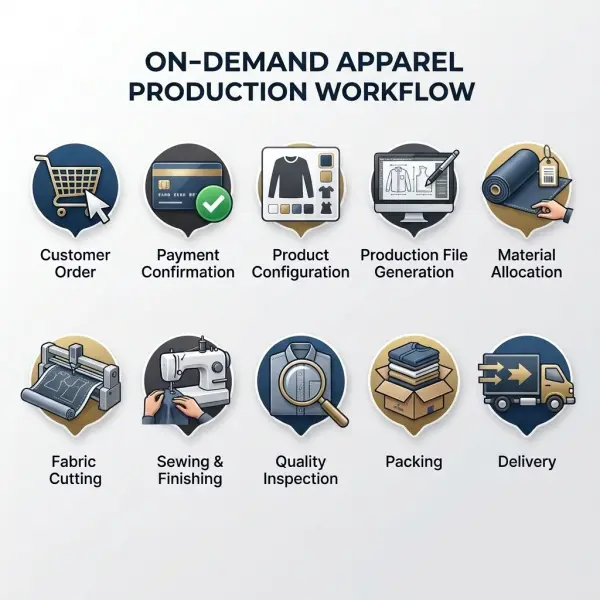
1. A customer or buyer creates a demand signal
The process begins when the system receives information that is strong enough to justify production. For a direct-to-consumer brand, this may be a paid order. For a preorder campaign, production may begin only after the business reaches a minimum volume. For a retail replenishment model, point-of-sale data may trigger a small repeat order.
The quality of this signal matters. Adding an item to a wish list is not the same as completing payment. A wholesale inquiry is not the same as a signed purchase order. Poorly defined triggers can create production work for demand that never becomes revenue.
2. The order is translated into a product configuration
The order must be converted into precise production information. At minimum, that information may include:
- Style or stock-keeping unit
- Size and color
- Fabric or blank-garment selection
- Print or embroidery artwork
- Placement and scale
- Personalization details
- Pattern version
- Bill of materials
- Label and packaging requirements
- Promised dispatch date
For standardized products, this configuration may be relatively simple. For made-to-measure or highly customizable garments, it may involve measurement validation, pattern adjustment rules, fabric compatibility, and approval steps.
3. Production files are generated or retrieved
Digital product data allows production teams to retrieve the correct pattern, artwork, marker, operation sequence, and quality specification. This is where integration becomes more important than isolated software.
A digital pattern is not useful if the production team cannot identify its approved version. A print file is risky if color profiles, garment dimensions, placement rules, and artwork ownership are unclear. A customized order can be delayed by a single missing measurement.
The NIST digital thread for manufacturing describes the broader manufacturing objective of connecting product-definition information with production and quality activities. In apparel, the same principle can be applied by maintaining a consistent data trail from product development through patternmaking, cutting, sewing, inspection, and order fulfillment.
Brands building this capability may benefit from first understanding how digital pattern making supports apparel production.
4. Materials and capacity are allocated
The system checks whether the required fabric, blanks, trims, thread, labels, packaging, machinery, and labor are available.
This step reveals an important reality: on-demand production does not always mean that nothing is held in stock. Many viable models rely on strategic material inventory. A print-on-demand operator may stock undecorated garments. A made-to-order brand may hold core fabrics in a limited color range. A footwear company may stock soles, uppers, and hardware modules.
The business is postponing product completion, not necessarily every purchasing decision.
5. Manufacturing activities are scheduled
Orders may be produced individually, grouped by similar specifications, or released in short production waves. Grouping orders can improve machine utilization and reduce setup time, but it may extend customer lead times.
For example, a digital printer may group orders by fabric type and pretreatment requirement. A cutting room may combine garments using the same fabric into one marker. A sewing unit may sequence similar operations to reduce repeated machine adjustments.
The system therefore balances two objectives that can conflict: producing quickly and producing efficiently.
6. Quality is checked at order level
In bulk production, quality teams often inspect a sample from a larger lot. In on-demand production, especially for personalized goods, each order may require direct verification.
The inspection may confirm:
- Correct garment and size
- Correct customer customization
- Print or embroidery placement
- Measurement tolerance
- Stitching and finishing quality
- Label and packaging accuracy
- Visual consistency with the approved product
- Completeness of the order
A defect in one customized garment cannot always be replaced from existing inventory. The item may need to return to the production queue, making first-pass quality especially important.
7. The order is packed, shipped, and recorded
After dispatch, order status, production time, defects, rework, return reasons, and customer feedback should be recorded. This data helps the business refine product configurations, lead-time promises, pricing, supplier decisions, and capacity planning.
A company that only connects ecommerce orders to production but does not capture production outcomes has created an automated order feed, not a learning manufacturing system.
Which Technologies Enable On-Demand Apparel Production?
No single platform creates an on-demand fashion business. The operating model usually depends on several connected technologies, supported by disciplined product development and manufacturing processes.
Ecommerce and order management systems
The commerce layer captures customer choices, payment status, addresses, cancellations, and service expectations. It may also restrict configurations based on product rules.
A strong order-management system should prevent invalid combinations. It should not allow a customer to choose a print method that is incompatible with the selected fabric, for example, or a customization option that the factory cannot produce within the promised lead time.
Product lifecycle management and product data systems
Product lifecycle management (PLM) systems can centralize style information, specifications, bills of materials, approved materials, supplier communication, and revision history.
The most valuable contribution is not the software label. It is the creation of one controlled product definition that can be used across design, sourcing, costing, production, and quality control.
Without this foundation, the order may refer to “blue,” the pattern file may use “navy,” purchasing may use a supplier’s color code, and the factory may be working from an older specification.
Digital patternmaking and three-dimensional product development
Computer-aided patternmaking helps brands create, grade, modify, store, and reuse patterns. Three-dimensional garment simulation may support design review, proportion evaluation, and selected fit decisions before a physical sample is produced.
These tools can shorten some development loops, but they do not remove the need for patternmaking knowledge, material testing, fit validation, or physical quality control. Fabric drape and stretch must be represented correctly, and simulated results should be compared with actual garments.
For personalized production, body measurements may be captured manually, through professional scanning systems, or through consumer-facing applications. A 2025 study involving 15 participants found that digital body-measurement tools showed potential for on-demand garment production, but it also reported incomplete measurements, operator-related issues, software limitations, and accuracy concerns in difficult anatomical areas. The findings should be treated as an indication of potential rather than proof that every smartphone measurement tool is ready for precision custom clothing.
Research on digital body measurement for on-demand fashion provides a useful technical overview of these opportunities and limitations.
Digital textile and garment printing
Digital printing can support shorter runs because it generally requires less physical screen preparation than conventional screen printing. Direct-to-garment systems apply designs to completed garments, while direct-to-fabric systems print onto rolls or fabric pieces before garment assembly.
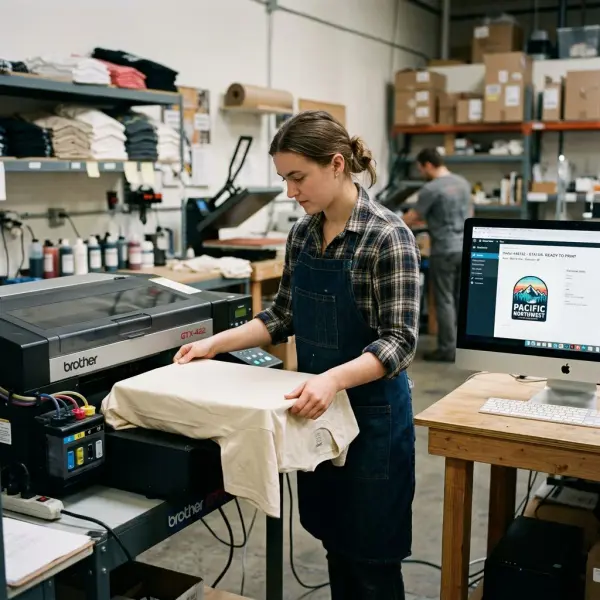
Digital printing may make small-order production more practical, but cost and performance depend on machine utilization, ink consumption, pretreatment, curing, maintenance, fabric composition, color requirements, operator skills, and quality expectations.
Commercial systems marketed for on-demand apparel emphasize small-run flexibility and integration between orders and printing. For example, Kornit’s description of print-on-demand fashion manufacturing illustrates how digital pigment printing is positioned for short runs and delayed product decoration. The claims remain technology- and application-specific rather than universal to every fabric or production environment.
Automated spreading and cutting
Automated cutting systems can receive digital marker files and cut garment components with greater repeatability than fully manual cutting. Some systems are designed to switch between individual orders, short runs, and larger production quantities.
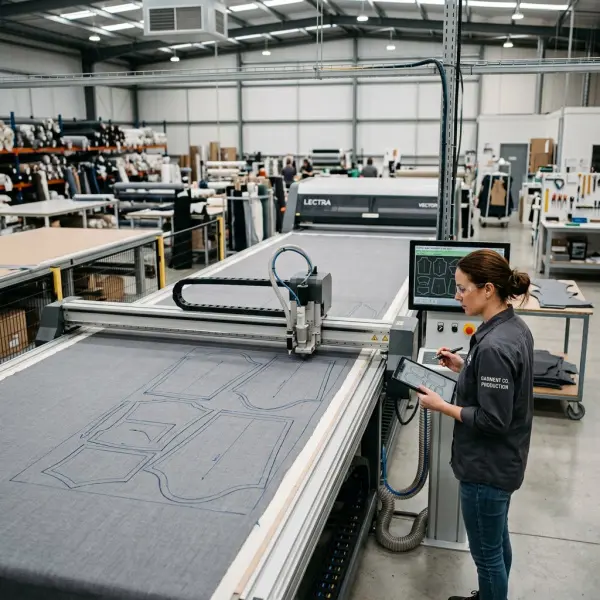
Automation is most effective when pattern files, material widths, grain requirements, cutting parameters, and order data are accurate. A sophisticated cutter cannot compensate for an incorrect pattern version or an unapproved fabric substitution.
Fashion technology providers now offer cloud-connected production platforms intended to connect order information with spreading and cutting operations. Lectra’s apparel production automation platform is one commercial example of software linking order processing, production data, and cutting-room activities.
Enterprise resource planning and manufacturing execution
Enterprise resource planning (ERP) systems coordinate areas such as purchasing, inventory, costing, orders, and finance. Manufacturing execution systems (MES) focus more closely on what is happening on the production floor, including work orders, production status, capacity, downtime, and output.
An on-demand apparel operation may not require a large enterprise platform at the beginning. It does require a dependable way to answer basic questions:
- Has payment been confirmed?
- Is the production specification complete?
- Are all materials available?
- Which process should happen next?
- Who is responsible for the order?
- Has the quality check been completed?
- Is the shipment still within the promised lead time?
- What caused any delay or rework?
A spreadsheet may support a controlled pilot. It becomes risky when order volume, customization, production locations, and product variety increase faster than the team’s ability to maintain data accurately.
Identification and production tracking
Barcodes, QR codes, and radio frequency identification may be used to connect a physical item or bundle with its digital order record. The objective is not technology for its own sake. It is to reduce mix-ups, provide production visibility, and preserve traceability as orders move between processes.
A small workshop may only need a printed barcode on each job ticket. A larger facility may require automated scanning at cutting, printing, sewing, quality control, and dispatch.
The appropriate system depends on order volume, item value, risk of mixing products, and the cost of errors.
How Is On-Demand Production Different from Conventional Fashion Manufacturing?
Conventional fashion production commonly relies on demand forecasting, seasonal commitments, supplier minimums, and bulk manufacturing. The brand assumes inventory risk before the full market response is known.
On-demand production shifts more decisions closer to the point of sale. It replaces some inventory exposure with other responsibilities, particularly production responsiveness, data accuracy, customer lead-time management, and unit-cost control.
|
Business factor |
Conventional forecast-led production |
On-demand production |
|
Production trigger |
Forecast and merchandising plan |
Confirmed demand or defined demand signal |
|
Finished-goods inventory |
Usually produced before most sales occur |
Reduced or postponed in suitable models |
|
Unit cost |
Often lower at efficient bulk volumes |
Often higher due to small runs and handling |
|
Customer lead time |
Immediate if stock is available |
Customer may wait for production |
|
Assortment flexibility |
Changes are difficult after bulk commitment |
Designs or configurations may change more easily |
|
Product data requirement |
Important |
Critical for order-level execution |
|
Production scheduling |
Planned around larger batches |
More dynamic and potentially fragmented |
|
Customization |
Usually limited |
Easier to offer within controlled rules |
|
Financial exposure |
Concentrated in inventory commitments |
Shifted toward technology, materials, capacity, and fulfillment |
|
Main operational risk |
Unsold or discounted stock |
Delay, complexity, inconsistent quality, or excessive unit cost |
Neither model is universally superior.
A basic school uniform program with predictable annual volumes may still benefit from planned batch production. A graphic apparel brand testing hundreds of designs may gain more from holding standard blanks and printing only proven orders. A premium occasionwear label may accept longer lead times because customers value fabric choice, fit adjustment, and limited production.
The production model should follow the product economics and customer proposition, not the popularity of the term “on demand.”
Why Does On-Demand Production Matter to Apparel Brands?
It can reduce exposure to finished-goods inventory
The clearest commercial advantage is the ability to postpone the creation of some finished stock. When products are manufactured after demand is confirmed, the business is less dependent on accurately predicting the exact combination of style, size, color, and quantity.
This does not mean the brand carries no inventory risk. It may still own fabric, trims, blank garments, packaging, or production reservations. However, these inputs may be more flexible than completed fashion products.
A roll of approved black jersey might support several designs. Five hundred finished dresses in an unpopular silhouette have far fewer alternative uses.
The deeper relationship between this model and stock risk is discussed in how made-to-order technology can reduce overstock and waste. Brands should also connect the strategy with disciplined fashion inventory management.
It can support broader design experimentation
When minimum production commitments are lower, brands may be able to test more artwork, colorways, or configurations. Weak sellers can be removed without leaving large quantities of finished stock, while stronger products can receive more production capacity.
This works particularly well when different designs share the same base product, fabric, or production process. The economics are less favorable when every new design requires unique materials, extensive sampling, specialist labor, and separate supplier minimums.
More options do not automatically create a stronger assortment. Customers may struggle to choose, production teams may face excessive variation, and marketing resources can become diluted across too many products.
It can make personalization commercially possible
On-demand systems can allow customers to select names, artwork, color combinations, measurements, lengths, or modular design features. The production process receives the selected configuration rather than relying on a salesperson to rewrite every instruction manually.
Personalization works best when the brand defines a controlled solution space. Customers may choose between four fabrics and three sleeve options, for example, rather than submit unrestricted design requests.
Controlled choice protects design coherence, production repeatability, product safety, and delivery performance.
It can improve alignment between product development and demand data
An on-demand system can create a shorter feedback loop between what customers order and what the business produces. Order patterns may reveal preferred colors, recurring fit issues, regional design differences, or customization options that customers rarely select.
This data can inform future product development, but order volume must be interpreted carefully. A product may sell poorly because of weak photography, confusing sizing, high delivery costs, or insufficient promotion rather than lack of product demand.
Production data explains what happened operationally. It does not explain every cause on its own.
It can respond to changing regulatory and commercial pressure
Inventory reduction is becoming more relevant as companies face pressure to disclose and manage unsold goods more responsibly. In the European Union, rules prohibiting large companies from destroying unsold apparel, clothing accessories, and footwear entered into application on July 19, 2026, with specified exceptions. Medium-sized companies are expected to become subject to the prohibition in 2030, while small and microbusinesses are exempt from these particular requirements.
The regulation does not require brands to adopt on-demand manufacturing. It does strengthen the business case for improving forecasting, inventory management, resale, reuse, repair, remanufacturing, and other methods that keep products in use.
Brands selling into the region should review the European Commission’s information on unsold apparel requirements and obtain appropriate legal or compliance advice for their specific company size, products, and market activity.
Which Fashion Categories Are Most Suitable?
On-demand production is easier to implement when the product architecture is stable, input materials are available, and customer choices can be converted into repeatable instructions.
Strong early candidates often include:
- Digitally printed T-shirts, sweatshirts, and tote bags
- Sports jerseys with names or numbers
- Corporate or community merchandise
- Uniform replenishment
- Customized accessories
- Selected knit products
- Standard silhouettes offered in multiple prints
- Occasionwear with controlled fabric and fit choices
- Premium basics offered in extended sizes
- Limited-edition or artist-collaboration products
Products become more difficult when they require long material lead times, complex washing, extensive handwork, specialist machinery, multiple fittings, or a large number of unique components.
Denim is one example. A brand may cut jeans to order, but fabric shrinkage, wash recipes, hardware, finishing capacity, fit tolerances, and minimum processing volumes can complicate true one-piece production.
A highly structured tailored jacket presents a different problem. Its value may justify made-to-order production, but fit development, canvas construction, pressing, skilled labor, and alteration risk make the operating model more demanding than printing a graphic on a standardized blank.
What On-Demand Production Does Not Mean
It does not mean zero inventory
Materials, trims, blanks, labels, and packaging may still need to be purchased before customers order. The inventory is often moved upstream or held in a more flexible form.
It does not mean zero waste
Producing only confirmed orders may reduce the risk of unsold finished products, but cutting waste, print-test waste, defective items, samples, returns, packaging, and obsolete materials can still occur.
The sustainability result depends on the entire system, including material sourcing, process efficiency, energy, product durability, transport, returns, repairability, and end-of-life treatment.
It does not mean every garment is customized
A product can be made after purchase while remaining completely standardized. Conversely, a customized product may still be manufactured in planned batches.
Demand timing and product personalization are separate design decisions.
It does not eliminate forecasting
Brands still need to forecast fabric demand, capacity, staffing, machine maintenance, shipping volume, and cash requirements. Forecasting becomes more focused on resources and capabilities instead of only finished-product quantities.
It does not guarantee faster delivery
Products already held in a warehouse can usually be dispatched faster than products that still require printing, cutting, sewing, finishing, inspection, and packing.
On-demand brands compete through relevance, choice, fit, inventory discipline, or exclusivity—not necessarily instant availability.
How Can Fashion Brands Apply On-Demand Production Strategically?
The safest path is usually to apply on-demand production to a carefully selected part of the assortment rather than immediately redesigning the entire business.
Start with the business problem
The project should solve a defined commercial or operational issue. Common objectives include:
- Reducing finished-stock exposure
- Testing more designs at lower volume
- Offering extended sizes
- Supporting personalized products
- Shortening replenishment cycles
- Localizing production for a specific market
- Improving availability of slow-moving sizes
- Launching limited editions without a large commitment
A clear objective makes it easier to choose technology and evaluate results.
Select a controlled pilot product
Choose a product with stable construction, reliable materials, manageable production steps, and a clear customer proposition.
A useful pilot might offer one T-shirt body, two fabric colors, ten graphic options, and five sizes. This creates meaningful variety while keeping the operational model understandable.
Launching 20 silhouettes, 15 fabrics, custom measurements, embroidery, printing, and unrestricted customer artwork in the first pilot creates too many possible failure points.
Map the order-to-delivery workflow
Document every action from checkout to shipment. Identify where data is created, transferred, checked, changed, and approved.

The map should answer practical questions:
- What confirms that an order may enter production?
- Who verifies artwork, measurements, and customization?
- When is material reserved?
- How is the correct production file selected?
- How are similar jobs grouped?
- Where can an order be paused?
- Who approves rework?
- How is the customer informed of delays?
- Which data is recorded after fulfillment?
This exercise often reveals that the first bottleneck is not manufacturing machinery. It is incomplete information or unclear responsibility.
Standardize product data before increasing automation
Each sellable configuration should connect to approved production instructions. At minimum, define:
- Product and variant codes
- Pattern and artwork versions
- Bills of materials
- Material consumption
- Supplier references
- Machine or process requirements
- Quality tolerances
- Packaging instructions
- Standard production time
- Costing assumptions
Automation applied to inconsistent master data can distribute mistakes faster across the operation.
Confirm supplier and material flexibility
Ask suppliers what can genuinely be purchased or reserved in small quantities. A factory may accept an order for one garment while the fabric mill requires hundreds of meters.
Potential solutions include:
- Core fabric platforms used across several products
- Stock-supported supplier collections
- Greige or undyed fabric held for later coloration
- Standard blank garments
- Shared trims across multiple styles
- Modular components
- Supplier capacity reservations
- Consolidated material orders across production periods
Each solution introduces its own cost, quality, color-consistency, and lead-time considerations.
Calculate order-level economics
The brand should understand the true cost of processing an individual or small-batch order.
Include:
- Material and trim consumption
- Printing or decoration
- Cutting and sewing labor
- Setup and changeover time
- Software and transaction costs
- Quality inspection
- Rework allowance
- Packing and shipping
- Customer service
- Return or remake exposure
- Machine depreciation and maintenance
- Unused capacity
- Payment fees
The absence of large finished-goods inventory does not guarantee a profitable model. A business may reduce markdown losses while simultaneously increasing production and fulfillment costs.
Design a realistic customer promise
Customers need to know that the product is produced after ordering. Product pages should communicate:
- Estimated production time
- Dispatch and delivery windows
- Customization limits
- Measurement instructions
- Cancellation policy
- Return or alteration conditions
- Possible appearance variation
- Care instructions
- Which elements are personalized
The promise should include operational buffer. Advertising a three-day production time when the process normally takes three days under perfect conditions leaves no room for maintenance, absence, rework, or material delays.
Measure the pilot beyond sales
Useful pilot metrics include:
|
Metric |
What it reveals |
|
Order-to-production release time |
Whether order validation is efficient |
|
Production cycle time |
How long physical manufacturing takes |
|
First-pass quality rate |
How often products pass without rework |
|
On-time dispatch rate |
Whether the customer promise is realistic |
|
Material utilization |
Whether small-run cutting is efficient |
|
Rework and remake rate |
Cost of errors and personalization |
|
Contribution margin per order |
Whether the model is financially viable |
|
Return reason |
Whether fit, quality, or expectation is failing |
|
Configuration popularity |
Which options provide real customer value |
|
Capacity utilization |
Whether equipment and labor are economically used |
The goal is to understand where the model creates value and where it transfers cost.
Common Mistakes Apparel Brands Make
Treating on-demand production as a technology purchase
A brand may buy a printer, scanner, cutting machine, or software platform without redesigning its product data, costing, production responsibilities, and customer communication.
The result is often a digital tool surrounded by manual exceptions. Orders still need to be corrected through chat messages, files are stored under inconsistent names, and production teams cannot trust what the system sends.
Technology should support the operating model. It cannot substitute for one.
Offering unrestricted customization
Unlimited choice sounds customer-centric but can make pricing, production, quality control, and delivery unpredictable.
A stronger approach is modular customization: the brand defines which elements customers can change and which remain fixed. This creates variety without turning every order into a new product-development project.
Ignoring upstream minimum quantities
A factory may be willing to cut one garment, but a zipper supplier, dye house, fabric mill, washing facility, or label producer may still impose minimum quantities.
Before advertising made-to-order products, the brand should map minimums across the complete bill of materials and process chain.
Promising inventory-like delivery speed
Some brands communicate made-to-order products as though they were immediately available. When production inevitably takes longer, customer service absorbs the gap between marketing and operational reality.
Longer delivery is not always a commercial weakness. Customers may accept it when the value—personalization, local production, fit choice, limited availability, or craftsmanship—is clearly explained.
Automating before stabilizing quality
On-demand production creates pressure to move each order quickly. If fit, printing, shrinkage, construction, or finishing remains unstable, faster order flow may increase remakes rather than improve performance.
The product should be repeatable before the production trigger is automated.
Describing the model as automatically sustainable
Demand-triggered production may reduce unsold finished goods, but a credible environmental assessment must consider more than inventory.
Small production runs can involve frequent machine setup, fragmented shipping, inefficient cutting, or increased packaging. Customized items may also be difficult to resell after a return.
Sustainability claims should identify the specific improvement being made and avoid implying that the entire product lifecycle has been optimized.
What Should Brands Verify Before Investing?
Before selecting an on-demand platform or production partner, verify the following areas.
Product suitability
Determine whether the garment construction, materials, finishes, fit requirements, and expected price can support short-run production.





Comments 0
Leave a CommentSend Comment
Anda harus Login terlebih dahulu untuk dapat memberikan komentar.