
Fashion Merchandising Explained for Retail Businesses
Quick Answer
Fashion merchandising is the business practice of planning, selecting, pricing, presenting, and managing fashion products so they reach the right customers, in the right place, at the right time, with the right commercial purpose. For retail businesses, merchandising connects creative product choices with sales performance, inventory control, customer behavior, and brand positioning.
In practical terms, fashion merchandising decides what a store sells, how much of each product it carries, when products are launched, how they are grouped, how they are priced, how they are promoted, and how performance is reviewed after launch. It is not only about making products look attractive. Visual presentation matters, but merchandising also includes assortment planning, stock allocation, size curve decisions, markdown control, product storytelling, and channel strategy.
For a fashion retailer, good merchandising can reduce the risk of overstock, improve sell-through, protect margins, and make shopping easier for customers. Poor merchandising often shows up as slow-moving inventory, confusing product ranges, weak category performance, excessive discounting, or products that look appealing but do not match real customer demand.

What Is Fashion Merchandising?
Fashion merchandising is a retail business function that manages how fashion products are planned, bought or developed, priced, allocated, presented, promoted, and evaluated in order to meet customer demand while supporting sales, margin, inventory, and brand goals.
That definition matters because merchandising is often misunderstood as store display. Display is only one part of the work. A beautifully styled rack will not solve a weak product mix, the wrong size curve, poor pricing architecture, late delivery, or excessive inventory in a color that customers do not want.
In fashion retail, merchandising sits between product, buying, marketing, operations, and sales. It translates customer insight into commercial product decisions. A merchandiser may ask: Which categories should lead this season? How deep should the store buy into denim, dresses, knitwear, or accessories? Which colors deserve volume? Which items should remain core products? Which products should be treated as trend capsules? Which styles should be replenished quickly, and which should be marked down before they consume too much cash?
A small boutique may handle these decisions informally through the owner’s judgment. A larger retail chain may use detailed merchandise financial plans, open-to-buy controls, allocation tools, category reports, and weekly trade meetings. The scale changes. The core question does not.
The retailer must match product decisions with customer behavior.
Why Fashion Merchandising Matters for Retail Businesses
Fashion merchandising matters because apparel retail is exposed to high uncertainty. Trends shift, seasons change, sizes sell unevenly, colors behave differently by region, and products lose value when they miss their selling window. A winter coat, Eid collection, resort capsule, or back-to-school uniform range cannot be managed like a generic product with unlimited shelf life.
In many fashion businesses, inventory is one of the largest uses of cash. NRF describes inventory as both a major investment and a major risk for retailers, and recommends using open-to-buy planning, purchase order tracking, and cash-flow discipline to reduce stockouts, overbuying, and last-minute discounting. NRF retail fundamentals
For fashion retailers, this risk becomes sharper because products carry style risk. A black basic T-shirt may sell steadily across many months. A metallic mini skirt, oversized bow blouse, or seasonal print dress may need a tighter launch window and more careful quantity control. Merchandising helps retailers separate products by role, not only by appearance.
A practical merchandise plan can help a retail business answer several commercial questions before stock arrives:
- Which products are meant to drive traffic?
- Which products protect margin?
- Which products complete the outfit or increase basket size?
- Which products express the brand story?
- Which products should be bought deeply, and which should be tested lightly?
- Which products need replenishment logic, and which should be treated as seasonal risk?
This is where merchandising becomes a financial discipline, not just a creative one. The retailer is not simply asking, “Do we like this product?” The stronger question is, “What job does this product perform in the business?”
The Core Elements of Fashion Merchandising
Fashion merchandising works through several connected decisions. None of them stand alone. A retailer can have a strong product idea but weak stock allocation. It can have attractive pricing but poor product hierarchy. It can have excellent visuals but an assortment that does not match customer lifestyle.
Assortment Planning
Assortment planning decides the mix of categories, styles, colors, sizes, price points, and product roles within a retail offer. In fashion, assortment planning is rarely just about variety. It is about controlled variety.
A womenswear store, for example, may carry dresses, blouses, trousers, skirts, outerwear, bags, scarves, and jewelry. But a good assortment plan clarifies which categories are commercial anchors, which are seasonal highlights, and which are supporting items. Without that logic, the store can look full but still feel directionless.
NRF recommends that retailers build assortments from core or seasonless styles, then layer in fashion products for trends, seasonal colors, or newness. That distinction is especially useful in apparel because not every product should carry the same level of risk. curate the right assortment
A simple assortment may include:
- Core products: repeatable items such as basic shirts, trousers, innerwear, denim, uniforms, or everyday knitwear.
- Seasonal products: items linked to weather, holidays, cultural moments, or seasonal colors.
- Trend products: smaller-volume items that create freshness but may carry higher demand uncertainty.
- Statement products: visually strong pieces used to express brand identity, even if volume is limited.
- Add-on products: accessories or complementary items that support styling and basket size.
A strong assortment gives customers enough choice without overwhelming them. For a smaller fashion retailer, this is often where discipline matters most. Buying too many styles in shallow quantities can create a store that looks diverse but cannot support size availability, replenishment, or clear product storytelling.
Pricing and Margin Structure
Pricing in fashion merchandising is not only about setting a retail price above cost. It is about building a price architecture that customers can understand and the business can sustain.
A retailer may use entry-level items to invite trial, mid-range items to drive volume, and premium items to reinforce positioning. The price gap between these layers should make sense. If a cotton blouse, viscose blouse, and silk-blend blouse are all priced too closely, customers may not understand the value difference. If the gap is too wide, the premium item may feel disconnected from the store’s usual customer.
Merchandising also considers markdown risk. A product with a high initial margin may still perform poorly if it requires heavy discounting to clear. A lower-margin core product may be commercially valuable if it sells consistently and rarely needs markdown.
This is one reason fashion retailers should review margin together with sell-through, not in isolation. A product is not successful simply because the gross margin percentage looks attractive on paper. It must move at the right pace, in the right quantity, with acceptable markdown exposure.

Inventory Planning and Allocation
Inventory planning determines how much stock a retailer carries and where that stock should sit. In a single-store business, the question may be straightforward: how many units of each style, color, and size should be purchased? In multi-store or omnichannel retail, the question becomes more complex: which branch, region, marketplace, or online channel should receive which depth of stock?
Fashion inventory planning must account for size curves, climate, local taste, store traffic, selling period, delivery timing, and replenishment capability. A modest dress may sell strongly in one market, while a more fitted silhouette performs better in another. A heavy jacket may need different allocation logic in a colder city than in a tropical market. Even within the same brand, one branch may behave differently because of customer income, store location, local culture, or mall positioning.
Shopify’s category management guidance notes that retail category management brings together product, order, and customer data to support merchandising and inventory decisions across channels. category management in retail The principle is relevant beyond Shopify as a platform: merchandising improves when product decisions are informed by actual sales, stock, and customer behavior rather than intuition alone.
Product Presentation and Storytelling
Product presentation is the part of merchandising most customers can see. It includes how products are grouped, styled, photographed, displayed, described, and promoted in-store or online. Shopify defines merchandising as how retailers present and promote products to boost sales, including displays, product placement, and promotional spotlighting. retail merchandising definition
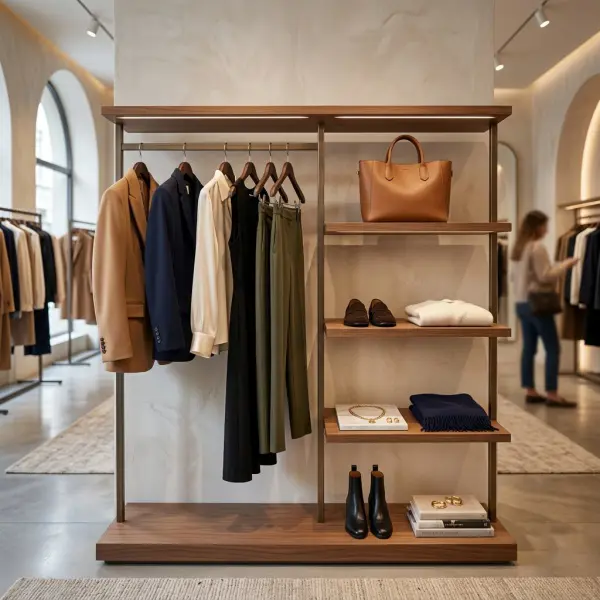
In fashion, presentation should help customers imagine use. A rack of blazers may be organized by color, but a stronger merchandising story may group the blazer with trousers, blouse options, belts, and shoes to show a workwear capsule. An online store may use filters and categories, but a stronger digital merchandising approach may create edits such as “office-ready linen,” “modest occasionwear,” “travel-friendly layers,” or “festival accessories.”
This is where merchandising overlaps with visual merchandising, but the two should not be treated as identical. Visual merchandising focuses more deeply on the physical or digital presentation environment. Broader merchandising decides what should be presented in the first place, why it matters commercially, and how it supports the retail plan. For a deeper discussion of display strategy, store layout, window concepts, and product storytelling, see visual merchandising strategies for fashion retail.
Merchandising Calendar
A merchandising calendar controls when products enter, peak, and exit the retail floor or online homepage. Fashion retail depends heavily on timing. A product launched too early may sit before demand appears. A product launched too late may miss the customer’s buying window.
The calendar may include seasonal drops, cultural holidays, payday periods, campaign launches, clearance windows, back-to-school periods, wedding season, vacation edits, or local events. In international retail, calendar planning becomes more nuanced because climate, holidays, and shopping habits differ by market.
A global brand cannot assume that the same product story will land at the same time everywhere. Linen may be summer-driven in one market and resort-driven in another. Modest occasionwear may peak around different religious or cultural calendars. Outerwear may require different launch timing depending on climate and consumer readiness.
Performance Review
Merchandising is incomplete without review. A retailer needs to know which products sold, which sizes were missing, which colors stalled, which categories drove margin, which products generated returns, and which items needed discounting too early.
The most useful review is not only a sales ranking. It asks why performance happened. A dress may sell slowly because the price is wrong, the fit is narrow, the photo is weak, the store team does not understand the styling, the size curve is mismatched, or the product was delivered after the key selling period. A strong merchandiser looks beyond the number and investigates the operating reason behind it.
Fashion Merchandising vs Buying, Marketing, and Visual Merchandising
Fashion merchandising overlaps with several retail functions, which is why roles can be confusing. In smaller businesses, one person may handle all of them. In larger companies, the responsibilities are usually separated.
The simplest distinction is this: merchandising connects product, customer, inventory, presentation, and profitability. Buying focuses more heavily on selecting or purchasing products. Marketing focuses on demand generation and communication. Visual merchandising focuses on how products are displayed and experienced.
|
Function |
Main Focus |
Typical Fashion Retail Question |
|
Fashion merchandising |
Product mix, stock, pricing, timing, presentation, performance |
What should we sell, how much, when, where, and why? |
|
Buying |
Product selection, supplier negotiation, purchase orders |
Which products should we buy or develop for the season? |
|
Marketing |
Campaigns, audience communication, traffic, brand message |
How do we attract customers and explain the offer? |
|
Visual merchandising |
Store layout, display, styling, window, product presentation |
How should the product story appear in the retail space? |
|
Category management |
Category roles, profitability, space, assortment performance |
Which categories deserve more focus, space, or investment? |
The boundaries are not rigid. A buyer may influence assortment structure. A marketer may shape product storytelling. A visual merchandiser may affect sell-through through stronger displays. But without merchandising coordination, these functions can pull in different directions.
A common example is a marketing campaign that promotes a product before stock is properly allocated. Traffic increases, but customers cannot find their size. Another example is a beautiful window display featuring a product that has only two units left in key sizes. The visual story works, but the commercial planning fails.
How the Fashion Merchandising Process Works
A practical fashion merchandising process usually moves from customer understanding to product planning, buying or development, launch, trading, and post-season learning. The process does not need to be complicated, but it does need to be repeatable.
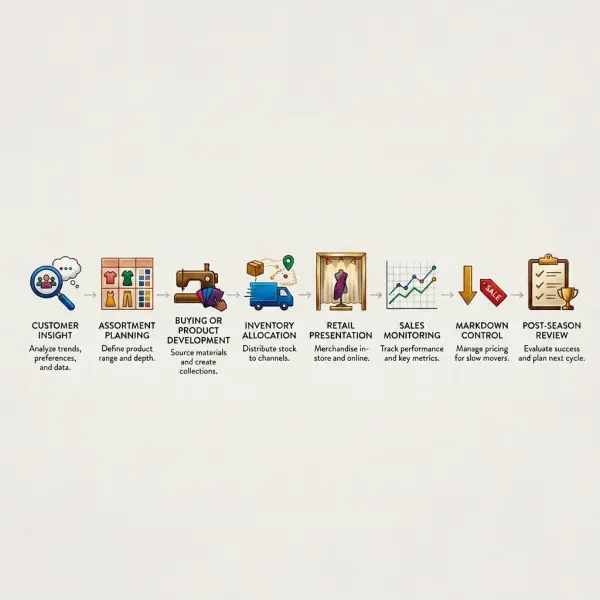
1. Understand the Customer and Market Context
The process begins with the customer. A retailer should know who buys, how they dress, what occasions they shop for, what price points feel acceptable, what sizes move, what colors repeat, and what objections stop purchase.
This does not mean chasing every trend. A retailer serving professional women in their 30s may interpret trends differently from a youth streetwear store, a modest fashion boutique, a school uniform supplier, or a premium tailoring brand. The same macro trend can produce different product decisions depending on the audience.
Market context also includes competitors, climate, local events, social media influence, economic pressure, and consumer spending behavior. McKinsey and Business of Fashion reported that fashion leaders entering 2026 face economic volatility, evolving consumer priorities, trade disruption, and rapid technology shifts. The State of Fashion 2026 For merchandisers, this kind of context matters because it affects pricing tolerance, sourcing cost, product timing, and inventory risk.
2. Build the Merchandise Plan
The merchandise plan translates business goals into product and financial decisions. It may define category targets, price architecture, planned sales, margin expectations, stock investment, launch periods, and markdown assumptions.
For a small retailer, this plan may be a structured spreadsheet. For a larger retailer, it may be part of a merchandise financial planning system. Either way, the purpose is the same: to prevent product decisions from becoming disconnected from business reality.
A useful merchandise plan usually clarifies:
- Target sales by category or collection.
- Planned gross margin and markdown allowance.
- Number of styles, colors, and stock keeping units.
- Depth of buy for core, seasonal, and trend products.
- Size curves based on historical or expected demand.
- Launch dates, selling periods, and exit plans.
- Replenishment rules for repeatable items.
The plan does not remove uncertainty. It gives the business a controlled starting point. Good merchandisers still adjust when real selling data appears.
3. Select, Buy, or Develop Products
Once the plan is clear, the retailer decides which products enter the assortment. This may involve buying finished goods from suppliers, developing private-label products, commissioning local production, or curating products from multiple brands.
Fashion judgment matters here, but it should be supported by commercial logic. A product may look beautiful but duplicate an existing style. A trend color may be attractive but unsuitable for the brand’s core customer. A supplier may offer good cost but unreliable delivery. A fabric may photograph well but wrinkle too easily for the target use case.
This stage often requires trade-offs. More variety can create excitement but increases complexity. Larger quantities can improve cost per unit but increase inventory risk. Faster product drops can keep the store fresh but put pressure on planning, photography, content, and store execution.
4. Allocate Stock Across Channels
Allocation decides where products go. For a single store, allocation may mean balancing front display, back stock, and online stock. For a multi-location retailer, it may involve allocating units by branch, region, demand pattern, and store capacity.
Omnichannel retail adds another layer. A product may sell slowly in-store but perform well online because customers need more size or color information before buying. Another item may perform better offline because fabric handfeel, fit, or drape matters. Merchandising teams need to read both channel behavior and product characteristics.
A satin dress, for example, may require strong photography, fit notes, return monitoring, and event-based timing online. A basic cotton tee may depend more on replenishment, size availability, and price consistency.
5. Launch and Present the Product Story
At launch, the merchandising plan meets the customer. The product must be visible, understandable, and easy to buy. In-store, this may involve fixtures, styling, staff briefing, signage, and product grouping. Online, it may involve homepage placement, category sorting, product naming, filters, images, descriptions, size guidance, and recommendation logic.
The goal is not simply to show every product equally. Merchandising creates hierarchy. Hero products receive visibility. Core products remain easy to find. Add-on products are placed near related items. Slow-moving products may be restyled, repositioned, bundled, or eventually marked down.
For a deeper look at how merchandising affects choice, product attention, perceived value, and buying behavior, the next cluster article can explore how merchandising influences consumer buying decisions.
6. Monitor Sales and Adjust Quickly
After launch, merchandisers need trading discipline. A weekly review can reveal whether a product is selling faster than expected, whether a size is missing, whether a color is underperforming, or whether a product needs stronger styling support.
The important point is speed with judgment. Reacting too slowly can lead to missed sales or excessive leftover stock. Reacting too aggressively can cause unnecessary markdowns or stock movement before the product has had enough exposure.
A retailer should distinguish between a true product problem and an execution problem. If a blouse is not selling because it is hidden in the wrong section, markdown is not the first answer. If a dress receives many fitting-room rejections, the issue may be fit, fabric behavior, or size grading. If online traffic is high but conversion is low, the issue may be photography, product description, price, shipping, or sizing uncertainty.
7. Review, Learn, and Improve the Next Buy
The final stage is post-season review. This is where merchandising becomes a learning system. The retailer should document what worked, what failed, and what should change in the next cycle.
The best reviews are specific. “Dresses sold well” is not enough. Better insight would be: “Midi dresses in dark florals sold through faster in sizes M and L, but pastel mini dresses needed markdown after week five.” That level of detail helps the next assortment become sharper.
Key Merchandising Metrics Fashion Retailers Should Track
Fashion merchandising decisions should be supported by metrics, but metrics need interpretation. A number can tell the team what happened. It rarely explains the full reason.
|
Metric |
What It Shows |
Why It Matters |
|
Sell-through rate |
Percentage of received stock sold during a period |
Helps identify product demand and markdown risk |
|
Gross margin |
Sales revenue after product cost |
Shows profitability before operating expenses |
|
Markdown rate |
Discount depth or value used to clear products |
Reveals pricing, demand, or timing issues |
|
Inventory turnover |
How often inventory is sold and replaced |
Indicates stock efficiency and cash movement |
|
Weeks of supply |
How long current stock may last at current sales rate |
Supports replenishment and clearance timing |
|
Average transaction value |
Average amount spent per order |
Helps assess styling, add-ons, and basket building |
|
Return rate |
Percentage of products returned |
Can reveal sizing, fit, quality, or expectation mismatch |
|
Size availability |
Whether key sizes remain in stock |
Affects conversion, customer satisfaction, and missed sales |
No single metric gives the full picture. A high sell-through rate may look positive, but if the product sold out too early, the retailer may have underbought and missed revenue. A slow seller may look weak, but if it is a premium image product, it may still support brand positioning or styling content. A high return rate may indicate poor fit, but it may also result from unclear product photography or inaccurate size guidance.
The most useful merchandising review combines numbers with context from store teams, customer service, fitting-room feedback, online behavior, and product quality checks.

What Makes Fashion Merchandising Different From General Retail Merchandising?
Fashion merchandising is more sensitive to seasonality, style risk, fit, size curves, and trend timing than many other retail categories. A fashion product is not only evaluated by utility. It is also judged by identity, occasion, body fit, fabric feel, cultural taste, styling relevance, and perceived newness.
A grocery retailer can use replenishment logic for many products with relatively stable demand. A fashion retailer often works with products whose desirability may fade quickly. Even basics are affected by fabric quality, fit consistency, color, and styling expectations.
Several factors make fashion merchandising especially demanding:
- Size complexity: A style may sell well overall but fail in specific sizes.
- Color variation: The same design may perform very differently in black, beige, red, pastel, or seasonal prints.
- Fit sensitivity: Customers may reject a garment because of shoulder width, waist placement, rise, sleeve length, fabric stretch, or drape.
- Seasonality: Many fashion products have limited selling windows.
- Trend exposure: Newness can attract attention, but trend-driven items can create leftover stock if overbought.
- Styling dependence: Some products need outfit context before customers understand how to wear them.
- Return risk: Online apparel can face returns due to size, fit, color expectation, fabric handfeel, or styling mismatch.
This is why fashion merchandising requires both commercial discipline and product sensitivity. A merchandiser needs to read numbers, but also understand silhouette, fabric, customer lifestyle, and retail presentation.
How Fashion Retail Businesses Can Apply Merchandising Strategically
Merchandising becomes useful when it changes daily decisions. It should not remain a planning document that sits in a folder after buying is complete.
Start With Product Roles, Not Just Product Categories
A common mistake is to plan only by category: tops, bottoms, dresses, outerwear, accessories. Category planning is necessary, but it is not enough. Retailers should also assign product roles.
A white shirt may be a core item. A dramatic printed blouse may be a campaign item. A belt may be an add-on item. A premium blazer may be an image item that supports brand perception. These roles influence how much stock to buy, where to display the item, how to price it, how to photograph it, and how quickly to react if sales are slow.
Use a Balanced Assortment Structure
A healthy fashion assortment usually needs a balance between stability and freshness. Too much core product can make the store feel predictable. Too much novelty can make inventory hard to manage.
For many retailers, a practical balance may include a foundation of proven products, a seasonal layer, and a controlled trend layer. The exact ratio depends on the business model. A fast-fashion retailer, premium boutique, school uniform supplier, modest fashion brand, and sustainable basics label should not use the same merchandising logic.
Connect Merchandising With Sourcing and Production
Merchandising decisions affect sourcing. If a retailer wants faster replenishment, it may need suppliers that can produce smaller batches quickly. If it wants premium margin, it may need stronger fabric control, finishing quality, and fit consistency. If it wants trend responsiveness, it may need shorter lead times, but this can create cost or capacity pressure.
For private-label fashion businesses, merchandising should inform product development before samples are finalized. The merchandising team should know which styles are expected to carry volume, which fabrics require testing, which colors need cautious quantities, and which products need stronger quality control because they affect brand trust.
Make Online Merchandising as Intentional as Store Merchandising
Digital merchandising is not simply uploading products to an online catalog. It includes product naming, category structure, filters, image order, size guidance, recommendation modules, homepage edits, campaign landing pages, and search results.
A physical store uses fixtures and sightlines. An online store uses navigation, sorting, product cards, and content hierarchy. Both need merchandising logic.
For example, if a customer searches for “linen pants,” the online store should not only show all pants. It should make relevant linen or linen-blend options easy to identify, show fit and length clearly, and suggest tops or sandals that complete the look. If the product is prone to wrinkles, the description should manage expectations honestly instead of creating return risk.
Build Feedback Loops Into Weekly Operations
Fashion merchandising improves when feedback is fast and specific. Store associates may know which garments customers try but do not buy. Customer service may hear repeated questions about size or fabric. Warehouse teams may notice packing or return patterns. Digital teams may see search terms that reveal unmet demand.
A weekly merchandising rhythm can bring these signals together. The discussion should not only ask what sold. It should ask what the business learned.

Common Fashion Merchandising Mistakes
Fashion merchandising mistakes often happen when a business relies too heavily on taste, trend excitement, or short-term sales pressure. The better approach is not to remove creativity. It is to give creativity a commercial structure.
Mistake 1: Buying What Looks Good Without Defining Its Business Role
A product can be attractive and still be a poor buy. It may duplicate an existing item, sit outside the customer’s price comfort, require styling support the store cannot provide, or arrive too late for the relevant occasion.
The better approach is to assign every product a role before committing to volume. If the role is unclear, the buy should usually be smaller, tested more carefully, or removed.
Mistake 2: Expanding the Assortment Too Quickly
Many fashion retailers try to grow by adding more categories. More products can create more selling opportunities, but they also create more stock risk, more operational complexity, more photography work, more size management, and more markdown exposure.
A small brand that sells dresses successfully may not automatically be ready to add shoes, bags, activewear, and beauty products. Expansion should follow customer demand, operational capability, and clear category logic.
Mistake 3: Treating All Stores or Channels the Same
A product that works in one branch may not work in another. A style that sells online may not sell offline. A branch near offices may need different product depth from a resort-area branch. An online customer may need more fit guidance than an in-store customer.
Uniform merchandising is easier to manage, but it can hide local demand differences. Retailers should adapt allocation and presentation where data and customer behavior justify it.
Mistake 4: Using Discounts as the First Solution
Markdowns are sometimes necessary. Fashion products have selling windows, and slow-moving stock consumes cash and space. But discounting too early or too often can train customers to wait, weaken margin, and damage perceived value.
Before discounting, the retailer should check whether the issue is visibility, styling, size availability, product description, store placement, staff knowledge, or price architecture. A product should not be marked down simply because it has not been properly merchandised.
Mistake 5: Ignoring Returns and Fitting-Room Feedback
Sales data can be misleading if returns and try-on behavior are ignored. A product may sell online but return heavily because the fabric feels different from expectations. Another product may enter fitting rooms often but convert poorly because the waistline, sleeve, or length does not suit the customer.
Return and fitting-room feedback can reveal merchandising problems, product development issues, or content gaps. For apparel, these signals are too important to treat as after-sales noise.
What Retailers Should Verify Before Making Merchandising Decisions
Fashion merchandising works best when decisions are grounded in evidence, but retailers should be careful about the quality of that evidence. A small sample can mislead. A viral product can distort expectations. A strong sales week may reflect a promotion, payday, weather change, or influencer mention rather than stable demand.
Before acting, retailers should verify several things:
- Whether sales performance reflects full-price demand or discounted demand.
- Whether stockouts made demand look smaller than it really was.
- Whether poor sales came from weak product appeal or weak visibility.
- Whether returns are concentrated in certain sizes, colors, or channels.
- Whether a trend fits the brand’s actual customer, not just the market mood.
- Whether supplier lead times support replenishment or only one-time buying.
- Whether markdown plans are protecting cash flow or eroding brand value.
- Whether online product content accurately represents fit, color, fabric, and use case.
The strongest merchandising decisions usually come from combining quantitative and qualitative evidence. Sales reports show patterns. Customers, staff, product teams, and operational teams help explain those patterns.
The Role of Technology in Fashion Merchandising
Technology can improve fashion merchandising when it helps retailers see demand, inventory, and customer behavior more clearly. Point-of-sale systems, inventory management tools, product information management systems, customer relationship management platforms, analytics dashboards, and AI-supported recommendations can all support better decisions.
But technology does not replace merchandising judgment. A dashboard may show that a product is selling quickly, but a merchandiser still needs to ask whether the store underbought, whether the product deserves replenishment, whether the trend will last, whether supplier capacity exists, and whether margin remains acceptable.
McKinsey and Business of Fashion note that AI is affecting how fashion companies work and how customers search, compare, and receive recommendations. AI in fashion retail context For merchandising teams, this may increase the importance of clean product data, structured attributes, accurate sizing information, strong product descriptions, and consistent category logic.
A product that is poorly categorized or described can be difficult for customers and AI-powered discovery systems to understand. In that sense, merchandising now extends beyond the store floor and website homepage. It also affects how products are interpreted by search engines, marketplaces, recommendation systems, and AI shopping assistants.
Practical Merchandising Framework for Fashion Retailers
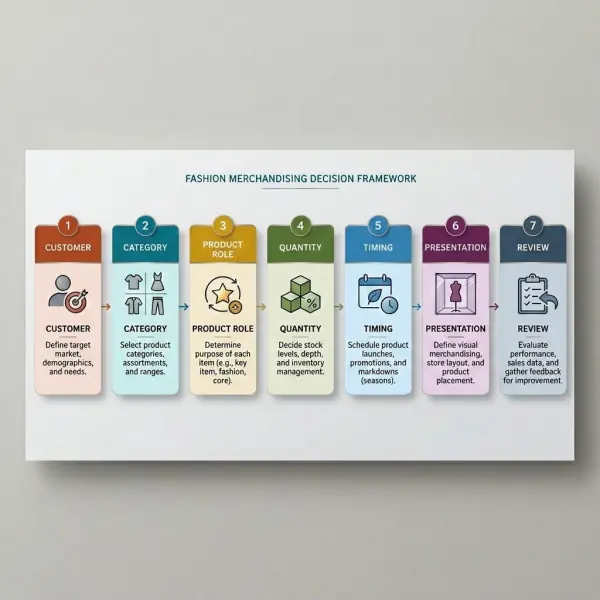
A simple fashion merchandising framework can help retail teams make clearer decisions without overcomplicating the process.
|
Decision Area |
Practical Question |
Business Impact |
|
Customer |
Who is this product for, and what occasion does it serve? |
Improves relevance and reduces random buying |
|
Category |
What role does this category play in the business? |
Supports clearer assortment investment |
|
Product role |
Is this core, seasonal, trend, image, or add-on? |
Guides buy depth, pricing, and presentation |
|
Quantity |
How much stock should be bought by size and color? |
Controls cash risk and stock availability |
|
Timing |
When should the product launch, peak, and exit? |
Reduces missed selling windows |
|
Presentation |
How should customers understand and style the product? |
Improves conversion and basket building |
|
Review |
What did sales, returns, and feedback reveal? |
Improves the next buying cycle |
For a growing retailer, this framework can be used before every buying meeting. It gives teams a shared language. Instead of debating products based only on taste, they can discuss customer fit, business role, stock risk, and commercial purpose.
FAQ: Fashion Merchandising for Retail Businesses
What is the simplest meaning of fashion merchandising?
Fashion merchandising means managing fashion products so they are selected, priced, stocked, presented, and reviewed in a way that supports customer demand and business goals. It connects the creative side of fashion with retail performance. For a store, this may include deciding which products to sell, how many units to buy, which sizes and colors to carry, how to display the collection, when to promote it, and when to mark it down or replenish it.
Is fashion merchandising the same as visual merchandising?
No. Visual merchandising is part of the broader merchandising system, but they are not the same. Visual merchandising focuses on how products are displayed through store layout, styling, windows, fixtures, signage, lighting, and digital presentation. Fashion merchandising includes those presentation decisions but also covers assortment planning, buying logic, pricing, inventory planning, allocation, sales review, and markdown control.
Why is fashion merchandising important for small retail businesses?
Fashion merchandising helps small retailers avoid random buying and uncontrolled stock risk. Small businesses usually have limited cash, limited space, and less room for large mistakes. A clear merchandising plan helps them choose products more carefully, manage quantities, understand which items deserve visibility, and reduce unnecessary markdowns. It also helps the store feel more coherent to customers, even with a smaller assortment.
What skills does a fashion merchandiser need?
A fashion merchandiser needs a mix of product sense, customer understanding, numerical ability, retail awareness, and operational discipline. They should understand categories, trends, pricing, margin, size curves, stock movement, sales reports, and product presentation. In many fashion businesses, the best merchandisers are not only creative or analytical. They can connect both sides and make practical trade-offs.
How does merchandising affect inventory risk?
Merchandising affects inventory risk through product selection, buy depth, size curves, timing, pricing, and markdown planning. If a retailer buys too many trend items, misjudges sizes, launches late, or ignores slow sell-through, leftover stock can build quickly. Strong merchandising reduces this risk by planning quantities carefully, monitoring performance, replenishing proven products, and clearing weak products before they damage cash flow.
Can fashion merchandising improve online sales?
Yes, fashion merchandising can improve online sales when it makes products easier to find, understand, compare, and style. Online merchandising includes category structure, filters, product naming, search results, product images, descriptions, size guidance, recommendation modules, and landing pages. For apparel, clear fit information, fabric explanation, and styling context can be especially important because customers cannot touch or try the garment before purchase.
What is the biggest misconception about fashion merchandising?
The biggest misconception is that merchandising is mainly about making products look attractive. Attractive presentation helps, but it cannot compensate for weak assortment planning, poor size availability, unclear pricing, late delivery, or products that do not match the customer. Effective merchandising begins before the product reaches the rack or product page. It starts with customer insight, product role, stock planning, and commercial discipline.
Conclusion
Fashion merchandising is the discipline that turns fashion products into a workable retail business. It gives structure to creative choices, connects customer insight with product decisions, and helps retailers manage the financial risk of inventory.
For retail businesses, the strongest merchandising is not only beautiful, data-driven, or trend-aware. It is balanced. It understands the customer, respects the brand position, controls stock exposure, supports clear presentation, and learns from every selling cycle.




Comments 0
Leave a CommentSend Comment
Anda harus Login terlebih dahulu untuk dapat memberikan komentar.