
Lightweight vs Heavyweight Fabrics: How to Choose the Right Material
Quick Answer
Choose between lightweight and heavyweight fabric by starting with the garment’s intended use, silhouette, climate, durability requirements, construction, and customer expectations. Lightweight fabrics can reduce garment mass, support layering, and create airy or fluid movement, but they may need solutions for transparency, instability, or wear. Heavyweight fabrics can provide structure, substance, coverage, and potential wear resistance, yet may add heat, bulk, sewing difficulty, and physical load.
Neither category is inherently better. A summer blouse, packable shell, work trouser, structured overshirt, and winter sweatshirt require different balances of weight and performance. Even within one category, two fabrics with the same GSM may behave differently because of fiber, yarn, construction, thickness, stretch, and finishing.
The most reliable selection process combines an intended GSM range with a physical benchmark, fabric-performance tests, garment prototyping, care trials, and a clear bulk-production tolerance. Choose the lightest or heaviest material only when that direction serves the complete product—not because weight alone is being used as a shortcut for quality.
What Is the Difference Between Lightweight and Heavyweight Fabric?
Lightweight and heavyweight describe relative levels of fabric mass per unit area. GSM, or grams per square metre, is the most common international measurement. A higher GSM means more fabric mass is present within the same surface area.
There is no universal GSM boundary separating lightweight, medium-weight, and heavyweight textiles. The classification depends on the material family and product category. A 220 GSM fabric may be substantial for a shirting textile, routine for a T-shirt jersey, or relatively light for a sweatshirt fleece.
Before comparing categories, teams should understand what fabric GSM measures and how it is calculated. The important selection principle is that weight categories provide direction, not proof of performance.
The following ranges are broad commercial references rather than technical standards:
|
Approximate fabric weight |
General description |
Common development contexts |
|
Below 100 GSM |
Very light |
Some linings, sheer apparel, lightweight shells, overlays |
|
100–160 GSM |
Lightweight |
Some shirts, blouses, dresses, summer trousers, lightweight jerseys |
|
160–220 GSM |
Medium-weight |
Many T-shirts, shirts, dresses, casual trousers, and everyday fabrics |
|
220–300 GSM |
Medium-heavy |
Structured jerseys, overshirts, sweatshirts, trousers, lighter denim |
|
Above 300 GSM |
Heavyweight |
Some denim, fleece, coating, workwear, and structured outerwear |
These bands should not be used as purchase specifications without further detail. Fiber composition, width, weave or knit construction, finish, stretch, shrinkage, opacity, and performance requirements still need to be defined.
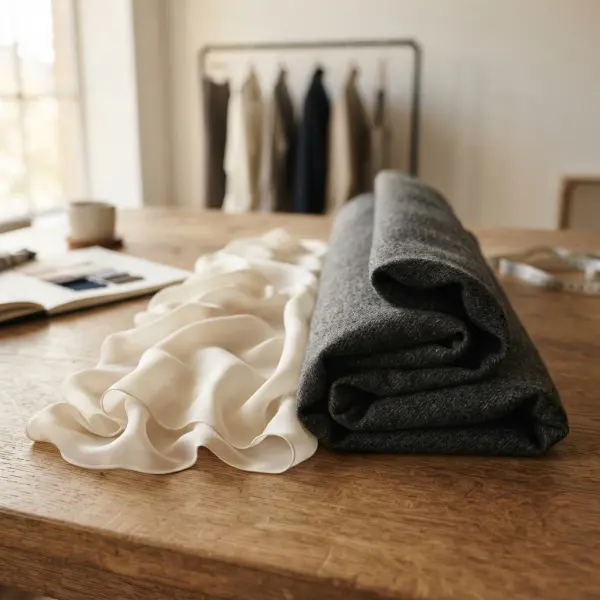
Start with the Garment, Not the GSM
The right fabric weight is determined by what the garment must do. Selecting a number before defining the product can lead to a textile that meets the specification but fails the design.
A useful material brief begins with four questions:
- What silhouette should the garment create?
- Under what conditions will it be worn?
- Which types of wear or failure must it withstand?
- What should the customer perceive when touching and wearing it?
A fluid bias-cut dress may need low bending resistance and enough mass to fall cleanly. A utility trouser may need structure, abrasion resistance, pocket support, and dimensional stability. A travel jacket may prioritize low packed weight while still requiring wind resistance and adequate strength.
The answers create a performance profile. GSM is then selected as one part of that profile.
When Does Lightweight Fabric Make Sense?
Lightweight fabric is suitable when low garment mass, mobility, packability, layering, or an airy visual character is important. It is commonly considered for warm-weather apparel, blouses, shirts, linings, flowing dresses, base layers, and some performance garments.
Its advantages are conditional. Lightweight does not automatically mean soft, breathable, cool, or weak.
Warm-Climate and High-Activity Products
Reducing fabric mass can help a garment feel less burdensome in warm conditions or during activity. The benefit depends on construction. A lightweight coated textile may restrict airflow, while a heavier open knit may permit considerable ventilation.
Air permeability should be evaluated directly when airflow is central to the product. ISO 9237:1995 describes a method for measuring the permeability of fabrics to air.
Thermal and moisture comfort require similar care. Fiber, fabric thickness, trapped air, water-vapour resistance, moisture spreading, drying behavior, garment fit, and ventilation contribute to the final experience. Low GSM alone cannot substantiate claims such as “cooling” or “highly breathable.”
Layering and Packability
Lightweight fabrics can reduce bulk when garments are intended to sit beneath other layers. Base layers, linings, packable shirts, and light shells may benefit from this approach.
Yet the complete system matters. A lightweight layer that holds moisture, creates friction, or restricts movement can make the outfit less comfortable. A shell that is too delicate may also be unsuitable for frequent packing or contact with straps and equipment.
Fluid and Airy Silhouettes
Lightweight fabrics can create softness, flutter, transparency, gathering, or volume with limited bulk. These qualities work well for selected dresses, skirts, sleeves, overlays, and blouses.
Weight is not the only determinant of movement. A light but crisp organza behaves differently from a light, fluid chiffon. The intended silhouette should therefore be translated into both weight and stiffness expectations.
ASTM D1388 measures fabric stiffness through bending length and calculated flexural rigidity. For styles in which movement is critical, a physical drape benchmark or stiffness requirement can be more informative than GSM alone.

Lower-Weight Product Engineering
A lower-weight fabric can reduce material mass per garment and may reduce shipment weight. It can also create new costs if additional lining, reinforcement, interfacing, seam stabilization, or quality control is needed.
For example, reducing the shell weight of a dress may create transparency that requires a full lining. The finished garment could then contain similar or greater total material mass than the original single-layer design.
Lightweighting works best when it is treated as product engineering rather than simple material reduction.

What Are the Risks of Choosing Fabric That Is Too Light?
A fabric can be technically lightweight yet commercially unsuitable. Problems often appear only after the material is cut, sewn, washed, or worn.
Transparency and Show-Through
Low fabric mass may contribute to reduced coverage, but opacity also depends on fiber, yarn, density, color, finish, and construction. Light colors may reveal more than dark colors in the same material.
Show-through can expose undergarments, pocket bags, seam allowances, facings, or interfacing edges. This may be intentional in a sheer design, but it becomes a quality problem when the product is marketed as opaque.
Evaluate opacity under realistic lighting, on the body, and in each planned color rather than holding a small swatch over a hand.
Seam Distortion and Handling Difficulty
Fine or unstable materials may shift, stretch, fray, pucker, or become damaged during spreading, cutting, sewing, pressing, and finishing. The factory may need suitable needles, thread, stitch density, seam construction, cutting support, and operator handling.
A lower fabric price can be offset by slower sewing, additional reinforcement, rework, or a higher rejection rate.
Insufficient Support
Pockets, zippers, buttons, snaps, embroidery, and other components concentrate force in specific areas. A lightweight fabric may need reinforcement to support them without tearing, stretching, or visibly distorting.
The reinforcement must not create an abrupt stiffness difference that shows through the garment. Compatibility matters as much as strength.
Reduced Wear Margin
Less mass may leave less material available before abrasion or fiber loss becomes visible, but the outcome depends strongly on fiber and construction. Lightweight does not automatically mean short-lived.
Where the product will encounter repeated rubbing, abrasion performance should be tested. ASTM D4966 covers testing textile-fabric abrasion resistance using the Martindale method.
Unintended Cling or Instability
Very light fabrics may cling through static, moisture, body contours, or insufficient structure. Knits may roll at cut edges, distort during sewing, or grow if the construction is unstable.
Pattern adjustment, lining, anti-static finishing, hemming, or a different fabric construction may solve the problem, but each solution affects cost and production complexity.
When Does Heavyweight Fabric Make Sense?
Heavyweight fabric is appropriate when a product needs substance, coverage, structure, protection, warmth, or a generous wear reserve. It is frequently considered for denim, workwear, sweatshirts, structured trousers, overshirts, coats, and some premium basics.
A high GSM should still serve a product requirement. Using extra weight only to create a vague impression of quality can produce an uncomfortable or inefficient garment.
Structured Silhouettes
Heavier fabrics can support defined shapes, straighter lines, and greater distance from the body. They may help trousers fall cleanly, give an overshirt visual authority, or allow outerwear to maintain a planned form.
Weight does not guarantee structure. A heavy, softly finished knit may collapse around the body, while a lighter crisp woven can hold volume. Structure depends on weight, stiffness, thickness, construction, finish, pattern, and internal support.
Coverage and Substantial Handfeel
Higher fabric mass can contribute to opacity and a sense of substance. This is useful for leggings, trousers, close-fitting knitwear, uniforms, and basic garments expected to feel less revealing.
Customers in some categories interpret substantial handfeel as reassuring or premium. That perception is not universal. A luxury warm-climate shirt, for example, may be valued for fineness and lightness rather than mass.
Commercial positioning should reflect the category and customer, not an assumption that heavier always feels more expensive.
High-Wear Applications
Workwear, uniforms, bags, utility garments, and frequently worn trousers may benefit from substantial constructions. More material can provide a wear reserve, especially when paired with suitable fibers, yarns, density, reinforcement, and finishing.
The product’s likely failure modes should still guide testing. Abrasion, tearing, seam slippage, bursting, pilling, and dimensional stability represent different risks. A high GSM result cannot replace those tests.
Cold-Weather and Protective Layering
Heavier textiles are often selected for cold-weather garments because they may provide greater thickness, density, or loft. The thermal result depends on trapped air, wind resistance, fiber, moisture, and the complete layer system.
ISO 11092:2026 specifies methods for measuring thermal resistance and water-vapour resistance under steady-state conditions. These properties should be assessed when thermal comfort is a product claim or important performance requirement.
What Are the Risks of Choosing Fabric That Is Too Heavy?
Extra substance can solve one problem while creating several others.
Heat and Moisture Discomfort
A heavier garment may feel uncomfortable in warm or humid conditions, particularly if its construction restricts air and water-vapour movement. Activity level and garment coverage intensify the effect.
Brands should evaluate the intended climate and use rather than assigning seasonality from GSM alone. A heavy open knit and a dense coated woven will behave differently.
Restricted Movement
Weight, stiffness, thickness, friction, stretch, and garment ease influence mobility together. Heavy fabric can resist folding around joints or make large garments tiring to wear.
This is particularly relevant around knees, elbows, shoulders, waistbands, and layered seam intersections. A fabric may feel acceptable as a flat swatch but become restrictive when several layers meet in the finished garment.
Stress on Seams and Support Points
Heavy garments place additional load on shoulders, waistbands, hanger loops, closures, pockets, and seams. Knitted products may lengthen during wear or storage if recovery is insufficient.
Pattern engineering and reinforcement need to distribute the weight without creating uncomfortable thickness or visible distortion.
Sewing and Pressing Difficulty
Thick seam intersections may exceed machine or folder capacity, create skipped stitches, prevent even topstitching, or produce unattractive ridges. Pressing may require different temperature, pressure, moisture, equipment, and handling.
Before approval, the factory should test representative seam intersections—not only a single layer of fabric.
Higher Material and Logistics Burden
Heavyweight material may increase purchase cost when fabric is priced by weight. It can also increase shipment mass, storage requirements, carton weight, and fulfilment charges.
The commercial effect depends on width, yield, fiber price, order volume, marker efficiency, and logistics structure. A heavier fabric that cuts efficiently may still compete well with a lighter but narrower or less stable option.
Lightweight vs Heavyweight Fabrics by Product Category
The following ranges are development starting points, not fixed standards. Actual fabrics may fall outside them and still perform well.
|
Product category |
Commonly encountered development range |
What to prioritize |
|
Lining |
Approximately 50–120 GSM |
Low bulk, smooth movement, opacity where needed, seam durability, colorfastness |
|
Blouse or lightweight shirt |
Approximately 70–160 GSM |
Drape or crispness, transparency, seam appearance, comfort, care |
|
T-shirt |
Approximately 130–240 GSM |
Opacity, recovery, surface quality, climate, silhouette |
|
Dress |
Approximately 80–280 GSM |
Drape, coverage, volume, seam support, lining requirements |
|
Casual trouser |
Approximately 170–320 GSM |
Structure, abrasion, recovery, pocket support, movement |
|
Sweatshirt or hoodie |
Approximately 240–400 GSM |
Loft, warmth, recovery, seam bulk, drying, total garment mass |
|
Denim garment |
Approximately 250–500 GSM |
Rigidity or softness, wash response, abrasion, shrinkage, comfort |
|
Outerwear shell |
Very broad; approximately 70–500+ GSM |
Weather function, layering, strength, thermal system, construction |
These ranges overlap because fabric selection is not a category lookup exercise. A 150 GSM woven dress and a 150 GSM knitted T-shirt can behave differently. A lightweight outerwear shell may use a dense, coated construction, while a heavier wool coating relies on thickness and loft.
T-Shirts and Knit Tops
For T-shirts, lighter jersey can suit warm conditions, layering, or a relaxed fluid look. Risks include show-through, neck distortion, curling, and limited recovery. Heavier jersey can support a boxy or premium-substantial silhouette, but it may feel warm and create bulky seams.
Neck rib compatibility is critical. A heavy body fabric paired with weak rib may produce poor recovery, while an overly strong rib can gather or distort a lighter neckline.
Shirts, Blouses, and Dresses
Lightweight fabrics can support gathering, soft sleeves, layered transparency, and movement. Medium weights may improve opacity and sewing stability. Heavier choices can work for shirt-jackets or structured dresses but may create bulky collars, plackets, cuffs, and gathers.
The right choice depends on whether the style should float, fall, or hold a line.
Trousers and Workwear
Trousers need enough stability for pockets, waistbands, sitting, bending, and repeated friction. Very light material may show pocket bags or strain at seams. Excess weight can restrict movement or feel uncomfortable in warm conditions.
Workwear should be selected against the actual job environment. Office uniforms, hospitality trousers, workshop clothing, and outdoor utility garments face different abrasion, movement, climate, and care demands.
Sweatshirts and Hoodies
Heavy fleece can communicate warmth and substance, but finished garment weight rises quickly because hoodies contain large overlapping panels, a hood, rib, pockets, and seam allowances. The hood may pull backward, and thick seam intersections can become difficult to sew.
A moderate-weight fabric with good loft may deliver warmth without the same mass as a denser alternative.
Outerwear
Outerwear cannot be selected by shell GSM alone. The system may include shell, membrane, coating, insulation, interlining, lining, seam tape, hardware, and reinforcement.
A light shell can belong to a highly protective garment, while a heavy coating fabric may provide warmth and structure without being waterproof. Product claims must follow the tested assembly.
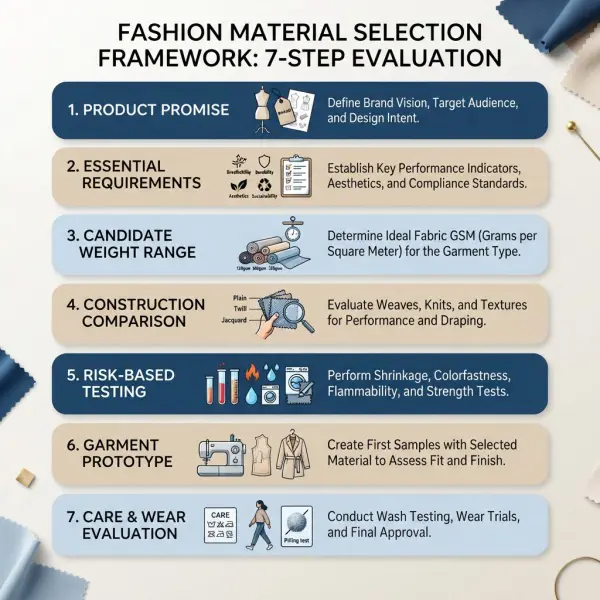
A Practical Framework for Choosing Fabric Weight
Step 1: Define the Product Promise
Write a short statement describing what the garment should deliver. For example:
“A warm-climate work shirt that remains opaque, allows routine movement, survives frequent laundering, and maintains a neat appearance.”
This is more useful than beginning with “We need 140 GSM fabric.” The GSM target should emerge from the promise.
Step 2: Identify Non-Negotiable Requirements
Separate essential requirements from preferences. Opacity may be mandatory, while an especially soft handfeel may be preferred. Abrasion resistance may be critical for work trousers but secondary for an occasional dress.
This prioritization helps when no fabric performs perfectly across every criterion.
Step 3: Build a Candidate Weight Range
Use existing successful products, supplier capability, and category knowledge to establish a starting range. Avoid locking the range so tightly that promising constructions are excluded before evaluation.
A physical benchmark should accompany the number. Words such as “substantial,” “fluid,” or “crisp” are interpreted differently across teams and suppliers.
Step 4: Compare Structure, Not Just GSM
Record fiber content, yarn type, construction, density, thickness, width, finish, stretch, recovery, and care method. Candidates with similar GSM may produce different garment results.
This stage prevents a common sourcing error: treating a cheaper same-GSM fabric as an equivalent substitute without examining how it was constructed.
Step 5: Test According to Risk
Choose tests that correspond to the garment’s use. Depending on the product, this may include:
- Dimensional stability
- Colorfastness
- Abrasion or pilling resistance
- Tear, breaking, or bursting performance
- Stretch and recovery
- Seam strength or seam slippage
- Air permeability
- Thermal or water-vapour resistance
- Water resistance or repellency
- Snagging or surface appearance
Test methods, requirements, and acceptance criteria should be agreed before bulk production.
Step 6: Produce a Representative Prototype
Use the intended material, trims, lining, interfacing, seam construction, and finishing. Review silhouette, mobility, opacity, support points, garment weight, and sewing quality.
A prototype made with a substitute fabric can confirm basic pattern shape but may not validate the final material decision.
Step 7: Conduct Care and Wear Evaluation
The first fitting does not reveal how the fabric will behave after washing, drying, pressing, folding, hanging, sitting, or extended movement. Testing should reproduce the care instructions and realistic use conditions.
If the product depends on a special finish, assess whether its appearance or performance changes during intended care.
How Fabric Weight Affects Sourcing and Manufacturing
Supplier Quotations
A lower price per metre may reflect lower GSM, narrower usable width, different fiber content, simplified finishing, or weaker performance. A higher price may reflect expensive fiber or processing rather than weight.
Compare quotations using:
- Finished GSM and tolerance
- Total and usable width
- Price unit: metre, yard, or kilogram
- Fiber and construction
- Finish and color
- Shrinkage and defect allowance
- Minimum order quantity
- Test requirements
- Freight and delivery terms
This makes cost differences visible instead of attributing them vaguely to “quality.”
Fabric Yield
When fabric is purchased by kilogram, lighter GSM can provide more theoretical linear metres at the same width. Garment yield still depends on marker efficiency, size ratio, shrinkage, matching, defects, and cutting loss.
When fabric is purchased by metre, width can be as commercially important as GSM. A wider material may produce better marker yield even if its price per metre is higher.
Cutting
Lightweight fabrics may shift, distort, or lift during spreading and cutting. Heavy fabrics may limit lay height because the stack becomes difficult to compress or cut accurately.
The cutting room should establish spreading tension, lay height, rest time, cutting equipment, and handling procedures for the actual material. The fabric cutting process must accommodate the selected weight rather than assume one standard setup.
Sewing
Lightweight textiles may require fine needles, suitable thread, controlled tension, stabilization, and careful feeding. Heavyweight materials may require stronger machines, appropriate needles and thread, reduced seam bulk, and equipment capable of handling thick intersections.
Production trials should use critical operations such as collars, waistbands, pocket corners, hems, zippers, and crossed seams.
Pressing and Finishing
Weight and thickness affect how quickly heat and moisture move through a fabric. Delicate lightweight textiles can mark, glaze, shrink, or distort. Heavy fabrics may require more time or pressure to shape seams effectively.
Pressing conditions should be developed for the exact fiber, finish, color, and construction. More pressure is not automatically the correct answer for heavier fabric.
Retail and Customer Communication
Fabric weight can help customers understand product differences, especially when shopping online. Terms such as lightweight, mid-weight, and heavyweight are useful when accompanied by context.
A product description might explain that a T-shirt uses “a substantial 240 GSM jersey designed for a structured fit,” or that a shirt uses “a lightweight 110 GSM woven fabric intended for warm-weather layering.”
This is more informative than presenting GSM as a quality rank.
Customer communication should clarify:
- Intended season or climate
- Whether the garment is lined
- Level of opacity
- Fit and silhouette
- Stretch and structure
- Layering purpose
- Expected warmth
- Care requirements
Product photography and video should also show movement and thickness realistically. If marketing describes a garment as airy, structured, or substantial, the visual presentation should support that expectation.

Common Fabric-Weight Selection Mistakes
Choosing the Highest GSM to Signal Quality
This approach overlooks whether customers actually want the extra warmth, bulk, and garment mass. It can also increase cost and create production problems without improving relevant performance.
Quality should be defined as fitness for purpose, consistency, construction, appearance, and service life—not maximum mass.
Copying a Competitor’s GSM
A competitor’s published weight does not reveal its yarn, construction, finish, test method, pattern, supplier capability, or customer profile. Copying the number may produce a very different result.
Competitor information can provide a market reference, but the product should be developed and tested independently.
Selecting by Climate Alone
Warm climate does not always require the lowest possible GSM, and cold climate does not always require the heaviest shell. Coverage, activity, ventilation, moisture, wind, layering, and customer habits also matter.
Climate should be translated into measurable comfort requirements rather than a single weight rule.
Ignoring Color Variations
Different colors can change perceived opacity, heat absorption in sunlight, surface appearance, and sometimes processing behavior. A fabric approved in black may not perform visually the same way in white or pastel colors.
Review each important color in garment form.
Changing GSM Without Rechecking the Pattern
A lighter or heavier version may fall differently, alter fit perception, change seam bulk, or place different loads on elastic and support points.
Fabric substitution should trigger a targeted pattern, construction, and fit review.
Focusing on Fabric Price Instead of Total Product Cost
A cheaper lightweight fabric may require lining, reinforcement, slower sewing, or higher rejection. A heavy option may increase freight and storage costs. Either can affect return risk if the customer receives a product that feels different from the marketing promise.
Compare the total product cost and commercial risk, not only the supplier’s material price.
What Brands Should Verify Before Final Approval
Before approving a lightweight or heavyweight fabric, confirm:
- Is the GSM measured on finished and properly conditioned fabric?
- Is the quoted range achievable consistently in bulk?
- Does the construction reproduce the approved drape and handfeel?
- Is every planned color sufficiently opaque?
- Does the fabric support trims, seams, pockets, and closures?
- Is garment movement suitable for the intended activity?
- Does the material meet relevant durability requirements?
- Is the thermal and moisture behavior suitable for the target climate?
- Can the factory cut, sew, press, and finish it reliably?
- Has the complete garment passed intended care and wear evaluation?
- Does the total cost include lining, reinforcement, production, freight, and returns risk?
- Can marketing describe the product accurately without equating weight with quality?
A fabric should move into bulk production only when the material, pattern, construction, factory process, and customer promise work together.
Frequently Asked Questions
Is lightweight or heavyweight fabric better?
Neither is universally better. Lightweight fabric may suit warm-weather clothing, layering, travel products, or fluid silhouettes. Heavyweight fabric may be more suitable for structure, coverage, warmth, or high-wear applications. The decision should reflect garment use, climate, construction, durability requirements, production capability, and customer expectations. Compare actual fabric samples and finished prototypes rather than selecting from GSM alone.
What GSM is best for a T-shirt?
Many T-shirt fabrics fall broadly between approximately 130 and 240 GSM, but there is no single best weight. A lighter jersey may suit warm conditions or layering, while a heavier jersey can create a more structured silhouette and greater coverage. Fiber, stitch construction, compactness, stretch, recovery, shrinkage, and finish can make two equal-GSM jerseys behave differently. The neckline, seams, fit, and intended market should be evaluated in a finished sample.
What GSM should be used for trousers?
Casual trouser fabrics are often encountered around 170–320 GSM, while some products sit outside that range. The appropriate weight depends on the silhouette, fiber, stretch, opacity, climate, pockets, abrasion exposure, and intended formality. Wide-leg trousers may need enough mass to hang cleanly, whereas active or warm-climate trousers may prioritize lower weight and mobility. Test seam strength, recovery, dimensional stability, and wear at high-friction areas.
Is heavyweight cotton always more durable?
No. Heavyweight cotton may contain more material per unit area, but durability depends on fiber quality, yarn strength, weave or knit construction, finishing, abrasion, tearing, pilling, seams, and care. A heavy, loosely constructed cotton may distort or abrade quickly. A lighter compact textile may perform better for a specific use. Durability claims should be supported by relevant testing and product trials rather than GSM.
Can lightweight fabric still be opaque?
Yes. Opacity depends on construction density, yarn, fiber, color, finish, thickness, stretch, and light conditions as well as weight. A compact lightweight fabric can provide useful coverage, while a heavier open or stretched textile may reveal more than expected. Test every important color on the body under realistic lighting and movement. For close-fitting garments, evaluate opacity at the expected stretch level.
Should outerwear always use heavyweight fabric?
No. Outerwear ranges from ultralight shells to heavy wool coats. Performance depends on the complete assembly, including shell construction, coatings or membranes, insulation, lining, seam treatment, ventilation, and garment design. A lightweight shell can provide wind or rain protection when properly engineered, while a heavy coating fabric may emphasize warmth and structure. Define the intended weather conditions and validate the finished system.
Can a brand reduce GSM to lower costs?
A brand can investigate lower GSM, but the change should be treated as material redevelopment. Reduced weight may affect opacity, drape, stability, durability, sewing, shrinkage, and customer perception. Any savings can be offset by lining, reinforcement, production inefficiency, complaints, or returns. Compare prototypes, repeat relevant tests, recalculate total product cost, and communicate any intentional product difference accurately.
How should GSM be communicated to customers?
Use GSM together with a plain-language explanation of the garment’s feel and purpose. For example, describe a 280 GSM sweatshirt as substantial and intended for cooler layering rather than claiming that it is automatically higher quality. Clarify fit, lining, stretch, warmth, opacity, and seasonality where relevant. Published values should be accurate, and normal production tolerance should not materially change the customer experience.
Conclusion
Choosing between lightweight and heavyweight fabric is not a contest between less and more material. It is a product decision that connects silhouette, comfort, durability, production, cost, climate, and customer perception.
Lightweight textiles can deliver mobility, fluidity, layering, and packability, but they may require careful control of opacity, seams, support, and wear. Heavyweight textiles can provide substance, structure, and coverage while introducing heat, bulk, sewing challenges, and additional load.
The right choice is rarely found by reading a GSM chart in isolation. It emerges from a defined product promise, a complete fabric specification, representative testing, and a finished garment prototype. When those elements agree, fabric weight becomes a strategic design and sourcing decision rather than an arbitrary number.





Comments 0
Leave a CommentSend Comment
Anda harus Login terlebih dahulu untuk dapat memberikan komentar.