
Fusible vs Sew-In Interlining: What Fashion Teams Should Know
Two garments can use almost identical shell fabrics and still require very different approaches to internal support.
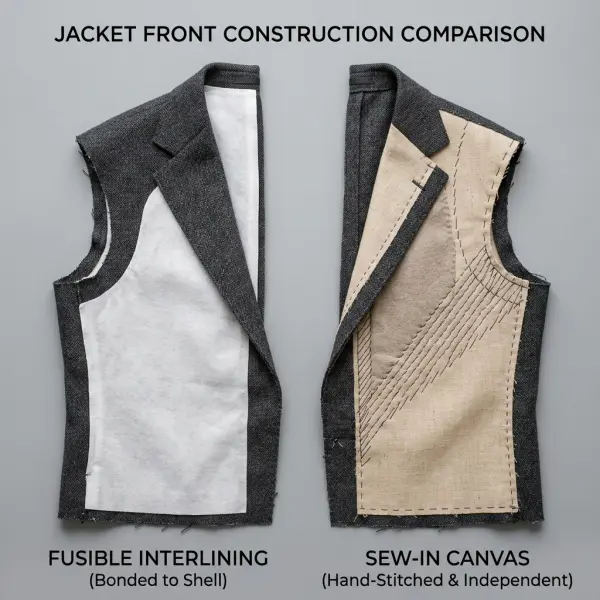
One may use a fusible interlining bonded directly to the shell under controlled heat, pressure, and time. Another may depend on a sew-in canvas or other non-fusible support attached through stitching and garment construction. Both methods can stabilize a garment. They simply achieve that support in different ways.
For fashion teams, the choice is not a debate between a modern method and an old-fashioned one. Fusible interlining is highly practical for industrial production and appears across shirts, trousers, dresses, jackets, coats, and other apparel. Sew-in systems remain important in traditional tailoring, premium structured garments, heat-sensitive materials, and situations where bonding the support directly to the shell is undesirable.
The better option depends on the shell fabric, required silhouette, handfeel, care method, equipment, labor capability, production volume, cost structure, and quality target.
That makes the decision a product-engineering question rather than a simple materials preference.
Quick Answer
Fusible interlining is an interlining coated with thermoplastic adhesive that is bonded to garment fabric using controlled heat, pressure, and time. Sew-in interlining is incorporated into the garment through stitching or construction rather than adhesive bonding.
Fusible systems are widely suited to repeatable industrial production because large garment components can be reinforced efficiently and consistently when the fabric, adhesive, and fusing conditions are compatible. Sew-in interlinings avoid the need to bond adhesive to the shell and are particularly relevant to traditional tailoring, certain delicate or heat-sensitive fabrics, and constructions where independent movement between the shell and internal structure is desirable. Chargeurs PCC similarly distinguishes fusible interfacing as heat-bonded material and sew-in interlining as an unglued structural layer secured through sewing.
Neither method is universally better. Fashion teams should evaluate garment design, shell sensitivity, required drape, manufacturing process, care conditions, production scale, and test results before approving one system.
First, What Is the Difference Between Fusible and Sew-In Interlining?
The fundamental difference is the attachment method.
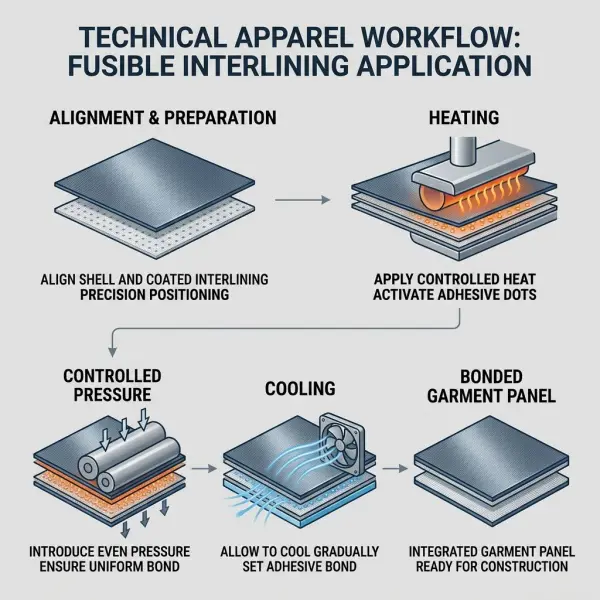
A fusible interlining contains an adhesive coating, commonly based on a thermoplastic resin. During fusing, heat softens or melts the adhesive sufficiently for it to interact with the shell fabric. Pressure brings the two textile surfaces into appropriate contact, and cooling helps consolidate the bond.
A sew-in interlining does not depend on this adhesive bond. The supporting textile is positioned within the garment and secured through sewing and construction techniques.
This distinction should not be confused with whether the interlining itself is woven, knitted, or nonwoven.
As explained in Interlining Fabric Explained for Garment Structure and Support, those terms describe the textile base structure. Fusible and sew-in describe how that structural material is integrated into the garment.
A woven interlining, for example, can be manufactured as a fusible product with an adhesive coating or as an uncoated sew-in material.
That distinction is basic, but commercially important. If a tech pack says only "woven interfacing," the factory still does not know whether the material is intended to be fused or incorporated through sewing.
How Fusible Interlining Works
Fusible interlining creates a composite in which the interlining and shell fabric are bonded over the selected area.
The process is more sophisticated than simply putting adhesive behind a fabric and pressing it.
A typical fusible product consists of:
- a textile substrate, which may be woven, knitted, or nonwoven;
- an adhesive coating formulated for the intended textile and care conditions;
- a coating pattern and quantity designed to create the required bond without unnecessarily changing the shell.
Commercial products may use adhesive dots rather than a continuous adhesive film because localized coating can preserve greater flexibility in the resulting textile composite. Technical literature on fusible interlinings also describes thermoplastic resin systems applied to interlining substrates before bonding to garment fabrics.
During production, several variables interact.
Temperature
Enough heat must reach the adhesive for it to develop the intended bonding characteristics.
Too little heat can result in inadequate bonding. Excessive temperature, meanwhile, can cause adhesive to flow too aggressively or can affect heat-sensitive shell fabrics.
Pressure
Pressure creates contact between the interlining and outer fabric while the adhesive is activated.
The appropriate pressure depends on the materials and fusing equipment. More pressure is not automatically better. Excessive pressure can flatten textured surfaces or encourage unwanted resin penetration on sensitive fabrics.
Time
The assembly must remain within the effective fusing conditions long enough for heat transfer and bonding to occur.
Changing the conveyor speed of a continuous press, for example, changes how long a garment component spends in the heating zone.
Cooling
The fused component also needs appropriate cooling before handling because the adhesive bond consolidates as the assembly cools.
A major technical review of fusible interlining identifies temperature, pressure, processing time, and cooling among the core conditions required for reliable fusing.
The practical conclusion is important: there is no single universal fusing temperature or press setting that fashion teams should apply to every fabric.
The supplier's specification and tests on the actual shell-interlining combination should determine production parameters.
How Sew-In Interlining Works
Sew-in interlining supports the garment without creating a full adhesive bond between the structural layer and the shell fabric.
Instead, the interlining becomes part of the garment through stitching, seam attachment, pad stitching, edge control, or other construction methods depending on the product.
This allows the shell and internal support to behave more independently than a fully fused composite.
In traditional tailoring, that distinction can be central to how a jacket front, chest, or lapel is engineered. Tailoring canvases, chest pieces, undercollar felts, sleeve heads, and similar internal components remain commercial sew-in product categories. Chargeurs PCC, for example, currently lists both fusible and sew-in solutions and identifies tailoring canvas and chest pieces among sew-in applications for jackets and coats.
This does not mean every sew-in garment is handcrafted or luxury-priced.
Sew-in shirt interlinings, for example, also exist for collars, cuffs, and plackets. Current supplier ranges include uncoated woven shirt interlinings designed for sewing rather than fusing.
The difference lies in the construction system.
Because no fusible adhesive needs to be activated against the shell, sew-in interlining can also be valuable when heat, pressure, adhesive penetration, surface sensitivity, or the desired garment hand makes direct bonding problematic.
Fusible vs Sew-In Interlining at a Glance
The easiest way to understand the choice is to compare what each method changes operationally.
|
Decision factor |
Fusible interlining |
Sew-in interlining |
|
Attachment |
Adhesive bond activated under specified fusing conditions |
Incorporated through sewing or garment construction |
|
Relationship with shell |
Usually bonded across the supported area |
Can retain more independent movement |
|
Production equipment |
Requires suitable fusing equipment or controlled pressing method |
Requires sewing operations and appropriate construction capability |
|
Production speed |
Can support efficient, repeatable processing at industrial scale |
May require more sewing and handling, depending on construction |
|
Fabric sensitivity |
Must tolerate compatible adhesive, heat, pressure, and processing |
Useful when bonding or fusing conditions are unsuitable |
|
Tailoring application |
Common in modern tailored and ready-to-wear products |
Important in traditional canvas and structured tailoring |
|
Failure risks |
Delamination, bubbling, strike-through, surface change, excessive stiffness, poor bonding |
Distortion, bulk, shifting, inconsistent construction, additional labor if poorly controlled |
|
Modification during assembly |
Bonded areas are less independent once fused |
Individual structural layers can often be manipulated more independently |
|
Quality control emphasis |
Bond quality plus appearance and dimensional compatibility |
Sewing accuracy, positioning, balance, bulk, and structural consistency |
The table should not be read as a scorecard.
A well-engineered fusible jacket can outperform a poorly executed canvas construction, and a carefully developed sew-in garment can deliver characteristics that a particular fusible combination cannot.
Execution matters as much as category.
Why Fusible Interlining Became So Important in Apparel Manufacturing
Fusible systems allow garment manufacturers to add controlled reinforcement without sewing every point of an interlining to the shell.
That has obvious industrial value.
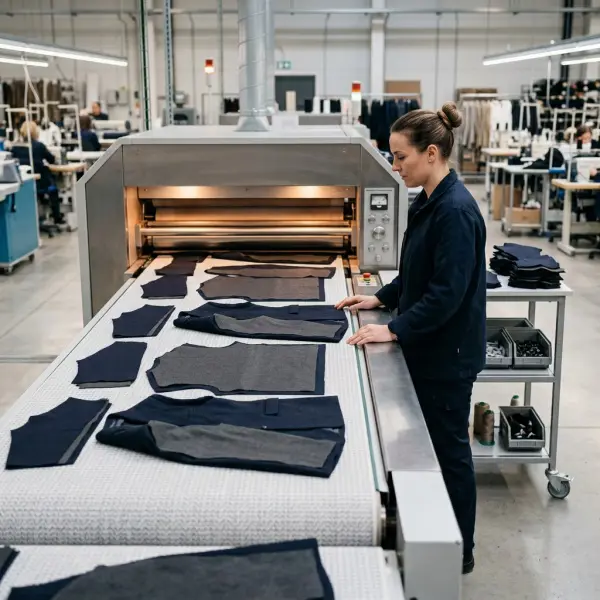
Once a material combination and process have been validated, components can be cut, aligned, fused, cooled, and passed to subsequent sewing operations in a relatively repeatable workflow. Continuous fusing presses are particularly compatible with production environments handling significant garment volumes.
This can reduce handling complexity and help factories standardize the appearance of reinforced areas.
It also explains why fusible technology is not confined to inexpensive garments. Current commercial interlining ranges include highly specialized fusible woven and knitted products intended for shirts, tailoring, coats, dresses, stretch garments, and premium apparel.
What industrial efficiency does not mean is that fusible interlining is automatically the cheapest option in every product.
Cost depends on material price, yield, fusing equipment, energy, labor, production volume, process control, quality losses, and the construction steps being replaced.
The commercial advantage comes from an efficient system, not merely from the presence of adhesive.
Why Sew-In Interlining Still Matters
If fusible processing is efficient, why not fuse everything?
Because bonding the support directly to the shell changes the material system, and that is not desirable for every garment.
Sew-in construction remains particularly relevant when the design requires a more traditional internal architecture, when the shell should move somewhat independently from the support, or when adhesive and fusing conditions create unacceptable risks.
Tailored jackets offer a familiar example.
A traditional canvas structure can be built from internal layers shaped and stitched into the garment rather than permanently fused over the entire supported surface. The result depends heavily on the quality of the canvas, pattern, pressing, stitching, tailoring skill, and overall construction.
This should not be reduced to the claim that canvas is always better than fusible tailoring.
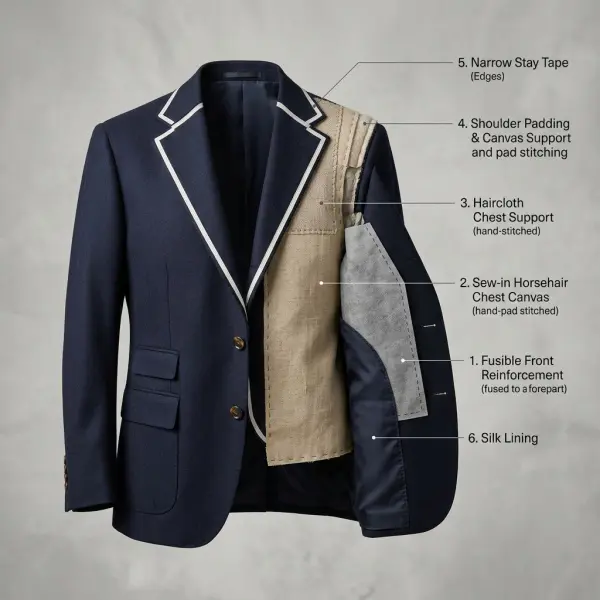
Different brands sell different products at different price points, production volumes, and silhouette expectations. Modern tailoring can also combine techniques—for example, using fusible support in some areas and sew-in structural components in others.
A hybrid construction may make more commercial sense than choosing one philosophy for the entire garment.
Fabric Compatibility Should Come Before Production Convenience
One of the easiest sourcing mistakes is selecting an attachment method because it suits the factory rather than because it suits the fabric.
A manufacturer equipped with efficient continuous fusing machines may naturally prefer fusible solutions. That does not remove the need for compatibility testing.
Certain shell fabrics can respond poorly to the heat, pressure, moisture, or adhesive involved in fusing.
Potential issues include changes to:
- surface texture;
- color or shade;
- loft;
- elasticity;
- dimensional stability;
- handfeel;
- drape;
- visual smoothness.
Sheer and very lightweight fabrics also require particular caution because adhesive penetration can become visible on the face of the garment.
Technical literature describes strike-through as adhesive resin penetrating toward or through the face fabric, with risks increasing under unsuitable combinations of temperature, pressure, time, material structure, and adhesive quantity.
Highly textured surfaces create another challenge. Excessive press pressure can flatten or mark the shell even if the adhesive itself technically bonds.
This is one reason sew-in systems remain relevant for delicate materials. Chargeurs PCC specifically identifies sew-in interlining as an option for fabrics that do not tolerate adhesive bonding or the heat involved in fusible application.
That does not mean "delicate fabric = sew-in" should become another oversimplified rule.
Low-temperature adhesives and lightweight fusibles may work well on many sensitive fabrics. Only testing can establish whether a particular combination is acceptable.
What Can Go Wrong With Fusible Interlining?
Fusible interlining is reliable when properly specified and processed. When the material system or fusing conditions are wrong, however, defects can become highly visible.
Several failure modes matter in industrial quality control.
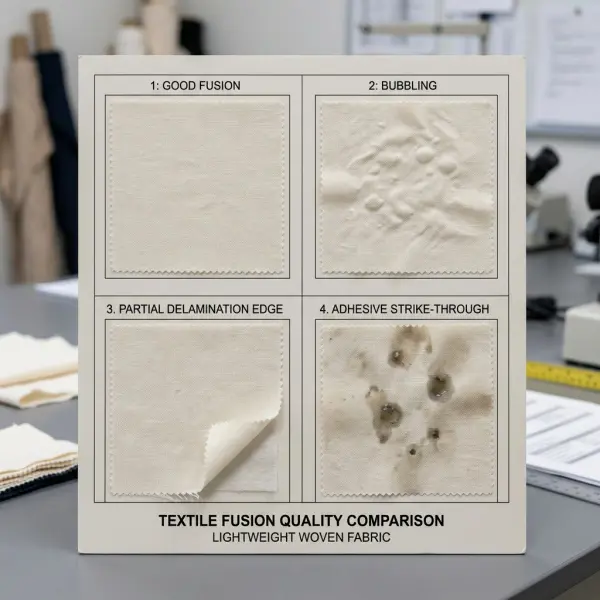
Delamination
Delamination occurs when the interlining loses its bond with the shell.
A component that initially appears flat may develop areas where the layers separate during production, wear, laundering, or dry cleaning.
Possible contributors include inadequate bonding, unsuitable adhesive compatibility, incorrect fusing conditions, or insufficient cooling.
From a business perspective, delamination is particularly problematic because it may escape factory inspection and only become obvious after the customer begins caring for the garment.
Bubbling
Bubbling creates an uneven or puckered surface where the fused layers no longer lie together smoothly.
It can result from poor bonding, differential dimensional change, inconsistent fusing conditions, or delamination.
On a jacket front or collar, the visual consequence can immediately downgrade the perceived quality of the entire garment.
Strike-Through and Strike-Back
When adhesive flows too far into the textile system, resin can penetrate toward the face fabric or back into the interlining.
On lightweight or sensitive fabrics, this can affect appearance and hand.
Increasing temperature or pressure in response to weak bonding without understanding the cause can therefore make the problem worse rather than better.
Excessive Stiffness
A fused composite can become too board-like when the interlining, adhesive quantity, or processing conditions produce more rigidity than the design requires.
Research on fusible interlining identifies changes in mechanical properties after bonding because the shell and interlining begin functioning as a laminated composite rather than two independent fabrics.
This is why a development team should judge the fused sample, not simply touch the interlining roll.
Differential Shrinkage
The shell and interlining may react differently to heat, moisture, laundering, or other care processes.
If their dimensional behavior diverges significantly, the garment surface can distort.
Testing before production is substantially cheaper than discovering that relationship after thousands of components have already been fused.
Sew-In Interlining Has Its Own Production Risks
Avoiding adhesive does not eliminate manufacturing problems. It changes them.
Sew-in interlinings need to be positioned, controlled, and incorporated accurately into the garment. If the internal structure is incorrectly balanced, the shell can pull, distort, or hang poorly.
Bulky seam areas can become another issue when multiple internal layers meet.
In tailored construction, inconsistent stitching or shaping can also create differences between operators. This becomes commercially significant when a brand moves from a highly skilled sample maker to bulk production requiring dozens of operators to reproduce the same garment.
The main risks tend to include:
- incorrect positioning or grain direction;
- shifting during sewing;
- unwanted bulk near seams;
- inconsistent shaping;
- puckering or tension caused by poor attachment;
- additional handling and labor;
- greater dependence on sewing capability for complex constructions.
These risks are different from delamination and adhesive strike-through, but they are not necessarily less important.
For a brand considering sew-in construction, the question should therefore include factory capability:
Can this supplier reproduce the intended internal construction consistently at the required production volume?
Does Fusible Interlining Always Reduce Production Cost?
No.
Fusible systems can simplify assembly and reduce certain sewing operations, which can make them economically attractive in industrial production. But total cost should be assessed at garment level.
A technically weak sourcing comparison might look only at:
Fusible interlining price versus sew-in canvas price.
A more useful comparison includes:
- material consumption;
- cutting yield;
- fusing equipment and maintenance;
- energy;
- operator time;
- sewing operations;
- pressing;
- production throughput;
- rejection and rework;
- testing requirements;
- expected care durability.
Suppose a garment manufacturer saves sewing minutes by using fusible support but experiences frequent re-fusing, bubbling, or surface rejection because the combination has not been properly developed. The theoretical labor saving quickly becomes irrelevant.
The reverse also applies. A sew-in construction that produces an attractive sample but requires highly specialized labor may become difficult to scale across multiple factories or large order quantities.
Cost engineering should therefore compare the complete approved construction, not one component in isolation.
How Production Scale Changes the Decision
Production volume changes what "practical" means.
A small atelier producing a few dozen tailored jackets may accept construction steps that would be difficult for a factory producing tens of thousands of units.
Large-scale apparel operations usually value processes that are:
- repeatable;
- measurable;
- trainable;
- compatible with established equipment;
- fast enough for required output;
- easy to inspect.
Fusible systems can fit this environment well because press parameters can be standardized and monitored.
But production scale does not automatically eliminate sew-in interlining. Sew-in products are also used industrially, particularly where the garment architecture or material requires them.
The critical distinction is whether the construction has been engineered for the chosen manufacturing environment.
A beautiful prototype that cannot be reproduced consistently is not yet a commercially resolved product.
When Fusible Interlining May Be the More Practical Choice
Fusible interlining often makes sense when the shell can tolerate the required fusing process and the product benefits from consistent bonded reinforcement.
Common examples can include shirt collars and cuffs, waistbands, jacket fronts, facings, plackets, pocket areas, and selected dress or blouse components.
Commercial interlining suppliers currently offer fusible materials for all of these categories, including woven, knitted, and nonwoven bases.
From a business standpoint, fusible systems can be particularly attractive when:
- production volumes justify standardized fusing;
- manufacturing facilities have appropriate equipment;
- the shell and adhesive are compatible;
- consistent reinforcement is required across many units;
- reducing sewing complexity provides meaningful production value;
- test results confirm adequate bond durability.
The final condition matters most.
Fusible should be chosen because the tested system works, not simply because the factory owns a fusing press.
When Sew-In Interlining May Be the More Appropriate Choice
Sew-in construction becomes particularly relevant when direct adhesive bonding would interfere with the product.
This may include certain:
- heat-sensitive fabrics;
- highly textured fabrics;
- delicate or surface-sensitive materials;
- traditional tailored constructions;
- garments requiring particular internal movement;
- premium canvas-based jackets and coats;
- specialized shirt constructions.
It may also be selected for aesthetic reasons. A brand producing traditional tailoring may deliberately choose canvas construction because the internal architecture is part of the product proposition.
That business case is different from merely saying sew-in is "higher quality."
Quality is an outcome of materials, engineering, workmanship, consistency, and fitness for purpose.
A badly constructed canvas jacket is not superior because it contains canvas. Likewise, the use of fusible interlining does not automatically identify a garment as low quality.
Hybrid Construction Is Often the More Useful Question
Real garment engineering does not always fit a binary choice.
A jacket may use fusible reinforcement in one area, a chest piece in another, shoulder support elsewhere, and additional tapes around specific edges.
Manufacturers offer specialized components precisely because different parts of one garment perform different jobs.
This creates a more productive question for fashion teams:
Instead of asking "Should this garment be fusible or sew-in?", ask "Which construction method should support each functional area?"
That approach can balance:
- appearance;
- drape;
- production efficiency;
- tailoring behavior;
- cost;
- scalability.
It also prevents a traditional classification such as "fused jacket" or "canvas jacket" from oversimplifying a much more detailed internal construction.
How Fashion Teams Should Test Fusible Interlining
Fusible interlining should be evaluated as a shell-interlining-process combination.
Testing only the adhesive material is not enough.
A sensible development trial uses the actual bulk-intent shell fabric and candidate interlining under documented processing conditions.
Teams should examine:
Appearance
Does the face remain smooth?
Check for bubbling, pressing marks, shade change, adhesive penetration, texture flattening, and unwanted surface distortion.
Hand and Drape
Has the garment component become noticeably harder or less flexible than intended?
Design and technical teams should both assess this because a bond can be technically strong but aesthetically wrong.
Bond Integrity
The interlining needs adequate attachment for production handling and the expected care process.
Peel or bond-strength testing may be used in technical evaluation, but required criteria should follow the brand's specification, supplier guidance, material system, and intended product use rather than an arbitrary universal number.
Dimensional Compatibility
Compare shrinkage and deformation after the relevant heat, moisture, washing, dry-cleaning, or finishing conditions.
Repeated Care Performance
A garment designed for repeated laundering should not be approved solely on the basis of an untouched fused sample.
Published technical research on fusible interlinings repeatedly identifies bonding conditions and post-care performance as important to the quality of fused composites.
How Fashion Teams Should Evaluate Sew-In Construction
The quality controls are different because there is no adhesive bond to evaluate.
Teams need to inspect how well the support has been integrated into the garment.
Relevant checks include:
- correct size and positioning of the interlining;
- grain and stretch orientation;
- attachment points;
- seam and edge control;
- bulk at construction junctions;
- balance and symmetry;
- shell smoothness;
- movement and drape;
- consistency between samples and bulk units.
For tailored products, evaluating the garment on the body or an appropriate form is particularly important.
A sew-in structure can appear acceptable while lying flat on a table yet behave differently around the chest, shoulder, lapel, or neckline once three-dimensional shaping is involved.
What Fashion Brands Should Put in the Tech Pack
"Add interfacing" is not a sufficient specification for commercial production.
The exact information required varies by garment and company, but a useful tech pack may identify:
- interlining supplier;
- product or article reference;
- base construction;
- composition where relevant;
- fusible or sew-in attachment;
- color;
- weight or supplier specification;
- garment application area;
- orientation;
- approved alternative;
- fusing conditions according to approved test;
- care requirement;
- reference sample or approval standard.
For sew-in tailoring, construction diagrams may also be needed to communicate placement, seam attachment, pad-stitching areas, chest-piece dimensions, or other details.
This level of control becomes more important as sourcing becomes geographically distributed.
Without it, the garment approved in development and the garment produced six months later may contain materially different internal structures.
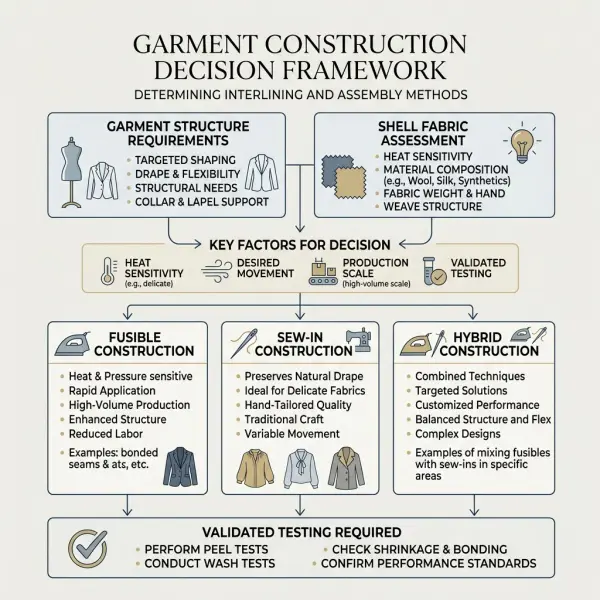
Practical Decision Framework for Fashion Businesses
When choosing between fusible and sew-in interlining, start with the product rather than with factory habit.
Step 1: Define the required garment behavior
Should the component be crisp, softly supported, flexible, stretchable, sculpted, or highly stable?
The answer determines what the internal structure needs to achieve.
Step 2: Understand the shell
Document weight, thickness, construction, stretch, texture, fiber content, finishing, and sensitivity to heat or pressure.
Step 3: Identify manufacturing constraints
Check available fusing equipment, sewing skills, throughput requirements, factory experience, production volume, and quality-control capability.
Step 4: Build competing prototypes
When the decision is not obvious, testing a fusible and sew-in option can reveal differences that are difficult to predict from specifications alone.
Step 5: Evaluate after finishing and care
The garment should survive its actual expected lifecycle, not merely the sample-room approval meeting.
Step 6: Compare total commercial cost
Include manufacturing time, rework risk, scalability, quality consistency, and expected durability—not only trim prices.
This framework shifts the discussion from "Which method is better?" to a much more useful question: Which construction reliably delivers this garment at the intended quality, scale, and cost?
Common Decision Mistakes
Assuming Fusible Means Low Quality
It does not.
High-end and technically demanding garments can use sophisticated fusible products. The quality question is whether the chosen system produces the required garment behavior and remains reliable through production and care.
Assuming Sew-In Automatically Means Premium
Canvas and other sew-in constructions can support premium tailoring, but the presence of a sew-in interlining does not guarantee good pattern engineering or workmanship.
Construction quality still needs to be evaluated.
Copying Fusing Settings From Another Fabric
This is risky because thermal behavior, surface structure, thickness, adhesive compatibility, and pressure sensitivity vary between shell materials.
Use supplier guidance as a starting point and verify the actual combination.
Solving Weak Adhesion by Simply Increasing Heat
Poor bonding can result from several causes.
Increasing temperature without understanding them may damage the shell or create excessive adhesive flow. Time, pressure, material compatibility, equipment condition, adhesive type, and cooling may also need investigation.
Comparing Only Material Prices
Interlining affects operations downstream.
A cheaper roll is not cheaper if it increases labor, rejection, rework, returns, or production variability.
Forgetting That One Garment Can Use Both Systems
Complex garments do not necessarily require one universal interlining method.
Hybrid engineering can be more effective when individual garment areas need different types of support.
Important Technical Caveats
There is no universal fusing recipe that safely applies to all shell fabrics and fusible interlinings.
Technical publications may provide broad ranges for temperature, time, or pressure, but production specifications should be based on the specific adhesive system, shell fabric, interlining, equipment, garment finish, and supplier recommendations. A review of industrial fusible interlinings explicitly notes that effective processing conditions depend on resin characteristics and the complete fusing system.
Supplier documentation reinforces the same principle. Freudenberg advises testing the handle and bond on the actual material and following product-specific fusing instructions rather than assuming one method fits all products.
This matters because raising temperature, pressure, or time is not a neutral adjustment. It can change adhesive penetration, shell appearance, shrinkage, and final hand.
Likewise, choosing sew-in does not remove the need for validation. Grain direction, construction, sewing tension, placement, and interaction with the outer fabric still need to be tested.
For both systems, compatibility testing is part of material selection—not an optional check after selection has already been made.
How the Choice Affects Shape, Stability, and Finish
Attachment method changes how the support interacts with the garment.
Fusing creates a composite in which the outer fabric and interlining behave more closely as one bonded structure. Sew-in systems can allow a greater degree of independent movement between layers, depending on how the component is constructed.
Those differences can influence bending, drape, resilience, surface smoothness, lapel behavior, edge definition, and long-term appearance.
They deserve more detailed treatment than a simple fusible-versus-sew-in comparison.
The companion article How Interlining Improves Garment Shape, Stability, and Finish examines those performance effects specifically, including why reinforcement should be judged through the finished garment rather than by interlining specifications alone.
Frequently Asked Questions
Is fusible interlining stronger than sew-in interlining?
Not as a universal rule.
"Strength" could refer to adhesive bond strength, textile tensile strength, structural support, dimensional stability, or durability after laundering. Fusible and sew-in systems achieve support differently, so one number cannot meaningfully rank them in every garment.
A fusible interlining needs an adequate and durable bond with its shell. A sew-in structure depends more on material construction, sewing, positioning, and garment engineering. Fashion teams should define which performance property matters and test the complete construction rather than assuming attachment method determines overall strength.
Can fusible interlining be used in tailored jackets?
Yes. Fusible interlinings are widely available for jacket and coat fronts, including sophisticated woven and knitted constructions designed for tailoring applications. Current supplier catalogs include weft-inserted fusible products specifically recommended for jacket fronts.
Traditional canvas tailoring remains another option, and some jackets combine fusible and sew-in components.
The appropriate construction depends on silhouette, shell fabric, target hand, brand positioning, factory capability, production scale, and price architecture. A jacket should therefore not be classified as high or low quality solely from whether fusible reinforcement appears inside it.
Why does fusible interlining sometimes bubble after washing?
Bubbling can occur when the shell and interlining no longer remain uniformly bonded.
Potential causes include inadequate initial bonding, differential shrinkage, unsuitable adhesive compatibility, uneven fusing conditions, or delamination during subsequent care. Technical literature identifies all of these as relevant mechanisms.
Because the defect may appear only after laundering or dry cleaning, brands should validate fused samples under the actual expected care conditions before bulk approval. Inspecting only freshly fused components can miss problems that develop later.
Is sew-in interlining better for delicate fabrics?
It can be, particularly when the shell is sensitive to the heat, pressure, or adhesive required for fusing. Sew-in systems avoid permanently bonding adhesive across the supported area.
But "delicate" covers many different textiles. Some lightweight or sensitive fabrics can work with carefully selected low-temperature or lightweight fusible products.
The safest decision is therefore not to classify the fabric by name alone. Test the specific shell and candidate interlining for surface change, hand, drape, dimensional stability, and intended care performance.
Do factories need a fusing press to use fusible interlining?
Not every application necessarily uses the same equipment. Fusible materials can be applied with different controlled heating methods, including industrial flatbed and continuous fusing presses, while some products are intended for iron application.
For commercial garment manufacturing, however, repeatability matters. Equipment needs to provide the temperature, pressure, time, and contact conditions required by the approved material system.
A brand should therefore verify the factory's actual process capability rather than assuming that any pressing equipment will reproduce development results.




Comments 0
Leave a CommentSend Comment
Anda harus Login terlebih dahulu untuk dapat memberikan komentar.