
How Fashion Designers Choose Jacquard Fabrics for Premium Apparel
A beautifully woven jacquard can make a garment feel distinctive before the designer adds a single decorative detail. Subtle tonal patterns, sculptural textures, and carefully arranged motifs give the textile a visual identity that ordinary plain fabrics may not provide. For premium apparel brands, this makes jacquard an appealing option for tailored jackets, structured dresses, coordinated separates, and statement pieces.
Yet selecting a jacquard fabric is not simply a matter of finding the most attractive pattern. A textile that looks impressive on a swatch may behave differently when cut into garment panels, pressed around a collar, or shaped into a fitted bodice. Its weight, stiffness, surface floats, and pattern repeat can influence everything from silhouette development to fabric consumption and production cost.
The challenge becomes more significant when a brand is developing a commercially viable collection rather than a single presentation sample. Designers must balance visual sophistication with wearer comfort, manufacturing consistency, sourcing feasibility, and the price customers are expected to pay.
That requires a structured approach to fabric selection. The right jacquard should reinforce the collection's design language while meeting the practical requirements of the finished garment.
This guide explains how fashion designers and product development teams evaluate jacquard fabrics for premium apparel, from initial concept and textile specifications to sampling, supplier approval, and bulk production.
Quick Answer: How Do Fashion Designers Choose Jacquard Fabrics?
Fashion designers choose jacquard fabrics by evaluating how the woven pattern, fiber composition, fabric weight, drape, surface texture, and manufacturing characteristics support the intended garment. The goal is to select a textile that delivers the desired visual effect without compromising fit, comfort, production quality, or commercial feasibility.
For premium apparel, designers typically begin with the silhouette and design concept. They then compare jacquard samples for motif scale, yarn quality, handfeel, flexibility, color consistency, and compatibility with garment construction. A structured blazer may need a fabric with sufficient body and stable pressing behavior, while a flowing dress requires a more flexible construction.
Pattern repeat, cutting direction, seam bulk, lining requirements, and fabric performance must also be considered before production approval. These characteristics influence material consumption, sewing procedures, garment durability, and total manufacturing cost.
Importantly, jacquard is a weaving technique rather than a fixed quality grade. An intricate pattern does not automatically make a fabric luxurious or durable.
The most reliable selection process combines technical specifications, physical fabric evaluation, garment sampling, appropriate performance testing, and supplier verification.
Start With the Garment, Not the Fabric Pattern
One of the most consequential decisions in jacquard sourcing happens before a designer begins comparing swatches: defining what the finished garment needs to achieve.
Premium apparel can encompass very different design requirements. A sharply tailored jacket needs fabric behavior that supports controlled shaping, while a softly draped dress must accommodate fluid movement. An elaborate evening coat may prioritize surface decoration, but a frequently worn premium skirt needs to perform under repeated sitting, walking, and cleaning.
Jacquard fabrics are particularly sensitive to this distinction because their decorative appearance can distract from the physical properties that determine garment performance.
Match Fabric Body to the Intended Silhouette
A jacquard intended for structured tailoring needs sufficient body to maintain the desired silhouette without creating excessive stiffness. For a blazer, the fabric should work with the intended interfacing, lining, shoulder construction, and pressing techniques.
A substantial jacquard may hold a defined shape, but it can also create unwanted bulk where several layers meet. This becomes noticeable at lapels, collars, sleeve heads, and pocket edges.
For a dress with a fitted bodice and voluminous skirt, moderate stiffness might help establish the desired volume. A more fluid dress, however, may require lighter yarns, a different weave construction, or a softer finish.
The designer should not assume that heavier fabric always produces a more premium result. The relevant characteristic is how the fabric behaves in the specific garment structure.
Consider Movement and Wearer Comfort
Premium positioning creates expectations that extend beyond visual appearance. Customers may accept a structured garment that feels substantial, but they are less likely to appreciate unnecessary restriction, uncomfortable seams, or abrasive surfaces.
The reverse side of jacquard deserves attention because some constructions contain yarn floats or textured areas that feel different from the decorative face. A garment worn directly against the skin may require lining or changes in textile selection.
Movement testing is also valuable. A fabric suitable for a straight skirt may not perform equally well in narrow trousers, where the seat and knees experience repeated stress.
These are garment-specific considerations rather than universal restrictions on jacquard. The same textile may perform successfully in one silhouette and poorly in another.
Decide How Prominent the Pattern Should Be
Not every premium garment benefits from a highly elaborate woven design.
A minimalist brand may prefer a tonal jacquard that becomes visible mainly under directional lighting. An occasionwear label might choose a more prominent floral motif, while a contemporary tailoring brand may use small geometric patterns that read almost like texture from a distance.
The pattern should work with the overall design language. If the silhouette already includes complex seams, sculptural sleeves, or multiple decorative details, a large jacquard motif can compete for attention.
Conversely, a simple garment can provide an effective canvas for a highly detailed woven surface.
The decision is fundamentally about visual balance, not the amount of decoration a fabric can carry.
How Fiber Composition Changes the Character of Jacquard
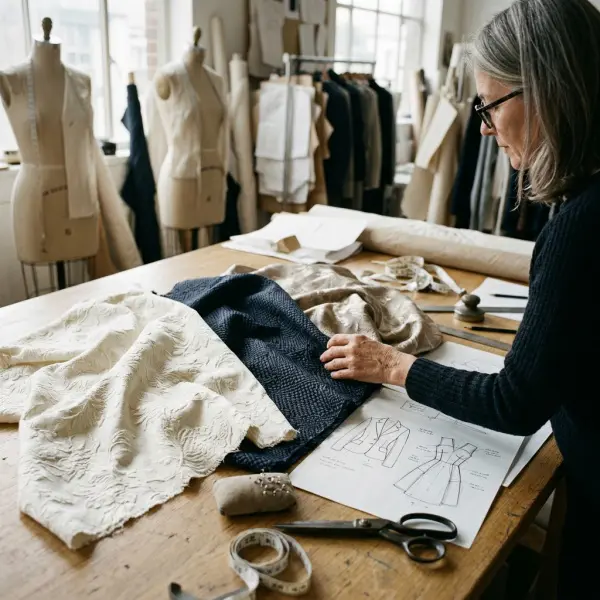
Jacquard is not a fiber type. It is a textile construction approach that can be applied to different yarn materials, creating fabrics with widely varying physical and aesthetic properties.
This distinction becomes important when designers associate certain visual characteristics with particular fibers. A lustrous surface does not necessarily indicate silk, and a firm handfeel does not prove that a fabric contains synthetic fibers.
The interaction between yarn composition, weave structure, density, and finishing determines the final result. CottonWorks explains that complex jacquard patterns can be formed through combinations of basic weave arrangements, including different satin, plain, and other structural effects.
The CottonWorks technical guide to complex woven designs provides useful background for understanding these construction possibilities.
Silk Jacquard for Refined Surface Effects
Silk jacquard can offer a distinctive combination of sheen, texture, and drape, depending on the yarn and fabric construction. It is often considered for luxury occasionwear, formal jackets, dresses, and decorative garment details.
However, silk composition does not automatically guarantee softness or fluidity. A densely woven silk jacquard may have considerable body, while a lighter construction can behave quite differently.
Designers should also evaluate abrasion, exposure to moisture, colorfastness, and the care expectations of the intended customer. For garments requiring frequent laundering or rough everyday wear, the specific silk jacquard may present practical limitations.
A premium label should select silk jacquard because its physical and visual properties serve the design, not simply because silk is associated with luxury.
Cotton Jacquard for Structured and Wearable Designs
Cotton jacquard can be useful for tailored separates, structured dresses, skirts, and selected casualwear applications.
Depending on its construction, it may offer a relatively natural handfeel and a matte or softly reflective surface. Cotton can also absorb moisture, although breathability and thermal comfort still depend on the full fabric and garment construction.
Cotton-rich jacquards may wrinkle or experience dimensional change during washing. These characteristics should be evaluated through appropriate material testing and care development.
For brands building collections intended to combine distinctive texture with regular wear, a suitable cotton jacquard can be an option worth considering.
Viscose and Other Regenerated Cellulosic Jacquards
Viscose jacquard may be considered when designers want softness, fluidity, or a particular surface sheen. Depending on the yarns and weaving structure, it can be suitable for dresses, relaxed jackets, and garments with less rigid silhouettes.
However, regenerated cellulosic fabrics differ in wet strength, dimensional stability, and care behavior. The properties of one viscose jacquard cannot safely be generalized to all regenerated-cellulose materials.
Blends may also behave differently from fabrics made predominantly from one fiber. Designers should examine the actual construction and determine whether the resulting flexibility, weight, and care requirements support the garment.
For a premium blouse or dress, evaluating drape after finishing and cleaning may be especially important.
Polyester and Blended Jacquards
Polyester jacquards can provide a broad variety of visual effects, including lustrous surfaces, colored motifs, and structured textures. Their suitability depends on the filament or spun yarn characteristics, weaving method, density, and finishing.
Blending polyester with cotton, viscose, wool, or other fibers can change the fabric's handfeel, appearance, and performance. These combinations may help a mill achieve particular design or commercial requirements.
Nevertheless, polyester does not automatically guarantee wrinkle resistance, easy care, or durability in every jacquard construction. Decorative yarn floats, dense weave structures, and inappropriate finishing can still create problems.
For apparel brands, blends should be evaluated as complete textile constructions rather than through assumptions about the individual fibers.
Comparing Fiber Options for Premium Apparel
|
Fiber category |
Potential design characteristics |
Common applications |
Main verification needs |
|
Silk jacquard |
Lustrous, refined, potentially fluid or structured |
Occasionwear, jackets, formal dresses |
Surface durability, care behavior, stability |
|
Cotton jacquard |
Varied texture, often matte or softly lustrous |
Structured dresses, skirts, casual tailoring |
Shrinkage, creasing, colorfastness |
|
Viscose jacquard |
Potentially soft, fluid, and lustrous |
Dresses, relaxed separates |
Wet-care behavior, dimensional stability |
|
Polyester jacquard |
Broad range of textures, colors, and structural effects |
Jackets, dresses, occasionwear |
Heat sensitivity, comfort, abrasion, care |
|
Wool or wool-blend jacquard |
Varied warmth, handfeel, and body |
Tailored jackets, coats, selected dresses |
Pressing, bulk, pilling, cleaning |
|
Mixed-fiber jacquard |
Properties depend on yarn distribution and construction |
Premium separates, formalwear, accessories |
Performance of the complete blend |
These are possible material characteristics rather than guaranteed outcomes. Two fabrics with the same stated fiber percentages may behave differently because of their yarn specifications, weave density, finishing, and decorative structures.
Why Pattern Scale and Texture Matter in Premium Garment Design
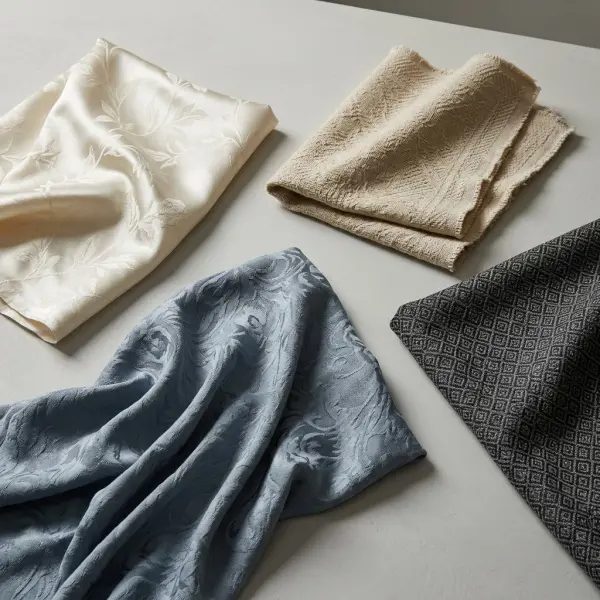
The decorative pattern is often the most immediate reason a designer chooses jacquard. However, its scale and placement can influence how the garment looks across different sizes, how efficiently fabric can be cut, and whether the finished product appears balanced.
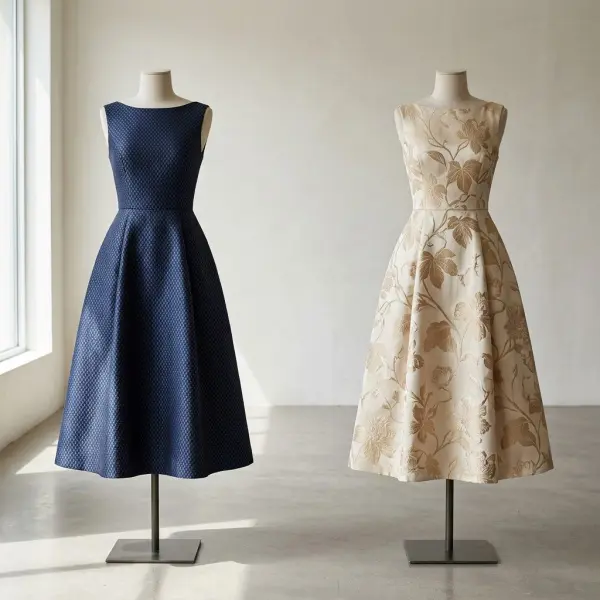
A small repeating pattern may integrate easily into tailored garment panels. A large botanical motif can create a stronger statement but may require careful positioning at the center front, shoulders, and side seams.
For fashion businesses, these choices connect creative direction with patternmaking and manufacturing.
Small Motifs for Controlled Visual Texture
Small-scale jacquard patterns can work well when a designer wants texture that supports rather than dominates the silhouette.
Fine geometric repeats, understated florals, and compact abstract patterns may provide subtle decorative interest. Their relatively frequent repeats can also make some cutting layouts easier to manage, although direction and matching requirements still matter.
A premium suit made from a compact tonal jacquard, for example, may maintain a sophisticated appearance without requiring each garment panel to display a specific large motif.
This can be useful for brands producing the same style across several sizes, where consistent visual balance is important.
Large Motifs for Statement Apparel
Large-scale jacquard designs can make dresses, coats, and statement jackets visually distinctive. Their effectiveness depends on how the motif interacts with garment proportions.
Imagine a floral jacquard developed for a full-skirted dress. A large flower positioned near the hem may create a pleasing composition in one sample size, but its placement can shift when the garment is graded.
Large repeats can also influence fabric consumption. When specific motifs must be positioned or matched, pattern pieces cannot always be nested in the most material-efficient arrangement.
Designers should therefore review the fabric at full width and evaluate representative garment sizes before approving a large-scale design.
Tonal Contrast vs Multicolored Patterning
Tonal jacquard relies on subtle differences in texture, weave reflection, or closely related colors. Multicolored jacquard uses more visible color contrast to emphasize the motif.
Neither approach is inherently more premium.
A tonal ivory jacquard may suit understated bridal or tailored apparel, while a multicolored floral pattern may be appropriate for a more expressive collection. The decision depends on the brand's visual identity, styling concept, and intended customer.
Lighting is particularly relevant. Reflective yarns and satin-related weave areas can change appearance under daylight, studio lighting, and retail illumination. Designers should examine samples under more than one lighting condition before approving color and surface effects.
Pattern Direction and Matching
Jacquard patterns may be directional, symmetrical, or designed as continuous repeats. These characteristics affect cutting and seam placement.
A clearly directional motif may require all garment panels to follow the same orientation. Large geometric patterns may need matching across center-front openings, while elaborate floral designs may require specific placement to avoid awkward interruptions.
A manufacturer should not be expected to determine these details independently after receiving the fabric. The designer's approved sample and technical instructions should establish the intended appearance.
Pattern placement decisions are particularly important when the same textile will be used across multiple sizes or garment styles.
Evaluating Fabric Weight, Drape, and Construction Compatibility
Fabric weight is an important screening parameter, but it should not be treated as a complete measure of suitability.
Two jacquards with similar weight per square meter can have different drape, stiffness, and thickness. The differences may result from yarn type, weave density, thickness, finishing, and the distribution of decorative structures.
For garment development, designers need to understand how the textile behaves in three dimensions.
Weight Does Not Tell the Whole Story
Fabric weight is commonly expressed in grams per square meter (g/m²). This helps designers compare materials, but it does not independently describe flexibility or softness.
A dense, thin fabric may weigh as much as a thicker but less compact construction. Similarly, two fabrics with comparable mass may respond differently to bending and folding.
Designers should combine weight measurements with physical drape evaluation and garment sampling. It is usually more useful to ask whether the fabric produces the required silhouette than whether it falls within a predetermined weight category.
Test Drape on a Dress Form or Garment Prototype
A fabric swatch can demonstrate texture and color, but it may not represent the material's behavior across a complete garment.
A larger sample draped over a dress form can reveal stiffness, folding behavior, surface highlights, and the way decorative motifs follow curves.
For tailored garments, prototypes should include representative interfacing, seam allowances, and lining construction. A fabric may appear flexible before interfacing but become excessively rigid when combined with the planned support materials.
Physical samples are also useful for identifying distortion around darts, curved seams, and areas of tension.
Evaluate Seam Bulk and Pressing Behavior
Jacquard fabrics with pronounced texture or dense yarn arrangements may create thick seam intersections.
This can affect tailored collars, lapels, cuffs, and other areas where multiple fabric layers overlap. A garment that appears well balanced in a technical drawing may develop unwanted bulk when the chosen jacquard is sewn.
Pressing is another consideration. Excessive pressure or unsuitable heat can flatten certain surface textures or affect sensitive yarns and finishes.
Before approving a material, the production team should test representative seams and pressing procedures on the actual fabric.
A Practical Jacquard Selection Framework for Fashion Designers
The most reliable fabric decision is one that evaluates several criteria together instead of prioritizing a single desirable characteristic.
For premium apparel, the selection framework should connect aesthetics, wearer experience, garment engineering, supply reliability, and commercial cost.
|
Selection criterion |
Key evaluation question |
What a designer should verify |
|
Visual identity |
Does the motif support the collection concept? |
Pattern scale, color, surface effect |
|
Silhouette |
Does the fabric create the intended garment shape? |
Drape, stiffness, thickness |
|
Comfort |
Is the material suitable for the intended wearing experience? |
Handfeel, flexibility, skin contact |
|
Construction |
Can the fabric be cut and sewn consistently? |
Fraying, seam bulk, yarn movement |
|
Surface performance |
Will the decorative texture withstand expected use? |
Abrasion, snagging, pilling where relevant |
|
Care |
Can the finished garment be maintained appropriately? |
Dimensional stability, colorfastness, care process |
|
Sourcing |
Can the supplier reproduce the approved material? |
Yarn availability, capacity, repeatability |
|
Commercial viability |
Does the fabric support the target product economics? |
MOQ, landed cost, consumption, defect allowance |
|
Brand positioning |
Does the material justify its role in the product? |
Appearance, quality consistency, perceived value |
A fabric that performs strongly in one category may still be unsuitable overall. An elaborate jacquard with excellent visual appeal but poor seam stability may create unacceptable manufacturing risk. Conversely, a less dramatic textile may be commercially stronger if it supports consistent quality across several products.
Designers should distinguish between mandatory requirements and preferences. Minimum comfort, quality, and production standards should generally be treated as approval conditions, while decorative preferences can be compared among fabrics that pass those conditions.
From Fabric Swatch to Approved Jacquard: A Product Development Workflow
Premium fabric selection should follow a documented development process. This reduces ambiguity between designers, textile suppliers, sourcing teams, and garment manufacturers.
The exact sequence depends on whether the brand is purchasing an existing mill design or commissioning a custom jacquard. A stock fabric may require relatively limited development, while a custom motif can involve additional design translation, weaving trials, and technical adjustments.
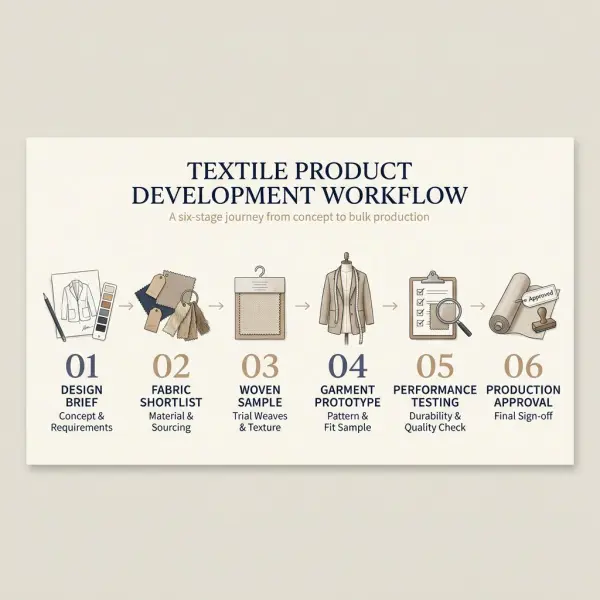
Stage 1: Define the Design Brief
The process begins with a clear description of the intended garment and material characteristics.
The designer should identify the silhouette, visual references, required texture, color direction, approximate weight range, intended care approach, and target commercial positioning.
The brief should distinguish essential properties from negotiable preferences. For example, a structured silhouette might be mandatory, while the exact floral scale could remain open to supplier suggestions.
This allows the sourcing team to evaluate alternatives without losing the design's core requirements.
Stage 2: Shortlist Suitable Fabric Constructions
Suppliers can then propose existing jacquard qualities or potential custom constructions.
Each candidate should be assessed for fiber composition, weight, usable width, pattern repeat, handfeel, and surface characteristics. Small swatches are useful for initial screening, but larger samples are preferable for evaluating complex motifs or garment drape.
A practical shortlist might contain several alternatives with different cost and performance characteristics rather than multiple versions of essentially the same fabric.
The objective is to identify viable directions before committing resources to garment sampling.
Stage 3: Develop or Confirm the Woven Design
For custom jacquard, the artwork must be translated into a weave structure compatible with the supplier's equipment and yarn configuration.
A digital design can establish pattern placement and color relationships, but a woven trial is needed to confirm how the motif actually appears.
The mill may need to adjust weave arrangements, yarn selection, pattern scale, or finishing to achieve the desired result.
This stage illustrates why textile design and garment design are interconnected. An attractive digital motif is not automatically a technically suitable fabric.
Stage 4: Produce Garment Samples
Once a promising fabric is available, the design team should produce a representative garment sample.
The sample should be assessed for silhouette, comfort, motif positioning, seam quality, lining compatibility, and pressing behavior. If the fabric is intended for several sizes, pattern placement and garment balance should be evaluated across representative size requirements.
Any adjustments must be documented. Otherwise, the production team may reproduce an earlier version of the textile or construction.
Stage 5: Complete Testing and Production Approval
Before bulk fabric purchasing, the brand should confirm that the selected material meets its agreed performance requirements.
The supplier should provide applicable test results and technical specifications, while the garment manufacturer should confirm that the material can be processed consistently.
The final approval package may include a reference swatch, approved color standard, construction details, finished garment sample, test documentation, and agreed tolerances.
This creates a common standard against which bulk deliveries and finished garments can be assessed.
What Technical Specifications Should Brands Request From Jacquard Suppliers?
A fabric's commercial name is not enough to support reliable production. Suppliers may describe two textiles as premium floral jacquard even when their composition, construction, usable width, and performance differ significantly.
A written fabric specification helps ensure that sampling, purchasing, and bulk manufacturing teams are evaluating the same material.
For premium jacquard, useful specifications include fiber composition, mass per unit area, usable width, weave construction, horizontal and vertical pattern repeats, pattern direction, finishing, and agreed appearance tolerances. Custom developments may require additional yarn and pattern-control information.
The specification should also define the approved fabric face, color references, and any special handling requirements. These details are especially valuable when the same textile is produced in multiple batches.
Test the Properties That Matter for the Garment
Material testing should be based on the intended garment and its expected use rather than a universal checklist applied without context.
The following internationally recognized methods can support appropriate evaluation:
|
Test consideration |
Relevant standard |
What it evaluates |
|
Dimensional stability |
ISO 5077:2007 |
Dimensional change after specified washing and drying |
|
Abrasion resistance |
ISO 12947-2:2016 |
Fabric specimen breakdown under Martindale abrasion testing |
|
Rubbing colorfastness |
ISO 105-X12:2016 |
Color transfer through dry or wet rubbing |
|
Seam slippage |
ISO 13936-2:2004 |
Resistance of woven yarn systems to slippage at a sewn seam |
|
Pilling behavior |
ISO 12945-2:2020 |
Resistance to pilling, fuzzing, and matting using a modified Martindale method |
These methods are documented by the International Organization for Standardization, including ISO 5077 for dimensional change, ISO 12947-2 for abrasion-related specimen breakdown, and ISO 13936-2 for seam slippage.
The test methods do not establish one universal acceptable result for all premium garments. The brand must set appropriate acceptance criteria for the product category and intended market.
Certain jacquard constructions may also require snagging, colorfastness to light, or other assessments. Not every test is necessary for every fabric.
Establish a Reference Standard for Bulk Quality
An approved swatch should represent more than a preferred color or motif. It should establish the expected appearance and physical characteristics of the production material.
For bulk orders, sourcing teams should confirm that delivered fabric corresponds to the approved construction and agreed tolerances. Inspection may include pattern clarity, weaving defects, color variation, surface appearance, usable width, and consistency across rolls.
If a fabric contains decorative floats or metallic-effect yarns, the inspection criteria should account for those characteristics.
Without a reference standard, disputes may arise when a fabric is technically similar to the sample but visibly different in the finished garment.
Balancing Fabric Cost, Exclusivity, and Production Scale
Premium jacquard sourcing often involves a trade-off between visual distinction and commercial flexibility.
A custom woven motif can help a brand establish a recognizable collection identity, but development may require additional sampling, production setup, and minimum-order commitments. These requirements can be difficult to justify for a collection with uncertain demand.
An existing mill design may offer a more practical starting point, particularly for smaller fashion brands. However, stock availability, design exclusivity, and continuity across future orders should still be verified.
Consider Total Fabric Consumption
The quoted price per meter represents only part of the financial decision.
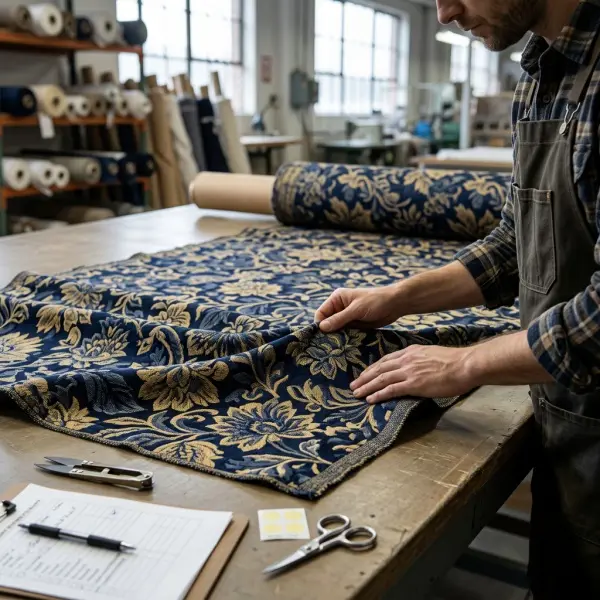
A directional jacquard with a large pattern repeat may require additional fabric for motif matching. The resulting cutting loss can make a seemingly affordable material more expensive in finished-garment terms.
Brands should calculate effective fabric cost using realistic marker efficiency, consumption per garment, expected material defects, and purchasing conditions.
This becomes particularly important when an elaborate pattern is used across several garment sizes or when matching requirements limit the manufacturer's cutting flexibility.
Evaluate Custom Development Against Expected Volume
Custom jacquard development may require pattern programming, yarn selection, weaving trials, and finishing adjustments.
CottonWorks explains that jacquard production commonly carries higher costs because of weaving complexity and potentially slower weaving speed.
For a limited capsule collection, these costs may be difficult to distribute economically. A recurring signature style with predictable production volume may provide a different commercial justification.
Designers and sourcing managers should evaluate the expected sales volume, target margin, and reorder potential before approving a bespoke textile.
Use Jacquard Where It Adds Meaningful Product Value
Not every garment in a premium collection needs a complex woven fabric.
A carefully selected jacquard jacket may establish the collection's visual direction while simpler trousers, skirts, or blouses provide styling flexibility. This approach can also reduce the number of difficult-to-source textiles required across the range.
Fabric selection should therefore connect to the broader assortment strategy. The principles discussed in fashion assortment planning and product mix decisions are relevant when balancing distinctive products with commercially repeatable styles.
Common Mistakes When Selecting Jacquard for Premium Apparel
Mistake 1: Choosing the Most Elaborate Pattern
A complex motif can create a strong impression during fabric selection, but it may overwhelm the garment silhouette or become difficult to position across seams. Designers who prioritize decorative complexity without reviewing full garment proportions risk creating an unbalanced result. The better approach is to assess the pattern at realistic garment scale and determine whether its visual emphasis supports the collection concept.
Mistake 2: Approving Fabric From a Small Swatch Alone
Small swatches can conceal problems with drape, pattern repeat, stiffness, and surface consistency. These issues often become visible only when the fabric is evaluated in larger sections or sewn into a prototype. Approving bulk purchasing too early can create expensive garment-development changes. Brands should use full-width material when necessary and confirm suitability through representative sampling.
Mistake 3: Ignoring the Reverse Side of the Fabric
The decorative face of jacquard may look refined while the reverse contains floats, rough textures, or yarn arrangements that affect comfort and handling. If the designer evaluates only the visible surface, the manufacturer may later discover that lining or additional protection is necessary. Both sides should be examined during sourcing, particularly when the fabric will contact skin or be used in partially lined garments.
Mistake 4: Assuming Higher Fabric Cost Guarantees Better Quality
Expensive yarns and complex weaving may contribute to price, but they do not guarantee consistent construction or appropriate performance. A costly jacquard can still suffer from excessive seam slippage, unacceptable dimensional change, or surface abrasion. Brands should compare technical quality and garment suitability alongside price rather than treating the supplier quotation as evidence of premium performance.
Mistake 5: Overlooking Reorder Consistency
A fabric may perform well during initial sampling but become difficult to reproduce when the supplier changes yarn lots, finishing conditions, or production arrangements. Differences in color, surface reflection, and weave appearance can affect collection consistency. Before committing to a recurring style, brands should confirm material continuity, approved standards, production capacity, and the supplier's change-control process.
Sustainability and Material Claims: What Premium Brands Should Verify
Jacquard weaving does not automatically make a textile environmentally preferable to printed, embroidered, or conventionally woven alternatives.
Its environmental impact depends on fiber production, dyeing, yarn preparation, weaving efficiency, finishing, and other manufacturing activities. A complex woven motif may replace certain decorative operations, but that does not establish an overall environmental advantage without an appropriate comparison.
Textile Exchange's February 2026 guidance emphasizes evaluating preferred production systems rather than assuming that particular material categories are universally preferable. The organization's Preferred Production Systems: Principles, Definitions, and Guidance provides a relevant framework for considering fiber and material sourcing within production systems.
Premium brands should also distinguish between design durability and material durability. A woven pattern may remain visually recognizable without surface printing, but that does not prevent color fading, yarn damage, or fabric deterioration.
Any environmental or performance claim should be supported by evidence specific to the material and process being described.
Communicating Jacquard Quality to Premium Fashion Customers
The commercial value of jacquard does not end when the fabric is approved for production. Brands also need to explain its qualities accurately to customers.
A product description that merely calls a garment luxury jacquard offers limited useful information. Customers may be more interested in the actual fiber composition, distinctive woven motif, garment shape, lining, and care requirements.
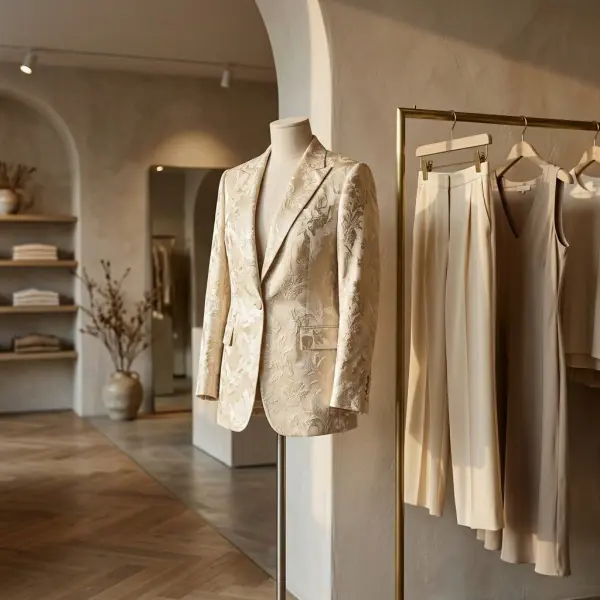
For an understated tailored jacket, product photography should reveal the jacquard pattern without exaggerating its texture. Close-up images can demonstrate the difference between a woven design and a printed surface.
Brand communication should also avoid suggesting that all jacquard fabrics are handmade, exceptionally durable, or made from luxury fibers. These are separate claims that require their own evidence.
The strongest product presentation connects material characteristics with the garment's actual design and wearing experience.
Frequently Asked Questions About Choosing Jacquard Fabrics
1. What makes a jacquard fabric suitable for premium apparel?
A jacquard is suitable for premium apparel when its appearance, construction, comfort, and durability support the intended garment and customer expectations. An intricate woven motif can contribute visual distinction, but premium quality also depends on yarn selection, weaving consistency, finishing, and garment construction. Designers should evaluate weight, drape, surface stability, pattern clarity, and appropriate performance results. The fabric should also work consistently across the planned size range and production volume. A visually elaborate material that causes fit problems, discomfort, or excessive manufacturing defects may be less suitable than a simpler jacquard with better overall performance.
2. Should designers choose silk or polyester jacquard for luxury garments?
Neither fiber is universally the better choice. Silk jacquard may be selected for its particular sheen, handfeel, or drape, while polyester jacquard can offer different structural, visual, and commercial possibilities. The final performance depends on yarn characteristics, weave density, finishing, and garment construction. A carefully manufactured polyester jacquard may perform well in an appropriate premium garment, while a silk jacquard may require more restrictive care or handling. Designers should choose according to the product's intended appearance, wearer expectations, performance requirements, and cost structure rather than relying exclusively on fiber prestige.
3. How can designers determine the right jacquard pattern size?
The appropriate pattern size depends on garment proportions, seam placement, intended visual emphasis, and production requirements. Small repeats may integrate more easily into tailored panels, while large motifs can provide a stronger decorative statement. Designers should examine the fabric at full width and test the pattern against actual garment pieces. For graded styles, motif placement may need to be reviewed across representative sizes. Pattern direction and matching requirements also influence cutting efficiency. The best repeat is one that maintains the intended appearance without creating unacceptable fabric waste or production complications.
4. Is custom jacquard development worthwhile for small fashion brands?
Custom jacquard can be worthwhile when a distinctive woven design provides clear value and the brand can support its development and production requirements. However, minimum orders, sampling costs, loom setup, and reorder conditions may create financial pressure for smaller collections. Existing mill designs can offer a practical alternative, especially when the brand is testing customer demand. A small fashion label should compare the cost of custom development against expected sales, margins, and future production needs. Exclusivity is valuable only when it supports a product strategy that remains commercially viable.
5. What fabric tests are most important before producing jacquard garments?
The most relevant tests depend on how the garment will be worn and maintained. Dimensional stability and colorfastness may be important for washable apparel, while seam slippage and abrasion performance may require particular attention in fitted or frequently worn garments. Some constructions may also need evaluation for snagging, pilling, or lightfastness. There is no single universal test package that guarantees premium quality. Brands should define performance requirements according to the garment category, select appropriate standardized methods, and establish acceptance criteria before bulk approval. Testing should complement physical garment trials rather than replace them.





Comments 0
Leave a CommentSend Comment
Anda harus Login terlebih dahulu untuk dapat memberikan komentar.