

Fleece and Terry Fabrics Explained for Casual Apparel
Quick Answer
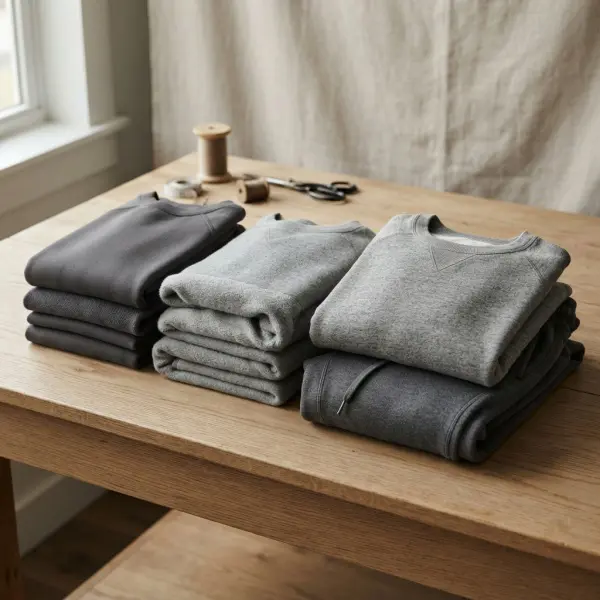
Fleece and terry fabrics are soft, knit-based textile families widely used in sweatshirts, hoodies, joggers, loungewear, casual separates, and some activewear. Their comfort comes not simply from fiber content, but from how yarns are knitted and how the fabric surface is finished. Terry constructions typically use visible loops to create additional bulk and absorbency, while many apparel fleece fabrics use brushing or napping to create a raised, softer surface that can hold more still air around the body.
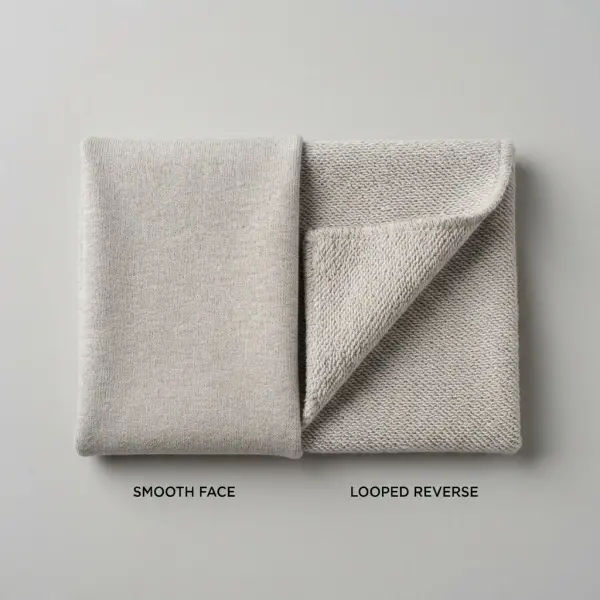
The terminology needs care. French terry commonly has a relatively smooth outer face and unbrushed loops on the reverse. Sweatshirt fleece often begins with a related knit structure but has its inner surface brushed to create a soft nap. Polar fleece, meanwhile, is generally a different polyester-based fleece category rather than simply brushed French terry. CottonWorks likewise treats fleece and French terry as distinct but closely related casual knit categories used across loungewear and active apparel. CottonWorks fleece and French terry resources
For fashion businesses, the practical question is therefore not merely “fleece or terry?” It is which construction, fiber blend, fabric weight, surface finish, stretch profile, and quality level best match the intended garment and climate.
What Are Fleece and Terry Fabrics?
Fleece and terry are better understood as fabric construction and surface categories than as fiber names. A fabric sold as fleece may contain cotton, polyester, recycled polyester, other fibers, or blends, while terry fabrics may also vary considerably in fiber composition. This distinction matters because two fabrics carrying similar commercial names can behave differently after washing, during sewing, against the skin, and in different climates.
In casual apparel, terry usually refers to knitted fabrics with looped yarns forming part of the reverse surface. French terry is the most familiar example: the garment-facing exterior is relatively smooth, while the technical back contains uncut loops. Those loops add yarn volume without creating the fully fuzzy interior associated with conventional brushed sweatshirt fleece.
Fleece is a broader term. In the sweatshirt market, it often describes a knit fabric with a smooth outer surface and a brushed or napped reverse. In outdoor apparel, however, “fleece” frequently refers to polyester pile fabrics such as polar fleece or microfleece. Buyers therefore need more information than the word fleece alone before approving a material.
This naming ambiguity has practical consequences. A supplier quotation for “300 GSM fleece,” for example, still does not tell a development team whether the fabric is cotton-rich sweatshirt fleece, polyester polar fleece, heavily brushed fleece-back jersey, or another construction. A useful specification needs to describe the material more precisely.
Understanding the Terry Side of the Ecosystem
Terry fabrics are characterized by looped yarn structures that increase surface area and give the textile more volume than a simple flat knit. Terry toweling may have prominent loops designed primarily around absorbency, whereas apparel-oriented French terry usually presents a smoother face and loops primarily on the reverse.
For casualwear, this creates a useful middle ground between lightweight jersey and heavily brushed fleece. The material can have enough body for a sweatshirt or jogger while avoiding the dense fuzzy interior associated with colder-weather fleece. The final result still depends on yarn count, stitch density, loop construction, weight, finishing, fiber blend, and garment pattern.
French Terry as a Casual Apparel Fabric
French terry is a knitted fabric with a relatively smooth face and visible unbrushed loops on its reverse. The loops are part of the fabric construction rather than an added lining, which is why a French terry sweatshirt can remain structurally simple while offering noticeably more body than ordinary T-shirt jersey.
It appears frequently in crewneck sweatshirts, hoodies, shorts, joggers, relaxed dresses, children’s clothing, and transitional activewear. CottonWorks includes French terry among its core cotton knit categories and associates it with breathable casual and active applications.
The word French terry, however, does not establish a fixed weight, fiber composition, stretch percentage, or quality level. A cotton-rich loopback fabric intended for a premium sweatshirt may behave very differently from a lighter polyester-cotton-elastane version developed for flexible athleisure bottoms. Buyers should treat the construction name as the beginning of a specification rather than the complete specification.
Terry Cloth Is Not Automatically French Terry
This distinction is easy to miss because both fabrics rely on loops. Traditional terry cloth used for towels and robes is designed around a prominent loop pile and moisture absorption, and terry constructions can be woven or knitted. French terry used in apparel normally has a smoother front surface with loops concentrated on the reverse.
That difference affects appearance as much as performance. A towel-like terry surface can become an intentional visible design feature in resortwear, polo shirts, shorts, or retro leisure garments, while loopback French terry is usually selected because its face gives hoodies and sweatshirts a cleaner exterior.
For sourcing teams, “terry” should therefore trigger another question: what type of terry? The buyer should confirm whether the mill means French terry, toweling terry, terry jersey, loopback knit, or another commercially named variant.

Understanding the Fleece Side of the Ecosystem
Fleece describes several textiles with soft, raised, or pile-like surfaces, and the category is more diverse than the interior of a typical hoodie suggests. Within casual apparel, two broad groups deserve to be separated: brushed sweatshirt fleece and polyester pile fleece.
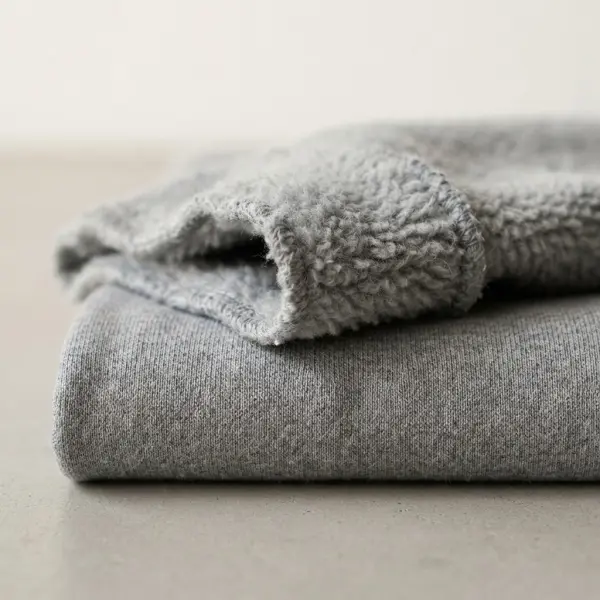
Sweatshirt fleece often uses a knit construction in which the inside is mechanically brushed or napped. Brushing raises fibers from the surface, turning what may originally be visible loop structures into a softer, fuzzier layer. That raised layer can increase loft and alter thermal comfort, handfeel, appearance, pilling behavior, and shedding.
Polyester fleece, including familiar polar-fleece styles, is commonly engineered as a synthetic pile textile and may be used in jackets, quarter-zips, outdoor layers, blankets, or casual cold-weather garments. Although it shares the “fleece” name with sweatshirt fleece, its fiber composition, surface structure, visual character, and end-use expectations can be quite different.
Why Brushing Changes the Fabric
Brushing is not merely a cosmetic finish. Mechanical action raises fibers from the fabric surface, producing a nap that feels softer and creates additional loft. The extra air held within this raised surface can make a brushed fabric feel warmer than an otherwise comparable unbrushed loopback construction, although actual thermal performance depends on fabric thickness, density, fiber type, garment fit, layering, moisture, and environmental conditions.
Brushing can also change how the fabric ages. A highly soft, heavily raised surface may look attractive in a showroom but can behave differently after repeated abrasion and laundering. Surface fuzzing, matting, and pilling should therefore be evaluated rather than inferred from the initial handfeel alone.
ISO maintains dedicated methods for evaluating textile pilling, fuzzing, and matting. ISO 12945-3, for example, covers the random tumble pilling method and explicitly includes napped fabrics such as fleeces among its applicable fabric categories. ISO 12945-3 textile pilling test
How Construction, Fiber, and Finish Work Together
A garment does not perform a certain way simply because the label says fleece or terry. Its behavior comes from an interaction between fiber composition, yarn, knit structure, fabric weight, density, finishing, dyeing, and garment construction. This is one of the most important principles for buyers comparing apparently similar casual fabrics.
Cotton can contribute moisture absorption and a familiar natural hand, while polyester can change dimensional stability, drying behavior, strength, surface character, and cost structure depending on how it is used. Elastane may be introduced when greater stretch and recovery are required. None of these fibers automatically makes a fleece or terry fabric “premium”; the suitability depends on the product brief and how the full fabric system is engineered.
The same principle applies to fabric weight. GSM—grams per square meter—is useful for describing fabric mass per unit area, but it should not be treated as a direct measurement of warmth, durability, or quality. Two fabrics with identical GSM can differ substantially in thickness, density, yarn size, brushing intensity, stretch, air permeability, and handfeel.
For product development teams, a more useful fabric record therefore combines several attributes rather than relying on one commercial name.
|
Fabric attribute |
What it tells the team |
Why it matters |
|
Fiber composition |
Which fibers and percentages are used |
Influences handfeel, moisture behavior, care, cost, and performance |
|
Construction |
How the fabric is knitted or otherwise formed |
Affects stretch, stability, texture, and surface structure |
|
GSM |
Mass per square meter |
Helps control weight and costing, but does not define performance alone |
|
Surface finish |
Whether the back is looped, brushed, sheared, or otherwise finished |
Strongly influences tactile feel and visual character |
|
Stretch and recovery |
How far the fabric extends and how well it returns |
Important for cuffs, joggers, fitted silhouettes, and active movement |
|
Dimensional stability |
How much dimensions change after laundering |
Critical for fit consistency and finished garment measurements |
|
Pilling performance |
Resistance to surface pills and fuzzing |
Affects appearance during wear |
|
Colorfastness |
Resistance to color change or transfer |
Important for repeated washing and consumer satisfaction |
The deeper distinction between the two most common sweatshirt constructions is covered separately in French Terry vs Fleece: What Makes Them Different?. Keeping that comparison separate is useful because fabric selection is more nuanced than simply choosing whichever option feels softer.
Why These Fabrics Work So Well in Casual Apparel
Fleece and terry align closely with the requirements of casual clothing because knit structures can provide flexibility, softness, and body without requiring the rigid construction associated with many woven fabrics. They also work naturally with silhouettes such as sweatshirts, joggers, relaxed shorts, hoodies, lounge sets, and oversized tops, where ease of movement and tactile comfort matter.
Their versatility is equally important commercially. A brand can use lighter loopback terry for warmer conditions or transitional products, midweight sweatshirt fabrics for year-round collections in some markets, and more heavily brushed fleece for colder-weather programs. Fabric selection can therefore support seasonal assortment planning without forcing a brand to abandon familiar casual silhouettes.
There is also an aesthetic advantage. Smooth exterior faces give many sweatshirt knits enough visual consistency for screen printing, embroidery, appliqué, garment dyeing, or minimal premium styling. The inside can simultaneously be engineered for a different tactile function, creating a two-sided fabric experience within one material.

Matching the Fabric to the Garment
Fabric selection should begin with the garment’s intended use rather than with a preference for a particular textile name. A hoodie intended for cool outdoor evenings, for example, has a different comfort brief from shorts intended for humid weather, even if both belong to the same casualwear collection.
French terry and other unbrushed loopback fabrics can work well where moderate body, a casual handfeel, and less internal loft are useful. Brushed sweatshirt fleece becomes more relevant when tactile warmth and a softer interior are priorities. Polyester pile fleece may be appropriate for outer or mid-layer garments where its particular loft, lightweight warmth, drying behavior, and outdoor aesthetic suit the design.
A practical development discussion should consider several variables together:
- Climate and season: determine how much insulation and air movement the wearer is likely to need.
- Garment silhouette: oversized hoodies, slim joggers, relaxed shorts, and structured sweatshirts place different demands on drape and recovery.
- End use: everyday lounge clothing, gym travel pieces, school uniforms, promotional hoodies, and premium streetwear have different durability and appearance expectations.
- Decoration: printing, embroidery, washing, and surface treatments may perform differently depending on the face structure and fiber blend.
- Care expectations: repeated laundering can expose shrinkage, skew, pilling, colorfastness, and surface-quality problems that are not visible in a fabric swatch.
This is why approving a fabric by handfeel alone is risky. A soft sample may perform poorly after washing, while a slightly firmer fabric may stabilize into a more commercially reliable garment.
What Fleece and Terry Mean for Product Development
For product developers, these materials create decisions that extend well beyond fabric selection. Pattern measurements, rib specifications, seam construction, shrinkage allowance, wash testing, cutting behavior, and finishing all need to work with the selected knit.
A fabric with significant dimensional change, for instance, can produce an acceptable pre-wash sample but an undersized finished garment after consumer laundering. ISO 5077 specifies a method for measuring dimensional change in fabrics and garments after defined washing and drying procedures, while AATCC TM135 provides a corresponding framework for fabrics subjected to home laundering. ISO 5077 dimensional change testing
Stretch recovery deserves similar attention. Jogger knees, waistbands, cuffs, and elbows are repeated stress areas. A fabric that extends comfortably but does not recover well can develop bagging even when its initial appearance is excellent. Conversely, a dense, stable sweatshirt fabric may hold shape well but feel too restrictive for a design developed around movement.
Sampling should therefore use the intended production fabric or a technically representative substitute as early as practical. Developing fit in one knit and shifting to a materially different fleece or terry at production can change drape, ease, seam behavior, garment weight, and finished dimensions.
Sourcing Implications for Fashion Businesses
Fabric sourcing teams should request a technical specification that separates construction from marketing terminology. “Premium cotton fleece” is not sufficient information for a production commitment because the phrase does not define composition, weight, usable width, finish, shrinkage, pilling performance, colorfastness, stretch, or tolerances.
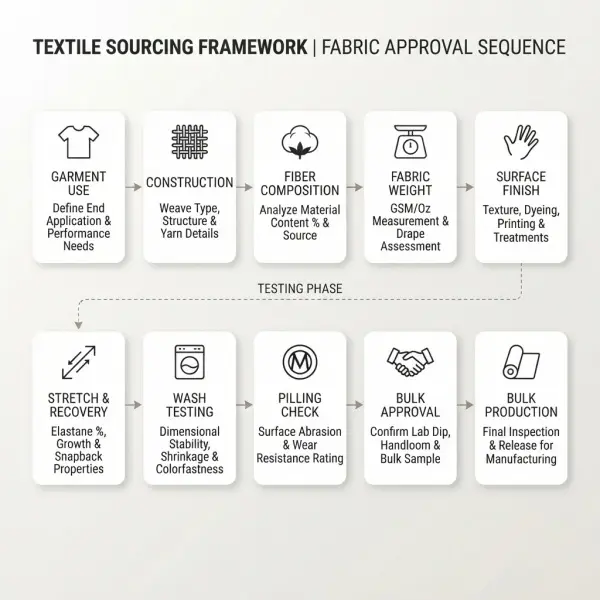
A more operational inquiry might request fiber composition, fabric construction, finished GSM and tolerance, usable width, brushing details, stretch and recovery, shrinkage after defined laundering, colorfastness requirements, pilling performance, and any chemical or certification requirements relevant to the brand.
Physical sampling remains important even when specifications are detailed. Surface feel, loop uniformity, brushing consistency, face appearance, color depth, drape, and garment-level behavior are difficult to assess from a specification sheet alone. For larger programs, buyers may also want production-lot controls so that approved bulk fabric does not drift materially from the development standard.
The objective is not to make the specification unnecessarily complicated. It is to ensure that the attributes affecting fit, appearance, consumer experience, and production repeatability are explicitly agreed rather than assumed.
Quality Control Issues That Matter Most
Quality control for casual fleece and terry should focus on what the customer will actually notice after wearing and laundering the garment. Surface appearance is one obvious area, but dimensional stability, skew, color performance, seam behavior, and fabric recovery can be just as important.
Pilling deserves particular attention for brushed and napped fabrics because friction can change the appearance of their raised surfaces. ISO 12945 provides several standardized approaches for assessing pilling, fuzzing, and matting rather than relying on subjective impressions from an untouched sample.
Shrinkage should also be evaluated against the actual care claim and construction. A brand selling a relaxed-fit sweatshirt cannot assume that a small dimensional change is harmless; length shrinkage, width shrinkage, rib behavior, and seam distortion may affect the intended silhouette differently.
For knitted garments subjected to repeated wear, additional performance tests may also be relevant depending on the product and buyer requirement. ISO 13938, for example, specifies bursting-strength methods applicable to knitted as well as woven fabrics. ISO 13938-1 bursting strength testing

How Fashion Businesses Can Apply These Insights
A useful fleece-and-terry strategy starts by translating the customer proposition into measurable material requirements. “We want a luxurious hoodie” is too subjective to guide a mill consistently. The product team needs to define what luxury means in that specific product: heavier body, cleaner face, dense construction, soft brushed interior, low visible pilling, dimensional stability, specific fiber composition, or perhaps a deliberately dry and structured hand.
For sourcing, the first step is to create a repeatable material specification rather than repeatedly buying whichever fabric feels closest to a previous season. For product development, the team should connect fabric performance to pattern and trim choices. A heavy sweatshirt body paired with weak ribbing, for example, may create poor recovery at cuffs and hems even when the main fabric itself is satisfactory.
Manufacturing teams should verify that machinery, needles, seam types, feed settings, and pressing conditions suit the knit. Thick fleece seams can become bulky, while some softer loopback constructions may stretch during sewing if handling and machine settings are poorly controlled. The correct approach depends on the specific fabric rather than on a universal “fleece setting.”
Retail and marketing teams also have a role. Product descriptions should tell customers something meaningful about the material instead of relying on ambiguous phrases such as premium fleece. Descriptions such as cotton-rich brushed-back sweatshirt fabric, unbrushed loopback French terry, or lightweight polyester fleece communicate more useful expectations.
For assortment planning, the broader opportunity is explored in Why Soft Knit Fabrics Remain Popular in Everyday Clothing, which looks beyond construction and into the consumer, wardrobe, and lifestyle logic behind this fabric category.
Common Mistakes When Working With Fleece and Terry
Mistake 1: Treating “Fleece” as a Complete Fabric Specification
The word fleece describes too broad a category to support reliable sourcing by itself. A merchandising team may expect a cotton-rich brushed sweatshirt fabric while the supplier interprets the requirement as polyester fleece, or two mills may quote fabrics with similar names but completely different structures. The better approach is to specify construction, composition, GSM, surface treatment, width, stretch, and performance requirements alongside the commercial name.
Mistake 2: Choosing Fabric Only by GSM
GSM is useful, particularly for weight consistency and costing, but it does not independently tell a team how warm, thick, durable, soft, breathable, or stable a fabric will be. Knit density, yarn construction, fiber composition, brushing, loop height, and finishing can make two fabrics of similar mass feel and perform differently. Sampling and testing remain necessary when the product depends on specific comfort or performance outcomes.
Mistake 3: Approving the Softest Sample Without Testing It
An exceptionally fluffy brushed surface can create a strong first impression, but initial softness does not prove that the surface will retain its appearance after abrasion and laundering. Aggressive finishing can alter the surface substantially, and different yarn and fabric combinations respond differently. Brands should evaluate softness together with pilling, fuzzing, dimensional stability, appearance retention, and the intended wash program.
Mistake 4: Assuming Cotton Fleece and Polyester Fleece Behave the Same Way
Fiber content changes important aspects of how a fabric absorbs moisture, dries, responds to heat, holds dimensions, pills, sheds fibers, and feels against the skin. Those outcomes also depend on yarn and construction, so fiber alone cannot predict them completely. Product teams should compare actual candidate fabrics under relevant garment conditions instead of transferring assumptions from one fleece category to another.
Mistake 5: Ignoring the Reverse Side During Development
The inside surface is functionally important in both terry and sweatshirt fleece. Loop size, brushing consistency, shedding, softness, and contact with the skin can materially affect customer perception even when the exterior looks identical. Inspecting only the garment face can therefore miss one of the most distinctive characteristics of these fabrics.
Important Technical and Sustainability Caveats
Neither fleece nor terry should automatically be described as sustainable or unsustainable. Environmental impact depends on fiber source, manufacturing processes, dyeing and finishing, product durability, energy and water systems, chemical management, transport, use, laundering, and end-of-life pathways. Recycled content can change parts of the impact profile, but it does not eliminate every environmental issue associated with textile production.
Synthetic textiles also require attention to fiber fragmentation. Research synthesized by environmental agencies shows that textile fibers can be released during production, wear, and laundering, while the amount released depends on multiple material and use variables. This means it would be inaccurate to claim that every synthetic fleece sheds at the same rate or that fiber composition alone determines shedding. U.S. EPA resources on microfiber pollution
Recycled polyester deserves similarly careful communication. Textile Exchange's recent polyester life-cycle work evaluates different polyester production systems and notes that life-cycle assessment boundaries and methodologies affect what can legitimately be concluded. Recycled polyester may reduce dependence on virgin fossil feedstock in some sourcing strategies, but that should not be converted into an unsupported blanket claim that a garment is environmentally benign.
For brands making sustainability claims, the safest practice is to describe the specific verified attribute—such as certified fiber content, recycled content, manufacturing certification, or tested durability—rather than assigning a broad environmental label to the entire garment.
What Should Brands Verify Before Buying Fleece or Terry?
Before committing to bulk production, fashion businesses should know exactly what material they are approving and how it performs under the conditions relevant to the product. The list does not need to become a laboratory exercise for every basic garment, but the risks with the greatest commercial impact should be covered.
A practical pre-production review should verify:
- exact fiber composition and relevant certification claims;
- knit or fabric construction;
- finished GSM and allowed tolerance;
- usable width and roll consistency;
- looped, brushed, napped, or pile surface specification;
- stretch and recovery where fit depends on elasticity;
- dimensional change after the required care procedure;
- pilling, fuzzing, or matting expectations;
- colorfastness relevant to the garment and wash program;
- shade and handfeel consistency between approved sample and bulk;
- compatibility with printing, embroidery, garment dye, washing, or other planned finishing;
- final garment performance after representative laundering.
These checks make the specification more commercially useful. Instead of asking whether a fabric is “good quality,” the brand defines what quality means for that particular hoodie, jogger, sweatshirt, or fleece jacket.
FAQ: Fleece and Terry Fabrics
Is French Terry a Type of Fleece?
French terry and sweatshirt fleece are closely related in many apparel supply chains, but they should not automatically be treated as the same finished fabric. Classic French terry retains visible unbrushed loops on the reverse, whereas conventional sweatshirt fleece usually has a brushed or napped back. Because terminology differs between mills and markets, buyers should confirm the actual construction rather than relying entirely on a product name. The distinction becomes especially important when warmth, surface texture, pilling, printing, or seasonal use matters.
Are Fleece and Terry Always Made From Cotton?
No. Neither term inherently guarantees cotton content. French terry is frequently produced in cotton or cotton-rich blends, while sweatshirt fleece can use cotton-polyester blends and other combinations. Polar fleece and many outdoor fleece fabrics are commonly polyester based. Elastane may also be added when additional stretch and recovery are required. The precise composition should therefore be confirmed from the supplier specification rather than inferred from the fabric name.
Which Fabric Is Better for Hoodies?
There is no universally better fabric because the appropriate choice depends on the hoodie brief. An unbrushed loopback fabric may suit a transitional or lighter casual hoodie, while brushed sweatshirt fleece may be preferable when a warmer and softer interior is desired. Polyester fleece can serve different layering or outdoor applications. Product teams should consider climate, garment weight, silhouette, decoration, laundering, target price, and customer expectation before selecting the material.
Does Higher GSM Mean Better Fleece?
No. Higher GSM means greater mass per unit area, not automatically higher quality. A heavy fabric can still have poor recovery, unstable dimensions, excessive pilling, inconsistent brushing, or unsuitable drape. Conversely, a well-engineered lighter fabric may perform extremely well for its intended use. GSM is most useful when it is evaluated alongside construction, fiber composition, density, finish, stretch, dimensional stability, surface performance, and the requirements of the finished garment.
Why Does Some Fleece Pill Quickly?
Pilling occurs when fibers become entangled into small surface balls under mechanical wear, but the tendency depends on fiber properties, yarn structure, fabric construction, finishing, and abrasion conditions. Brushed surfaces contain raised fibers and therefore require particular attention to appearance retention, although brushing alone does not determine the final result. Standardized testing such as the ISO 12945 series can help brands compare fabrics under controlled conditions instead of relying only on visual inspection of new samples.
Should Brands Pre-Wash Fleece and Terry Before Production?
Industrial production normally requires a controlled fabric and garment testing strategy rather than simply pre-washing every roll in the way a home sewer might. What matters is understanding expected dimensional change and building the result into fabric finishing, pattern development, garment washing, or production tolerances as appropriate. Brands should test using procedures that reflect the intended care instructions and production process, then confirm finished-garment measurements after representative laundering.
Is Polyester Fleece Less Sustainable Than Cotton Terry?
That comparison cannot be answered reliably from fiber names alone. Polyester and cotton have different environmental impact profiles, and results depend on raw material sourcing, manufacturing, dyeing and finishing, durability, energy systems, laundering, recycling pathways, and the assessment methodology being used. Synthetic textiles also raise fiber-fragmentation concerns, while cotton production has its own land, water, agricultural, and processing considerations. Sustainability claims should therefore be based on specific, verified attributes rather than a blanket ranking of fleece against terry.
Conclusion
Fleece and terry fabrics occupy an important place in casual apparel because their knit structures and surface treatments can deliver the combination of softness, flexibility, body, and tactile comfort expected from sweatshirts, hoodies, joggers, lounge pieces, and many everyday layers. But the familiar names can hide substantial technical differences.
For fashion businesses, the most useful distinction is not simply fleece versus terry. It is the complete material specification behind the name: fiber composition, construction, fabric weight, density, loop or pile structure, brushing, stretch, dimensional stability, surface durability, care performance, and intended garment use.
That approach changes fabric sourcing from a handfeel decision into a product-development decision. A successful casual knit is not necessarily the softest, heaviest, or most expensive option; it is the material whose construction and performance remain aligned with the garment after production, repeated wear, and laundering.
Understanding this broader ecosystem also creates a stronger basis for the more specific comparison between French terry and brushed fleece. Once construction and finishing are separated from fiber and marketing terminology, teams can make fabric decisions with far greater precision.




Comments 0
Leave a CommentSend Comment
Anda harus Login terlebih dahulu untuk dapat memberikan komentar.