

How Marker Efficiency Reduces Fabric Waste in Garment Manufacturing
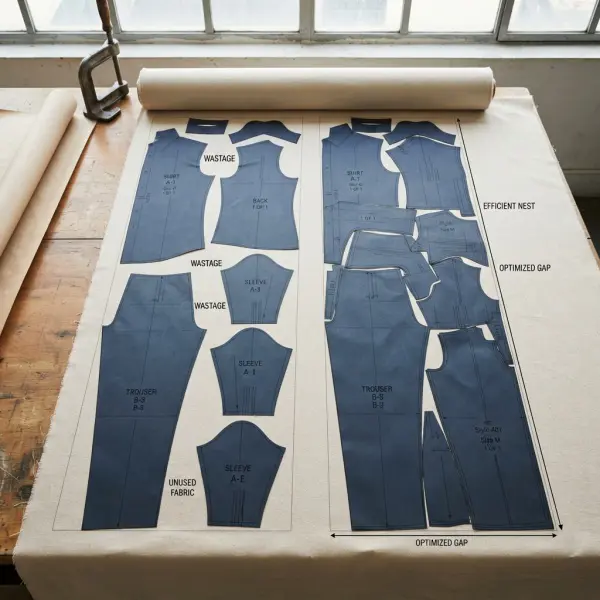
Marker efficiency reduces fabric waste by increasing the proportion of the marker area occupied by garment pattern pieces and reducing the unused gaps between them. Because a cutting marker determines how much fabric length is needed for a given set of garment components, even a modest improvement in layout can reduce material consumption when the pattern area, fabric width, size assortment, and production constraints remain comparable.
The principle is simple, but the production reality is not. Garment pattern pieces have irregular shapes, and they cannot always be rotated or repositioned freely. Grain direction, nap, stretch orientation, plaid or stripe matching, print placement, usable fabric width, garment size mix, and spreading requirements can all limit how closely the pieces fit together.
For that reason, marker efficiency should not be treated as a competition to achieve the highest possible percentage. The useful question is whether a factory is obtaining strong material utilization within the technical constraints of the garment and fabric.
This distinction matters financially as well as environmentally. Fabric that remains between pattern pieces becomes cutting-room scrap rather than a garment component. Improving the marker can therefore reduce material purchased and cut for the same production requirement—but only the waste generated within the marker itself. Other losses, including fabric defects, roll ends, splicing, spreading allowances, cutting errors, and recuts, require separate controls.
Quick Answer: How Does Marker Efficiency Reduce Fabric Waste?
Marker efficiency measures how much of a marker's total area is occupied by garment pattern pieces. When efficiency increases, less of the fabric inside that marker is left as unused space between the pieces, which can reduce the fabric length required to cut the same garment components.
Academic research on apparel marker planning describes the task as arranging irregular garment patterns within a fixed-width material surface to maximize fabric utilization. Because those pieces do not fit together perfectly, some unusable area remains; improving their arrangement can reduce that loss.
The important caveat is that marker efficiency addresses marker-related waste, not every source of material loss in garment manufacturing. A marker can be highly efficient while the cutting room still loses fabric through roll defects, inaccurate spreading, motif misalignment, recutting, or poor material planning. Lectra's cutting-room guidance similarly treats marker efficiency alongside—not instead of—yield, recuts, fabric specifications, and production accuracy.
For apparel manufacturers, marker efficiency is therefore best used as one material-utilization KPI within a broader cutting-room control system.
What Is Marker Efficiency?
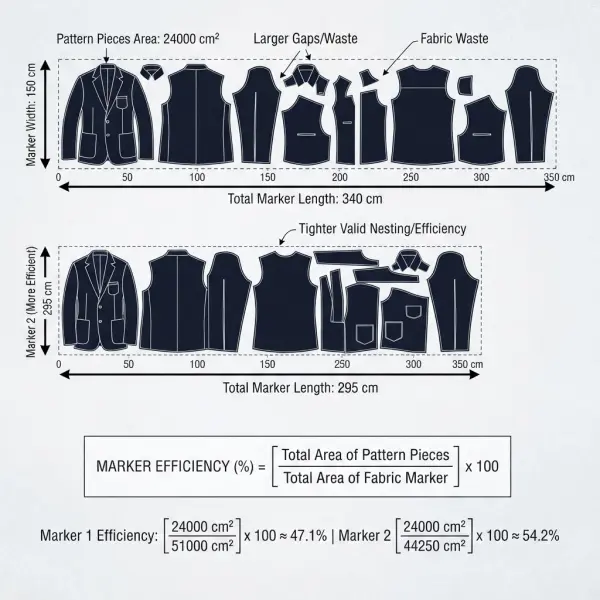
Marker efficiency is the percentage of the total marker area occupied by garment pattern pieces. It is commonly expressed as:
Marker Efficiency (%) = Total Area of Pattern Pieces ÷ Total Marker Area × 100
The total marker area is generally determined by marker width multiplied by marker length. The pattern area is the combined area of all garment components placed inside that marker.
A marker that uses more of its rectangular area for actual garment pieces has higher efficiency. The remaining area consists mainly of spaces between irregular pattern shapes and other unavoidable gaps created by production restrictions.
This concept is central to garment cutting because pattern pieces rarely tessellate neatly. A sleeve cap creates curves. Armholes, necklines, crotch curves, collars, waist shaping, and tapered garment sections generate spaces that cannot always be filled by another component. Marker planning therefore behaves like a two-dimensional irregular packing problem rather than simple rectangular stacking.
The purpose of marker optimization is to reduce those gaps without violating technical requirements.
For readers who need the broader production process before considering utilization, CAD marker making for apparel production explains how pattern pieces, size quantities, fabric width, placement rules, and cutting requirements are combined into a production marker.
Why Higher Marker Efficiency Usually Means Lower Fabric Consumption
If the total area of pattern pieces stays the same, a more efficient marker needs less total marker area to contain those pieces. When marker width is fixed, reducing total marker area effectively means reducing marker length.
That shorter marker can translate directly into lower linear fabric consumption.
Imagine that a group of pattern pieces has a combined area of 100 square units.
At 85% marker efficiency, the required marker area would theoretically be:
100 ÷ 0.85 = 117.65 square units
At 88% marker efficiency, the same pattern area would require:
100 ÷ 0.88 = 113.64 square units
Under otherwise identical conditions, the second layout requires about 3.4% less marker area than the first—not simply 3%, even though marker efficiency improved by three percentage points.
That distinction is useful for costing. An increase from 85% to 88% marker efficiency does not automatically mean fabric consumption falls by exactly three percent. The relationship is mathematically dependent on the starting efficiency, and actual production savings also depend on whether marker width, piece content, order quantities, spreading conditions, and other variables remain comparable.
The underlying relationship is well established in marker-planning research: compact placement reduces the material area required for the same pattern set, which in turn can reduce fabric consumption and cutting waste.
Marker length is often the operational bridge
Factories usually buy and spread fabric by length, while the marker occupies a known width and length. If the usable width is fixed, improving the arrangement of pieces can shorten the marker.
Suppose two markers contain the same garments and use the same usable fabric width:
|
Marker |
Efficiency |
Relative marker requirement |
Practical interpretation |
|
Marker A |
85% |
Higher |
More fabric length is needed for the same pattern area |
|
Marker B |
88% |
Lower |
Less fabric length is required if all other conditions remain equal |
This is why marker efficiency matters far beyond the CAD screen. A few centimeters saved in one small marker may appear trivial, but the saving can be repeated across lays, production batches, colors, and large order quantities.
The economic value therefore depends on scale. A marker improvement for a 30-piece sample run and the same percentage improvement for tens of thousands of production units do not have the same financial impact.

Marker Waste and Total Cutting-Room Waste Are Not the Same Thing
Marker efficiency is useful precisely because it measures a defined part of material utilization. Problems arise when that metric is interpreted as though it represents every gram or meter of fabric lost in production.
It does not.
A marker may leave unused fabric between pattern pieces. That is marker-related loss. The cutting room can also consume additional fabric for reasons that occur before, during, or after the marker is applied.
These may include:
- fabric left at roll ends;
- ends of lays and spreading allowances;
- splices required around defects;
- damaged or off-shade material;
- width variation across fabric rolls;
- cutting defects;
- misplaced or distorted pattern pieces;
- motif or plaid mismatch;
- rejected panels;
- recutting of defective components.
Lectra's current material-waste guidance identifies low marker efficiency alongside inaccurate estimation, motif misalignment, fabric distortion, and recuts as separate causes of material loss. This reinforces an important management point: improving nesting is valuable, but a cutting room needs additional controls if its objective is to reduce total material consumption.
A factory reporting 90% marker efficiency, for example, should not automatically conclude that only 10% of its purchased fabric becomes waste. The marker percentage describes the geometry of the marker rectangle. Actual yield from purchased roll to acceptable cut panels is a broader measurement.
Why this distinction matters for sustainability claims
The distinction is also important when apparel companies communicate environmental improvements.
A factory can legitimately say that better marker planning reduced unused space within its cutting layouts if production data supports that statement. Claiming that the same improvement eliminated overall fabric waste would be much harder to justify unless roll losses, defects, spreading, recuts, and remaining scrap were also measured.
Marker optimization is therefore a material-efficiency intervention, not automatically a zero-waste system.
The Journal of Cleaner Production has published case-study research specifically examining marker planning as a way to reduce cut-and-sew waste, while also demonstrating that marker performance depends on garment and material conditions such as fabric width and one-way placement.
Where Does the Waste Inside a Marker Come From?
The basic source of marker waste is geometric incompatibility. Garment patterns are irregular, while fabric is supplied as a continuous rectangular surface.
A trouser front cannot fill every gap around a sleeve. A curved neckline leaves a different negative space from the edge of a skirt panel. Small components such as collars, cuffs, pockets, facings, belt loops, and waistband pieces can sometimes fill spaces between larger pieces, but their orientation may also be restricted.
This is why two styles using the same fabric width can produce very different marker efficiencies.
A simple T-shirt with relatively regular front, back, and sleeve shapes presents a different nesting problem from a tailored jacket containing multiple curved panels, facings, lapels, collars, pockets, and interfacing-related components. Complexity does not automatically mean poor efficiency, but garment geometry changes the optimization problem.
Research into marker planning classifies this as a two-dimensional irregular cutting-and-packing problem, where the objective is to place non-overlapping shapes compactly within the material boundary.
The unused areas between those shapes become unavoidable or potentially reducible cutting waste.
What Factors Affect Marker Efficiency?
There is no universal marker-efficiency percentage that is "correct" for every garment. Marker performance should be evaluated against the constraints of the specific style, material, and order.
Several factors have a particularly strong operational effect.
Fabric width
Changing usable fabric width changes the geometry available for nesting.
A pattern combination that works efficiently at one width may create awkward gaps at another. Conversely, a slightly different width may allow a large component to sit beside a smaller one instead of forcing them into a longer sequence.
This is why sourcing teams should avoid assuming that wider fabric automatically means proportionally better utilization. The result depends on how the garment's particular shapes interact with that width.
Recent research continues to examine the relationship between marker parameters and fabric consumption, highlighting that consumption is influenced by combinations of marker configuration, garment quantities, size content, and marker efficiency rather than by one variable alone.
Garment size mix
Combining different garment sizes can create opportunities for pieces to interlock more effectively. A smaller sleeve or bodice may fit into a gap that cannot accommodate the corresponding component from a larger size.
However, the correct size assortment must always follow the actual production requirement. Manipulating the ratio simply to produce a stronger efficiency number would create the wrong quantities.
Marker optimization therefore needs to work inside the order plan rather than independently of it.
Number and shape of pattern pieces
Garments with many small components sometimes offer additional opportunities to fill spaces between larger pieces. In other cases, complex curved or asymmetric components can make nesting more difficult.
The number of pieces alone is therefore not enough to predict performance. Their geometry, orientation, size relationships, and pairing requirements matter.
This explains why cross-style benchmarking should be handled carefully. A marker maker producing 87% efficiency on a technically restrictive style may be doing stronger work than someone reaching 90% on a relatively straightforward product.
Grain direction and allowable rotation
Pattern pieces normally need to follow defined grain requirements. Depending on the fabric and garment, some may permit 180-degree rotation while others cannot.
Every additional orientation restriction reduces the set of possible nesting arrangements.
From a purely mathematical perspective, unrestricted rotation might produce a more compact marker. From a production perspective, the layout may be unacceptable if it changes garment drape, stretch behavior, surface direction, or appearance.
Marker efficiency is therefore subordinate to technical correctness.
Nap and one-way fabrics
Velvet, brushed fabrics, pile materials, some directional surfaces, and one-way prints may require pattern pieces to face the same direction.
This can remove many of the head-to-toe placements that would otherwise improve nesting.
A published garment-production case study found that a one-way nap marker was a major reason for relatively low utilization in the original layout studied, demonstrating how a legitimate material rule can reduce apparent efficiency.
The correct response is not to break the direction rule. It is to optimize as effectively as possible within it.
Stripes, plaids, and repeating motifs
Pattern matching introduces another constraint.
If a plaid must align across a center front, pocket, side seam, or other visible connection, the pattern piece cannot necessarily be shifted a few centimeters merely because the movement fills an empty gap.
The visual requirement becomes part of the material requirement.
Modern cutting-room systems therefore treat motif alignment as a distinct optimization challenge. Lectra's 2026 guidance, for example, identifies motif alignment, material distortion, nesting, and recutting as interconnected—but separate—sources of material performance.

Why a Higher Percentage Is Not Always a Better Production Decision
Marker efficiency is valuable because it reduces an important problem to a comparable percentage. The danger is that teams begin optimizing the percentage rather than the production outcome.
Suppose a marker maker obtains 89% efficiency while respecting every grainline and directional rule. Another layout reaches 91%, but only because several pieces were rotated in a way that creates visible shading on the finished garment.
The 91% marker is numerically superior and operationally inferior.
The same problem can appear with motif matching. A layout may be compressed by shifting a pocket away from the stripe position required to match the garment front. The material figure improves, but the finished piece becomes off-spec.
This is why the correct objective is:
Highest practical material utilization within valid production constraints.
Not:
Highest marker-efficiency percentage regardless of consequence.
That distinction should also shape management incentives. If CAD operators are judged only on marker-efficiency percentages, they may be encouraged to pursue configurations that look impressive in reports but create complexity or quality problems downstream.
A balanced system should evaluate material utilization together with cutting accuracy, first-pass quality, recut rate, and actual consumption.
How Marker Efficiency Affects Garment Costing
Marker efficiency affects costing because marker length contributes directly to expected fabric consumption.
For a simplified marker containing several garments:
Estimated linear fabric consumption per garment = Marker Length ÷ Number of Garments in the Marker
This simplified calculation assumes the marker is executed as planned and does not include additional allowances that may be required for actual production.
If a marker can be shortened while containing the same garment quantities, its fabric consumption per garment falls. Multiply that saving by the production quantity and the financial impact becomes easier to see.
Consider a hypothetical production marker containing ten garments:
- Marker A length: 12.0 meters
- Marker B length after valid optimization: 11.6 meters
- Garments per marker: 10
The theoretical marker-based consumption changes from:
12.0 ÷ 10 = 1.20 meters per garment
to:
11.6 ÷ 10 = 1.16 meters per garment
That is a saving of 0.04 meter per garment at the marker level.
On an order of 1,000 garments, that difference would correspond to roughly 40 meters before accounting for spreading losses, roll conditions, defects, shrinkage allowances, recuts, and any other production adjustments.
The example is deliberately hypothetical. Its purpose is to show why seemingly small improvements can matter at volume—not to establish a universal savings benchmark.
The effect is larger when material is expensive
The same number of meters saved can have very different financial value depending on fabric price.
Saving 40 meters of an inexpensive basic fabric is commercially useful. Saving the same amount of premium wool, technical performance textile, imported lace, or specialty jacquard can have a much greater impact on product margin.
This is why marker work may deserve more attention on high-material-cost styles even when order quantities are smaller.
Marker improvement should therefore be evaluated in both percentage terms and financial terms.
How Marker Efficiency Can Reduce Pre-Consumer Fabric Scrap
When a marker is cut, the pattern pieces continue into garment production while most of the gaps between them become offcuts.
Tighter valid nesting reduces the size or total area of those gaps. In that sense, marker optimization operates upstream: instead of attempting to recycle scrap after it has been generated, the factory prevents part of that scrap from being created in the first place.
This is an important distinction in material management.
Recycling cutting waste may still be useful where appropriate collection and recycling infrastructure exists, but waste prevention avoids purchasing and processing part of the material that would otherwise become scrap.
The environmental benefit should nevertheless be expressed carefully. Less material consumption can reduce the material demand associated with a production order, but the magnitude of environmental improvement depends on the textile, upstream processes, energy system, recycling pathway, and whether planned savings are actually achieved in production.
Marker efficiency is therefore a meaningful resource-efficiency lever, not a standalone sustainability score.

How Fashion Manufacturers Can Improve Marker Efficiency Without Distorting Production
The most reliable marker-efficiency improvements usually come from better planning and better data rather than chasing a target percentage in isolation.
A practical improvement process starts by establishing comparable baselines. A factory should know the style, material, usable width, garment quantities, size assortment, direction rules, marker efficiency, marker length, and actual consumption associated with each marker.
From there, teams can evaluate where meaningful improvement is possible.
Useful actions include:
- Use verified usable fabric width. Nesting against inaccurate width data can make theoretical efficiency irrelevant to the fabric actually supplied.
- Maintain clean production pattern files. Obsolete or duplicate pieces distort both marker content and consumption calculations.
- Review size combinations. Within legitimate order requirements, different size groupings can produce different nesting opportunities.
- Define directional constraints correctly. Unnecessary one-way restrictions may reduce utilization, while missing restrictions can create quality failures.
- Plan motif matching before marker release. Stripe, plaid, and placement requirements should enter the marker strategy rather than being repaired during cutting.
- Compare several valid nesting scenarios. The first acceptable marker is not necessarily the strongest one.
- Measure planned versus actual material use. A strong marker with poor actual yield signals that another cutting-room problem may be responsible.
- Separate style difficulty from operator performance. Marker makers should not be penalized simply because a product contains legitimate constraints that reduce achievable utilization.
Lectra's current cutting-room guidance similarly recommends establishing baseline measures, correcting foundational material and pattern data, improving production-accurate estimation, and monitoring marker efficiency alongside yield and recut metrics.
The important management principle is consistency. Improvement becomes much easier when marker data can be compared over time using the same definitions and comparable production conditions.
What KPIs Should Be Tracked Alongside Marker Efficiency?
Marker efficiency becomes more useful when it is connected to actual material performance.
A factory attempting to understand why consumption exceeds plan should not rely on a single metric. A practical dashboard might include:
|
KPI |
What it helps reveal |
|
Marker efficiency |
How effectively pattern pieces occupy the marker area |
|
Marker length |
How much linear fabric the layout requires |
|
Planned consumption per garment |
Expected fabric use based on marker/cut plan |
|
Actual fabric consumption |
What production actually used |
|
Planned vs actual variance |
Whether execution matches the marker-based expectation |
|
Recut rate |
Additional material consumed because pieces had to be cut again |
|
Fabric defect loss |
Material unavailable because of faults |
|
End loss / roll remnants |
Fabric left unusable around rolls or lays |
|
First-pass cutting quality |
Whether panels are acceptable without corrective cutting |
The comparison between planned and actual consumption is particularly informative.
If marker efficiency improves but actual fabric consumption does not, the factory should look beyond the marker. Width variation, defects, excessive end allowance, recuts, spreading practices, or poor execution may be absorbing the theoretical saving.
Current cutting-room technology providers increasingly frame marker efficiency in this broader performance context rather than as an isolated CAD statistic.

Common Mistakes When Managing Marker Efficiency
Chasing a universal efficiency benchmark
A target such as "every marker must exceed X percent" sounds simple but ignores garment geometry and material constraints. A basic solid-fabric style and a complex plaid jacket do not have equal nesting freedom. Better benchmarking compares similar product types and material conditions rather than forcing every marker into one number.
Treating efficiency improvement as equivalent to the same percentage of fabric savings
A three-percentage-point increase in marker efficiency does not necessarily produce an exact three-percent reduction in consumption. Because marker area is related inversely to efficiency for a fixed pattern area, the actual theoretical reduction depends on the starting and ending values. Production conditions can further alter realized savings.
Ignoring actual consumption after marker approval
A factory may celebrate a strong digital marker and never verify whether the expected material saving appeared on the cutting floor. This can hide losses from width variation, damaged fabric, recuts, or spreading practices. Marker efficiency should therefore be connected to post-cutting material reconciliation.
Comparing unrelated styles directly
A marker for a T-shirt, a tailored jacket, a bra, and a plaid shirt solve very different geometric and directional problems. Ranking operators or suppliers solely by raw efficiency percentages can produce misleading conclusions. Comparison becomes more meaningful when product category, fabric width, matching requirements, and size mix are reasonably similar.
Breaking material rules to increase efficiency
Rotation and flipping can fill gaps, but only when the material and pattern permit them. Ignoring nap, grain direction, stretch direction, or motif orientation can turn a material-saving initiative into a quality problem requiring recuts or rejected garments—the opposite of the intended result.
Assuming better nesting solves the whole waste problem
Marker waste is only one component of cutting-room loss. A factory with strong markers but frequent recuts or poor defect management may still consume excessive material. Waste reduction therefore needs both optimized markers and disciplined production execution.
What Should Brands Verify When a Supplier Claims Better Marker Efficiency?
Brands do not need to become marker-making specialists, but they should understand enough to evaluate material claims intelligently.
If a supplier reports that a marker has been improved, ask what changed.
Was the marker simply nested more effectively? Was a different usable fabric width assumed? Were sizes combined differently? Were direction restrictions changed? Was the garment pattern revised? Did print matching requirements remain identical?
Without this context, two efficiency percentages may not be directly comparable.
A useful review should include:
- original and revised marker efficiency;
- marker width and length;
- pattern revision;
- garment quantities and size assortment;
- fabric direction and matching requirements;
- expected fabric consumption per garment;
- actual consumption once production is complete.
For high-volume or expensive-material programs, this level of visibility can improve supplier conversations considerably. Instead of negotiating consumption only as a commercial number, the brand and manufacturer can discuss the production assumptions creating that number.
When Lower Marker Efficiency Can Be Completely Acceptable
Lower efficiency is not automatically evidence of poor marker planning.
A style may legitimately need additional fabric space because:
- all pieces must run in one direction;
- large motifs must appear in specific garment locations;
- stripes or plaids must match across seams;
- the fabric has a limited usable width;
- components are unusually large or irregular;
- asymmetric left and right pieces cannot be freely flipped;
- production requirements restrict piece rotation.
The summer-dress case study published in the Journal of Cleaner Production is useful because it illustrates this contextual reality: one-way nap requirements were associated with lower marker utilization, and alternative marker scenarios had to be considered in relation to the fabric and production conditions.
The operational goal is therefore not to judge a marker by percentage alone. It is to distinguish avoidable inefficiency from necessary space created by valid production constraints.
That distinction is one of the most important pieces of judgment in marker management.
Manual Optimization and Digital Nesting Are Different Questions
A marker can be efficient whether created through skilled manual planning or digital tools. Digital nesting changes how quickly and systematically alternatives can be evaluated, but marker efficiency itself remains a measure of material utilization rather than a measure of how the layout was created.
This distinction prevents the current discussion from turning into a technology comparison.
Automated algorithms can explore many placement combinations and are increasingly used to optimize irregular pattern layouts. Academic research continues to test heuristic and metaheuristic approaches to the apparel marker-planning problem, confirming that the optimization challenge is computationally significant.
But technology choice also involves labor, investment, repeatability, training, production scale, integration, and workflow considerations. Those questions are better addressed separately in Manual Marker vs Digital Marker: What Fashion Teams Should Know.
For material management, the immediate question remains simpler: Does the approved marker use the available fabric effectively without violating garment requirements?
FAQ About Marker Efficiency and Fabric Waste
What is a good marker efficiency percentage?
There is no single marker-efficiency percentage that is appropriate for every garment. Achievable utilization depends on pattern geometry, garment sizes, usable fabric width, grain restrictions, nap, asymmetric components, motif matching, and other production constraints. A percentage is more meaningful when compared with previous markers for similar styles and fabrics under similar rules. A technically difficult marker may be well optimized even when its efficiency is lower than that of a simple basic garment.
Does 90% marker efficiency mean only 10% of purchased fabric is wasted?
No. It means approximately 90% of the marker's rectangular area is occupied by pattern pieces and the remaining area inside that marker is not. Purchased-fabric losses can also occur through roll ends, defects, width variation, splices, spreading allowances, rejected panels, cutting errors, and recuts. Marker efficiency should therefore not be used as a direct substitute for total fabric yield or total waste percentage.
Does improving marker efficiency always reduce fabric consumption?
Under comparable conditions, higher marker efficiency generally reduces the marker area—and, with fixed width, the marker length—needed for the same pattern area. That can reduce theoretical fabric consumption. Actual savings still depend on whether the marker is executed as planned and whether other losses offset the improvement. The comparison is strongest when garment quantities, pattern revision, fabric width, and technical constraints remain consistent.
Why can two markers for the same garment have different efficiencies?
They may use different size combinations, fabric widths, layout arrangements, directional settings, marker lengths, or material constraints. Even when the garment style is identical, changing the ratio of sizes can alter how components interlock. The correct comparison therefore requires more information than the final efficiency percentage.
Can fabric width be changed to improve marker efficiency?
Sometimes. Alternative fabric widths can produce better or worse pattern arrangements because width changes the available nesting geometry. However, a wider fabric is not automatically more economical. Price per meter, supplier availability, usable width, order minimums, fabric quality, and resulting marker length all need consideration. The best commercial option is the combination that produces the strongest overall material and cost outcome, not necessarily the highest marker-efficiency percentage.
Can pattern design itself improve marker efficiency?
Yes, but design changes need to be handled deliberately. Pattern geometry influences how pieces nest, so product development decisions can affect material utilization. However, altering a pattern solely to improve the marker can change fit, appearance, construction, or quality. When material efficiency is a design objective, it is better considered early in product development rather than imposed after the garment has already been approved.
Is marker optimization enough to make garment production zero waste?
No. Conventional marker optimization can reduce cutting scrap, but it does not inherently eliminate all unused material, and it does not address every waste source elsewhere in production. Zero-waste pattern cutting is a broader design methodology that intentionally develops garment pieces and layouts to minimize or eliminate cutting remnants. Even then, total manufacturing waste can include defects, test materials, trims, rejected products, and other losses.
How often should manufacturers review marker efficiency?
It should be reviewed whenever marker conditions materially change and monitored as part of regular cutting-room performance. New fabric widths, revised patterns, different size assortments, major order changes, or new directional requirements may justify new marker evaluation. For repeat production, comparing marker efficiency with actual material consumption also helps determine whether the expected savings are consistently reaching the cutting floor.
Conclusion
Marker efficiency matters because every unused area inside a garment marker represents fabric that was purchased, spread, and cut without becoming part of the intended garment. By fitting pattern pieces more effectively within the available width, manufacturers can shorten markers and reduce the material required for the same production content.
The percentage, however, needs interpretation.
A higher number is valuable only when the marker still respects grain direction, nap, stretch, motif matching, garment quantities, and other production constraints. The most efficient mathematical layout is not necessarily the best manufacturing layout.
Nor does marker efficiency describe all fabric waste. Roll ends, defects, spreading losses, recuts, and quality failures sit outside the marker calculation and can erase part of the theoretical saving if they are not controlled.
For fashion businesses, the strongest approach is therefore to treat marker efficiency as part of a larger material-management system. Measure it, compare it under equivalent conditions, translate improvements into expected consumption, and then check whether actual cutting-room performance confirms the saving.
That is where marker optimization becomes commercially meaningful: not when a percentage looks impressive on a CAD report, but when less material is genuinely required to produce the correct garments at the required quality.





Comments 0
Leave a CommentSend Comment
Anda harus Login terlebih dahulu untuk dapat memberikan komentar.